
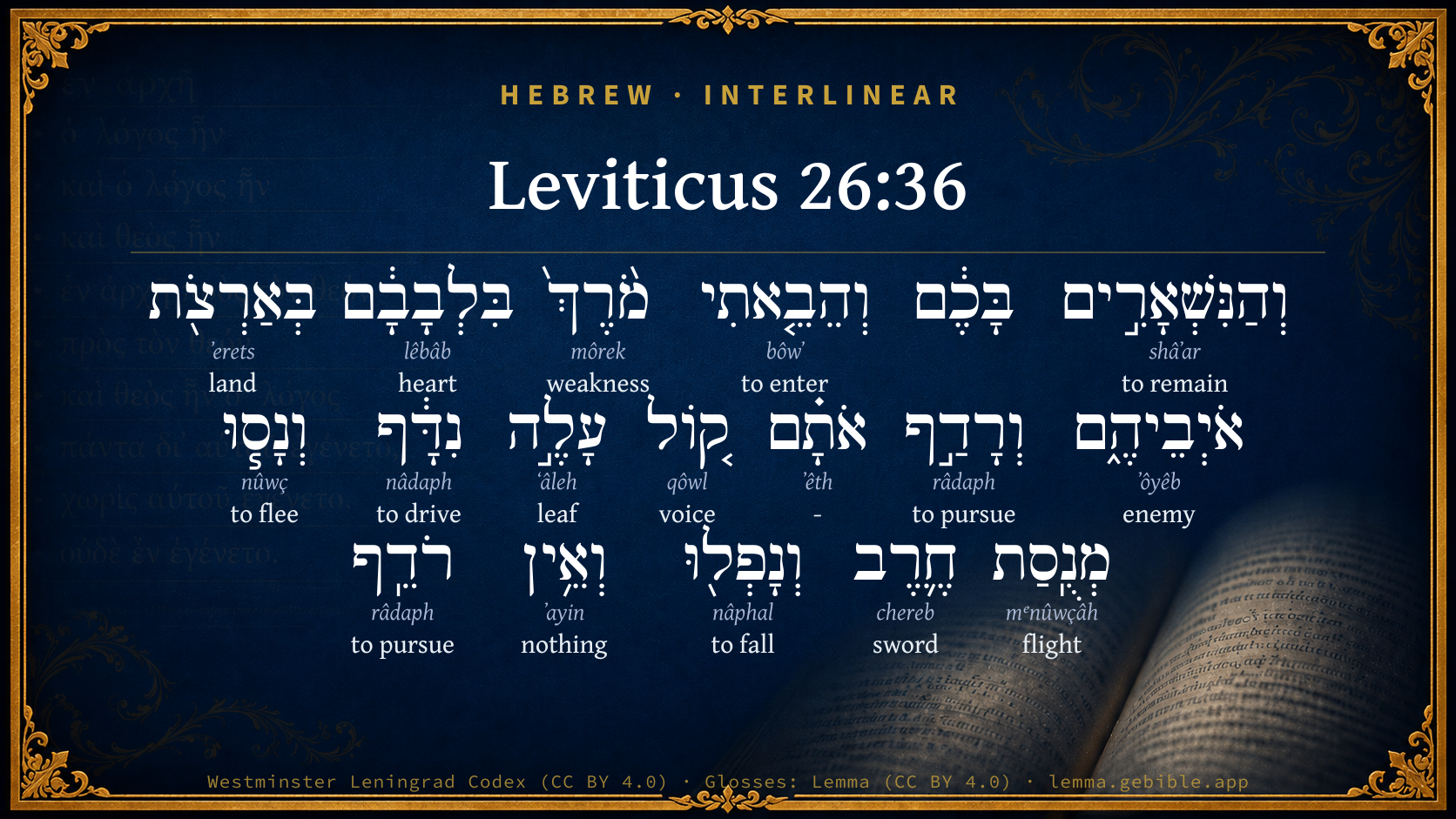
Leviticus 26:36

Hebrew (Westminster Leningrad Codex) Leviticus 26:36 appears in the Hebrew Old Testament. The text above is from the Westminster Leningrad Codex. Each word links to its Strong’s number, a concise gloss, and parsing drawn from the Open Scriptures Hebrew Bible morphology. Click any word for its full Brown-Driver-Briggs (BDB) entry.
Download image
Cite this verse

Leviticus 26:36 (World English Bible). Public Domain. Lemma interlinear Bible study tool, https://lemma.gebible.app/v/leviticus/26/36.

Show BibTeX & RIS
BibTeX
RIS
English Translation
"'As for those of you who are left, I will send a faintness into their hearts in the lands of their enemies: and the sound of a driven leaf will put them to flight; and they shall flee, as one flees from the sword; and they will fall when no one pursues.
World English Bible · Public Domain
Highlights
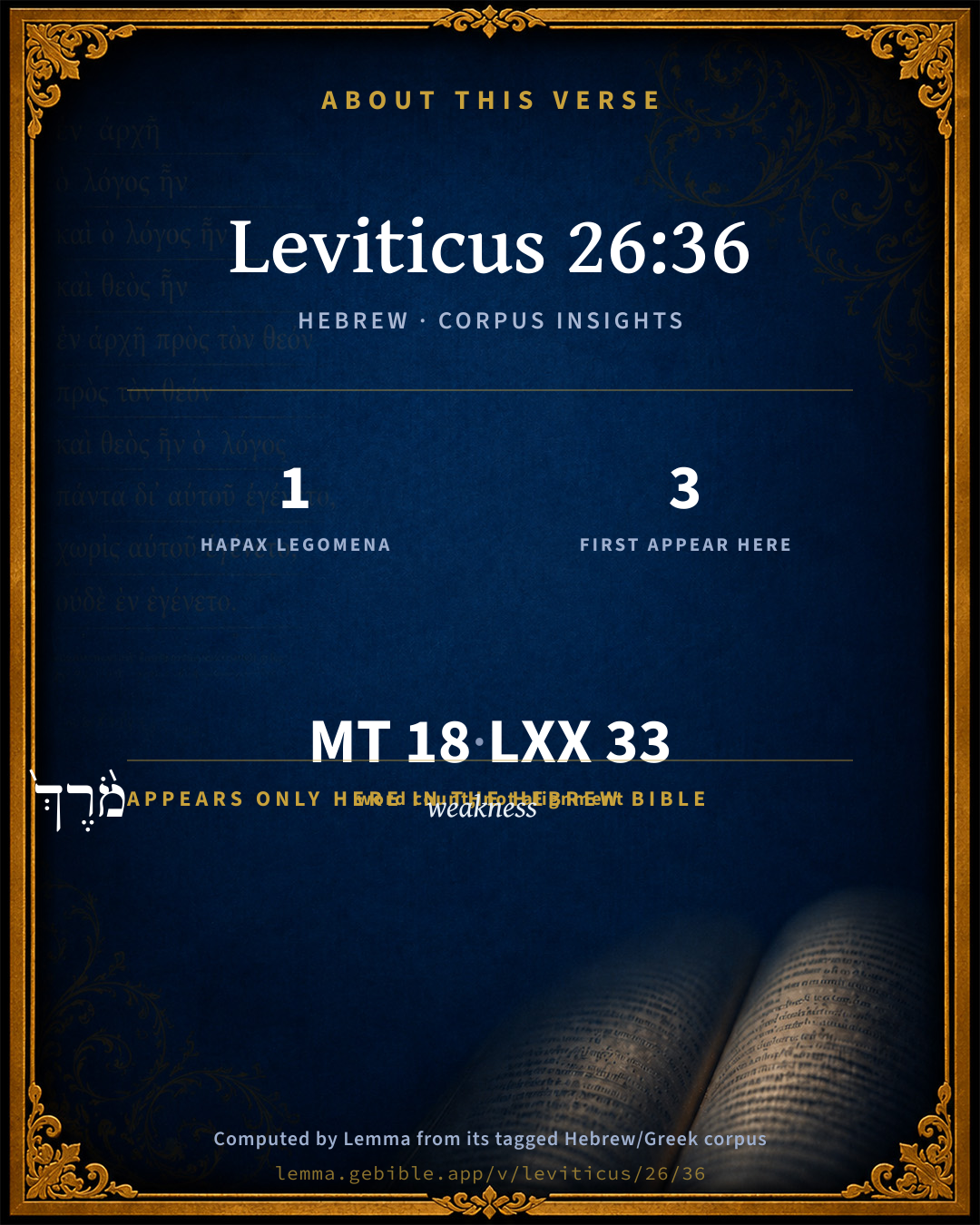
  • 1 hapax legomenon — only here in the Hebrew Bible
  • 3 first appearances in the Hebrew Bible
Full analysis ↓
Download a study sheet

One document with this verse’s original text, its word-by-word gloss line, the meaning frame, cross-references with their text, attributed commentary, and full source and license credits — printable, and it pastes into notes with its structure intact.

This verse Autodidact and up

Study sheet (.html) Plain text (.txt)

A passage Seminary Student

Up to 50 verses in one chapter. A passage sheet keeps up to 6 commentary sources and 12 cross-references per verse, in the order this page ranks them, and says so on the sheet whenever that leaves anything out. Ask for a single verse and you get the Autodidact verse sheet above.

Everything on this page stays free to read, with no account — the sheet is a download of what is already on screen, not access to it.

Want to remove ads? Support Godless Engineer
Compare translations 3

The same verse in 3 English versions, stacked beneath the original-language interlinear above. Click any original word for its lexicon entry.

Each is an independent rendering of the whole verse — the interlinear is not word-aligned to these translations.

Highlighted words mark where these versions differ — a whole-verse word diff, not a word-by-word alignment.

  • World English Bible Public Domain
    "'As for those of you who are left, I will send a faintness into their hearts in the lands of their enemies: and the sound of a driven leaf will put them to flight; and they shall flee, as one flees from the sword; and they will fall when no one pursues.
  • King James Version Public Domain
    And upon them that are left alive of you I will send a faintness into their hearts in the lands of their enemies; and the sound of a shaken leaf shall chase them; and they shall flee, as fleeing from a sword; and they shall fall when none pursueth.
  • unfoldingWord Literal Text CC BY-SA 4.0
    And the remaining in you, and I will bring faintness into their heart in the land of their enemies. And the sound of a driven leaf will chase them, and they will flee fleeing from a sword, and they will fall when there is no pursuer.

unfoldingWord Literal Text — © unfoldingWord, licensed CC BY-SA 4.0. Word-aligned USFM3 via Door43 (git.door43.org/unfoldingWord/en_ult).

Versions to compare (up to 4)

3 of 4 selected

Show all 18 translations

Every available English version of this verse, each an independent rendering of the whole verse.

  • World English Bible Public Domain
    "'As for those of you who are left, I will send a faintness into their hearts in the lands of their enemies: and the sound of a driven leaf will put them to flight; and they shall flee, as one flees from the sword; and they will fall when no one pursues.
  • Berean Standard Bible Public Domain
    As for those of you who survive, I will send a faintness into their hearts in the lands of their enemies, so that even the sound of a windblown leaf will put them to flight. And they will flee as one flees the sword, and fall when no one pursues them.
  • Majority Standard Bible Public Domain
    As for those of you who survive, I will send a faintness into their hearts in the lands of their enemies, so that even the sound of a windblown leaf will put them to flight. And they will flee as one flees the sword, and fall when no one pursues them.
  • King James Version Public Domain
    And upon them that are left alive of you I will send a faintness into their hearts in the lands of their enemies; and the sound of a shaken leaf shall chase them; and they shall flee, as fleeing from a sword; and they shall fall when none pursueth.
  • American Standard Version (1901) Public Domain
    And as for them that are left of you, I will send a faintness into their heart in the lands of their enemies: and the sound of a driven leaf shall chase them; and they shall flee, as one fleeth from the sword; and they shall fall when none pursueth.
  • Revised Version (1885) Public Domain
    And as for them that are left of you, I will send a faintness into their heart in the lands of their enemies: and the sound of a driven leaf shall chase them; and they shall flee, as one fleeth from the sword; and they shall fall when none pursueth.
  • Geneva Bible (1599) Public Domain
    And vpon them that are left of you, I will send euen a faintnes into their hearts in ye land of their enemies, and the sounde of a leafeshaken shall chase them, and they shall flee as fleeing from a sword, and they shall fall, no man pursuing them.
  • Douay-Rheims (1899) Public Domain
    And as to them that shall remain of you I will send fear in their hearts in the countries of their enemies, the sound of a flying leaf shall terrify them, and they shall flee as it were from the sword: they shall fall, when no man pursueth them,
  • Young's Literal Translation Public Domain
    `And those who are left of you -- I have also brought a faintness into their heart in the lands of their enemies, and the sound of a leaf driven away hath pursued them, and they have fled -- flight from a sword -- and they have fallen, and there is none pursuing.
  • Literal Standard Version CC BY-SA 4.0
    And those who are left of you—I have also brought a faintness into their heart in the lands of their enemies, and the sound of a leaf driven away has pursued them, and they have fled [as in] flight from a sword—and they have fallen, and there is none pursuing.
  • Unlocked Literal Bible CC BY-SA 4.0
    As for those of you who are left in your enemies' lands, I will send fear into your hearts so that even the sound of a leaf blowing in the wind will startle you, and you will flee as though you were fleeing from the sword. You will fall, even when no one is chasing you.
  • unfoldingWord Literal Text CC BY-SA 4.0
    And the remaining in you, and I will bring faintness into their heart in the land of their enemies. And the sound of a driven leaf will chase them, and they will flee fleeing from a sword, and they will fall when there is no pursuer.
  • Darby Bible Public Domain
    And as to those that remain of you -- I will send faintness into their hearts in the lands of their enemies, that the sound of a driven leaf shall chase them, and they shall flee, as fleeing from a sword; and they shall fall when none pursueth;
  • World Messianic Bible Public Domain
    “‘As for those of you who are left, I will send a faintness into their hearts in the lands of their enemies. The sound of a driven leaf will put them to flight; and they shall flee, as one flees from the sword. They will fall when no one pursues.
  • Webster's Bible Public Domain
    And upon them that are left alive of you, I will send a faintness into their hearts in the lands of their enemies; and the sound of a shaken leaf shall chase them; and they shall flee, as fleeing from a sword; and they shall fall, when none pursueth.
  • Free Bible Version CC BY-SA 4.0
    I will make those of you who survive so discouraged that as you live in the lands of your enemies even the sound of a leaf blowing in the wind will scare you into running away! You'll run away like you're being chased by someone with a sword, and fall down even though no one is after you.
  • Bible in Basic English Public Domain
    And as for the rest of you, I will make their hearts feeble in the land of their haters, and the sound of a leaf moved by the wind will send them in flight, and they will go in flight as from the sword, falling down when no one comes after them;
  • JPS Tanakh (1917) Public Domain
    And as for them that are left of you, I will send a faintness into their heart in the lands of their enemies; and the sound of a driven leaf shall chase them; and they shall flee, as one fleeth from the sword; and they shall fall when none pursueth.

Literal Standard Version (2020), Covenant Press — licensed CC BY-SA 4.0. Text via the HelloAO Bible API (eBible.org). Unlocked Literal Bible (unfoldingWord) — licensed CC BY-SA 4.0. Text via the HelloAO Bible API (eBible.org). unfoldingWord Literal Text — © unfoldingWord, licensed CC BY-SA 4.0. Word-aligned USFM3 via Door43 (git.door43.org/unfoldingWord/en_ult). Free Bible Version, Dr. Jonathan Gallagher — licensed CC BY-SA 4.0. Text via the HelloAO Bible API (eBible.org).

Word by word

More ways to search: Search by grammar → Find every occurrence → Compare this word →

Practice this passage: Drill this verse → Learn its vocabulary →

מֹ֨רֶךְ֙
môrek
H4816
“weakness”
Noun, Common, Masculine, Singular, Absolute
Part of Speech
Noun
Type
Common
Gender
Masculine
Number
Singular
State
Absolute
Full BDB Definition

Origin: perhaps from H7401

TWOT: 2164c

weakness
  1. וְהַנִּשְׁאָרִ֣ים shâʼar H7604 “and · the · remaining” Conjunction + Particle, Definite Article + Verb, Niphal, Participle Active, Masculine, Plural, Absolute
  2. וְהֵבֵ֤אתִי bôwʼ H935 “and · to enter” Conjunction + Verb, Hiphil, Sequential Perfect, 1st Person, Common, Singular
  3. בִּלְבָבָ֔ם lêbâb H3824 “in/at · heart · their” Preposition + Noun, Common, Masculine, Singular, Construct + Suffix, Personal, 3rd Person, Masculine, Plural
  4. בְּאַרְצֹ֖ת ʼerets H776 “in/at · lands of” Preposition + Noun, Common, Both, Plural, Construct
  5. אֹיְבֵיהֶ֑ם ʼôyêb H341 “enemy · them” Verb, Qal, Participle Active, Masculine, Plural, Construct + Suffix, Personal, 3rd Person, Masculine, Plural
  6. וְרָדַ֣ף râdaph H7291 “and · to pursue” Conjunction + Verb, Qal, Sequential Perfect, 3rd Person, Masculine, Singular
  7. אֹתָ֗ם ʼêth H853 “- · them” Particle, Direct Object + Suffix, Personal, 3rd Person, Masculine, Plural
  8. ק֚וֹל qôwl H6963 “voice of” Noun, Common, Masculine, Singular, Construct
  9. עָלֶ֣ה ʻâleh H5929 “leaf” Noun, Common, Masculine, Singular, Absolute
  10. נִדָּ֔ף nâdaph H5086 “driving” Verb, Niphal, Participle Active, Masculine, Singular, Absolute
  11. וְנָס֧וּ nûwç H5127 “and · to flee” Conjunction + Verb, Qal, Sequential Perfect, 3rd Person, Common, Plural
  12. מְנֻֽסַת mᵉnûwçâh H4499 “flight of” Noun, Common, Feminine, Singular, Construct
  13. חֶ֛רֶב chereb H2719 “sword” Noun, Common, Feminine, Singular, Absolute
  14. וְנָפְל֖וּ nâphal H5307 “and · to fall” Conjunction + Verb, Qal, Sequential Perfect, 3rd Person, Common, Plural
  15. וְאֵ֥ין ʼayin H369 “and · nothing” Conjunction + Particle, Negative
  16. רֹדֵֽף râdaph H7291 “pursuing” Verb, Qal, Participle Active, Masculine, Singular, Absolute

About this verse

These counts appear in no published source. They are computed here, from the morphology-tagged text and Lemma’s own curated glosses. What Lemma adds →

18
words
16
distinct lemmas
Pentateuch
section

Notable vocabulary

1 hapax legomenon — a word that appears only here in the entire Hebrew Bible:

  • מֹ֨רֶךְ֙ weakness H4816

First appearance in Scripture

These words make their first canonical appearance in the Hebrew Bible here:

  • מֹ֨רֶךְ֙ weakness H4816
  • נִדָּ֔ף to drive H5086
  • מְנֻֽסַת flight H4499

Shared distinctive vocabulary

מְנֻֽסַת flight H4499 occurs in 2 verses of the Hebrew Bible. Also found in:

Grammatical profile

  • 8 verbs
  • 7 nouns
  • 1 preposition
  • 2 particles

Verb forms

  • וְהַנִּשְׁאָרִ֣ים Niphal · Participle Active
  • וְהֵבֵ֤אתִי Hiphil · Sequential Perfect
  • אֹיְבֵיהֶ֑ם Qal · Participle Active
  • וְרָדַ֣ף Qal · Sequential Perfect
  • נִדָּ֔ף Niphal · Participle Active
  • וְנָס֧וּ Qal · Sequential Perfect
  • וְנָפְל֖וּ Qal · Sequential Perfect
  • רֹדֵֽף Qal · Participle Active

Repetition

A word recurs within this verse — often emphatic in Hebrew:

  • וְרָדַ֣ף to pursue H7291 ×2

Hebrew & Septuagint length

In English translation the verse runs 52 words from the Hebrew and 46 from the Septuagint (LXX English) — closely comparable.

A rough comparison of the two English renderings, which tokenize alike — not a word-level alignment.

Word counts can differ between the Hebrew and the Greek without any difference in meaning — e.g. the Hebrew direct-object marker אֵת has no separate Greek word, and Greek often adds the article ὁ.

In the original languages it is 18 Hebrew tokens and 33 Greek tokens — but the two are counted differently (Hebrew bundles its prefixes and suffixes into one token; the Greek is in lemma form), so that isn’t a like-for-like length.

Cross-references

18

Topical passages linked to Leviticus 26:36 in the Treasury of Scripture Knowledge — connected by theme and wording, ordered by reader-vote popularity; previews shown in the World English Bible.

  • Ezekiel 21:7 It shall be, when they tell you, Why do you sigh? that you shall say, Because of the news, for it comes; and every heart shall melt, and all hands shall be feeble, and every spirit shall faint, and all knees shall be weak as water: behold, it comes, and it shall be done, says the Lord Yahweh.
  • Isaiah 30:17 One thousand [shall flee] at the threat of one; at the threat of five shall you flee: until you be left as a beacon on the top of a mountain, and as an ensign on a hill.
  • Leviticus 26:17 I will set my face against you, and you will be struck before your enemies. Those who hate you will rule over you; and you will flee when no one pursues you.
  • Deuteronomy 28:65–67 Among these nations shall you find no ease, and there shall be no rest for the sole of your foot: but Yahweh will give you there a trembling heart, and failing of eyes, and pining of soul;
  • Joshua 2:9–11 and she said to the men, I know that Yahweh has given you the land, and that the fear of you is fallen on us, and that all the inhabitants of the land melt away before you.
  • Joshua 5:1 It happened, when all the kings of the Amorites, who were beyond the Jordan westward, and all the kings of the Canaanites, who were by the sea, heard how that Yahweh had dried up the waters of the Jordan from before the children of Israel, until we were passed over, that their heart melted, neither was there spirit in them any more, because of the children of Israel.
  • 1 Samuel 17:24 All the men of Israel, when they saw the man, fled from him, and were sore afraid.
  • 2 Kings 7:6–7 For the Lord had made the host of the Syrians to hear a noise of chariots, and a noise of horses, even the noise of a great host: and they said one to another, Behold, the king of Israel has hired against us the kings of the Hittites, and the kings of the Egyptians, to come on us.
  • 2 Chronicles 14:14 They struck all the cities round about Gerar; for the fear of Yahweh came on them: and they despoiled all the cities; for there was much spoil in them.
  • Job 15:21–22 A sound of terrors is in his ears; In prosperity the destroyer shall come on him.
  • Proverbs 28:1 The wicked flee when no one pursues; But the righteous are as bold as a lion.
  • Isaiah 7:2 It was told the house of David, saying, "Syria is allied with Ephraim." His heart trembled, and the heart of his people, as the trees of the forest tremble with the wind.
  • Isaiah 7:4 Tell him, 'Be careful, and keep calm. Don't be afraid, neither let your heart be faint because of these two tails of smoking firebrands, for the fierce anger of Rezin and Syria, and of the son of Remaliah.
  • Ezekiel 21:12 Cry and wail, son of man; for it is on my people, it is on all the princes of Israel: they are delivered over to the sword with my people; strike therefore on your thigh.
  • Ezekiel 21:15 I have set the threatening sword against all their gates, that their heart may melt, and their stumblings be multiplied: ah! it is made as lightning, it is pointed for slaughter.
  • Genesis 35:5 They traveled: and a terror of God was on the cities that were round about them, and they didn't pursue the sons of Jacob.
  • Leviticus 26:7–8 You shall chase your enemies, and they shall fall before you by the sword.
  • Deuteronomy 1:44 The Amorites, who lived in that hill-country, came out against you, and chased you, as bees do, and beat you down in Seir, even to Hormah.

Cross-references courtesy of OpenBible.info (CC BY 4.0).

Hebrew and Greek witnesses Masoretic Hebrew ↔ Greek Septuagint

The same verse in the two great witnesses to the Old Testament, shown verse-for-verse.

These are two independent witnesses, not word-aligned to each other, and the Septuagint is shown in lemma (dictionary) form.

Hebrew Leviticus 26:36 Masoretic · Westminster Leningrad Codex

וְהַנִּשְׁאָרִ֣ים בָּכֶ֔ם וְהֵבֵ֤אתִי מֹ֨רֶךְ֙ בִּלְבָבָ֔ם בְּאַרְצֹ֖ת אֹיְבֵיהֶ֑ם וְרָדַ֣ף אֹתָ֗ם ק֚וֹל עָלֶ֣ה נִדָּ֔ף וְנָס֧וּ מְנֻֽסַת חֶ֛רֶב וְנָפְל֖וּ וְאֵ֥ין רֹדֵֽף

"'As for those of you who are left, I will send a faintness into their hearts in the lands of their enemies: and the sound of a driven leaf will put them to flight; and they shall flee, as one flees from the sword; and they will fall when no one pursues.

World English Bible · Public Domain

Greek LXX Leviticus 26:36 Septuagint · lemma form

καί ὁ καταλείπω ἐκ σύ ἐπιἄγω δειλία εἰς ὁ καρδία αὐτός ἐν ὁ γῆ ὁ ἐχθρός αὐτός καί διώκω αὐτός φωνή φύλλον φέρω καί φεύγω ὡς φεύγω ἀπό πόλεμος καί πίπτω οὐδείς διώκω

And to those who are left of you I will bring bondage into their heart in the land of their enemies; and the sound of a shaken leaf shall chase them, and they shall flee as fleeing from war, and shall fall when none pursues them.

LXX2012 (modern English Septuagint) · Public Domain

On this verse, Haydock's Catholic Bible Commentary discusses the Septuagint’s reading. Read the note in Commentary ↓

Hebrew: Westminster Leningrad Codex (CC BY 4.0). Greek: Septuagint (public domain); English from LXX2012 (modern English Septuagint) (Public Domain). How the Septuagint differs from the Hebrew →

Targum (Aramaic paraphrase)

2

The Targum is the ancient Jewish Aramaic paraphrase of the Hebrew Scriptures — an interpretive translation, not the Hebrew text itself. Onkelos (literal) and Pseudo-Jonathan (expansive) render the Torah, and Jonathan the Prophets. Coverage is partial: where no permissively-licensed English translation exists for a verse, only the Aramaic is shown. This is verse-level text, not a word-by-word alignment to the Hebrew.

  1. Targum Onkelos Torah (Genesis–Deuteronomy)
    וּדְיִשְׁתַּאֲרוּן בְּכוֹן וְאָעֵל תַּבְרָא בְּלִבְּהוֹן בְּאַרְעֲתָא דְסַנְאֵיהוֹן וְיִרְדוֹף יָתְהוֹן קַל טַרְפָּא דְשַׁקִיף וְיֵעַרְקֻן כְּמֵעִירוֹק מִן קֳדָם דְקַטְלִין בְּחַרְבָּא וְיִפְּלוּן וְלֵית דְרָדִיף

    (no public-domain English translation for this verse)

    Targum Onkelos — Aramaic: “Onkelos Genesis” (public domain); “Onkelos Exodus” (public domain); “Onkelos Leviticus” (public domain); “Onkelos Numbers” (public domain); “Onkelos Deuteronomy” (public domain). English: “Sefaria Community Translation” (CC0 1.0 (public-domain dedication)); “J.W. Etheridge. The Targums of Onkelos and Jonathan Ben Uzziel on the Pentateuch. London: Longmans, Green, 1862” (public domain). Text via Sefaria.

  2. Targum Pseudo-Jonathan Torah (Genesis–Deuteronomy)
    וּדְיִשְׁתַּיְירוּן בְכוֹן וְאָעֵיל תַּבְרָא בְּלִבְּהוֹן בְּאַרְעֲתָא דְסַנְאֵיהוֹן וִיהֵי רָדִיף יַתְהוֹן קַל טַרְפָא דְנָתִיר מִן אִילַן וִיעַרְקוּן הֵי כְּמַעֲרוּקֵי חַרְבָּא וְיִפְּלוּן וְלֵית דְרָדִיף

    And unto those of you who remain will I bring brokenness of their hearts in the land of their enemies; and the sound of a leaf falling from the tree shall put them to flight; and they shall flee as those who flee from the sword, and fall, while no man pursueth.

    Targum Pseudo-Jonathan — Aramaic: “Targum Jonathan on Genesis” (public domain); “Targum Jonathan on Exodus” (public domain); “Targum Jonathan on Leviticus” (public domain); “Targum Jonathan on Numbers” (public domain); “Targum Jonathan on Deuteronomy” (public domain). English: “The Targum of Jonathan ben Uzziel, trans. J. W. Etheridge, London, 1862” (public domain). Text via Sefaria.

Commentary

Notes on Leviticus 26:36 from classic Christian and Jewish commentators (each source and its license shown beneath its notes). The classic Christian expositions comment on the surrounding passage and are grouped to its opening verse, so a note may address several verses; the Jewish commentaries on the Tanakh (Rashi and others) are per-verse, so they appear only where the commentator wrote on this verse.

Lemma curates 59 commentaries, every one of them public domain or Creative Commons licensed, each selected and text-cleaned for this edition rather than reprinted as found. About our sources →

Trapp's Complete Commentary

John Trapp

Lev 26:36 And upon them that are left [alive] of you I will send a faintness into their hearts in the lands of their enemies; and the sound of a shaken leaf shall chase them; and they shall flee, as fleeing from a sword; and they shall fall when none pursueth.

Ver. 36. I will send a faintness.] See this explained in Job 15:21-22.

John Trapp, A Commentary or Exposition upon All the Books of the Old and New Testament (1647–1656) — public domain. Text from a community e-Sword module.

Joseph Benson's Commentary

Lev 26:36. The sound of a shaken leaf shall chase them — A very significant phrase, importing that they should sink into a state of the most slavish fear and despicable cowardice.

Joseph Benson's Commentary on the Old and New Testaments (1811–1818) — public domain. Text from a community e-Sword module.

Tyndale Open Study Notes

Tyndale Open Resources

26:36-39 Disastrous defeat and captivity would later be the fate of both Israel and Judah (see study notes on 18:28; 26:14-39).

Tyndale Open Study Notes — © Tyndale Open Resources, licensed CC BY-SA 4.0. Text via the HelloAO Bible API.

Geneva Bible (1599)

Geneva Bible translators

As if their enemies did chase them.

Or, cowardness.

Geneva Bible (1599) marginal notes — public domain. Text via Bolls.life.

Ellicott's Commentary for English Readers

(36, 37) And upon them that are left alive of you.—Better, And as to those that remain of you, as the Authorised Version generally renders this expression. This obviates the insertion of the expression “alive,” which is not in the original, and is not put in the Authorised Version in Lev_26:39, where the same phrase occurs. Where these will remain is explained in the next clause.

I will send a faintness into their hearts.—That is, He will implant in them such timidity and cowardice that they will be frightened at the faintest sound. He will make life a misery to them. (Comp. Deu_28:65-67.)

A Bible Commentary for English Readers, edited by Charles John Ellicott (1878–1897) — public domain. Text from a community e-Sword module.

The Cambridge Bible for Schools and Colleges

gen. ed. J. J. S. Perowne

36. the sound of driven leaf] Cp. Lev_26:17; Pro_28:1.

The Cambridge Bible for Schools and Colleges (gen. ed. J. J. S. Perowne; Cambridge University Press, 1878–1918) — public domain. Text from a community e-Sword module.

John Gill's Exposition

And they shall fall one upon another,.... In their hurry and confusion, everyone making all the haste he can to escape the imaginary danger; or "a man upon his brother" (z); his friend, as Aben Ezra interprets it, having no regard to relation and friendship, every one endeavouring to save himself. There is another sense which some Jewish writers (a) give of this phrase, and is observed by Jarchi, which is, that everyone shall fall for the iniquities of his brother; for all the Israelites say, they are sureties for one another; but the former sense is best:

as it were before a sword, when none pursueth: as if a sword was drawn and brandished at them, just ready to be thrust in them, filling them with the utmost dread and terror, and yet at the same time none in pursuit of them:

and ye shall have no power to stand before your enemies; no heart to resist them, no strength nor spirit to oppose them, and defend themselves but be obliged to surrender their cities, themselves, their families and goods, into the hand of the enemy.

(z) "vir in fratrem suum", Vatablus, Drusius, Piscator. (a) Torat Cohanim apud Yalkut, par. 1. fol. 197. 2.

John Gill's Exposition of the Whole Bible (1746–1763) — public domain (CC PDM 1.0). Text via the HelloAO Bible API.

Haydock's Catholic Bible Commentary

Fear. Septuagint, "timidity, or slavishness." Hebrew morec, "softness and inactivity." (Calmet) --- Their haughty temper shall be broken; and though they have dared to rebel against their God, the fall of a leaf shall now terrify them. (Haydock)

George Leo Haydock (1774–1849), Haydock's Catholic Family Bible and Commentary, 1859 edition — public domain. Excludes Psalms (Douay-Rheims chapter numbering differs from Protestant) and Deuterocanonical books (Catholic canon only).

Matthew Poole's English Annotations

Faintness: the word notes a tenderness and softness of mind, whereby they are disenabled from bearing the present miseries, and are in continual dread of further and sorer miseries.

Matthew Poole's English Annotations on the Holy Bible (1683–1685) — public domain. Text from a community e-Sword/MySword module.

Whedon's Commentary on the Bible

Daniel D. Whedon

36. The sound of a shaken leaf — The Hebrew is more poetical, the voice of a driven leaf. “So wrong doing is never blessed. Even when men appear to succeed and to save themselves alive, their success is partial, and may only create an opportunity for further divine judgment. Do not suppose that men are successful simply because they are living. A man may have escaped the sea only to die a more terrible death on land. Marvellous are the judicial resources of God. We have an indication here of a law to whose subtle force many men can testify. Fear takes away all power, and turns the most dauntless soldier into a coward.” — Joseph Parker. No expression could more vividly portray the perpetual terror, the distressing alarm, of the poor captives.

In the lands of their enemies — In the Orient, outside of the Hebrew theocracy, slaves had no civil rights. Even under Roman law the master with impunity could chop up his slaves into mince meat for his fish ponds if he should choose. After the return from Babylon four different dynasties obtained the supremacy of the land of Canaan. The dominion of Persia was from 536 to 333 B.C.; of Greece, from 333 to 167 B.C.; of the Asmoneans, from 167 to 63 B.C.; of the Herods under Rome, from 40 B.C., to 70 A.D.

Daniel D. Whedon (gen. ed.), Commentary on the Old and New Testaments (1874–1909) — public domain. Text from a community e-Sword module.

The Pulpit Commentary

Vers. 36-39. The final punishment.

Upon them that are left, that is, the surviving captives and exiles, I will send a faintness into their hearts, so Eze_21:7, "And every heart shall melt, and all hands shall be feeble, and every spirit shall faint, and all knees shall be weak as water ... and the sound of a shaken (or driven) leaf shall chase them; ... and they shall fall,... and ye shall perish among the heathen, and the land of your enemies shall eat you up. And they that are left of you shall pine away in their iniquity in your enemies" lands. This is the concluding threat. It is conditional in its nature, and the condition having been fulfilled, we may say with reverence that it has been accomplished. Those of the ten tribes who did not find their way to Babylon, and so became absorbed in the body which returned to Jerusalem, have been eaten up by the land of their enemies, and have pined away in their enemies" lands. Neither they nor their descendants are to be found in any part of the globe, however much investigation may employ itself in searching for them. They have been absorbed by the populations among which they were scattered.

The Pulpit Commentary (1880–1919), ed. H.D.M. Spence-Jones & Joseph S. Exell — public domain. Text from a community e-Sword module.

Keil & Delitzsch

C. F. Keil & F. Delitzsch

So far as the nation was concerned, those who were left when the kingdom was overthrown would find no rest in the land of their enemies, but would perish among the heathen for their own and their fathers' iniquities, till they confessed their sins and bent their uncircumcised hearts under the righteousness of the divine punishments. בּכם הנּשׁארים (nominative abs.): "as for those who are left in (as in Lev 5:9), i.e., of, you," who have not perished in the destruction of the kingdom and dispersion of the people, God will bring despair into their heart in the lands of your enemies, that the sound ("voice") of a moving leaf will hunt them to flee as before the sword, so that they will fall in their anxious flight, and stumble one over another, though no one is pursuing. The ἁπ. λεγ. מרך from מרך, related to מרח and מרק to rub, rub to pieces, signifies that inward anguish, fear, and despair, which rend the heart and destroy the life, δειλία, pavor (lxx, Vulg.), what is described in Deu 28:65 in even stronger terms as "a trembling heart, and failing of eyes, and sorrow of mind." There should not be to them תּקוּמה, standi et resistendi facultas (Rosenmller), standing before the enemy; but they should perish among the nations. "The land of their enemies will eat them up," sc., by their falling under the pressure of the circumstances in which they were placed (cf. Num 13:32; Eze 36:13).

Keil & Delitzsch — Biblical Commentary on the Old Testament (1861–1891) — public domain (CC PDM 1.0). Text via the HelloAO Bible API. (Old Testament only.)

Rashi

Rabbi Shlomo Yitzchaki (Rashi)

והבאתי מרך AND I WILL SEND A FAINTNESS [INTO THEIR HEART] — מרך‎ means timidity and faint-heartedness. The מ is an essential letter of the noun, which, however, is omitted in the root; as is the case with the מ in the nouns מועד and ומוקש.

ונסו מנוסת חרב AND THEY SHALL RUN AWAY AS RUNNING AWAY FROM THE SWORD — as though pursuers were about to kill them.

עלה נדף A RUSTLING LEAF — i. e. a leaf which the wind pushes along and beats it against another leaf, so that, in tapping it, it produces a sound. This, too, is its translation in the Targum: the sound of a leaf דשקיף — a term that signifies beating. The words (Genesis 41:6): שדופות קדים are rendered in the Targum by שקיפן קידום, beaten by the east wind, the first word being of the same meaning as משקוף, a lintel, that being the place against which the door beats. Similarly the Targum translation of חבורה, a wound, (Exodus 21:25), is משקופי (a spot that has been beaten).

Rashi on the Tanakh — English translations: “The Judaica Press complete Tanach with Rashi, translated by A. J. Rosenberg” (CC BY 4.0); “Pentateuch with Rashi's commentary by M. Rosenbaum and A.M. Silbermann, 1929-1934” (public domain); “The Metsudah Tanach series, Lakewood, N.J” (CC BY 4.0); and “The Book of Joshua, Metsudah Publications, 1997” (CC BY 4.0). Text via Sefaria.

Lesson kit

Teaching starters — assembled from the data on this page, not authored interpretation. Every prompt links to the verse data it draws on. Edit before teaching.

Leviticus, in the Pentateuch, opens this verse with 18 words (16 distinct Hebrew lemmas). Its most distinctive word is môrek (“weakness”). A historical commentator’s framing appears above. Read the whole chapter for the surrounding context.

Discussion questions

  1. What does “weakness” (môrek) contribute to the verse as a whole?
  2. 1 word here appears nowhere else in the Hebrew Bible. Why might the author reach for such rare wording?
  3. 3 words make their first appearance in Scripture here. What does this debut establish?
  4. How does Isaiah 52:12, which shares the word «flight», read alongside this verse?
  5. What does the repetition of “to pursue” (2× in this one verse) do in this verse?
  6. These translations render this verse differently; the difference is in the English rendering, not the original. What questions does that raise?
  7. «וְהַנִּשְׁאָרִ֣ים» is a Niphal Participle Active verb. How does that grammatical form shape the action described?
  8. Compare how Trapp's Complete Commentary and Joseph Benson's Commentary read this verse. Where do they agree or differ?

Things to notice

  • 1 word in this verse appears nowhere else in the Hebrew Bible.
  • 3 words make their first canonical appearance in Scripture here.
  • This verse counts 18 Hebrew ↔ 33 Greek words.
  • These translations choose different wording for 25 words in this verse.
  • “to pursue” occurs 2× in this single verse.

Reading settings

Reading text

Shown beneath each verse's original-language words.

Old Testament
Old Testament edition

Read the OT as the Masoretic Hebrew (MT) or the Greek Septuagint (LXX).

English shown for the Greek Septuagint (in the Hebrew ↔ Greek comparison).

Comparing translations? Open the Compare panel on any verse page to stack up to four side by side.