Isaiah 37:7

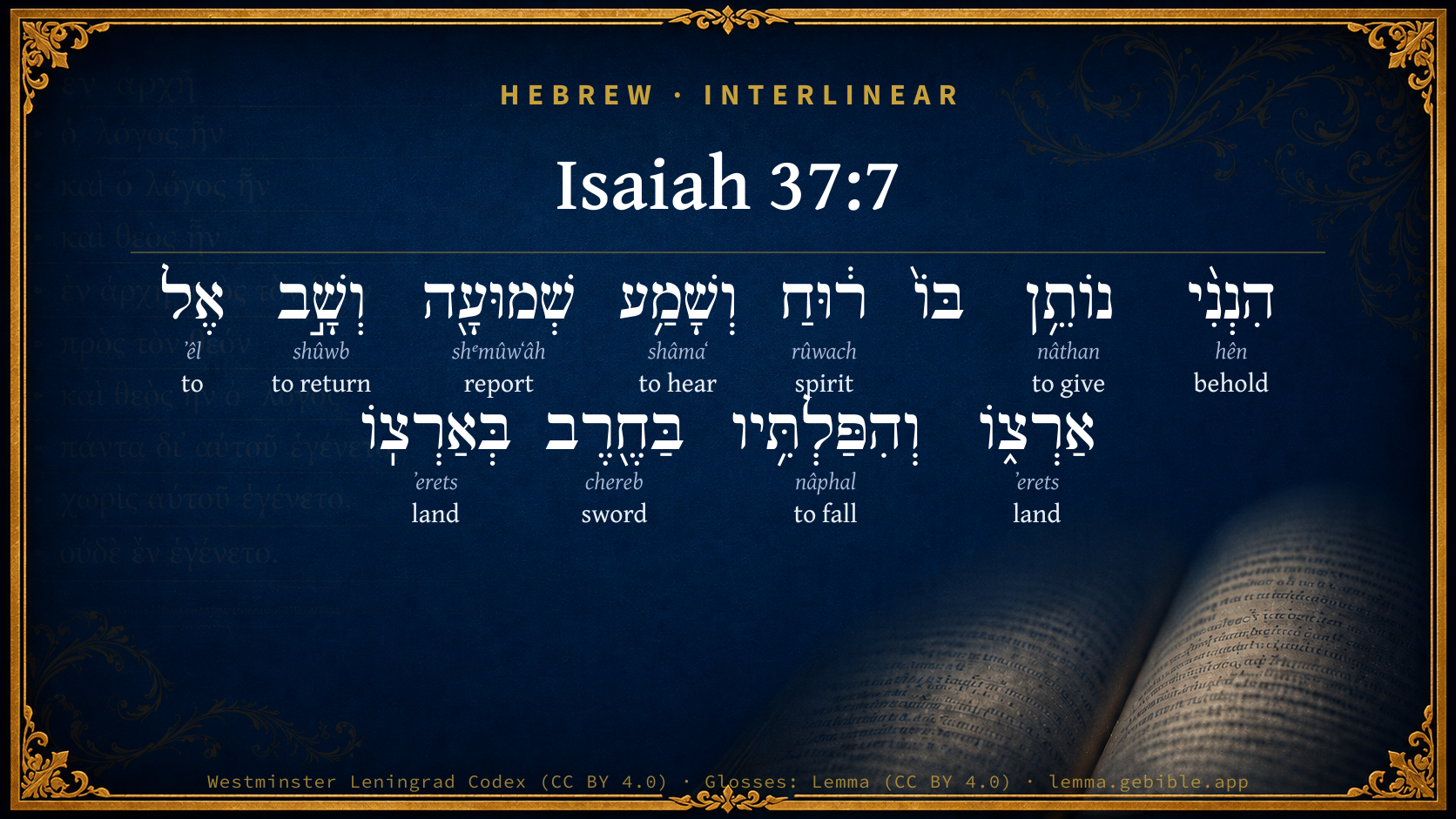
Hebrew (Westminster Leningrad Codex) Isaiah 37:7 appears in the Hebrew Old Testament. The text above is from the Westminster Leningrad Codex. Each word links to its Strong’s number, a concise gloss, and parsing drawn from the Open Scriptures Hebrew Bible morphology. Click any word for its full Brown-Driver-Briggs (BDB) entry.
Download image
Cite this verse

Isaiah 37:7 (World English Bible). Public Domain. Lemma interlinear Bible study tool, https://lemma.gebible.app/v/isaiah/37/7.

Show BibTeX & RIS
BibTeX
RIS
English Translation
Behold, I will put a spirit in him, and he shall hear news, and shall return to his own land; and I will cause him to fall by the sword in his own land.
World English Bible · Public Domain
Download a study sheet

One document with this verse’s original text, its word-by-word gloss line, the meaning frame, cross-references with their text, attributed commentary, and full source and license credits — printable, and it pastes into notes with its structure intact.

This verse Autodidact and up

Study sheet (.html) Plain text (.txt)

A passage Seminary Student

Up to 50 verses in one chapter. A passage sheet keeps up to 6 commentary sources and 12 cross-references per verse, in the order this page ranks them, and says so on the sheet whenever that leaves anything out. Ask for a single verse and you get the Autodidact verse sheet above.

Everything on this page stays free to read, with no account — the sheet is a download of what is already on screen, not access to it.

Want to remove ads? Support Godless Engineer
Compare translations 3

The same verse in 3 English versions, stacked beneath the original-language interlinear above. Click any original word for its lexicon entry.

Each is an independent rendering of the whole verse — the interlinear is not word-aligned to these translations.

Highlighted words mark where these versions differ — a whole-verse word diff, not a word-by-word alignment.

  • World English Bible Public Domain
    Behold, I will put a spirit in him, and he shall hear news, and shall return to his own land; and I will cause him to fall by the sword in his own land.
  • King James Version Public Domain
    Behold, I will send a blast upon him, and he shall hear a rumour, and return to his own land; and I will cause him to fall by the sword in his own land.
  • unfoldingWord Literal Text CC BY-SA 4.0
    Behold me, putting a spirit in him, and he will hear a report, and he will return to his land, and I will make him fall by the sword in his land.”’”

unfoldingWord Literal Text — © unfoldingWord, licensed CC BY-SA 4.0. Word-aligned USFM3 via Door43 (git.door43.org/unfoldingWord/en_ult).

Versions to compare (up to 4)

3 of 4 selected

Show all 18 translations

Every available English version of this verse, each an independent rendering of the whole verse.

  • World English Bible Public Domain
    Behold, I will put a spirit in him, and he shall hear news, and shall return to his own land; and I will cause him to fall by the sword in his own land.
  • Berean Standard Bible Public Domain
    Behold, I will put a spirit in him so that he will hear a rumor and return to his own land, where I will cause him to fall by the sword.’”
  • Majority Standard Bible Public Domain
    Behold, I will put a spirit in him so that he will hear a rumor and return to his own land, where I will cause him to fall by the sword.’”
  • King James Version Public Domain
    Behold, I will send a blast upon him, and he shall hear a rumour, and return to his own land; and I will cause him to fall by the sword in his own land.
  • American Standard Version (1901) Public Domain
    Behold, I will put a spirit in him, and he shall hear tidings, and shall return unto his own land; and I will cause him to fall by the sword in his own land.
  • Revised Version (1885) Public Domain
    Behold, I will put a spirit in him, and he shall hear a rumour, and shall return unto his own land; and I will cause him to fall by the sword in his own land.
  • Geneva Bible (1599) Public Domain
    Beholde, I wil send a blast vpon him, and he shall heare a noyse, and returne to his owne land, and I will cause him to fall by the sword in his owne land.
  • Douay-Rheims (1899) Public Domain
    Behold, I will send a spirit upon him, and he shall hear a message, and shall return to his own country, and I will cause him to fall by the sword in his own country.
  • Young's Literal Translation Public Domain
    Lo, I am giving in him a spirit, and he hath heard a report, and hath turned back unto his land, and I have caused him to fall by the sword in his land.'
  • Literal Standard Version CC BY-SA 4.0
    Behold, I am giving a spirit in him, and he has heard a report, and has turned back to his land, and I have caused him to fall by the sword in his land.”
  • Unlocked Literal Bible CC BY-SA 4.0
    Look, I will put a spirit in him, and he will hear a certain report and go back to his own land. I will cause him to fall by the sword in his own land.”'”
  • unfoldingWord Literal Text CC BY-SA 4.0
    Behold me, putting a spirit in him, and he will hear a report, and he will return to his land, and I will make him fall by the sword in his land.”’”
  • Darby Bible Public Domain
    Behold, I will put a spirit into him, and he shall hear tidings, and shall return to his own land; and I will cause him to fall by the sword in his own land.
  • World Messianic Bible Public Domain
    Behold, I will put a spirit in him and he will hear news, and will return to his own land. I will cause him to fall by the sword in his own land.”’”
  • Webster's Bible Public Domain
    Behold, I will send a blast upon him, and he shall hear a rumor, and return to his own land; and I will cause him to fall by the sword in his own land.
  • Free Bible Version CC BY-SA 4.0
    Look, I'm going to scare him—he'll hear a rumor, and he'll have to return to his own country. When he's there I'll have him killed by the sword.”
  • Bible in Basic English Public Domain
    See, I will put a spirit into him, and bad news will come to his ears, and he will go back to his land; and there I will have him put to death.
  • JPS Tanakh (1917) Public Domain
    Behold, I will put a spirit in him, and he shall hear a rumour, and shall return unto his own land; and I will cause him to fall by the sword in his own land.'

Literal Standard Version (2020), Covenant Press — licensed CC BY-SA 4.0. Text via the HelloAO Bible API (eBible.org). Unlocked Literal Bible (unfoldingWord) — licensed CC BY-SA 4.0. Text via the HelloAO Bible API (eBible.org). unfoldingWord Literal Text — © unfoldingWord, licensed CC BY-SA 4.0. Word-aligned USFM3 via Door43 (git.door43.org/unfoldingWord/en_ult). Free Bible Version, Dr. Jonathan Gallagher — licensed CC BY-SA 4.0. Text via the HelloAO Bible API (eBible.org).

Word by word

More ways to search: Search by grammar → Find every occurrence → Compare this word →

Practice this passage: Drill this verse → Learn its vocabulary →

שְׁמוּעָ֖ה
shᵉmûwʻâh
H8052
“report”
Noun, Common, Feminine, Singular, Absolute
Part of Speech
Noun
Type
Common
Gender
Feminine
Number
Singular
State
Absolute
Full BDB Definition

Origin: pass part of H8074

TWOT: 2412d

report, news, rumour - report, news, tidings - mention
  1. הִנְנִ֨י hên H2005 “behold · me” Particle, Demonstrative + Suffix, Personal, 1st Person, Common, Singular
  2. נוֹתֵ֥ן nâthan H5414 “giving” Verb, Qal, Participle Active, Masculine, Singular, Absolute
  3. ר֔וּחַ rûwach H7307 “spirit” Noun, Common, Both, Singular, Absolute
  4. וְשָׁמַ֥ע shâmaʻ H8085 “and · to hear” Conjunction + Verb, Qal, Sequential Perfect, 3rd Person, Masculine, Singular
  5. וְשָׁ֣ב shûwb H7725 “and · to return” Conjunction + Verb, Qal, Sequential Perfect, 3rd Person, Masculine, Singular
  6. אֶל ʼêl H413 “to” Preposition
  7. אַרְצ֑וֹ ʼerets H776 “land · his” Noun, Common, Both, Singular, Construct + Suffix, Personal, 3rd Person, Masculine, Singular
  8. וְהִפַּלְתִּ֥יו nâphal H5307 “and · to fall · him” Conjunction + Verb, Hiphil, Sequential Perfect, 1st Person, Common, Singular + Suffix, Personal, 3rd Person, Masculine, Singular
  9. בַּחֶ֖רֶב chereb H2719 “in/at the · sword” Preposition, Determined + Noun, Common, Feminine, Singular, Absolute
  10. בְּאַרְצֽוֹ ʼerets H776 “in/at · land · his” Preposition + Noun, Common, Both, Singular, Construct + Suffix, Personal, 3rd Person, Masculine, Singular

About this verse

These counts appear in no published source. They are computed here, from the morphology-tagged text and Lemma’s own curated glosses. What Lemma adds →

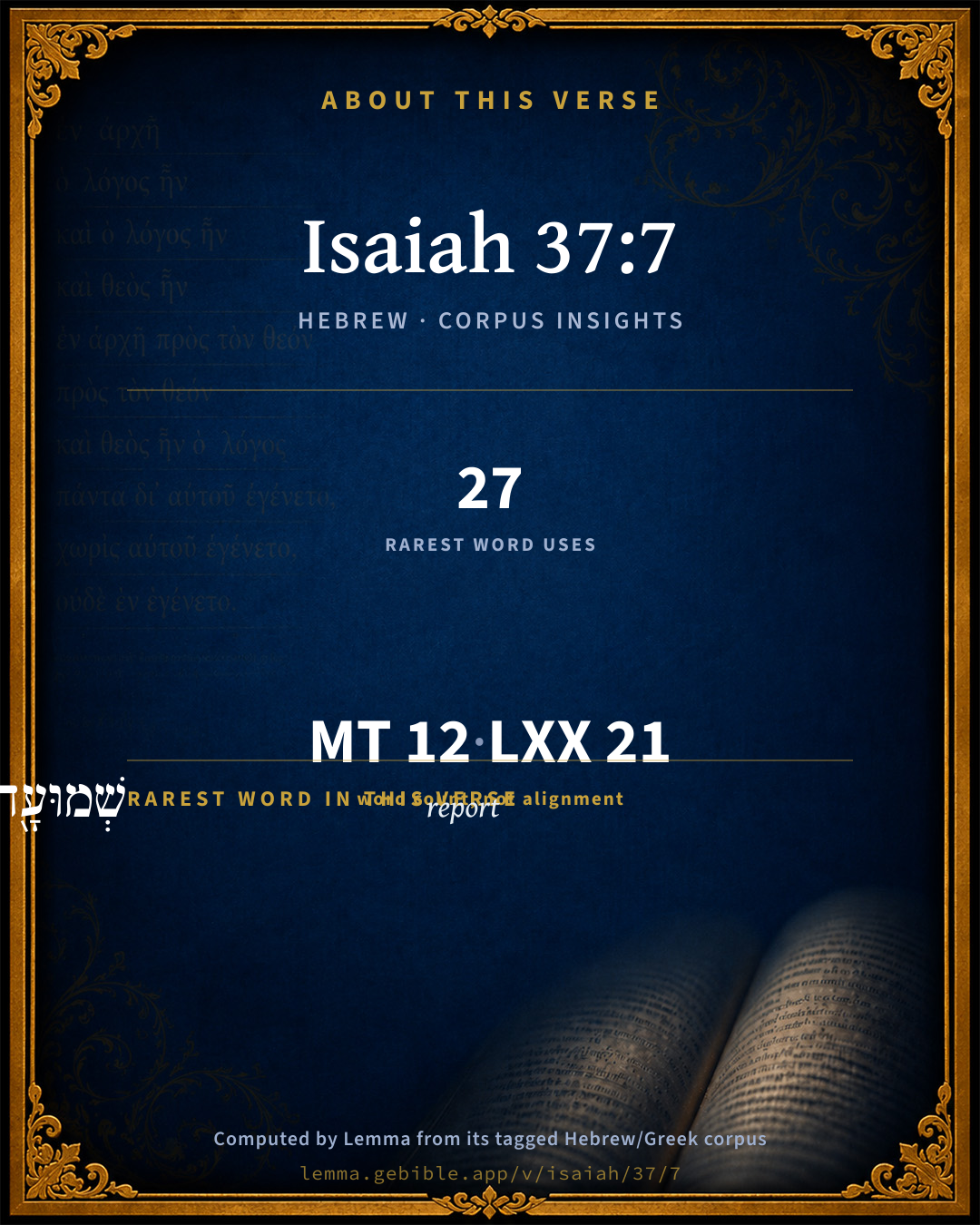
12
words
10
distinct lemmas
Prophets
section

Shared distinctive vocabulary

שְׁמוּעָ֖ה report H8052 occurs in 24 verses of the Hebrew Bible. Also found in:

Grammatical profile

  • 4 verbs
  • 5 nouns
  • 2 prepositions
  • 1 particle

Verb forms

  • נוֹתֵ֥ן Qal · Participle Active
  • וְשָׁמַ֥ע Qal · Sequential Perfect
  • וְשָׁ֣ב Qal · Sequential Perfect
  • וְהִפַּלְתִּ֥יו Hiphil · Sequential Perfect

Repetition

A word recurs within this verse — often emphatic in Hebrew:

  • אַרְצ֑וֹ land H776 ×2

Hebrew & Septuagint length

In English translation the verse runs 34 words from the Hebrew and 31 from the Septuagint (LXX English) — closely comparable.

A rough comparison of the two English renderings, which tokenize alike — not a word-level alignment.

Word counts can differ between the Hebrew and the Greek without any difference in meaning — e.g. the Hebrew direct-object marker אֵת has no separate Greek word, and Greek often adds the article ὁ.

In the original languages it is 12 Hebrew tokens and 21 Greek tokens — but the two are counted differently (Hebrew bundles its prefixes and suffixes into one token; the Greek is in lemma form), so that isn’t a like-for-like length.

Cross-references

14

Topical passages linked to Isaiah 37:7 in the Treasury of Scripture Knowledge — connected by theme and wording, ordered by reader-vote popularity; previews shown in the World English Bible.

  • 2 Chronicles 32:21 Yahweh sent an angel, who cut off all the mighty men of valor, and the leaders and captains, in the camp of the king of Assyria. So he returned with shame of face to his own land. When he was come into the house of his god, those who came forth from his own bowels killed him there with the sword.
  • Isaiah 31:8–9 The Assyrian shall fall by the sword, not of man; and the sword, not of men, shall devour him; and he shall flee from the sword, and his young men shall become subject to forced labor.
  • 2 Kings 7:6 For the Lord had made the host of the Syrians to hear a noise of chariots, and a noise of horses, even the noise of a great host: and they said one to another, Behold, the king of Israel has hired against us the kings of the Hittites, and the kings of the Egyptians, to come on us.
  • Job 4:9 By the breath of God they perish, By the blast of his anger are they consumed.
  • Job 15:21 A sound of terrors is in his ears; In prosperity the destroyer shall come on him.
  • Isaiah 10:16–18 Therefore will the Lord, Yahweh of Hosts, send among his fat ones leanness; and under his glory there shall be kindled a burning like the burning of fire.
  • Isaiah 10:33–34 Behold, the Lord, Yahweh of Hosts, will lop the boughs with terror: and the high of stature shall be hewn down, and the lofty shall be brought low.
  • Isaiah 17:13–14 The nations shall rush like the rushing of many waters: but he shall rebuke them, and they shall flee far off, and shall be chased as the chaff of the mountains before the wind, and like the whirling dust before the storm.
  • Isaiah 29:5–8 But the multitude of your foes shall be like small dust, and the multitude of the awesome ones as chaff that passes away: yes, it shall be in an instant suddenly.
  • Isaiah 30:28–33 and his breath is as an overflowing stream, that reaches even to the neck, to sift the nations with the sieve of destruction: and a bridle that causes to err [shall be] in the jaws of the peoples.
  • Isaiah 33:10–12 Now will I arise, says Yahweh; now will I lift up myself; now will I be exalted.
  • Isaiah 37:9 He heard say concerning Tirhakah king of Ethiopia, He is come out to fight against you. When he heard it, he sent messengers to Hezekiah, saying,
  • Isaiah 37:36–38 The angel of Yahweh went forth, and struck in the camp of the Assyrians one hundred and eighty-five thousand; and when men arose early in the morning, behold, these were all dead bodies.
  • Psalms 58:9 Before your pots can feel the heat of the thorns, He will sweep away the green and the burning alike.

Cross-references courtesy of OpenBible.info (CC BY 4.0).

Hebrew and Greek witnesses Masoretic Hebrew ↔ Greek Septuagint

The same verse in the two great witnesses to the Old Testament, shown verse-for-verse.

These are two independent witnesses, not word-aligned to each other, and the Septuagint is shown in lemma (dictionary) form.

Hebrew Isaiah 37:7 Masoretic · Westminster Leningrad Codex

הִנְנִ֨י נוֹתֵ֥ן בּוֹ֙ ר֔וּחַ וְשָׁמַ֥ע שְׁמוּעָ֖ה וְשָׁ֣ב אֶל אַרְצ֑וֹ וְהִפַּלְתִּ֥יו בַּחֶ֖רֶב בְּאַרְצֽוֹ

Behold, I will put a spirit in him, and he shall hear news, and shall return to his own land; and I will cause him to fall by the sword in his own land.

World English Bible · Public Domain

Greek LXX Isaiah 37:7 Septuagint · lemma form

ἰδού ἐγώ ἐνβάλλω εἰς αὐτός πνεῦμα καί ἀκούω ἀγγελία ἀποστρέφω εἰς ὁ χώρα αὐτός καί πίπτω μάχαιρα ἐν ὁ γῆ αὐτός

Behold, I will send a blast upon him, and he shall hear a report, and return to his own country, and he shall fall by the sword in his own land.

LXX2012 (modern English Septuagint) · Public Domain

Hebrew: Westminster Leningrad Codex (CC BY 4.0). Greek: Septuagint (public domain); English from LXX2012 (modern English Septuagint) (Public Domain). How the Septuagint differs from the Hebrew →

Targum (Aramaic paraphrase)

1

The Targum is the ancient Jewish Aramaic paraphrase of the Hebrew Scriptures — an interpretive translation, not the Hebrew text itself. Onkelos (literal) and Pseudo-Jonathan (expansive) render the Torah, and Jonathan the Prophets. Coverage is partial: where no permissively-licensed English translation exists for a verse, only the Aramaic is shown. This is verse-level text, not a word-by-word alignment to the Hebrew.

  1. Targum Jonathan Prophets (Joshua–Malachi)
    הָא אֲנָא יָהֵיב בֵיהּ רוּחָא וְיִשְׁמַע בְּשׂוֹרָא וִיתוּב לְאַרְעֵהּ וְאִפְלִינֵהּ בְּחַרְבָּא בְּאַרְעֵהּ:

    Behold, I will put a spirit within him, and he shall hear a rumour, and return to his own land: and I will cause him to fall by the sword in his own land.

    Targum Jonathan — Aramaic: “Mikraot Gedolot” (public domain). English: “Sefaria Community Translation” (CC0 1.0 (public-domain dedication)); “London "Chaldee Paraphrase," 1871” (public domain). Text via Sefaria.

Commentary

Notes on Isaiah 37:7 from classic Christian and Jewish commentators (each source and its license shown beneath its notes). The classic Christian expositions comment on the surrounding passage and are grouped to its opening verse, so a note may address several verses; the Jewish commentaries on the Tanakh (Rashi and others) are per-verse, so they appear only where the commentator wrote on this verse.

Lemma curates 59 commentaries, every one of them public domain or Creative Commons licensed, each selected and text-cleaned for this edition rather than reprinted as found. About our sources →

Geneva Bible (1599)

Geneva Bible translators

Of the Egyptians and Ethiopians, that shall come and fight against him.

Geneva Bible (1599) marginal notes — public domain. Text via Bolls.life.

Jamieson, Fausset & Brown

Robert Jamieson, A. R. Fausset & David Brown

blast--rather, "I will put a spirit (Isa 28:6; Kg1 22:23) into him," that is, so influence his judgment that when he hears the report (Isa 37:9, concerning Tirhakah), he shall return [GESENIUS]; the "report" also of the destruction of his army at Jerusalem, reaching Sennacherib, while he was in the southwest of Palestine on the borders of Egypt, led him to retreat.

by the sword-- (Isa 37:38).

Jamieson, Fausset & Brown — Commentary Critical and Explanatory on the Whole Bible (1871) — public domain (CC PDM 1.0). Text via the HelloAO Bible API.

Adam Clarke's Commentary

Verse 7. I will send a blast - "I will infuse a spirit into him"] "נותין בו רוח nothen bo ruach never signifies any thing but putting a spirit into a person: this was πνευμα δειλιας, the spirit of deceit." - Secker. "I will send a blast" - I do not think that Archbishop Secker has hit the true meaning of these words. I believe רוח ruach means here a pestilential wind, such as the Arabs call simoom, that instantly suffocates both man and beast; and is what is termed "the angel of the Lord," God's messenger of death to the Assyrians, Isa 37:36.

Adam Clarke's Commentary on the Bible (1810–1826) — public domain. Text from a community e-Sword/MySword module.

Ellicott's Commentary for English Readers

(7) I will send a blast upon him.—Better, I will put a spirit in him. The Authorised Version suggests the idea of some physical calamity, like that which actually destroyed the Assyrian army. Here, however, the “spirit,” stands for the impulse, strong and mighty, which overpowers previous resolves. (Comp. Isa_30:28.)

He shall hear a rumour.—The words admit of being explained either as a prediction rising out of a purely supernatural foresight, or as resting on some secret intelligence which Israel had received as to the movements of Tirhakah.

A Bible Commentary for English Readers, edited by Charles John Ellicott (1878–1897) — public domain. Text from a community e-Sword module.

The Cambridge Bible for Schools and Colleges

gen. ed. J. J. S. Perowne

7. I will send a blast upon him] Render as in R.V. I will put a spirit in him, i.e. a spirit of craven fear, depriving him of his natural courage and resourcefulness. How the spirit will work is stated in what follows: a mere rumour will drive him back to his own land, there to meet his death (cf. 2Ki_7:6). There is no allusion in this oracle to the disastrous blow recorded in Isa_37:36. The “rumour” is no doubt that of the approach of Tirhakah (Isa_37:9).

The Cambridge Bible for Schools and Colleges (gen. ed. J. J. S. Perowne; Cambridge University Press, 1878–1918) — public domain. Text from a community e-Sword module.

John Gill's Exposition

So Rabshakeh returned,.... To the king of Assyria his master, to give him an account how things went at Jerusalem, and that he could get no direct answer from the king of Judah, and to consult with him what was proper to be done in the present situation of things; leaving the army before Jerusalem, under the command of the other two generals. For that he should take the army with him does not seem reasonable, when Hezekiah and his people were in such a panic on account of it; besides, the king of Assyria's letters to Hezekiah clearly suppose the army to be still at Jerusalem, or his menacing letters would have signified nothing; and after this the destruction of the Assyrian army before Jerusalem is related:

and found the king of Assyria warring against Libnah; a city in the tribe of Judah, Jos 10:29, and lay nearer to Jerusalem than Lachish, where Rabshakeh left him; so that he seemed to be drawing his army towards that city, on which his heart was set. Josephus (u) makes him to be at this time besieging Pelusium, a city in Egypt, but wrongly; which has led some into a mistake that Libnah and Pelusium are the same:

for he had heard that he was departed from Lachish; where he was, when he sent him to Jerusalem, Isa 36:2, having very probably taken it.

(u) Antiqu. l. 10. c. 1. sect. 4.

John Gill's Exposition of the Whole Bible (1746–1763) — public domain (CC PDM 1.0). Text via the HelloAO Bible API.

Albert Barnes' Notes on the Bible

Behold, I will send a blast upon him - Margin, ‘Put a spirit into him.’ The word rendered ‘blast’ (רוח rûach) is commonly rendered ‘spirit.’ It may denote breath, air, soul, or spirit. There is no reason to think that the word is used here in the sense of blast of wind, as our translators seem to have supposed. The sense is probably, ‘I will infuse into him a spirit of fear, by which be shall be alarmed by the rumour which he shall hear, and return to his own land.’ The word is often used in this sense (compare 1Sa 16:14; see also Isa 31:8-9). Gesenius understands it here in the sense of will or disposition. ‘I will change his will or disposition, so that he will return to his own land.’

And he shall hear a rumour - The rumour or report here referred to, was doubtless that respecting Tirhakah king of Ethiopia Isa 37:9. It was this which would alarm him, and drive him in haste from the cities which he was now besieging, and be the means of expelling him from the land.

And I will cause him ... - This is said in accordance with the usual statements in the Scriptures, that all events are under God’s providential control (compare the note at Isa 10:5-6).

By the sword in his own land - (See the note at Isa 37:38).

Albert Barnes' Notes on the Bible (1834–1885) — public domain. Text from a community e-Sword/MySword module.

Haydock's Catholic Bible Commentary

CHAPTER XXXVII.

Spirit. Angel, or a different design, 2 Thessalonians ii. 8. (Calmet)

George Leo Haydock (1774–1849), Haydock's Catholic Family Bible and Commentary, 1859 edition — public domain. Excludes Psalms (Douay-Rheims chapter numbering differs from Protestant) and Deuterocanonical books (Catholic canon only).

The Pulpit Commentary

Behold, I will send a blast upon him; rather, I will put a spirit within him; i.e. I will take away from him the spirit of pride and arrogance by which he has been hitherto actuated, and I will infuse into his heart, instead, a spirit of hesitation and fear. He shall hear a rumour; literally, as Delitzsch translates, he shall hear a hearsay; i.e. "a report," or tidings. " It is uncertain what "tidings" are intended. Some suppose "tidings of the movements of Tirhakah;" others, "tidings of the destruction of his host;" a few, "tidings of an insurrection in some other part of the Assyrian empire." This last supposition is wholly gratuitous, since we have no indication, either in Scripture or in the inscriptions, of any such insurrection. The choice lies between the other two, or between one or other of them, and the two combined. The vagueness is owing, not to the time at which the present narrative took shape, but to the fact that a vague promise quite sufficient for its purpose was given at first, the filling in of the details being reserved for a later period (see vers. 22-35). I will cause him to fall by the sword (see ver. 38).

The Pulpit Commentary (1880–1919), ed. H.D.M. Spence-Jones & Joseph S. Exell — public domain. Text from a community e-Sword module.

J. A. Alexander on Isaiah

Joseph Addison Alexander

“Behold I am putting (or about to put) a spirit in him, and he shall hear a noise, and shall return to his own land, and I will cause him to fall by the sword in his own land.” The English Version renders the first clause, ‘behold I will send a blast upon him’, meaning either a pestilential blast or a destructive tempest. But the phrase refers to an effect to be produced upon the mind of the Assyrian. The most probable conclusion is, that it does not denote a specific change, but divine influence as governing his movements.

Most writers understand the phrase, ‘he shall hear a noise’, as referring to the news mentioned in v. 9 below. But as this news, far from driving Sennacherib home, led to a fresh defiance of Jerusalem, it has been ingeniously suggested that this expression has reference to the news of the destruction of his host before Jerusalem while he himself was absent. But in the next verse Rabshakeh is said to have rejoined his master, nor is there any further mention of an army at Jerusalem. It is possible, indeed, though not recorded, that Rabshakeh left the troops behind him when he went to Libnah, under the command of Tartan or Rabsaris (2Ki 18:17), and this is still more probable if, as some suppose, Rabshakeh was a mere ambassador or herald, and Tartan the real military chief. If it can be assumed, on any ground, that the great catastrophe took place in the absence of Sennacherib, which would account for his personal escape, then the explanation given above is more satisfactory than any other.

Joseph Addison Alexander, The Prophecies of Isaiah (1846–1847; New York: Scribner, 1870–1878) — public domain. Text from a community e-Sword module.

Rashi

Rabbi Shlomo Yitzchaki (Rashi)

and he will hear a rumor immediately. This is the rumor of Tirhakah, king of Cush, because of which he will leave you this time to battle with Tirhakah, but this is not the return to his land. Afterwards he will return here, and I am destined to return him to his land and to cause him to fall there by the sword.

Rashi on the Tanakh — English translations: “The Judaica Press complete Tanach with Rashi, translated by A. J. Rosenberg” (CC BY 4.0); “Pentateuch with Rashi's commentary by M. Rosenbaum and A.M. Silbermann, 1929-1934” (public domain); “The Metsudah Tanach series, Lakewood, N.J” (CC BY 4.0); and “The Book of Joshua, Metsudah Publications, 1997” (CC BY 4.0). Text via Sefaria.

Lesson kit

Teaching starters — assembled from the data on this page, not authored interpretation. Every prompt links to the verse data it draws on. Edit before teaching.

Isaiah, in the Prophets, opens this verse with 12 words (10 distinct Hebrew lemmas). Its most distinctive word is shᵉmûwʻâh (“report”). A historical commentator’s framing appears above. Read the whole chapter for the surrounding context.

Discussion questions

  1. What does “report” (shᵉmûwʻâh) contribute to the verse as a whole?
  2. 1 Samuel 2:24 shares the word «report» with this verse. How do the two illuminate each other?
  3. “land” occurs 2× in this one verse. What is the effect of the repetition?
  4. These translations render this verse differently. What is at stake in choosing one wording over another?
  5. The verb «נוֹתֵ֥ן» is Qal Participle Active. How does its form color the action?
  6. Reading how Geneva Bible (1599) and Jamieson, Fausset & Brown read this verse, where do the two commentators agree and where do they part?

Things to notice

Reading settings

Reading text

Shown beneath each verse's original-language words.

Old Testament
Old Testament edition

Read the OT as the Masoretic Hebrew (MT) or the Greek Septuagint (LXX).

English shown for the Greek Septuagint (in the Hebrew ↔ Greek comparison).

Comparing translations? Open the Compare panel on any verse page to stack up to four side by side.