Isaiah 51:19

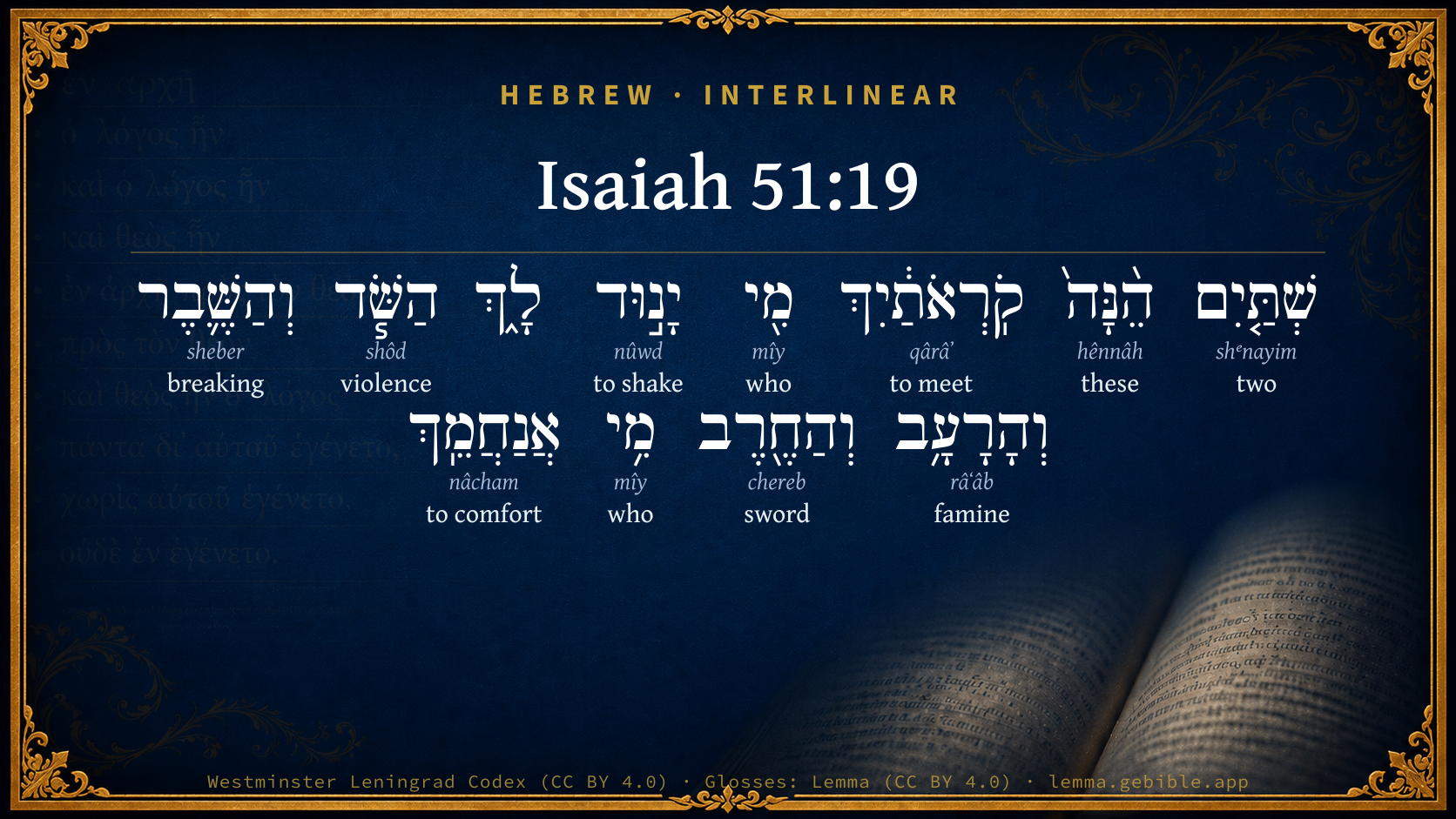
Hebrew (Westminster Leningrad Codex) Isaiah 51:19 appears in the Hebrew Old Testament. The text above is from the Westminster Leningrad Codex. Each word links to its Strong’s number, a concise gloss, and parsing drawn from the Open Scriptures Hebrew Bible morphology. Click any word for its full Brown-Driver-Briggs (BDB) entry.
Download image
Cite this verse

Isaiah 51:19 (World English Bible). Public Domain. Lemma interlinear Bible study tool, https://lemma.gebible.app/v/isaiah/51/19.

Show BibTeX & RIS
BibTeX
RIS
English Translation
These two things have happened to you. Who will bemoan you? Desolation and destruction, and the famine and the sword; how shall I comfort you?
World English Bible · Public Domain
Download a study sheet

One document with this verse’s original text, its word-by-word gloss line, the meaning frame, cross-references with their text, attributed commentary, and full source and license credits — printable, and it pastes into notes with its structure intact.

This verse Autodidact and up

Study sheet (.html) Plain text (.txt)

A passage Seminary Student

Up to 50 verses in one chapter. A passage sheet keeps up to 6 commentary sources and 12 cross-references per verse, in the order this page ranks them, and says so on the sheet whenever that leaves anything out. Ask for a single verse and you get the Autodidact verse sheet above.

Everything on this page stays free to read, with no account — the sheet is a download of what is already on screen, not access to it.

Want to remove ads? Support Godless Engineer
Compare translations 3

The same verse in 3 English versions, stacked beneath the original-language interlinear above. Click any original word for its lexicon entry.

Each is an independent rendering of the whole verse — the interlinear is not word-aligned to these translations.

Highlighted words mark where these versions differ — a whole-verse word diff, not a word-by-word alignment.

  • World English Bible Public Domain
    These two things have happened to you. Who will bemoan you? Desolation and destruction, and the famine and the sword; how shall I comfort you?
  • King James Version Public Domain
    These two things are come unto thee; who shall be sorry for thee? desolation, and destruction, and the famine, and the sword: by whom shall I comfort thee?
  • unfoldingWord Literal Text CC BY-SA 4.0
    These two are meeting you— who will sympathize with you?— destruction and breaking, and famine and the sword; who will comfort you?

unfoldingWord Literal Text — © unfoldingWord, licensed CC BY-SA 4.0. Word-aligned USFM3 via Door43 (git.door43.org/unfoldingWord/en_ult).

Versions to compare (up to 4)

3 of 4 selected

Show all 18 translations

Every available English version of this verse, each an independent rendering of the whole verse.

  • World English Bible Public Domain
    These two things have happened to you. Who will bemoan you? Desolation and destruction, and the famine and the sword; how shall I comfort you?
  • Berean Standard Bible Public Domain
    These pairs have befallen you: devastation and destruction, famine and sword. Who will grieve for you? Who can comfort you?
  • Majority Standard Bible Public Domain
    These pairs have befallen you: devastation and destruction, famine and sword. Who will grieve for you? Who can comfort you?
  • King James Version Public Domain
    These two things are come unto thee; who shall be sorry for thee? desolation, and destruction, and the famine, and the sword: by whom shall I comfort thee?
  • American Standard Version (1901) Public Domain
    These two things are befallen thee, who shall bemoan thee? desolation and destruction, and the famine and the sword; how shall I comfort thee?
  • Revised Version (1885) Public Domain
    These two things are befallen thee; who shall bemoan thee? desolation and destruction, and the famine and the sword; how shall I comfort thee?
  • Geneva Bible (1599) Public Domain
    These two thinges are come vnto thee: who will lament thee? desolation and destruction and famine, and the sworde: by whome shall I comfort thee?
  • Douay-Rheims (1899) Public Domain
    There are two things that have happened to thee: who shall be sorry for thee? desolation, and destruction, and the famine, and the sword, who shall comfort thee?
  • Young's Literal Translation Public Domain
    These two are meeting thee, who is moved for thee? Spoiling and destruction -- Famine and sword, who -- I comfort thee?
  • Literal Standard Version CC BY-SA 4.0
    These two are meeting you, || Who is moved for you? Spoiling and destruction, famine and sword! By whom do I comfort you?
  • Unlocked Literal Bible CC BY-SA 4.0
    These two troubles happened to you—who will grieve with you?— desolation and destruction, and the famine and the sword. Who will comfort you?
  • unfoldingWord Literal Text CC BY-SA 4.0
    These two are meeting you— who will sympathize with you?— destruction and breaking, and famine and the sword; who will comfort you?
  • Darby Bible Public Domain
    These two [things] are come unto thee; who will bemoan thee? -- desolation and destruction, and famine and sword: how shall I comfort thee?
  • World Messianic Bible Public Domain
    These two things have happened to you— who will grieve with you?— desolation and destruction, and famine and the sword. How can I comfort you?
  • Webster's Bible Public Domain
    These two things have come to thee; who shall be sorry for thee? desolation, and destruction, and famine, and the sword: by whom shall I comfort thee?
  • Free Bible Version CC BY-SA 4.0
    Two tragedies have struck you: devastation caused by famine, and destruction caused by war. Who is going to sympathize with you? Who is going to comfort you?
  • Bible in Basic English Public Domain
    These two things have come on you; who will be weeping for you? wasting and destruction; death from need of food, and from the sword; how may you be comforted?
  • JPS Tanakh (1917) Public Domain
    These two things are befallen thee; who shall bemoan thee? desolation and destruction, and the famine and the sword; how shall I comfort thee?

Literal Standard Version (2020), Covenant Press — licensed CC BY-SA 4.0. Text via the HelloAO Bible API (eBible.org). Unlocked Literal Bible (unfoldingWord) — licensed CC BY-SA 4.0. Text via the HelloAO Bible API (eBible.org). unfoldingWord Literal Text — © unfoldingWord, licensed CC BY-SA 4.0. Word-aligned USFM3 via Door43 (git.door43.org/unfoldingWord/en_ult). Free Bible Version, Dr. Jonathan Gallagher — licensed CC BY-SA 4.0. Text via the HelloAO Bible API (eBible.org).

Word by word

More ways to search: Search by grammar → Find every occurrence → Compare this word →

Practice this passage: Drill this verse → Learn its vocabulary →

יָנ֣וּד
nûwd
H5110
“to shake”
Verb, Qal, Imperfect, 3rd Person, Masculine, Singular
Part of Speech
Verb
Stem
Qal
Form
Imperfect
Person
3rd Person
Gender
Masculine
Number
Singular
Full BDB Definition

Origin: a primitive root

TWOT: 1319

to shake, waver, wander, move to and fro, flutter, show grief, have compassion on - (Qal) - to move to and fro, wander (aimlessly), take flight - to flutter - to waver, wave, shake - to show grief - to lament, condole, show sympathy - (Hiphil) - to cause to wander (aimlessly) - to make a wagging, wag (with the head) - (Hithpolel) - to move oneself to and fro, sway, totter - to shake oneself - to bemoan oneself
  1. שְׁתַּ֤יִם shᵉnayim H8147 “two” Adjective, Cardinal number, Feminine, Dual, Absolute
  2. הֵ֨נָּה֙ hênnâh H2007 “these” Pronoun, Personal, 3rd Person, Feminine, Plural
  3. קֹֽרְאֹתַ֔יִךְ qârâʼ H7122 “meeting · you” Verb, Qal, Participle Active, Feminine, Plural, Construct + Suffix, Personal, 2nd Person, Feminine, Singular
  4. מִ֖י mîy H4310 “who” Particle, Interrogative
  5. הַשֹּׁ֧ד shôd H7701 “the · violence” Particle, Definite Article + Noun, Common, Masculine, Singular, Absolute
  6. וְהַשֶּׁ֛בֶר sheber H7667 “and · the · breaking” Conjunction + Particle, Definite Article + Noun, Common, Masculine, Singular, Absolute
  7. וְהָרָעָ֥ב râʻâb H7458 “and · the · famine” Conjunction + Particle, Definite Article + Noun, Common, Masculine, Singular, Absolute
  8. וְהַחֶ֖רֶב chereb H2719 “and · the · sword” Conjunction + Particle, Definite Article + Noun, Common, Feminine, Singular, Absolute
  9. מִ֥י mîy H4310 “who” Particle, Interrogative
  10. אֲנַחֲמֵֽךְ nâcham H5162 “to comfort · you” Verb, Piel, Imperfect, 1st Person, Common, Singular + Suffix, Personal, 2nd Person, Feminine, Singular

About this verse

These counts appear in no published source. They are computed here, from the morphology-tagged text and Lemma’s own curated glosses. What Lemma adds →

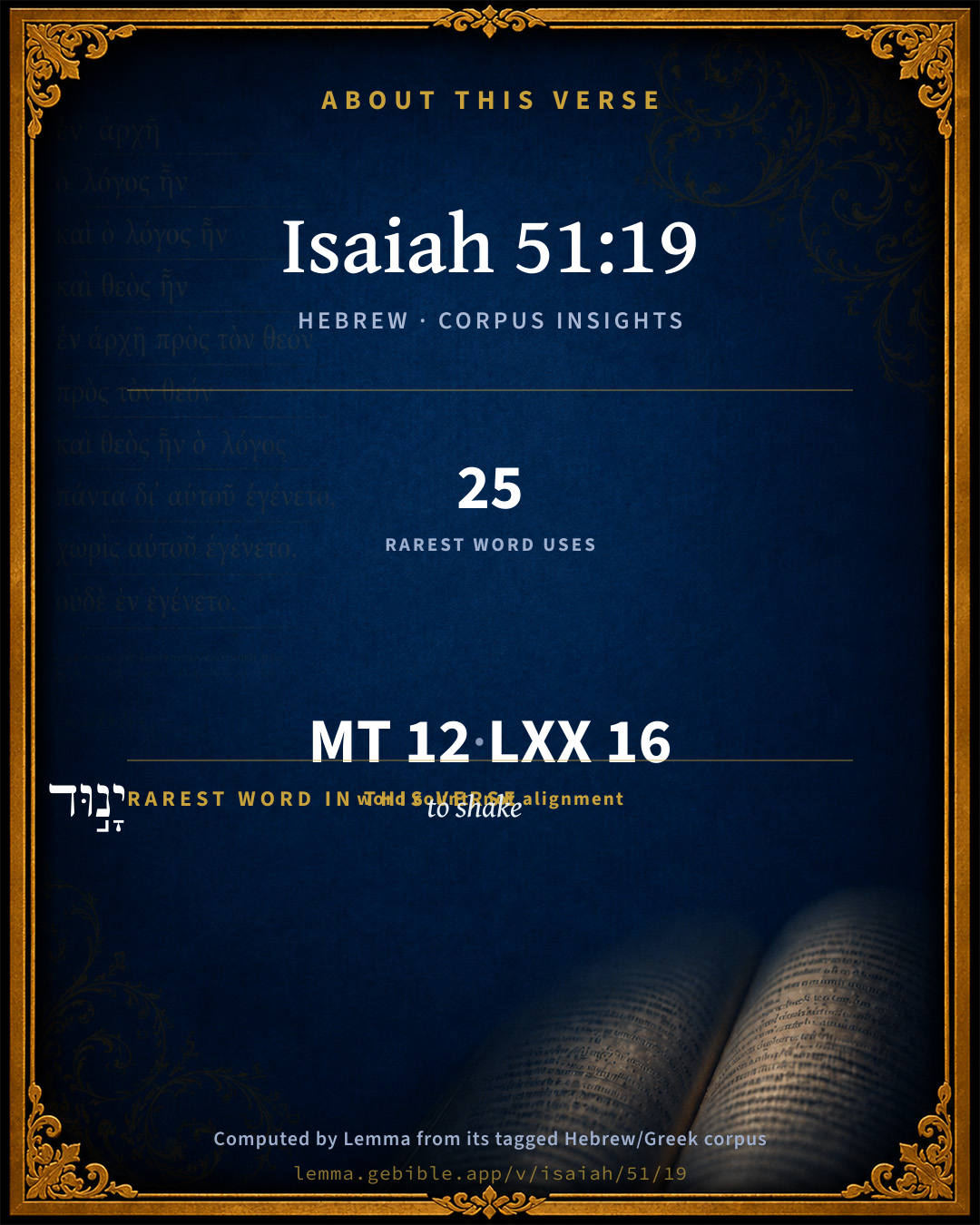
12
words
10
distinct lemmas
Prophets
section

Notable vocabulary

The rarest word here is יָנ֣וּד to shake H5110 — appearing just 25 times in the whole Hebrew Bible.

Shared distinctive vocabulary

יָנ֣וּד to shake H5110 occurs in 24 verses of the Hebrew Bible. Also found in:

Grammatical profile

  • 3 verbs
  • 4 nouns
  • 1 adjective
  • 1 pronoun
  • 1 preposition
  • 2 particles

Verb forms

  • קֹֽרְאֹתַ֔יִךְ Qal · Participle Active
  • יָנ֣וּד Qal · Imperfect
  • אֲנַחֲמֵֽךְ Piel · Imperfect

Repetition

A word recurs within this verse — often emphatic in Hebrew:

Hebrew & Septuagint length

In English translation the verse runs 25 words from the Hebrew and 24 from the Septuagint (LXX English) — closely comparable.

A rough comparison of the two English renderings, which tokenize alike — not a word-level alignment.

Word counts can differ between the Hebrew and the Greek without any difference in meaning — e.g. the Hebrew direct-object marker אֵת has no separate Greek word, and Greek often adds the article ὁ.

In the original languages it is 12 Hebrew tokens and 16 Greek tokens — but the two are counted differently (Hebrew bundles its prefixes and suffixes into one token; the Greek is in lemma form), so that isn’t a like-for-like length.

Cross-references

17

Topical passages linked to Isaiah 51:19 in the Treasury of Scripture Knowledge — connected by theme and wording, ordered by reader-vote popularity; previews shown in the World English Bible.

  • Isaiah 47:9 but these two things shall come to you in a moment in one day, the loss of children, and widowhood; in their full measure shall they come on you, in the multitude of your sorceries, and the great abundance of your enchantments.
  • Amos 7:2 It happened that, when they made an end of eating the grass of the land, then I said, "Lord Yahweh, forgive, I beg you! How could Jacob stand? For he is small."
  • Job 2:11 Now when Job's three friends heard of all this evil that had come on him, they each came from his own place: Eliphaz the Temanite, Bildad the Shuhite, and Zophar the Naamathite, and they made an appointment together to come to sympathize with him and to comfort him.
  • Job 42:11 Then came there to him all his brothers, and all his sisters, and all those who had been of his acquaintance before, and ate bread with him in his house. They comforted him, and consoled him concerning all the evil that Yahweh had brought on him. Everyone also gave him a piece of money, and everyone a ring of gold.
  • Psalms 69:20 Reproach has broken my heart, and I am full of heaviness. I looked for some to take pity, but there was none; For comforters, but I found none.
  • Ecclesiastes 4:1 Then I returned and saw all the oppressions that are done under the sun: and, behold, the tears of those who were oppressed, and they had no comforter; and on the side of their oppressors there was power; but they had no comforter.
  • Isaiah 14:30 The firstborn of the poor shall feed, and the needy shall lie down in safety; and I will kill your root with famine, and your remnant shall be killed.
  • Isaiah 22:4 Therefore said I, Look away from me, I will weep bitterly; don't labor to comfort me for the destruction of the daughter of my people.
  • Isaiah 61:2 to proclaim the year of Yahweh's favor, and the day of vengeance of our God; to comfort all who mourn;
  • Jeremiah 9:17–21 Thus says Yahweh of Hosts, Consider you, and call for the mourning women, that they may come; and send for the skillful women, that they may come:
  • Lamentations 1:9 Her filthiness was in her skirts; she didn't remember her latter end; Therefore is she come down wonderfully; she has no comforter: See, Yahweh, my affliction; for the enemy has magnified himself.
  • Lamentations 1:12 Is it nothing to you, all you who pass by? Look, and see if there be any sorrow like my sorrow, which is brought on me, With which Yahweh has afflicted [me] in the day of his fierce anger.
  • Lamentations 1:16–17 For these things I weep; my eye, my eye runs down with water; Because the comforter who should refresh my soul is far from me: My children are desolate, because the enemy has prevailed.
  • Ezekiel 14:21 For thus says the Lord Yahweh: How much more when I send my four sore judgments on Jerusalem, the sword, and the famine, and the evil animals, and the pestilence, to cut off from it man and animal!
  • 2 Corinthians 7:6–7 Nevertheless, he who comforts the lowly, God, comforted us by the coming of Titus;
  • 2 Corinthians 7:13 Therefore we have been comforted. In our comfort we rejoiced the more exceedingly for the joy of Titus, because his spirit has been refreshed by you all.
  • 2 Thessalonians 2:16–17 Now our Lord Jesus Christ himself, and God our Father, who loved us and gave us eternal comfort and good hope through grace,

Cross-references courtesy of OpenBible.info (CC BY 4.0).

Hebrew and Greek witnesses Masoretic Hebrew ↔ Greek Septuagint

The same verse in the two great witnesses to the Old Testament, shown verse-for-verse.

These are two independent witnesses, not word-aligned to each other, and the Septuagint is shown in lemma (dictionary) form.

Hebrew Isaiah 51:19 Masoretic · Westminster Leningrad Codex

שְׁתַּ֤יִם הֵ֨נָּה֙ קֹֽרְאֹתַ֔יִךְ מִ֖י יָנ֣וּד לָ֑ךְ הַשֹּׁ֧ד וְהַשֶּׁ֛בֶר וְהָרָעָ֥ב וְהַחֶ֖רֶב מִ֥י אֲנַחֲמֵֽךְ

These two things have happened to you. Who will bemoan you? Desolation and destruction, and the famine and the sword; how shall I comfort you?

World English Bible · Public Domain

Greek LXX Isaiah 51:19 Septuagint · lemma form

δύο οὗτος ἀντικεῖμαι σύ τίς σύ συνλυπέω πτῶμα καί σύντριμμα λιμός καί μάχαιρα τίς σύ παρακαλέω

Therefore these things are against you; who shall sympathize with you in your grief? downfall, and destruction, famine, and sword: who shall comfort you?

LXX2012 (modern English Septuagint) · Public Domain

On this verse, Adam Clarke's Commentary discusses the Septuagint’s reading. Read the note in Commentary ↓

Hebrew: Westminster Leningrad Codex (CC BY 4.0). Greek: Septuagint (public domain); English from LXX2012 (modern English Septuagint) (Public Domain). How the Septuagint differs from the Hebrew →

Targum (Aramaic paraphrase)

1

The Targum is the ancient Jewish Aramaic paraphrase of the Hebrew Scriptures — an interpretive translation, not the Hebrew text itself. Onkelos (literal) and Pseudo-Jonathan (expansive) render the Torah, and Jonathan the Prophets. Coverage is partial: where no permissively-licensed English translation exists for a verse, only the Aramaic is shown. This is verse-level text, not a word-by-word alignment to the Hebrew.

  1. Targum Jonathan Prophets (Joshua–Malachi)
    תַּרְתֵּין עָקָן אָתָאָה עֲלָךְ יְרוּשְׁלֵם לָא יְכֵילֵית לְמֵיקָם כַּד אַרְבַּע יֵיתוּן עֲלָךְ בִּיזָא וּתְבָרָא וְכַפְנָא וְחַרְבָּא לֵית דִי מְנַחֲמֵיךְ אֱלָהֵין אֲנָא:

    Two tribulations have come upon thee, O Jerusalem, thou art not able to arise; when four shall come upon thee, spoiling, and destruction, and famine, and sword, there shall be none to comfort thee beside me.

    Targum Jonathan — Aramaic: “Mikraot Gedolot” (public domain). English: “Sefaria Community Translation” (CC0 1.0 (public-domain dedication)); “London "Chaldee Paraphrase," 1871” (public domain). Text via Sefaria.

Commentary

Notes on Isaiah 51:19 from classic Christian and Jewish commentators (each source and its license shown beneath its notes). The classic Christian expositions comment on the surrounding passage and are grouped to its opening verse, so a note may address several verses; the Jewish commentaries on the Tanakh (Rashi and others) are per-verse, so they appear only where the commentator wrote on this verse.

Lemma curates 59 commentaries, every one of them public domain or Creative Commons licensed, each selected and text-cleaned for this edition rather than reprinted as found. About our sources →

Trapp's Complete Commentary

John Trapp

Isa 51:19 These two [things] are come unto thee; who shall be sorry for thee? desolation, and destruction, and the famine, and the sword: by whom shall I comfort thee?

Ver. 19. These two things are come unto thee.] As they seldom are separated; as some write of the asp, that he never wanders alone without his companion.

Who shall be sorry for thee?] Condole and comfort thee.

Desolation and destruction, and the famine and the sword,] i.e., Desolation by famine, and destruction by the sword; or, as some will have it, desolation by famine and sword, and want of consolation. {as Isa 51:18}

By whom shall I comfort thee?] By whom but by myself, when thou art at thy greatest under, and even forsaken of thy hopes. See Isa 51:12.

John Trapp, A Commentary or Exposition upon All the Books of the Old and New Testament (1647–1656) — public domain. Text from a community e-Sword module.

Geneva Bible (1599)

Geneva Bible translators

Whereof the one is outward, as of the things that come to the body, as war, and famine, and the other is inward, and appertaineth to the mind: that is, to be without comfort: therefore he saith, How shalt thou be comforted?

Geneva Bible (1599) marginal notes — public domain. Text via Bolls.life.

Jamieson, Fausset & Brown

Robert Jamieson, A. R. Fausset & David Brown

two--classes of evils, for he enumerates four, namely, desolation and destruction to the land and state; famine and the sword to the people.

who shall be sorry for thee--so as to give thee effectual relief: as the parallel clause, "By whom shall I comfort thee?" shows (Lam 2:11-13).

Jamieson, Fausset & Brown — Commentary Critical and Explanatory on the Whole Bible (1871) — public domain (CC PDM 1.0). Text via the HelloAO Bible API.

Adam Clarke's Commentary

Verse 19. These two things - desolation, and destruction, and the famine, and the sword] That is, desolation by famine, and destruction by the sword, taking the terms alternately: of which form of construction see other examples. De S. Poesi, Heb. Prael. xix., and Prelim. Dissert. p. xxx. The Chaldee paraphrast, not rightly understanding this, has had recourse to the following expedient: "Two afflictions are come upon thee, and when four shall come upon thee, depredation, and destruction, and the famine, and the sword - " Five MSS. הרעב haraab, without the conjunction ו vau; and so the Septuagint and Syriac.

By whom shall I comfort thee - "Who shall comfort thee"] A MS., the Septuagint, Syriac, Chaldee, and Vulgate have it in the third person, ינחמך yenachamech, which is evidently right.

Adam Clarke's Commentary on the Bible (1810–1826) — public domain. Text from a community e-Sword/MySword module.

Ellicott's Commentary for English Readers

(19) These two things . . .—The two things are amplified into four: (1) the two effects, and (2) the two causes.

Who shall be sorry for thee?—Better, Be sorry with thee, or who shall console thee? Even Jehovah is represented as failing, or seeming to fail, in finding a comforter for such affliction.

A Bible Commentary for English Readers, edited by Charles John Ellicott (1878–1897) — public domain. Text from a community e-Sword module.

The Cambridge Bible for Schools and Colleges

gen. ed. J. J. S. Perowne

19. These two things] (ch. Isa_47:9), i.e. two kinds of calamities; namely, devastation and destruction on land and city; famine and sword on the inhabitants.

who shall be sorry for thee] Better who condoles with thee (Jer_15:5; Nah_3:7), i.e. “thou hast no sympathizers.” To “condole” is in Hebr. to shake the head (cf. Jer_16:5; Job_2:11; Job_42:11 &c.), a similar gesture, expressed by a different verb, denotes contempt (see on ch. Isa_37:22).

by whom shall I comfort thee?] Rather: how (lit. who) shall I comfort thee? The idiom cannot be reproduced exactly; see Amo_7:2; Amo_7:5 and comp. Davidson’s Synt. § 8 R. 1 (where it is suggested that the peculiar use of the pronoun may be provincial or colloquial). The Ancient Versions, however, read the third person, which is far easier; “who comforts thee?”

The Cambridge Bible for Schools and Colleges (gen. ed. J. J. S. Perowne; Cambridge University Press, 1878–1918) — public domain. Text from a community e-Sword module.

John Gill's Exposition

These two things are come unto thee,.... Affliction from the hand of God, though by means of enemies, and no friends to help, support, and comfort, as before hinted: or else this respects what follows, after it is said,

who shall be sorry for thee? lament or bemoan thee? they of the earth will rejoice and be glad, and others will not dare to show any concern outwardly, whatever inward grief may be in their breasts, Rev 11:10,

desolation, and destruction, and the famine, and the sword; which may be the two things before mentioned, for though there are four words, they are reducible to two things, desolation, which is the sword, and by it, and destruction, which is the famine, and comes by that, as Kimchi observes: or the words may be rendered thus, "desolation, and destruction, even the famine and the sword"; so that there is no need of making these things four, and of considering them as distinct from the other two, as the Targum makes them, which paraphrases the whole thus,

"two tribulations come upon thee, O Jerusalem, thou canst not arise; when four shall come upon thee, spoiling and breach, and the famine and the sword, there shall be none to comfort thee but I.''

All this was literally true of Jerusalem, both at the destruction of it by the Chaldeans and by the Romans, and will be mystically true of the church at the slaying of the witnesses by the sword of antichrist; when there will be a famine, not of bread, nor of water, but of hearing the word of the Lord; and which will bring great devastation and desolation on the interest of Christ:

by whom shall I comfort thee? there being no ministry of the word, nor administration of the ordinances, the usual means of comfort, the witnesses being slain; see Lam 1:9.

John Gill's Exposition of the Whole Bible (1746–1763) — public domain (CC PDM 1.0). Text via the HelloAO Bible API.

Albert Barnes' Notes on the Bible

These two things are come unto thee - Margin, ‘Happened.’ That is, two sources of calamity have come upon thee; to wit, famine and the sword, producing desolation and destruction; or desolation by famine, and destruction by the sword (see Lowth on Hebrew Poetry, Lect. xix.) The idea here is, that far-spread destruction had occurred, caused by the two things, famine and the sword.

Who shall be sorry for thee? - That is, who shall be able so to pity thee as to furnish relief?

Desolation - By famine.

And destruction - Margin, as Hebrew, ‘Breaking.’ refers to the calamities which would be inflicted by the sword. The land would be desolated, and famine would spread over it. This refers, doubtless, to the series of calamities that would come upon it in connection with the invasion of the Chaldeans.

By whom shall I comfort thee? - This intimates a desire on the part of Yahweh to give them consolation. But the idea is, that the land would be laid waste, and that they who would have been the natural comforters should be destroyed. There would be none left to whom a resort could be had for consolation.

Albert Barnes' Notes on the Bible (1834–1885) — public domain. Text from a community e-Sword/MySword module.

Haydock's Catholic Bible Commentary

Two. War and famine cause desolation and destruction. (Worthington) --- Jerusalem was reduced to the greatest misery in the last siege under Nabuchodonosor, Lamentations iv. 3. (Calmet)

George Leo Haydock (1774–1849), Haydock's Catholic Family Bible and Commentary, 1859 edition — public domain. Excludes Psalms (Douay-Rheims chapter numbering differs from Protestant) and Deuterocanonical books (Catholic canon only).

Matthew Poole's English Annotations

These two things; either,

1. Those which were now mentioned:

1. That she was drunk with the cup of God’s wrath, Isa 51:17.

2. That she had none to support or comfort her in that condition, Or,

2. Those which here follow, which although they be expressed in four words, yet they may fitly be reduced to two things, the desolation or devastation of the land, and the destruction of the people, by famine and sword. So

famine and

sword are not named as new evils, but only as the particular ways or means of bringing the

destruction there mentioned; and the words may be thus rendered, desolation and destruction, even (this Hebrew particle being oft taken expositively, whereof many instances have been given) famine (or, by famine) and sword. Or two, nay be put indefinitely for many, as double is put for abundantly more, Job 11:6; Isa 40:2; 61:7; Zec 9:12, and elsewhere. By whom shall I comfort thee? I cannot find any man who is able to comfort and relieve thee.

Matthew Poole's English Annotations on the Holy Bible (1683–1685) — public domain. Text from a community e-Sword/MySword module.

The Pulpit Commentary

These two things. What are the "two things," it is asked, since four are mentioneddesolation, and destruction, and the famine, and the sword? The right answer seems to be that of Aben Ezra and Kimchi, that the two things are "desolation," or rather "wasting" within, produced by "famine;" and "destruction" without, produced by "the sword." Who shall be sorry for thee? rather, who will mourn with thee? Jerusalem is without friends; no man condoles with her over her misfortunes. God alone feels compassion; but even he scarce knows how to comfort. By whom? rather, how? (comp. Amo_7:2, Amo_7:5)

The Pulpit Commentary (1880–1919), ed. H.D.M. Spence-Jones & Joseph S. Exell — public domain. Text from a community e-Sword module.

John Wesley's Explanatory Notes

These things - Those which follow, which tho' expressed in four words, may fitly be reduced to two things, the desolation or devastation of the land, and the destruction of the people by famine and sword. So famine and sword are not named as new evils, but only as the particular ways of bringing the destruction. By whom - I cannot find any man who is able to comfort and relieve thee.

John Wesley, Explanatory Notes Upon the Whole Bible (1754–1765) — public domain. Text via the GEBible commentary corpus.

J. A. Alexander on Isaiah

Joseph Addison Alexander

“Both those things are befalling (or about to befall) thee; who will mourn for thee? Wasting and ruin, famine and sword; who (but) I will comfort thee?” A difficulty here is the mention of two things in the first clause, followed by an enumeration of four in the second. Some suppose the two things to refer to what precedes, others to wasting and ruin only. Others think that wasting and famine, ruin and sword, are to be combined as synonyms. The modern writers understand the second phrase as an explanation or specification of the first. As if he had said, wasting and ruin (such as are produced by) famine and the sword. The general meaning of the verse evidently is that her grief was beyond the reach of any human comforter.

Joseph Addison Alexander, The Prophecies of Isaiah (1846–1847; New York: Scribner, 1870–1878) — public domain. Text from a community e-Sword module.

unfoldingWord translationNotes

Door43 World Missions Community

General Information:

Isaiah continues speaking to the people of Israel.

who will grieve with you? ... Who will comfort you?

Isaiah uses questions to emphasize that now there is no one to weep with them or comfort them. These questions may be written as statements. AT: "but there is no one to grieve with you ... There is no one to comfort you." (See: Rhetorical Question)

These two troubles

The two troubles refer to the following two phrases: "desolation and destruction" and "the famine and the sword."

desolation and destruction

These words have similar meanings and emphasize the destruction of the land caused by the opposing army. AT: "your enemies have left your city empty and ruined" (See: Doublet)

the famine and the sword

The words "famine" and "sword" describe the trouble that will come upon the people. The "sword" refers to "war." AT: "many of you have died from hunger and war" (See: Metonymy)

they lie at every street corner

This is generalization. Many children will lie in the street, but not necessarily on every street corner. AT: "they lie on the street" (See: Hyperbole and Generalization)

like an antelope in a net

This speaks of the children being exhausted and helpless as if they were an antelope caught in a trap. AT: "they are helpless, like an antelope caught in a net" or "as helpless as a trapped antelope" (See: Simile)

antelope

This is an animal, similar to a deer, that has horns and runs very fast. AT: "deer" (See: Translate Unknowns)

they are filled with the anger of Yahweh, the rebuke of your God

The "anger of Yahweh" refers to Yahweh punishing his people because of his anger against them. This speaks of the people having been severely punished as if they had become full of Yahweh's anger. Also, the word "rebuke" can be written as a verb. AT: "they have been severely punished by Yahweh because he was angry with them and rebuked them" (See: Metaphor and Abstract Nouns)

translationWords

desolate

famine

sword

son

rebuke

unfoldingWord translationNotes — © Distant Shores Media and the Door43 World Missions Community, licensed CC BY-SA 4.0. Source: git.door43.org/Door43/en_tn.

Rashi

Rabbi Shlomo Yitzchaki (Rashi)

These two things have befallen you Twofold calamities, two by two.

[With] whom will I console you? Whom will I bring to you to console you and to say that also that certain nation suffered in the same manner as you?

Rashi on the Tanakh — English translations: “The Judaica Press complete Tanach with Rashi, translated by A. J. Rosenberg” (CC BY 4.0); “Pentateuch with Rashi's commentary by M. Rosenbaum and A.M. Silbermann, 1929-1934” (public domain); “The Metsudah Tanach series, Lakewood, N.J” (CC BY 4.0); and “The Book of Joshua, Metsudah Publications, 1997” (CC BY 4.0). Text via Sefaria.

Ibn Ezra

Rabbi Abraham ibn Ezra

ינוד Shall be sorry. Comp. לנוד to mourn (Job 2:11). שתים וגוי

Two things, etc. Desolation and the sword are the same, for desolation accompanies the sword; destruction and famine are likewise the same; comp. בשברי לכם מטה לחם. and when I have broken the staff of your bread (Lev. 26:26). Others explain שתים In pairs. The evils come unto thee in pairs.

במי═מי By whom. By whom shall I comfort thee? Man is usually comforted by being told that some other man has met with the same accident.

Ibn Ezra on the Tanakh — English translations: “Sefaria Community Translation” (CC0 1.0 (public-domain dedication)); “Yalkut, Sifsei Chachomim Chumash, Metsudah Publications, 2009” (CC BY 4.0); and “Commentary of Ibn Ezra on Isaiah - trans. by M. Friedlander, 1873” (public domain). Text via Sefaria.

Lesson kit

Teaching starters — assembled from the data on this page, not authored interpretation. Every prompt links to the verse data it draws on. Edit before teaching.

Isaiah, in the Prophets, opens this verse with 12 words (10 distinct Hebrew lemmas). Its most distinctive word is nûwd (“to shake”). A historical commentator’s framing appears above. Read the whole chapter for the surrounding context.

Discussion questions

  1. The word nûwd carries the sense “to shake.” How does it shape the verse?
  2. How does Genesis 4:12, which shares the word «to shake», read alongside this verse?
  3. What does the repetition of “who” (2× in this one verse) do in this verse?
  4. The translations on this page render this verse differently — a whole-verse word diff, not a word-by-word alignment. What might account for the different wordings?
  5. «קֹֽרְאֹתַ֔יִךְ» is a Qal Participle Active verb. How does that grammatical form shape the action described?
  6. Compare how Trapp's Complete Commentary and Geneva Bible (1599) read this verse. Where do they agree or differ?

Things to notice

Reading settings

Reading text

Shown beneath each verse's original-language words.

Old Testament
Old Testament edition

Read the OT as the Masoretic Hebrew (MT) or the Greek Septuagint (LXX).

English shown for the Greek Septuagint (in the Hebrew ↔ Greek comparison).

Comparing translations? Open the Compare panel on any verse page to stack up to four side by side.