Isaiah 22:2

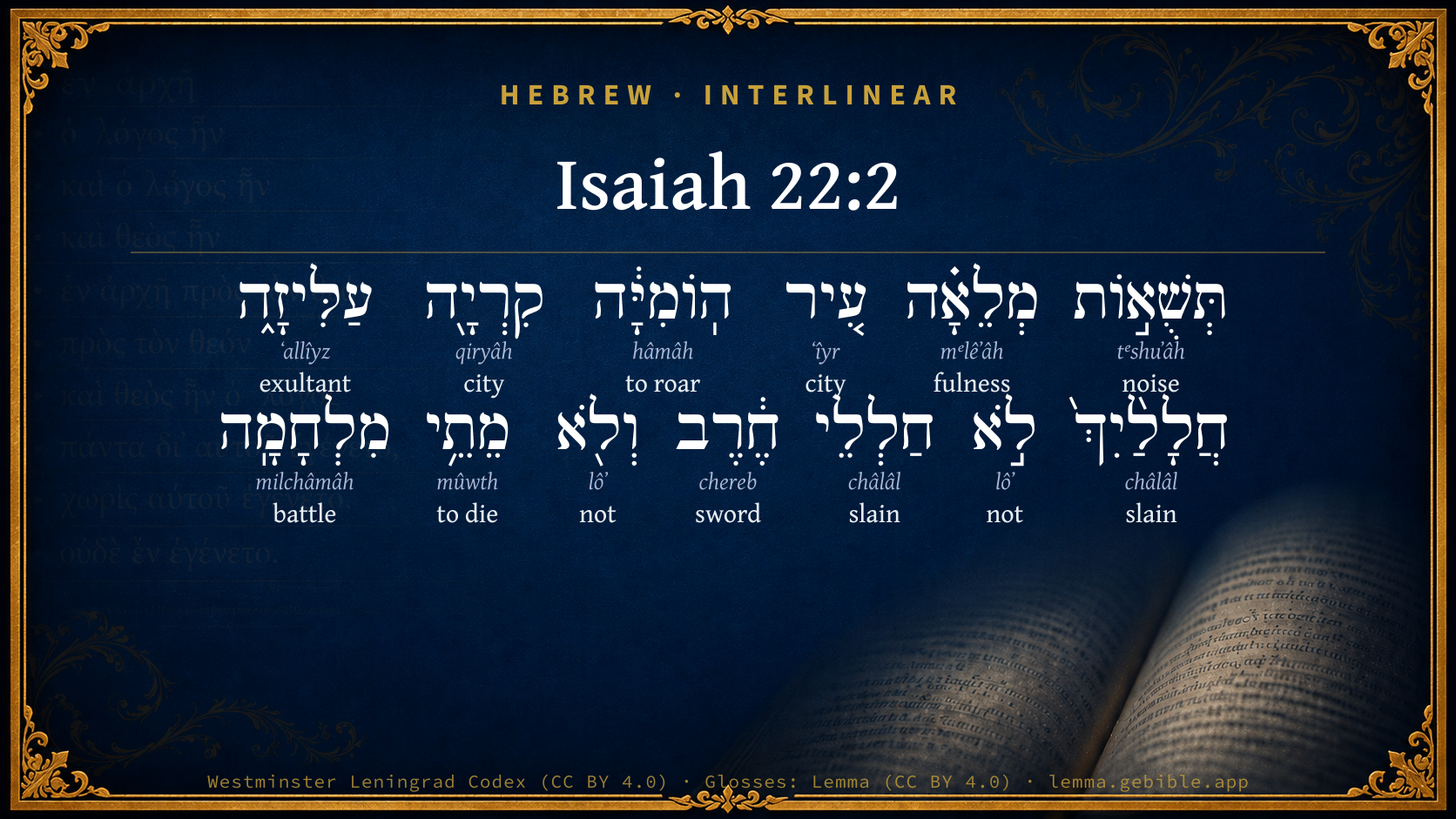
Hebrew (Westminster Leningrad Codex) Isaiah 22:2 appears in the Hebrew Old Testament. The text above is from the Westminster Leningrad Codex. Each word links to its Strong’s number, a concise gloss, and parsing drawn from the Open Scriptures Hebrew Bible morphology. Click any word for its full Brown-Driver-Briggs (BDB) entry.
Download image
Cite this verse

Isaiah 22:2 (World English Bible). Public Domain. Lemma interlinear Bible study tool, https://lemma.gebible.app/v/isaiah/22/2.

Show BibTeX & RIS
BibTeX
RIS
English Translation
You that are full of shouting, a tumultuous city, a joyous town; your slain are not slain with the sword, neither are they dead in battle.
World English Bible · Public Domain
Download a study sheet

One document with this verse’s original text, its word-by-word gloss line, the meaning frame, cross-references with their text, attributed commentary, and full source and license credits — printable, and it pastes into notes with its structure intact.

This verse Autodidact and up

Study sheet (.html) Plain text (.txt)

A passage Seminary Student

Up to 50 verses in one chapter. A passage sheet keeps up to 6 commentary sources and 12 cross-references per verse, in the order this page ranks them, and says so on the sheet whenever that leaves anything out. Ask for a single verse and you get the Autodidact verse sheet above.

Everything on this page stays free to read, with no account — the sheet is a download of what is already on screen, not access to it.

Want to remove ads? Support Godless Engineer
Compare translations 3

The same verse in 3 English versions, stacked beneath the original-language interlinear above. Click any original word for its lexicon entry.

Each is an independent rendering of the whole verse — the interlinear is not word-aligned to these translations.

Highlighted words mark where these versions differ — a whole-verse word diff, not a word-by-word alignment.

  • World English Bible Public Domain
    You that are full of shouting, a tumultuous city, a joyous town; your slain are not slain with the sword, neither are they dead in battle.
  • King James Version Public Domain
    Thou that art full of stirs, a tumultuous city, joyous city: thy slain men are not slain with the sword, nor dead in battle.
  • unfoldingWord Literal Text CC BY-SA 4.0
    Full noises, the clamoring city, the exultant town! Your slain not the slain of the sword and not ones having died in battle.

unfoldingWord Literal Text — © unfoldingWord, licensed CC BY-SA 4.0. Word-aligned USFM3 via Door43 (git.door43.org/unfoldingWord/en_ult).

Versions to compare (up to 4)

3 of 4 selected

Show all 18 translations

Every available English version of this verse, each an independent rendering of the whole verse.

  • World English Bible Public Domain
    You that are full of shouting, a tumultuous city, a joyous town; your slain are not slain with the sword, neither are they dead in battle.
  • Berean Standard Bible Public Domain
    O city of commotion, O town of revelry? Your slain did not die by the sword, nor were they killed in battle.
  • Majority Standard Bible Public Domain
    O city of commotion, O town of revelry? Your slain did not die by the sword, nor were they killed in battle.
  • King James Version Public Domain
    Thou that art full of stirs, a tumultuous city, joyous city: thy slain men are not slain with the sword, nor dead in battle.
  • American Standard Version (1901) Public Domain
    O thou that art full of shoutings, a tumultuous city, a joyous town; thy slain are not slain with the sword, neither are they dead in battle.
  • Revised Version (1885) Public Domain
    O thou that art full of shoutings, a tumultuous city, a joyous town; thy slain are not slain with the sword, neither are they dead in battle.
  • Geneva Bible (1599) Public Domain
    Thou that art full of noise, a citie full of brute, a ioyous citie: thy slaine men shall not bee slaine with sworde, nor die in battell.
  • Douay-Rheims (1899) Public Domain
    Full of clamour, a populous city, a joyous city: thy slain are not slain by the sword, nor dead in battle.
  • Young's Literal Translation Public Domain
    Full of stirs -- a noisy city -- an exulting city, Thy pierced are not pierced of the sword, Nor dead in battle.
  • Literal Standard Version CC BY-SA 4.0
    Full of stirs—a noisy city—an exulting city, || Your pierced are not pierced of the sword, || Nor dead in battle.
  • Unlocked Literal Bible CC BY-SA 4.0
    Is it so you may hear a city full of noises, a town full of revelry? Your dead were not killed with the sword, and they did not die in battle.
  • unfoldingWord Literal Text CC BY-SA 4.0
    Full noises, the clamoring city, the exultant town! Your slain not the slain of the sword and not ones having died in battle.
  • Darby Bible Public Domain
    Thou that wast full of stir, a town of tumult, a joyous city: thy slain men are not slain with the sword, nor dead in battle.
  • World Messianic Bible Public Domain
    You that are full of shouting, a tumultuous city, a joyous town, your slain are not slain with the sword, neither are they dead in battle.
  • Webster's Bible Public Domain
    Thou that art full of stirs, a tumultuous city, a joyous city: thy slain men are not slain with the sword, nor dead in battle.
  • Free Bible Version CC BY-SA 4.0
    There are shouts and commotion all over the city with people celebrating. Your dead weren't killed by the sword or in battle.
  • Bible in Basic English Public Domain
    You, who are full of loud voices, a town of outcries, given up to joy; your dead men have not been put to the sword, or come to their death in war.
  • JPS Tanakh (1917) Public Domain
    Thou that art full of uproar, a tumultuous city, a joyous town? Thy slain are not slain with the sword, nor dead in battle.

Literal Standard Version (2020), Covenant Press — licensed CC BY-SA 4.0. Text via the HelloAO Bible API (eBible.org). Unlocked Literal Bible (unfoldingWord) — licensed CC BY-SA 4.0. Text via the HelloAO Bible API (eBible.org). unfoldingWord Literal Text — © unfoldingWord, licensed CC BY-SA 4.0. Word-aligned USFM3 via Door43 (git.door43.org/unfoldingWord/en_ult). Free Bible Version, Dr. Jonathan Gallagher — licensed CC BY-SA 4.0. Text via the HelloAO Bible API (eBible.org).

Word by word

More ways to search: Search by grammar → Find every occurrence → Compare this word →

Practice this passage: Drill this verse → Learn its vocabulary →

תְּשֻׁא֣וֹת
tᵉshuʼâh
H8663
“noises”
Noun, Common, Feminine, Plural, Absolute
Part of Speech
Noun
Type
Common
Gender
Feminine
Number
Plural
State
Absolute
Full BDB Definition

Origin: from H7722

TWOT: 2339c

noise, clamour
  1. מְלֵאָ֗ה mᵉlêʼâh H4395 “fulness” Adjective, Adjective, Feminine, Singular, Absolute
  2. עִ֚יר ʻîyr H5892 “city” Noun, Common, Feminine, Singular, Absolute
  3. הֽוֹמִיָּ֔ה hâmâh H1993 “roaring” Verb, Qal, Participle Active, Feminine, Singular, Absolute
  4. קִרְיָ֖ה qiryâh H7151 “city” Noun, Common, Feminine, Singular, Absolute
  5. עַלִּיזָ֑ה ʻallîyz H5947 “exultant” Adjective, Adjective, Feminine, Singular, Absolute
  6. חֲלָלַ֨יִךְ֙ châlâl H2491 “slain · your” Adjective, Adjective, Masculine, Plural, Construct + Suffix, Personal, 2nd Person, Feminine, Singular
  7. לֹ֣א lôʼ H3808 “not” Particle, Negative
  8. חַלְלֵי châlâl H2491 “slain of” Adjective, Adjective, Masculine, Plural, Construct
  9. חֶ֔רֶב chereb H2719 “sword” Noun, Common, Feminine, Singular, Absolute
  10. וְלֹ֖א lôʼ H3808 “and · not” Conjunction + Particle, Negative
  11. מֵתֵ֥י mûwth H4191 “dying” Verb, Qal, Participle Active, Masculine, Plural, Construct
  12. מִלְחָמָֽה milchâmâh H4421 “battle” Noun, Common, Feminine, Singular, Absolute

About this verse

These counts appear in no published source. They are computed here, from the morphology-tagged text and Lemma’s own curated glosses. What Lemma adds →

13
words
11
distinct lemmas
Prophets
section

Notable vocabulary

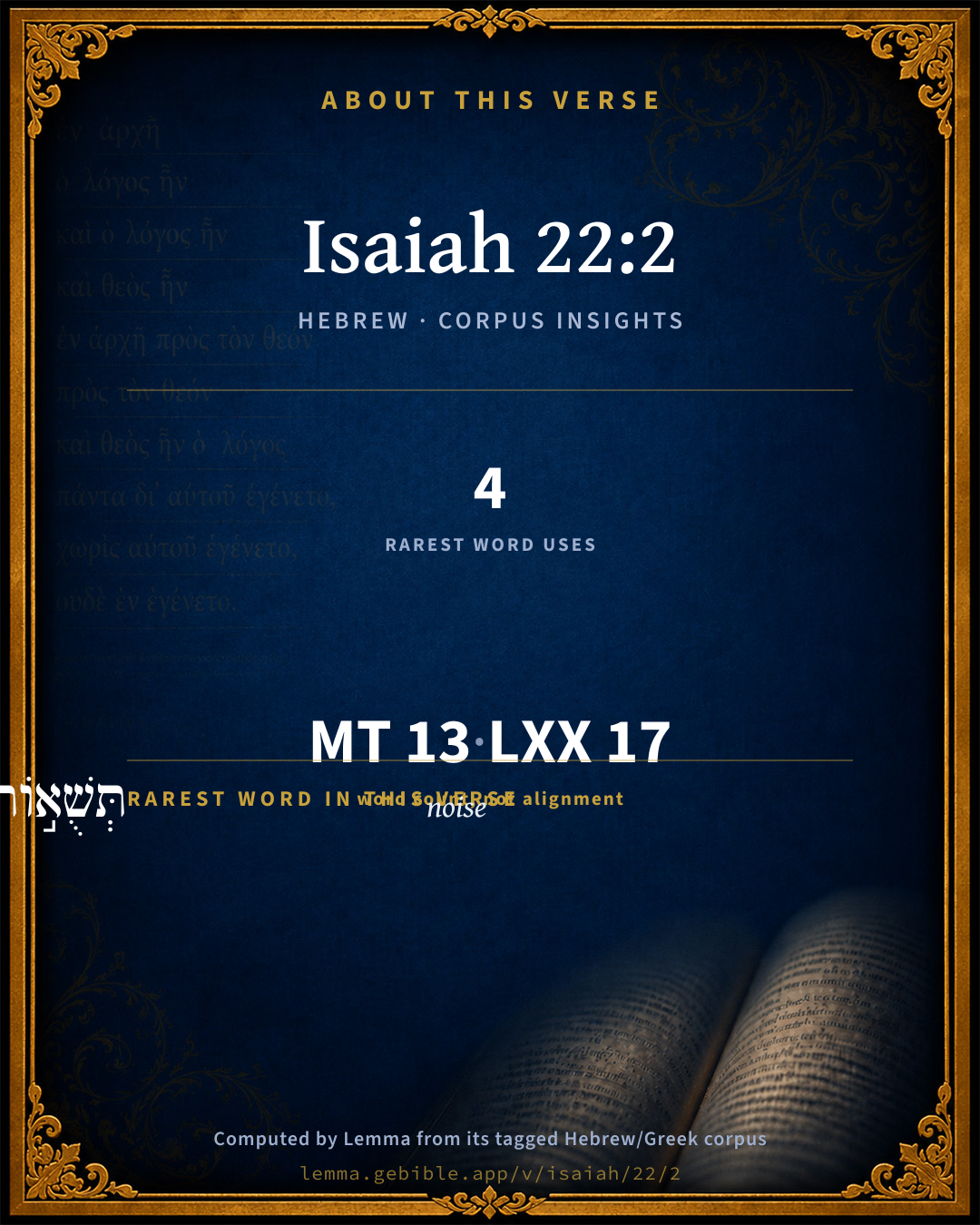
The rarest word here is תְּשֻׁא֣וֹת noise H8663 — appearing just 4 times in the whole Hebrew Bible.

Shared distinctive vocabulary

תְּשֻׁא֣וֹת noise H8663 occurs in 4 verses of the Hebrew Bible. Also found in:

Grammatical profile

  • 2 verbs
  • 5 nouns
  • 4 adjectives
  • 2 particles

Verb forms

  • הֽוֹמִיָּ֔ה Qal · Participle Active
  • מֵתֵ֥י Qal · Participle Active

Repetition

Words recur within this verse — often emphatic in Hebrew:

  • חֲלָלַ֨יִךְ֙ slain H2491 ×2
  • לֹ֣א not H3808 ×2

Hebrew & Septuagint length

In English translation the verse runs 26 words from the Hebrew and 24 from the Septuagint (LXX English) — closely comparable.

A rough comparison of the two English renderings, which tokenize alike — not a word-level alignment.

Word counts can differ between the Hebrew and the Greek without any difference in meaning — e.g. the Hebrew direct-object marker אֵת has no separate Greek word, and Greek often adds the article ὁ.

In the original languages it is 13 Hebrew tokens and 17 Greek tokens — but the two are counted differently (Hebrew bundles its prefixes and suffixes into one token; the Greek is in lemma form), so that isn’t a like-for-like length.

Cross-references

11

Topical passages linked to Isaiah 22:2 in the Treasury of Scripture Knowledge — connected by theme and wording, ordered by reader-vote popularity; previews shown in the World English Bible.

  • Isaiah 32:13 On the land of my people shall come up thorns and briers; yes, on all the houses of joy in the joyous city.
  • Isaiah 23:7 Is this your joyous [city], whose antiquity is of ancient days, whose feet carried her afar off to sojourn?
  • Jeremiah 14:18 If I go forth into the field, then, behold, the slain with the sword! and if I enter into the city, then, behold, those who are sick with famine! for both the prophet and the priest go about in the land, and have no knowledge.
  • Lamentations 2:20 Look, Yahweh, and see to whom you have done thus! Shall the women eat their fruit, the children that are dandled in the hands? Shall the priest and the prophet be killed in the sanctuary of the Lord?
  • Isaiah 22:12–13 In that day did the Lord, Yahweh of Hosts, call to weeping, and to mourning, and to baldness, and to girding with sackcloth:
  • Isaiah 37:33 Therefore thus says Yahweh concerning the king of Assyria, He shall not come to this city, nor shoot an arrow there, neither shall he come before it with shield, nor cast up a mound against it.
  • Isaiah 37:36 The angel of Yahweh went forth, and struck in the camp of the Assyrians one hundred and eighty-five thousand; and when men arose early in the morning, behold, these were all dead bodies.
  • Jeremiah 38:2 Thus says Yahweh, He who remains in this city shall die by the sword, by the famine, and by the pestilence; but he who goes forth to the Chaldeans shall live, and his life shall be to him for a prey, and he shall live.
  • Jeremiah 52:6 In the fourth month, in the ninth day of the month, the famine was sore in the city, so that there was no bread for the people of the land.
  • Lamentations 4:9–10 Those who are killed with the sword are better than those who are killed with hunger; For these pine away, stricken through, for want of the fruits of the field.
  • Amos 6:3–6 Those who put far away the evil day, And cause the seat of violence to come near;

Cross-references courtesy of OpenBible.info (CC BY 4.0).

Hebrew and Greek witnesses Masoretic Hebrew ↔ Greek Septuagint

The same verse in the two great witnesses to the Old Testament, shown verse-for-verse.

These are two independent witnesses, not word-aligned to each other, and the Septuagint is shown in lemma (dictionary) form.

Hebrew Isaiah 22:2 Masoretic · Westminster Leningrad Codex

תְּשֻׁא֣וֹת מְלֵאָ֗ה עִ֚יר הֽוֹמִיָּ֔ה קִרְיָ֖ה עַלִּיזָ֑ה חֲלָלַ֨יִךְ֙ לֹ֣א חַלְלֵי חֶ֔רֶב וְלֹ֖א מֵתֵ֥י מִלְחָמָֽה

You that are full of shouting, a tumultuous city, a joyous town; your slain are not slain with the sword, neither are they dead in battle.

World English Bible · Public Domain

Greek LXX Isaiah 22:2 Septuagint · lemma form

μάταιος ἐνπίμπλημι ὁ πόλις βοάω ὁ τραυματίας σύ οὐ τραυματίας μάχαιρα οὐδέ ὁ νεκρός σύ νεκρός πόλεμος

The city is filled with shouting men: your slain are not slain with swords, nor are your dead those who have died in battle.

LXX2012 (modern English Septuagint) · Public Domain

Hebrew: Westminster Leningrad Codex (CC BY 4.0). Greek: Septuagint (public domain); English from LXX2012 (modern English Septuagint) (Public Domain). How the Septuagint differs from the Hebrew →

Targum (Aramaic paraphrase)

1

The Targum is the ancient Jewish Aramaic paraphrase of the Hebrew Scriptures — an interpretive translation, not the Hebrew text itself. Onkelos (literal) and Pseudo-Jonathan (expansive) render the Torah, and Jonathan the Prophets. Coverage is partial: where no permissively-licensed English translation exists for a verse, only the Aramaic is shown. This is verse-level text, not a word-by-word alignment to the Hebrew.

  1. Targum Jonathan Prophets (Joshua–Malachi)
    מִן קֳדָם אִתְרְגוּשָׁא דְאִתְמְלִיאַת קַרְתָּא מְשַׁבַּחְתָּא כְּרַכָּא חֲדָאָה קְטִילַיִךְ לָא אִתְקְטִילוּ בְחַרְבָּא וְאַף בִּקְרָבָא לָא מִיתוּ:

    On account of the tumult wherewith the praiseworthy, the fortified, the joyous city is filled. Thy slain were not slain by the sword, neither did they die in battle.

    Targum Jonathan — Aramaic: “Mikraot Gedolot” (public domain). English: “Sefaria Community Translation” (CC0 1.0 (public-domain dedication)); “London "Chaldee Paraphrase," 1871” (public domain). Text via Sefaria.

Commentary

Notes on Isaiah 22:2 from classic Christian and Jewish commentators (each source and its license shown beneath its notes). The classic Christian expositions comment on the surrounding passage and are grouped to its opening verse, so a note may address several verses; the Jewish commentaries on the Tanakh (Rashi and others) are per-verse, so they appear only where the commentator wrote on this verse.

Lemma curates 59 commentaries, every one of them public domain or Creative Commons licensed, each selected and text-cleaned for this edition rather than reprinted as found. About our sources →

Trapp's Complete Commentary

John Trapp

Isa 22:2 Thou that art full of stirs, a tumultuous city, a joyous city: thy slain [men are] not slain with the sword, nor dead in battle.

Ver. 2. Thou that art full of stirs.] Clamoribus fragosis, {a} How soon hast thou changed thy cheer and thy note? thy joyful acclamations into doleful exclamations?

Thy slain men are not slain with the sword.] Sed mortui ex anxietate; but are foreslain with fear, or, as others, by the visible vengeance of God, as Titus acknowledged at the last sack of that city, {b} and as the poet sang of Troy -

“ Non tibi Tindaridis facies invisa Lacaenae,

Culpatusve Paris; verum inclcmcntia divum

Has evertit opes. ” - Virgil.

{a} Strepera [?Strepitus.]

{b} Joseph., lib. vii. cap. 16.

John Trapp, A Commentary or Exposition upon All the Books of the Old and New Testament (1647–1656) — public domain. Text from a community e-Sword module.

Tyndale Open Study Notes

Tyndale Open Resources

22:2 The reveling city was full of feasting and drinking (22:13; see 23:7; 32:13), probably in response to the Assyrian retreat. Now a new threat approaches—the Babylonian siege (586 BC). • The people died not in battle but by famine and disease. Siege warfare left the inhabitants of the city cut off from needed agricultural resources and in a terrible sanitation and health crisis.

Tyndale Open Study Notes — © Tyndale Open Resources, licensed CC BY-SA 4.0. Text via the HelloAO Bible API.

Geneva Bible (1599)

Geneva Bible translators

Which was wont to be full of people and joy.

But for hunger.

Geneva Bible (1599) marginal notes — public domain. Text via Bolls.life.

Jamieson, Fausset & Brown

Robert Jamieson, A. R. Fausset & David Brown

art--rather, "wert"; for it could not now be said to be "a joyous city" (Isa 32:13). The cause of their joy (Isa 22:13) may have been because Sennacherib had accepted Hezekiah's offer to renew the payment of tribute, and they were glad to have peace on any terms, however humiliating (Kg2 18:14-16), or on account of the alliance with Egypt. If the reference be to Zedekiah's time, the joy and feasting are not inapplicable, for this recklessness was a general characteristic of the unbelieving Jews (Isa 56:12).

not slain with the sword--but with the famine and pestilence about to be caused by the coming siege (Lam 4:9). MAURER refers this to the plague by which he thinks Sennacherib's army was destroyed, and Hezekiah was made sick (Isa 37:36; Isa 38:1). But there is no authority for supposing that the Jews in the city suffered such extremities of plague at this time, when God destroyed their foes. BARNES refers it to those slain in flight, not in open honorable "battle"; Isa 22:3 favors this.

Jamieson, Fausset & Brown — Commentary Critical and Explanatory on the Whole Bible (1871) — public domain (CC PDM 1.0). Text via the HelloAO Bible API.

Ellicott's Commentary for English Readers

(2) A joyous city . . .—It would seem from Isa_32:13 as if this was the characteristic on which Jerusalem, like Athens afterwards (Thucyd. ii. 40), specially prided itself.

Thy slain men are not slain with the sword . . .—The words imply something like a reproach of cowardice. Those who had perished had not died fighting bravely in battle, but by the pestilence which then, as at all times, was prevalent in the crowded streets of a besieged city.

A Bible Commentary for English Readers, edited by Charles John Ellicott (1878–1897) — public domain. Text from a community e-Sword module.

The Cambridge Bible for Schools and Colleges

gen. ed. J. J. S. Perowne

2. full of stirs] R.V. full of shoutings. joyous city] jubilant city, as ch. Isa_32:13. A festive disposition seems to have characterised the inhabitants of Jerusalem in Isaiah’s time; cf. also ch. Isa_5:14. That their gladness on this occasion was “the forced gaiety of despair” is indicated by nothing in the passage; it was due to the sense of relief from imminent peril.

thy slain … battle] Jerusalem’s warriors have not met a glorious death on the battle-field, but have been taken prisoners and ignominiously executed (see Isa_22:3). Some critics, however, take this clause and the next verse as the description of a vision which the prophet has of the future. On that view, which is plausible enough, it would be more natural to think of deaths from famine and pestilence (Lam_4:9).

The Cambridge Bible for Schools and Colleges (gen. ed. J. J. S. Perowne; Cambridge University Press, 1878–1918) — public domain. Text from a community e-Sword module.

John Gill's Exposition

Thou art full of stirs,.... Or, "wast full of stirs"; through the multitude of people walking about in it, and the vast hurry of business done in it; but now all hush and quiet, the streets clear of people, and the shops shut up, and all got up to the housetops for shelter; or, "full of noises" (l), as a populous trading city is. The word signifies shoutings and acclamations, and is used for joyful ones, Zac 4:7 and may be so taken here, and may design such as were expressed at their festivals, and on other occasions; unless it is to be understood of doleful ones, on account of the invasion and siege:

a tumultuous city; through the throng of people, and the noise of thorn:

a joyous city; some on business, others on pleasure; some hurrying from place to place about their trade and commerce, and others amusing themselves with pastime, mirth, and jollity; which is commonly the case of populous cities in prosperity. This had been Jerusalem's case, but now it was otherwise:

thy slain men are not slain with the sword, nor dead in battle; for Sennacherib never entered into it, nor put any of its inhabitants to the sword; nor was there any battle fought between them, nor was he suffered so much as to shoot an arrow into it, Isa 37:33 wherefore those that died in it died either through the fright and consternation they were put into, or through the famine his army had caused, in laying the country round about them desolate.

(l) "plena strepitibus", Munster; "tumultuationibus", Montanus, Junius & Tremellius; "fragoribus", Piscator.

John Gill's Exposition of the Whole Bible (1746–1763) — public domain (CC PDM 1.0). Text via the HelloAO Bible API.

Albert Barnes' Notes on the Bible

Thou that art full of stirs - Of tumult, of commotion, of alarm. Or, perhaps, this whole description may mean that it was formerly a city distinguished for the hum of business, or for pleasure; a busy, active, enterprising city. The Hebrew will bear this, but I prefer the former interpretation, as indicating mingled alarm and consternation, and at the same time a disposition to engage in riot and revelry.

A joyous city - A city exulting; rejoicing; given to pleasure, and to riot. (See the description of Nineveh in Zep 2:15) It is remarkable that the prophet has blended these things together, and has spoken of the tumult, the alarm, and the rejoicing, in the same breath. ‘This may be either because it was the “general” character of the city thus to be full of revelry, dissipation, and riot, and he designates it by that which “usually and appropriately” described it; or because it was, even then, notwithstanding the general consternation and alarm, given up to revelry, and the rather on account of the approaching danger. So he describes the city in Isa 22:12-13.

Thy slain men are not slain with the sword - The words ‘thy slain’ here (חלליך chălâlayikā), seem to be intended to be applied to the soldiers on whom the defense of the city rested; and to mean those who had not died an honorable death “in” the city in its defense, but who had “fled” in consternation, and who were either taken in their flight and made captive, or who were pursued and put to death. To be slain with the sword here is equivalent to being slain in an honorable engagement with the enemy. But here the prophet speaks of their consternation, their cowardice, and of their being partly trampled down in their hasty and ignominious flight by each other; and partly of the fugitives being overtaken by the enemy, and thus put to death.

Albert Barnes' Notes on the Bible (1834–1885) — public domain. Text from a community e-Sword/MySword module.

Haydock's Catholic Bible Commentary

Battle. He taxes the king with cowardice.

George Leo Haydock (1774–1849), Haydock's Catholic Family Bible and Commentary, 1859 edition — public domain. Excludes Psalms (Douay-Rheims chapter numbering differs from Protestant) and Deuterocanonical books (Catholic canon only).

Matthew Poole's English Annotations

Thou art full of stirs; or, thou who wast full of stirs, or noises, to wit, of joyful shouts, as the following words limit it, and as this word is used, Zec 4:7, though elsewhere it be taken for doleful cries.

Tumultuous; or, streperous; full of noise and clamour, through revelling and jollity. See Pro 20:1; Zec 9:15.

Not slain with the sword, nor dead in battle, but either by famine or pestilence in the siege, as many died, Jer 14:18; 38:2, or in their flight, as others were; both which were inglorious kinds of death.

Matthew Poole's English Annotations on the Holy Bible (1683–1685) — public domain. Text from a community e-Sword/MySword module.

Whedon's Commentary on the Bible

Daniel D. Whedon

2. Thy slain men — Or, men destined to perish, as the prophet sees a dire siege at hand.

Not slain with the sword — Not to have this honour. They will die inside, not in battle; or, they will die as captives, far away.

Daniel D. Whedon (gen. ed.), Commentary on the Old and New Testaments (1874–1909) — public domain. Text from a community e-Sword module.

The Pulpit Commentary

A joyous city (comp. ver. 13). Thy slain men are not slain with the sword. It is a blockade rather than a siege. Men die, not of wounds, but of privations. (Lam_4:9) Sennacherib himself says, "Hezekiah, like a caged bird, within Jerusalem, his royal city, I confined; towers round about him I raised; and the exit of the great gate of his city I shut" (G. Smith, "Eponym Canon," p. 135, II 15-18).

The moral influence of pestilence.

"Thy slain men are not slain with the sword." "The words imply something like a reproach of cowardice. Those who had perished had not died fighting bravely in battle, but by the pestilence which then, as at all times, was prevalent in the crowded streets of a besieged city? The law of epidemic disease is found to be this the conditions which are peculiarly favorable to the development of vice and immorality are exactly the conditions most favorable to epidemic disease. Illustrative references may be made to overcrowding in houses, and to want of cleanliness, and neglect of adequate sanitary precautions. From the picture given in the passage now before us we gather the following sentences.

I PESTILENCE CREATES FRIGHT. And this prepares the way for the march of the pestilence; partly because those in whom are the seeds of disease go to other places, carrying the evil with them; and partly because fear lowers vitality, and so limits the power of resistance to disease. Fright in time of pestilence was painfully exhibited in the recent visit of the cholera to the towns in the south of France.

II PESTILENCE BREAKS UP SOCIAL LIFE. By the flight, from the infected neighborhood, of all whose means permit. By the disturbance of commerce, business, education, etc. Worse than this, danger of life nourishes self-interest, so that men are ready to sacrifice others to save themselves. At such times the worst of humanity is revealed in the many, and the best of humanity in the few.

III PESTILENCE OFTEN LEADS TO RECKLESSNESS. As was most painfully seen in the time of the great plague of London, and as is indicated by Isaiah in the text. Despair flings the reins on the neck of lust.

IV PESTILENCE MAKES HEROES. Madame de Genlis tells of an incident in connection with the peste at Marseilles. The true nature of the disease was unknown, and could only be discovered by a post-mortem examination, but that was certain death to the operator. All the doctors drew back. Then a young surgeon, named Guyon, of great celebrity in his profession, devoted himself for the safety of his country. He made the necessary examination, recorded his observations, made his suggestions, placed the papers in a vase Of vinegar, retired to the lazaretto, and in twelve hours was dead a hero made by the pestilence. R.T.

The Pulpit Commentary (1880–1919), ed. H.D.M. Spence-Jones & Joseph S. Exell — public domain. Text from a community e-Sword module.

John Wesley's Explanatory Notes

Noises - Of joyful shouts. Tumultuous - Through revelling and jollity. Battle - But either by famine or pestilence in the siege, or in their flight.

John Wesley, Explanatory Notes Upon the Whole Bible (1754–1765) — public domain. Text via the GEBible commentary corpus.

J. A. Alexander on Isaiah

Joseph Addison Alexander

“Full of stirs, a noisy town, a joyous city, thy slain are not slain with the sword nor dead in battle.” The first clause is commonly explained by the older writers as descriptive of the commotion and alarm occasioned by the enemy’s approach. The latest writers are agreed in making it descriptive of the opposite condition of joyous excitement, frivolous gayety, and reckless indifference, described in v. 13. The expression ‘thy slain are not slain with the sword’ cannot mean that none were slain, but necessarily implies mortality of another kind. The allusion is supposed by some to be to pestilence, by others to famine, such as prevailed in the siege of Jerusalem by Nebuchadnezzar and also by the Romans. As neither is specified, the words may be more generally understood as describing all kinds of mortality incident to sieges, excepting that of actual warfare.

Joseph Addison Alexander, The Prophecies of Isaiah (1846–1847; New York: Scribner, 1870–1878) — public domain. Text from a community e-Sword module.

Rashi

Rabbi Shlomo Yitzchaki (Rashi)

full of clamor A city that was full of clamor, the voice of many people, tumultuous and happy, now, what ails you that you mourn?

your fallen have not fallen by the sword It would have been better had they fallen by the sword than now that they have perished by hunger.

Rashi on the Tanakh — English translations: “The Judaica Press complete Tanach with Rashi, translated by A. J. Rosenberg” (CC BY 4.0); “Pentateuch with Rashi's commentary by M. Rosenbaum and A.M. Silbermann, 1929-1934” (public domain); “The Metsudah Tanach series, Lakewood, N.J” (CC BY 4.0); and “The Book of Joshua, Metsudah Publications, 1997” (CC BY 4.0). Text via Sefaria.

Ibn Ezra

Rabbi Abraham ibn Ezra

תשואות Stirs. Root שאה to stir; comp. שאון noise (13:4).

עליזה Joyous.—Jerusalem had been full of men, but they were smitten with captivity and famine, and could not fight.

Ibn Ezra on the Tanakh — English translations: “Sefaria Community Translation” (CC0 1.0 (public-domain dedication)); “Yalkut, Sifsei Chachomim Chumash, Metsudah Publications, 2009” (CC BY 4.0); and “Commentary of Ibn Ezra on Isaiah - trans. by M. Friedlander, 1873” (public domain). Text via Sefaria.

Lesson kit

Teaching starters — assembled from the data on this page, not authored interpretation. Every prompt links to the verse data it draws on. Edit before teaching.

Isaiah, in the Prophets, opens this verse with 13 words (11 distinct Hebrew lemmas). Its most distinctive word is tᵉshuʼâh (“noise”). A historical commentator’s framing appears above. Read the whole chapter for the surrounding context.

Discussion questions

  1. The word tᵉshuʼâh carries the sense “noise.” How does it shape the verse?
  2. How does Job 36:29, which shares the word «noise», read alongside this verse?
  3. What does the repetition of “slain” (2× in this one verse) do in this verse?
  4. These translations render this verse differently. What is at stake in choosing one wording over another?
  5. «הֽוֹמִיָּ֔ה» is a Qal Participle Active verb. How does that grammatical form shape the action described?
  6. Compare how Trapp's Complete Commentary and Tyndale Open Study Notes read this verse. Where do they agree or differ?

Things to notice

Reading settings

Reading text

Shown beneath each verse's original-language words.

Old Testament
Old Testament edition

Read the OT as the Masoretic Hebrew (MT) or the Greek Septuagint (LXX).

English shown for the Greek Septuagint (in the Hebrew ↔ Greek comparison).

Comparing translations? Open the Compare panel on any verse page to stack up to four side by side.