
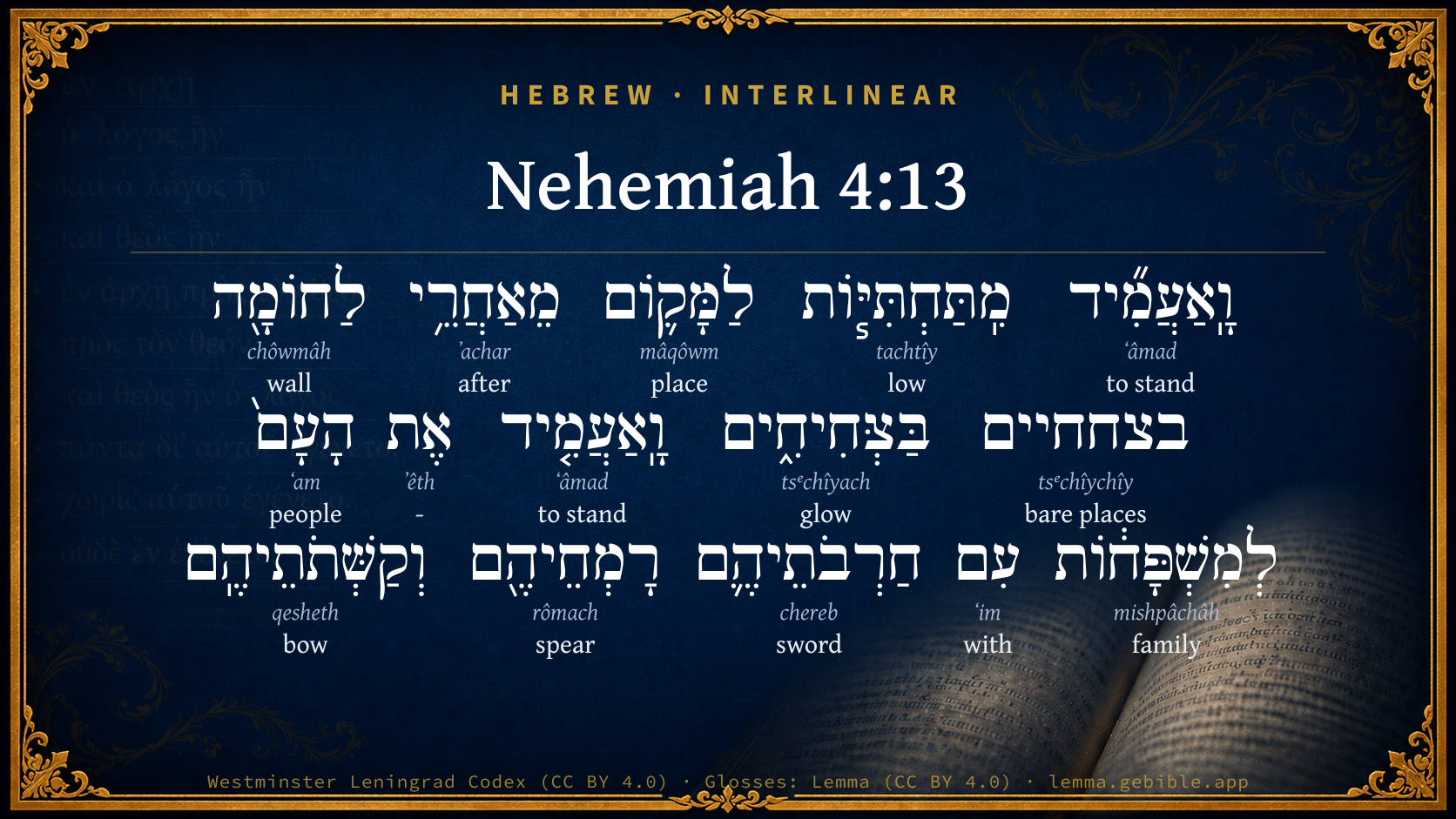
Nehemiah 4:13

Hebrew (Westminster Leningrad Codex) Nehemiah 4:13 appears in the Hebrew Old Testament. The text above is from the Westminster Leningrad Codex. Each word links to its Strong’s number, a concise gloss, and parsing drawn from the Open Scriptures Hebrew Bible morphology. Click any word for its full Brown-Driver-Briggs (BDB) entry.
Download image
Cite this verse

Nehemiah 4:13 (World English Bible). Public Domain. Lemma interlinear Bible study tool, https://lemma.gebible.app/v/nehemiah/4/13.

Show BibTeX & RIS
BibTeX
RIS
English Translation
Therefore set I in the lowest parts of the space behind the wall, in the open places, I set [there] the people after their families with their swords, their spears, and their bows.
World English Bible · Public Domain
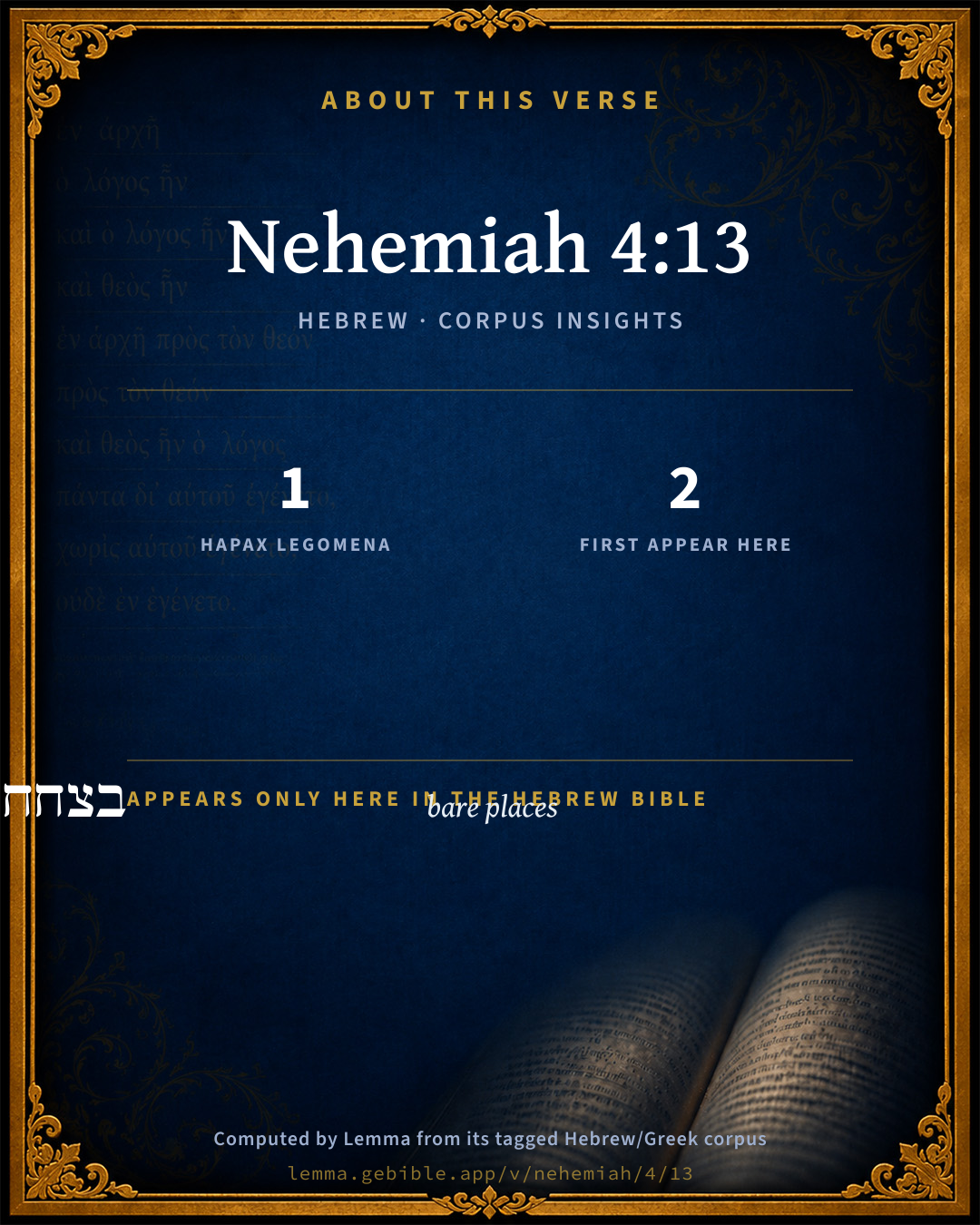
Highlights
  • 1 hapax legomenon — only here in the Hebrew Bible
  • 2 first appearances in the Hebrew Bible
Full analysis ↓
Download a study sheet

One document with this verse’s original text, its word-by-word gloss line, the meaning frame, cross-references with their text, attributed commentary, and full source and license credits — printable, and it pastes into notes with its structure intact.

This verse Autodidact and up

Study sheet (.html) Plain text (.txt)

A passage Seminary Student

Up to 50 verses in one chapter. A passage sheet keeps up to 6 commentary sources and 12 cross-references per verse, in the order this page ranks them, and says so on the sheet whenever that leaves anything out. Ask for a single verse and you get the Autodidact verse sheet above.

Everything on this page stays free to read, with no account — the sheet is a download of what is already on screen, not access to it.

Want to remove ads? Support Godless Engineer
Compare translations 3

The same verse in 3 English versions, stacked beneath the original-language interlinear above. Click any original word for its lexicon entry.

Each is an independent rendering of the whole verse — the interlinear is not word-aligned to these translations.

Highlighted words mark where these versions differ — a whole-verse word diff, not a word-by-word alignment.

  • World English Bible Public Domain
    Therefore set I in the lowest parts of the space behind the wall, in the open places, I set [there] the people after their families with their swords, their spears, and their bows.
  • King James Version Public Domain
    Therefore set I in the lower places behind the wall, and on the higher places, I even set the people after their families with their swords, their spears, and their bows.
  • unfoldingWord Literal Text CC BY-SA 4.0
    And I stationed from the lowest of places behind the wall, in the bare places; and I stationed the people by families with their swords, their spears, and their bows.

unfoldingWord Literal Text — © unfoldingWord, licensed CC BY-SA 4.0. Word-aligned USFM3 via Door43 (git.door43.org/unfoldingWord/en_ult).

Versions to compare (up to 4)

3 of 4 selected

Show all 18 translations

Every available English version of this verse, each an independent rendering of the whole verse.

  • World English Bible Public Domain
    Therefore set I in the lowest parts of the space behind the wall, in the open places, I set [there] the people after their families with their swords, their spears, and their bows.
  • Berean Standard Bible Public Domain
    So I stationed men behind the lowest sections of the wall, at the vulnerable areas. I stationed them by families with their swords, spears, and bows.
  • Majority Standard Bible Public Domain
    So I stationed men behind the lowest sections of the wall, at the vulnerable areas. I stationed them by families with their swords, spears, and bows.
  • King James Version Public Domain
    Therefore set I in the lower places behind the wall, and on the higher places, I even set the people after their families with their swords, their spears, and their bows.
  • American Standard Version (1901) Public Domain
    Therefore set I in the lowest parts of the space behind the wall, in the open places, I set `there' the people after their families with their swords, their spears, and their bows.
  • Revised Version (1885) Public Domain
    Therefore set I in the lowest parts of the space behind the wall, In the open places, I even set the people after their families with their swords, their spears, and their bows.
  • Geneva Bible (1599) Public Domain
    Therefore set I in the lower places behind the wall vpon the toppes of the stones, and placed the people by their families, with their swordes, their speares and their bowes.
  • Douay-Rheims (1899) Public Domain
    I set the people in the place behind the wall round about in order, with their swords, and spears, and bows.
  • Young's Literal Translation Public Domain
    And I appoint at the lowest of the places, at the back of the wall, in the clear places, yea, I appoint the people, by their families, with their swords, their spears, and their bows.
  • Literal Standard Version CC BY-SA 4.0
    And I appoint at the lowest of the places, at the back of the wall, in the clear places, indeed, I appoint the people, by their families, with their swords, their spears, and their bows.
  • Unlocked Literal Bible CC BY-SA 4.0
    So I positioned people in the lowest parts of the wall in the exposed areas. I positioned each family with their swords, spears, and bows.
  • unfoldingWord Literal Text CC BY-SA 4.0
    And I stationed from the lowest of places behind the wall, in the bare places; and I stationed the people by families with their swords, their spears, and their bows.
  • Darby Bible Public Domain
    I set in the lower places behind the wall in exposed places, I even set the people, according to their families, with their swords, their spears and their bows.
  • World Messianic Bible Public Domain
    Therefore I set guards in the lowest parts of the space behind the wall, in the open places. I set the people by family groups with their swords, their spears, and their bows.
  • Webster's Bible Public Domain
    Therefore I set in the lower places behind the wall, and on the higher places, I even set the people after their families with their swords, their spears, and their bows.
  • Free Bible Version CC BY-SA 4.0
    So I positioned defenders behind the lowest, most vulnerable sections, of the wall. I had them take their positions by families, armed with their swords, spears, and bows.
  • Bible in Basic English Public Domain
    So in the lowest part of the space at the back of the walls, in the open places, I put the people by families, with their swords, their spears, and their bows.
  • JPS Tanakh (1917) Public Domain
    (4-7) Therefore set I in the lowest parts of the space behind the wall, in the open places, I even set the people after their families with their swords, their spears, and their bows.

Literal Standard Version (2020), Covenant Press — licensed CC BY-SA 4.0. Text via the HelloAO Bible API (eBible.org). Unlocked Literal Bible (unfoldingWord) — licensed CC BY-SA 4.0. Text via the HelloAO Bible API (eBible.org). unfoldingWord Literal Text — © unfoldingWord, licensed CC BY-SA 4.0. Word-aligned USFM3 via Door43 (git.door43.org/unfoldingWord/en_ult). Free Bible Version, Dr. Jonathan Gallagher — licensed CC BY-SA 4.0. Text via the HelloAO Bible API (eBible.org).

Word by word

More ways to search: Search by grammar → Find every occurrence → Compare this word →

Practice this passage: Drill this verse → Learn its vocabulary →

בצחחיים
tsᵉchîychîy
H6708
“in/at the · bare places”
Preposition, Determined + Noun, Common, Masculine, Plural, Absolute
Part of Speech
Preposition + Noun
Type
Common
Gender
Masculine
Number
Plural
State
Absolute
Full BDB Definition

Origin: from H6706

TWOT: 1903b

shining or glaring surface, bare places
  1. וָֽאַעֲמִ֞יד ʻâmad H5975 “and · to stand” Conjunction + Verb, Hiphil, Sequential Imperfect, 1st Person, Common, Singular
  2. מִֽתַּחְתִּיּ֧וֹת tachtîy H8482 “from · low” Preposition + Adjective, Adjective, Feminine, Plural, Absolute
  3. לַמָּק֛וֹם mâqôwm H4725 “to/for the · place” Preposition, Determined + Noun, Common, Masculine, Singular, Absolute
  4. מֵאַחֲרֵ֥י ʼachar H310 “from · after” Preposition + Preposition
  5. לַחוֹמָ֖ה chôwmâh H2346 “to/for the · wall” Preposition, Determined + Noun, Common, Feminine, Singular, Absolute
  6. בַּצְּחִיחִ֑ים tsᵉchîyach H6706 “in/at the · bare places” Preposition, Determined + Noun, Common, Masculine, Plural, Absolute
  7. וָֽאַעֲמִ֤יד ʻâmad H5975 “and · to stand” Conjunction + Verb, Hiphil, Sequential Imperfect, 1st Person, Common, Singular
  8. אֶת ʼêth H853 “-” Particle, Direct Object
  9. הָעָם֙ ʻam H5971 “the · people” Particle, Definite Article + Noun, Common, Masculine, Singular, Absolute
  10. לְמִשְׁפָּח֔וֹת mishpâchâh H4940 “to/for · families” Preposition + Noun, Common, Feminine, Plural, Absolute
  11. עִם ʻim H5973 “with” Preposition
  12. חַרְבֹתֵיהֶ֛ם chereb H2719 “swords · their” Noun, Common, Feminine, Plural, Construct + Suffix, Personal, 3rd Person, Masculine, Plural
  13. רָמְחֵיהֶ֖ם rômach H7420 “spears · their” Noun, Common, Masculine, Plural, Construct + Suffix, Personal, 3rd Person, Masculine, Plural
  14. וְקַשְּׁתֹתֵיהֶֽם qesheth H7198 “and · bows · their” Conjunction + Noun, Common, Feminine, Plural, Construct + Suffix, Personal, 3rd Person, Masculine, Plural

About this verse

These counts appear in no published source. They are computed here, from the morphology-tagged text and Lemma’s own curated glosses. What Lemma adds →

15
words
14
distinct lemmas
Historical
section

Notable vocabulary

1 hapax legomenon — a word that appears only here in the entire Hebrew Bible:

  • בצחחיים bare places H6708

First appearance in Scripture

These words make their first canonical appearance in the Hebrew Bible here:

  • בצחחיים bare places H6708
  • בַּצְּחִיחִ֑ים glow H6706

Shared distinctive vocabulary

בַּצְּחִיחִ֑ים glow H6706 occurs in 5 verses of the Hebrew Bible. Also found in:

Grammatical profile

  • 2 verbs
  • 9 nouns
  • 1 adjective
  • 2 prepositions
  • 1 particle

Verb forms

  • וָֽאַעֲמִ֞יד Hiphil · Sequential Imperfect
  • וָֽאַעֲמִ֤יד Hiphil · Sequential Imperfect

Repetition

A word recurs within this verse — often emphatic in Hebrew:

  • וָֽאַעֲמִ֞יד to stand H5975 ×2

Cross-references

8

Topical passages linked to Nehemiah 4:13 in the Treasury of Scripture Knowledge — connected by theme and wording, ordered by reader-vote popularity; previews shown in the World English Bible.

  • Nehemiah 4:17–18 They all built the wall and those who bore burdens loaded themselves; everyone with one of his hands worked in the work, and with the other held his weapon;
  • Ephesians 6:11–20 Put on the whole armor of God, that you may be able to stand against the wiles of the devil.
  • Genesis 32:13–20 He lodged there that night, and took from that which he had with him, a present for Esau, his brother:
  • 2 Chronicles 32:2–8 When Hezekiah saw that Sennacherib was come, and that he was purposed to fight against Jerusalem,
  • Psalms 112:5 It is well with the man who deals graciously and lends. He will maintain his cause in judgment.
  • Song of Solomon 3:7–8 Behold, it is Solomon's carriage! Sixty mighty men are around it, Of the mighty men of Israel.
  • Matthew 10:16 "Behold, I send you out as sheep in the midst of wolves. Therefore be wise as serpents, and harmless as doves.
  • 1 Corinthians 14:20 Brothers, don't be children in thoughts, yet in malice be babies, but in thoughts be mature.

Cross-references courtesy of OpenBible.info (CC BY 4.0).

Hebrew and Greek witnesses Masoretic Hebrew ↔ Greek Septuagint

The same verse in the two great witnesses to the Old Testament, shown verse-for-verse.

These are two independent witnesses, not word-aligned to each other, and the Septuagint is shown in lemma (dictionary) form.

Hebrew Nehemiah 4:13 Masoretic · Westminster Leningrad Codex

וָֽאַעֲמִ֞יד מִֽתַּחְתִּיּ֧וֹת לַמָּק֛וֹם מֵאַחֲרֵ֥י לַחוֹמָ֖ה בצחחיים בַּצְּחִיחִ֑ים וָֽאַעֲמִ֤יד אֶת הָעָם֙ לְמִשְׁפָּח֔וֹת עִם חַרְבֹתֵיהֶ֛ם רָמְחֵיהֶ֖ם וְקַשְּׁתֹתֵיהֶֽם

Therefore set I in the lowest parts of the space behind the wall, in the open places, I set [there] the people after their families with their swords, their spears, and their bows.

World English Bible · Public Domain

Greek LXX Structure differs

The Septuagint has no separate book of Nehemiah. Its Greek text is the second half of Esdras B (2 Esdras), chapters 11–23; Ezra is the first half (1–10).

A verse-for-verse comparison isn’t shown here because the chapters and verses don’t line up. Switch to the LXX edition with the MT / LXX toggle above to read the Greek directly.

On this verse, The Cambridge Bible for Schools and Colleges discusses the Septuagint’s reading. Read the note in Commentary ↓

Hebrew: Westminster Leningrad Codex (CC BY 4.0). Greek: Septuagint (public domain); English from a public-domain English Septuagint. How the Septuagint differs from the Hebrew →

Commentary

Notes on Nehemiah 4:13 from classic Christian and Jewish commentators (each source and its license shown beneath its notes). The classic Christian expositions comment on the surrounding passage and are grouped to its opening verse, so a note may address several verses; the Jewish commentaries on the Tanakh (Rashi and others) are per-verse, so they appear only where the commentator wrote on this verse.

Lemma curates 59 commentaries, every one of them public domain or Creative Commons licensed, each selected and text-cleaned for this edition rather than reprinted as found. About our sources →

Trapp's Complete Commentary

John Trapp

Neh 4:13 Therefore set I in the lower places behind the wall, [and] on the higher places, I even set the people after their families with their swords, their spears, and their bows.

Ver. 13. Therefore set I in the lower places] I took them off their work, and appointed them to stand upon their guard; appointing them their stations, and giving them orders.

I even set the people after their families] Or, according to their kindreds; for he knew that nature will move one kinsman to be truer to another in all dangers than a stranger; and that one kinsman will open his grief to his friend and take comfort at his hand, rather than to him whom he knoweth not. Hence Nehemiah in policy sorted his soldiers after this sort.

With their swords, their spears, and their bows] These were the ancient weapons of war; neither had death yet learned to cut his way through a wood of men out of the mouth of a murdering piece. Whether the Emperor Wenceslaus did well or ill in executing Barthold Swartz for inventing gunpowder, A. D. 1378, I determine not.

John Trapp, A Commentary or Exposition upon All the Books of the Old and New Testament (1647–1656) — public domain. Text from a community e-Sword module.

Joseph Benson's Commentary

Neh 4:13. Therefore, in the lower places behind the wall — Within the walls, where they were not yet raised to their due height, and therefore most liable to the enemies’ assault. On the higher places — Upon the tops of the walls, where they were finished, and the towers which were built here and there upon the wall, whence they might shoot arrows, or throw stones.

Joseph Benson's Commentary on the Old and New Testaments (1811–1818) — public domain. Text from a community e-Sword module.

Tyndale Open Study Notes

Tyndale Open Resources

4:13 Nehemiah countered by positioning armed guards near the most vulnerable parts of the wall. He also made sure opponents outside the wall could see the forces ready to defend the city.

Tyndale Open Study Notes — © Tyndale Open Resources, licensed CC BY-SA 4.0. Text via the HelloAO Bible API.

Ellicott's Commentary for English Readers

(13) After their families.—In allusion to the ambushes of Neh_4:11, Nehemiah set families together—besides the appointed guards—“ in the lower places,” where the wall was not raised to the due height, that is, really, “on the higher places,” or rather, the bare places, whence enemies might be better seen. The “lower” were the “bare” places.

A Bible Commentary for English Readers, edited by Charles John Ellicott (1878–1897) — public domain. Text from a community e-Sword module.

The Cambridge Bible for Schools and Colleges

gen. ed. J. J. S. Perowne

13. Therefore set I, &c.] Nehemiah’s action recorded in this verse was intended to meet the needs of the situation generally. ‘Therefore’ must not be limited in application to Neh_4:12. The difficulties which beset him on so many sides compelled him to suspend part of the building operations, and to employ some of his available men for purposes of defence.

in the lower places behind the wall, and on the higher places] R.V. In the lowest parts of the space behind the wall, In the open places. The original in this passage is very obscure. The true meaning seems to be given by the R.V. Nehemiah stationed armed detachments under the cover of the wall, in the open spaces, where houses and buildings would not interfere with their movement.

The difficulties of the clause are occasioned by (1) the verb ‘I set’ without an object, although repeated with an object in the next clause: (2) the word rendered ‘the space’ (lit. ‘the place’); (3) the words ‘in the open places.’ The LXX. ἐν τοῖς σκεπεινοῖς seems to have understood ‘sheltered places.’ Others explain of ‘places where the sun shone,’ i.e. where the glint of the soldiers’ armour would betray their presence and deter attack.

According to one bold conjecture we should render, ‘And I set the engines (or catapults) in the space behind the wall in well-protected positions.’

after their families] Probably defending the portion of the wall upon which they were at work. This distribution of the defence among families guaranteed the discipline and organization and energy resulting from the strong clan feeling of the Semitic races. Many would thus be required merely to defend their own homes: cf. Neh_3:28.

swords … spears … bows] the chief offensive weapons: swords for the hand-to-hand melée, spears as the enemy drew near, the bow and arrow for attack from the distance.

The Cambridge Bible for Schools and Colleges (gen. ed. J. J. S. Perowne; Cambridge University Press, 1878–1918) — public domain. Text from a community e-Sword module.

John Gill's Exposition

Therefore set I in the lower places behind the wall,.... Where the wall was lowest, and the enemy could more easily break it down, or get over it:

and on the higher places; where the wall was higher; or rather on the towers upon the walls, as the word signifies the tops of rocks, which are dry and smooth, see Eze 24:2.

I even set the people after their families; according to their rank, number, strength, and valour:

with their swords, their spears, and their bows; with weapons they could use both near, and at a distance.

John Gill's Exposition of the Whole Bible (1746–1763) — public domain (CC PDM 1.0). Text via the HelloAO Bible API.

Albert Barnes' Notes on the Bible

The lower places - The places where those within the walls had the least advantage of elevation, the naturally weak places, where an enemy was likely to make his attack.

Albert Barnes' Notes on the Bible (1834–1885) — public domain. Text from a community e-Sword/MySword module.

Haydock's Catholic Bible Commentary

Place. Hebrew adds, "below." --- Round. Hebrew, "on the hills." (Haydock) --- To remove the apparent contradiction, (Calmet) Protestants supply, "and on the higher places." Septuagint, "in lurking holes," Greek: skepeinois.

George Leo Haydock (1774–1849), Haydock's Catholic Family Bible and Commentary, 1859 edition — public domain. Excludes Psalms (Douay-Rheims chapter numbering differs from Protestant) and Deuterocanonical books (Catholic canon only).

Matthew Poole's English Annotations

In the lower places behind the wall; to stand by and within the walls where they were lowest, and not yet raised to their due height, and therefore most liable to the enemy’s assault.

On the higher places; upon the tops of the walls where they were finished, and the towers which were built here and there upon the wall; whence they might shoot arrows or throw stones against their enemies, when they made their approaches.

Matthew Poole's English Annotations on the Holy Bible (1683–1685) — public domain. Text from a community e-Sword/MySword module.

Whedon's Commentary on the Bible

Daniel D. Whedon

13. Set I — Or, then I stationed, to wit, people, as is seen further on.

In the lower places — Better, as the margin, from, or at, the lower parts of the place. That is, he stationed men at the lower parts of the city, where there was special danger and greater exposure.

Behind the wall — To defend it, and prevent the enemy from entering the city at those points. The wall thus served as a fortification.

And on the higher places — The and should be omitted, and the rest rendered in the exposed parts. This phrase is not, as the English version makes it, the opposite of the lower places, but relates to behind the wall. He stationed men behind the wall in the exposed places.

I even set — This is a repetition of the first words of the verse, and followed immediately by the object of the verb.

The people — All the inhabitants of the city. They were distributed into the various parts of the city, especially in the lower and more exposed parts, so that all the place was under guard.

After their families — Rather, according to families. The people were distributed by family groups, so that the men that guarded any particular part of the wall had their families and kinsmen nearest them.

Swords… spears… bows — These were not the only kinds of weapons with which they were provided. See Neh_4:16.

Daniel D. Whedon (gen. ed.), Commentary on the Old and New Testaments (1874–1909) — public domain. Text from a community e-Sword module.

The Pulpit Commentary

Then set I in the lower places behind the wall, and on the higher places. There is no and m the original. Nehemiah means that in the less elevated places, where the wall was least strong by nature, he had his men posted on conspicuous spots within the walls, where they could be seen from a distance, and so deterred the enemy from advancing. He drew them up after their families, that each man might feel he was fighting for his brethren, sons, etc. (ver. 14).

The Pulpit Commentary (1880–1919), ed. H.D.M. Spence-Jones & Joseph S. Exell — public domain. Text from a community e-Sword module.

John Wesley's Explanatory Notes

Behind - Within the walls where they were not yet raised to their due height, and therefore most liable to the enemies assault. Higher - Upon the tops of the walls where they were finished, and the towers which were built here and there upon the wall; whence they might shoot arrows, or throw stones.

John Wesley, Explanatory Notes Upon the Whole Bible (1754–1765) — public domain. Text via the GEBible commentary corpus.

Rashi

Rabbi Shlomo Yitzchaki (Rashi)

much Heb. הַרְבֵּה, a great [amount of work].

Rashi on the Tanakh — English translations: “The Judaica Press complete Tanach with Rashi, translated by A. J. Rosenberg” (CC BY 4.0); “Pentateuch with Rashi's commentary by M. Rosenbaum and A.M. Silbermann, 1929-1934” (public domain); “The Metsudah Tanach series, Lakewood, N.J” (CC BY 4.0); and “The Book of Joshua, Metsudah Publications, 1997” (CC BY 4.0). Text via Sefaria.

Lesson kit

Teaching starters — assembled from the data on this page, not authored interpretation. Every prompt links to the verse data it draws on. Edit before teaching.

Nehemiah, in the Historical, opens this verse with 15 words (14 distinct Hebrew lemmas). Its most distinctive word is tsᵉchîychîy (“bare places”). A historical commentator’s framing appears above. Read the whole chapter for the surrounding context.

Discussion questions

  1. What does “bare places” (tsᵉchîychîy) contribute to the verse as a whole?
  2. 1 word here appears nowhere else in the Hebrew Bible. Why might the author reach for such rare wording?
  3. 2 words make their first appearance in Scripture here. What does this debut establish?
  4. How does Ezekiel 24:7, which shares the word «glow», read alongside this verse?
  5. What does the repetition of “to stand” (2× in this one verse) do in this verse?
  6. These translations render this verse differently; the difference is in the English rendering, not the original. What questions does that raise?
  7. «וָֽאַעֲמִ֞יד» is a Hiphil Sequential Imperfect verb. How does that grammatical form shape the action described?
  8. Compare how Trapp's Complete Commentary and Joseph Benson's Commentary read this verse. Where do they agree or differ?

Things to notice

  • 1 word in this verse appears nowhere else in the Hebrew Bible.
  • 2 words make their first canonical appearance in Scripture here.
  • These translations choose different wording for 13 words in this verse.
  • “to stand” occurs 2× in this single verse.
  • 14 distinct Hebrew lemmas span 15 words in this verse.

Reading settings

Reading text

Shown beneath each verse's original-language words.

Old Testament
Old Testament edition

Read the OT as the Masoretic Hebrew (MT) or the Greek Septuagint (LXX).

English shown for the Greek Septuagint (in the Hebrew ↔ Greek comparison).

Comparing translations? Open the Compare panel on any verse page to stack up to four side by side.