Ezekiel 6:8

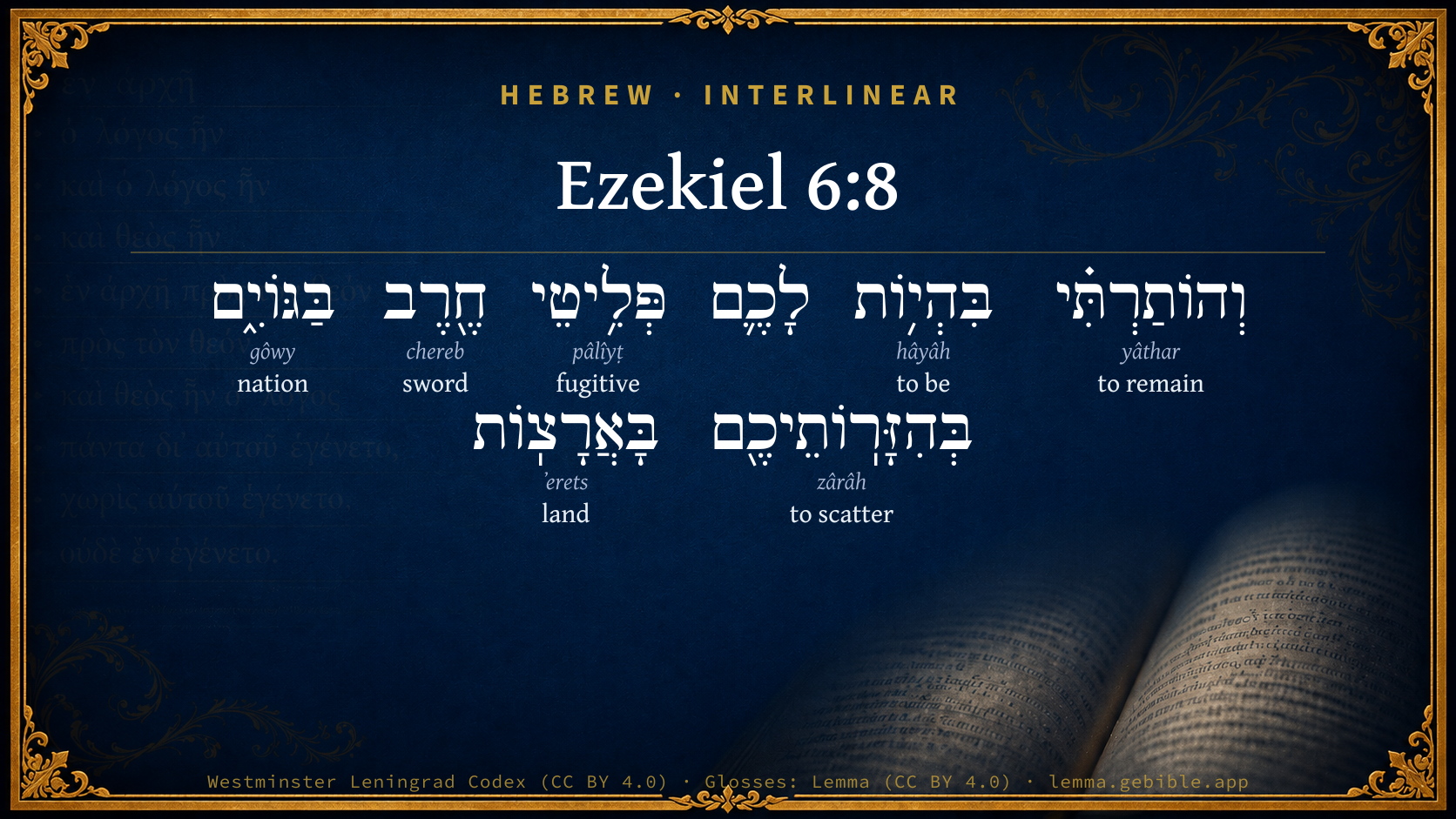
Hebrew (Westminster Leningrad Codex) Ezekiel 6:8 appears in the Hebrew Old Testament. The text above is from the Westminster Leningrad Codex. Each word links to its Strong’s number, a concise gloss, and parsing drawn from the Open Scriptures Hebrew Bible morphology. Click any word for its full Brown-Driver-Briggs (BDB) entry.
Download image
Cite this verse

Ezekiel 6:8 (World English Bible). Public Domain. Lemma interlinear Bible study tool, https://lemma.gebible.app/v/ezekiel/6/8.

Show BibTeX & RIS
BibTeX
RIS
English Translation
Yet will I leave a remnant, in that you shall have some that escape the sword among the nations, when you shall be scattered through the countries.
World English Bible · Public Domain
Download a study sheet

One document with this verse’s original text, its word-by-word gloss line, the meaning frame, cross-references with their text, attributed commentary, and full source and license credits — printable, and it pastes into notes with its structure intact.

This verse Autodidact and up

Study sheet (.html) Plain text (.txt)

A passage Seminary Student

Up to 50 verses in one chapter. A passage sheet keeps up to 6 commentary sources and 12 cross-references per verse, in the order this page ranks them, and says so on the sheet whenever that leaves anything out. Ask for a single verse and you get the Autodidact verse sheet above.

Everything on this page stays free to read, with no account — the sheet is a download of what is already on screen, not access to it.

Want to remove ads? Support Godless Engineer
Compare translations 3

The same verse in 3 English versions, stacked beneath the original-language interlinear above. Click any original word for its lexicon entry.

Each is an independent rendering of the whole verse — the interlinear is not word-aligned to these translations.

Highlighted words mark where these versions differ — a whole-verse word diff, not a word-by-word alignment.

  • World English Bible Public Domain
    Yet will I leave a remnant, in that you shall have some that escape the sword among the nations, when you shall be scattered through the countries.
  • King James Version Public Domain
    Yet will I leave a remnant, that ye may have some that shall escape the sword among the nations, when ye shall be scattered through the countries.
  • unfoldingWord Literal Text CC BY-SA 4.0
    But I will preserve a remnant among you, and there will be some who escape the sword among the nations, when you are scattered throughout the countries.

unfoldingWord Literal Text — © unfoldingWord, licensed CC BY-SA 4.0. Word-aligned USFM3 via Door43 (git.door43.org/unfoldingWord/en_ult).

Versions to compare (up to 4)

3 of 4 selected

Show all 18 translations

Every available English version of this verse, each an independent rendering of the whole verse.

  • World English Bible Public Domain
    Yet will I leave a remnant, in that you shall have some that escape the sword among the nations, when you shall be scattered through the countries.
  • Berean Standard Bible Public Domain
    Yet I will leave a remnant, for some of you will escape the sword when you are scattered among the nations and throughout the lands.
  • Majority Standard Bible Public Domain
    Yet I will leave a remnant, for some of you will escape the sword when you are scattered among the nations and throughout the lands.
  • King James Version Public Domain
    Yet will I leave a remnant, that ye may have some that shall escape the sword among the nations, when ye shall be scattered through the countries.
  • American Standard Version (1901) Public Domain
    Yet will I leave a remnant, in that ye shall have some that escape the sword among the nations, when ye shall be scattered through the countries.
  • Revised Version (1885) Public Domain
    Yet will I leave a remnant, in that ye shall have some that escape the sword among the nations, when ye shall be scattered through the countries.
  • Geneva Bible (1599) Public Domain
    Yet will I leaue a remnant, that you may haue some that shall escape the sword among the nations, when you shalbe scattred through the countreyes.
  • Douay-Rheims (1899) Public Domain
    And I will leave in you some that shall escape the sword among the nations, when I shall have scattered you, through the countries.
  • Young's Literal Translation Public Domain
    And I have caused `some' to remain, In their being to you the escaped of the sword among nations, In your being scattered through lands.
  • Literal Standard Version CC BY-SA 4.0
    And I have caused [some] to remain, || In their being for you the escaped of the sword among nations, || In your being scattered through lands.
  • Unlocked Literal Bible CC BY-SA 4.0
    But I will preserve a remnant among you, and there will be some who escape the sword among the nations, when you are scattered throughout the countries.
  • unfoldingWord Literal Text CC BY-SA 4.0
    But I will preserve a remnant among you, and there will be some who escape the sword among the nations, when you are scattered throughout the countries.
  • Darby Bible Public Domain
    Yet will I leave a remnant, in that ye shall have some escaped from the sword among the nations, when ye shall be scattered through the countries.
  • World Messianic Bible Public Domain
    “‘“Yet I will leave a remnant, in that you will have some that escape the sword among the nations, when you are scattered through the countries.
  • Webster's Bible Public Domain
    Yet will I leave a remnant, that ye may have some that shall escape the sword among the nations, when ye shall be scattered through the countries.
  • Free Bible Version CC BY-SA 4.0
    However, I will let some of you survive and scatter you among the different nations and countries.
  • Bible in Basic English Public Domain
    But still, I will keep a small band safe from the sword among the nations, when you are sent wandering among the countries.
  • JPS Tanakh (1917) Public Domain
    Yet will I leave a remnant, in that ye shall have some that escape the sword among the nations, when ye shall be scattered through the countries.

Literal Standard Version (2020), Covenant Press — licensed CC BY-SA 4.0. Text via the HelloAO Bible API (eBible.org). Unlocked Literal Bible (unfoldingWord) — licensed CC BY-SA 4.0. Text via the HelloAO Bible API (eBible.org). unfoldingWord Literal Text — © unfoldingWord, licensed CC BY-SA 4.0. Word-aligned USFM3 via Door43 (git.door43.org/unfoldingWord/en_ult). Free Bible Version, Dr. Jonathan Gallagher — licensed CC BY-SA 4.0. Text via the HelloAO Bible API (eBible.org).

Word by word

More ways to search: Search by grammar → Find every occurrence → Compare this word →

Practice this passage: Drill this verse → Learn its vocabulary →

About this verse

These counts appear in no published source. They are computed here, from the morphology-tagged text and Lemma’s own curated glosses. What Lemma adds →

8
words
7
distinct lemmas
Prophets
section

Notable vocabulary

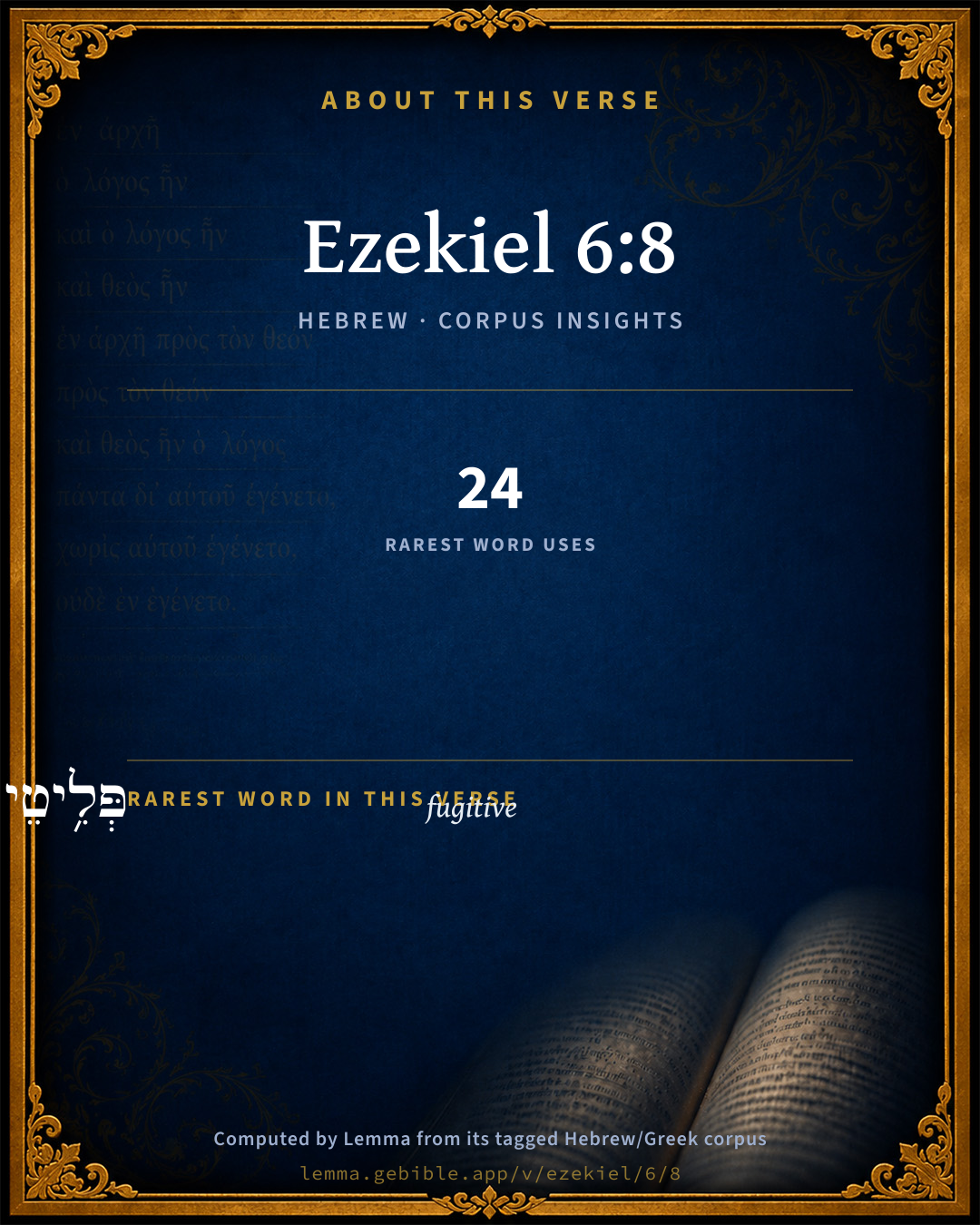
The rarest word here is פְּלִ֥יטֵי fugitive H6412 — appearing just 24 times in the whole Hebrew Bible.

Shared distinctive vocabulary

פְּלִ֥יטֵי fugitive H6412 occurs in 23 verses of the Hebrew Bible. Also found in:

Grammatical profile

  • 3 verbs
  • 4 nouns
  • 1 preposition

Verb forms

  • וְהוֹתַרְתִּ֗י Hiphil · Sequential Perfect
  • בִּהְי֥וֹת Qal · Infinitive Construct
  • בְּהִזָּרֽוֹתֵיכֶ֖ם Niphal · Infinitive Construct

Hebrew & Septuagint length

In English translation the verse runs 27 words from the Hebrew and 21 from the Septuagint (LXX English) — closely comparable.

A rough comparison of the two English renderings, which tokenize alike — not a word-level alignment.

Word counts can differ between the Hebrew and the Greek without any difference in meaning — e.g. the Hebrew direct-object marker אֵת has no separate Greek word, and Greek often adds the article ὁ.

Cross-references

13

Topical passages linked to Ezekiel 6:8 in the Treasury of Scripture Knowledge — connected by theme and wording, ordered by reader-vote popularity; previews shown in the World English Bible.

  • Ezekiel 14:22 Yet, behold, therein shall be left a remnant that shall be carried forth, both sons and daughters: behold, they shall come forth to you, and you shall see their way and their doings; and you shall be comforted concerning the evil that I have brought on Jerusalem, even concerning all that I have brought on it.
  • Isaiah 6:13 If there are yet a tenth in it, It also shall in turn be eaten up: As a terebinth, and as an oak, whose stock remains, when they are felled; So the holy seed is its stock."
  • Jeremiah 44:14 so that none of the remnant of Judah, who have gone into the land of Egypt to sojourn there, shall escape or be left, to return into the land of Judah, to which they have a desire to return to dwell there: for none shall return save such as shall escape.
  • Jeremiah 44:28 Those who escape the sword shall return out of the land of Egypt into the land of Judah, few in number; and all the remnant of Judah, who have gone into the land of Egypt to sojourn there, shall know whose word shall stand, mine, or theirs.
  • Ezekiel 12:16 But I will leave a few men of them from the sword, from the famine, and from the pestilence; that they may declare all their abominations among the nations where they come; and they shall know that I am Yahweh.
  • Jeremiah 30:11 For I am with you, says Yahweh, to save you: for I will make a full end of all the nations where I have scattered you, but I will not make a full end of you; but I will correct you in measure, and will in no way leave you unpunished.
  • Isaiah 27:7–8 Has he struck them as he struck those who struck them? or are they slain according to the slaughter of those who were slain by them?
  • Jeremiah 46:28 Don't be afraid you, O Jacob my servant, says Yahweh; for I am with you: for I will make a full end of all the nations where I have driven you; but I will not make a full end of you, but I will correct you in measure, and will in no way leave you unpunished.
  • Ezekiel 5:2 A third part shall you burn in the fire in the midst of the city, when the days of the siege are fulfilled; and you shall take a third part, and strike with the sword round about it; and a third part you shall scatter to the wind, and I will draw out a sword after them.
  • Ezekiel 5:12 A third part of you shall die with the pestilence, and with famine shall they be consumed in the midst of you; and a third part shall fall by the sword round about you; and a third part I will scatter to all the winds, and will draw out a sword after them.
  • Ezekiel 7:16 But those of those who escape shall escape, and shall be on the mountains like doves of the valleys, all of them moaning, every one in his iniquity.
  • Romans 9:27 Isaiah cries concerning Israel, "If the number of the children of Israel are as the sand of the sea, It is the remnant who will be saved;
  • Romans 11:5–6 Even so then at this present time also there is a remnant according to the election of grace.

Cross-references courtesy of OpenBible.info (CC BY 4.0).

Hebrew and Greek witnesses Masoretic Hebrew ↔ Greek Septuagint

The same verse in the two great witnesses to the Old Testament, shown verse-for-verse.

These are two independent witnesses, not word-aligned to each other, and the Septuagint is shown in lemma (dictionary) form.

Hebrew Ezekiel 6:8 Masoretic · Westminster Leningrad Codex

וְהוֹתַרְתִּ֗י בִּהְי֥וֹת לָכֶ֛ם פְּלִ֥יטֵי חֶ֖רֶב בַּגּוֹיִ֑ם בְּהִזָּרֽוֹתֵיכֶ֖ם בָּאֲרָצֽוֹת

Yet will I leave a remnant, in that you shall have some that escape the sword among the nations, when you shall be scattered through the countries.

World English Bible · Public Domain

Greek LXX Ezekiel 6:8 Septuagint · lemma form

ἐν ὁ γίγνομαι ἐκ σύ ἀνασώζω ἐκ ῥομφαία ἐν ὁ ἔθνος καί ἐν ὁ διασκορπισμός σύ ἐν ὁ χώρα

When there are some of you escaping from the sword among the Gentiles, and when you⌃ are scattered in the countries;

LXX2012 (modern English Septuagint) · Public Domain

On this verse, The Cambridge Bible for Schools and Colleges discusses the Septuagint’s reading. Read the note in Commentary ↓

Hebrew: Westminster Leningrad Codex (CC BY 4.0). Greek: Septuagint (public domain); English from LXX2012 (modern English Septuagint) (Public Domain). How the Septuagint differs from the Hebrew →

Targum (Aramaic paraphrase)

1

The Targum is the ancient Jewish Aramaic paraphrase of the Hebrew Scriptures — an interpretive translation, not the Hebrew text itself. Onkelos (literal) and Pseudo-Jonathan (expansive) render the Torah, and Jonathan the Prophets. Coverage is partial: where no permissively-licensed English translation exists for a verse, only the Aramaic is shown. This is verse-level text, not a word-by-word alignment to the Hebrew.

  1. Targum Jonathan Prophets (Joshua–Malachi)
    וְאַשְׁאַר בְּמֶהֱוֵי לְכוֹן מְשֵׁזְבֵי חַרְבָּא בֵּינֵי עַמְמַיָא בְּאִתְבַּדָרוּתֵיכוֹן בִּמְדִינָתָא:

    (no public-domain English translation for this verse)

    Targum Jonathan — Aramaic: “Mikraot Gedolot” (public domain). English: “Sefaria Community Translation” (CC0 1.0 (public-domain dedication)); “London "Chaldee Paraphrase," 1871” (public domain). Text via Sefaria.

Commentary

Notes on Ezekiel 6:8 from classic Christian and Jewish commentators (each source and its license shown beneath its notes). The classic Christian expositions comment on the surrounding passage and are grouped to its opening verse, so a note may address several verses; the Jewish commentaries on the Tanakh (Rashi and others) are per-verse, so they appear only where the commentator wrote on this verse.

Lemma curates 59 commentaries, every one of them public domain or Creative Commons licensed, each selected and text-cleaned for this edition rather than reprinted as found. About our sources →

Matthew Henry's Commentary

Judgment had hitherto triumphed, but in these verses mercy rejoices against judgment. A sad end is made of this provoking people, but not a full end. The ruin seems to be universal, and yet will I leave a remnant, a little remnant, distinguished from the body of the people, a few of many, such as are left when the rest perish; and it is God that leaves them. This intimates that they deserved to be cut off with the rest, and would have been cut off if God had not left them. See Isa 1:9. And it is God who by his grace works that in them which he has an eye to in sparing them. Now,

I. It is a preserved remnant, saved from the ruin which the body of the nation is involved in (Eze 6:8): That you may have some who shall escape the sword. God said (Eze 5:12) that he would draw a sword after those who were scattered, that destruction should pursue them in their dispersion; but here is mercy remembered in the midst of that wrath, and a promise that some of the Jews of the dispersion, as they were afterwards called, should escape the sword. None of those who were to fall by the sword about Jerusalem shall escape; for they trust to Jerusalem's walls for security, and shall be made ashamed of that vain confidence. but some of them shall escape the sword among the nations, where, being deprived of all other stays, they stay themselves upon God only. They are said to have those who shall escape; for they shall be the seed of another generation, out of which Jerusalem shall flourish again.

II. It is a penitent remnant (Eze 6:9): Those who escape of you shall remember me. Note, To those whom god designs for life he will give repentance unto life. They are reprieved, and escape the sword, that they may have time to return to God. Note, God's patience both leaves room for repentance and is an encouragement to sinners to repent. Where God designs grace to repent he allows space to repent; yet many who have the space want the grace, many who escape the sword do not forsake the sin, as it is promised that these shall do. This remnant, here marked for salvation, is a type of the remnant reserved out of the body of mankind to be monuments of mercy, who are made safe in the same way that these were, by being brought to repentance. Now observe here,

1. The occasion of their repentance, and that is a mixture of judgment and mercy-judgment, that they were carried captives, but mercy, that they escaped the sword in the land of their captivity. They were driven out of their own land, but not out of the land of the living, not chased out of the world, as other were and they deserved to be. Note, The consideration of the just rebukes of Providence we are under, and yet of the mercy mixed with them, should engage us to repent, that we may answer God's end in both. And true repentance shall be accepted of God, though we are brought to it by our troubles; nay, sanctified afflictions often prove means of conversion, as to Manasseh.

2. The root and principle of their repentance: They shall remember me among the nations. Those who forgot God in the land of their peace and prosperity, who waxed fat and kicked, were brought to remember him in the land of their captivity. The prodigal son never bethought himself of his father's house till he was ready to perish for hunger in the far country. Their remembering God was the first step they took in returning to him. Note, Then there begins to be some hopes of sinners when they have sinned against, and to enquire, Where is God my Maker? Sin takes rise in forgetting God, Jer 3:21. Repentance takes rise from the remembrance of him and of our obligations to him. God says, They shall remember me, that is, "I will give them grace to do so;" for otherwise they would for ever forget him. That grace shall find them out wherever they are, and by bringing God to their mind shall bring them to their right mind. The prodigal, when he remembered his father, remembered how he has sinned against Heaven and before him; so do these penitents. (1.) They remember the base affront they had put upon God by their idolatries, and this is that which an ingenuous repentance fastens upon and most sadly laments. They had departed from God to idols, and given that honour to pretended deities, the creatures of men's fancies and the work of men's hands, which they should have given to the God of Israel. They departed from God, from his word, which they should have made their rule, from his work, which they should have made their business. Their hearts departed from him. The heart, which he requires and insists upon, and without which bodily exercise profits nothing, the heart, which should be set upon him, and carried out towards him, when that departs from him, is as the treacherous elopement of a wife from her husband or the rebellious revolt of a subject from his sovereign. Their eyes also go after their idols; they doted on them, and had great expectations from them. Their hearts followed their eyes in the choice of their gods (they must have gods that they could see), and then their eyes followed their hearts in the adoration of them. Now the malignity of this sin is that it is spiritual whoredom; it is a whorish heart that departs from God; and they are eyes that go a whoring after their idols. Note, Idolatry is spiritual whoredom; it is the breach of a marriage-covenant with God; it is the setting of the affections upon that which is a rival with him, and the indulgence of a base lust, which deceives and defiles the soul, and is a great wrong to God in his honour, (2.) They remember what a grief this was to him and how he resented it. They shall remember that I am broken with their whorish heart and their eyes that are full of this spiritual adultery, not only angry at it, but grieved, as a husband is at the lewdness of a wife whom he dearly loved, grieved to such a degree that he is broken with it; it breaks his heart to think that he should be so disingenuously dealt with; he is broken as an aged father is with the undutiful behaviour of a rebellious and disobedient son, which sinks his spirits and makes him to stoop. Forty years long was I grieved with this generation, Psa 95:10. God's measures were broken (so some); a stop was put to the current of his favours towards them, and he was even compelled to punish them. This they shall remember in the day of their repentance, and it shall affect and humble them more than any thing, not so much that their peace was broken, and their country broken, as that God was broken by their sin. Thus they shall look on him whom they have pierced and shall mourn, Zac 12:10. Note, Nothing grieves a true penitent so much as to think that his sin has been a grief to God and to the Spirit of his grace.

3. The product and evidence of their repentance: They shall loathe themselves for the evils which they have committed in all their abominations. Thus God will give them grace to qualify them for pardon and deliverance. Though he had been broken by their whorish heart, yet he would not quite cast them off. See Isa 57:17, Isa 57:18; Hos 2:13, Hos 2:14. His goodness takes occasion from their badness to appear the more illustrious. note, (1.) True penitents see sin to be an abominable thing, that abominable thing which the Lord hates and which makes sinners, and even their services, odious to him, Jer 44:4; Isa 1:11. It defiles the sinner's own conscience, and makes him, unless he be past feeling, an abomination to himself. An idol is particularly called an abomination, Isa 44:19. Those gratifications which the hearts of sinners were set upon as delectable things the hearts of penitents are turned against as detestable things. (2.) There are many evils committed in these abominations, many included in them, attendant on them, and flowing from them, many transgressions in one sin, Lev 16:21. In their idolatries they were sometimes guilty of whoredom (as in the worship of Peor), sometimes of murder (as in the worship of Moloch); these were evils committed in their abominations. Or it denotes the great malignity there is in sin; it is an abomination that has abundance of evil in it. (3.) Those that truly loathe sin cannot but loathe themselves because of sin; self-loathing is evermore the companion of true repentance. Penitents quarrel with themselves, and can never be reconciled to themselves till they have some ground to hope that God is reconciled to them; nay, then they shall lie down in their shame, when he is pacified towards them, Eze 16:63.

4. The glory that will redound to God by their repentance (Eze 6:10): "They shall know that I am the Lord; they shall be convinced of it by experience, and shall be ready to own it, and that I have not said in vain that I would do this evil unto them, finding that what I have said is made good, and made to work for good, and to answer a good intention, and that it was not without just provocation that they were thus threatened and thus punished." Note, (1.) One way or other God will make sinners to know and own that he is the lord, either by their repentance or by their ruin. (2.) All true penitents are brought to acknowledge both the equity and the efficacy of the word of God, particularly the threatenings of the word, and to justify God in them and in the accomplishment of them.

Matthew Henry's Commentary on the Whole Bible (1708–1710) — public domain (CC PDM 1.0). Text via the HelloAO Bible API.

Ellicott's Commentary for English Readers

(8) Yet will I leave a remnant.—In Eze_6:8-10 the general gloom of this prophecy of judgment is lightened for a moment by the mention of the remnant who shall be brought by their afflictions “to know that I am the Lord” in a far higher and better sense than those mentioned in Eze_6:7. This Divine plan pursued from the beginning, as is shown by St. Paul in Rom_9:6-13, of purifying the people by setting aside the mass, and showing mercy to a remnant, looks far beyond the Babylonish captivity, as is shown by the parallel prophecy of Zechariah, uttered after the return from that captivity, “They shall remember me in far countries; and they shall live with their children, and turn again” (Zec_10:9). Beyond this brief glimpse at the remnant, however, the cloud settles down again upon the prophecy; for the period until the destruction of Jerusalem, now but a few years off, must be almost exclusively a period of the denunciation of judgment.

A Bible Commentary for English Readers, edited by Charles John Ellicott (1878–1897) — public domain. Text from a community e-Sword module.

The Cambridge Bible for Schools and Colleges

gen. ed. J. J. S. Perowne

8. that ye may have] R.V. in that ye shall have some is better. The original reads very awkwardly, and in LXX. the words: “yet will I leave a remnant” are wanting. Eze_6:9 seems the apodosis of Eze_6:8, and when ye shall have them that escape the sword … 9 then shall they that escape of you remember.

8–10. A remnant shall be preserved, and shall remember the Lord among the nations whither they are scattered

The Cambridge Bible for Schools and Colleges (gen. ed. J. J. S. Perowne; Cambridge University Press, 1878–1918) — public domain. Text from a community e-Sword module.

Trapp's Complete Commentary

John Trapp

Eze 6:8 Yet will I leave a remnant, that ye may have [some] that shall escape the sword among the nations, when ye shall be scattered through the countries.

Ver. 8. Yet will I leave a remnant.] For royal use. See on Eze 5:3.

John Trapp, A Commentary or Exposition upon All the Books of the Old and New Testament (1647–1656) — public domain. Text from a community e-Sword module.

Joseph Benson's Commentary

Eze 6:8-10. Yet will I leave a remnant — “A gracious exception that often occurs in the prophets when they denounce general judgments against the Jews; implying that God will still preserve a remnant of that people; to whom he will fulfil the promises made to their fathers.” And they that escape of you shall remember me, &c. — Your afflictions shall bring you to the knowledge of yourselves, and a sense of your duty to me. Because I am broken with their whorish hearts — I am much grieved, and my patience is tired out with this people’s idolatries, called in Scripture spiritual whoredom. God is here introduced as speaking after the manner of men, whose patience is tired out by the repeated provocations of others, especially when they see no hopes of amendment. And with their eyes go a whoring after their idols — The eyes are the seat of lascivious inclinations: see 2Pe 2:14. So, in pursuit of the same metaphor, the eyes are said to go a whoring after idols, the people being often tempted to idolatrous worship by the costliness of the images, and the fine show they made. And they shall loathe themselves, &c. — With a mixture of grief toward God, of indignation against themselves, and abhorrence of the offence. And they shall know I have not said in vain, &c. — Without cause, as the word חנם is more significantly translated Eze 14:22; the sufferers had given him just cause to pronounce that evil. Or, without effect: their sins were the cause, and their destruction is the effect of their sufferings.

Joseph Benson's Commentary on the Old and New Testaments (1811–1818) — public domain. Text from a community e-Sword module.

Tyndale Open Study Notes

Tyndale Open Resources

6:8-10 A remnant would be scattered among the nations of the world to bear witness to God’s faithfulness to his covenant. They would recognize the reality of their own unfaithful hearts and hate themselves for all their detestable sins, and they will know that God’s threat of calamity on covenant breakers was absolutely serious. Some of those who know that I alone am the Lord might even experience the other side of God’s faithfulness: his swiftness to forgive those who repent. In the book of Exodus, Israel came to know that God is the Lord through his mighty acts of rescue (see Exod 6:7). Unfortunately, Israel’s behavior throughout their history showed that they had forgotten. They would come again to that knowledge through God’s acts of judgment.

Tyndale Open Study Notes — © Tyndale Open Resources, licensed CC BY-SA 4.0. Text via the HelloAO Bible API.

Geneva Bible (1599)

Geneva Bible translators

He showeth that in all dangers God will preserve a few, which shall be as the seed of his Church and call upon his Name.

Geneva Bible (1599) marginal notes — public domain. Text via Bolls.life.

Jamieson, Fausset & Brown

Robert Jamieson, A. R. Fausset & David Brown

Mitigation of the extreme severity of their punishment; still their life shall be a wretched one, and linked with exile (Eze 5:2, Eze 5:12; Eze 12:16; Eze 14:22; Jer 44:28).

Jamieson, Fausset & Brown — Commentary Critical and Explanatory on the Whole Bible (1871) — public domain (CC PDM 1.0). Text via the HelloAO Bible API.

John Calvin's Commentaries

Yet here another promise is added, which may temper the bitterness of so sorrowful a prophecy. For hitherto God shows that he burns with indignation against the land of Israel, so that he determined to destroy it, since it was polluted everywhere, and at all corners. Nothing could therefore be hoped for, if Ezekiel had spoken precisely; therefore a promise is added in mitigation — I will leave a remnant, says he, that you may have some who escape the sword; that is, that some of you may survive. But how? God does not promise simple pardon, that he may leave the Israelites quiet and safe in the land, but he says that their safety shall be in exile. Hence therefore we collect that they were so depraved that they were unable to obtain pardon, because God says that his patience was their scorn and aversion. Although, therefore, he gives the Israelites some hope of favor, yet he also admonishes them that they could not obtain safety in any other way, except by a kind of death, namely exile. I will leave a remnant, says he, of you, who shall escape the sword; but how? whom shall the enemy have spared so that they do not change their place? nay, he says, when ye shall be dispersed among the Gentiles He promises them life, therefore, but a wretched one, because it was united with exile. But God’s favor cannot be sufficiently estimated from these words, unless what follows immediately is added.

John Calvin's Commentaries (1540-1563) — public domain. Text from the Calvin Translation Society English edition (1840s-50s) via the Christian Classics Ethereal Library (ccel.org). Calvin's coverage is partial (roughly two-thirds of the Bible); uncommented books and verses are honest gaps, never fabricated. The 19th-century editor's footnotes and remarks are omitted so the notes are faithfully Calvin's own voice.

John Gill's Exposition

And they that escape of you shall remember me,.... Either my grace and mercy to them, as Jarchi; or the fear of me, as the Targum; and so return by repentance, and worship the Lord their God, being influenced by his kindness and goodness to them: even when

among the nations, whither they shall be carried captive; so that their afflictions should be sanctified and made useful to them: in prosperity men are apt to forget God; in adversity they are brought to a sense of themselves and duty; and happy it is when chastening dispensations are teaching ones, and bring to God, and not drive from him:

because I am broken with their whorish heart, which hath departed from me: by committing spiritual adultery, which is idolatry. The sense is, either that he was grieved at heart with their idolatry, which was the reason of their being carried captive, which, when they were sensible of, wrought repentance in them; or that he was full of compassion towards them; his heart was tender and pitiful towards them, though they departed from him in such a dreadful manner, justly to be resented by him. The Targum is,

"I have broken their foolish heart;''

and so the Syriac and Vulgate Latin versions, "I have broken their whorish heart"; by afflictive providences humbled them, and brought them to repentance:

and with their eyes, which go a whoring after their idols; they committed fornication with their heart and eyes in a spiritual sense, as wicked men do in a natural sense; see Pe2 2:14;

and they shall loathe themselves for the evils which they have committed in all their abominations; abominable idolatry, Pe1 4:3; when men remember God, against whom they have sinned, and consider how grieving sin is to him; and when they are broken for it themselves, they then loathe their sins, and themselves for it; and where all this is there is true repentance.

John Gill's Exposition of the Whole Bible (1746–1763) — public domain (CC PDM 1.0). Text via the HelloAO Bible API.

Haydock's Catholic Bible Commentary

Some. Providence still preserves some faithful or penitent souls. (Worthington)

George Leo Haydock (1774–1849), Haydock's Catholic Family Bible and Commentary, 1859 edition — public domain. Excludes Psalms (Douay-Rheims chapter numbering differs from Protestant) and Deuterocanonical books (Catholic canon only).

Matthew Poole's English Annotations

It is the Lord that preserves a remnant, the enemies’ rage would destroy all; and it is an act of deliberate and voluntary resolution, not by chance, but by choice.

A remnant; some few in comparison with the great multitudes that are cut off. Though he promiseth a handful shall remain, yet it shall be in that condition that they are little more than escaped, a poor and small remnant left, as Zep 3:12.

Ye shall be scattered; either by your own choice, shifting from country to country; or else, dissipated by the order of the proud oppressing conqueror, who will scatter families, lest they should be a little comfort to one another, and great jealousy to him; he will scatter to prevent conspiracies.

Matthew Poole's English Annotations on the Holy Bible (1683–1685) — public domain. Text from a community e-Sword/MySword module.

Whedon's Commentary on the Bible

Daniel D. Whedon

8. Yet will I leave a remnant, that ye may have some — A remnant would be saved from their idolatry, though as by fire, and would preserve the true faith to the end of time (Isa_1:9; Isa_10:20; Zep_2:7; Zep_3:13; Jer_43:5). This word only referred to the immediate future, yet it may have a larger application. Although Israel for thousands of years has been a “taunt” and “astonishment” to the whole earth, a people without a country, and exposed to such persecutions as no other nation ever endured, yet a “remnant” has always been preserved. The Assyrians and Phoenicians and all other nations who were neighbors to Israel when this prophecy was written have disappeared, but Jehovah’s people remain unique and separate in every land — a nation still, though “scattered through the countries.”

Daniel D. Whedon (gen. ed.), Commentary on the Old and New Testaments (1874–1909) — public domain. Text from a community e-Sword module.

The Pulpit Commentary

Yet will I leave a remnant, ere. The thought, though not the word, is that of Isa_1:9 Isa_10:20; Zep_2:7 Zep_3:13; Jer_43:5. For these, at least, the punishment would, in greater or less measure,do its work; and, in remembering Jehovah, they would find the beginning of conversion.

The remnant.

The remnant that is to escape in the greatest destruction appears repeatedly in Hebrew prophecy. Its existence is evidently regarded as of deep significance, over and above the value of the individual lives spared, as a ray of light in the otherwise universal gloom, a glimmer of hope amidst the deepening despair.

I THE REMNANT IS A SIGN OF GOD"S MERCY. He did not utterly destroy his guilty people. Not loving the work of judgment, he spared all whom it was safe to spare. God is never given over to wholesale and indiscriminate wrath. In his darkest hours of anger he makes a way of escape. Perhaps few as yet can avail themselves of it only a "remnant." Still it is provided by God, since he loves to heal, and hates to destroy.

II THE REMNANT IS BOUND TO SERVE GOD. All who are saved out of great destruction by the merciful hand of God should consider themselves the redeemed of the Lord, who belong to the God who has delivered them. God does not spare that we may be negligent or indifferent. Every Christian is like a part of this remnant, delivered by God from the doom of a guilty world; therefore every Christian has reason to acknowledge that his life belongs to God, and to spend it in God"s service.

III THE REMNANT IS A SECURITY FOR HISTORICAL CONTINUITY. This remnant treasures up the tradition of the fathers. If all Israel had been cut off, there would have been an end to the development of Hebrew revelation, the Scriptures would have been lost, the line of descent in which the Christ was to appear would have been stopped, and God"s great purposes for blessing the world through Israel would have been frustrated. But the thin thread of the "remnant" carries down the ancient tradition, and becomes the invaluable link of connection between the venerable glory of the past and the even greater glory of the future. It thus illustrates the continuity of history, revelation, and religion. This continuity is an essential condition of progress. Had there been no remnant, the Divine education would have needed to begin again de novo. In the dark ages a remnant of the better days before still lingered, and though it was but as a smouldering spark, it was sufficient to be fanned into a new flame by the fresh winds of the Renaissance and the Reformation. It is plainly according to God"s purpose that future enterprises for the good of the world should be linked on to the attainments of the past. The danger of a democracy lies in being too blind and self-satisfied to see this Divine method of continuity.

IV THE REMNANT IS A SEED OF A LARGER FUTURE. It is not to be always only a remnant. The old stamp will sprout and grow into a tree again. The remnant of Israel became a nation mice more in the days of Cyrus. Thus like the "elect," first as a nation and later as a Church, this "remnant" is not favoured exclusively for its own sake, as especially meritorious, or as arbitrarily chosen for a privileged position. Every Divine privilege is given that they who receive it may be the better able to convey the blessing of God to their fellow men. The Church is chosen out of the world that she may labour for the good of the world, and, by bringing the gospel to all men, enlarge her own borders and ultimately share her privileges with all mankind.

A remnant.

When the corn is threshed by the flail, or by the teeth of the threshing-implement, as in the literal "tribulation," its bulk is reduced; for the grain is separated from the straw and the husk. It is so with a nation visited by the calamities which came upon the Hebrew people. Pestilence, famine, and sword are the means by which multitudes may perish; yet some may be left, and these are "a remnant.

I THE CALAMITIES AND JUDGMENTS WHICH LEFT THE FEW AS A REMNANT. These were they who escaped. When the horrors that came upon the land are considered, the wonder is that there were survivors. As he who is saved from a fire looks back upon the sudden and furious conflagration, surveys the smoking ruins from which he has been rescued; as he who is the sole survivor from a shipwreck remembers with shuddering the violence of the tempest by which his comrades were engulfed in the ocean; so may those who have been spared in time of national calamity profit as they recall the circumstances of peril and terror by which they, with others, were encompassed, from which they, as distinguished from other"s, have been delivered. Who is there who, looking back upon the past scenes of even an uneventful life, cannot call to mind many of his early companions who have been the victims of disease, of misfortune, of accident, of temptation, whose earthly probation has been brought to a sudden close, whilst he himself, and a few others with him, are, as it were, "a remnant," and that through no personal merit?

II THE MERCY THAT SPARES THEM AS A REMNANT. The same inscrutable wisdom which suffers some to be overtaken and overwhelmed, provides that others shall be spared and saved. As Noah and his family were spared, whilst a vast population was engulfed in the Flood; as Lot and his household were spared, whilst the inhabitants of the guilty city were consumed by fire from heaven; so again and again has the forbearance of God been revealed in providing for the escape of "a remnant," who have remained to witness to Divine justice, and to use aright the opportunity afforded by Divine mercy towards themselves.

III THE PURPOSE FOR WHICH A REMNANT IS PERMITTED TO SURVIVE. This is only very partially explained in the context. The mind of the prophet was so absorbed with the consideration of the guilt of his idolatrous and rebellious fellow countrymen, and with their impending fate, that for the time he was not able to reflect upon the ultimate ends for which some were spared amidst the awful catastrophe. Yet this was present to his mind as one immediate result of the mingled judgments and mercies of God; those spared from the calamities of the nation should know and acknowledge that Jehovah was the Lord. As a matter of fact, the lesson was learnt; and the remnant who returned to Palestine returned free henceforth from all inclination to idolatry. And if they did not cease to sin, at all events they were henceforth free from sin of this form. They lived to remember for themselves, and to witness to their children, that the nations are ruled by a God of righteousness, and that in subjection to his authority and in obedience to his Law man"s true welfare must ever lie. Their song was of mercy and of judgment. If they were few in numbers they were purified and strengthened, and fitted to fulfil the peculiar vocation of the sons of Abraham among the nations of the earth.

APPLICATION. Who is there who has not experienced the sparing mercy and long suffering kindness of the Lord? Who has not been delivered from danger, from calamity, from destruction? Let all who acknowledge themselves to be, as it were, "a remnants" indebted to God"s compassion, acknowledge the peculiar obligation under which they have been laid, to witness to the mercy of their heavenly Father, and by their practical loyalty to him to prove that they have not been spared in vain. T.

Vers. 8-10. Many lost; few saved.

The prospects of God"s kingdom on the earth have never been wholly dark. A glint of light has always pierced the heavy clouds of gloom. Among the diseased grapes of the cluster, a solitary sound one is found. A thousand acorns are on the oak in autumn time; three or four only take root and flourish. The elect are still the few. But it shall not always be so. The turning point in their fortune is repentance. The internal change must always precede the external.

I THE OCCASION OF THIS REPENTANCE. The occasion was affliction. Until disaster, defeat, and exile came, no change of mind appeared. The ploughshare of calamity broke up the hard and stolid soil, so that the sweet energies of grace might find an entrance. Judgment alone will not soften and subdue the proud will of man; but judgment and mercy combined have an almighty efficacy. No teacher is so effective as experience. The scattered few, who had escaped the all-devouring sword, pondered, reflected, mourned.

II THE REALITY OF THEIR REPENTANCE. There is a spurious repentance which is only remorsei.e. regret that the sin has been detected. But real repentance has respect to God. The sorrow does not so much respect self. It is grief that God is pained that his heart is broken by our perversity and folly. The old selfishness has disappeared, and God has obtained his proper place in the soul if so, repentance is real.

III THE PROOF OF REPENTANCE. The proof indicated is self-loathing, self-condemnation. The things formerly loved are now hated. More than this, the penitent passes sentence on himself. He censures himself more severely than others censure him. His past deeds are as obnoxious to him as a dunghill, and that dunghill is within him. His own former self is detestable. He hates himself. No penalty seems for him too heavy. His chief fear is lest such sin as his should be beyond the possibility of mercy.

IV THE EFFECT OF REPENTANCE. The result is intimate acquaintance with God inward conviction of his truth and faithfulness. This knowledge of God is knowledge gained by experience. Such knowledge brings with it trust, admiration, love, peace; yea, life itself. "They that know thy Name wilt put their trust in thee." Formerly they were the dupes of falsehood; they wandered in darkness self-created, Now they are smitten by the charms of truth, and loyally follow the Truth. D.

Vers. 8-10. Stages in the soups prestress from sin unto salvation.

will I leave a remnant, that ye may have some that shall escape the sword among the nations," etc. These verses exhibit the exercise of mercy even in the execution of judgment; and they indicate certain stages in the restoration of a remnant of the people to the Lord Jehovah.

I SIN LEADING TO PUNISHMENT. In dealing with previous paragraphs we have already spoken of the sin and of the punishment of the Israelites. Their chief sin was idolatry. It is spoken of in our text as whoredom. The chosen people are looked upon as the wife of Jehovah. (cf. Jer_2:2; Hos_2:19, Hos_2:20) And in turning from him to worship idols, they played the part of a wife that is unfaithful to her husband (cf. Jer_3:9, Jer_3:20) And when they persisted in this infidelity, despite exhortation, remonstrance, and warning, the righteous judgment of God came upon them siege, famine, pestilence, sword, captivity. Sin ever leads to suffering. Sooner or later penalty follows transgression. "Be sure your sin will find you out;" "Whoso breaketh a hedge, a serpent shall bite him.

II PUNISHMENT LEAVING TO RECOLLECTION. "They that escape of you shall remember me among the nations whither they shall be carried captives." The goodness of God is designed to lead men to repentance; (cf. Rom_2:4) but sometimes it fails to do so by reason of the perversity of the heart of man. Some men partake of the gifts of the Divine goodness without any thought of the bountiful Bestower. But affliction not unfrequently accomplishes that which prosperity failed to effect. It was in the far country, in poverty, degradation, and destitution, that the prodigal son came to himself, and remembered his father"s house. (Luk_15:14-17) And though Israel had forsaken the Lord, he had not forsaken them.

Even his judgments were an evidence of this. (cf. Hos_2:6, Hos_2:7) In wrath he remembers mercy. In his terrible visitation for their sins he spares a remnant of them. And in the miseries of captivity that remnant remembers him. As a faithless wife who has deserted a good husband will almost certainly have occasion to remember in bitterness of soul him whom she has so basely and cruelly wronged, so the remnant of the Israelites, in the sorrows of their exile, would remember the Lord Jehovah, whom they had rejected for vain idols. Suffering should induce recollection and reflection. Trials should lead us to review our life and consider our ways.

III RECOLLECTION LEADING TO REPENTANCE. "When I have broken their whorish heart, which hath departed from me, and their eyes, which go a-whoring after their idols; and they shall loathe themselves for the evils which they have committed in all their abominations." Where this rendering differs from that of the Authorized Version it is supported by Hengstenberg, Schroder, and the "Speaker"s Commentary." Amongst the remnant of the Israelites, recollection prepared the way for repentance, of which three aspects are here indicated.

1. Repentance in its origin. "When I have broken their whorish heart." Whatever may be the means by which it is brought about, penitence is the product of Divine grace (cf. Act_5:31 Act_11:18) In this Christian age, God brings gracious gospel influences to bear upon the hearts of men by the operation of his Holy Spirit, in order to quicken them into penitence for sin.

2. Repentance in its seat. "When I have broken their heart." Repentance is not merely a change of mind, but a change of feeling. It is godly sorrow on account of sin. (cf. 2Co_7:9, 2Co_7:10) "The sacrifices of God are a broken spirit: a broken and a contrite heart, O God, thou wilt not despise.

3. Repentance in its expression. "They shall loathe themselves for the evils they have committed in all their abominations." The true penitent never seeks to excuse himself on account of his sins, or to explain them away, or to extenuate the guilt of them. He takes shame to himself on account of them; and humbly confesses them to God. He says, "I acknowledge my transgression, and my sin is ever before me," etc.; (Psa_51:3-5) "O my God, I am ashamed and blush to lilt up my face to thee, my God," etc.; (Ezr_9:6) "God be merciful to me a sinner." It is well when recollection thus leads to repentance unto life. It did so in the case of the psalmist: "I thought on my ways, and turned my feet unto thy testimonies,". (Psa_119:59, Psa_119:60) And David prophesied that it should be so throughout the world: "All the ends of the world shall remember and turn unto the Lord," etc.. (Psa_22:27)

IV REPENTANCE LEADING TO DEVOUT RECOGNITION OF GOD. "And they shall know that I am the Lord, and that I have not said in vain that I would do this evil unto them." "The Lord would have spoken in vain, or to no purpose, if the event had not corresponded with the utterance. By the correspondence of utterance and event, they know that he who has spoken by the son of man is Jehovah is God in the fullest sense" (Hengstenberg). They shall know him as the living and true God in contrast to the dead and vain idols (see on ver. 7). And more than this, true repentance leads to forgiveness and reconciliation with God; and thus the penitent soul comes to know him by devout sympathy and hallowed communion with him.

CONCLUSION. Learn that pain and trial are blessed when by Divine grace they lead to earnest reflection, and sincere repentance, and saving knowledge of God. W.J. (cf. Psa_119:67, Psa_119:71; Heb_12:10, Heb_12:11)

The Pulpit Commentary (1880–1919), ed. H.D.M. Spence-Jones & Joseph S. Exell — public domain. Text from a community e-Sword module.

John Wesley's Explanatory Notes

Remnant - It is the Lord that preserves a remnant, the enemies rage would destroy all.

John Wesley, Explanatory Notes Upon the Whole Bible (1754–1765) — public domain. Text via the GEBible commentary corpus.

Scofield Reference Notes

C. I. Scofield

remnant

(See Scofield "Jer 15:21").

The Scofield Reference Bible (1917 edition), notes by C. I. Scofield — public domain. Text from a community e-Sword module.

Kretzmann's Popular Commentary

Paul E. Kretzmann

The Fate of those who Remain

v. 8. Yet will I leave a remnant, in the general destruction spoken of in the first part of the chapter, that ye may have some that shall escape the sword among the nations when ye shall be scattered through the countries, in the exile which had been threatened by various prophets.

v. 9. And they that escape of you shall remember Me among the nations whither they shall be carried captives, realizing that He who brought this calamity upon them was Jehovah, the God of Israel, and that His Word is the eternal truth, also in the threats uttered against their idolatry, because I am broken with their whorish heart, or, "when I have broken their whorish heart," which hath departed from Me, in the spiritual adultery so often reproved in the Old Testament, and with their eyes, which go a-whoring after their idols, instead of being faithful to the God of the covenant; and they shall loathe themselves for the evils which they have committed in all their abominations, they will have a feeling of revulsion against themselves for ever having yielded to the idolatry of the heathen nations. Thus the first part of a true repentance would be wrought in them, the feeling of disgust over their unfaithfulness to the true Lord.

v. 10. And they shall know that I am the Lord, being brought to this realization by the lessons of a bitter experience, and that I have not said in vain, with an empty threat, that I would do this evil unto them. Since they would not listen before, they would be obliged to heed when the proof of the Lord’s faithfulness in keeping His word would bring them to their senses.

v. 11. Thus saith the Lord God, Smite with thine hand, either in clapping or in striking the thigh, and stamp with thy foot, in indignant impatience with Israel’s hard-heartedness, and say, Alas for all the evil abominations of the house of Israel! that it should have been necessary to go to such extremes in bringing them to their senses. For they shall fall by the sword, by the famine, and by the pestilence, the great scourges of the Lord’s wrath.

v. 12. He that is far off, out of time enemies’ reach, shall die of the pestilence, being unable to escape the avenging army of the Lord; and he that is near, within reach of the invaders, shall fall by the sword; and he that remaineth and is besieged shall die by the famine, having escaped the sword in the siege, he nevertheless becomes a victim. Thus will I accomplish, fully carry out, My fury upon them.

v. 13. Then shall ye know that I am the Lord, when their slain men shall be among their idols round about their altars,

v. 5. upon every high hill, in all the tops of the mountains, where the idolatrous sanctuaries to the heavenly powers were usually erected, and under every green tree, and under every thick oak, the terebinth-oak of Palestine, found either in groves or s individual trees in the brook-channels and ravines, the place where they did offer sweet savor to all their idols, namely, in sacrificing incense to Baal and Astarte.

v. 14. So will I stretch out My hand upon them, in sending His punishment, and make the land desolate, yea, more desolate than the wilderness toward Diblath, a desert otherwise unknown, but probably located in Arabia, in all their habitations; and they shall know that I am the Lord. In one form or other, but with constantly increasing emphasis, the Lord brings out His lesson: "Be not deceived; God is not mocked!"

Paul E. Kretzmann, Popular Commentary of the Bible (1921–1924) — public domain. Text from a community e-Sword module.

unfoldingWord translationNotes

Door43 World Missions Community

General Information:

These are Yahweh's words to the people of Israel.

some who escape the sword

The word "sword" is a metonym for soldiers who kill people using swords. AT: "some whom the soldiers do not kill" (See: Metonymy)

when you are scattered throughout the countries

This can be translated in active form. AT: "when I scatter you in different countries" or "when I force you to live in other countries" (See: Active or Passive)

I was grieved by their promiscuous heart that turned away from me

Yahweh speaks of the Israelites as if they were a woman who sleeps with many people. AT: "I was sad because they were like a wife who has left me to sleep with other men" (See: Synecdoche)

by their eyes that whored after their idols

Yahweh speaks of the Israelites as if they were a married woman who looks at other men and desires to sleep with them. AT: "by the way they desired strongly to worship idols" (See: Synecdoche)

they will show loathing on their face for the wickedness which they have committed

Possible meanings are 1) "their faces will show that they hate themselves because of the wicked things they have done" or 2) "their faces will show that they hate the wicked things that they have done."

translationWords

remnant

sword

nation

captive

heart

prostitute

evil

abomination

unfoldingWord translationNotes — © Distant Shores Media and the Door43 World Missions Community, licensed CC BY-SA 4.0. Source: git.door43.org/Door43/en_tn.

Lesson kit

Teaching starters — assembled from the data on this page, not authored interpretation. Every prompt links to the verse data it draws on. Edit before teaching.

Ezekiel, in the Prophets, opens this verse with 8 words (7 distinct Hebrew lemmas). Its most distinctive word is pâlîyṭ (“fugitive”). A historical commentator’s framing appears above. Read the whole chapter for the surrounding context.

Discussion questions

  1. The word pâlîyṭ carries the sense “fugitive.” How does it shape the verse?
  2. How does Genesis 14:13, which shares the word «fugitive», read alongside this verse?
  3. These translations render this verse differently; the difference is in the English rendering, not the original. What questions does that raise?
  4. «וְהוֹתַרְתִּ֗י» is a Hiphil Sequential Perfect verb. How does that grammatical form shape the action described?
  5. Compare how Matthew Henry's Commentary and Ellicott's Commentary for English Readers read this verse. Where do they agree or differ?

Things to notice

Reading settings

Reading text

Shown beneath each verse's original-language words.

Old Testament
Old Testament edition

Read the OT as the Masoretic Hebrew (MT) or the Greek Septuagint (LXX).

English shown for the Greek Septuagint (in the Hebrew ↔ Greek comparison).

Comparing translations? Open the Compare panel on any verse page to stack up to four side by side.