Judges 8:20

Hebrew (Westminster Leningrad Codex) Judges 8:20 appears in the Hebrew Old Testament. The text above is from the Westminster Leningrad Codex. Each word links to its Strong’s number, a concise gloss, and parsing drawn from the Open Scriptures Hebrew Bible morphology. Click any word for its full Brown-Driver-Briggs (BDB) entry.
Download image
Cite this verse

Judges 8:20 (World English Bible). Public Domain. Lemma interlinear Bible study tool, https://lemma.gebible.app/v/judges/8/20.

Show BibTeX & RIS
BibTeX
RIS
English Translation
He said to Jether his firstborn, Up, and kill them. But the youth didn't draw his sword; for he feared, because he was yet a youth.
World English Bible · Public Domain
Download a study sheet

One document with this verse’s original text, its word-by-word gloss line, the meaning frame, cross-references with their text, attributed commentary, and full source and license credits — printable, and it pastes into notes with its structure intact.

This verse Autodidact and up

Study sheet (.html) Plain text (.txt)

A passage Seminary Student

Up to 50 verses in one chapter. A passage sheet keeps up to 6 commentary sources and 12 cross-references per verse, in the order this page ranks them, and says so on the sheet whenever that leaves anything out. Ask for a single verse and you get the Autodidact verse sheet above.

Everything on this page stays free to read, with no account — the sheet is a download of what is already on screen, not access to it.

Want to remove ads? Support Godless Engineer
Compare translations 3

The same verse in 3 English versions, stacked beneath the original-language interlinear above. Click any original word for its lexicon entry.

Each is an independent rendering of the whole verse — the interlinear is not word-aligned to these translations.

Highlighted words mark where these versions differ — a whole-verse word diff, not a word-by-word alignment.

  • World English Bible Public Domain
    He said to Jether his firstborn, Up, and kill them. But the youth didn't draw his sword; for he feared, because he was yet a youth.
  • King James Version Public Domain
    And he said unto Jether his firstborn, Up, and slay them. But the youth drew not his sword: for he feared, because he was yet a youth.
  • unfoldingWord Literal Text CC BY-SA 4.0
    Then he said to Jether his firstborn, “Arise, kill them!” But the youth did not draw his sword, for he feared, for he still a youth.

unfoldingWord Literal Text — © unfoldingWord, licensed CC BY-SA 4.0. Word-aligned USFM3 via Door43 (git.door43.org/unfoldingWord/en_ult).

Versions to compare (up to 4)

3 of 4 selected

Show all 18 translations

Every available English version of this verse, each an independent rendering of the whole verse.

  • World English Bible Public Domain
    He said to Jether his firstborn, Up, and kill them. But the youth didn't draw his sword; for he feared, because he was yet a youth.
  • Berean Standard Bible Public Domain
    So he said to Jether, his firstborn, “Get up and kill them.” But the young man did not draw his sword; he was fearful because he was still a youth.
  • Majority Standard Bible Public Domain
    So he said to Jether, his firstborn, “Get up and kill them.” But the young man did not draw his sword; he was fearful because he was still a youth.
  • King James Version Public Domain
    And he said unto Jether his firstborn, Up, and slay them. But the youth drew not his sword: for he feared, because he was yet a youth.
  • American Standard Version (1901) Public Domain
    And he said unto Jether his first-born, Up, and slay them. But the youth drew not his sword; for he feared, because he was yet a youth.
  • Revised Version (1885) Public Domain
    And he said unto Jether his firstborn, Up, and slay them. But the youth drew not his sword: for he feared, because he was yet a youth.
  • Geneva Bible (1599) Public Domain
    Then he sayde vnto Iether his first borne sonne, Vp, and slay them: but the boy drew not his sword: for he feared, because he was yet yong.
  • Douay-Rheims (1899) Public Domain
    And he said to Jether his eldest son: Arise, and slay them. But he drew not his sword: for he was afraid, being but yet a boy.
  • Young's Literal Translation Public Domain
    And he saith to Jether his first-born, `Rise, slay them;' and the young man hath not drawn his sword, for he hath been afraid, for he `is' yet a youth.
  • Literal Standard Version CC BY-SA 4.0
    And he says to his firstborn Jether, “Rise, slay them”; and the young man has not drawn his sword, for he has been afraid, for he [is] yet a youth.
  • Unlocked Literal Bible CC BY-SA 4.0
    He said to Jether (his firstborn), “Get up and kill them!” But the young man did not draw his sword for he was afraid, because he was still a young boy.
  • unfoldingWord Literal Text CC BY-SA 4.0
    Then he said to Jether his firstborn, “Arise, kill them!” But the youth did not draw his sword, for he feared, for he still a youth.
  • Darby Bible Public Domain
    And he said to Jether his first-born, "Rise, and slay them." But the youth did not draw his sword; for he was afraid, because he was still a youth.
  • World Messianic Bible Public Domain
    He said to Jether his firstborn, “Get up and kill them!” But the youth didn’t draw his sword; for he was afraid, because he was yet a youth.
  • Webster's Bible Public Domain
    And he said to Jether his first-born, Arise, and slay them. But the youth drew not his sword: for he feared, because he was yet a youth.
  • Free Bible Version CC BY-SA 4.0
    He told Jether, his oldest son, “Go on, kill them!” But the boy refused to draw his sword, because he was young and afraid.
  • Bible in Basic English Public Domain
    Then he said to Jether, his oldest son, Up! Put them to death. But the boy did not take out his sword, fearing because he was still a boy.
  • JPS Tanakh (1917) Public Domain
    And he said unto Jether his first-born: 'Up, and slay them.' But the youth drew not his sword; for he feared, because he was yet a youth.

Literal Standard Version (2020), Covenant Press — licensed CC BY-SA 4.0. Text via the HelloAO Bible API (eBible.org). Unlocked Literal Bible (unfoldingWord) — licensed CC BY-SA 4.0. Text via the HelloAO Bible API (eBible.org). unfoldingWord Literal Text — © unfoldingWord, licensed CC BY-SA 4.0. Word-aligned USFM3 via Door43 (git.door43.org/unfoldingWord/en_ult). Free Bible Version, Dr. Jonathan Gallagher — licensed CC BY-SA 4.0. Text via the HelloAO Bible API (eBible.org).

Word by word

More ways to search: Search by grammar → Find every occurrence → Compare this word →

Practice this passage: Drill this verse → Learn its vocabulary →

לְיֶ֣תֶר
Yether
H3500
“to/for · Jether”
Preposition + Noun, Proper
Part of Speech
Preposition + Noun
Type
Proper
Full BDB Definition

Origin: the same as H3499

TWOT: None

Jether = "abundance" - father-in-law of Moses - oldest son of Gideon - father of Jephunneh and the chief of a line of warriors of the line of Asher - father of Amasa, the commander of Absalom's army - son of Jada, a descendant of Hezron, of the tribe of Judah - a son of Ezra, a Judaite
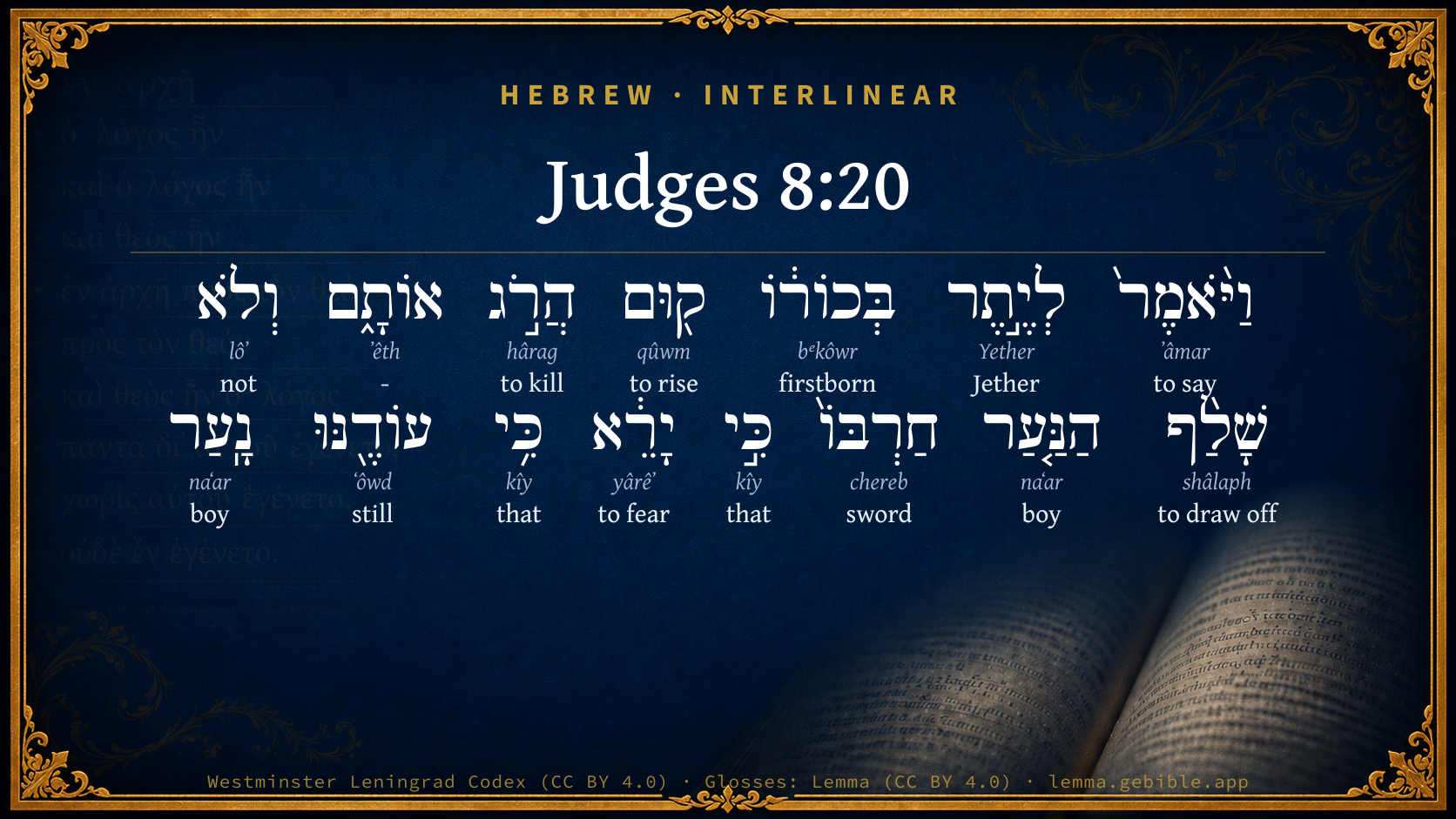
  1. וַיֹּ֨אמֶר֙ ʼâmar H559 “and · to say” Conjunction + Verb, Qal, Sequential Imperfect, 3rd Person, Masculine, Singular
  2. בְּכוֹר֔וֹ bᵉkôwr H1060 “firstborn · his” Noun, Common, Masculine, Singular, Construct + Suffix, Personal, 3rd Person, Masculine, Singular
  3. ק֖וּם qûwm H6965 “rise” Verb, Qal, Imperative, 2nd Person, Masculine, Singular
  4. הֲרֹ֣ג hârag H2026 “kill” Verb, Qal, Imperative, 2nd Person, Masculine, Singular
  5. אוֹתָ֑ם ʼêth H853 “- · them” Particle, Direct Object + Suffix, Personal, 3rd Person, Masculine, Plural
  6. וְלֹא lôʼ H3808 “and · not” Conjunction + Particle, Negative
  7. שָׁלַ֨ף shâlaph H8025 “to draw off” Verb, Qal, Perfect, 3rd Person, Masculine, Singular
  8. הַנַּ֤עַר naʻar H5288 “the · boy” Particle, Definite Article + Noun, Common, Masculine, Singular, Absolute
  9. חַרְבּוֹ֙ chereb H2719 “sword · his” Noun, Common, Feminine, Singular, Construct + Suffix, Personal, 3rd Person, Masculine, Singular
  10. כִּ֣י kîy H3588 “that” Conjunction
  11. יָרֵ֔א yârêʼ H3372 “to fear” Verb, Qal, Perfect, 3rd Person, Masculine, Singular
  12. כִּ֥י kîy H3588 “that” Conjunction
  13. עוֹדֶ֖נּוּ ʻôwd H5750 “still · his” Adverb + Suffix, Personal, 3rd Person, Masculine, Singular
  14. נָֽעַר naʻar H5288 “boy” Noun, Common, Masculine, Singular, Absolute

About this verse

These counts appear in no published source. They are computed here, from the morphology-tagged text and Lemma’s own curated glosses. What Lemma adds →

15
words
13
distinct lemmas
Historical
section

Notable vocabulary

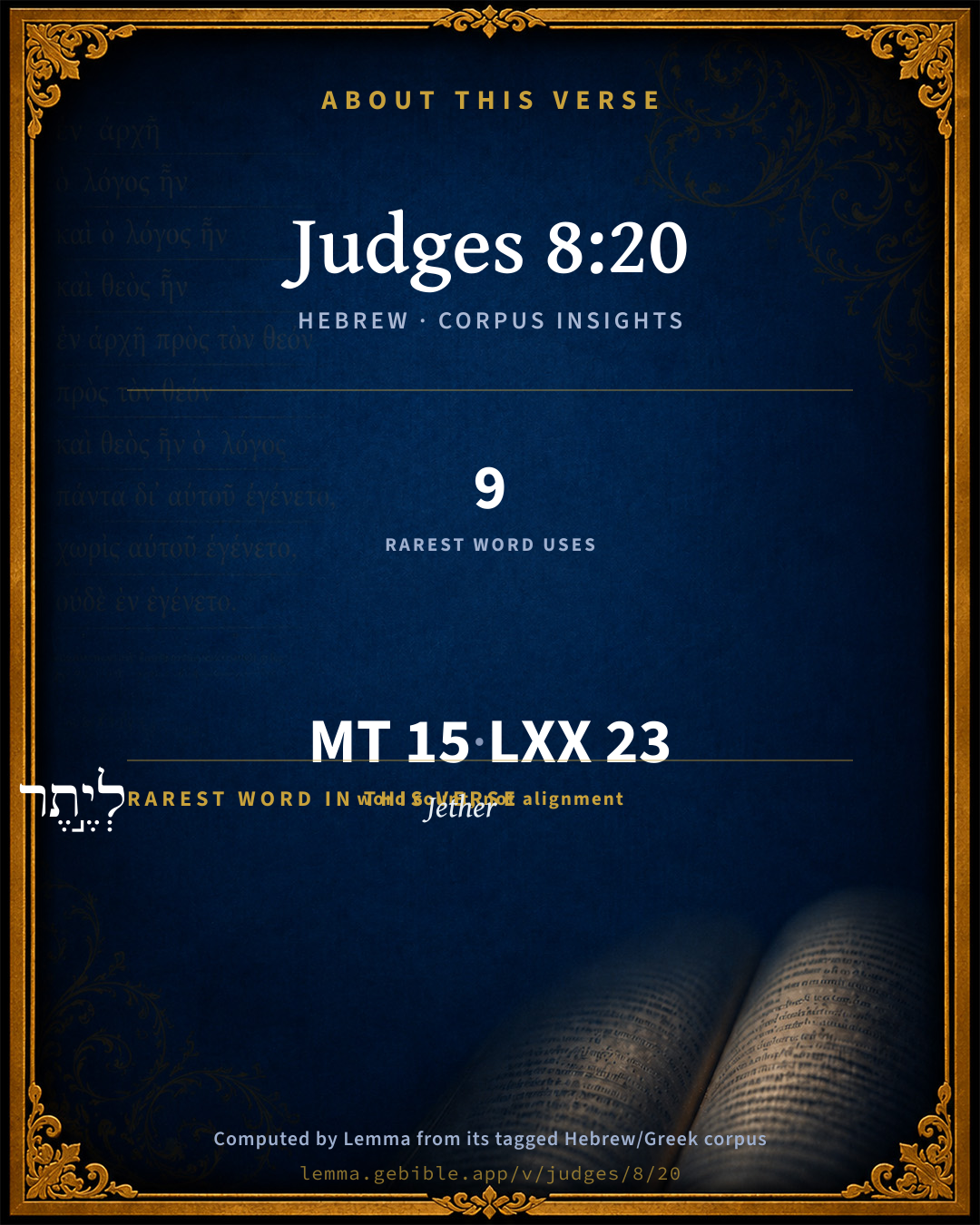
The rarest word here is לְיֶ֣תֶר Jether H3500 — appearing just 9 times in the whole Hebrew Bible.

Shared distinctive vocabulary

לְיֶ֣תֶר Jether H3500 occurs in 8 verses of the Hebrew Bible. Also found in:

Grammatical profile

  • 5 verbs
  • 5 nouns
  • 2 conjunctions
  • 1 adverb
  • 2 particles

Verb forms

  • וַיֹּ֨אמֶר֙ Qal · Sequential Imperfect
  • ק֖וּם Qal · Imperative
  • הֲרֹ֣ג Qal · Imperative
  • שָׁלַ֨ף Qal · Perfect
  • יָרֵ֔א Qal · Perfect

Repetition

Words recur within this verse — often emphatic in Hebrew:

  • הַנַּ֤עַר boy H5288 ×2
  • כִּ֣י that H3588 ×2

Hebrew & Septuagint length

In English translation the verse runs 26 words from the Hebrew and 28 from the Septuagint (LXX English) — closely comparable.

A rough comparison of the two English renderings, which tokenize alike — not a word-level alignment.

Word counts can differ between the Hebrew and the Greek without any difference in meaning — e.g. the Hebrew direct-object marker אֵת has no separate Greek word, and Greek often adds the article ὁ.

In the original languages it is 15 Hebrew tokens and 23 Greek tokens — but the two are counted differently (Hebrew bundles its prefixes and suffixes into one token; the Greek is in lemma form), so that isn’t a like-for-like length.

Cross-references

3

Topical passages linked to Judges 8:20 in the Treasury of Scripture Knowledge — connected by theme and wording, ordered by reader-vote popularity; previews shown in the World English Bible.

  • Joshua 10:24 It happened, when they brought forth those kings to Joshua, that Joshua called for all the men of Israel, and said to the chiefs of the men of war who went with him, Come near, put your feet on the necks of these kings. They came near, and put their feet on the necks of them.
  • 1 Samuel 15:33 Samuel said, As your sword has made women childless, so shall your mother be childless among women. Samuel hewed Agag in pieces before Yahweh in Gilgal.
  • Psalms 149:9 To execute on them the written judgment. All his saints have this honor. Praise Yah!

Cross-references courtesy of OpenBible.info (CC BY 4.0).

Hebrew and Greek witnesses Masoretic Hebrew ↔ Greek Septuagint

The same verse in the two great witnesses to the Old Testament, shown verse-for-verse.

These are two independent witnesses, not word-aligned to each other, and the Septuagint is shown in lemma (dictionary) form.

Hebrew Judges 8:20 Masoretic · Westminster Leningrad Codex

וַיֹּ֨אמֶר֙ לְיֶ֣תֶר בְּכוֹר֔וֹ ק֖וּם הֲרֹ֣ג אוֹתָ֑ם וְלֹא שָׁלַ֨ף הַנַּ֤עַר חַרְבּוֹ֙ כִּ֣י יָרֵ֔א כִּ֥י עוֹדֶ֖נּוּ נָֽעַר

He said to Jether his firstborn, Up, and kill them. But the youth didn't draw his sword; for he feared, because he was yet a youth.

World English Bible · Public Domain

Greek LXX Judges 8:20 Septuagint · lemma form

καί εἶπον ιεθερ ὁ πρωτότοκος αὐτός ἀναἵστημι ἀποκτείνω αὐτός καί οὐ σπάω ὁ παιδάριον ὁ ῥομφαία αὐτός ὅτι φοβέω ὅτι ἔτι νέος εἰμί

And he said to Jether his firstborn, Rise and kill them; but the lad drew not his sword, for he was afraid, for he was yet very young.

LXX2012 (modern English Septuagint) · Public Domain

Hebrew: Westminster Leningrad Codex (CC BY 4.0). Greek: Septuagint (public domain); English from LXX2012 (modern English Septuagint) (Public Domain). How the Septuagint differs from the Hebrew →

Targum (Aramaic paraphrase)

1

The Targum is the ancient Jewish Aramaic paraphrase of the Hebrew Scriptures — an interpretive translation, not the Hebrew text itself. Onkelos (literal) and Pseudo-Jonathan (expansive) render the Torah, and Jonathan the Prophets. Coverage is partial: where no permissively-licensed English translation exists for a verse, only the Aramaic is shown. This is verse-level text, not a word-by-word alignment to the Hebrew.

  1. Targum Jonathan Prophets (Joshua–Malachi)
    וַאֲמַר לְיֶתֶר בּוּכְרֵיהּ קוּם קְטוֹל יַתְהוֹן וְלָא שְׁלַף עוּלֵימָא חַרְבֵּיהּ אֲרֵי דָחִיל אֲרֵי עַד כְּעַן יָנִיק:

    (no public-domain English translation for this verse)

    Targum Jonathan — Aramaic: “Mikraot Gedolot” (public domain). English: “Sefaria Community Translation” (CC0 1.0 (public-domain dedication)); “London "Chaldee Paraphrase," 1871” (public domain). Text via Sefaria.

Commentary

Notes on Judges 8:20 from classic Christian and Jewish commentators (each source and its license shown beneath its notes). The classic Christian expositions comment on the surrounding passage and are grouped to its opening verse, so a note may address several verses; the Jewish commentaries on the Tanakh (Rashi and others) are per-verse, so they appear only where the commentator wrote on this verse.

Lemma curates 59 commentaries, every one of them public domain or Creative Commons licensed, each selected and text-cleaned for this edition rather than reprinted as found. About our sources →

Trapp's Complete Commentary

John Trapp

Jdg 8:20 And he said unto Jether his firstborn, Up, [and] slay them. But the youth drew not his sword: for he feared, because he [was] yet a youth.

Ver. 20. And he said unto Jether his firstborn, Up, and slay them.]

“ Adeo a teneris assuescere magnum est. ”

Gideon would inure his son to manlike actions from his youth, and make him share with him in the honour of his victory.

John Trapp, A Commentary or Exposition upon All the Books of the Old and New Testament (1647–1656) — public domain. Text from a community e-Sword module.

Joseph Benson's Commentary

Jdg 8:20. He said unto Jether, Up, and slay them — Some think he said this to animate his son to the use of arms for his God and country, and that he might have a share in the honour of the victory. It must be observed, that it was not unusual or disgraceful for great persons to do execution upon offenders in ancient times; no more than it was to sentence them to death: and therefore they had not, as now, public executioners; but Saul commanded such as waited on him to kill the priests; and Doeg, one of his great officers, performed that office, 1Sa 22:17-18. And Samuel himself is said to have hewed Agag to pieces in Gilgal; and Benaiah, the general of the army, to have fallen upon Joab at the horns of the altar. But the youth feared — The two kings were men, it is likely, of good stature, and of a fierce and stern countenance.

Joseph Benson's Commentary on the Old and New Testaments (1811–1818) — public domain. Text from a community e-Sword module.

Jamieson, Fausset & Brown

Robert Jamieson, A. R. Fausset & David Brown

he said unto Jether his first-born, Up, and slay them--The nearest of kin was the blood-avenger; but a magistrate might order any one to do the work of the executioner; and the person selected was always of a rank equal or proportioned to that of the party doomed to suffer (Kg1 2:29). Gideon intended, then, by the order to Jether, to put an honor on his son, by employing him to slay two enemies of his country; and on the youth declining, he performed the bloody deed himself.

Jamieson, Fausset & Brown — Commentary Critical and Explanatory on the Whole Bible (1871) — public domain (CC PDM 1.0). Text via the HelloAO Bible API.

Adam Clarke's Commentary

Verse 20. He said unto Jether his first-born] By the ancient laws of war, prisoners taken in war might be either slain, sold, or kept for slaves. To put a captive enemy to death no executioner was required. Gideon slays Zebah and Zalmunna with his own hand. So Samuel is said to have hewn Agag in pieces, 1Sa 15:33. Benaiah slew Joab, 1Kg 2:25. Saul orders his guards to slay the priests who had contributed to the escape of David, 1Sa 22:17; and David caused one of his attendants to slay the Amalekite who pretended to have slain Saul, 2Sa 1:15.

Adam Clarke's Commentary on the Bible (1810–1826) — public domain. Text from a community e-Sword/MySword module.

Ellicott's Commentary for English Readers

(20) And he said unto Jether.—By the jus talionis. as well as by every other consideration of that time, Gideon, as the last survivor of all his kingly brothers, would hold himself justified in putting his captives to death. Jether also would inherit the duties of goel (Num_35:12; 2Sa_2:22, &c), and Gideon desired both to train the boy to fearlessness against the enemies of Israel (Jos_10:24-25). to give him prestige, and to add to the disgrace of the Midianite kings. Again. Gideon must only be judged by the standard and the customs of his own day. (Comp. 1Sa_15:33, Samuel and Agag; 2Sa_1:15, David and the Amalekite.) The name Jether is another form of Jethro and means “pre-eminence.”

A Bible Commentary for English Readers, edited by Charles John Ellicott (1878–1897) — public domain. Text from a community e-Sword module.

The Cambridge Bible for Schools and Colleges

gen. ed. J. J. S. Perowne

20. Jether his firstborn] Did Gideon wish to bestow an honour upon his son, and humiliate these famous warriors? Or was the youth chosen for ceremonial reasons? Robertson Smith compares the choice of young men as sacrificers in Exo_24:5, and illustrates from the custom of the Saracens who charged lads with the slaying of their captives; Rel. of Semites, p. 396 n.

The Cambridge Bible for Schools and Colleges (gen. ed. J. J. S. Perowne; Cambridge University Press, 1878–1918) — public domain. Text from a community e-Sword module.

John Gill's Exposition

And he said unto Jether, his firstborn, up, and slay them,.... Being the near kinsman of his father's brethren, whom these kings had slain, was a proper person to avenge their blood on them; and the rather Gideon might order him to do it, for the greater mortification of the kings, to die by the hand of a youth; and for the honour of his son, to be the slayer of two kings, and to inure him to draw his sword against the enemies of Israel, and embolden him to do such exploits:

but the youth drew not his sword, for he feared, because he was yet a youth; his not drawing is sword was not out of disobedience to his father, but through fear of the kings; not of their doing him any harm, being bound; but there was perhaps a ferocity, as well as majesty in their countenances, which made the young man timorous and fearful.

John Gill's Exposition of the Whole Bible (1746–1763) — public domain (CC PDM 1.0). Text via the HelloAO Bible API.

Albert Barnes' Notes on the Bible

It was Gideon’s place to act the part of the “avenger of blood” Num 35:12; Deu 19:6. The fierce manners of the age break out in the slaying of the captives (compare 1Sa 15:32-33), and in Gideon’s attempt to initiate his youthful son Jether in the stern work of slaying his country’s enemies.

Albert Barnes' Notes on the Bible (1834–1885) — public domain. Text from a community e-Sword/MySword module.

Matthew Poole's English Annotations

Up and slay them; partly, that he might animate him to the use of arms for his God and country against their enemies, and to the exercise of justice; partly, that the death of those mischievous persons might be more shameful and painful; and partly, that he might have some share in the honour of the victory.

Matthew Poole's English Annotations on the Holy Bible (1683–1685) — public domain. Text from a community e-Sword/MySword module.

Whedon's Commentary on the Bible

Daniel D. Whedon

20. Said unto Jether — He would add to their disgrace by making them perish by the hand of a boy. They had dared to lift their hands against his kingly brethren, and now, as blood-avenger, he would have them perish with all possible ignominy and reproach.

He feared — The youth was not used to such bloody work, and perhaps the threatening looks of the two captive kings terrified him.

Daniel D. Whedon (gen. ed.), Commentary on the Old and New Testaments (1874–1909) — public domain. Text from a community e-Sword module.

The Pulpit Commentary

He said unto Jether, etc. These marks of savage life are painful to contemplate in such a man as Gideon. But it is well for us to be made aware how the best and greatest men cannot rise above the manners and received maxims of their age; and it teaches us to make due allowance for the faults of uncivilised men with whom we have to do, whether Afghans, or Zulus, or others.

The Pulpit Commentary (1880–1919), ed. H.D.M. Spence-Jones & Joseph S. Exell — public domain. Text from a community e-Sword module.

John Wesley's Explanatory Notes

Up, and slay - That he might animate him to the use of arms for his God and country, and that he might have a share in the honour of the victory.

John Wesley, Explanatory Notes Upon the Whole Bible (1754–1765) — public domain. Text via the GEBible commentary corpus.

unfoldingWord translationNotes

Door43 World Missions Community

Jether

This is the name of Gideon's son. (See: How to Translate Names)

For as the man is, so is his strength

This is an idiom. AT: "It is a job for a man to do" (See: Idiom)

crescent

This is a curved shape with two points. This shape occurs when the moon is mostly covered in shadow.

ornaments

decorations

translationWords

firstborn

sword

Gideon

camel

unfoldingWord translationNotes — © Distant Shores Media and the Door43 World Missions Community, licensed CC BY-SA 4.0. Source: git.door43.org/Door43/en_tn.

Rashi

Rabbi Shlomo Yitzchaki (Rashi)

But the boy would not draw his sword to execute them, for he was afraid of them.

Rashi on the Tanakh — English translations: “The Judaica Press complete Tanach with Rashi, translated by A. J. Rosenberg” (CC BY 4.0); “Pentateuch with Rashi's commentary by M. Rosenbaum and A.M. Silbermann, 1929-1934” (public domain); “The Metsudah Tanach series, Lakewood, N.J” (CC BY 4.0); and “The Book of Joshua, Metsudah Publications, 1997” (CC BY 4.0). Text via Sefaria.

Lesson kit

Teaching starters — assembled from the data on this page, not authored interpretation. Every prompt links to the verse data it draws on. Edit before teaching.

Judges, in the Historical, opens this verse with 15 words (13 distinct Hebrew lemmas). Its most distinctive word is Yether (“Jether”). A historical commentator’s framing appears above. Read the whole chapter for the surrounding context.

Discussion questions

  1. How does “Jether” (Yether) shape what this verse is saying?
  2. Exodus 4:18 shares the word «Jether» with this verse. How do the two illuminate each other?
  3. “boy” occurs 2× in this one verse. What is the effect of the repetition?
  4. These translations render this verse differently. What is at stake in choosing one wording over another?
  5. The verb «וַיֹּ֨אמֶר֙» is Qal Sequential Imperfect. How does its form color the action?
  6. Reading how Trapp's Complete Commentary and Joseph Benson's Commentary read this verse, where do the two commentators agree and where do they part?

Things to notice

Reading settings

Reading text

Shown beneath each verse's original-language words.

Old Testament
Old Testament edition

Read the OT as the Masoretic Hebrew (MT) or the Greek Septuagint (LXX).

English shown for the Greek Septuagint (in the Hebrew ↔ Greek comparison).

Comparing translations? Open the Compare panel on any verse page to stack up to four side by side.