
Isaiah 34:6

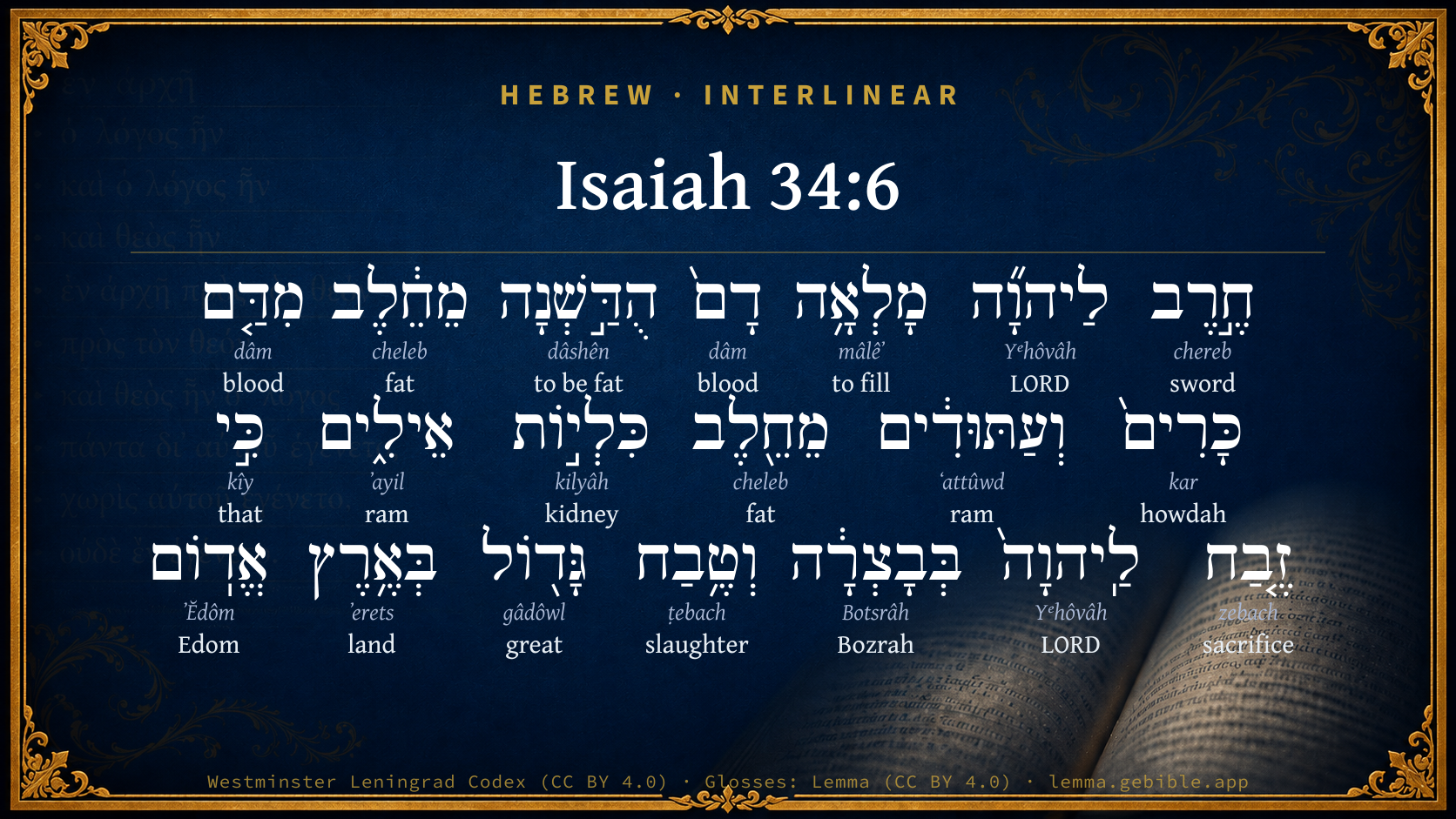
Hebrew (Westminster Leningrad Codex) Isaiah 34:6 appears in the Hebrew Old Testament. The text above is from the Westminster Leningrad Codex. Each word links to its Strong’s number, a concise gloss, and parsing drawn from the Open Scriptures Hebrew Bible morphology. Click any word for its full Brown-Driver-Briggs (BDB) entry.
Download image
Cite this verse

Isaiah 34:6 (World English Bible). Public Domain. Lemma interlinear Bible study tool, https://lemma.gebible.app/v/isaiah/34/6.

Show BibTeX & RIS
BibTeX
RIS
English Translation
The sword of Yahweh is filled with blood, it is made fat with fatness, with the blood of lambs and goats, with the fat of the kidneys of rams; for Yahweh has a sacrifice in Bozrah, and a great slaughter in the land of Edom.
World English Bible · Public Domain
Download a study sheet

One document with this verse’s original text, its word-by-word gloss line, the meaning frame, cross-references with their text, attributed commentary, and full source and license credits — printable, and it pastes into notes with its structure intact.

This verse Autodidact and up

Study sheet (.html) Plain text (.txt)

A passage Seminary Student

Up to 50 verses in one chapter. A passage sheet keeps up to 6 commentary sources and 12 cross-references per verse, in the order this page ranks them, and says so on the sheet whenever that leaves anything out. Ask for a single verse and you get the Autodidact verse sheet above.

Everything on this page stays free to read, with no account — the sheet is a download of what is already on screen, not access to it.

Want to remove ads? Support Godless Engineer
Compare translations 3

The same verse in 3 English versions, stacked beneath the original-language interlinear above. Click any original word for its lexicon entry.

Each is an independent rendering of the whole verse — the interlinear is not word-aligned to these translations.

Highlighted words mark where these versions differ — a whole-verse word diff, not a word-by-word alignment.

  • World English Bible Public Domain
    The sword of Yahweh is filled with blood, it is made fat with fatness, with the blood of lambs and goats, with the fat of the kidneys of rams; for Yahweh has a sacrifice in Bozrah, and a great slaughter in the land of Edom.
  • King James Version Public Domain
    The sword of the LORD is filled with blood, it is made fat with fatness, and with the blood of lambs and goats, with the fat of the kidneys of rams: for the LORD hath a sacrifice in Bozrah, and a great slaughter in the land of Idumea.
  • unfoldingWord Literal Text CC BY-SA 4.0
    The sword of Yahweh is full of blood, fattened from fat, from the blood of lambs and goats, from the fat of the kidneys of rams. For a sacrifice to Yahweh in Bozrah, and a great slaughter in the land of Edom.

unfoldingWord Literal Text — © unfoldingWord, licensed CC BY-SA 4.0. Word-aligned USFM3 via Door43 (git.door43.org/unfoldingWord/en_ult).

Versions to compare (up to 4)

3 of 4 selected

Show all 18 translations

Every available English version of this verse, each an independent rendering of the whole verse.

  • World English Bible Public Domain
    The sword of Yahweh is filled with blood, it is made fat with fatness, with the blood of lambs and goats, with the fat of the kidneys of rams; for Yahweh has a sacrifice in Bozrah, and a great slaughter in the land of Edom.
  • Berean Standard Bible Public Domain
    The sword of the LORD is bathed in blood. It drips with fat—with the blood of lambs and goats, with the fat of the kidneys of rams. For the LORD has a sacrifice in Bozrah, a great slaughter in the land of Edom.
  • Majority Standard Bible Public Domain
    The sword of the LORD is bathed in blood. It drips with fat—with the blood of lambs and goats, with the fat of the kidneys of rams. For the LORD has a sacrifice in Bozrah, a great slaughter in the land of Edom.
  • King James Version Public Domain
    The sword of the LORD is filled with blood, it is made fat with fatness, and with the blood of lambs and goats, with the fat of the kidneys of rams: for the LORD hath a sacrifice in Bozrah, and a great slaughter in the land of Idumea.
  • American Standard Version (1901) Public Domain
    The sword of Jehovah is filled with blood, it is made fat with fatness, with the blood of lambs and goats, with the fat of the kidneys of rams; for Jehovah hath a sacrifice in Bozrah, and a great slaughter in the land of Edom.
  • Revised Version (1885) Public Domain
    The sword of the LORD is filled with blood, it is made fat with fatness, with the blood of lambs and goats, with the fat of the kidneys of rams: for the LORD hath a sacrifice in Bozrah, and a great slaughter in the land of Edom.
  • Geneva Bible (1599) Public Domain
    The sword of the Lord is filled with blood: it is made fat with the fat and with the blood of the lambes and the goates, with the fat of the kidneis of the rams: for the Lord hath a sacrifice in Bozrah, and a great slaughter in the land of Edom.
  • Douay-Rheims (1899) Public Domain
    The sword of the Lord is filled with blood, it is made thick with the blood of lambs and buck goats, with the blood of rams full of marrow: for there is a victim of the Lord in Bosra and a great slaughter in the land of Edom.
  • Young's Literal Translation Public Domain
    A sword `is' to Jehovah -- it hath been full of blood, It hath been made fat with fatness, With blood of lambs and he-goats. With fat of kidneys of rams, For a sacrifice `is' to Jehovah in Bozrah, And a great slaughter in the land of Edom.
  • Literal Standard Version CC BY-SA 4.0
    A sword [is] to YHWH—it has been full of blood, || It has been made fat with fatness, || With blood of lambs and male goats. With fat of kidneys of rams, || For to YHWH [is] a sacrifice in Bozrah, || And a great slaughter in the land of Edom.
  • Unlocked Literal Bible CC BY-SA 4.0
    The sword of Yahweh is dripping with blood and covered with fat, dripping with the blood of lambs and goats, covered with the fat of the kidneys of rams. For Yahweh has a sacrifice in Bozrah and a great slaughter in the land of Edom.
  • unfoldingWord Literal Text CC BY-SA 4.0
    The sword of Yahweh is full of blood, fattened from fat, from the blood of lambs and goats, from the fat of the kidneys of rams. For a sacrifice to Yahweh in Bozrah, and a great slaughter in the land of Edom.
  • Darby Bible Public Domain
    The sword of Jehovah is filled with blood, it is made fat with fatness, with the blood of lambs and goats, with the fat of the kidneys of rams; for Jehovah hath a sacrifice in Bozrah, and a great slaughter in the land of Edom.
  • World Messianic Bible Public Domain
    The LORD’s sword is filled with blood. It is covered with fat, with the blood of lambs and goats, with the fat of the kidneys of rams; for the LORD has a sacrifice in Bozrah, and a great slaughter in the land of Edom.
  • Webster's Bible Public Domain
    The sword of the LORD is filled with blood, it is made fat with fatness, and with the blood of lambs and goats, with the fat of the kidneys of rams: for the LORD hath a sacrifice in Bozrah, and a great slaughter in the land of Edom.
  • Free Bible Version CC BY-SA 4.0
    The sword of the Lord is coated in blood and covered with fat—the blood of lambs and goats, and the fat of rams' kidneys. For there is a sacrifice for Lord happening in Bozrah, a great slaughter in the land of Edom.
  • Bible in Basic English Public Domain
    The sword of the Lord is full of blood, it is fat with the best of the meat, with the blood of lambs and goats, with the best parts of the sheep: for the Lord has a feast in Bozrah, and much cattle will be put to death in the land of Edom.
  • JPS Tanakh (1917) Public Domain
    The sword of the LORD is filled with blood, it is made fat with fatness, with the blood of lambs and goats, with the fat of the kidneys of rams; for the LORD hath a sacrifice in Bozrah, and a great slaughter in the land of Edom.

Literal Standard Version (2020), Covenant Press — licensed CC BY-SA 4.0. Text via the HelloAO Bible API (eBible.org). Unlocked Literal Bible (unfoldingWord) — licensed CC BY-SA 4.0. Text via the HelloAO Bible API (eBible.org). unfoldingWord Literal Text — © unfoldingWord, licensed CC BY-SA 4.0. Word-aligned USFM3 via Door43 (git.door43.org/unfoldingWord/en_ult). Free Bible Version, Dr. Jonathan Gallagher — licensed CC BY-SA 4.0. Text via the HelloAO Bible API (eBible.org).

Word by word

More ways to search: Search by grammar → Find every occurrence → Compare this word →

Practice this passage: Drill this verse → Learn its vocabulary →

בְּבָצְרָ֔ה
Botsrâh
H1224
“in/at · Bozrah”
Preposition + Noun, Proper
Part of Speech
Preposition + Noun
Type
Proper
Full BDB Definition

Origin: the same as H1223

TWOT: None

Bozrah = "sheepfold" or " fortress" - a town in Edom - a town in Moab
  1. חֶ֣רֶב chereb H2719 “sword” Noun, Common, Feminine, Singular, Absolute
  2. לַיהוָ֞ה Yᵉhôvâh H3068 “to/for · LORD” Preposition + Noun, Proper
  3. מָלְאָ֥ה mâlêʼ H4390 “to fill” Verb, Qal, Perfect, 3rd Person, Feminine, Singular
  4. דָם֙ dâm H1818 “blood” Noun, Common, Masculine, Singular, Absolute
  5. הֻדַּ֣שְׁנָה dâshên H1878 “to be fat” Verb, Hothpaal, Perfect, 3rd Person, Feminine, Singular
  6. מֵחֵ֔לֶב cheleb H2459 “from · fat” Preposition + Noun, Common, Masculine, Singular, Absolute
  7. מִדַּ֤ם dâm H1818 “from · blood of” Preposition + Noun, Common, Masculine, Singular, Construct
  8. כָּרִים֙ kar H3733 “howdahs” Noun, Common, Masculine, Plural, Absolute
  9. וְעַתּוּדִ֔ים ʻattûwd H6260 “and · rams” Conjunction + Noun, Common, Masculine, Plural, Absolute
  10. מֵחֵ֖לֶב cheleb H2459 “from · fat of” Preposition + Noun, Common, Masculine, Singular, Construct
  11. כִּלְי֣וֹת kilyâh H3629 “kidneys of” Noun, Common, Feminine, Plural, Construct
  12. אֵילִ֑ים ʼayil H352 “rams” Noun, Common, Masculine, Plural, Absolute
  13. כִּ֣י kîy H3588 “that” Conjunction
  14. זֶ֤בַח zebach H2077 “sacrifice” Noun, Common, Masculine, Singular, Absolute
  15. לַֽיהוָה֙ Yᵉhôvâh H3068 “to/for · LORD” Preposition + Noun, Proper
  16. וְטֶ֥בַח ṭebach H2874 “and · slaughter” Conjunction + Noun, Common, Masculine, Singular, Absolute
  17. גָּד֖וֹל gâdôwl H1419 “great” Adjective, Adjective, Masculine, Singular, Absolute
  18. בְּאֶ֥רֶץ ʼerets H776 “in/at · land of” Preposition + Noun, Common, Both, Singular, Construct
  19. אֱדֽוֹם ʼĔdôm H123 “Edom” Noun, Proper

About this verse

These counts appear in no published source. They are computed here, from the morphology-tagged text and Lemma’s own curated glosses. What Lemma adds →

20
words
17
distinct lemmas
Prophets
section

Notable vocabulary

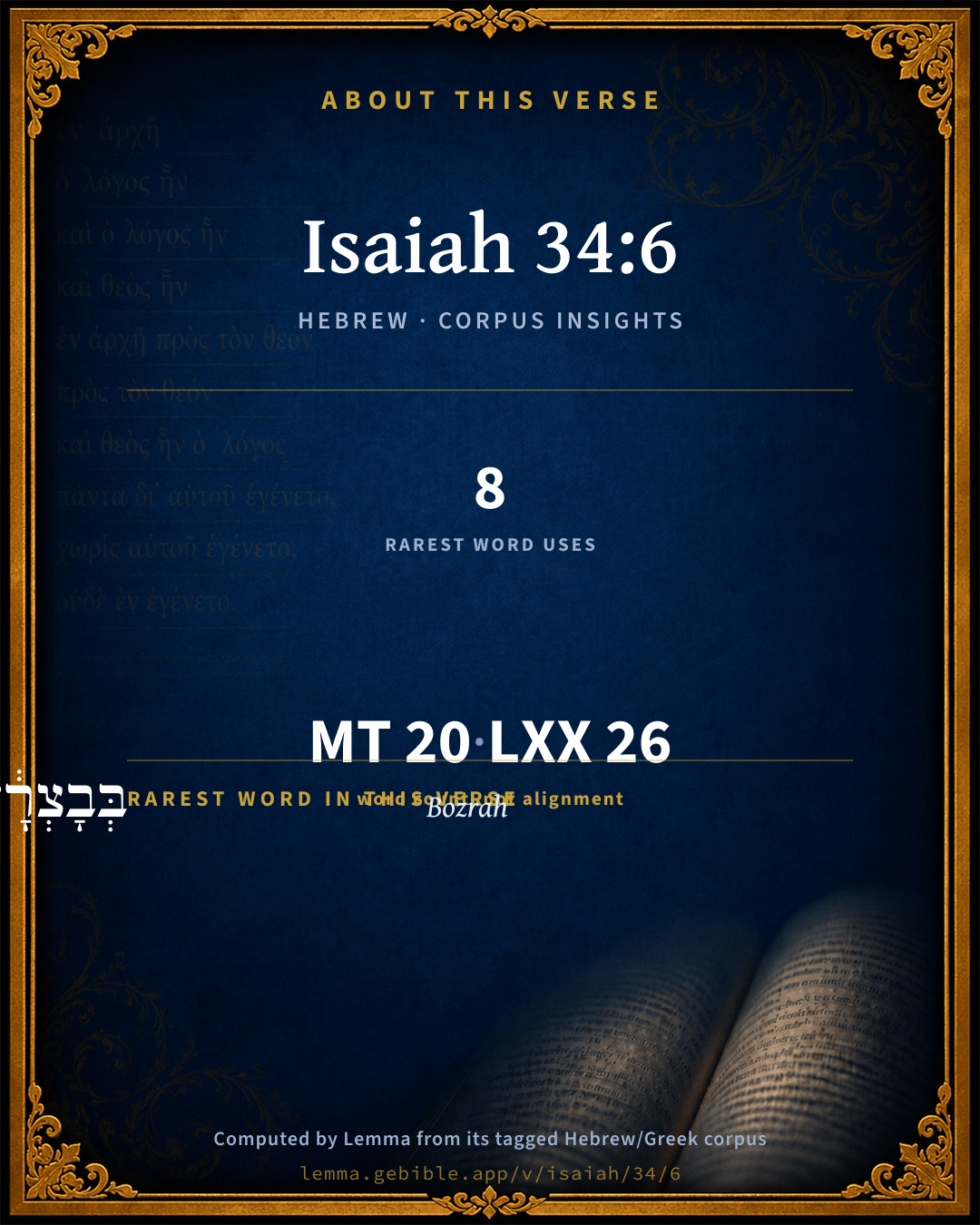
The rarest word here is בְּבָצְרָ֔ה Bozrah H1224 — appearing just 8 times in the whole Hebrew Bible.

Shared distinctive vocabulary

בְּבָצְרָ֔ה Bozrah H1224 occurs in 8 verses of the Hebrew Bible. Also found in:

Grammatical profile

  • 2 verbs
  • 16 nouns
  • 1 adjective
  • 1 conjunction

Verb forms

  • מָלְאָ֥ה Qal · Perfect
  • הֻדַּ֣שְׁנָה Hothpaal · Perfect

Repetition

Words recur within this verse — often emphatic in Hebrew:

  • לַיהוָ֞ה LORD H3068 ×2
  • דָם֙ blood H1818 ×2
  • מֵחֵ֔לֶב fat H2459 ×2

Hebrew & Septuagint length

In English translation the verse runs 45 words from the Hebrew and 43 from the Septuagint (LXX English) — closely comparable.

A rough comparison of the two English renderings, which tokenize alike — not a word-level alignment.

Word counts can differ between the Hebrew and the Greek without any difference in meaning — e.g. the Hebrew direct-object marker אֵת has no separate Greek word, and Greek often adds the article ὁ.

In the original languages it is 20 Hebrew tokens and 26 Greek tokens — but the two are counted differently (Hebrew bundles its prefixes and suffixes into one token; the Greek is in lemma form), so that isn’t a like-for-like length.

Cross-references

12

Topical passages linked to Isaiah 34:6 in the Treasury of Scripture Knowledge — connected by theme and wording, ordered by reader-vote popularity; previews shown in the World English Bible.

  • Isaiah 63:1 Who is this who comes from Edom, with dyed garments from Bozrah? this who is glorious in his clothing, marching in the greatness of his strength? I who speak in righteousness, mighty to save.
  • Jeremiah 49:13 For I have sworn by myself, says Yahweh, that Bozrah shall become an astonishment, a reproach, a waste, and a curse; and all the cities of it shall be perpetual wastes.
  • Deuteronomy 32:14 Butter of the herd, and milk of the flock, With fat of lambs, Rams of the breed of Bashan, and goats, With the finest of the wheat; Of the blood of the grape you drank wine.
  • Isaiah 34:5 For my sword has drunk its fill in the sky: behold, it shall come down on Edom, and on the people of my curse, to judgment.
  • Isaiah 63:3 I have trodden the winepress alone; and of the peoples there was no man with me: yes, I trod them in my anger, and trampled them in my wrath; and their lifeblood is sprinkled on my garments, and I have stained all my clothing.
  • Jeremiah 50:27 Kill all her bulls; let them go down to the slaughter: woe to them! for their day is come, the time of their visitation.
  • Jeremiah 51:40 I will bring them down like lambs to the slaughter, like rams with male goats.
  • Ezekiel 21:4–5 Seeing then that I will cut off from you the righteous and the wicked, therefore shall my sword go forth out of its sheath against all flesh from the south to the north:
  • Ezekiel 39:17–20 You, son of man, thus says the Lord Yahweh: Speak to the birds of every sort, and to every animal of the field, Assemble yourselves, and come; gather yourselves on every side to my sacrifice that I do sacrifice for you, even a great sacrifice on the mountains of Israel, that you may eat flesh and drink blood.
  • Zephaniah 1:7 Be silent at the presence of the Lord Yahweh, for the day of Yahweh is at hand. For Yahweh has prepared a sacrifice. He has consecrated his guests.
  • Revelation 19:17–18 I saw an angel standing in the sun. He cried with a loud voice, saying to all the birds that fly in the sky, "Come! Be gathered together to the great supper of God,
  • Ezekiel 21:10 it is sharpened that it may make a slaughter; it is furbished that it may be as lightning: shall we then make mirth? the rod of my son, it condemns every tree.

Cross-references courtesy of OpenBible.info (CC BY 4.0).

Hebrew and Greek witnesses Masoretic Hebrew ↔ Greek Septuagint

The same verse in the two great witnesses to the Old Testament, shown verse-for-verse.

These are two independent witnesses, not word-aligned to each other, and the Septuagint is shown in lemma (dictionary) form.

Hebrew Isaiah 34:6 Masoretic · Westminster Leningrad Codex

חֶ֣רֶב לַיהוָ֞ה מָלְאָ֥ה דָם֙ הֻדַּ֣שְׁנָה מֵחֵ֔לֶב מִדַּ֤ם כָּרִים֙ וְעַתּוּדִ֔ים מֵחֵ֖לֶב כִּלְי֣וֹת אֵילִ֑ים כִּ֣י זֶ֤בַח לַֽיהוָה֙ בְּבָצְרָ֔ה וְטֶ֥בַח גָּד֖וֹל בְּאֶ֥רֶץ אֱדֽוֹם

The sword of Yahweh is filled with blood, it is made fat with fatness, with the blood of lambs and goats, with the fat of the kidneys of rams; for Yahweh has a sacrifice in Bozrah, and a great slaughter in the land of Edom.

World English Bible · Public Domain

Greek LXX Isaiah 34:6 Septuagint · lemma form

ὁ μάχαιρα κύριος ἐνπίμπλημι αἷμα παχύνω ἀπό στέαρ ἀρνός καί ἀπό στέαρ τράγος καί κριός ὅτι θυσία κύριος ἐν βοσορ καί σφαγή μέγας ἐν ὁ ιδουμαία

The sword of the Lord is filled with blood, it is glutted with fat, with the blood of goats and lambs, and with the fat of goats and rams: for the Lord has a sacrifice in Bosor, and a great slaughter in Idumea.

LXX2012 (modern English Septuagint) · Public Domain

Hebrew: Westminster Leningrad Codex (CC BY 4.0). Greek: Septuagint (public domain); English from LXX2012 (modern English Septuagint) (Public Domain). How the Septuagint differs from the Hebrew →

Targum (Aramaic paraphrase)

1

The Targum is the ancient Jewish Aramaic paraphrase of the Hebrew Scriptures — an interpretive translation, not the Hebrew text itself. Onkelos (literal) and Pseudo-Jonathan (expansive) render the Torah, and Jonathan the Prophets. Coverage is partial: where no permissively-licensed English translation exists for a verse, only the Aramaic is shown. This is verse-level text, not a word-by-word alignment to the Hebrew.

  1. Targum Jonathan Prophets (Joshua–Malachi)
    חַרְבָּא קֳדָם יְיָ אִיתְמְלִיאַת דַם אִדַהֲנַת מִתְּרַב מִדַם מַלְכִין וְשִׁלְטוֹנִין מִתְּרַב כָּלְיָת רַבְרְבִין אֲרֵי קְטָלָא קֳדָם יְיָ בְּבָצְרָה וְנִכְסָא סַגִיאָה בְּאַרְעָא דֶאֱדוֹם:

    The sword before the presence of the Lord is filled with blood, it is fattened, it is fattened with the blood of kings and rulers, it is fattened with the kidneys of princes; because there is a slaughter before the Lord in Bozrah, and a great sacrifice in the land of Edom.

    Targum Jonathan — Aramaic: “Mikraot Gedolot” (public domain). English: “Sefaria Community Translation” (CC0 1.0 (public-domain dedication)); “London "Chaldee Paraphrase," 1871” (public domain). Text via Sefaria.

Commentary

Notes on Isaiah 34:6 from classic Christian and Jewish commentators (each source and its license shown beneath its notes). The classic Christian expositions comment on the surrounding passage and are grouped to its opening verse, so a note may address several verses; the Jewish commentaries on the Tanakh (Rashi and others) are per-verse, so they appear only where the commentator wrote on this verse.

Lemma curates 59 commentaries, every one of them public domain or Creative Commons licensed, each selected and text-cleaned for this edition rather than reprinted as found. About our sources →

Trapp's Complete Commentary

John Trapp

Isa 34:6 The sword of the LORD is filled with blood, it is made fat with fatness, [and] with the blood of lambs and goats, with the fat of the kidneys of rams: for the LORD hath a sacrifice in Bozrah, and a great slaughter in the land of Idumea.

Ver. 6. The sword of the Lord is filled with blood, &c.] That is, It maketh clean work, as the blood and fat were in sacrifices consumed, {Lev 1:16-17} and this execution was no less pleasing to God than some solemn sacrifice.

For the Lord hath a sacrifice in Bozrah.] The metropolis of Idumea; Ptolemy calleth it Botsra. And it prefigured Rome, saith Piscator, the chief city and seat of Antichrist’s kingdom.

John Trapp, A Commentary or Exposition upon All the Books of the Old and New Testament (1647–1656) — public domain. Text from a community e-Sword module.

Tyndale Open Study Notes

Tyndale Open Resources

34:6 Bozrah was a city in Edom, southeast of the Dead Sea.

Tyndale Open Study Notes — © Tyndale Open Resources, licensed CC BY-SA 4.0. Text via the HelloAO Bible API.

Geneva Bible (1599)

Geneva Bible translators

That is, both of young and old, poor and rich of his enemies.

That famous city shall be consumed as a sacrifice burnt to ashes.

Geneva Bible (1599) marginal notes — public domain. Text via Bolls.life.

Jamieson, Fausset & Brown

Robert Jamieson, A. R. Fausset & David Brown

filled--glutted. The image of a sacrifice is continued.

blood . . . fat--the parts especially devoted to God in a sacrifice (Sa2 1:22).

lambs . . . goats--sacrificial animals: the Idumeans, of all classes, doomed to slaughter, are meant (Zep 1:7).

Bozrah--called Bostra by the Romans, &c., assigned in Jer 48:24 to Moab, so that it seems to have been at one time in the dominion of Edom, and at another in that of Moab (Isa 63:1; Jer 49:13, Jer 49:20, Jer 49:22); it was strictly not in Edom, but the capital of Auranitis (the Houran). Edom seems to have extended its dominion so as to include it (compare Lam 4:21).

Jamieson, Fausset & Brown — Commentary Critical and Explanatory on the Whole Bible (1871) — public domain (CC PDM 1.0). Text via the HelloAO Bible API.

Adam Clarke's Commentary

Verse 6. The Lord hath a sacrifice - "For JEHOVAH celebrateth a sacrifice"] Ezekiel, Eze 39:16-17, has manifestly imitated this place of Isaiah. He hath set forth the great leaders and princes of the adverse powers under the same emblems of goats, bulls, rams, fatlings, c., and has added to the boldness of the imagery, by introducing God as summoning all the fowls of the air, and all the beasts of the field, and bidding them to the feast which he has prepared for them by the slaughter of the enemies of his people: -

"And thou, son of man,

Thus saith the Lord JEHOVAH,

Say to the bird of every wing,

And to every beast of the field:

Assemble yourselves, and come

Gather together from every side,

To the sacrifice which I make for you,

A great slaughter on the mountains of Israel.

And ye shall eat flesh and drink blood:

The flesh of the mighty shall ye eat,

And the blood of the lofty of the earth shall ye drink;

Of rams, of lambs, and of goats,

Of bullocks, all of them the fat ones of Bashan;

And ye shall eat fat, till ye are cloyed,

And drink blood, till ye are drunken;

Of my slaughter, which I have slain for you."

The sublime author of the Revelation, Re 19:17-18, has taken this image from Ezekiel, rather than from Isaiah.

Adam Clarke's Commentary on the Bible (1810–1826) — public domain. Text from a community e-Sword/MySword module.

Ellicott's Commentary for English Readers

(6) The Lord hath a sacrifice in Bozrah . . .—Two cities of this name appear in history; one in the Haurân, more or less conspicuous in ecclesiastical history, and the other, of which Isaiah now speaks, in Edom. It was a strongly fortified city, and is named again and again. (Comp. Isa_63:1; Amo_1:12; Jer_49:13; Jer_49:22.) The image both of the sword and the sacrifice appears in Jer_46:10.

A Bible Commentary for English Readers, edited by Charles John Ellicott (1878–1897) — public domain. Text from a community e-Sword module.

The Cambridge Bible for Schools and Colleges

gen. ed. J. J. S. Perowne

6. The sword of the Lord is filled] Render: A sword hath Jehovah which is filled, &c.

made fat with fatness] Or, “greased with fat” (different words in the original). The Edomites are compared to sacrificial animals; cf. Zep_1:7; Jer_46:10; Jer_51:40; Eze_39:17 ff. (See also 2Sa_1:22.)

Bozrah (ch. Isa_63:1; Gen_36:33; Amo_1:12; Jer_49:13; Jer_49:22) was a chief city of Edom, certainly not a place of that name in the Hauran; more probably El-Buṣeira, south of the Dead Sea; but Wetzstein identifies it with Petra.

The Cambridge Bible for Schools and Colleges (gen. ed. J. J. S. Perowne; Cambridge University Press, 1878–1918) — public domain. Text from a community e-Sword module.

John Gill's Exposition

The sword of the Lord is filled with blood,.... Multitudes being slain by it; the "Lord" here is that divine Person that is described as a warrior, as a General of an army, with a sharp sword, by whom many are slain, such a number as that it is filled with the blood of them, Rev 19:11,

it is made fat with fatness: not only filled with the blood, but fattened by it; the allusion is to ravenous creatures gorged and sated with the blood of others, and thereby made fat; perhaps this may refer to Christian princes, the sword in the hand of the Lord, who shall be enriched with the plunder and spoil of the antichristian states:

and with the blood of lambs and goats, with the fat of the kidneys of rams. The Targum is,

"with the blood of kings and governors, with the fat of the kidneys princes;''

and Jarchi interprets them, of princes and rulers; but rather the common people are designed, or the common soldiers in the army, or however the inferior officers of it; kings, princes, and generals, being intended in the following verse Isa 34:7. It denotes the great carnage of all sorts and ranks of men made at this time, and which is described in Rev 19:18,

for the Lord hath a sacrifice in Bozrah, and a great slaughter in the land of Idumea: there seems to be two Bozrahs the Scripture speaks of, the one in Moab, Jer 48:24 and another in Edom, Isa 63:1 which is here meant, and was a chief city of the Edomites, and signifies a fortress, being no doubt a place well fortified; this is the Bostra of Ptolemy (k), and which he places in Arabia Petraea. Aben Ezra says that some interpret it of Constantinople, the metropolis of the Ottoman empire; but it is best to understand it of Rome, as Menasseh ben Israel (l) does, and Idumea of the whole Roman jurisdiction; Rome being the chief city of the antichristian states, that great city, which John in his Revelation describes as reigning over the kings of the earth; here and in all the antichristian kingdoms will be a great "slaughter" of men, called a "sacrifice" of the Lord, because by his order and direction, and for the honour of his justice, and being acceptable to him; and perhaps there may be an allusion to the blood sacrifices being the Lord's; this slaughter and sacrifice is called the supper of the great God, Rev 19:17.

(k) Geograph. l. 5. c. 17. (l) Spes Israelis, sect. 30. p. 91.

John Gill's Exposition of the Whole Bible (1746–1763) — public domain (CC PDM 1.0). Text via the HelloAO Bible API.

Albert Barnes' Notes on the Bible

The sword of the Lord is filled with blood - The idea here is taken from the notion of sacrifice, and is, that God would devote to sacrifice, or to destruction, the inhabitants of Idumea. With reference to that, he says, that his sword, the instrument of slaughter, would be satiated with blood. “It is made fat with fatness.” The allusion here is to the sacrifices which were made for sin, in which the blood. and the fat were devoted to God as an offering (see Lev. 7)

With the blood of lambs and goats - These were the animals which were usually offered in sacrifice to God among the Jews. and to speak of a sacrifice was the same as to speak of the offering of rams, lambs, bullocks, etc. Yet it is evident that they denote here the people of Idumea, and that these terms are used to keep up the image of a sacrifice. The idea of sacrifice was always connected with that of slaughter, as the animals were slaughtered before they were offered. So here, the idea is, that there would be a great slaughter in Idumea; that it would be so far of the nature of a sacrifice that they would be devoted to God and to his cause. It is not probable that any particular classes of people are denoted by the different animals mentioned here, as the animals here mentioned include all, or nearly all those usually offered in sacrifice, the expressions denote simply that all classes of people in Idumea would be devoted to the slaughter. Grotius, however, supposes that the following classes are intended by the animals specified, to wit, by the lambs, the people in general; by the goats, the priests; by the rams, the opulent inhabitants.

For the Lord hath a sacrifice in Bozrah - Bozrah is mentioned here as one of the chief cities of Idumea. It was a city of great antiquity, and was known among the Greeks and Romans by the name of Bostra. It is generally mentioned in the Scriptunes as a city of the Edomites Isa 63:1; Jer 49:13, Jer 49:22; Amo 1:12; but once it is mentioned as a city of Moab Jer 48:24. It probably belonged at different periods to both nations, as in their wars the possession of cities often passed into different hands. Bozrah lay southeast of Edrei, one of the capitals of Bashan, and was thus not properly within the limits of the Edomites, but was north of the Ammonites, or in the region of Auranitis, or in what is now called tho Houran. It is evident, therefore, that in the time of Isaiah, the Edomites had extended their conquests to that region.

According to Burckhardt, who visited the Houran, and who went to Bozrah, it is at this day one of the most important cities there. ‘It is situated,’ says he, ‘in the open plain, and is at present the last inhabited place in the southeast extremity of the Houran; it was formerly the capital of the Arabia Provincia, and is now, including its ruins, the largest town in the Houran. It is of an oval shape, its greatest length being from east to west; its circumference is three quarters of an hour. It was anciently encompassed with a thick wall, which gave it the reputation of great strength Many parts of this wall, especially on the west side, remain; it was constructed of stones of moderate size, strongly cemented together. The south, and southeast quarters are covered with ruins of private dwellings, the walls Of many of which are still standing, but the roofs are fallen in. The style of building seems to have been similar to that observed in all the other ancient towns of the Houran. On the west side are springs of fresh water, of which I counted five beyond the precincts of the town, and six within the walls; their waters unite with a rivulet whose source is on the northwest side, within the town, and which loses itself in the southern plain at several hours’ distance; it is called by the Arabs, El Djeheir. The principal ruins of Bozrah are the following: A square building which within is circular, and has many arches and niches in the wall.

The diameter of the arounda is four paces; its roof has fallen in, but the walls are entire. It appears to have been a Greek church. An oblong square building, called by the natives Deir Boheiry, or the Monastery of the priest Boheiry. The gate of an ancient house com municating with the ruins of an edifice, the only remains of which is a large semicircular vault. The great mosque of Bozrah, which is certainly coeval with the first era of Mahometanism, and is commonly ascribed to Omar el Khattah. The walls of the mosque are covered with a fine coat of plaster, upon which are many Curie inscriptions in bas-relief, running all round the wall The remains of a temple, situated on the side of a long street which runs across the whole town, and terminates at the western gate,’ etc. Of these, and other magnificent ruins of temples, theaters, and palaces, all attesting its former importance, Burckhardt has given a copious description in his Travels in Syria, pp. 226-235, Quarto Ed. LoRd. 1822.

Albert Barnes' Notes on the Bible (1834–1885) — public domain. Text from a community e-Sword/MySword module.

Matthew Poole's English Annotations

Is filled with blood; shall drink its fill of blood. The metaphor is here taken from a great glutton or drunkard, who is almost insatiable with meat and drink.

With the blood of lambs and goats, with the fat of the kidneys of rams: by, lambs, and goats, and rams, he means people of all ranks and conditions, high and low, rich and poor. A sacrifice; so he calleth this bloody work, because it was done by God’s command, and for his honour; and therefore was a service acceptable to him.

Bozrah; a chief city of Edom, Isa 63:1; Jer 49:13, and a type of those cities which should be most opposite and mischievous to God’s people.

Matthew Poole's English Annotations on the Holy Bible (1683–1685) — public domain. Text from a community e-Sword/MySword module.

The Pulpit Commentary

The sword of the Lord is filled; or, glutted (Lowth). The tense is "the perfect of prophetic certainty." It is made fat with fatness. "Fed, as it were, on the fat of sacrifices". (see Lev_3:3, Lev_3:4, Lev_3:9, Lev_3:10, 15 7:3, etc.) Lambs... goats... rams. The lesser cattle represent the lower classes of those about to be slain, while the unicorns" and bullocks" of ver. 7 represent the upper classes the great men and leaders. The Lord hath a sacrifice in Bozrah. This Bozrah, one of the principal cities of Idumaea, is to be distinguished from "Bozrah of Moab," which was known to the Romans as "Bostra." It lay in the hilly country to the south-cast of the Dead Sea, about thirty-five miles north of Petra, and was one of the earliest settlements of the descendants of Esau, being mentioned as a well-known place in. (Gen_34:3) The threats here uttered against it are repeated by Jeremiah, (Jer_49:13) who says that "Bozrah shall become a desolation, a reproach, a waste, and a curse; all the cities thereof i.e. the dependent cities shall be perpetual wastes." Bozrah is probably identified with the modern El-Busaireh, a village of about fifty houses, occupying a site in the position above indicated, amid ruins which seem to be those of a considerable city (Burckhardt, "Syria," p. 407; Robinson, "Researches in Palestine," vol. 2. pp. 570, 571).

The Pulpit Commentary (1880–1919), ed. H.D.M. Spence-Jones & Joseph S. Exell — public domain. Text from a community e-Sword module.

John Wesley's Explanatory Notes

The sword - The metaphor is taken from a great glutton, who is almost insatiable. Rams - By lambs, and goats, and rams, he means people of all ranks and conditions, high and low, rich and poor. Bozrah - A chief city of Edom, and a type of those cities which should be most opposite to God's people.

John Wesley, Explanatory Notes Upon the Whole Bible (1754–1765) — public domain. Text via the GEBible commentary corpus.

J. A. Alexander on Isaiah

Joseph Addison Alexander

“A sword (is) to Jehovah (or Jehovah has a sword); it is full of blood.” The genitive construction (the sword of Jehovah), although not ungrammatical, is not to be assumed without necessity. “It is smeared with fat.” The allusion is to fat and blood as the animal substances offered in sacrifice. With the blood of lambs and goats, mentioned as well-known sacrificial animals, “with the fat of the kidneys (or the kidney-fat) of rams,” mentioned either as remarkable for fatness or as a parallel expression to the foregoing clause. “For there is to Jehovah (or Jehovah has) a sacrifice in Bozrah and a great slaughter in the land of Edom.” Bozrah was an ancient city of Edom, perhaps the same with the modern Busaireh, a village and castle in Arabia Petraea south-east of the Dead Sea.

Joseph Addison Alexander, The Prophecies of Isaiah (1846–1847; New York: Scribner, 1870–1878) — public domain. Text from a community e-Sword module.

Rashi

Rabbi Shlomo Yitzchaki (Rashi)

lambs and goats princes and governors.

in Bozrah It is from the land of Moab, but since it supplied a king for Edom, as it is stated (Gen. 36:33): “And Jobab son of Zerah of Bozrah reigned in his stead,” it will, therefore, suffer with them. This is found in Pesikta.

Rashi on the Tanakh — English translations: “The Judaica Press complete Tanach with Rashi, translated by A. J. Rosenberg” (CC BY 4.0); “Pentateuch with Rashi's commentary by M. Rosenbaum and A.M. Silbermann, 1929-1934” (public domain); “The Metsudah Tanach series, Lakewood, N.J” (CC BY 4.0); and “The Book of Joshua, Metsudah Publications, 1997” (CC BY 4.0). Text via Sefaria.

Ibn Ezra

Rabbi Abraham ibn Ezra

The sword of the Lord. The divine decree.

הודשנה Is made fat. Many think it is a form composed of the Hophal and Hithpael, but wrongly; it is an irregular form; it is derived from דשן to be fat; comp. דשן fat (30:23).

כרים Lambs. Comp. Deut. 32:14. — The nobles are figuratively called lambs; comp. אילי מואב the chiefs of Moab.

Bozrah. According to some it is the name of the town now called Constantinople; this is impossible, because since the foundation of that town, there have not yet elapsed a thousand years; Bozrah is a province in Edom.

Ibn Ezra on the Tanakh — English translations: “Sefaria Community Translation” (CC0 1.0 (public-domain dedication)); “Yalkut, Sifsei Chachomim Chumash, Metsudah Publications, 2009” (CC BY 4.0); and “Commentary of Ibn Ezra on Isaiah - trans. by M. Friedlander, 1873” (public domain). Text via Sefaria.

Lesson kit

Teaching starters — assembled from the data on this page, not authored interpretation. Every prompt links to the verse data it draws on. Edit before teaching.

Isaiah, in the Prophets, opens this verse with 20 words (17 distinct Hebrew lemmas). Its most distinctive word is Botsrâh (“Bozrah”). A historical commentator’s framing appears above. Read the whole chapter for the surrounding context.

Discussion questions

  1. What does “Bozrah” (Botsrâh) contribute to the verse as a whole?
  2. Genesis 36:33 shares the word «Bozrah» with this verse. How do the two illuminate each other?
  3. “LORD” occurs 2× in this one verse. What is the effect of the repetition?
  4. These translations render this verse differently; the difference is in the English rendering, not the original. What questions does that raise?
  5. The verb «מָלְאָ֥ה» is Qal Perfect. How does its form color the action?
  6. Reading how Trapp's Complete Commentary and Tyndale Open Study Notes read this verse, where do the two commentators agree and where do they part?

Things to notice

Reading settings

Reading text

Shown beneath each verse's original-language words.

Old Testament
Old Testament edition

Read the OT as the Masoretic Hebrew (MT) or the Greek Septuagint (LXX).

English shown for the Greek Septuagint (in the Hebrew ↔ Greek comparison).

Comparing translations? Open the Compare panel on any verse page to stack up to four side by side.