
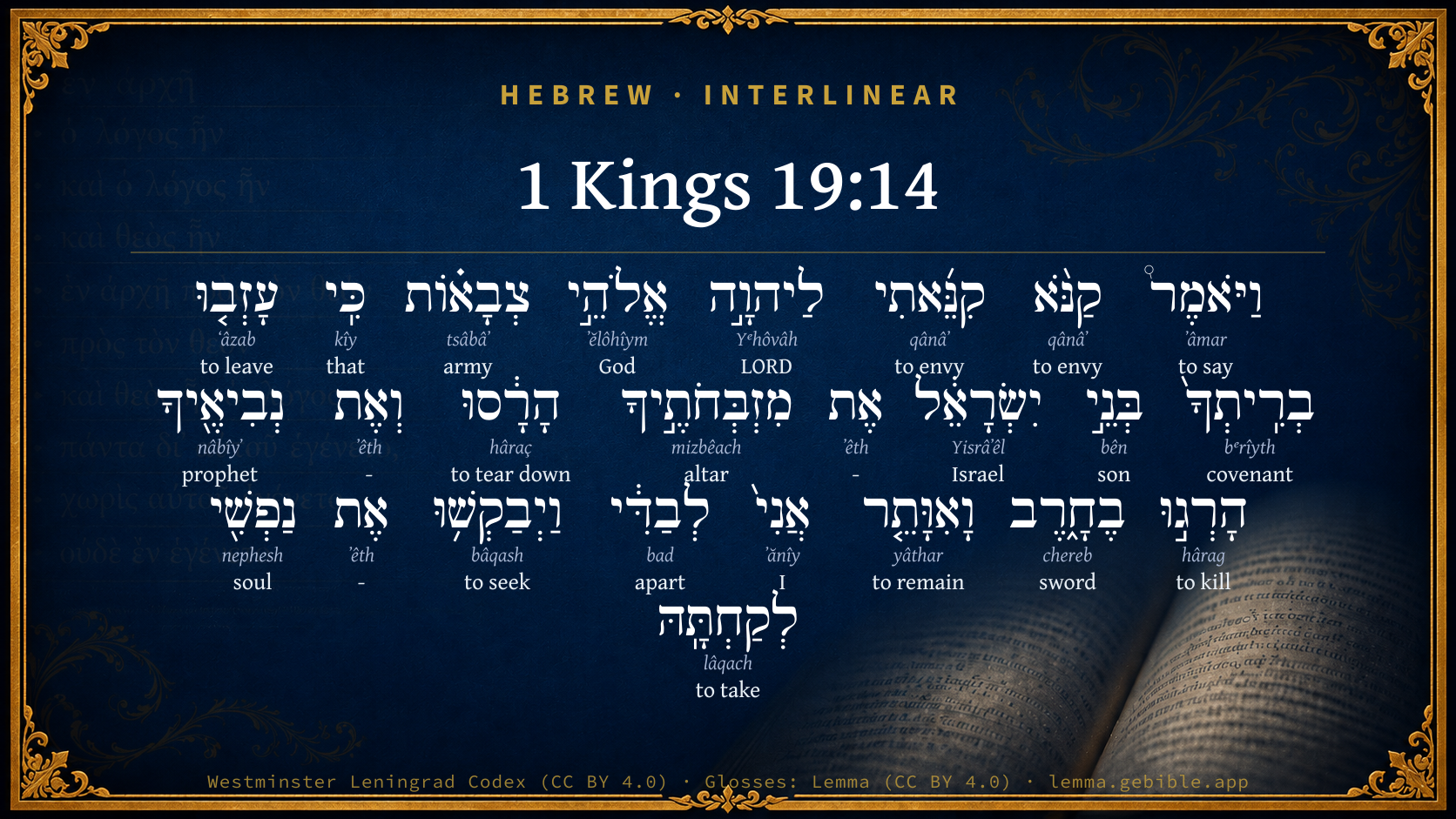
1 Kings 19:14

Hebrew (Westminster Leningrad Codex) 1 Kings 19:14 appears in the Hebrew Old Testament. The text above is from the Westminster Leningrad Codex. Each word links to its Strong’s number, a concise gloss, and parsing drawn from the Open Scriptures Hebrew Bible morphology. Click any word for its full Brown-Driver-Briggs (BDB) entry.
Download image
Cite this verse

1 Kings 19:14 (World English Bible). Public Domain. Lemma interlinear Bible study tool, https://lemma.gebible.app/v/1-kings/19/14.

Show BibTeX & RIS
BibTeX
RIS
English Translation
He said, I have been very jealous for Yahweh, the God of hosts; for the children of Israel have forsaken your covenant, thrown down your altars, and slain your prophets with the sword; and I, even I only, am left; and they seek my life, to take it away.
World English Bible · Public Domain
Download a study sheet

One document with this verse’s original text, its word-by-word gloss line, the meaning frame, cross-references with their text, attributed commentary, and full source and license credits — printable, and it pastes into notes with its structure intact.

This verse Autodidact and up

Study sheet (.html) Plain text (.txt)

A passage Seminary Student

Up to 50 verses in one chapter. A passage sheet keeps up to 6 commentary sources and 12 cross-references per verse, in the order this page ranks them, and says so on the sheet whenever that leaves anything out. Ask for a single verse and you get the Autodidact verse sheet above.

Everything on this page stays free to read, with no account — the sheet is a download of what is already on screen, not access to it.

Want to remove ads? Support Godless Engineer
Compare translations 3

The same verse in 3 English versions, stacked beneath the original-language interlinear above. Click any original word for its lexicon entry.

Each is an independent rendering of the whole verse — the interlinear is not word-aligned to these translations.

Highlighted words mark where these versions differ — a whole-verse word diff, not a word-by-word alignment.

  • World English Bible Public Domain
    He said, I have been very jealous for Yahweh, the God of hosts; for the children of Israel have forsaken your covenant, thrown down your altars, and slain your prophets with the sword; and I, even I only, am left; and they seek my life, to take it away.
  • King James Version Public Domain
    And he said, I have been very jealous for the LORD God of hosts: because the children of Israel have forsaken thy covenant, thrown down thine altars, and slain thy prophets with the sword; and I, even I only, am left; and they seek my life, to take it away.
  • unfoldingWord Literal Text CC BY-SA 4.0
    And he said, “Being jealous, I have been jealous for Yahweh, the God of Armies, for the sons of Israel have forsaken your covenant, they have torn down your altars, and they have killed your prophets with the sword. And I am left, I alone, and they seek my life, to take it.”

unfoldingWord Literal Text — © unfoldingWord, licensed CC BY-SA 4.0. Word-aligned USFM3 via Door43 (git.door43.org/unfoldingWord/en_ult).

Versions to compare (up to 4)

3 of 4 selected

Show all 18 translations

Every available English version of this verse, each an independent rendering of the whole verse.

  • World English Bible Public Domain
    He said, I have been very jealous for Yahweh, the God of hosts; for the children of Israel have forsaken your covenant, thrown down your altars, and slain your prophets with the sword; and I, even I only, am left; and they seek my life, to take it away.
  • Berean Standard Bible Public Domain
    “I have been very zealous for the LORD, the God of Hosts,” he replied, “but the Israelites have forsaken Your covenant, torn down Your altars, and killed Your prophets with the sword. I am the only one left, and they are seeking my life as well.”
  • Majority Standard Bible Public Domain
    “I have been very zealous for the LORD, the God of Hosts,” he replied, “but the Israelites have forsaken Your covenant, torn down Your altars, and killed Your prophets with the sword. I am the only one left, and they are seeking my life as well.”
  • King James Version Public Domain
    And he said, I have been very jealous for the LORD God of hosts: because the children of Israel have forsaken thy covenant, thrown down thine altars, and slain thy prophets with the sword; and I, even I only, am left; and they seek my life, to take it away.
  • American Standard Version (1901) Public Domain
    And he said, I have been very jealous for Jehovah, the God of hosts; for the children of Israel have forsaken thy covenant, thrown down thine altars, and slain thy prophets with the sword; and I, even I only, am left; and they seek my life, to take it away.
  • Revised Version (1885) Public Domain
    And he said, I have been very jealous for the LORD, the God of hosts; for the children of Israel have forsaken thy covenant, thrown down thine altars, and slain thy prophets with the sword; and I, even I only, am left; and they seek my life, to take it away.
  • Geneva Bible (1599) Public Domain
    And he answered, I haue bene very ielous for the Lord God of hostes, because the children of Israel haue forsaken thy couenant, cast downe thine altars, and slayne thy Prophets with the sworde, and I onely am left, and they seeke my life to take it away.
  • Douay-Rheims (1899) Public Domain
    With zeal have I been zealous for the Lord God of hosts: because the children of Israel have forsaken thy covenant: they have destroyed thy altars, they have slain thy prophets with the sword, and I alone am left, and they seek my life to take it away.
  • Young's Literal Translation Public Domain
    And he saith, `I have been very zealous for Jehovah, God of Hosts; for the sons of Israel have forsaken Thy covenant, Thine altars they have thrown down, and Thy prophets they have slain by the sword, and I am left, I, by myself, and they seek my life -- to take it.'
  • Literal Standard Version CC BY-SA 4.0
    And he says, “I have been very zealous for YHWH, God of Hosts; for the sons of Israel have forsaken Your covenant, they have thrown down Your altars, and they have slain Your prophets by the sword, and I am left, I, by myself, and they seek my life—to take it.”
  • Unlocked Literal Bible CC BY-SA 4.0
    Elijah replied, “I have been very zealous for Yahweh, God of hosts, because the people of Israel have forsaken your covenant, destroyed your altars, and killed your prophets with the sword. Now I, only I, am left and they are also trying to take my life.”
  • unfoldingWord Literal Text CC BY-SA 4.0
    And he said, “Being jealous, I have been jealous for Yahweh, the God of Armies, for the sons of Israel have forsaken your covenant, they have torn down your altars, and they have killed your prophets with the sword. And I am left, I alone, and they seek my life, to take it.”
  • Darby Bible Public Domain
    And he said, I have been very jealous for Jehovah the God of hosts; for the children of Israel have forsaken thy covenant, thrown down thine altars, and slain thy prophets with the sword; and I am left, I alone, and they seek my life, to take it away.
  • World Messianic Bible Public Domain
    He said, “I have been very jealous for the LORD, the God of Hosts; for the children of Israel have forsaken your covenant, thrown down your altars, and killed your prophets with the sword. I, even I only, am left; and they seek my life, to take it away.”
  • Webster's Bible Public Domain
    And he said, I have been very jealous for the LORD God of hosts: because the children of Israel have forsaken thy covenant, thrown down thy altars, and slain thy prophets with the sword; and I, I only, am left; and they seek my life, to take it away.
  • Free Bible Version CC BY-SA 4.0
    “I have worked passionately for the Lord God Almighty,” he replied. “But the Israelites have abandoned your agreement, torn down your altars, and killed your prophets with the sword. I am the only one who's left, and they are trying to kill me as well.”
  • Bible in Basic English Public Domain
    And he said, I have been burning for the honour of the Lord, the God of armies; for the children of Israel have not kept your agreement; they have had your altars broken down, and have put your prophets to death with the sword: till I, even I, am the only one living; and now they are attempting to take away my life.
  • JPS Tanakh (1917) Public Domain
    And he said: 'I have been very jealous for the LORD, the God of hosts; for the children of Israel have forsaken Thy covenant, thrown down Thine altars, and slain Thy prophets with the sword; and I, even I only, am left; and they seek my life, to take it away.'

Literal Standard Version (2020), Covenant Press — licensed CC BY-SA 4.0. Text via the HelloAO Bible API (eBible.org). Unlocked Literal Bible (unfoldingWord) — licensed CC BY-SA 4.0. Text via the HelloAO Bible API (eBible.org). unfoldingWord Literal Text — © unfoldingWord, licensed CC BY-SA 4.0. Word-aligned USFM3 via Door43 (git.door43.org/unfoldingWord/en_ult). Free Bible Version, Dr. Jonathan Gallagher — licensed CC BY-SA 4.0. Text via the HelloAO Bible API (eBible.org).

Word by word

More ways to search: Search by grammar → Find every occurrence → Compare this word →

Practice this passage: Drill this verse → Learn its vocabulary →

קַנֹּ֨א
qânâʼ
H7065
“to envy”
Verb, Piel, Infinitive Absolute
Part of Speech
Verb
Stem
Piel
Form
Infinitive Absolute
Full BDB Definition

Origin: a primitive root

TWOT: 2038

to envy, be jealous, be envious, be zealous - (Piel) - to be jealous of - to be envious of - to be zealous for - to excite to jealous anger - (Hiphil) to provoke to jealous anger, cause jealousy
  1. וַיֹּאמֶר֩ ʼâmar H559 “and · to say” Conjunction + Verb, Qal, Sequential Imperfect, 3rd Person, Masculine, Singular
  2. קִנֵּ֜אתִי qânâʼ H7065 “to envy” Verb, Piel, Perfect, 1st Person, Common, Singular
  3. לַיהוָ֣ה Yᵉhôvâh H3068 “to/for · LORD” Preposition + Noun, Proper
  4. אֱלֹהֵ֣י ʼĕlôhîym H430 “God(s) of” Noun, Common, Masculine, Plural, Construct
  5. צְבָא֗וֹת tsâbâʼ H6635 “armies” Noun, Common, Both, Plural, Absolute
  6. כִּֽי kîy H3588 “that” Conjunction
  7. עָזְב֤וּ ʻâzab H5800 “to leave” Verb, Qal, Perfect, 3rd Person, Common, Plural
  8. בְרִֽיתְךָ֙ bᵉrîyth H1285 “covenant · your” Noun, Common, Feminine, Singular, Construct + Suffix, Personal, 2nd Person, Masculine, Singular
  9. בְּנֵ֣י bên H1121 “sons of” Noun, Common, Masculine, Plural, Construct
  10. יִשְׂרָאֵ֔ל Yisrâʼêl H3478 “Israel” Noun, Proper
  11. אֶת ʼêth H853 “-” Particle, Direct Object
  12. מִזְבְּחֹתֶ֣יךָ mizbêach H4196 “altars · your” Noun, Common, Masculine, Plural, Construct + Suffix, Personal, 2nd Person, Masculine, Singular
  13. הָרָ֔סוּ hâraç H2040 “to tear down” Verb, Qal, Perfect, 3rd Person, Common, Plural
  14. וְאֶת ʼêth H853 “and · -” Conjunction + Particle, Direct Object
  15. נְבִיאֶ֖יךָ nâbîyʼ H5030 “prophets · your” Noun, Common, Masculine, Plural, Construct + Suffix, Personal, 2nd Person, Masculine, Singular
  16. הָרְג֣וּ hârag H2026 “to kill” Verb, Qal, Perfect, 3rd Person, Common, Plural
  17. בֶחָ֑רֶב chereb H2719 “in/at the · sword” Preposition, Determined + Noun, Common, Feminine, Singular, Absolute
  18. וָאִוָּתֵ֤ר yâthar H3498 “and · to remain” Conjunction + Verb, Niphal, Sequential Imperfect, 1st Person, Common, Singular
  19. אֲנִי֙ ʼănîy H589 “I” Pronoun, Personal, 1st Person, Common, Singular
  20. לְבַדִּ֔י bad H905 “to/for · apart · my” Preposition + Noun, Common, Masculine, Singular, Construct + Suffix, Personal, 1st Person, Common, Singular
  21. וַיְבַקְשׁ֥וּ bâqash H1245 “and · to seek” Conjunction + Verb, Piel, Sequential Imperfect, 3rd Person, Masculine, Plural
  22. אֶת ʼêth H853 “-” Particle, Direct Object
  23. נַפְשִׁ֖י nephesh H5315 “soul · my” Noun, Common, Both, Singular, Construct + Suffix, Personal, 1st Person, Common, Singular
  24. לְקַחְתָּֽהּ lâqach H3947 “to take · her” Preposition + Verb, Qal, Infinitive Construct + Suffix, Personal, 3rd Person, Feminine, Singular

About this verse

These counts appear in no published source. They are computed here, from the morphology-tagged text and Lemma’s own curated glosses. What Lemma adds →

25
words
22
distinct lemmas
Historical
section

Shared distinctive vocabulary

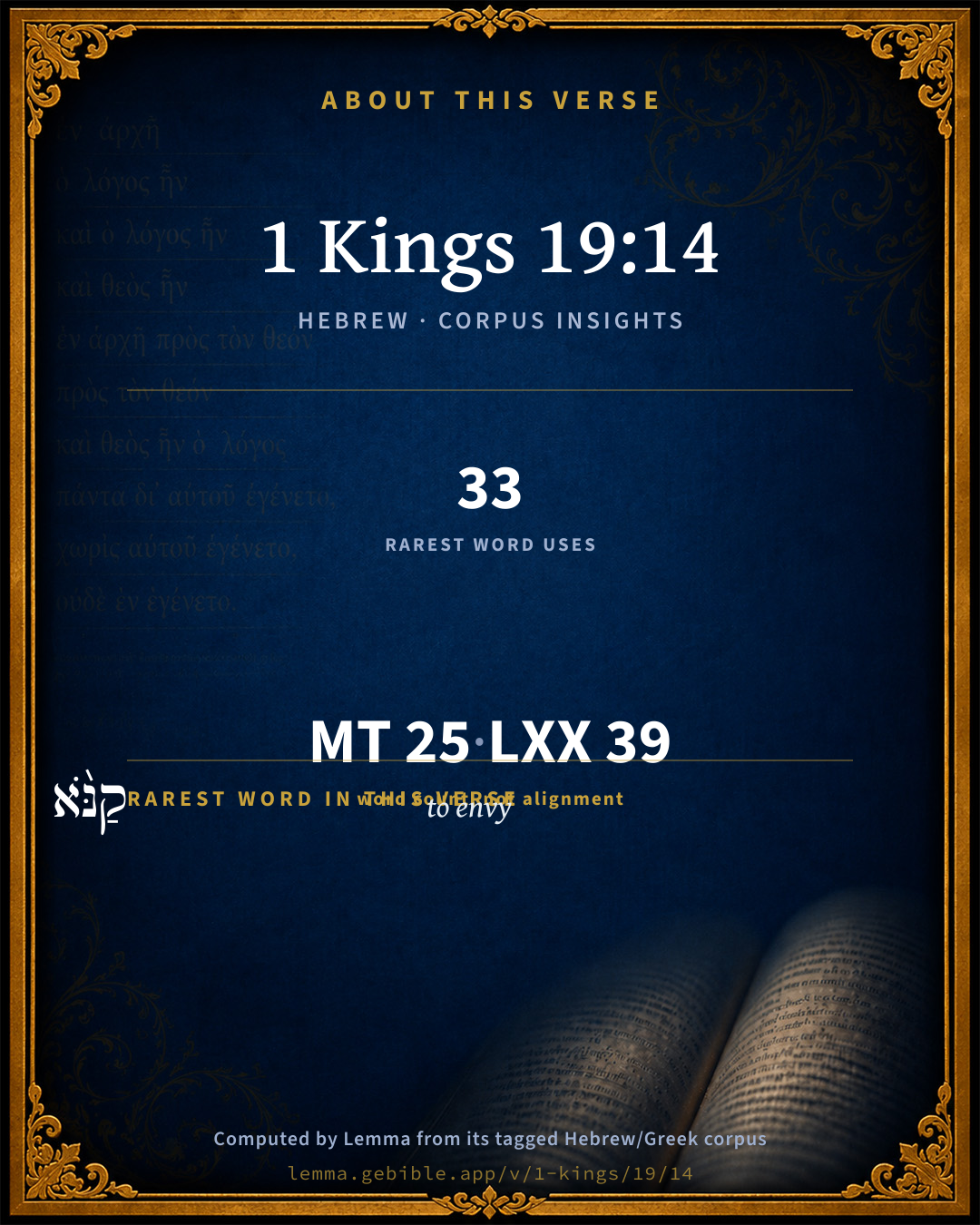
קַנֹּ֨א to envy H7065 occurs in 28 verses of the Hebrew Bible. Also found in:

Grammatical profile

  • 9 verbs
  • 11 nouns
  • 1 pronoun
  • 1 conjunction
  • 3 particles

Verb forms

  • וַיֹּאמֶר֩ Qal · Sequential Imperfect
  • קַנֹּ֨א Piel · Infinitive Absolute
  • קִנֵּ֜אתִי Piel · Perfect
  • עָזְב֤וּ Qal · Perfect
  • הָרָ֔סוּ Qal · Perfect
  • הָרְג֣וּ Qal · Perfect
  • וָאִוָּתֵ֤ר Niphal · Sequential Imperfect
  • וַיְבַקְשׁ֥וּ Piel · Sequential Imperfect
  • לְקַחְתָּֽהּ Qal · Infinitive Construct

Repetition

A word recurs within this verse — often emphatic in Hebrew:

  • קַנֹּ֨א to envy H7065 ×2

Hebrew & Septuagint length

In English translation the verse runs 49 words from the Hebrew and 49 from the Septuagint (LXX English) — the same length.

A rough comparison of the two English renderings, which tokenize alike — not a word-level alignment.

Word counts can differ between the Hebrew and the Greek without any difference in meaning — e.g. the Hebrew direct-object marker אֵת has no separate Greek word, and Greek often adds the article ὁ.

In the original languages it is 25 Hebrew tokens and 39 Greek tokens — but the two are counted differently (Hebrew bundles its prefixes and suffixes into one token; the Greek is in lemma form), so that isn’t a like-for-like length.

Cross-references

11

Topical passages linked to 1 Kings 19:14 in the Treasury of Scripture Knowledge — connected by theme and wording, ordered by reader-vote popularity; previews shown in the World English Bible.

  • Deuteronomy 29:25 Then men shall say, Because they forsook the covenant of Yahweh, the God of their fathers, which he made with them when he brought them forth out of the land of Egypt,
  • Deuteronomy 31:20 For when I shall have brought them into the land which I swore to their fathers, flowing with milk and honey, and they shall have eaten and filled themselves, and grown fat; then will they turn to other gods, and serve them, and despise me, and break my covenant.
  • 1 Kings 19:9–10 He came there to a cave, and lodged there; and, behold, the word of Yahweh came to him, and he said to him, What are you doing here, Elijah?
  • Psalms 78:37 For their heart was not right with him, Neither were they faithful in his covenant.
  • Isaiah 1:4 Ah sinful nation, A people loaded with iniquity, A seed of evil-doers, Children who deal corruptly! They have forsaken Yahweh. They have despised the Holy One of Israel. They are estranged and backward.
  • Isaiah 62:1 For Zion's sake will I not hold my peace, and for Jerusalem's sake I will not rest, until her righteousness go forth as brightness, and her salvation as a lamp that burns.
  • Isaiah 62:6–7 I have set watchmen on your walls, Jerusalem; they shall never hold their peace day nor night: you who call on Yahweh, take no rest,
  • Jeremiah 22:9 Then they shall answer, Because they forsook the covenant of Yahweh their God, and worshiped other gods, and served them.
  • Daniel 11:30 For ships of Kittim shall come against him; therefore he shall be grieved, and shall return, and have indignation against the holy covenant, and shall do [his pleasure]: he shall even return, and have regard to those who forsake the holy covenant.
  • Hosea 6:7 But they, like Adam, have broken the covenant. They were unfaithful to me, there.
  • Hebrews 8:9 Not according to the covenant that I made with their fathers, In the day that I took them by the hand to lead them out of the land of Egypt; For they didn't continue in my covenant, And I disregarded them," says the Lord.

Cross-references courtesy of OpenBible.info (CC BY 4.0).

Hebrew and Greek witnesses Masoretic Hebrew ↔ Greek Septuagint

The same verse in the two great witnesses to the Old Testament, shown verse-for-verse.

These are two independent witnesses, not word-aligned to each other, and the Septuagint is shown in lemma (dictionary) form.

Hebrew 1 Kings 19:14 Masoretic · Westminster Leningrad Codex

וַיֹּאמֶר֩ קַנֹּ֨א קִנֵּ֜אתִי לַיהוָ֣ה אֱלֹהֵ֣י צְבָא֗וֹת כִּֽי עָזְב֤וּ בְרִֽיתְךָ֙ בְּנֵ֣י יִשְׂרָאֵ֔ל אֶת מִזְבְּחֹתֶ֣יךָ הָרָ֔סוּ וְאֶת נְבִיאֶ֖יךָ הָרְג֣וּ בֶחָ֑רֶב וָאִוָּתֵ֤ר אֲנִי֙ לְבַדִּ֔י וַיְבַקְשׁ֥וּ אֶת נַפְשִׁ֖י לְקַחְתָּֽהּ

He said, I have been very jealous for Yahweh, the God of hosts; for the children of Israel have forsaken your covenant, thrown down your altars, and slain your prophets with the sword; and I, even I only, am left; and they seek my life, to take it away.

World English Bible · Public Domain

Greek LXX 1 Kings 19:14 Septuagint · lemma form

καί εἶπον ηλιου ζηλόω ζηλόω ὁ κύριος παντοκράτωρ ὅτι ἐν καταλείπω ὁ διαθήκη σύ ὁ υἱός ἰσραήλ ὁ θυσιαστήριον σύ κατααἱρέω καί ὁ προφήτης σύ ἀποκτείνω ἐν ῥομφαία καί ὑπολείπω ἐγώ μόνος καί ζητέω ὁ ψυχή ἐγώ λαμβάνω αὐτός

And Eliu said, I have been very jealous for the Lord Almighty; for the children of Israel have forsaken your covenant, and they have overthrown your altars, and have slain your prophets with the sword! and I am left entirely alone, and they seek my life to take it.

LXX2012 (modern English Septuagint) · Public Domain

Hebrew: Westminster Leningrad Codex (CC BY 4.0). Greek: Septuagint (public domain); English from LXX2012 (modern English Septuagint) (Public Domain). How the Septuagint differs from the Hebrew →

Targum (Aramaic paraphrase)

1

The Targum is the ancient Jewish Aramaic paraphrase of the Hebrew Scriptures — an interpretive translation, not the Hebrew text itself. Onkelos (literal) and Pseudo-Jonathan (expansive) render the Torah, and Jonathan the Prophets. Coverage is partial: where no permissively-licensed English translation exists for a verse, only the Aramaic is shown. This is verse-level text, not a word-by-word alignment to the Hebrew.

  1. Targum Jonathan Prophets (Joshua–Malachi)
    וַאֲמַר קַנָאָה קַנֵיתִי קֳדָם יְיָ אֱלָהָא צְבָאוֹת אֲרֵי שְׁבַקוּ קְיָמָךְ בְּנֵי יִשְׂרָאֵל יַת מַדְבְּחָךְ פַגַרוּ וְיַת נְבִיָךְ קְטַלוּ בְחַרְבָּא וְאִשְׁתַּאֲרִית אֲנָא בִלְחוֹדִי וּבְעוֹ יַת נַפְשִׁי לְמִקְטְלָהּ:

    (no public-domain English translation for this verse)

    Targum Jonathan — Aramaic: “Mikraot Gedolot” (public domain). English: “Sefaria Community Translation” (CC0 1.0 (public-domain dedication)); “London "Chaldee Paraphrase," 1871” (public domain). Text via Sefaria.

Commentary

Notes on 1 Kings 19:14 from classic Christian and Jewish commentators (each source and its license shown beneath its notes). The classic Christian expositions comment on the surrounding passage and are grouped to its opening verse, so a note may address several verses; the Jewish commentaries on the Tanakh (Rashi and others) are per-verse, so they appear only where the commentator wrote on this verse.

Lemma curates 59 commentaries, every one of them public domain or Creative Commons licensed, each selected and text-cleaned for this edition rather than reprinted as found. About our sources →

Trapp's Complete Commentary

John Trapp

1Ki 19:14 And he said, I have been very jealous for the LORD God of hosts: because the children of Israel have forsaken thy covenant, thrown down thine altars, and slain thy prophets with the sword; and I, [even] I only, am left; and they seek my life, to take it away.

Ver. 14. I have been very zealous.] See on 1Ki 19:10.

And I, even I, am left alone.] Such was the paucity and obscurity of God’s people in these times, that the prophet miserably crieth out of his aloneness. Such was it in Basil’s time, {a} by reason of Arianism overspreading all, that he crieth out, Hath the Lord utterly forsaken his churches? Is it now the last hour? &c. The ship of the church was then almost overwhelmed, saith Jerome. The church was not then to be sought in palaces and outward pomp, saith Hilary, but rather in prisons and dens of the desert. Where was the church in Elias’s time, said Mr Bradford? Doth not he say, I only am left? And whereas God saith there were "seven thousand that had not bowed their knees to Baal," these were not known. And the text saith, Reliqui mihi, I have reserved to myself, to mine own knowledge, &c.

{a} Basil, Epist. 17.

John Trapp, A Commentary or Exposition upon All the Books of the Old and New Testament (1647–1656) — public domain. Text from a community e-Sword module.

Joseph Benson's Commentary

1Ki 19:14. And he said, I have been very jealous, &c. — “Though Elijah showed tokens of humble adoration on this occasion, the repetition of his answer to the Lord’s renewed inquiry, (‘What doest thou here?’) shows, that he did not fully understand the emblematic display; and that he was not properly convinced of his unbelief, in fleeing out of the land; nor reconciled to going back to his station and employment. He afterward better understood the Lord’s meaning, as it appears from his subsequent conduct.” — Scott.

Joseph Benson's Commentary on the Old and New Testaments (1811–1818) — public domain. Text from a community e-Sword module.

Geneva Bible (1599)

Geneva Bible translators

We ought not to depend on the multitude in maintaining God’s glory, but because our duty so requireth, we ought to do it.

Geneva Bible (1599) marginal notes — public domain. Text via Bolls.life.

John Gill's Exposition

And he said,.... Elijah, in answer to the question put, and he says the same as before:

I have been very jealous,.... which the question was designed to draw from him, in order to give him some instructions and directions; which would suggest to him, that though he should not deal severely with Israel, nor with Ahab and his house, yet he would hereafter by the kings he should anoint over Syria and Israel, and by the prophet he should anoint in his room, as instruments of his vengeance.

John Gill's Exposition of the Whole Bible (1746–1763) — public domain (CC PDM 1.0). Text via the HelloAO Bible API.

The Pulpit Commentary

And he said, I have been very jealous for the Lord God of hosts: because the children of Israel have forsaken thy covenant, thrown down thine altars, and slain thy prophets with the sword; and I, even I only, am left; and they seek my life, to take it away. Verbatim as in ver. 10. What are we to understand from this repetition of the former answer? Has the lesson of this theophany been lost upon him? Has he failed to grasp its significance? It is probable that he only partially understood its meaning, and it certainly looks as if he still felt himself an injured and disappointed man; as if the recollection of the way in which his work had been frustrated still rankled in his soul. But though the words are the same, it is possible, and indeed probable, that the tone was entirely different; that instead of speaking, as he had spoken before, querulously and almost defiantly, he now, catching his inspiration from the still small voice, speaks with bated breath and profound self humiliation. The facts are the same. He repeats them, because they and they alone explain why he is there, and because he cannot see as yet how they are to be remedied. But he is now conscious of a misgiving as to the wisdom and piety of his course. He feels he has acted hastily and faithlessly, and has wanted to do God"s work in his own rough way. He will go back, if it be God"s will; he will be content to wait God"s time, and to follow His leading. The commission which is straightway given him almost proves that he had experienced a change. It implies that he is now fitted for his high ministry.

I have been very jealous," etc. The same question, and precisely the same words in reply. But everything was not the same. The man and the manner wore alike changed. (cf. 1Sa_10:6) He has heard the "still small voice," and it has hushed his own. How true it is, "It is not the words we say, but the manner and spirit in which we say them, gives them their force and significance."

The Pulpit Commentary (1880–1919), ed. H.D.M. Spence-Jones & Joseph S. Exell — public domain. Text from a community e-Sword module.

Lesson kit

Teaching starters — assembled from the data on this page, not authored interpretation. Every prompt links to the verse data it draws on. Edit before teaching.

1 Kings, in the Historical, opens this verse with 25 words (22 distinct Hebrew lemmas). Its most distinctive word is qânâʼ (“to envy”). A historical commentator’s framing appears above. Read the whole chapter for the surrounding context.

Discussion questions

  1. How does “to envy” (qânâʼ) shape what this verse is saying?
  2. Genesis 26:14 shares the word «to envy» with this verse. How do the two illuminate each other?
  3. “to envy” occurs 2× in this one verse. What is the effect of the repetition?
  4. The translations on this page render this verse differently — a whole-verse word diff, not a word-by-word alignment. What might account for the different wordings?
  5. The verb «וַיֹּאמֶר֩» is Qal Sequential Imperfect. How does its form color the action?
  6. Reading how Trapp's Complete Commentary and Joseph Benson's Commentary read this verse, where do the two commentators agree and where do they part?

Things to notice

Reading settings

Reading text

Shown beneath each verse's original-language words.

Old Testament
Old Testament edition

Read the OT as the Masoretic Hebrew (MT) or the Greek Septuagint (LXX).

English shown for the Greek Septuagint (in the Hebrew ↔ Greek comparison).

Comparing translations? Open the Compare panel on any verse page to stack up to four side by side.