
Ezekiel 38:4

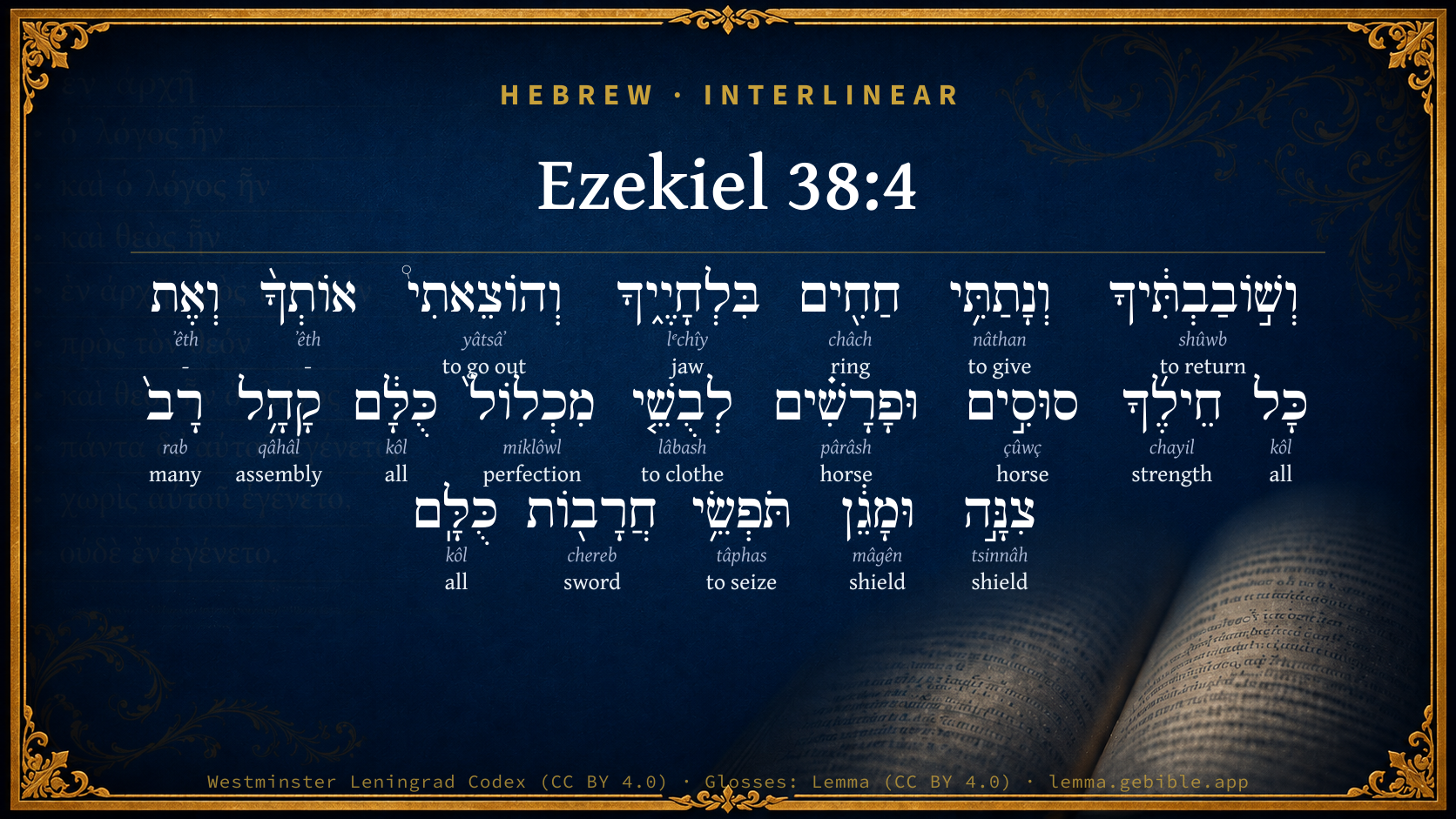
Hebrew (Westminster Leningrad Codex) Ezekiel 38:4 appears in the Hebrew Old Testament. The text above is from the Westminster Leningrad Codex. Each word links to its Strong’s number, a concise gloss, and parsing drawn from the Open Scriptures Hebrew Bible morphology. Click any word for its full Brown-Driver-Briggs (BDB) entry.
Download image
Cite this verse

Ezekiel 38:4 (World English Bible). Public Domain. Lemma interlinear Bible study tool, https://lemma.gebible.app/v/ezekiel/38/4.

Show BibTeX & RIS
BibTeX
RIS
English Translation
and I will turn you about, and put hooks into your jaws, and I will bring you forth, and all your army, horses and horsemen, all of them clothed in full armor, a great company with buckler and shield, all of them handling swords;
World English Bible · Public Domain
Download a study sheet

One document with this verse’s original text, its word-by-word gloss line, the meaning frame, cross-references with their text, attributed commentary, and full source and license credits — printable, and it pastes into notes with its structure intact.

This verse Autodidact and up

Study sheet (.html) Plain text (.txt)

A passage Seminary Student

Up to 50 verses in one chapter. A passage sheet keeps up to 6 commentary sources and 12 cross-references per verse, in the order this page ranks them, and says so on the sheet whenever that leaves anything out. Ask for a single verse and you get the Autodidact verse sheet above.

Everything on this page stays free to read, with no account — the sheet is a download of what is already on screen, not access to it.

Want to remove ads? Support Godless Engineer
Compare translations 3

The same verse in 3 English versions, stacked beneath the original-language interlinear above. Click any original word for its lexicon entry.

Each is an independent rendering of the whole verse — the interlinear is not word-aligned to these translations.

Highlighted words mark where these versions differ — a whole-verse word diff, not a word-by-word alignment.

  • World English Bible Public Domain
    and I will turn you about, and put hooks into your jaws, and I will bring you forth, and all your army, horses and horsemen, all of them clothed in full armor, a great company with buckler and shield, all of them handling swords;
  • King James Version Public Domain
    And I will turn thee back, and put hooks into thy jaws, and I will bring thee forth, and all thine army, horses and horsemen, all of them clothed with all sorts of armour, even a great company with bucklers and shields, all of them handling swords:
  • unfoldingWord Literal Text CC BY-SA 4.0
    So I will turn you around and set hooks in your jaw; I will send you out with all your army, horses, and horsemen, all of them dressed in full armor, a great company with large shields and small shields, all of them holding swords!

unfoldingWord Literal Text — © unfoldingWord, licensed CC BY-SA 4.0. Word-aligned USFM3 via Door43 (git.door43.org/unfoldingWord/en_ult).

Versions to compare (up to 4)

3 of 4 selected

Show all 18 translations

Every available English version of this verse, each an independent rendering of the whole verse.

  • World English Bible Public Domain
    and I will turn you about, and put hooks into your jaws, and I will bring you forth, and all your army, horses and horsemen, all of them clothed in full armor, a great company with buckler and shield, all of them handling swords;
  • Berean Standard Bible Public Domain
    I will turn you around, put hooks in your jaws, and bring you out with all your army—your horses, your horsemen in full armor, and a great company armed with shields and bucklers, all brandishing their swords.
  • Majority Standard Bible Public Domain
    I will turn you around, put hooks in your jaws, and bring you out with all your army—your horses, your horsemen in full armor, and a great company armed with shields and bucklers, all brandishing their swords.
  • King James Version Public Domain
    And I will turn thee back, and put hooks into thy jaws, and I will bring thee forth, and all thine army, horses and horsemen, all of them clothed with all sorts of armour, even a great company with bucklers and shields, all of them handling swords:
  • American Standard Version (1901) Public Domain
    and I will turn thee about, and put hooks into thy jaws, and I will bring thee forth, and all thine army, horses and horsemen, all of them clothed in full armor, a great company with buckler and shield, all of them handling swords;
  • Revised Version (1885) Public Domain
    and I will turn thee about, and put hooks into thy jaws, and I will bring thee forth, and all thine army, horses and horsemen, all of them clothed in full armour, a great company with buckler and shield, all of them handling swords:
  • Geneva Bible (1599) Public Domain
    And I wil destroy thee, and put hookes in thy chawes, and I will bring thee forth, and all thine host both horses, and horsemen, all clothed with al sorts of armour, eue a great multitude with bucklers, and shieldes, all handling swords.
  • Douay-Rheims (1899) Public Domain
    And I will turn thee about, and I will put a bit in thy jaws: and I will bring thee forth, and ail thy army, horses and horsemen all clothed with coats of mail, a great multitude, armed with spears and shields and swords.
  • Young's Literal Translation Public Domain
    And I have turned thee back, And I have put hooks in thy jaws, And have brought thee out, and all thy force, Horses and horsemen, Clothed in perfection all of them, A numerous assembly, `with' buckler and shield, Handling swords -- all of them.
  • Literal Standard Version CC BY-SA 4.0
    And I have turned you back, || And I have put hooks in your jaws, || And have brought you out, and all your force, || Horses and horsemen, || All of them clothed in perfection, || A numerous assembly, [with] buckler and shield, || All of them handling swords.
  • Unlocked Literal Bible CC BY-SA 4.0
    So I will turn you around and set hooks in your jaw; I will send you out with all your army, horses, and horsemen, all of them dressed in full armor, a great company with large shields and small shields, all of them holding swords!
  • unfoldingWord Literal Text CC BY-SA 4.0
    So I will turn you around and set hooks in your jaw; I will send you out with all your army, horses, and horsemen, all of them dressed in full armor, a great company with large shields and small shields, all of them holding swords!
  • Darby Bible Public Domain
    And I will turn thee back, and put hooks into thy jaws, and I will bring thee forth, and all thine army, horses and horsemen, all of them thoroughly equipped, a great assemblage with targets and shields, all of them handling swords:
  • World Messianic Bible Public Domain
    I will turn you around, and put hooks into your jaws, and I will bring you out, with all your army, horses and horsemen, all of them clothed in full armor, a great company with buckler and shield, all of them handling swords;
  • Webster's Bible Public Domain
    And I will turn thee back, and put hooks into thy jaws, and I will bring thee forth, and all thy army, horses and horsemen, all of them clothed with all sorts of armor, even a great company with bucklers and shields, all of them handling swords:
  • Free Bible Version CC BY-SA 4.0
    I will send you in a different direction, put hooks in your jaws, and drag you out with your whole army, including your horses, your horsemen in uniform, and a host of men with large and small shields and bucklers, all waving their swords.
  • Bible in Basic English Public Domain
    And turning you round, I will put hooks in your mouth and make you come out with all your army, horses and horsemen, all of them in full war-dress, a great force with breastplate and body-cover, all of them armed with swords:
  • JPS Tanakh (1917) Public Domain
    and I will turn thee about, and put hooks into thy jaws, and I will bring thee forth, and all thine army, horses and horsemen, all of them clothed most gorgeously, a great company with buckler and shield, all of them handling swords:

Literal Standard Version (2020), Covenant Press — licensed CC BY-SA 4.0. Text via the HelloAO Bible API (eBible.org). Unlocked Literal Bible (unfoldingWord) — licensed CC BY-SA 4.0. Text via the HelloAO Bible API (eBible.org). unfoldingWord Literal Text — © unfoldingWord, licensed CC BY-SA 4.0. Word-aligned USFM3 via Door43 (git.door43.org/unfoldingWord/en_ult). Free Bible Version, Dr. Jonathan Gallagher — licensed CC BY-SA 4.0. Text via the HelloAO Bible API (eBible.org).

Word by word

More ways to search: Search by grammar → Find every occurrence → Compare this word →

Practice this passage: Drill this verse → Learn its vocabulary →

מִכְלוֹל֙
miklôwl
H4358
“perfection”
Noun, Common, Masculine, Singular, Absolute
Part of Speech
Noun
Type
Common
Gender
Masculine
Number
Singular
State
Absolute
Full BDB Definition

Origin: from H3634

TWOT: 985c

perfection, gorgeous attire (noun masculine) - perfectly, most gorgeously (adverb)
  1. וְשׁ֣וֹבַבְתִּ֔יךָ shûwb H7725 “and · to return · you” Conjunction + Verb, Polel, Sequential Perfect, 1st Person, Common, Singular + Suffix, Personal, 2nd Person, Masculine, Singular
  2. וְנָתַתִּ֥י nâthan H5414 “and · to give” Conjunction + Verb, Qal, Sequential Perfect, 1st Person, Common, Singular
  3. חַחִ֖ים châch H2397 “rings” Noun, Common, Masculine, Plural, Absolute
  4. בִּלְחָיֶ֑יךָ lᵉchîy H3895 “in/at · jaws · your” Preposition + Noun, Common, Both, Dual, Construct + Suffix, Personal, 2nd Person, Masculine, Singular
  5. וְהוֹצֵאתִי֩ yâtsâʼ H3318 “and · to go out” Conjunction + Verb, Hiphil, Sequential Perfect, 1st Person, Common, Singular
  6. אוֹתְךָ֨ ʼêth H853 “- · you” Particle, Direct Object + Suffix, Personal, 2nd Person, Masculine, Singular
  7. וְאֶת ʼêth H853 “and · -” Conjunction + Particle, Direct Object
  8. כָּל kôl H3605 “all of” Noun, Common, Masculine, Singular, Construct
  9. חֵילֶ֜ךָ chayil H2428 “strength · your” Noun, Common, Masculine, Singular, Construct + Suffix, Personal, 2nd Person, Masculine, Singular
  10. סוּסִ֣ים çûwç H5483 “horses” Noun, Common, Masculine, Plural, Absolute
  11. וּפָרָשִׁ֗ים pârâsh H6571 “and · horses” Conjunction + Noun, Common, Masculine, Plural, Absolute
  12. לְבֻשֵׁ֤י lâbash H3847 “clothed of” Adjective, Adjective, Masculine, Plural, Construct
  13. כֻּלָּ֔ם kôl H3605 “all · their” Noun, Common, Masculine, Singular, Construct + Suffix, Personal, 3rd Person, Masculine, Plural
  14. קָהָ֥ל qâhâl H6951 “assembly” Noun, Common, Masculine, Singular, Absolute
  15. רָב֙ rab H7227 “many” Adjective, Adjective, Masculine, Singular, Absolute
  16. צִנָּ֣ה tsinnâh H6793 “shield” Noun, Common, Feminine, Singular, Absolute
  17. וּמָגֵ֔ן mâgên H4043 “and · shield” Conjunction + Noun, Common, Both, Singular, Absolute
  18. תֹּפְשֵׂ֥י tâphas H8610 “seizing” Verb, Qal, Participle Active, Masculine, Plural, Construct
  19. חֲרָב֖וֹת chereb H2719 “swords” Noun, Common, Feminine, Plural, Absolute
  20. כֻּלָּֽם kôl H3605 “all · their” Noun, Common, Masculine, Singular, Construct + Suffix, Personal, 3rd Person, Masculine, Plural

About this verse

These counts appear in no published source. They are computed here, from the morphology-tagged text and Lemma’s own curated glosses. What Lemma adds →

21
words
18
distinct lemmas
Prophets
section

Notable vocabulary

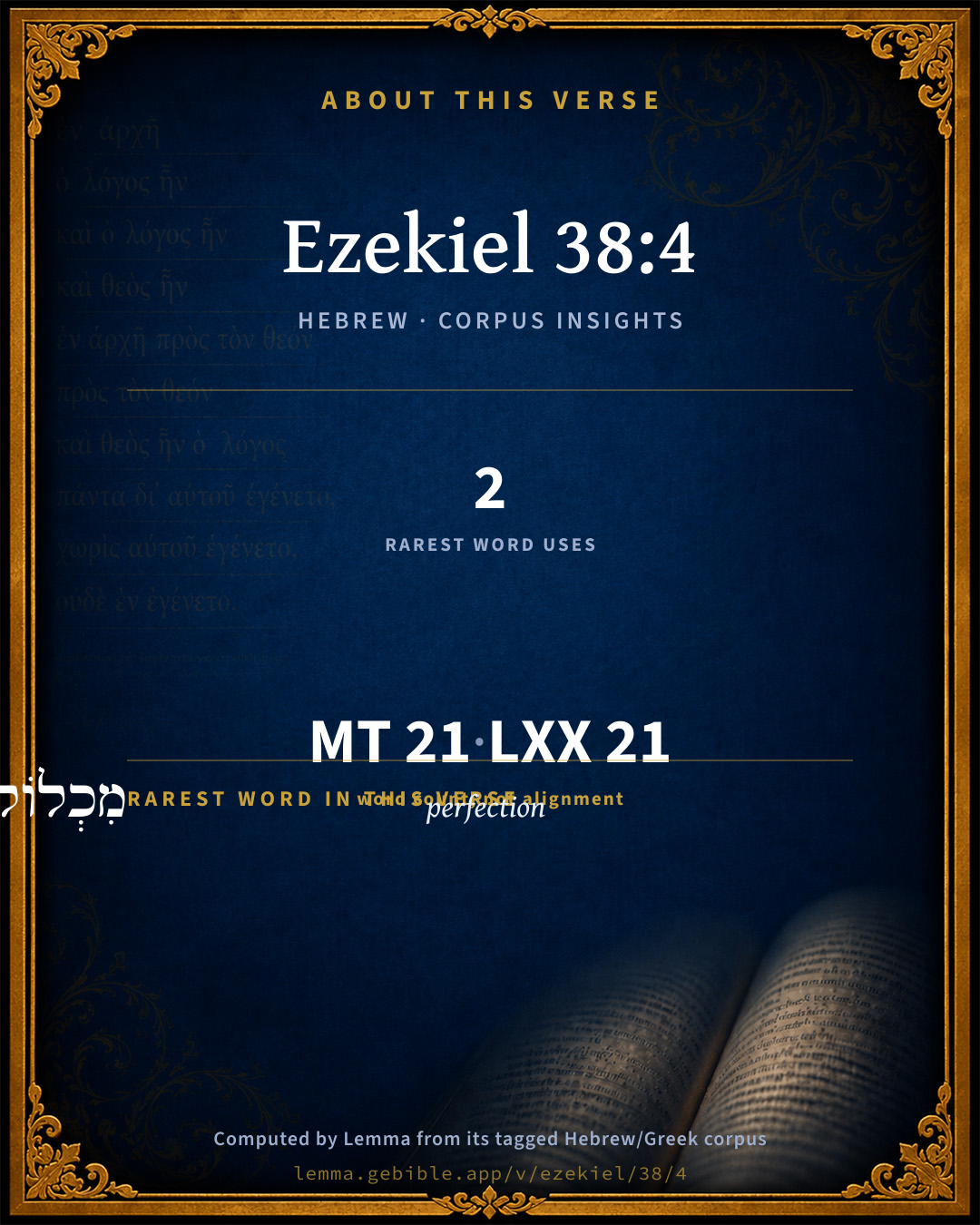
The rarest word here is מִכְלוֹל֙ perfection H4358 — appearing just 2 times in the whole Hebrew Bible.

Shared distinctive vocabulary

מִכְלוֹל֙ perfection H4358 occurs in 2 verses of the Hebrew Bible. Also found in:

Grammatical profile

  • 4 verbs
  • 13 nouns
  • 2 adjectives
  • 2 particles

Verb forms

  • וְשׁ֣וֹבַבְתִּ֔יךָ Polel · Sequential Perfect
  • וְנָתַתִּ֥י Qal · Sequential Perfect
  • וְהוֹצֵאתִי֩ Hiphil · Sequential Perfect
  • תֹּפְשֵׂ֥י Qal · Participle Active

Repetition

A word recurs within this verse — often emphatic in Hebrew:

Hebrew & Septuagint length

In English translation the verse runs 44 words from the Hebrew and 24 from the Septuagint (LXX English) — the Septuagint runs noticeably shorter here. See the side-by-side →

A rough comparison of the two English renderings, which tokenize alike — not a word-level alignment.

Word counts can differ between the Hebrew and the Greek without any difference in meaning — e.g. the Hebrew direct-object marker אֵת has no separate Greek word, and Greek often adds the article ὁ.

In the original languages it is 21 Hebrew tokens and 21 Greek tokens — but the two are counted differently (Hebrew bundles its prefixes and suffixes into one token; the Greek is in lemma form), so that isn’t a like-for-like length.

Cross-references

10

Topical passages linked to Ezekiel 38:4 in the Treasury of Scripture Knowledge — connected by theme and wording, ordered by reader-vote popularity; previews shown in the World English Bible.

  • Ezekiel 29:4 I will put hooks in your jaws, and I will cause the fish of your rivers to stick to your scales; and I will bring you up out of the midst of your rivers, with all the fish of your rivers which stick to your scales.
  • Daniel 11:40 At the time of the end shall the king of the south contend with him; and the king of the north shall come against him like a whirlwind, with chariots, and with horsemen, and with many ships; and he shall enter into the countries, and shall overflow and pass through.
  • 2 Kings 19:28 Because of your raging against me, and because your arrogance is come up into my ears, therefore will I put my hook in your nose, and my bridle in your lips, and I will turn you back by the way by which you came.
  • Ezekiel 38:15 You shall come from your place out of the uttermost parts of the north, you, and many peoples with you, all of them riding on horses, a great company and a mighty army;
  • Ezekiel 39:2 and I will turn you about, and will lead you on, and will cause you to come up from the uttermost parts of the north; and I will bring you on the mountains of Israel;
  • 1 Chronicles 12:8 Of the Gadites there separated themselves to David to the stronghold in the wilderness, mighty men of valor, men trained for war, that could handle shield and spear; whose faces were like the faces of lions, and they were as swift as the roes on the mountains;
  • 2 Chronicles 25:5 Moreover Amaziah gathered Judah together, and ordered them according to their fathers' houses, under captains of thousands and captains of hundreds, even all Judah and Benjamin: and he numbered them from twenty years old and upward, and found them three hundred thousand chosen men, able to go forth to war, who could handle spear and shield.
  • Isaiah 37:29 Because of your raging against me, and because your arrogance is come up into my ears, therefore will I put my hook in your nose, and my bridle in your lips, and I will turn you back by the way by which you came.
  • Jeremiah 46:9 Go up, you horses; and rage, you chariots; and let the mighty men go forth: Cush and Put, who handle the shield; and the Ludim, who handle and bend the bow.
  • Ezekiel 23:12 She doted on the Assyrians, governors and rulers, [her] neighbors, clothed most gorgeously, horsemen riding on horses, all of them desirable young men.

Cross-references courtesy of OpenBible.info (CC BY 4.0).

Hebrew and Greek witnesses Masoretic Hebrew ↔ Greek Septuagint

The same verse in the two great witnesses to the Old Testament, shown verse-for-verse.

Here the Septuagint runs noticeably shorter than the Hebrew — LXX2012 (modern English Septuagint) 24 words vs World English Bible 44. A rough length comparison of the two English translations, not a word-level alignment — read both below.

These are two independent witnesses, not word-aligned to each other, and the Septuagint is shown in lemma (dictionary) form.

Hebrew Ezekiel 38:4 Masoretic · Westminster Leningrad Codex

וְשׁ֣וֹבַבְתִּ֔יךָ וְנָתַתִּ֥י חַחִ֖ים בִּלְחָיֶ֑יךָ וְהוֹצֵאתִי֩ אוֹתְךָ֨ וְאֶת כָּל חֵילֶ֜ךָ סוּסִ֣ים וּפָרָשִׁ֗ים לְבֻשֵׁ֤י מִכְלוֹל֙ כֻּלָּ֔ם קָהָ֥ל רָב֙ צִנָּ֣ה וּמָגֵ֔ן תֹּפְשֵׂ֥י חֲרָב֖וֹת כֻּלָּֽם

and I will turn you about, and put hooks into your jaws, and I will bring you forth, and all your army, horses and horsemen, all of them clothed in full armor, a great company with buckler and shield, all of them handling swords;

World English Bible · Public Domain

Greek LXX Ezekiel 38:4 Septuagint · lemma form

καί συνἄγω σύ καί πᾶς ὁ δύναμις σύ ἵππος καί ἱππεύς ἐνδύω θώραξ πᾶς συναγωγή πολύς πέλτη καί περικεφαλαία καί μάχαιρα

and I will gather you, and all your host, horses and horsemen, all wearing breastplates, with a great multitude, shields and helmets and swords:

LXX2012 (modern English Septuagint) · Public Domain

On this verse, The Cambridge Bible for Schools and Colleges discusses the Septuagint’s reading. Read the note in Commentary ↓

Hebrew: Westminster Leningrad Codex (CC BY 4.0). Greek: Septuagint (public domain); English from LXX2012 (modern English Septuagint) (Public Domain). How the Septuagint differs from the Hebrew →

Targum (Aramaic paraphrase)

1

The Targum is the ancient Jewish Aramaic paraphrase of the Hebrew Scriptures — an interpretive translation, not the Hebrew text itself. Onkelos (literal) and Pseudo-Jonathan (expansive) render the Torah, and Jonathan the Prophets. Coverage is partial: where no permissively-licensed English translation exists for a verse, only the Aramaic is shown. This is verse-level text, not a word-by-word alignment to the Hebrew.

  1. Targum Jonathan Prophets (Joshua–Malachi)
    וַאֲשַׁדְלִינָךְ וְאֶתֵּן שֵׁירִין עַל לִיסָתָךְ וְאַפֵּיק יָתָךְ וְיַת כָּל מַשְׁרִיָתָךְ סוּסְוָן וּפָרָשִׁין לְבוּשֵׁי גְמִיר כּוּלְהוֹן מַשִׁרְיָן סַגִיאָן דִי מְזַיְנִין בַּעֲגִילִין וּתְרֵיסִין אָחֳדֵי סַיְפִין כּוּלְהוֹן:

    (no public-domain English translation for this verse)

    Targum Jonathan — Aramaic: “Mikraot Gedolot” (public domain). English: “Sefaria Community Translation” (CC0 1.0 (public-domain dedication)); “London "Chaldee Paraphrase," 1871” (public domain). Text via Sefaria.

Commentary

Notes on Ezekiel 38:4 from classic Christian and Jewish commentators (each source and its license shown beneath its notes). The classic Christian expositions comment on the surrounding passage and are grouped to its opening verse, so a note may address several verses; the Jewish commentaries on the Tanakh (Rashi and others) are per-verse, so they appear only where the commentator wrote on this verse.

Lemma curates 59 commentaries, every one of them public domain or Creative Commons licensed, each selected and text-cleaned for this edition rather than reprinted as found. About our sources →

Trapp's Complete Commentary

John Trapp

Eze 38:4 And I will turn thee back, and put hooks into thy jaws, and I will bring thee forth, and all thine army, horses and horsemen, all of them clothed with all sorts [of armour, even] a great company [with] bucklers and shields, all of them handling swords:

Ver. 4. And I will turn thee back.] As he did Antiochus Epiphanes by the Jews; the Turks oft by Hunniades; the Pope’s forces by the Hussites in Germany, and lately by the Swedes. It hath been long ago foretold, and for many ages believed, and by the Turks themselves not a little feared, that the Mohammedan superstition, by the sword begun, and by the sword maintained, shall at length, by the Christian sword, also be destroyed, so that the name of Gog and Magog, saith the historian, {a} shall be no more heard of under heaven. A cold sweat also stands at this time upon the limbs of the western antichrist, by reason of the growing greatness of the Protestant princes.

And put hooks into thy jaws.] A metaphor from those that catch whales. Compare Eze 29:4.

And I will bring thee.] But for an ill bargain.

{a} Turkish History, 1153.

John Trapp, A Commentary or Exposition upon All the Books of the Old and New Testament (1647–1656) — public domain. Text from a community e-Sword module.

Joseph Benson's Commentary

Eze 38:4-6. I will turn thee back, and put hooks into thy jaws — I will disappoint all thy designs, and turn thee about as easily as a fisherman masters a great fish, when he hath once fastened the hook into its jaws: see Eze 29:4. And I will bring thee forth — Or, after I have brought thee forth; that is, after I have so disposed matters that thou hast been induced to come forth out of thine own country, to invade, spoil, and destroy other countries. Persia, Ethiopia, and Libya with them — As their allies. Ethiopia and Libya are called Cush and Phut in the Hebrew, and are joined together as allies, Eze 30:5, where see the note. The Persians are in like manner joined with Africans, Eze 27:10. All of them with shield and helmet — So the Libyans, or people of Phut, are described, Jer 46:9, as handling the shield, that is, being remarkable for their great and large shields, as Xenophon relates of them, Cyropæd., lib. 6. Gomer and all his bands — Gomer is joined with Magog, Gen 10:2, and probably here signifies Galatia, Phrygia, and Bithynia, which, with Cappadocia, denoted by Togarmah, comprehend all the northern parts of Asia Minor, which border upon the Euxine sea. Concerning Togarmah, see note on Eze 27:14. And many people with thee — Those of Cilicia, Pamphylia, and other nations inhabiting Asia Minor.

Joseph Benson's Commentary on the Old and New Testaments (1811–1818) — public domain. Text from a community e-Sword module.

Tyndale Open Study Notes

Tyndale Open Resources

38:4 Gog’s rebellion would be under God’s complete control. Though they would regard themselves as free-willed aggressors, they would actually be prisoners with hooks in their jaws (cp. 29:4).

Tyndale Open Study Notes — © Tyndale Open Resources, licensed CC BY-SA 4.0. Text via the HelloAO Bible API.

Geneva Bible (1599)

Geneva Bible translators

He showeth that the enemies should bend themselves against the Church, but it should be to their own destruction.

Geneva Bible (1599) marginal notes — public domain. Text via Bolls.life.

Jamieson, Fausset & Brown

Robert Jamieson, A. R. Fausset & David Brown

turn thee back--as a refractory wild beast, which thinks to take its own way, but is bent by a superior power to turn on a course which must end in its destruction. Satan shall be, by overruling Providence, permitted to deceive them to their ruin (Rev 20:7-8).

hooks into thy jaws-- (Eze 29:4; Kg2 19:28).

Jamieson, Fausset & Brown — Commentary Critical and Explanatory on the Whole Bible (1871) — public domain (CC PDM 1.0). Text via the HelloAO Bible API.

Adam Clarke's Commentary

Verse 4. I will turn thee back] Thy enterprise shall fail.

Adam Clarke's Commentary on the Bible (1810–1826) — public domain. Text from a community e-Sword/MySword module.

Ellicott's Commentary for English Readers

(4) I will turn thee back.—This is the more common meaning of the word; but if this meaning be retained here, it is not to be taken in the sense of turning back from the holy land, but rather, in connection with the figure of the next clause, of turning away the wild beast from his natural inclination to the fulfilment of God’s purpose. It is better, however, to take it in the sense in which it is used in Isa_47:10 (perverted) and Jer_8:5 (slidden back; comp. Eze_1:6), “I will lead thee astray.” In Rev_20:8, this leading astray of the nations is ascribed to Satan, just as in 2Sa_24:1, God, and in 1Ch_21:1, Satan, are said to move David to number the people; in either case God is said to do that which He allows to be done by Satan. For the same Divine gathering of the nations against God’s people see Joe_3:2; Zec_14:2-3.

Hooks into thy jaws.—See the same figure in Eze_29:4.

A Bible Commentary for English Readers, edited by Charles John Ellicott (1878–1897) — public domain. Text from a community e-Sword module.

The Cambridge Bible for Schools and Colleges

gen. ed. J. J. S. Perowne

4. I will turn thee back] Either: I will turn thee about, or, I will lead thee. The sense entice or “decoy” (Ew.) has scarcely evidence (Isa_47:10). The clause “and I will turn … jaws” is wanting in LXX. Putting hooks into the jaws suggests unwillingness and compulsion (ch. Eze_29:4; 2Ki_19:28), whereas Gog comes up of his own accord. This, however, is not quite conclusive, as Jehovah is leading him on to his destruction.

with all sorts of armour] Rather: clothed gorgeously (cf. Eze_23:12), or, in full armour (R.V.). The host of Gog is probably not exclusively cavalry, though these are specially mentioned; and besides their vast numbers their splendid uniforms and heavy armour are vividly pictured.

The Cambridge Bible for Schools and Colleges (gen. ed. J. J. S. Perowne; Cambridge University Press, 1878–1918) — public domain. Text from a community e-Sword module.

John Gill's Exposition

Persia, Ethiopia, and Lybia with them,.... These are the confederates or auxiliaries of the Turks, which shall join with them in this expedition. Persia is a neighbouring kingdom to the Turks, and may fall into their hands before this comes to pass; and is in a fair way for it at this time, through the internal divisions in it; however, it will be confederate with them. Ethiopia or Cush does not design the country of the Abyssines in the dominions of the Great Mogul, but Arabia Chusea, which lay between Judea and Egypt, and is now in the hands of the Turks; and Lybia or Phut is the name of one of the sons of Ham, Gen 10:6 who, according to Josephus (g), founded Lybia; and from him the inhabitants of it were called Phuteans (as they are here by the Targum); and he observes that there is a river of his name in Mauritania. Lybia is a country in Africa, to the west of Egypt and subject to the Turks:

all of them with shield and helmet; the Lybians are described by Jeremiah, Jer 46:9, as

those that handle the shield; and the Egyptians, to whom the Lybians were near neighbours, and whom they might imitate in their warlike arms, as in other things, wore shields down to the feet, as Xenophon (h) relates.

(g) Antiqu. l. 1. c. 6. sect. 2. (h) Cyropaedia, l. 6. c. 14. & l. 7. c. 11.

John Gill's Exposition of the Whole Bible (1746–1763) — public domain (CC PDM 1.0). Text via the HelloAO Bible API.

Albert Barnes' Notes on the Bible

With all sorts - Or, “gorgeously;” see the marginal reference. Omit “of armor.”

Albert Barnes' Notes on the Bible (1834–1885) — public domain. Text from a community e-Sword/MySword module.

Haydock's Catholic Bible Commentary

Jaws. Thus Cambyses treated the son of Psammenites. God has the most absolute dominion over all monarchs, ver. 7.

George Leo Haydock (1774–1849), Haydock's Catholic Family Bible and Commentary, 1859 edition — public domain. Excludes Psalms (Douay-Rheims chapter numbering differs from Protestant) and Deuterocanonical books (Catholic canon only).

Matthew Poole's English Annotations

I will turn thee back: the words seem to imply a diverting him from some other enterprise, or else intimate to us, when that mighty power come out, that they are still under God’s control, and he will turn them back from what they intended, that they shall not effect it.

Hooks: see this expression Eze 29:4.

I will bring thee forth; so dispose affairs, thou shalt leave thine own country to invade, and spoil, and destroy.

All thy army; the whole power thou canst make.

Horses; those nations, Sarmatee, or Scythians, Cappadocians, &c., or which comprise all the Turks and Tartars, are to this day strong in horse, and their armies consist much of horsemen.

All of them clothed; their leaders both rich and gaudy, yet well armed, and their soldiers well provided too, and we know how they and other antichristian soldiers march with all warlike provisions.

A great company; in vast armies, far greater than any of their neighbours can bring out against them.

Bucklers for their foot, and

shields for their horsemen, as Servius observes the difference between the two Latin words scutum and clypeus, if not misreported. I doubt whether the Hebrew words do so differ; however, these were for defence of those that bear them, and to this day the Tartars use oblong shields for defence on horseback, as the figures represent them to our eye.

Handling swords; that is, very ready, expert, and strong in using the sword; this to slay the enemies, as the other to save themselves.

Matthew Poole's English Annotations on the Holy Bible (1683–1685) — public domain. Text from a community e-Sword/MySword module.

Whedon's Commentary on the Bible

Daniel D. Whedon

4. Put hooks into thy jaws — So the Pharaonic “dragon” was pulled out of the Nile (Eze_29:4). On the Assyrian monuments the king of Tyre (Baal) and the king of Egypt (Tirhakah) are represented as led by the great king Esar-haddon by cords attached to rings or hooks through their lips or jaws. (Compare Isa_37:29.) The figure represents control by a superior power.

With all sorts of armor — Rather, “in full armor” (R.V.), or, “gorgeously” (Eze_23:12).

Daniel D. Whedon (gen. ed.), Commentary on the Old and New Testaments (1874–1909) — public domain. Text from a community e-Sword module.

The Pulpit Commentary

I will turn thee back. (pilel of bWv, and signifying "to cause to return") has by Hitzig, Havernick, Ewald, and Keil, been interpreted in the sense of "enticing," "misleading," decoying to a dangerous enterprise, as in Isa_47:10; but the ordinary meaning seems sufficient, that Jehovah would turn him back from his own self-devised career, or turn him about like a wild beast, putting hooks into his jaws (comp. Eze_29:4; 2Ki_19:28; Isa_37:29) and socompelling him to follow the lead of a power superior to himself. It is as evident that a turning back from the Holy Land cannot be intended, as it is that a turning back to the Holy Land is unsuitable, unless, with Hengstenberg and Ewald, one regards Gog as the Chaldeans, or, with Hitzig, and Schroder, as the Scythiaus, though these latter never were in Palestine, having left it unvisited in their campaign in B.C. 626, and had not as yet formed the design of invading Israel. Smend is not wide of the mark in suggesting that the thought expressed in the verb is simply that of the superior might of Jehovah. I will bring thee forth. That the power which stirs up Gog is here represented as that of Jehovah, while in Rev_20:8 it is affirmed to be that of Satan, need occasion no more difficultythan the similar statements, in 1Sa_24:1, about God and in 1Ch_21:1 about Satan, stirring up David to number Israel. The enumeration of horses and horsemen in Gog"s army points to the Scythians, who, according to Herodotus (4:46, 136), were mostly equestrian tribes, although the Scythian remains discovered at Kerteh do not give an example of a Scythian horse-archer (see Rawlinson"s "Herodotus," vol. 3. p. 34, note 6). All of them clothed with all sorts of armor, better, clothed with perfection, i.e. splendidly attired, all of them. A characteristic of the Assyrian army. (comp. Eze_23:12; Nah_2:3) The arms of the warlike hosta great company, as in Eze_17:17 (Rev_20:8, "the number of whom is as the sand of the sea are described as consisting of bucklers, or shields large enough to cover the whole of the soldier, and not so suitable for cavalry as for infantry; (comp. Eze_23:24) shields, i.e. bucklers of smaller size than the proceeding, such as Assyrian warriors were accustomed to carry (Sayce, "Assyria, its Princes, Priests, and People," p. 126); and swords, or weapons for laying waste. The Assyrian soldiery employed "the short dagger, or dirk, and the sword, which was of two kinds. The ordinary kind was long and straight, the less usual kind being curved, like a scimitar" ("Assyria, its Princes," etc.). In connection with the allied nations in ver. 5, only the small "shield" and "helmet" are mentioned.

Divine control.

The picture of Israel"s foes is indeed one fitted to strike dismay into any heart depending upon human aid, defense, or deliverance. Gog and his armies, the hostile nations in league with him, are described with all the pomp and circumstance of war. Yet, when Jehovah declares, "I will turn thee about, and will put hooks into thy jaws," this declaration outweighs all the professions, all the threats, all the designs of the enemy. We are reminded and the whole Church in every age needs, in time of danger especially, to learn the lesson that above all the plans and purposes of men there reigns Divine control.

I IT IS LITTLE EXPECTED. When plans are laid, and evil designs matured, nothing is further from the mind of the enemies of God"s people than the unquestionable fact that the Lord of all is supreme. Some poor, faint human opposition may be anticipated; but it is not expected that a superior Power should intervene.

II IT IS HAUGHTILY SPURNED. Shall hooks be put into the jaws of the dragon? Shall the wild horse of the desert be bridled? Shall the lion of the jungle be tamed? The very thought is repudiated and resented. The mighty of the earth are not wont to brook restraint or interference. Those who plan the ruin of the cause of God, of the religion of Christ, of the Church on earth and all its agencies whether they so plan in the name of atheism and secularism, or in the name of worldly policy spurn and contemn the restraint of Heaven. They see no power which they need to fear, and in their view it is superstition to fear the unseen.

III IT IS VARIOUSLY EXERCISED. Sometimes God controls the foe by natural causes and instrumentalities. The destroying angel comes down upon the camp and smites the host; pestilence decimates the bands of the enemy; an earthquake opens the prison-doors; the storm scatters the invader"s fleet. Sometimes God controls the foe by human agency. One enemy of God makes war upon another, and cripples the forces which were on the point of being employed against the Lord"s people. Or a great deliverer is raised up, whose valor and heroism crush the enemy, and set the threatened free from fear and danger. In any case God is never at a loss for means by which he may bring his counsels to pass.

IV IT IS ALWAYS EFFECTUAL. The control of God may be defied by God"s enemies, and it may be ignored or distrusted by his friends. But it exists, and it is superior to all earthly powers and machinations. Revelation is full of instances of this control as manifested in the history of Israel and in the history of the infant Church of Christ. And the annals of Christianity, through long centuries, contain abundant confirmation of the great and blessed truth the Lord reigneth.

V IT SHALL BE FINALLY ACKNOWLEDGED. Here and now men may withhold the confession. But sooner or later it shall be publicly admitted that all powers are subject to the King of kings. T.

Sent back by God.

will turn thee back." "There is a way which seemeth right unto a man, but the end thereof are the ways of death". (Pro_14:12) There are paths that attract us, that we enter upon with keen expectancy, that we pursue with pleasure, but that, in time, we find to be wrong; then is it best to turn back, and to "return on our way" at once.

I MISTAKEN PATHS. Such as those of:

1. Extravagance. A larger expenditure of our means than we can properly afford, pointing toward and leading to financial embarrassment and grave difficulty and distress.

2. Unregulated activity. Such mental or physical work as, either in measure or in method, draws too largely on our resources, and ends in nervous disorder or some serious illness.

3. Self-indulgence; either in unwholesome literature or in the grosser gratifications of the flesh.

4. A skeptical habit. The disposition, which in time becomes a habit, to regard everything with a cynical and distrustful eye, and would rather accept the uncharitable view than the generous one.

5. Worldliness. The way in which the multitudes are walking; the endeavor to find satisfaction and rest in the interests and engagements, in the treasures and the pleasures, of time and sense.

II A CONVICTION WHICH COMES FROM GOD. The conviction that the way that has been chosen is the wrong one. This assurance may come through one of many channels; it may be the utterance of one of many voices; it may be the solemn warning of some providential occurrence; or it may be the faithful rebuke of a true and fearless friend; or it may be a deep and bitter sense of insufficiency, of failure, of heart-ache, of perversion of power and misuse of opportunity, a sense of wrong and sin; or it may be the direct enlightenment and appeal of the Spirit of God. But the conviction is written on the tablet of the soul that the way is wrong; a voice is heard in the inner chambers of the spirit. "Turn back, return on thy way, pursue a different course, start in an opposite direction, seek another and a better goal.

III THE WISDOM OF RETURNING.

1. We can afford to return. It may cost us something; there may be some companions to forsake, but these are best at a distance; there may be some tender regrets, but these are temporary and will soon be left behind; there may be some humiliation to endure, but this is not of an unmanly kind, but, on the contrary, honorable and commendable; there may be some sacrifice of enjoyment or of treasure, but this can very well be borne with a moderate measure of fortitude, we shall very soon reconcile ourselves to that. But:

2. We cannot afford to go on. If we do, we must prepare for the very worst that we can suffer; the wrong road leads not only to embarrassment, but also to saddest loss, to bitter disappointment, to helplessness, to ruin, to death. Moreover, God has met us with a Divine encouragement. He has taught us that:

3. There is a way upward, which we can all take. One has come to us to say, "I am the Way," Intimate association, living union, with him is the way of wisdom, the way of righteousness, the way of life. C.

The Pulpit Commentary (1880–1919), ed. H.D.M. Spence-Jones & Joseph S. Exell — public domain. Text from a community e-Sword module.

John Wesley's Explanatory Notes

Handling swords - That is, very ready, expert and strong in using the sword.

John Wesley, Explanatory Notes Upon the Whole Bible (1754–1765) — public domain. Text via the GEBible commentary corpus.

unfoldingWord translationNotes

Door43 World Missions Community

Connecting Statement:

Yahweh continues speaking to Gog.

General Information:

These verses list the various nations who will join Gog's army.

set hooks in your jaw

Here "hooks in your jaw" represents God's control over Gog. People put hooks in the mouths of animals so that they could lead the animals wherever they wanted. (See: Metaphor)

in full armor ... holding swords ... with shields and helmets

These phrases describe an army that is ready for battle.

Gomer

a nation that lived north of the Black Sea

Beth Togarmah

See how you translated this in Ezekiel 27:14.

translationWords

send

horse

armor

sword

Persia

Cush

people group

unfoldingWord translationNotes — © Distant Shores Media and the Door43 World Missions Community, licensed CC BY-SA 4.0. Source: git.door43.org/Door43/en_tn.

Rashi

Rabbi Shlomo Yitzchaki (Rashi)

And I shall unbridle you [Heb. וְשּׁוֹבַבְתִּיךָ.] I shall make you שׁוֹבָב a unbridled, backsliding, envoyzer in Old French, to unbridle. Whoever follows the dictates of his heart is called שּׁוֹבַב, as (Isa. 57: 17): “for he went rebelliously (שּׁוֹבֵב) in the way of his heart.”

and I shall put hooks into your jaws It is customary to lead out a beast with the hooks in its jaws because it does not want to go [voluntarily]. I, too, will put thoughts into your heart and an urge that will draw you from your land to come upon Israel.

Rashi on the Tanakh — English translations: “The Judaica Press complete Tanach with Rashi, translated by A. J. Rosenberg” (CC BY 4.0); “Pentateuch with Rashi's commentary by M. Rosenbaum and A.M. Silbermann, 1929-1934” (public domain); “The Metsudah Tanach series, Lakewood, N.J” (CC BY 4.0); and “The Book of Joshua, Metsudah Publications, 1997” (CC BY 4.0). Text via Sefaria.

Lesson kit

Teaching starters — assembled from the data on this page, not authored interpretation. Every prompt links to the verse data it draws on. Edit before teaching.

Ezekiel, in the Prophets, opens this verse with 21 words (18 distinct Hebrew lemmas). Its most distinctive word is miklôwl (“perfection”). The Greek Septuagint runs shorter here. A historical commentator’s framing appears above. Read the whole chapter for the surrounding context.

Discussion questions

  1. The word miklôwl carries the sense “perfection.” How does it shape the verse?
  2. Ezekiel 23:12 shares the word «perfection» with this verse. How do the two illuminate each other?
  3. “all” occurs 3× in this one verse. What is the effect of the repetition?
  4. Compared with the Hebrew, the Septuagint runs shorter here. What questions does that raise?
  5. These translations render this verse differently. What is at stake in choosing one wording over another?
  6. The verb «וְשׁ֣וֹבַבְתִּ֔יךָ» is Polel Sequential Perfect. How does its form color the action?
  7. Reading how Trapp's Complete Commentary and Joseph Benson's Commentary read this verse, where do the two commentators agree and where do they part?

Things to notice

Reading settings

Reading text

Shown beneath each verse's original-language words.

Old Testament
Old Testament edition

Read the OT as the Masoretic Hebrew (MT) or the Greek Septuagint (LXX).

English shown for the Greek Septuagint (in the Hebrew ↔ Greek comparison).

Comparing translations? Open the Compare panel on any verse page to stack up to four side by side.