
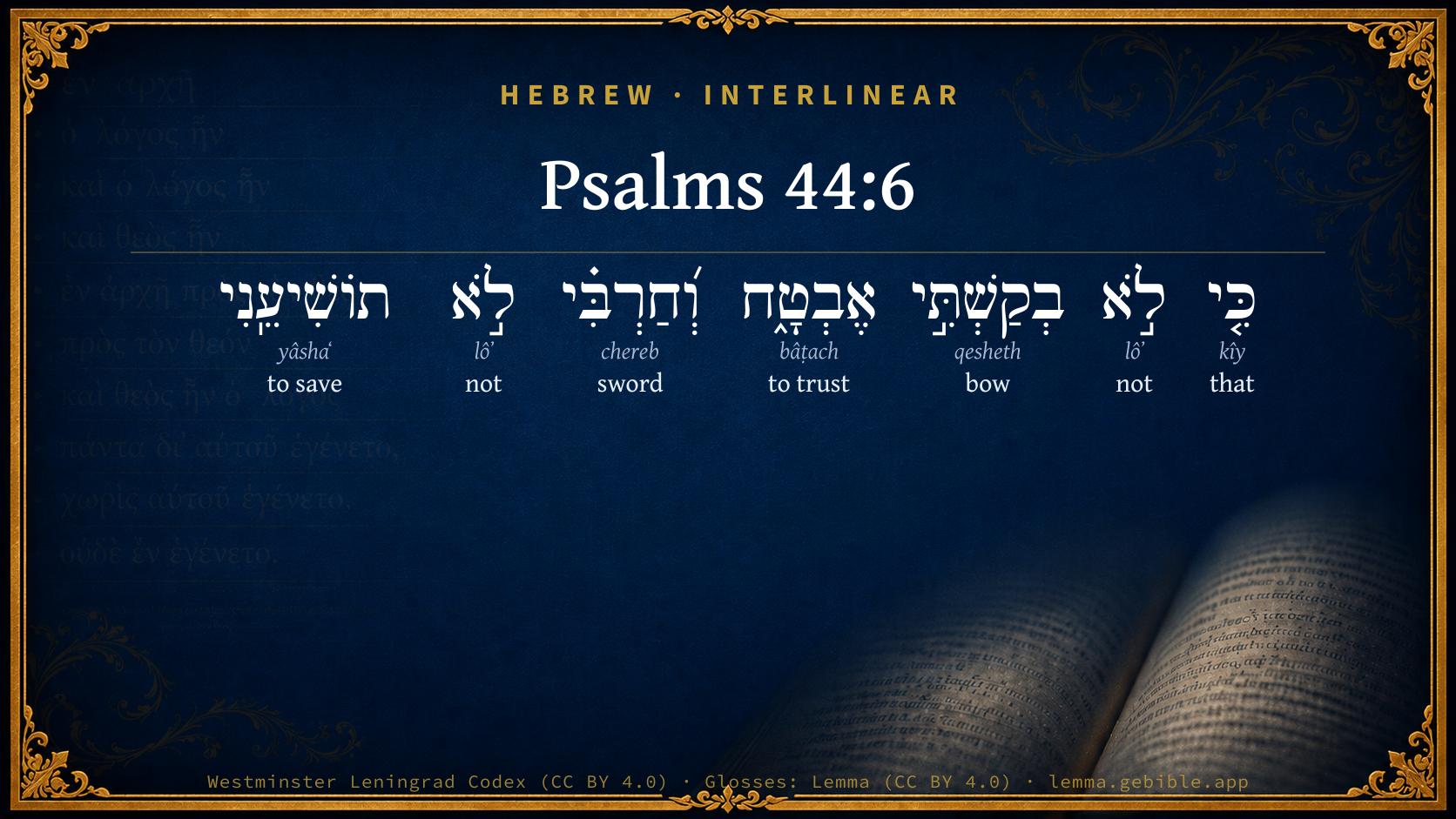
Psalms 44:6

Hebrew (Westminster Leningrad Codex) Psalms 44:6 appears in the Hebrew Old Testament. The text above is from the Westminster Leningrad Codex. Each word links to its Strong’s number, a concise gloss, and parsing drawn from the Open Scriptures Hebrew Bible morphology. Click any word for its full Brown-Driver-Briggs (BDB) entry.
Download image
Cite this verse

Psalms 44:6 (World English Bible). Public Domain. Lemma interlinear Bible study tool, https://lemma.gebible.app/v/psalms/44/6.

Show BibTeX & RIS
BibTeX
RIS
English Translation
For I will not trust in my bow, Neither shall my sword save me.
World English Bible · Public Domain
Download a study sheet

One document with this verse’s original text, its word-by-word gloss line, the meaning frame, cross-references with their text, attributed commentary, and full source and license credits — printable, and it pastes into notes with its structure intact.

This verse Autodidact and up

Study sheet (.html) Plain text (.txt)

A passage Seminary Student

Up to 50 verses in one chapter. A passage sheet keeps up to 6 commentary sources and 12 cross-references per verse, in the order this page ranks them, and says so on the sheet whenever that leaves anything out. Ask for a single verse and you get the Autodidact verse sheet above.

Everything on this page stays free to read, with no account — the sheet is a download of what is already on screen, not access to it.

Want to remove ads? Support Godless Engineer
Compare translations 3

The same verse in 3 English versions, stacked beneath the original-language interlinear above. Click any original word for its lexicon entry.

Each is an independent rendering of the whole verse — the interlinear is not word-aligned to these translations.

Highlighted words mark where these versions differ — a whole-verse word diff, not a word-by-word alignment.

  • World English Bible Public Domain
    For I will not trust in my bow, Neither shall my sword save me.
  • King James Version Public Domain
    For I will not trust in my bow, neither shall my sword save me.
  • unfoldingWord Literal Text CC BY-SA 4.0
    For I do not trust in my bow, and my sword does not save me,

unfoldingWord Literal Text — © unfoldingWord, licensed CC BY-SA 4.0. Word-aligned USFM3 via Door43 (git.door43.org/unfoldingWord/en_ult).

Versions to compare (up to 4)

3 of 4 selected

Show all 18 translations

Every available English version of this verse, each an independent rendering of the whole verse.

  • World English Bible Public Domain
    For I will not trust in my bow, Neither shall my sword save me.
  • Berean Standard Bible Public Domain
    For I do not trust in my bow, nor does my sword save me.
  • Majority Standard Bible Public Domain
    For I do not trust in my bow, nor does my sword save me.
  • King James Version Public Domain
    For I will not trust in my bow, neither shall my sword save me.
  • American Standard Version (1901) Public Domain
    For I will not trust in my bow, Neither shall my sword save me.
  • Revised Version (1885) Public Domain
    For I will not trust in my bow, neither shall my sword save me.
  • Geneva Bible (1599) Public Domain
    For I do not trust in my bowe, neither can my sworde saue me.
  • Douay-Rheims (1899) Public Domain
    Through thee we will push down our enemies with the horn: and through thy name we will despise them that rise up against us.
  • Young's Literal Translation Public Domain
    For, not in my bow do I trust, And my sword doth not save me.
  • Literal Standard Version CC BY-SA 4.0
    For I do not trust in my bow, || And my sword does not save me.
  • Unlocked Literal Bible CC BY-SA 4.0
    For I will not trust in my bow, neither will my sword save me.
  • unfoldingWord Literal Text CC BY-SA 4.0
    For I do not trust in my bow, and my sword does not save me,
  • Darby Bible Public Domain
    For I will not put confidence in my bow, neither shall my sword save me.
  • World Messianic Bible Public Domain
    For I will not trust in my bow, neither will my sword save me.
  • Webster's Bible Public Domain
    \\44:5\\Through thee will we push down our enemies: through thy name we will tread them under that rise up against us.
  • Free Bible Version CC BY-SA 4.0
    I do not trust my bow; I do not have confidence in my sword to save me.
  • Bible in Basic English Public Domain
    I will not put faith in my bow, my sword will not be my salvation.
  • JPS Tanakh (1917) Public Domain
    (44-7) For I trust not in my bow, neither can my sword save me.

Literal Standard Version (2020), Covenant Press — licensed CC BY-SA 4.0. Text via the HelloAO Bible API (eBible.org). Unlocked Literal Bible (unfoldingWord) — licensed CC BY-SA 4.0. Text via the HelloAO Bible API (eBible.org). unfoldingWord Literal Text — © unfoldingWord, licensed CC BY-SA 4.0. Word-aligned USFM3 via Door43 (git.door43.org/unfoldingWord/en_ult). Free Bible Version, Dr. Jonathan Gallagher — licensed CC BY-SA 4.0. Text via the HelloAO Bible API (eBible.org).

Word by word

More ways to search: Search by grammar → Find every occurrence → Compare this word →

Practice this passage: Drill this verse → Learn its vocabulary →

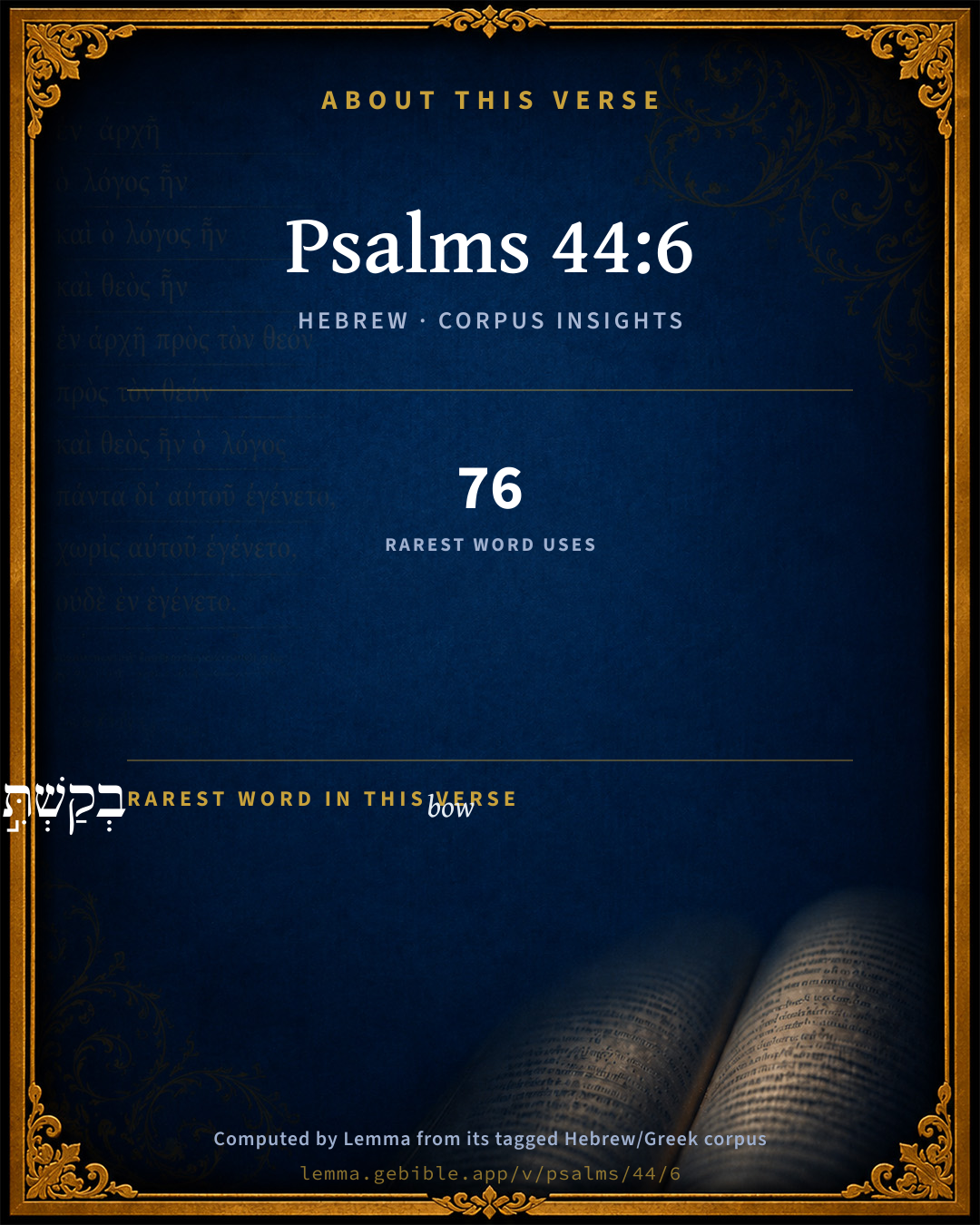
About this verse

These counts appear in no published source. They are computed here, from the morphology-tagged text and Lemma’s own curated glosses. What Lemma adds →

7
words
6
distinct lemmas
Wisdom
section

Grammatical profile

  • 2 verbs
  • 2 nouns
  • 1 conjunction
  • 2 particles

Verb forms

  • אֶבְטָ֑ח Qal · Imperfect
  • תוֹשִׁיעֵֽנִי Hiphil · Imperfect

Repetition

A word recurs within this verse — often emphatic in Hebrew:

Hebrew & Septuagint length

In English translation the verse runs 14 words from the Hebrew and 15 from the Septuagint (LXX English) — closely comparable.

A rough comparison of the two English renderings, which tokenize alike — not a word-level alignment.

Word counts can differ between the Hebrew and the Greek without any difference in meaning — e.g. the Hebrew direct-object marker אֵת has no separate Greek word, and Greek often adds the article ὁ.

Cross-references

4

Topical passages linked to Psalms 44:6 in the Treasury of Scripture Knowledge — connected by theme and wording, ordered by reader-vote popularity; previews shown in the World English Bible.

  • 1 Samuel 17:47 and that all this assembly may know that Yahweh doesn't save with sword and spear: for the battle is Yahweh's, and he will give you into our hand.
  • Psalms 20:7 Some trust in chariots, and some in horses, But we trust the name of Yahweh our God.
  • Hosea 1:7 But I will have mercy on the house of Judah, and will save them by Yahweh their God, and will not save them by bow, nor by sword, nor by battle, by horses, nor by horsemen."
  • Psalms 33:16–17 There is no king saved by the multitude of a host. A mighty man is not delivered by great strength.

Cross-references courtesy of OpenBible.info (CC BY 4.0).

Hebrew and Greek witnesses Masoretic Hebrew ↔ Greek Septuagint

The same verse in the two great witnesses to the Old Testament, shown verse-for-verse.

You’re reading Greek Psalm 43 (Hebrew Psalm 44). The Septuagint counts the superscription, so verse numbers can differ from the Hebrew — chapter-level alignment, not verse-by-verse. Numbering follows Rahlfs.

These are two independent witnesses, not word-aligned to each other, and the Septuagint is shown in lemma (dictionary) form.

Hebrew Psalms 44:6 Masoretic · Westminster Leningrad Codex

כִּ֤י לֹ֣א בְקַשְׁתִּ֣י אֶבְטָ֑ח וְ֝חַרְבִּ֗י לֹ֣א תוֹשִׁיעֵֽנִי

For I will not trust in my bow, Neither shall my sword save me.

World English Bible · Public Domain

Greek LXX Greek Psalm 43:6 Septuagint · lemma form

ἐν σύ ὁ ἐχθρός ἐγώ κερατίζω καί ἐν ὁ ὄνομα σύ ἐκοὐθενόω ὁ ἐπι ἀναἵστημι ἐγώ

For I will not trust in my bow, and my sword shall not save me.

LXX2012 (modern English Septuagint) · Public Domain

Hebrew: Westminster Leningrad Codex (CC BY 4.0). Greek: Septuagint (public domain); English from LXX2012 (modern English Septuagint) (Public Domain). How the Septuagint differs from the Hebrew →

Commentary

Notes on Psalms 44:6 from classic Christian and Jewish commentators (each source and its license shown beneath its notes). The classic Christian expositions comment on the surrounding passage and are grouped to its opening verse, so a note may address several verses; the Jewish commentaries on the Tanakh (Rashi and others) are per-verse, so they appear only where the commentator wrote on this verse.

Lemma curates 59 commentaries, every one of them public domain or Creative Commons licensed, each selected and text-cleaned for this edition rather than reprinted as found. About our sources →

Trapp's Complete Commentary

John Trapp

Psa 44:6 For I will not trust in my bow, neither shall my sword save me.

Ver. 6. For I will not trust in my bow] To trust in men or means is the ready road to utter ruin. Idas, one of the Argonauts, is brought in by the poet, bragging that he trusted not in the gods, but in his own arm and arms. αιια ουδε η οφελλει αιιευς τοσον οδατιον περ εμον δορυ.

What need we to fear the Turks (said Sigismund, the young king of Hungary, in his pride and jollity), who need not at all to fear the falling of the heavens, which, if they should fall, yet were we able with our spears and halberds to hold them up for falling upon us? He shortly after this received a notable overthrow. Carnal confidence endeth in confusion.

John Trapp, A Commentary or Exposition upon All the Books of the Old and New Testament (1647–1656) — public domain. Text from a community e-Sword module.

J. A. Alexander on Psalms

Joseph Addison Alexander

7. (Psa 44:6). For not in my bow will I trust, and my sword will (or can) not save me. "What was true of my fathers is equally true of me. As they did not prevail by their own strength, neither can I hope to prevail by mine."

Joseph Addison Alexander, The Psalms Translated and Explained (1850) — public domain. Text from a community e-Sword module.

Jamieson, Fausset & Brown

Robert Jamieson, A. R. Fausset & David Brown

God is not only our sole help, but only worthy of praise.

Jamieson, Fausset & Brown — Commentary Critical and Explanatory on the Whole Bible (1871) — public domain (CC PDM 1.0). Text via the HelloAO Bible API.

Adam Clarke's Commentary

Verse 6. I will not trust in my bow] As he is speaking of what God had already done for his forefathers, these words should be read in the past tense: "We have not trusted," &c.

Adam Clarke's Commentary on the Bible (1810–1826) — public domain. Text from a community e-Sword/MySword module.

The Cambridge Bible for Schools and Colleges

gen. ed. J. J. S. Perowne

6. Cp. Psa_20:7; Psa_33:16; Psa_60:11 f; 1Sa_17:47; Hos_1:7; and the noble speech of Judas Maccabaeus (1Ma_3:17 ff.); “The victory of battle standeth not in the multitude of an host, but strength cometh from heaven.”

The Cambridge Bible for Schools and Colleges (gen. ed. J. J. S. Perowne; Cambridge University Press, 1878–1918) — public domain. Text from a community e-Sword module.

John Gill's Exposition

For I will not trust in my bow,.... In any carnal weapon, in any creature help and assistance, or in an arm of flesh, but in the word of the Lord, and in his name; see Psa 20:7;

neither shall my sword save me; that is, I will not ascribe salvation to it; the church's weapons are not carnal, but spiritual; not the sword of the civil magistrate, but the sword of the Spirit, which is the word of God; Christ's kingdom, being not of this world, is not supported and defended by worldly means, or carnal weapons.

John Gill's Exposition of the Whole Bible (1746–1763) — public domain (CC PDM 1.0). Text via the HelloAO Bible API.

Albert Barnes' Notes on the Bible

For I will not trust in my bow - The author of the psalm himself again speaks as expressing his own feelings, and stating the grounds of his confidence and hope. Compare Psa 44:4. At the same time he doubtless expresses the feelings of the people, and speaks in their name. He had said Psa 44:3 that the ancestors of the Jewish people had not obtained possession of the promised land by any strength or skill of their own, and he now says that he, and those who were connected with him, did not depend on their own strength, or on the weapons of war which they might employ, but that their only ground of trust was God.

Albert Barnes' Notes on the Bible (1834–1885) — public domain. Text from a community e-Sword/MySword module.

Matthew Poole's English Annotations

But I will trust in thee only, as the next verse implies; and therefore do not frustrate my hope and confidence fixed upon thee.

Matthew Poole's English Annotations on the Holy Bible (1683–1685) — public domain. Text from a community e-Sword/MySword module.

The Treasury of David

Charles H. Spurgeon

Ver. 6. For I will not trust in my bow, neither shall my sword save me. Thy people Israel, under thy guidance, shouldered out the heathen, and gained their land, not by skill of weapons or prowess of arms, but by thy power alone; therefore will we renounce for ever all reliance upon outward confidences, of which other men make such boast, and we will cast ourselves upon the omnipotence of our God. Bows having been newly introduced by king Saul, were regarded as very formidable weapons in the early history of Israel, but they are here laid aside together with the all conquering sword, in order that there may be room for faith in the living God. This verse, in the first person singular, may serve as the confession of faith of every believer renouncing his own righteousness and strength, and looking alone to the Lord Jesus. O for grace to stand to this self renunciation, for alas! our proud nature is all too apt to fix its trust on the puffed up and supposititious power of the creature. Arm of flesh, how dare I trust thee? How dare I bring upon myself the curse of those who rely upon man?

Ver. 6. I will not trust in my bow, neither shall my sword save me. By bow and sword, he meaneth all manner of weapons and warlike instruments whatsoever; and by "saving, "he meaneth delivering from dangers, speaking under the person of one (because all the faithful are but one body), in the name of all the rest. Thomas Wilcocks.

Ver. 6. I will not trust in my bow, etc. I will not trust in my own sword or bow, but in the sword of the Divine Warrior, and in the bow of the Divine Archer, whose arrows are sharp in the heart of his enemies as described in the next Ps 45:3-5, which is connected by that imagery with this Psalm, as well as by its inner meaning. Christopher Wordsworth.

Ver. 6. The less confidence we have in ourselves or in anything beside God, the more evidence have we of the sincerity of our faith in God. David Dickson.

Ver. 6-7. The two verses correspond exactly to Ps 44:3. As there, in reference to the past, the salvation was ascribed wholly to God, so here in reference to the future. E. W. Hengstenberg.

Ver. 6. Relinquishment of outward trusts. My bow may miss its aim, may be broken, may be snatched away. My sword may snap, or grow blunt, or slip from my hold. We may not trust in our abilities, our experience, our shrewdness, our wealth, etc.

Ver. 6. Self renunciationthe duty of saint and sinner.

Psalms 44:7*

Ver. 6-7. The two verses correspond exactly to Ps 44:3. As there, in reference to the past, the salvation was ascribed wholly to God, so here is reference to the future. E. W. Hengstenberg.

Charles H. Spurgeon's The Treasury of David (1869–1885) — public domain. Psalms only. Text from a community e-Sword/MySword module.

The Pulpit Commentary

For I will not trust in my bow, neither shall my sword save me (comp. ver. 3). My trust, i.e. , shall not be in myself, but in thee. The sword and the bow were the ordinary weapons of Israel.

The Pulpit Commentary (1880–1919), ed. H.D.M. Spence-Jones & Joseph S. Exell — public domain. Text from a community e-Sword module.

Scofield Reference Notes

C. I. Scofield

trust

(See Scofield "Psa 2:12").

The Scofield Reference Bible (1917 edition), notes by C. I. Scofield — public domain. Text from a community e-Sword module.

Rashi

Rabbi Shlomo Yitzchaki (Rashi)

we will trample those who rise up against us Heb. נבוס. We will tread and trample our enemies, an expression of (Ezek. 16:6): “wallowing (מתבוססת) in your blood”; (Prov. 27:7), “tramples (תבוס) honeycomb”; (Zech. 10:5), “And they shall be like mighty men, treading (בוסים) the mire of the streets.”

Rashi on the Tanakh — English translations: “The Judaica Press complete Tanach with Rashi, translated by A. J. Rosenberg” (CC BY 4.0); “Pentateuch with Rashi's commentary by M. Rosenbaum and A.M. Silbermann, 1929-1934” (public domain); “The Metsudah Tanach series, Lakewood, N.J” (CC BY 4.0); and “The Book of Joshua, Metsudah Publications, 1997” (CC BY 4.0). Text via Sefaria.

Lesson kit

Teaching starters — assembled from the data on this page, not authored interpretation. Every prompt links to the verse data it draws on. Edit before teaching.

Psalms, in the Wisdom, opens this verse with 7 words (6 distinct Hebrew lemmas). Its most distinctive word is qesheth (“bow”). A historical commentator’s framing appears above. Read the whole chapter for the surrounding context.

Discussion questions

  1. What does “bow” (qesheth) contribute to the verse as a whole?
  2. 1 Samuel 17:47 shares this passage’s theme. How do the two illuminate each other?
  3. “not” occurs 2× in this one verse. What is the effect of the repetition?
  4. The translations on this page render this verse differently — a whole-verse word diff, not a word-by-word alignment. What might account for the different wordings?
  5. The verb «אֶבְטָ֑ח» is Qal Imperfect. How does its form color the action?
  6. Reading how Trapp's Complete Commentary and J. A. Alexander on Psalms read this verse, where do the two commentators agree and where do they part?

Things to notice

Reading settings

Reading text

Shown beneath each verse's original-language words.

Old Testament
Old Testament edition

Read the OT as the Masoretic Hebrew (MT) or the Greek Septuagint (LXX).

English shown for the Greek Septuagint (in the Hebrew ↔ Greek comparison).

Comparing translations? Open the Compare panel on any verse page to stack up to four side by side.