Job 1:15

Hebrew (Westminster Leningrad Codex) Job 1:15 appears in the Hebrew Old Testament. The text above is from the Westminster Leningrad Codex. Each word links to its Strong’s number, a concise gloss, and parsing drawn from the Open Scriptures Hebrew Bible morphology. Click any word for its full Brown-Driver-Briggs (BDB) entry.
Download image
Cite this verse

Job 1:15 (World English Bible). Public Domain. Lemma interlinear Bible study tool, https://lemma.gebible.app/v/job/1/15.

Show BibTeX & RIS
BibTeX
RIS
English Translation
and the Sabeans attacked, and took them away. Yes, they have killed the servants with the edge of the sword, and I alone have escaped to tell you."
World English Bible · Public Domain
Download a study sheet

One document with this verse’s original text, its word-by-word gloss line, the meaning frame, cross-references with their text, attributed commentary, and full source and license credits — printable, and it pastes into notes with its structure intact.

This verse Autodidact and up

Study sheet (.html) Plain text (.txt)

A passage Seminary Student

Up to 50 verses in one chapter. A passage sheet keeps up to 6 commentary sources and 12 cross-references per verse, in the order this page ranks them, and says so on the sheet whenever that leaves anything out. Ask for a single verse and you get the Autodidact verse sheet above.

Everything on this page stays free to read, with no account — the sheet is a download of what is already on screen, not access to it.

Want to remove ads? Support Godless Engineer
Compare translations 3

The same verse in 3 English versions, stacked beneath the original-language interlinear above. Click any original word for its lexicon entry.

Each is an independent rendering of the whole verse — the interlinear is not word-aligned to these translations.

Highlighted words mark where these versions differ — a whole-verse word diff, not a word-by-word alignment.

  • World English Bible Public Domain
    and the Sabeans attacked, and took them away. Yes, they have killed the servants with the edge of the sword, and I alone have escaped to tell you."
  • King James Version Public Domain
    And the Sabeans fell upon them, and took them away; yea, they have slain the servants with the edge of the sword; and I only am escaped alone to tell thee.
  • unfoldingWord Literal Text CC BY-SA 4.0
    And Sheba fell and took them, and they struck the servants with the edge of the sword, and only I alone have escaped to tell you.”

unfoldingWord Literal Text — © unfoldingWord, licensed CC BY-SA 4.0. Word-aligned USFM3 via Door43 (git.door43.org/unfoldingWord/en_ult).

Versions to compare (up to 4)

3 of 4 selected

Show all 18 translations

Every available English version of this verse, each an independent rendering of the whole verse.

  • World English Bible Public Domain
    and the Sabeans attacked, and took them away. Yes, they have killed the servants with the edge of the sword, and I alone have escaped to tell you."
  • Berean Standard Bible Public Domain
    the Sabeans swooped down and took them away. They put the servants to the sword, and I alone have escaped to tell you!”
  • Majority Standard Bible Public Domain
    the Sabeans swooped down and took them away. They put the servants to the sword, and I alone have escaped to tell you!”
  • King James Version Public Domain
    And the Sabeans fell upon them, and took them away; yea, they have slain the servants with the edge of the sword; and I only am escaped alone to tell thee.
  • American Standard Version (1901) Public Domain
    and the Sabeans fell `upon them', and took them away: yea, they have slain the servants with the edge of the sword; and I only am escaped alone to tell thee.
  • Revised Version (1885) Public Domain
    and the Sabeans fell upon them, and took them away; yea, they have slain the servants with the edge of the sword; and I only am escaped alone to tell thee.
  • Geneva Bible (1599) Public Domain
    And the Shabeans came violently, and tooke them: yea, they haue slayne the seruants with the edge of the sworde: but I onely am escaped alone to tell thee.
  • Douay-Rheims (1899) Public Domain
    And the Sabeans rushed in, and took all away, and slew the servants with the sword, and I alone have escaped to tell thee.
  • Young's Literal Translation Public Domain
    and Sheba doth fall, and take them, and the young men they have smitten by the mouth of the sword, and I am escaped -- only I alone -- to declare `it' to thee.'
  • Literal Standard Version CC BY-SA 4.0
    and Sheba falls, and takes them, and they have struck the young men by the mouth of the sword, and I have escaped—only I alone—to declare [it] to you.”
  • Unlocked Literal Bible CC BY-SA 4.0
    Then the Sabeans fell on them and took them away. As for the servants, they have struck them with the edge of the sword. I alone have escaped to tell you.”
  • unfoldingWord Literal Text CC BY-SA 4.0
    And Sheba fell and took them, and they struck the servants with the edge of the sword, and only I alone have escaped to tell you.”
  • Darby Bible Public Domain
    and [they of] Sheba fell [upon them] and took them, and the servants have they smitten with the edge of the sword; and I only am escaped, alone, to tell thee.
  • World Messianic Bible Public Domain
    and the Sabeans attacked, and took them away. Yes, they have killed the servants with the edge of the sword, and I alone have escaped to tell you.”
  • Webster's Bible Public Domain
    And the Sabeans fell upon them, and took them away; yes, they have slain the servants with the edge of the sword; and I only have escaped alone to tell thee.
  • Free Bible Version CC BY-SA 4.0
    the Sabeans attacked and took them, killing the herdsmen. Only I escaped to bring you this news.”
  • Bible in Basic English Public Domain
    And the men of Sheba came against them and took them away, putting the young men to the sword, and I was the only one who got away safe to give you the news.
  • JPS Tanakh (1917) Public Domain
    and the Sabeans made a raid, and took them away; yea, they have slain the servants with the edge of the sword; and I only am escaped alone to tell thee.'

Literal Standard Version (2020), Covenant Press — licensed CC BY-SA 4.0. Text via the HelloAO Bible API (eBible.org). Unlocked Literal Bible (unfoldingWord) — licensed CC BY-SA 4.0. Text via the HelloAO Bible API (eBible.org). unfoldingWord Literal Text — © unfoldingWord, licensed CC BY-SA 4.0. Word-aligned USFM3 via Door43 (git.door43.org/unfoldingWord/en_ult). Free Bible Version, Dr. Jonathan Gallagher — licensed CC BY-SA 4.0. Text via the HelloAO Bible API (eBible.org).

Word by word

More ways to search: Search by grammar → Find every occurrence → Compare this word →

Practice this passage: Drill this verse → Learn its vocabulary →

שְׁבָא֙
Shᵉbâʼ
H7614
“Sheba”
Noun, Proper
Part of Speech
Noun
Type
Proper
Full BDB Definition

Origin: of foreign origin

TWOT: None

Sheba = "seven" or " an oath" - son of Joktan and a descendant of Seth (noun proper masculine) - son of Raamah, grandson of Cush, and a descendant of Ham (noun proper masculine) - son of Jokshan, the son of Abraham by Keturah (noun proper masculine) - a nation in southern Arabia (noun proper locative)
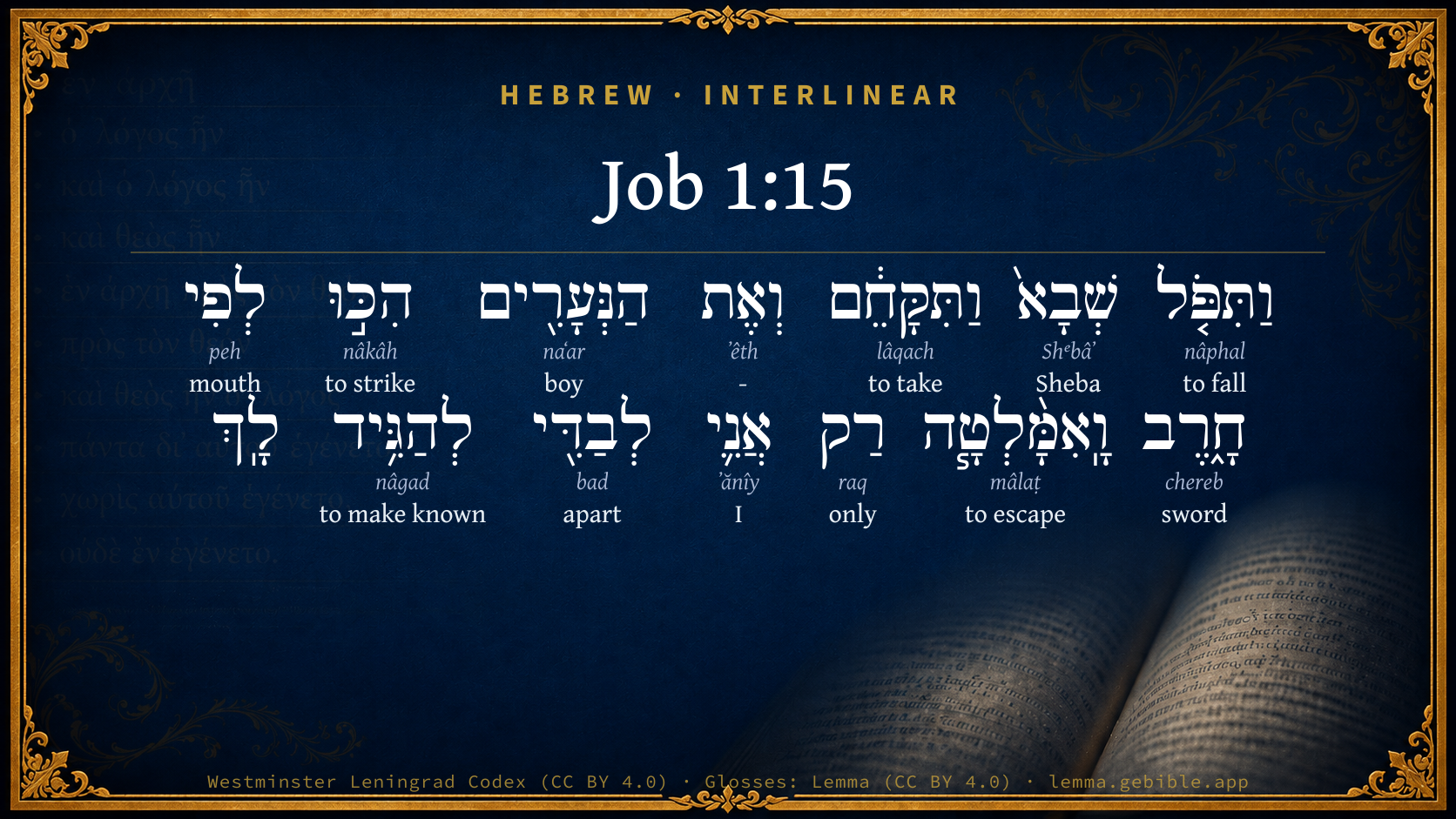
  1. וַתִּפֹּ֤ל nâphal H5307 “and · to fall” Conjunction + Verb, Qal, Sequential Imperfect, 3rd Person, Feminine, Singular
  2. וַתִּקָּחֵ֔ם lâqach H3947 “and · to take · them” Conjunction + Verb, Qal, Sequential Imperfect, 3rd Person, Feminine, Singular + Suffix, Personal, 3rd Person, Masculine, Plural
  3. וְאֶת ʼêth H853 “and · -” Conjunction + Particle, Direct Object
  4. הַנְּעָרִ֖ים naʻar H5288 “the · boys” Particle, Definite Article + Noun, Common, Masculine, Plural, Absolute
  5. הִכּ֣וּ nâkâh H5221 “to strike” Verb, Hiphil, Perfect, 3rd Person, Common, Plural
  6. לְפִי peh H6310 “to/for · mouth of” Preposition + Noun, Common, Masculine, Singular, Construct
  7. חָ֑רֶב chereb H2719 “sword” Noun, Common, Feminine, Singular, Absolute
  8. וָֽאִמָּ֨לְטָ֧ה mâlaṭ H4422 “and · to escape” Conjunction + Verb, Niphal, Sequential Imperfect, 1st Person, Common, Singular + Suffix, h
  9. רַק raq H7535 “only” Particle, Accusative
  10. אֲנִ֛י ʼănîy H589 “I” Pronoun, Personal, 1st Person, Common, Singular
  11. לְבַדִּ֖י bad H905 “to/for · apart · my” Preposition + Noun, Common, Masculine, Singular, Construct + Suffix, Personal, 1st Person, Common, Singular
  12. לְהַגִּ֥יד nâgad H5046 “to make known” Preposition + Verb, Hiphil, Infinitive Construct

About this verse

These counts appear in no published source. They are computed here, from the morphology-tagged text and Lemma’s own curated glosses. What Lemma adds →

14
words
13
distinct lemmas
Wisdom
section

Notable vocabulary

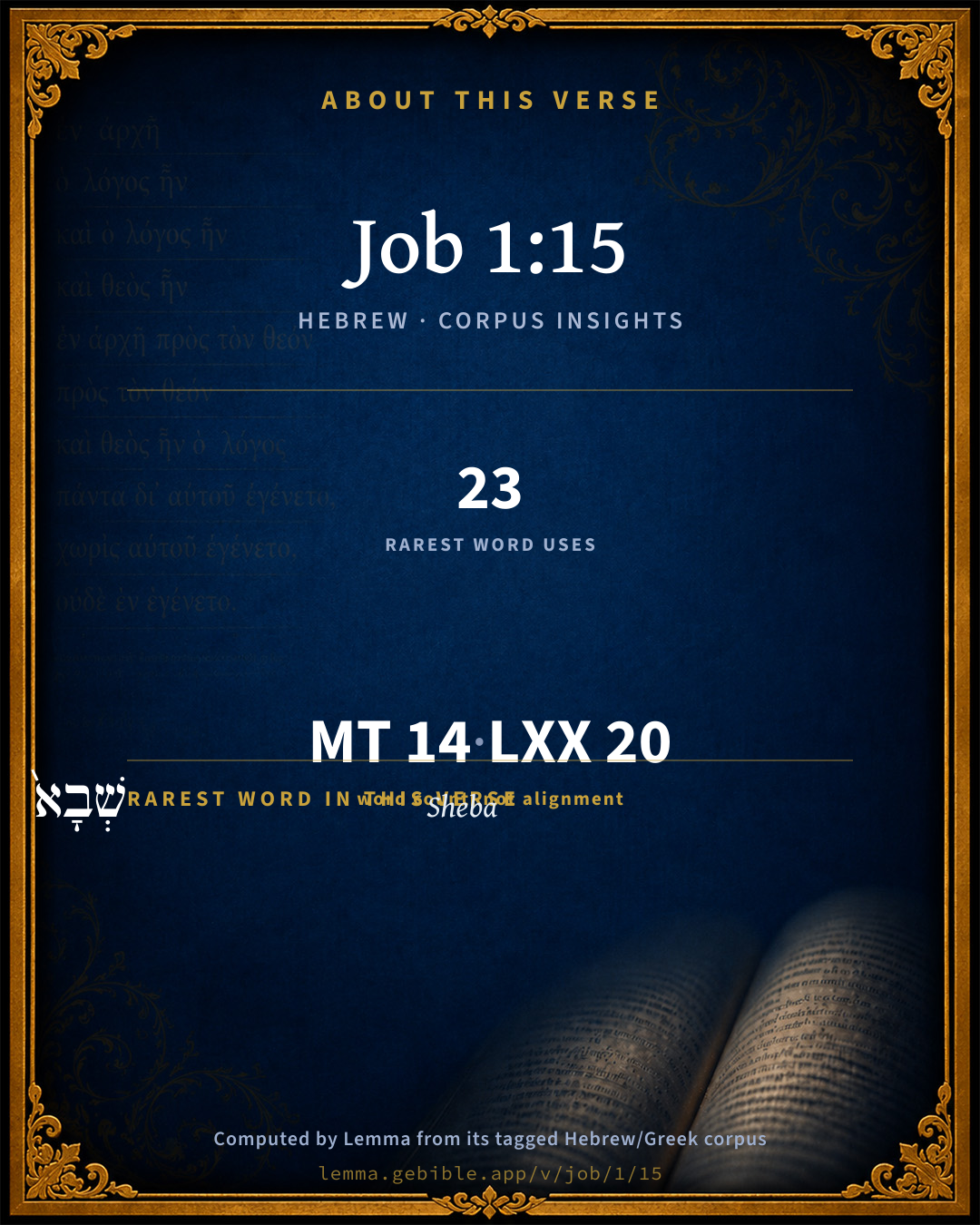
The rarest word here is שְׁבָא֙ Sheba H7614 — appearing just 23 times in the whole Hebrew Bible.

Shared distinctive vocabulary

שְׁבָא֙ Sheba H7614 occurs in 23 verses of the Hebrew Bible. Also found in:

Grammatical profile

  • 5 verbs
  • 5 nouns
  • 1 pronoun
  • 1 preposition
  • 2 particles

Verb forms

  • וַתִּפֹּ֤ל Qal · Sequential Imperfect
  • וַתִּקָּחֵ֔ם Qal · Sequential Imperfect
  • הִכּ֣וּ Hiphil · Perfect
  • וָֽאִמָּ֨לְטָ֧ה Niphal · Sequential Imperfect
  • לְהַגִּ֥יד Hiphil · Infinitive Construct

Hebrew & Septuagint length

In English translation the verse runs 28 words from the Hebrew and 27 from the Septuagint (LXX English) — closely comparable.

A rough comparison of the two English renderings, which tokenize alike — not a word-level alignment.

Word counts can differ between the Hebrew and the Greek without any difference in meaning — e.g. the Hebrew direct-object marker אֵת has no separate Greek word, and Greek often adds the article ὁ.

In the original languages it is 14 Hebrew tokens and 20 Greek tokens — but the two are counted differently (Hebrew bundles its prefixes and suffixes into one token; the Greek is in lemma form), so that isn’t a like-for-like length.

Cross-references

11

Topical passages linked to Job 1:15 in the Treasury of Scripture Knowledge — connected by theme and wording, ordered by reader-vote popularity; previews shown in the World English Bible.

  • Genesis 10:7 The sons of Cush: Seba, Havilah, Sabtah, Raamah, and Sabteca. The sons of Raamah: Sheba and Dedan.
  • Job 6:19 The caravans of Tema looked, The companies of Sheba waited for them.
  • Genesis 10:28 Obal, Abimael, Sheba,
  • Genesis 25:3 Jokshan became the father of Sheba, and Dedan. The sons of Dedan were Asshurim, Letushim, and Leummim.
  • 1 Samuel 22:20–21 One of the sons of Ahimelech, the son of Ahitub, named Abiathar, escaped, and fled after David.
  • Job 1:16–17 While he was still speaking, there also came another, and said, "The fire of God has fallen from the sky, and has burned up the sheep and the servants, and consumed them, and I alone have escaped to tell you."
  • Job 1:19 and, behold, there came a great wind from the wilderness, and struck the four corners of the house, and it fell on the young men, and they are dead. I alone have escaped to tell you."
  • Psalms 72:10 The kings of Tarshish and of the isles will bring tribute. The kings of Sheba and Seba shall offer gifts.
  • Isaiah 45:14 Thus says Yahweh: "The labor of Egypt, and the merchandise of Ethiopia, and the Sabeans, men of stature, shall come over to you, and they shall be yours. They shall go after you. In chains they shall come over; and they shall fall down to you. They shall make supplication to you: 'Surely God is in you; and there is none else, there is no other god.
  • Ezekiel 23:42 The voice of a multitude being at ease was with her: and with men of the common sort were brought drunkards from the wilderness; and they put bracelets on the hands of them [twain], and beautiful crowns on their heads.
  • Joel 3:8 And I will sell your sons and your daughters into the hands of the children of Judah, And they will sell them to the men of Sheba, To a faraway nation, For Yahweh has spoken it."

Cross-references courtesy of OpenBible.info (CC BY 4.0).

Hebrew and Greek witnesses Masoretic Hebrew ↔ Greek Septuagint

The same verse in the two great witnesses to the Old Testament, shown verse-for-verse.

These are two independent witnesses, not word-aligned to each other, and the Septuagint is shown in lemma (dictionary) form.

Hebrew Job 1:15 Masoretic · Westminster Leningrad Codex

וַתִּפֹּ֤ל שְׁבָא֙ וַתִּקָּחֵ֔ם וְאֶת הַנְּעָרִ֖ים הִכּ֣וּ לְפִי חָ֑רֶב וָֽאִמָּ֨לְטָ֧ה רַק אֲנִ֛י לְבַדִּ֖י לְהַגִּ֥יד לָֽךְ

and the Sabeans attacked, and took them away. Yes, they have killed the servants with the edge of the sword, and I alone have escaped to tell you."

World English Bible · Public Domain

Greek LXX Job 1:15 Septuagint · lemma form

καί ἔρχομαι ὁ αἰχμαλωτεύω αἰχμαλωτεύω αὐτός καί ὁ παῖς ἀποκτείνω ἐν μάχαιρα σώζω δέ ἐγώ μόνος ἔρχομαι ὁ ἀποἀγγέλλω σύ

and the spoilers came and took them for a prey, and killed the servants with the sword; and I having escaped alone am come to tell you.

LXX2012 (modern English Septuagint) · Public Domain

On this verse, Adam Clarke's Commentary discusses the Septuagint’s reading. Read the note in Commentary ↓

Hebrew: Westminster Leningrad Codex (CC BY 4.0). Greek: Septuagint (public domain); English from LXX2012 (modern English Septuagint) (Public Domain). How the Septuagint differs from the Hebrew →

Commentary

Notes on Job 1:15 from classic Christian and Jewish commentators (each source and its license shown beneath its notes). The classic Christian expositions comment on the surrounding passage and are grouped to its opening verse, so a note may address several verses; the Jewish commentaries on the Tanakh (Rashi and others) are per-verse, so they appear only where the commentator wrote on this verse.

Lemma curates 59 commentaries, every one of them public domain or Creative Commons licensed, each selected and text-cleaned for this edition rather than reprinted as found. About our sources →

Trapp's Complete Commentary

John Trapp

Job 1:15 And the Sabeans fell [upon them], and took them away; yea, they have slain the servants with the edge of the sword; and I only am escaped alone to tell thee.

Ver. 15. And the Sabeans fell upon them] i.e. The Arabians, a thievish people, that lived by rapine and robbery, Sabaei apud poetas molles vocantur; With the poets, the Sabeans were called effeminate, but Satan set them awork. They are at this day called Saracens, of Sarac, to rob; for they keep up their old trade, and are not all out so good as those Circassians, a kind of mongrel Christians who are said to divide their life between sin and devotion; dedicating their youth to rapine, and their old age to repentance.

Yea, they have slain the servants] Heb. The young men; for εργα νεων, &c., Iuniores ad labores, junior men to work. It was happy, howsoever, that they were taken away when in their lawful calling, and about their honest employments. Elijah chose to be taken in such a posture; for he knew the very time; and yet when the chariots of heaven came to fetch him up he was going and talking to his scholar Elisha. The busy attendance on our holy vocation is no less pleasing to God, or safe for us to die upon, than an immediate devotion. Happy is that servant whom the Master, when he cometh, shall find so doing.

And I only am escaped alone to tell thee] For no other cause escaped this one, this single one, but to add to Job’s affliction. There was no mercy in such a sparing; it was that Job might have the ill news brought him suddenly and certainly. That old manslayer had so contrived it for the greater mischief.

John Trapp, A Commentary or Exposition upon All the Books of the Old and New Testament (1647–1656) — public domain. Text from a community e-Sword module.

Tyndale Open Study Notes

Tyndale Open Resources

1:15 The Sabeans were marauding bandit tribes from the desert (cp. Judg 6:3). By the 700s BC, the southern Sabeans would become a national power that traded in gold, precious stones, perfume, and slaves (Ps 72:10; Isa 43:3; 45:14; 60:6; Jer 6:20).

Tyndale Open Study Notes — © Tyndale Open Resources, licensed CC BY-SA 4.0. Text via the HelloAO Bible API.

Geneva Bible (1599)

Geneva Bible translators

That is, the Arabians.

Geneva Bible (1599) marginal notes — public domain. Text via Bolls.life.

Jamieson, Fausset & Brown

Robert Jamieson, A. R. Fausset & David Brown

Sabeans--not those of Arabia-Felix, but those of Arabia-Deserta, descending from Sheba, grandson of Abraham and Keturah (Gen 25:3). The Bedouin Arabs of the present day resemble, in marauding habits, these Sabeans (compare Gen 16:12).

I alone am escaped--cunningly contrived by Satan. One in each case escapes (Job 1:16-17, Job 1:19), and brings the same kind of message. This was to overwhelm Job, and leave him no time to recover from the rapid succession of calamities--"misfortunes seldom come single."

Jamieson, Fausset & Brown — Commentary Critical and Explanatory on the Whole Bible (1871) — public domain (CC PDM 1.0). Text via the HelloAO Bible API.

Adam Clarke's Commentary

Verse 15. And the Sabeans fell] The Vulgate alone understands this of a people. The Septuagint, Syriac, and Arabic, understand it as implying a marauding party. The Chaldee says, "Lilith, queen of Zamargad, rushed suddenly upon them, and carried them away." The Sabeans mentioned here are supposed to have been the same with those who were the descendants of Abraham by Keturah, whose son Jokshan begat Sheba. The sons of Keturah were sent by Abraham into the east, Ge 25:6, and inhabited Arabia Deserta, on the east of the land of Uz. Hordes of predatory banditti were frequent in those countries and continue so to the present day. They made sudden incursions, and carried off men, women, children, cattle, and goods of every description; and immediately retired to the desert, whither it was in vain to pursue them.

Adam Clarke's Commentary on the Bible (1810–1826) — public domain. Text from a community e-Sword/MySword module.

Ellicott's Commentary for English Readers

(15) The Sabeans.—Literally, Sheba. Three persons named Sheba are found in Genesis: (1) The son of Raamah and grandson of Cush (Gen_10:7); (2) the son of Jokshan and grandson of Abraham (Gen_25:3); (3) The son of Joktanand grandson of Eber (Gen_10:28). It is probably the second who is referred to here, whose descendants led a predatory and marauding kind of life in the country bordering on that of Job. (Comp. Eze_38:13.)

A Bible Commentary for English Readers, edited by Charles John Ellicott (1878–1897) — public domain. Text from a community e-Sword module.

John Gill's Exposition

And the Sabeans fell upon them,.... Or, "Sheba fell" (e); that is, as Aben Ezra and Simeon Bar Tzemach supply it, an host of the Sabeans, or a company of them; these were not the descendants of that Sheba that sprung from Ham, Gen 10:7 nor of him that came from Shem, Gen 10:28, but from Sheba, the son of Jokshan, a son of Abraham by Keturah, who with the rest of her sons were sent into the east country, the country of Job; and these Sabeans, who descended from the same, were his near neighbours, Gen 25:3, they were the inhabitants of one of the Arabias, it is generally said Arabia Felix; but that is not likely, since it was a very plentiful country, the inhabitants of which had no need to rob and plunder others; and besides was at a great distance from the place of Job's habitation, and lay to the south, and not the east; though Strabo (f) indeed says, that the Sabeans inhabited Arabia Felix, and made excursions into Syria, which agrees with these Sabeans; but rather Arabia Deserta, as Spanheim (g) has abundantly proved, a barren place; hence we read of Sabeans from the wilderness, Eze 23:42, the inhabitants of which lived upon the plunder of others; and these being naturally given to spoil and rapine, were fit persons for Satan to work upon, as he does in the children of disobedience; into whose hearts he put it to make such a descent on Job's fields, and carry off his cattle, as they did; they fell upon his oxen and asses at once and unawares, in a body, in an hostile and furious manner:

and took them away; as a booty; they did not kill them, but drove them off the ground, and led them into their own country for their use and service:

yea, they have slain the servants with the edge of the sword; who were ploughing with the oxen, and looking after the asses, and who might make an opposition, though in vain; this was an addition to affliction, that not only his cattle were carried off, but his servants were slain, who were born in his house, or bought with his money:

and I only am escaped alone to tell thee; this single servant was preserved, either by the special providence of God, in kindness to Job, that he might know of a certainty, and exactly, and what had befallen him, and how it came to pass, which men are naturally desirous of; or else, as it is generally thought, through the malice and cunning of Satan, that the tidings might the sooner be brought to him, and more readily be believed by him, and strike him with the greater surprise, a servant of his own running with it, whom he knew, and could believe; and he appearing with the utmost concern of mind, and horror in his countenance.

(e) "et delapsa est Seba", Montanus, Bolducius; "et irruit Sheba", Schmidt, Cocceius. (f) Geograph. l. 16. p. 536. (g) Histor. Jobi, c. 3. sect. 12. p. 44, &c.

John Gill's Exposition of the Whole Bible (1746–1763) — public domain (CC PDM 1.0). Text via the HelloAO Bible API.

Albert Barnes' Notes on the Bible

And the Sabeans - Hebrew שׁבא shebâ', Vulgate, “Suboei.” The Septuagint gives a paraphrase, καὶ ἐλθόντες οἱ αἰχμαλωτεύοντες ἠχμαλώτευσαν kai elthonia hoi aichmalōteuontes ēchmalōteusan, “And the plunderers coming, plundered them,” or made them captive. On the situation of Sheba and Seba, see Isa 43:3, note; Isa 45:14, note; Isa 9:6, note. The people here referred to were, undoubtedly, inhabitants of some part of Arabia Felix. There are three persons of the name of Sheba mentioned in the Scriptures.

(1) A grandson of Cush; Gen 10:7.

(2) A son of Joktan; Gen 10:28.

(3) A son of Jokshan, the son of Abraham by Keturah.

“Calmet.” The Sheba here referred to was probably in the southern part of Arabia, and from the narrative it is evident that the Sabeans here mentioned were a predatory tribe. It is not improbable that these tribes were in the habit of wandering for purposes of plunder over the whole country, from the banks of the Euphrates to the outskirts of Egypt. The Bedawin Arabs of the present day resemble in a remarkable manner the ancient inhabitants of Arabia, and for many centuries the manners of the inhabitants of Arabia have not changed, for the habits of the Orientals continue the same from age to age. The Syriac renders this simply, “a multitude rushed” upon them;” omitting the word “Sabean.”

Fell upon them - With violence; or rushed unexpectedly upon them. This is the way in which the Arab tribes now attack the caravan, the traveler, or the village, for plunder.

And took them away - As plunder. It is common now to make such sudden incursions, and to carry off a large booty.

They have slain the servants - Hebrew נערים na‛arı̂ym, “the young men.” The word נער na‛ar, properly means a “boy,” and is applied to an infant just born, Exo 2:6; Jdg 13:5, Jdg 13:7; or to a youth, Gen 34:19; Gen 41:12. It came then to denote a servant or slave, like the Greek παῖς pais; Gen 24:2; 2Ki 5:20; compare Act 5:6. So the word “boy” is often used in the Southern States of North America to denote a slave. Here it evidently means the servants that were employed in cultivating the lands of Job, and keeping his cattle. There is no intimation that they were slaves. Jerome renders it “pueros, boys;” so the Septuagint τοῦς παὶδας tous paidas.

And I only am escaped alone - By myself, בד bad. There is no other one with me. It is remarkable that the same account is given by each one of the servants who escaped, Job 1:16-17, Job 1:19. The Chaldee has given a very singular version of this - apparently from the desire of accounting for everything, and of mentioning the “names” of all the persons intended. “The oxen were plowing, and Lelath, queen of Zamargad, suddenly rushed upon them, and carried them away.”

Albert Barnes' Notes on the Bible (1834–1885) — public domain. Text from a community e-Sword/MySword module.

Haydock's Catholic Bible Commentary

Sabeans, descended from Abraham, in the desert (Calmet) or happy Arabia. These nations lived on plunder. (Pliny, [Natural History?] vi. 28.) (Menochius)

George Leo Haydock (1774–1849), Haydock's Catholic Family Bible and Commentary, 1859 edition — public domain. Excludes Psalms (Douay-Rheims chapter numbering differs from Protestant) and Deuterocanonical books (Catholic canon only).

Matthew Poole's English Annotations

The Sabeans; a people of Arabia, who led a wandering life, and lived by robbery and spoiling of others, as Strabo and other heathen writers note.

I only am escaped alone to tell thee; whom Satan spared no less maliciously than he destroyed the rest, that Job might have speedy and certain intelligence of his calamity.

Matthew Poole's English Annotations on the Holy Bible (1683–1685) — public domain. Text from a community e-Sword/MySword module.

Whedon's Commentary on the Bible

Daniel D. Whedon

15. The Sabeans — In the original, Sheba; the name of the country, for its inhabitants. In broken and startling language he cries, “Sheba fell and took them.” Three races bearing the name Sabean are mentioned in Genesis: the one in the line of Cush, (Job_10:7,) the second of Joktan, (Job 10:28,) and the third in that of Abraham by Keturah, (Job_25:3.) The Sabeans of our text were of the last-named lineage, and as a nomadic tribe occupied the country south-east of Uz; that part of Arabia Deserts stretching from the Persian Gulf to Idumea — the home of Job. A similar state of lawlessness prevails throughout that entire country at the present time. “Wealth among the Arabs is extremely precarious, and the most rapid changes of fortune are daily experienced. The bold incursions of robbers and sudden attacks of hostile parties reduce, in a few days, the richest man to a state of beggary; and we may venture to say there are not many fathers of families who have escaped such disasters.” — BURCKHARDT, Bedawin, 1:81.

They have slain the servants — Ne’harim sometimes signifies children and young men as well as servants. A large body of men, in the pride of their manhood, through the malice of one being are put to the edge of the sword. “We must not here think of the paid day-labourer of the Syrian towns, or the servants of our landed proprietors, — they are unknown on the borders of the desert. The hand that toils has there a direct share in the gain; the workers belong to the aulad, — ’children of the house,’ — and are so called; in the hour of danger they will risk their life for their lord. This rustic labour is always undertaken simultaneously by all the quarterers, (so called from their receiving a fourth part of the harvest for their labour, the ustad meantime providing instruments of agriculture, and for the shelter and board of the ‘quarterers,’) for the sake of order, since the ustad, or in his absence, the village sheik, has the general work of the following day announced from the roof of his house every evening. Thus it is explained how the five hundred ploughmen could be together in one and the same district and be slain all together.” — WETZSTEIN in Delitzsch, 2:418.

And I only — Each of these four messengers represents himself to be the sole survivor of the dire calamity, and this has been objected against the historical character of the book. The author, it is to be remarked, however, gives us the message as they delivered it. Nothing would be more natural in the midst of the confusion and terror attending the apparently general destruction, than for each one to suppose himself alone to have escaped. It may have been a part of the diabolic machination that each should close his message in the same manner, in order to give to the series of calamities the unmistakable cast of a divine judgment.

Chrysostom indulges in the conceit that Satan repented of the first message because of the prominence given to the deeds of men. Job might still solace himself with the thought that God is not against him. Hence the startling opening of the next message — the fire of God!!

Daniel D. Whedon (gen. ed.), Commentary on the Old and New Testaments (1874–1909) — public domain. Text from a community e-Sword module.

The Pulpit Commentary

And the Sabeans (literally, Sheba) fell upon them, and took them away. The Sabeans were the principal people of Arabia in ancient times, and the name seems to be used sometimes in the general sense of "Arabs". (see Psa_72:10, 15 Jer_6:20) We may suppose that hem, either the general sense is intended, or, if the specific one, then that, at the date whereto the story of Job belongs, there were Sabeans in Eastern as well as in Southern Arabia, in the neighbourhood of the Upper Persian Gulf as well as in the neighbourhood of the Indian Ocean. The plundering habits of all the Arab tribes are well known. Strabo says that the Sabeans, even at the height of their prosperity, made excursions for the sake of plunder into Arabia Petraea and even Syria (Strab., 16:4) Yea, they have slain; rather, they slew, or they smote. The servants; literally, the young men; i.e. the labourers who were engaged in ploughing, and would be in duty bound to resist the carrying off of the cattle. With the edge of the sword. The lance is the chief weapon of the modern Bedouin, but it may have been different anciently. Or the expression used may merely mean "with weapons of war." And I only am escaped alone to tell thee. Professor Lee translates, "And I have hardly escaped alone to tell thee."

The Pulpit Commentary (1880–1919), ed. H.D.M. Spence-Jones & Joseph S. Exell — public domain. Text from a community e-Sword module.

John Wesley's Explanatory Notes

Sabeans - A people of Arabia, who led a wandering life, and lived by robbery and spoil. I - Whom Satan spared, that Job might have speedy and certain intelligence of his calamity.

John Wesley, Explanatory Notes Upon the Whole Bible (1754–1765) — public domain. Text via the GEBible commentary corpus.

Rashi

Rabbi Shlomo Yitzchaki (Rashi)

And Sheba The kingdom of Sheba fell upon them and encamped beside them, as in (Gen. 25: 18), “before all his brethren he settled.”

the youths Your servants who were guarding them.

and I... escaped Heb. ואמלטה. The word מליטה is only an expression of withdrawal, that one withdrew from trouble.

Rashi on the Tanakh — English translations: “The Judaica Press complete Tanach with Rashi, translated by A. J. Rosenberg” (CC BY 4.0); “Pentateuch with Rashi's commentary by M. Rosenbaum and A.M. Silbermann, 1929-1934” (public domain); “The Metsudah Tanach series, Lakewood, N.J” (CC BY 4.0); and “The Book of Joshua, Metsudah Publications, 1997” (CC BY 4.0). Text via Sefaria.

Lesson kit

Teaching starters — assembled from the data on this page, not authored interpretation. Every prompt links to the verse data it draws on. Edit before teaching.

Job, in the Wisdom, opens this verse with 14 words (13 distinct Hebrew lemmas). Its most distinctive word is Shᵉbâʼ (“Sheba”). A historical commentator’s framing appears above. Read the whole chapter for the surrounding context.

Discussion questions

  1. The word Shᵉbâʼ carries the sense “Sheba.” How does it shape the verse?
  2. Genesis 10:7 shares the word «Sheba» with this verse. How do the two illuminate each other?
  3. These translations render this verse differently. What is at stake in choosing one wording over another?
  4. The verb «וַתִּפֹּ֤ל» is Qal Sequential Imperfect. How does its form color the action?
  5. Reading how Trapp's Complete Commentary and Tyndale Open Study Notes read this verse, where do the two commentators agree and where do they part?

Things to notice

Reading settings

Reading text

Shown beneath each verse's original-language words.

Old Testament
Old Testament edition

Read the OT as the Masoretic Hebrew (MT) or the Greek Septuagint (LXX).

English shown for the Greek Septuagint (in the Hebrew ↔ Greek comparison).

Comparing translations? Open the Compare panel on any verse page to stack up to four side by side.