
Ezekiel 7:15

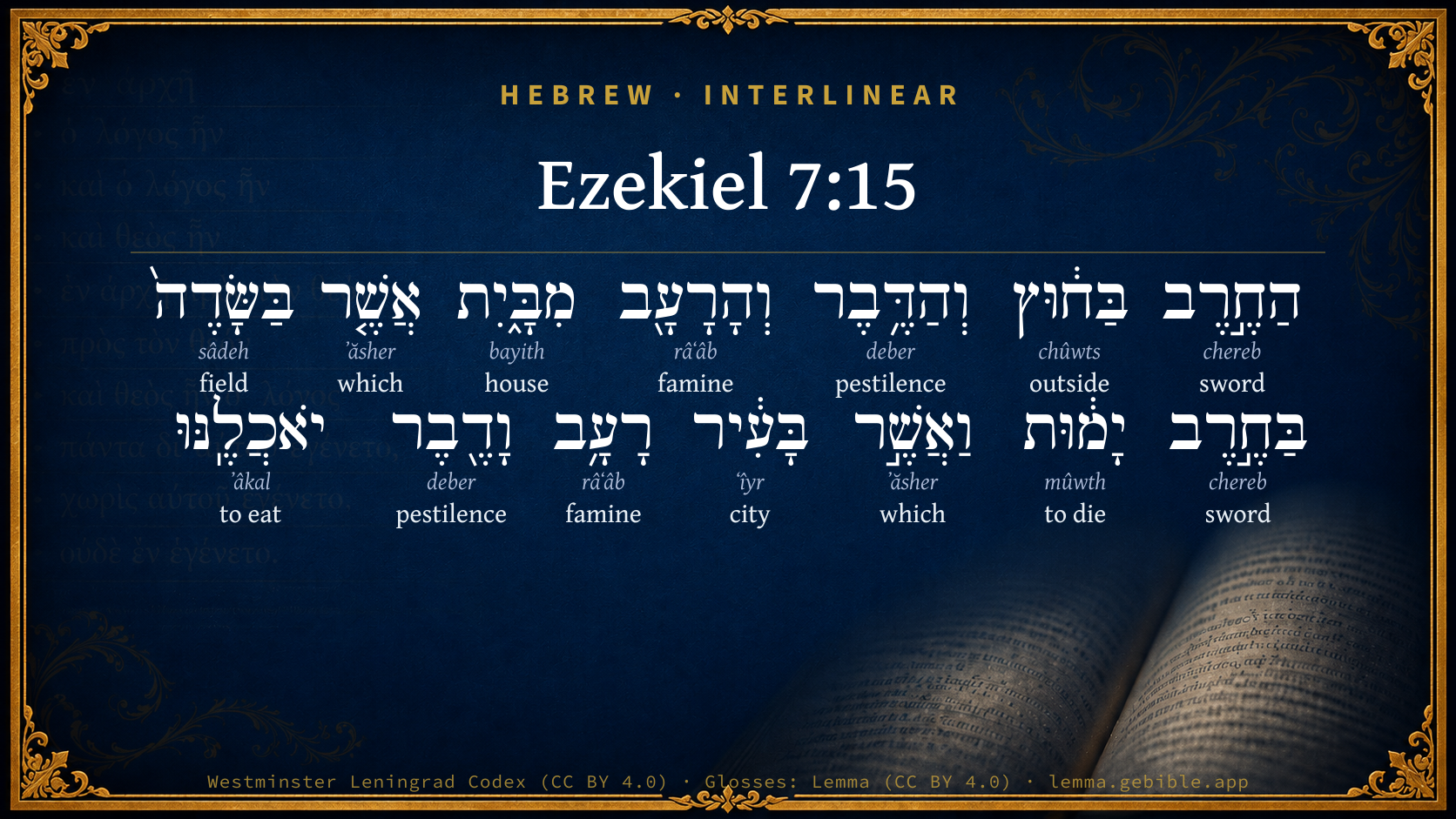
Hebrew (Westminster Leningrad Codex) Ezekiel 7:15 appears in the Hebrew Old Testament. The text above is from the Westminster Leningrad Codex. Each word links to its Strong’s number, a concise gloss, and parsing drawn from the Open Scriptures Hebrew Bible morphology. Click any word for its full Brown-Driver-Briggs (BDB) entry.
Download image
Cite this verse

Ezekiel 7:15 (World English Bible). Public Domain. Lemma interlinear Bible study tool, https://lemma.gebible.app/v/ezekiel/7/15.

Show BibTeX & RIS
BibTeX
RIS
English Translation
The sword is outside, and the pestilence and the famine within: he who is in the field shall die with the sword: and he who is in the city, famine and pestilence shall devour him.
World English Bible · Public Domain
Download a study sheet

One document with this verse’s original text, its word-by-word gloss line, the meaning frame, cross-references with their text, attributed commentary, and full source and license credits — printable, and it pastes into notes with its structure intact.

This verse Autodidact and up

Study sheet (.html) Plain text (.txt)

A passage Seminary Student

Up to 50 verses in one chapter. A passage sheet keeps up to 6 commentary sources and 12 cross-references per verse, in the order this page ranks them, and says so on the sheet whenever that leaves anything out. Ask for a single verse and you get the Autodidact verse sheet above.

Everything on this page stays free to read, with no account — the sheet is a download of what is already on screen, not access to it.

Want to remove ads? Support Godless Engineer
Compare translations 3

The same verse in 3 English versions, stacked beneath the original-language interlinear above. Click any original word for its lexicon entry.

Each is an independent rendering of the whole verse — the interlinear is not word-aligned to these translations.

Highlighted words mark where these versions differ — a whole-verse word diff, not a word-by-word alignment.

  • World English Bible Public Domain
    The sword is outside, and the pestilence and the famine within: he who is in the field shall die with the sword: and he who is in the city, famine and pestilence shall devour him.
  • King James Version Public Domain
    The sword is without, and the pestilence and the famine within: he that is in the field shall die with the sword; and he that is in the city, famine and pestilence shall devour him.
  • unfoldingWord Literal Text CC BY-SA 4.0
    The sword is on the outside, and plague and famine are inside the building. Those who are in the field will die by the sword, while famine and plague will consume those in the city.

unfoldingWord Literal Text — © unfoldingWord, licensed CC BY-SA 4.0. Word-aligned USFM3 via Door43 (git.door43.org/unfoldingWord/en_ult).

Versions to compare (up to 4)

3 of 4 selected

Show all 18 translations

Every available English version of this verse, each an independent rendering of the whole verse.

  • World English Bible Public Domain
    The sword is outside, and the pestilence and the famine within: he who is in the field shall die with the sword: and he who is in the city, famine and pestilence shall devour him.
  • Berean Standard Bible Public Domain
    The sword is outside; plague and famine are within. Those in the country will die by the sword, and those in the city will be devoured by famine and plague.
  • Majority Standard Bible Public Domain
    The sword is outside; plague and famine are within. Those in the country will die by the sword, and those in the city will be devoured by famine and plague.
  • King James Version Public Domain
    The sword is without, and the pestilence and the famine within: he that is in the field shall die with the sword; and he that is in the city, famine and pestilence shall devour him.
  • American Standard Version (1901) Public Domain
    The sword is without, and the pestilence and the famine within: he that is in the field shall die with the sword: and he that is in the city, famine and pestilence shall devour him.
  • Revised Version (1885) Public Domain
    The sword is without, and the pestilence and the famine within: he that is in the field shall die with the sword; and he that is in the city, famine and pestilence shall devour him.
  • Geneva Bible (1599) Public Domain
    The sword is without, and the pestilence, and the famine within: he that is in the field, shall dye with the sword, and he that is in the citie, famine and pestilence shall deuoure him.
  • Douay-Rheims (1899) Public Domain
    The sword without: and the pestilence, and the famine within: he that is in the field shall die by the sword: and they that are in the city, shall be devoured by the pestilence, and the famine.
  • Young's Literal Translation Public Domain
    The sword `is' without, And the pestilence and the famine within, He who is in a field by sword dieth, And he who is in a city, Famine and pestilence devour him.
  • Literal Standard Version CC BY-SA 4.0
    The sword [is] outside, || And the pestilence and the famine within, || He who is in a field dies by sword, || And he who is in a city—Famine and pestilence devour him.
  • Unlocked Literal Bible CC BY-SA 4.0
    The sword is on the outside, and plague and famine are inside the building. Those who are in the field will die by the sword, while famine and plague will consume those in the city.
  • unfoldingWord Literal Text CC BY-SA 4.0
    The sword is on the outside, and plague and famine are inside the building. Those who are in the field will die by the sword, while famine and plague will consume those in the city.
  • Darby Bible Public Domain
    The sword is without, and the pestilence and the famine within: he that is in the field shall die by the sword; and he that is in the city, famine and pestilence shall devour him.
  • World Messianic Bible Public Domain
    “‘The sword is outside, and the pestilence and the famine within. He who is in the field will die by the sword. He who is in the city will be devoured by famine and pestilence.
  • Webster's Bible Public Domain
    The sword is without, and the pestilence and the famine within: he that is in the field shall die with the sword; and he that is in the city, famine and pestilence shall devour him.
  • Free Bible Version CC BY-SA 4.0
    Outside the city are armed attacks; inside are disease and starvation. Those in the countryside will be killed by the sword, and those in the city will be destroyed by starvation and disease.
  • Bible in Basic English Public Domain
    Outside is the sword, and inside disease and need of food: he who is in the open country will be put to the sword; he who is in the town will come to his end through need of food and disease.
  • JPS Tanakh (1917) Public Domain
    The sword is without, and the pestilence and the famine within; he that is in the field shall die with the sword, and he that is in the city, famine and pestilence shall devour him.

Literal Standard Version (2020), Covenant Press — licensed CC BY-SA 4.0. Text via the HelloAO Bible API (eBible.org). Unlocked Literal Bible (unfoldingWord) — licensed CC BY-SA 4.0. Text via the HelloAO Bible API (eBible.org). unfoldingWord Literal Text — © unfoldingWord, licensed CC BY-SA 4.0. Word-aligned USFM3 via Door43 (git.door43.org/unfoldingWord/en_ult). Free Bible Version, Dr. Jonathan Gallagher — licensed CC BY-SA 4.0. Text via the HelloAO Bible API (eBible.org).

Word by word

More ways to search: Search by grammar → Find every occurrence → Compare this word →

Practice this passage: Drill this verse → Learn its vocabulary →

וְהַדֶּ֥בֶר
deber
H1698
“and · the · pestilence”
Conjunction + Particle, Definite Article + Noun, Common, Masculine, Singular, Absolute
Part of Speech
Conjunction + Particle + Noun
Type
Common
Gender
Masculine
Number
Singular
State
Absolute
Full BDB Definition

Origin: from H1696 (in the sense of destroying)

TWOT: 399b

pestilence, plague - murrain, cattle disease, cattle-plague
  1. הַחֶ֣רֶב chereb H2719 “the · sword” Particle, Definite Article + Noun, Common, Feminine, Singular, Absolute
  2. בַּח֔וּץ chûwts H2351 “in/at the · outside” Preposition, Determined + Noun, Common, Masculine, Singular, Absolute
  3. וְהָרָעָ֖ב râʻâb H7458 “and · the · famine” Conjunction + Particle, Definite Article + Noun, Common, Masculine, Singular, Absolute
  4. מִבָּ֑יִת bayith H1004 “from · house” Preposition + Noun, Common, Masculine, Singular, Absolute
  5. אֲשֶׁ֤ר ʼăsher H834 “which” Particle, Relative
  6. בַּשָּׂדֶה֙ sâdeh H7704 “in/at the · field” Preposition, Determined + Noun, Common, Masculine, Singular, Absolute
  7. בַּחֶ֣רֶב chereb H2719 “in/at the · sword” Preposition, Determined + Noun, Common, Feminine, Singular, Absolute
  8. יָמ֔וּת mûwth H4191 “to die” Verb, Qal, Imperfect, 3rd Person, Masculine, Singular
  9. וַאֲשֶׁ֣ר ʼăsher H834 “and · which” Conjunction + Particle, Relative
  10. בָּעִ֔יר ʻîyr H5892 “in/at the · city” Preposition, Determined + Noun, Common, Feminine, Singular, Absolute
  11. רָעָ֥ב râʻâb H7458 “famine” Noun, Common, Masculine, Singular, Absolute
  12. וָדֶ֖בֶר deber H1698 “and · pestilence” Conjunction + Noun, Common, Masculine, Singular, Absolute
  13. יֹאכֲלֶֽנּוּ ʼâkal H398 “to eat · him” Verb, Qal, Imperfect, 3rd Person, Masculine, Singular + Suffix, Personal, 3rd Person, Masculine, Singular

About this verse

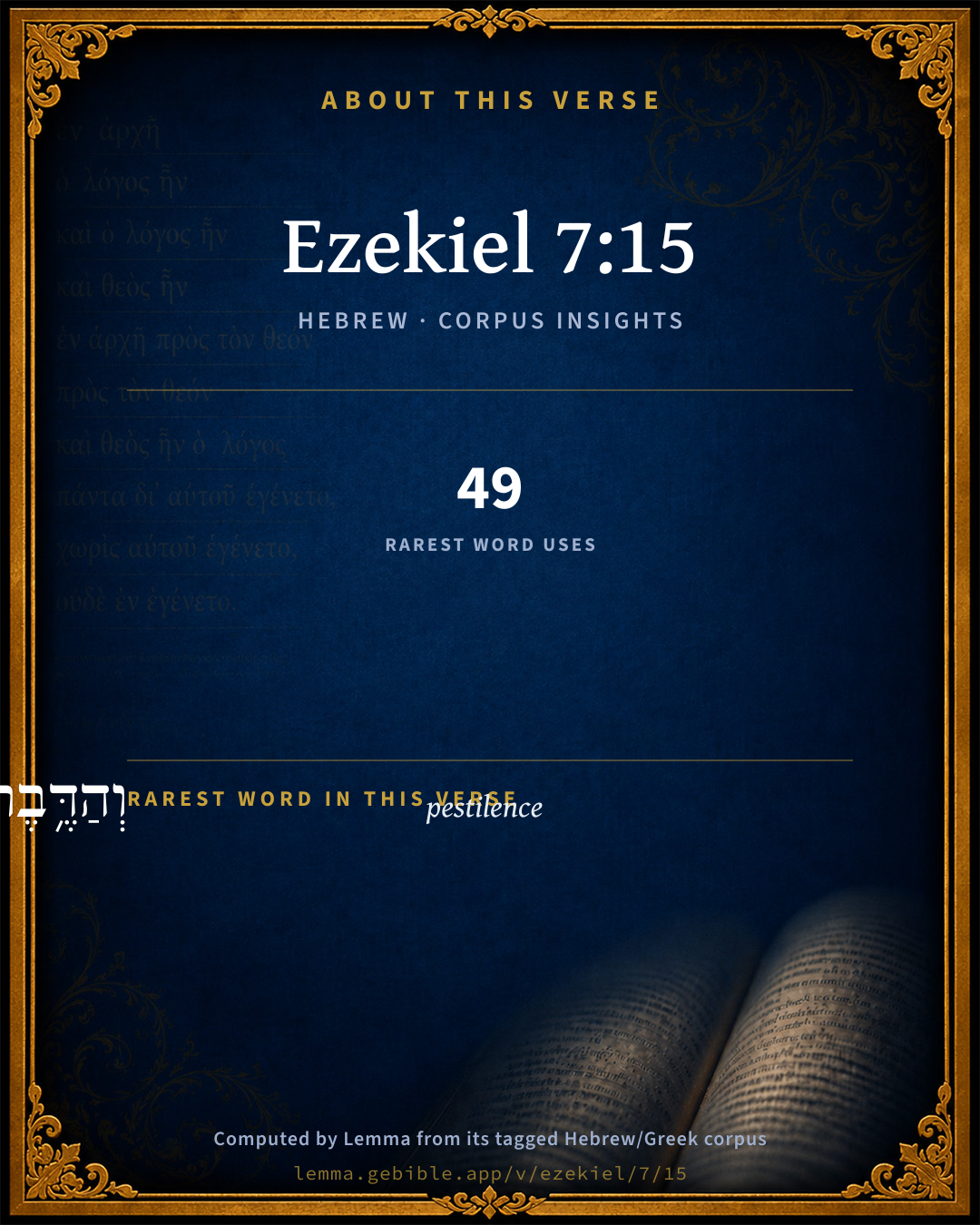
These counts appear in no published source. They are computed here, from the morphology-tagged text and Lemma’s own curated glosses. What Lemma adds →

14
words
10
distinct lemmas
Prophets
section

Shared distinctive vocabulary

וְהַדֶּ֥בֶר pestilence H1698 occurs in 48 verses of the Hebrew Bible. Also found in:

Grammatical profile

  • 2 verbs
  • 10 nouns
  • 2 particles

Verb forms

  • יָמ֔וּת Qal · Imperfect
  • יֹאכֲלֶֽנּוּ Qal · Imperfect

Repetition

Words recur within this verse — often emphatic in Hebrew:

  • הַחֶ֣רֶב sword H2719 ×2
  • וְהַדֶּ֥בֶר pestilence H1698 ×2
  • וְהָרָעָ֖ב famine H7458 ×2
  • אֲשֶׁ֤ר which H834 ×2

Hebrew & Septuagint length

In English translation the verse runs 35 words from the Hebrew and 36 from the Septuagint (LXX English) — closely comparable.

A rough comparison of the two English renderings, which tokenize alike — not a word-level alignment.

Word counts can differ between the Hebrew and the Greek without any difference in meaning — e.g. the Hebrew direct-object marker אֵת has no separate Greek word, and Greek often adds the article ὁ.

Cross-references

6

Topical passages linked to Ezekiel 7:15 in the Treasury of Scripture Knowledge — connected by theme and wording, ordered by reader-vote popularity; previews shown in the World English Bible.

  • Jeremiah 14:18 If I go forth into the field, then, behold, the slain with the sword! and if I enter into the city, then, behold, those who are sick with famine! for both the prophet and the priest go about in the land, and have no knowledge.
  • Ezekiel 5:12 A third part of you shall die with the pestilence, and with famine shall they be consumed in the midst of you; and a third part shall fall by the sword round about you; and a third part I will scatter to all the winds, and will draw out a sword after them.
  • Lamentations 1:20 See, Yahweh; for I am in distress; my heart is troubled; My heart is turned within me; for I have grievously rebelled: Abroad the sword bereaves, at home there is as death.
  • Deuteronomy 32:23–25 I will heap evils on them; I will spend my arrows on them:
  • Jeremiah 15:2–3 It shall happen, when they tell you, Where shall we go forth? then you shall tell them, Thus says Yahweh: Such as are for death, to death; and such as are for the sword, to the sword; and such as are for the famine, to the famine; and such as are for captivity, to captivity.
  • Ezekiel 6:12 He who is far off shall die of the pestilence; and he who is near shall fall by the sword; and he who remains and is besieged shall die by the famine: thus will I accomplish my wrath on them.

Cross-references courtesy of OpenBible.info (CC BY 4.0).

Hebrew and Greek witnesses Masoretic Hebrew ↔ Greek Septuagint

The same verse in the two great witnesses to the Old Testament, shown verse-for-verse.

These are two independent witnesses, not word-aligned to each other, and the Septuagint is shown in lemma (dictionary) form.

Hebrew Ezekiel 7:15 Masoretic · Westminster Leningrad Codex

הַחֶ֣רֶב בַּח֔וּץ וְהַדֶּ֥בֶר וְהָרָעָ֖ב מִבָּ֑יִת אֲשֶׁ֤ר בַּשָּׂדֶה֙ בַּחֶ֣רֶב יָמ֔וּת וַאֲשֶׁ֣ר בָּעִ֔יר רָעָ֥ב וָדֶ֖בֶר יֹאכֲלֶֽנּוּ

The sword is outside, and the pestilence and the famine within: he who is in the field shall die with the sword: and he who is in the city, famine and pestilence shall devour him.

World English Bible · Public Domain

Greek LXX Ezekiel 7:15 Septuagint · lemma form

ὁ πόλεμος ἐν ῥομφαία ἔξωθεν καί ὁ λιμός καί ὁ θάνατος ἔσωθεν ὁ ἐν ὁ πεδίον ἐν ῥομφαία τελευτάω ὁ δέ ἐν ὁ πόλις λιμός καί θάνατος συντελέω

There shall be war with the sword without, and famine and pestilence within: he that is in the field shall die by the sword; and famine and pestilence shall destroy them that are in the city.

LXX2012 (modern English Septuagint) · Public Domain

On this verse, Keil & Delitzsch discusses the Septuagint’s reading. Read the note in Commentary ↓

Hebrew: Westminster Leningrad Codex (CC BY 4.0). Greek: Septuagint (public domain); English from LXX2012 (modern English Septuagint) (Public Domain). How the Septuagint differs from the Hebrew →

Targum (Aramaic paraphrase)

1

The Targum is the ancient Jewish Aramaic paraphrase of the Hebrew Scriptures — an interpretive translation, not the Hebrew text itself. Onkelos (literal) and Pseudo-Jonathan (expansive) render the Torah, and Jonathan the Prophets. Coverage is partial: where no permissively-licensed English translation exists for a verse, only the Aramaic is shown. This is verse-level text, not a word-by-word alignment to the Hebrew.

  1. Targum Jonathan Prophets (Joshua–Malachi)
    חַרְבָּא מִלְבָרָא וּמוֹתָא וְכַפְנָא מִלְגָיו דִבְחַקְלָא בְּחַרְבָּא יִתְקְטֵיל וְדִי בְקַרְתָּא כַּפְנָא וּמוֹתָא יְשֵׁיצִינֵיהּ:

    (no public-domain English translation for this verse)

    Targum Jonathan — Aramaic: “Mikraot Gedolot” (public domain). English: “Sefaria Community Translation” (CC0 1.0 (public-domain dedication)); “London "Chaldee Paraphrase," 1871” (public domain). Text via Sefaria.

Commentary

Notes on Ezekiel 7:15 from classic Christian and Jewish commentators (each source and its license shown beneath its notes). The classic Christian expositions comment on the surrounding passage and are grouped to its opening verse, so a note may address several verses; the Jewish commentaries on the Tanakh (Rashi and others) are per-verse, so they appear only where the commentator wrote on this verse.

Lemma curates 59 commentaries, every one of them public domain or Creative Commons licensed, each selected and text-cleaned for this edition rather than reprinted as found. About our sources →

Trapp's Complete Commentary

John Trapp

Eze 7:15 The sword [is] without, and the pestilence and the famine within: he that [is] in the field shall die with the sword; and he that [is] in the city, famine and pestilence shall devour him.

Ver. 15. The sword is without, and the pestilence, &c.] No safety can be to such as are pursued by the divine vengeance, called therefore by the Greeks Aδραστεια, because there is no outrunning of it. {a} Of these three judgments (seldom separated) see Eze 42:1-20; Eze 3:1-27; Eze 16:1-63; Eze 17:1-24 Hξει Dωριακος πολεμος και λιμος {β} επ αυτω.

{a} Aδραστεια, οτι ουκ αν τις αυτην αποδρασαιτο.

{b} or λοιμος

John Trapp, A Commentary or Exposition upon All the Books of the Old and New Testament (1647–1656) — public domain. Text from a community e-Sword module.

Keil & Delitzsch

C. F. Keil & F. Delitzsch

Third strophe

Thus will they fall into irresistible destruction; even their silver and gold they will not rescue, but will cast it away as useless, and leave it for the enemy. - Eze 7:15. The sword without, and pestilence and famine within: he who is in the field will die by the sword; and famine and pestilence will devour him that is in the city. Eze 7:16. And if their escaped ones escape, they will be upon the mountains like the doves of the valleys, all moaning, every one for his iniquity. Eze 7:17. All hands will become feeble, and all knees flow with water. Eze 7:18. They will gird themselves with sackcloth, and terrors will cover them; on all faces there will be shame, and baldness on all their heads. Eze 7:19. They will throw their silver into the streets, and their gold will be as filth to them. Their silver and their gold will not be able to rescue them in the day of Jehovah's wrath; they will not satisfy their souls therewith, nor fill their stomachs thereby, for it was to them a stumbling-block to guilt. Eze 7:20. And His beautiful ornament, they used it for pride; and their abominable images, their abominations they made thereof: therefore I make it filth to them. Eze 7:21. And I shall give it into the hand of foreigners for prey, and to the wicked of the earth for spoil, that they may defile it. Eze 7:22. I shall turn my face from them, that they defile my treasure; and oppressors shall come upon it and defile it. - The chastisement of God penetrates everywhere (Eze 7:15 compare with Eze 5:12); even flight to the mountains, that are inaccessible to the foe (compare 1 Macc. 2:28; Mat 24:16), will only bring misery. Those who have fled to the mountains will coo - i.e., mourn, moan - like the doves of the valleys, which (as Bochart has correctly interpreted the simile in his Hieroz. II. p. 546, ed. Ros.), "when alarmed by the bird-catcher or the hawk, are obliged to forsake their natural abode, and fly elsewhere to save their lives. The mountain doves are contrasted with those of the valleys, as wild with tame." In כּלּם המות the figure and the fact are fused together. The words actually relate to the men who have fled; whereas the gender of המות is made to agree with that of כּיוני. The cooing of doves was regarded by the ancients as a moan (hâgâh), a mournful note (for proofs, see Gesen. on Isa 38:14); for which Ezekiel uses the still stronger expression hâmâh fremere, to howl or growl (cf. Isa 59:11). The low moaning has reference to their iniquity, the punishment of which they are enduring. When the judgment bursts upon them, they will all (not merely those who have escaped, but the whole nation) be overwhelmed with terror, shame, and suffering. The words, "all knees flow with water" (for hâlak in this sense, compare Joel 4:18), are a hyperbolical expression used to denote the entire loss of the strength of the knees (here, Eze 7:17 and Eze 21:12), like the heart melting and turning to water in Jos 7:5. With this utter despair there are associated grief and horror at the calamity that has fallen upon them, and shame and pain at the thought of the sins that have plunged them into such distress. For כּסּתה פלּצוּת, compare Psa 55:6; for אל־כּל־פנים בּוּשׁה, Mic 7:10; Jer 51:51; and for קרחה 'בּכל־ראשׁ, Isa 15:2; Amo 8:10. On the custom of shaving the head bald on account of great suffering or deep sorrow, see the comm. on Mic 1:16.

In this state of anguish they will throw all their treasures away as sinful trash (Eze 7:19.). By the silver and gold which they will throw away (Eze 7:19), we are not to understand idolatrous images particularly - these are first spoken of in Eze 7:20 - but the treasures of precious metals on which they had hitherto set their hearts. They will not merely throw these away as worthless, but look upon them as niddâh, filth, an object of disgust, inasmuch as they have been the servants of their evil lust. The next clause, "silver and gold cannot rescue them," are a reminiscence from Zep 1:18. But Ezekiel gives greater force to the thought by adding, "they will not appease their hunger therewith," - that is to say, they will not be able to protect their lives thereby, either from the sword of the enemy (see the comm. on Zep 1:18) or from death by starvation, because there will be no more food to purchase within the besieged city. The clause 'כּי assigns the reason for that which forms the leading thought of the verse, namely, the throwing away of the silver and gold as filth; מכשׁול עונם, a stumbling-block through which one falls into guilt and punishment; צבי עדיו, the beauty of his ornament, i.e., his beautiful ornament. The allusion is to the silver and gold; and the singular suffix is to be explained from the fact that the prophet fixed his mind upon the people as a whole, and used the singular in a general and indefinite sense. The words are written absolutely at the commencement of the sentence; hence the suffix attached to שׂמהוּ, Jerome has given the true meaning of the words: "what I (God) gave for an ornament of the possessors and for their wealth, they turned into pride." And not merely to ostentatious show (in the manner depicted in Isa 3:16.), but to abominable images, i.e., idols, did they apply the costly gifts of God (cf. Hos 8:4; Hos 13:2). עשׂה, to make of (gold and silver); ב denoting the material with which one works and of which anything is made (as in Exo 31:4; Exo 38:8). God punishes this abuse by making it (gold and silver) into niddâh to them, i.e., according to v. 19, by placing them in such circumstances that they cast it away as filth, and (v. 21) by giving it as booty to the foe. The enemy is described as "the wicked of the earth" (cf. Psa 75:9), i.e., godless men, who not only seize upon the possession of Israel, but in the most wicked manner lay hands upon all that is holy, and defile it. The Chetib חלּלוּה is to be retained, notwithstanding the fact that it was preceded by a masculine suffix. What is threatened will take place, because the Lord will turn away His face from His people (מהם, from the Israelites), i.e., will withdraw His gracious protection from them, so that the enemy will be able to defile His treasure. Tsâphuun, that which is hidden, the treasure (Job 20:26; Oba 1:6). Tsephuunii is generally supposed to refer to the temple, or the Most Holy Place in the temple. Jerome renders it arcanum meum, and gives this explanation: "signifying the Holy of Holies, which no one except the priests and the high priest dared to enter." This interpretation was so commonly adopted by the Fathers, that even Theodoret explains the rendering given in the Septuagint, τὴν ἐπισκοπήν μου, as signifying the Most Holy Place in the temple. On the other hand, the Chaldee has ארעא בּית שׁכינתי, "the land of the house of my majesty;" and Calvin understands it as signifying "the land which was safe under His (i.e., God's) protection." But it is difficult to reconcile either explanation with the use of the word tsâphuun. The verb tsâphan signifies to hide, shelter, lay up in safety. These meanings do not befit either the Holy of Holies in the temple or the land of Israel. It is true that the Holy of Holies was unapproachable by the laity, and even by the ordinary priests, but it was not a secret, a hidden place; and still less was this the case with the land of Canaan.We therefore adhere to the meaning, which is so thoroughly sustained by Job 20:26 and Oba 1:6 - namely, "treasure," by which, no doubt, the temple-treasure is primarily intended. This rendering suits the context, as only treasures have been referred to before; and it may be made to harmonize with בּאוּ בהּ which follows. בּוא ב signifies not merely intrare in locum, but also venire in (e.g., Kg2 6:23; possibly Eze 30:4), and may therefore be very properly rendered, "to get possession of," since it is only possible to obtain possession of a treasure by penetrating into the place where it is laid up or concealed. There is nothing at variance with this in the word חלּל, profanare, since it has already occurred in Eze 7:21 in connection with the defiling of treasures and jewels. Moreover, as Calvin has correctly observed, the word is employed here to denote "an indiscriminate abuse, when, instead of considering to what purpose things have been entrusted to us, we squander them rashly and without selection, in contempt and even in scorn."

Keil & Delitzsch — Biblical Commentary on the Old Testament (1861–1891) — public domain (CC PDM 1.0). Text via the HelloAO Bible API. (Old Testament only.)

Jamieson, Fausset & Brown

Robert Jamieson, A. R. Fausset & David Brown

No security should anywhere be found (Deu 32:25). Fulfilled (Lam 1:20); also at the Roman invasion (Mat 24:16-18).

Jamieson, Fausset & Brown — Commentary Critical and Explanatory on the Whole Bible (1871) — public domain (CC PDM 1.0). Text via the HelloAO Bible API.

Adam Clarke's Commentary

Verse 15. The sword is without] War through all the country, and pestilence and famine within the city, shall destroy the whole, except a small remnant. He who endeavours to flee from the one shall fall by the other.

Adam Clarke's Commentary on the Bible (1810–1826) — public domain. Text from a community e-Sword/MySword module.

John Calvin's Commentaries

He inculcates what we have seen before, although this sentence agrees with the last verse. He had said that God’s anger should be on all the people; now he shows that none were safe when God stretched forth his hand for avenging their sins. Now he says, he had in his hand a sword, and pestilence, and famine. If they went out into the field, says he, a sword shall meet them; if they remain at home in the city, pestilence and famine shall consume them there; as if he said, God could fetch various kinds of destruction from different quarters, because he will arm foreign enemies, who shall devastate the whole land; and if these enemies were at rest, yet there were others, famine and pestilence Here he signifies, that although the Israelites closed their houses, and desired and endeavored to expel every thing injurious, yet God’s wrath could penetrate all hiding-places. It follows —

John Calvin's Commentaries (1540-1563) — public domain. Text from the Calvin Translation Society English edition (1840s-50s) via the Christian Classics Ethereal Library (ccel.org). Calvin's coverage is partial (roughly two-thirds of the Bible); uncommented books and verses are honest gaps, never fabricated. The 19th-century editor's footnotes and remarks are omitted so the notes are faithfully Calvin's own voice.

The Cambridge Bible for Schools and Colleges

gen. ed. J. J. S. Perowne

15. Comp. Lam_1:20.

The Cambridge Bible for Schools and Colleges (gen. ed. J. J. S. Perowne; Cambridge University Press, 1878–1918) — public domain. Text from a community e-Sword module.

John Gill's Exposition

But they that escape of them shall escape,.... Some few should escape the pestilence, famine, and sword, and flee to the mountains, where they should live a very miserable and uncomfortable life; so that this is no contradiction to the wrath of God being upon the whole multitude, Eze 7:12; as it follows:

and shall be on the mountains; whither they shall flee, when the city is broken up and taken; and so the Syriac version reads it, in connection with the preceding words, "and they that escape of them shall escape to the mountains"; barren and desert places, where they shall find no subsistence, nor have any agreeable company and conversation, but live in solitude and distress:

like doves of the valleys, all of them mourning, everyone for his iniquity: like doves that live in valleys, or gather together there, and hide themselves in the holes of the rocks, on the sides of the valleys, from birds of prey; or are so called, to distinguish them from wild doves, which, when they have lost their mates, make a very mournful noise, though not loud and clamorous. So those Jews that escaped, being in such an uncomfortable condition, turned out of house and home, and deprived of their substance, should lament their fate; not in loud cries, lest they should be heard by the enemy and taken, but in secret sighs, and in a mournful tone; acknowledging to God, and to one another, their sins; they now became sensible of, which brought these calamities upon them. So God's people, the remnant according to the election of grace, who "escape" the general ruin sin has brought on mankind, are for the most part "upon the mountains", in an afflicted and persecuted state; they are like "doves" for their harmlessness, amiableness, cleanness, modesty chastity, sociableness, and timorous disposition; and like doves "of the valleys", in a low estate, through corruption, temptation, desertion, affliction, and persecution; and "mourn" over their own "iniquity", the sin of their nature, their unbelief and various transgressions being committed against a God of love, contrary to his grace, grieving to his Spirit, and dishonourable to his Gospel; and being what break their bereave them of comfort, and deprive them of communion with God.

John Gill's Exposition of the Whole Bible (1746–1763) — public domain (CC PDM 1.0). Text via the HelloAO Bible API.

Matthew Poole's English Annotations

Without; in the countries.

Within; in the besieged city.

With the sword of the Chaldean soldier. Shall devour him; shall eat him up; you, O Jews! shall be food for unsatiable pestilence and famine. Heavy tidings to sinful Jerusalem!

Matthew Poole's English Annotations on the Holy Bible (1683–1685) — public domain. Text from a community e-Sword/MySword module.

Whedon's Commentary on the Bible

Daniel D. Whedon

15. Compare Eze_5:12; Eze_6:12; Lev_26:25.

Daniel D. Whedon (gen. ed.), Commentary on the Old and New Testaments (1874–1909) — public domain. Text from a community e-Sword module.

The Pulpit Commentary

The sword is without. (see Eze_5:12 Eze_6:12) Here there seems a more traceable fitness in assigning the pestilence as well as the famine to those who are shut up in the besieged city.

The Pulpit Commentary (1880–1919), ed. H.D.M. Spence-Jones & Joseph S. Exell — public domain. Text from a community e-Sword module.

John Wesley's Explanatory Notes

Without - In the countries. Within - The besieged city. Field - Whoever is in the field.

John Wesley, Explanatory Notes Upon the Whole Bible (1754–1765) — public domain. Text via the GEBible commentary corpus.

Lesson kit

Teaching starters — assembled from the data on this page, not authored interpretation. Every prompt links to the verse data it draws on. Edit before teaching.

Ezekiel, in the Prophets, opens this verse with 14 words (10 distinct Hebrew lemmas). Its most distinctive word is deber (“pestilence”). A historical commentator’s framing appears above. Read the whole chapter for the surrounding context.

Discussion questions

  1. How does “pestilence” (deber) shape what this verse is saying?
  2. Exodus 5:3 shares the word «pestilence» with this verse. How do the two illuminate each other?
  3. “sword” occurs 2× in this one verse. What is the effect of the repetition?
  4. The translations on this page render this verse differently — a whole-verse word diff, not a word-by-word alignment. What might account for the different wordings?
  5. The verb «יָמ֔וּת» is Qal Imperfect. How does its form color the action?
  6. Reading how Trapp's Complete Commentary and Keil & Delitzsch read this verse, where do the two commentators agree and where do they part?

Things to notice

Reading settings

Reading text

Shown beneath each verse's original-language words.

Old Testament
Old Testament edition

Read the OT as the Masoretic Hebrew (MT) or the Greek Septuagint (LXX).

English shown for the Greek Septuagint (in the Hebrew ↔ Greek comparison).

Comparing translations? Open the Compare panel on any verse page to stack up to four side by side.