
Joshua 11:14

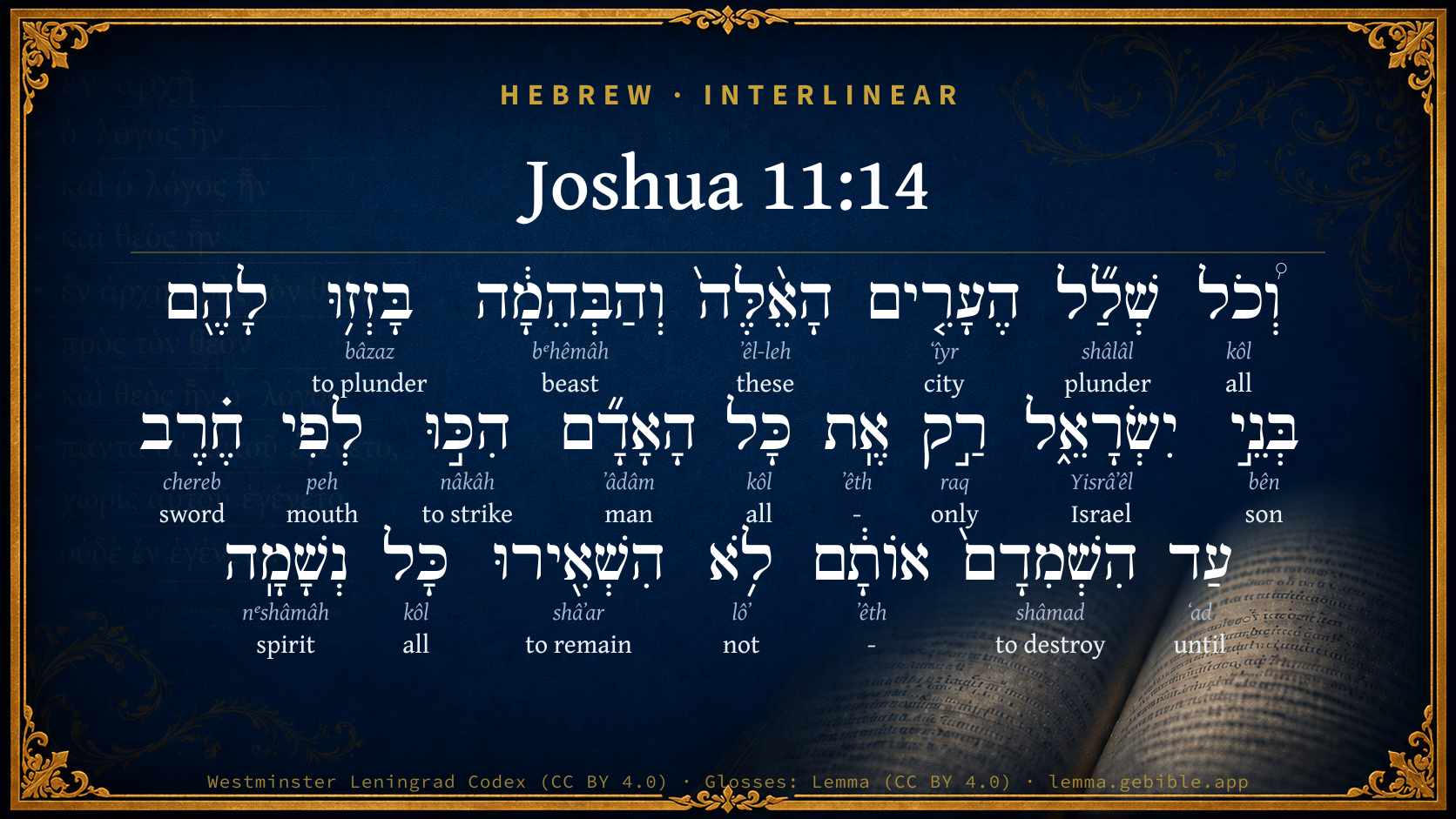
Hebrew (Westminster Leningrad Codex) Joshua 11:14 appears in the Hebrew Old Testament. The text above is from the Westminster Leningrad Codex. Each word links to its Strong’s number, a concise gloss, and parsing drawn from the Open Scriptures Hebrew Bible morphology. Click any word for its full Brown-Driver-Briggs (BDB) entry.
Download image
Cite this verse

Joshua 11:14 (World English Bible). Public Domain. Lemma interlinear Bible study tool, https://lemma.gebible.app/v/joshua/11/14.

Show BibTeX & RIS
BibTeX
RIS
English Translation
All the spoil of these cities, and the cattle, the children of Israel took for a prey to themselves; but every man they struck with the edge of the sword, until they had destroyed them, neither left they any who breathed.
World English Bible · Public Domain
Download a study sheet

One document with this verse’s original text, its word-by-word gloss line, the meaning frame, cross-references with their text, attributed commentary, and full source and license credits — printable, and it pastes into notes with its structure intact.

This verse Autodidact and up

Study sheet (.html) Plain text (.txt)

A passage Seminary Student

Up to 50 verses in one chapter. A passage sheet keeps up to 6 commentary sources and 12 cross-references per verse, in the order this page ranks them, and says so on the sheet whenever that leaves anything out. Ask for a single verse and you get the Autodidact verse sheet above.

Everything on this page stays free to read, with no account — the sheet is a download of what is already on screen, not access to it.

Want to remove ads? Support Godless Engineer
Compare translations 3

The same verse in 3 English versions, stacked beneath the original-language interlinear above. Click any original word for its lexicon entry.

Each is an independent rendering of the whole verse — the interlinear is not word-aligned to these translations.

Highlighted words mark where these versions differ — a whole-verse word diff, not a word-by-word alignment.

  • World English Bible Public Domain
    All the spoil of these cities, and the cattle, the children of Israel took for a prey to themselves; but every man they struck with the edge of the sword, until they had destroyed them, neither left they any who breathed.
  • King James Version Public Domain
    And all the spoil of these cities, and the cattle, the children of Israel took for a prey unto themselves; but every man they smote with the edge of the sword, until they had destroyed them, neither left they any to breathe.
  • unfoldingWord Literal Text CC BY-SA 4.0
    And all of the plunder of these cities and the livestock, the sons of Israel plundered for themselves. Only every human they struck to the mouth of the sword until they had destroyed them. They did not leave any breathing thing.

unfoldingWord Literal Text — © unfoldingWord, licensed CC BY-SA 4.0. Word-aligned USFM3 via Door43 (git.door43.org/unfoldingWord/en_ult).

Versions to compare (up to 4)

3 of 4 selected

Show all 18 translations

Every available English version of this verse, each an independent rendering of the whole verse.

  • World English Bible Public Domain
    All the spoil of these cities, and the cattle, the children of Israel took for a prey to themselves; but every man they struck with the edge of the sword, until they had destroyed them, neither left they any who breathed.
  • Berean Standard Bible Public Domain
    The Israelites took for themselves all the plunder and livestock of these cities, but they put all the people to the sword until they had completely destroyed them, not sparing anyone who breathed.
  • Majority Standard Bible Public Domain
    The Israelites took for themselves all the plunder and livestock of these cities, but they put all the people to the sword until they had completely destroyed them, not sparing anyone who breathed.
  • King James Version Public Domain
    And all the spoil of these cities, and the cattle, the children of Israel took for a prey unto themselves; but every man they smote with the edge of the sword, until they had destroyed them, neither left they any to breathe.
  • American Standard Version (1901) Public Domain
    And all the spoil of these cities, and the cattle, the children of Israel took for a prey unto themselves; but every man they smote with the edge of the sword, until they had destroyed them, neither left they any that breathed.
  • Revised Version (1885) Public Domain
    And all the spoil of these cities, and the cattle, the children of Israel took for a prey unto themselves; but every man they smote with the edge of the sword, until they had destroyed them, neither left they any that breathed.
  • Geneva Bible (1599) Public Domain
    And all the spoyle of these cities and the cattel the children of Israel tooke for their praye, but they smote euery man with the edge of the sword vntill they had destroyed them, not leauing one aliue.
  • Douay-Rheims (1899) Public Domain
    And the children of Israel divided among themselves all the spoil of these cities and the cattle, killing all the men.
  • Young's Literal Translation Public Domain
    and all the spoil of these cities, and the cattle, have the sons of Israel spoiled for themselves; only, every human being they have smitten by the mouth of the sword, till their destroying them; they have not left any one breathing.
  • Literal Standard Version CC BY-SA 4.0
    and all the spoil of these cities, and the livestock, the sons of Israel have spoiled for themselves; only, they have struck every man by the mouth of the sword, until their destroying them; they have not left anyone breathing.
  • Unlocked Literal Bible CC BY-SA 4.0
    The army of Israel took all the plunder from these cities along with the livestock for themselves. They killed every human being with the edge of the sword until all were dead. They left alive no creature that breathed.
  • unfoldingWord Literal Text CC BY-SA 4.0
    And all of the plunder of these cities and the livestock, the sons of Israel plundered for themselves. Only every human they struck to the mouth of the sword until they had destroyed them. They did not leave any breathing thing.
  • Darby Bible Public Domain
    And all the spoil of these cities and the cattle the children of Israel took as prey to themselves; only, they smote all the men with the edge of the sword, until they had destroyed them: they left none that breathed.
  • World Messianic Bible Public Domain
    The children of Israel took all the plunder of these cities, with the livestock, as plunder for themselves; but every man they struck with the edge of the sword, until they had destroyed them. They didn’t leave any who breathed.
  • Webster's Bible Public Domain
    And all the spoil of these cities, and the cattle, the children of Israel took for a prey to themselves: but every man they smote with the edge of the sword, until they had destroyed them, neither left they any to breathe.
  • Free Bible Version CC BY-SA 4.0
    The Israelites did take for themselves all the plunder and livestock from these towns. But they killed all the inhabitants, destroying them all so none were left alive.
  • Bible in Basic English Public Domain
    And all the goods taken from these towns, and their cattle, the children of Israel kept for themselves; but every man they put to death without mercy, till their destruction was complete, and there was no one living.
  • JPS Tanakh (1917) Public Domain
    And all the spoil of these cities, and the cattle, the children of Israel took for a prey unto themselves; but every man they smote with the edge of the sword, until they had destroyed them, neither left they any that breathed.

Literal Standard Version (2020), Covenant Press — licensed CC BY-SA 4.0. Text via the HelloAO Bible API (eBible.org). Unlocked Literal Bible (unfoldingWord) — licensed CC BY-SA 4.0. Text via the HelloAO Bible API (eBible.org). unfoldingWord Literal Text — © unfoldingWord, licensed CC BY-SA 4.0. Word-aligned USFM3 via Door43 (git.door43.org/unfoldingWord/en_ult). Free Bible Version, Dr. Jonathan Gallagher — licensed CC BY-SA 4.0. Text via the HelloAO Bible API (eBible.org).

Word by word

More ways to search: Search by grammar → Find every occurrence → Compare this word →

Practice this passage: Drill this verse → Learn its vocabulary →

נְשָׁמָֽה
nᵉshâmâh
H5397
“spirit”
Noun, Common, Feminine, Singular, Absolute
Part of Speech
Noun
Type
Common
Gender
Feminine
Number
Singular
State
Absolute
Full BDB Definition

Origin: from H5395

TWOT: 1433a

breath, spirit - breath (of God) - breath (of man) - every breathing thing - spirit (of man)
  1. וְ֠כֹל kôl H3605 “and · all of” Conjunction + Noun, Common, Masculine, Singular, Construct
  2. שְׁלַ֞ל shâlâl H7998 “plunder of” Noun, Common, Masculine, Singular, Construct
  3. הֶעָרִ֤ים ʻîyr H5892 “the · cities” Particle, Definite Article + Noun, Common, Feminine, Plural, Absolute
  4. הָאֵ֨לֶּה֙ ʼêl-leh H428 “the · these” Particle, Definite Article + Pronoun, Demonstrative, Common, Plural
  5. וְהַבְּהֵמָ֔ה bᵉhêmâh H929 “and · the · beast” Conjunction + Particle, Definite Article + Noun, Common, Feminine, Singular, Absolute
  6. בָּזְז֥וּ bâzaz H962 “to plunder” Verb, Qal, Perfect, 3rd Person, Common, Plural
  7. בְּנֵ֣י bên H1121 “sons of” Noun, Common, Masculine, Plural, Construct
  8. יִשְׂרָאֵ֑ל Yisrâʼêl H3478 “Israel” Noun, Proper
  9. רַ֣ק raq H7535 “only” Particle, Accusative
  10. אֶֽת ʼêth H853 “-” Particle, Direct Object
  11. כָּל kôl H3605 “all of” Noun, Common, Masculine, Singular, Construct
  12. הָאָדָ֞ם ʼâdâm H120 “the · man” Particle, Definite Article + Noun, Common, Masculine, Singular, Absolute
  13. הִכּ֣וּ nâkâh H5221 “to strike” Verb, Hiphil, Perfect, 3rd Person, Common, Plural
  14. לְפִי peh H6310 “to/for · mouth of” Preposition + Noun, Common, Masculine, Singular, Construct
  15. חֶ֗רֶב chereb H2719 “sword” Noun, Common, Feminine, Singular, Absolute
  16. עַד ʻad H5704 “until” Preposition
  17. הִשְׁמִדָם֙ shâmad H8045 “to destroy · them” Verb, Hiphil, Infinitive Construct + Suffix, Personal, 3rd Person, Masculine, Plural
  18. אוֹתָ֔ם ʼêth H853 “- · them” Particle, Direct Object + Suffix, Personal, 3rd Person, Masculine, Plural
  19. לֹ֥א lôʼ H3808 “not” Particle, Negative
  20. הִשְׁאִ֖ירוּ shâʼar H7604 “to remain” Verb, Hiphil, Perfect, 3rd Person, Common, Plural
  21. כָּל kôl H3605 “all of” Noun, Common, Masculine, Singular, Construct

About this verse

These counts appear in no published source. They are computed here, from the morphology-tagged text and Lemma’s own curated glosses. What Lemma adds →

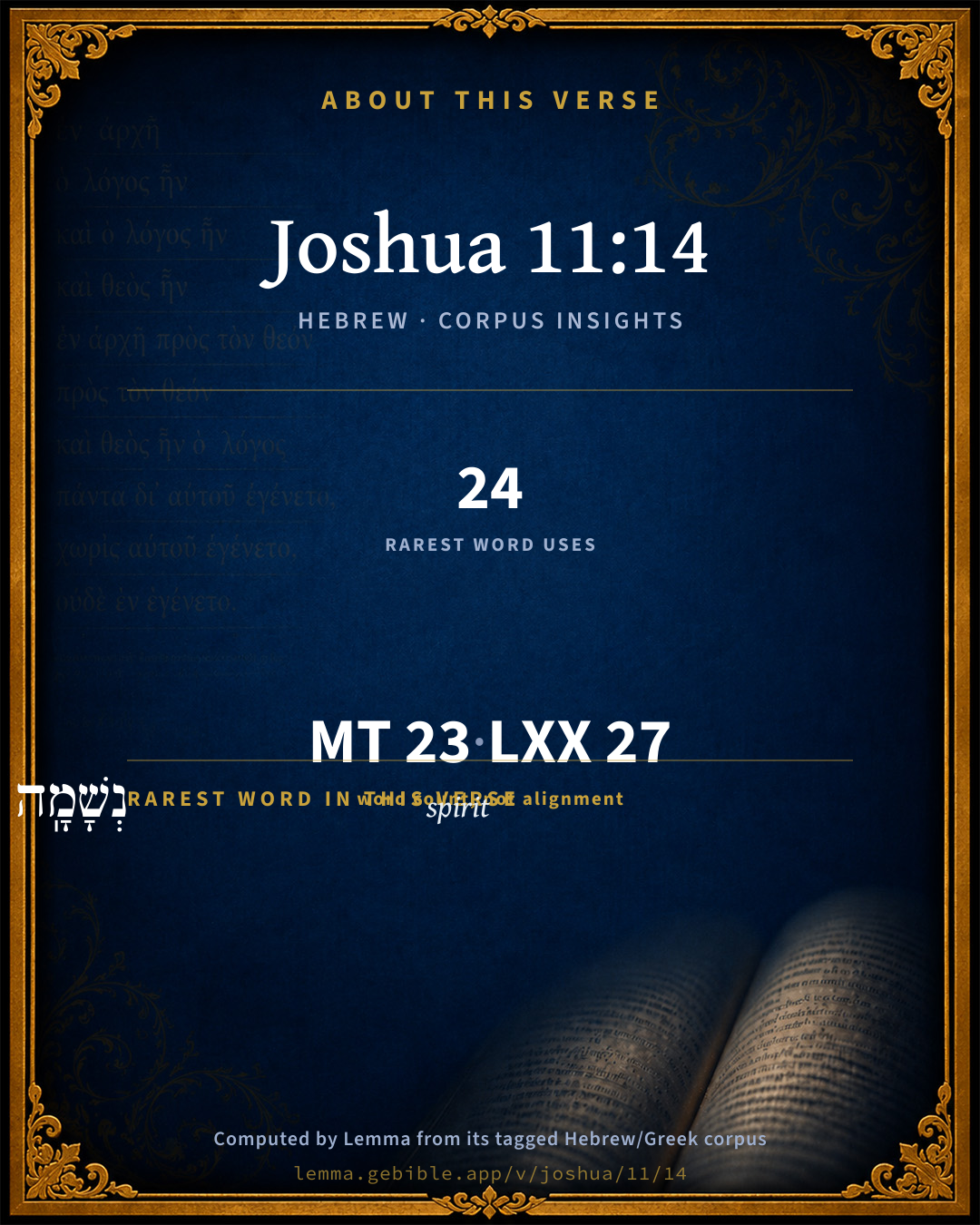
23
words
19
distinct lemmas
Historical
section

Notable vocabulary

The rarest word here is נְשָׁמָֽה spirit H5397 — appearing just 24 times in the whole Hebrew Bible.

Shared distinctive vocabulary

נְשָׁמָֽה spirit H5397 occurs in 24 verses of the Hebrew Bible. Also found in:

Grammatical profile

  • 4 verbs
  • 12 nouns
  • 1 pronoun
  • 2 prepositions
  • 4 particles

Verb forms

  • בָּזְז֥וּ Qal · Perfect
  • הִכּ֣וּ Hiphil · Perfect
  • הִשְׁמִדָם֙ Hiphil · Infinitive Construct
  • הִשְׁאִ֖ירוּ Hiphil · Perfect

Repetition

A word recurs within this verse — often emphatic in Hebrew:

  • וְ֠כֹל all H3605 ×3

Hebrew & Septuagint length

In English translation the verse runs 41 words from the Hebrew and 34 from the Septuagint (LXX English) — closely comparable.

A rough comparison of the two English renderings, which tokenize alike — not a word-level alignment.

Word counts can differ between the Hebrew and the Greek without any difference in meaning — e.g. the Hebrew direct-object marker אֵת has no separate Greek word, and Greek often adds the article ὁ.

In the original languages it is 23 Hebrew tokens and 27 Greek tokens — but the two are counted differently (Hebrew bundles its prefixes and suffixes into one token; the Greek is in lemma form), so that isn’t a like-for-like length.

Cross-references

7

Topical passages linked to Joshua 11:14 in the Treasury of Scripture Knowledge — connected by theme and wording, ordered by reader-vote popularity; previews shown in the World English Bible.

  • Numbers 31:9 The children of Israel took captive the women of Midian and their little ones; and all their cattle, and all their flocks, and all their goods, they took for a prey.
  • Numbers 31:11–12 They took all the spoil, and all the prey, both of man and of animal.
  • Deuteronomy 6:10–11 It shall be, when Yahweh your God shall bring you into the land which he swore to your fathers, to Abraham, to Isaac, and to Jacob, to give you, great and goodly cities, which you didn't build,
  • Deuteronomy 20:14 but the women, and the little ones, and the cattle, and all that is in the city, even all the spoil of it, shall you take for a prey to yourself; and you shall eat the spoil of your enemies, which Yahweh your God has given you.
  • Joshua 8:27 Only the cattle and the spoil of that city Israel took for prey to themselves, according to the word of Yahweh which he commanded Joshua.
  • Joshua 10:40 So Joshua struck all the land, the hill-country, and the South, and the lowland, and the slopes, and all their kings: he left none remaining, but he utterly destroyed all that breathed, as Yahweh, the God of Israel, commanded.
  • Joshua 11:11 They struck all the souls who were therein with the edge of the sword, utterly destroying them; there was none left who breathed: and he burnt Hazor with fire.

Cross-references courtesy of OpenBible.info (CC BY 4.0).

Hebrew and Greek witnesses Masoretic Hebrew ↔ Greek Septuagint

The same verse in the two great witnesses to the Old Testament, shown verse-for-verse.

These are two independent witnesses, not word-aligned to each other, and the Septuagint is shown in lemma (dictionary) form.

Hebrew Joshua 11:14 Masoretic · Westminster Leningrad Codex

וְ֠כֹל שְׁלַ֞ל הֶעָרִ֤ים הָאֵ֨לֶּה֙ וְהַבְּהֵמָ֔ה בָּזְז֥וּ לָהֶ֖ם בְּנֵ֣י יִשְׂרָאֵ֑ל רַ֣ק אֶֽת כָּל הָאָדָ֞ם הִכּ֣וּ לְפִי חֶ֗רֶב עַד הִשְׁמִדָם֙ אוֹתָ֔ם לֹ֥א הִשְׁאִ֖ירוּ כָּל נְשָׁמָֽה

All the spoil of these cities, and the cattle, the children of Israel took for a prey to themselves; but every man they struck with the edge of the sword, until they had destroyed them, neither left they any who breathed.

World English Bible · Public Domain

Greek LXX Joshua 11:14 Septuagint · lemma form

καί πᾶς ὁ σκῦλον αὐτός προνομεύω ἑαυτοῦ ὁ υἱός ἰσραήλ αὐτός δέ πᾶς ἐκὀλεθρεύω ἐν στόμα ξίφος ἕως ἀποὀλλύω αὐτός οὐ καταλείπω ἐκ αὐτός οὐδέ εἷς ἐμπνέος

And the children of Israel took all its spoils to themselves; and they killed all the men with the edge of the sword, until he destroyed them; they left not one of them breathing.

LXX2012 (modern English Septuagint) · Public Domain

Hebrew: Westminster Leningrad Codex (CC BY 4.0). Greek: Septuagint (public domain); English from LXX2012 (modern English Septuagint) (Public Domain). How the Septuagint differs from the Hebrew →

Targum (Aramaic paraphrase)

1

The Targum is the ancient Jewish Aramaic paraphrase of the Hebrew Scriptures — an interpretive translation, not the Hebrew text itself. Onkelos (literal) and Pseudo-Jonathan (expansive) render the Torah, and Jonathan the Prophets. Coverage is partial: where no permissively-licensed English translation exists for a verse, only the Aramaic is shown. This is verse-level text, not a word-by-word alignment to the Hebrew.

  1. Targum Jonathan Prophets (Joshua–Malachi)
    וְכָל עֲדֵי קִרְוַיָא הָאִלֵין וּבְעִירָא בְּזוֹ לְהוֹן בְּנֵי יִשְׂרָאֵל לְחוֹד יַת כָּל אֱנָשָׁא מְחוֹ לְפִתְגַם דְחָרֶב עַד דִי שֵׁיצִיאוּ יַתְהוֹן לָא אַשְׁאָרוּ כָּל נִשְׁמָא:

    (no public-domain English translation for this verse)

    Targum Jonathan — Aramaic: “Mikraot Gedolot” (public domain). English: “Sefaria Community Translation” (CC0 1.0 (public-domain dedication)); “London "Chaldee Paraphrase," 1871” (public domain). Text via Sefaria.

Commentary

Notes on Joshua 11:14 from classic Christian and Jewish commentators (each source and its license shown beneath its notes). The classic Christian expositions comment on the surrounding passage and are grouped to its opening verse, so a note may address several verses; the Jewish commentaries on the Tanakh (Rashi and others) are per-verse, so they appear only where the commentator wrote on this verse.

Lemma curates 59 commentaries, every one of them public domain or Creative Commons licensed, each selected and text-cleaned for this edition rather than reprinted as found. About our sources →

Trapp's Complete Commentary

John Trapp

Jos 11:14 And all the spoil of these cities, and the cattle, the children of Israel took for a prey unto themselves; but every man they smote with the edge of the sword, until they had destroyed them, neither left they any to breathe.

Ver. 14. Neither left they any to breathe,] viz., Upon that air which they had so infected while they filled the land from one end to another with their uncleanness. {Ezr 9:11}

John Trapp, A Commentary or Exposition upon All the Books of the Old and New Testament (1647–1656) — public domain. Text from a community e-Sword module.

Geneva Bible (1599)

Geneva Bible translators

All mankind.

Geneva Bible (1599) marginal notes — public domain. Text via Bolls.life.

Adam Clarke's Commentary

Verse 14. All the spoil of these cities - Israel took] With the exception of those things which had been employed for idolatrous purposes; see De 7:25.

Adam Clarke's Commentary on the Bible (1810–1826) — public domain. Text from a community e-Sword/MySword module.

The Cambridge Bible for Schools and Colleges

gen. ed. J. J. S. Perowne

14. all the spoil] This was not devoted as at Jericho, but divided as at Ai. Comp. Jos_8:2; Jos_8:27.

The Cambridge Bible for Schools and Colleges (gen. ed. J. J. S. Perowne; Cambridge University Press, 1878–1918) — public domain. Text from a community e-Sword module.

John Gill's Exposition

And all the spoil of these cities, and the cattle, the children of Israel took for a prey unto themselves,.... The gold, silver, household goods, corn, wine, oil, or any mercantile goods, together with cattle of every sort, all were taken by them for a prey, for their own use and benefit, which was allowed them:

but every man they smote with the edge of the sword, until they had destroyed them, neither left they any to breathe; for which they had warrant so to do from the Lord, as follows.

John Gill's Exposition of the Whole Bible (1746–1763) — public domain (CC PDM 1.0). Text via the HelloAO Bible API.

Haydock's Catholic Bible Commentary

Spoil, excepting what was found on the idols, which was burnt, Deuteronomy vii. 25. (Calmet)

George Leo Haydock (1774–1849), Haydock's Catholic Family Bible and Commentary, 1859 edition — public domain. Excludes Psalms (Douay-Rheims chapter numbering differs from Protestant) and Deuterocanonical books (Catholic canon only).

Whedon's Commentary on the Bible

Daniel D. Whedon

14. All the spoil of these cities… Israel took — Save “the graven images of their gods.” Deu_7:25.

Daniel D. Whedon (gen. ed.), Commentary on the Old and New Testaments (1874–1909) — public domain. Text from a community e-Sword module.

The Pulpit Commentary

Took for a prey unto themselves. (see Jos_8:2, Jos_8:27, and notes)

The Pulpit Commentary (1880–1919), ed. H.D.M. Spence-Jones & Joseph S. Exell — public domain. Text from a community e-Sword module.

unfoldingWord translationNotes

Door43 World Missions Community

for themselves

This phrase refers to the army of Israel. (See: Reflexive Pronouns)

They killed every human being with the edge of the sword until all were dead. They left alive no creature that breathed.

These two phrases share similar meanings and emphasize complete destruction. (See: Parallelism)

He left nothing undone of all that Yahweh commanded Moses to do

This negative phrase emphasizes that Joshua did everything that Yahweh commanded. AT: "Joshua did everything that Yahweh commanded" (See: Litotes)

translationWords

Israel

livestock

sword

creature

Yahweh

command

Moses

unfoldingWord translationNotes — © Distant Shores Media and the Door43 World Missions Community, licensed CC BY-SA 4.0. Source: git.door43.org/Door43/en_tn.

Lesson kit

Teaching starters — assembled from the data on this page, not authored interpretation. Every prompt links to the verse data it draws on. Edit before teaching.

Joshua, in the Historical, opens this verse with 23 words (19 distinct Hebrew lemmas). Its most distinctive word is nᵉshâmâh (“spirit”). A historical commentator’s framing appears above. Read the whole chapter for the surrounding context.

Discussion questions

  1. The word nᵉshâmâh carries the sense “spirit.” How does it shape the verse?
  2. How does Genesis 2:7, which shares the word «spirit», read alongside this verse?
  3. What does the repetition of “all” (3× in this one verse) do in this verse?
  4. These translations render this verse differently. What is at stake in choosing one wording over another?
  5. «בָּזְז֥וּ» is a Qal Perfect verb. How does that grammatical form shape the action described?
  6. Compare how Trapp's Complete Commentary and Geneva Bible (1599) read this verse. Where do they agree or differ?

Things to notice

Reading settings

Reading text

Shown beneath each verse's original-language words.

Old Testament
Old Testament edition

Read the OT as the Masoretic Hebrew (MT) or the Greek Septuagint (LXX).

English shown for the Greek Septuagint (in the Hebrew ↔ Greek comparison).

Comparing translations? Open the Compare panel on any verse page to stack up to four side by side.