
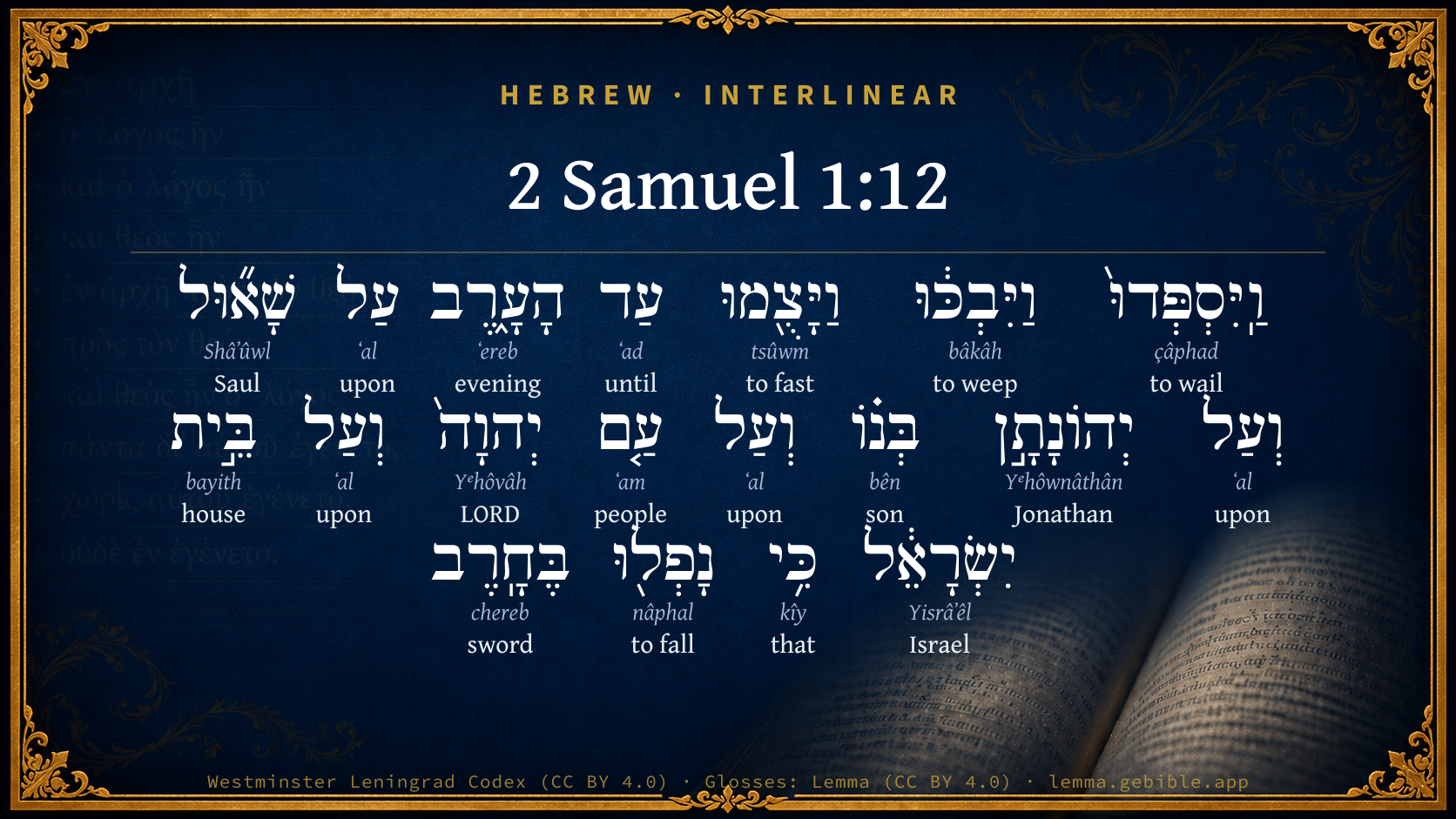
2 Samuel 1:12

Hebrew (Westminster Leningrad Codex) 2 Samuel 1:12 appears in the Hebrew Old Testament. The text above is from the Westminster Leningrad Codex. Each word links to its Strong’s number, a concise gloss, and parsing drawn from the Open Scriptures Hebrew Bible morphology. Click any word for its full Brown-Driver-Briggs (BDB) entry.
Download image
Cite this verse

2 Samuel 1:12 (World English Bible). Public Domain. Lemma interlinear Bible study tool, https://lemma.gebible.app/v/2-samuel/1/12.

Show BibTeX & RIS
BibTeX
RIS
English Translation
and they mourned, and wept, and fasted until even, for Saul, and for Jonathan his son, and for the people of Yahweh, and for the house of Israel; because they were fallen by the sword.
World English Bible · Public Domain
Download a study sheet

One document with this verse’s original text, its word-by-word gloss line, the meaning frame, cross-references with their text, attributed commentary, and full source and license credits — printable, and it pastes into notes with its structure intact.

This verse Autodidact and up

Study sheet (.html) Plain text (.txt)

A passage Seminary Student

Up to 50 verses in one chapter. A passage sheet keeps up to 6 commentary sources and 12 cross-references per verse, in the order this page ranks them, and says so on the sheet whenever that leaves anything out. Ask for a single verse and you get the Autodidact verse sheet above.

Everything on this page stays free to read, with no account — the sheet is a download of what is already on screen, not access to it.

Want to remove ads? Support Godless Engineer
Compare translations 3

The same verse in 3 English versions, stacked beneath the original-language interlinear above. Click any original word for its lexicon entry.

Each is an independent rendering of the whole verse — the interlinear is not word-aligned to these translations.

Highlighted words mark where these versions differ — a whole-verse word diff, not a word-by-word alignment.

  • World English Bible Public Domain
    and they mourned, and wept, and fasted until even, for Saul, and for Jonathan his son, and for the people of Yahweh, and for the house of Israel; because they were fallen by the sword.
  • King James Version Public Domain
    And they mourned, and wept, and fasted until even, for Saul, and for Jonathan his son, and for the people of the LORD, and for the house of Israel; because they were fallen by the sword.
  • unfoldingWord Literal Text CC BY-SA 4.0
    And they mourned and wept and fasted until the evening for Saul and for Jonathan his son and for the people of Yahweh and for the house of Israel, because they had fallen by the sword.

unfoldingWord Literal Text — © unfoldingWord, licensed CC BY-SA 4.0. Word-aligned USFM3 via Door43 (git.door43.org/unfoldingWord/en_ult).

Versions to compare (up to 4)

3 of 4 selected

Show all 18 translations

Every available English version of this verse, each an independent rendering of the whole verse.

  • World English Bible Public Domain
    and they mourned, and wept, and fasted until even, for Saul, and for Jonathan his son, and for the people of Yahweh, and for the house of Israel; because they were fallen by the sword.
  • Berean Standard Bible Public Domain
    They mourned and wept and fasted until evening for Saul and his son Jonathan, and for the people of the LORD and the house of Israel, because they had fallen by the sword.
  • Majority Standard Bible Public Domain
    They mourned and wept and fasted until evening for Saul and his son Jonathan, and for the people of the LORD and the house of Israel, because they had fallen by the sword.
  • King James Version Public Domain
    And they mourned, and wept, and fasted until even, for Saul, and for Jonathan his son, and for the people of the LORD, and for the house of Israel; because they were fallen by the sword.
  • American Standard Version (1901) Public Domain
    and they mourned, and wept, and fasted until even, for Saul, and for Jonathan his son, and for the people of Jehovah, and for the house of Israel; because they were fallen by the sword.
  • Revised Version (1885) Public Domain
    and they mourned, and wept, and fasted until even, for Saul, and for Jonathan his son, and for the people of the LORD, and for the house of Israel; because they were fallen by the sword.
  • Geneva Bible (1599) Public Domain
    And they mourned and wept, and fasted vntil euen, for Saul and for Ionathan his sonne, and for the people of the Lord, and for the house of Israel, because they were slaine with the sword.
  • Douay-Rheims (1899) Public Domain
    And they mourned, and wept, and fasted until evening for Saul, and for Jonathan his son, and for the people of the Lord, and for the house of Israel, because they were fallen by the sword.
  • Young's Literal Translation Public Domain
    and they mourn, and weep, and fast till the evening, for Saul, and for Jonathan his son, and for the people of Jehovah, and for the house of Israel, because they have fallen by the sword.
  • Literal Standard Version CC BY-SA 4.0
    and they mourn, and weep, and fast until the evening, for Saul, and for his son Jonathan, and for the people of YHWH, and for the house of Israel, because they have fallen by the sword.
  • Unlocked Literal Bible CC BY-SA 4.0
    They mourned, wept, and fasted until evening for Saul, for Jonathan his son, for the people of Yahweh, and for the house of Israel because they had fallen by the sword.
  • unfoldingWord Literal Text CC BY-SA 4.0
    And they mourned and wept and fasted until the evening for Saul and for Jonathan his son and for the people of Yahweh and for the house of Israel, because they had fallen by the sword.
  • Darby Bible Public Domain
    And they mourned, and wept, and fasted until even for Saul, and for Jonathan his son, and for the people of Jehovah, and for the house of Israel; because they were fallen by the sword.
  • World Messianic Bible Public Domain
    They mourned, wept, and fasted until evening for Saul and for Jonathan his son, and for the people of the LORD, and for the house of Israel, because they had fallen by the sword.
  • Webster's Bible Public Domain
    And they mourned and wept, and fasted until evening, for Saul and for Jonathan his son, and for the people of the LORD, and for the house of Israel; because they had fallen by the sword.
  • Free Bible Version CC BY-SA 4.0
    They mourned and cried and fasted until the evening for Saul and his son Jonathan, and for the army of the Lord, the Israelites, that had been killed by the sword.
  • Bible in Basic English Public Domain
    And till evening they gave themselves to sorrow and weeping, and took no food, weeping for Saul and for Jonathan, his son, and for the people of the Lord and for the men of Israel; because they had come to their end by the sword.
  • JPS Tanakh (1917) Public Domain
    And they wailed, and wept, and fasted until even, for Saul, and for Jonathan his son, and for the people of the LORD, and for the house of Israel; because they were fallen by the sword.

Literal Standard Version (2020), Covenant Press — licensed CC BY-SA 4.0. Text via the HelloAO Bible API (eBible.org). Unlocked Literal Bible (unfoldingWord) — licensed CC BY-SA 4.0. Text via the HelloAO Bible API (eBible.org). unfoldingWord Literal Text — © unfoldingWord, licensed CC BY-SA 4.0. Word-aligned USFM3 via Door43 (git.door43.org/unfoldingWord/en_ult). Free Bible Version, Dr. Jonathan Gallagher — licensed CC BY-SA 4.0. Text via the HelloAO Bible API (eBible.org).

Word by word

More ways to search: Search by grammar → Find every occurrence → Compare this word →

Practice this passage: Drill this verse → Learn its vocabulary →

וַיָּצֻ֖מוּ
tsûwm
H6684
“and · to fast”
Conjunction + Verb, Qal, Sequential Imperfect, 3rd Person, Masculine, Plural
Part of Speech
Conjunction + Verb
Stem
Qal
Form
Sequential Imperfect
Person
3rd Person
Gender
Masculine
Number
Plural
Full BDB Definition

Origin: a primitive root

TWOT: 1890

(Qal) to abstain from food, fast
  1. וַֽיִּסְפְּדוּ֙ çâphad H5594 “and · to wail” Conjunction + Verb, Qal, Sequential Imperfect, 3rd Person, Masculine, Plural
  2. וַיִּבְכּ֔וּ bâkâh H1058 “and · to weep” Conjunction + Verb, Qal, Sequential Imperfect, 3rd Person, Masculine, Plural
  3. עַד ʻad H5704 “until” Preposition
  4. הָעָ֑רֶב ʻereb H6153 “the · evening” Particle, Definite Article + Noun, Common, Masculine, Singular, Absolute
  5. עַל ʻal H5921 “upon” Preposition
  6. שָׁא֞וּל Shâʼûwl H7586 “Saul” Noun, Proper
  7. וְעַל ʻal H5921 “and · upon” Conjunction + Preposition
  8. יְהוֹנָתָ֣ן Yᵉhôwnâthân H3083 “Jonathan” Noun, Proper
  9. בְּנ֗וֹ bên H1121 “son · his” Noun, Common, Masculine, Singular, Construct + Suffix, Personal, 3rd Person, Masculine, Singular
  10. וְעַל ʻal H5921 “and · upon” Conjunction + Preposition
  11. עַ֤ם ʻam H5971 “people of” Noun, Common, Masculine, Singular, Construct
  12. יְהוָה֙ Yᵉhôvâh H3068 “LORD” Noun, Proper
  13. וְעַל ʻal H5921 “and · upon” Conjunction + Preposition
  14. בֵּ֣ית bayith H1004 “house of” Noun, Common, Masculine, Singular, Construct
  15. יִשְׂרָאֵ֔ל Yisrâʼêl H3478 “Israel” Noun, Proper
  16. כִּ֥י kîy H3588 “that” Conjunction
  17. נָפְל֖וּ nâphal H5307 “to fall” Verb, Qal, Perfect, 3rd Person, Common, Plural
  18. בֶּחָֽרֶב chereb H2719 “in/at the · sword” Preposition, Determined + Noun, Common, Feminine, Singular, Absolute

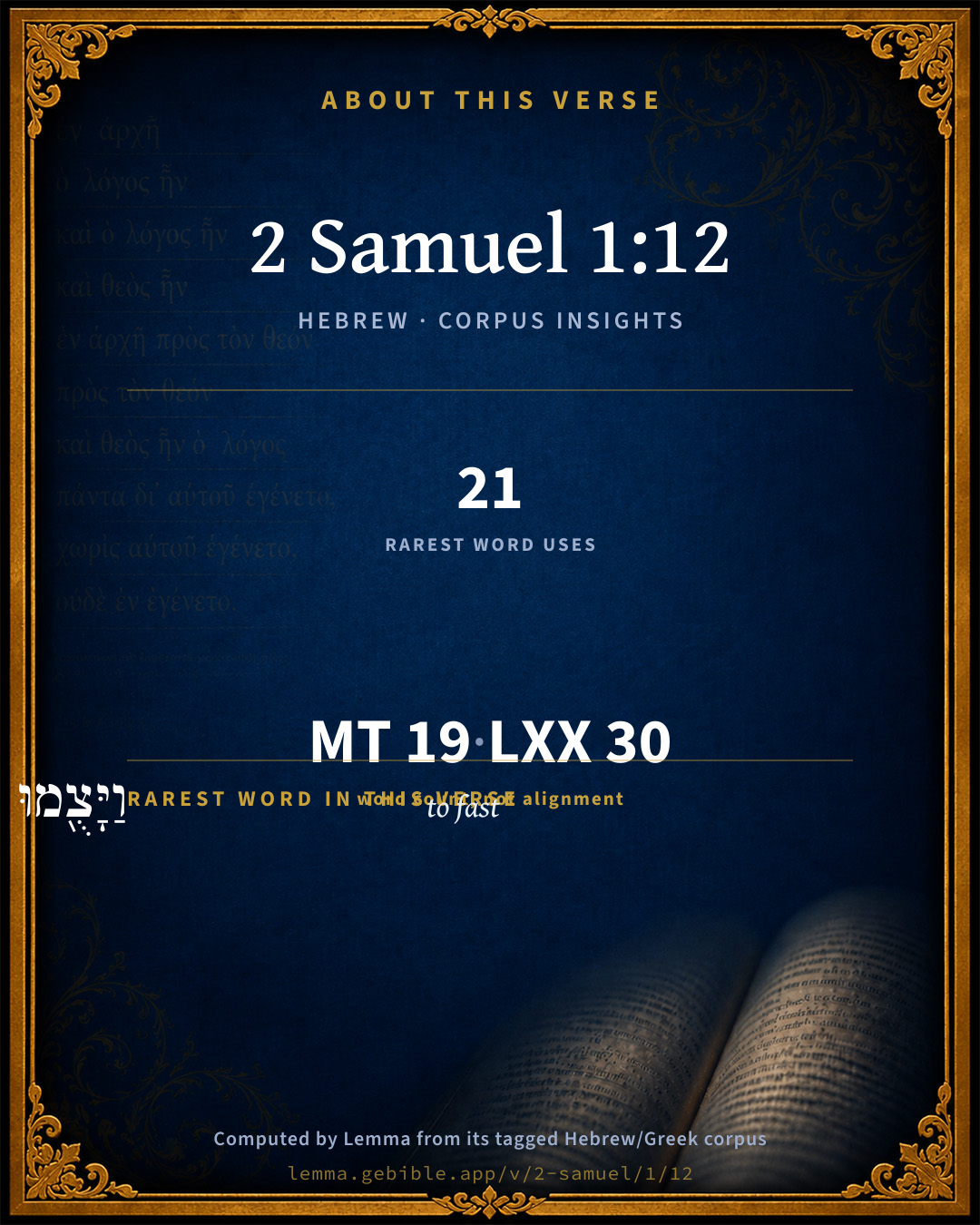
About this verse

These counts appear in no published source. They are computed here, from the morphology-tagged text and Lemma’s own curated glosses. What Lemma adds →

19
words
16
distinct lemmas
Historical
section

Notable vocabulary

The rarest word here is וַיָּצֻ֖מוּ to fast H6684 — appearing just 21 times in the whole Hebrew Bible.

Shared distinctive vocabulary

וַיָּצֻ֖מוּ to fast H6684 occurs in 17 verses of the Hebrew Bible. Also found in:

Grammatical profile

  • 4 verbs
  • 9 nouns
  • 5 prepositions
  • 1 conjunction

Verb forms

  • וַֽיִּסְפְּדוּ֙ Qal · Sequential Imperfect
  • וַיִּבְכּ֔וּ Qal · Sequential Imperfect
  • וַיָּצֻ֖מוּ Qal · Sequential Imperfect
  • נָפְל֖וּ Qal · Perfect

Repetition

A word recurs within this verse — often emphatic in Hebrew:

Hebrew & Septuagint length

In English translation the verse runs 35 words from the Hebrew and 35 from the Septuagint (LXX English) — the same length.

A rough comparison of the two English renderings, which tokenize alike — not a word-level alignment.

Word counts can differ between the Hebrew and the Greek without any difference in meaning — e.g. the Hebrew direct-object marker אֵת has no separate Greek word, and Greek often adds the article ὁ.

In the original languages it is 19 Hebrew tokens and 30 Greek tokens — but the two are counted differently (Hebrew bundles its prefixes and suffixes into one token; the Greek is in lemma form), so that isn’t a like-for-like length.

Cross-references

8

Topical passages linked to 2 Samuel 1:12 in the Treasury of Scripture Knowledge — connected by theme and wording, ordered by reader-vote popularity; previews shown in the World English Bible.

  • Psalms 35:13–14 But as for me, when they were sick, my clothing was sackcloth. I afflicted my soul with fasting. My prayer returned into my own bosom.
  • Proverbs 24:17 Don't rejoice when your enemy falls. Don't let your heart be glad when he is overthrown;
  • Matthew 5:44 But I tell you, love your enemies, bless those who curse you, do good to those who hate you, and pray for those who mistreat you and persecute you,
  • 2 Samuel 3:35 All the people came to cause David to eat bread while it was yet day; but David swore, saying, God do so to me, and more also, if I taste bread, or anything else, until the sun be down.
  • Amos 6:6 Who drink wine in bowls, And anoint themselves with the best oils; But they are not grieved for the affliction of Joseph.
  • 2 Corinthians 11:29 Who is weak, and I am not weak? Who is caused to stumble, and I don't burn with indignation?
  • 1 Peter 3:8 Finally, be all like-minded, compassionate, loving as brothers, tenderhearted, courteous,
  • Jeremiah 9:1 Oh that my head were waters, and my eyes a spring of tears, that I might weep day and night for the slain of the daughter of my people!

Cross-references courtesy of OpenBible.info (CC BY 4.0).

Hebrew and Greek witnesses Masoretic Hebrew ↔ Greek Septuagint

The same verse in the two great witnesses to the Old Testament, shown verse-for-verse.

These are two independent witnesses, not word-aligned to each other, and the Septuagint is shown in lemma (dictionary) form.

Hebrew 2 Samuel 1:12 Masoretic · Westminster Leningrad Codex

וַֽיִּסְפְּדוּ֙ וַיִּבְכּ֔וּ וַיָּצֻ֖מוּ עַד הָעָ֑רֶב עַל שָׁא֞וּל וְעַל יְהוֹנָתָ֣ן בְּנ֗וֹ וְעַל עַ֤ם יְהוָה֙ וְעַל בֵּ֣ית יִשְׂרָאֵ֔ל כִּ֥י נָפְל֖וּ בֶּחָֽרֶב

and they mourned, and wept, and fasted until even, for Saul, and for Jonathan his son, and for the people of Yahweh, and for the house of Israel; because they were fallen by the sword.

World English Bible · Public Domain

Greek LXX 2 Samuel 1:12 Septuagint · lemma form

καί κόπτω καί κλαίω καί νηστεύω ἕως δειλός ἐπί σαούλ καί ἐπί ιωναθαν ὁ υἱός αὐτός καί ἐπί ὁ λαός ιουδα καί ἐπί ὁ οἶκος ἰσραήλ ὅτι πλήσσω ἐν ῥομφαία

And they lamented, and wept, and fasted till evening, for Saul and for Jonathan his son, and for the people of Juda, and for the house of Israel, because they were struck with the sword.

LXX2012 (modern English Septuagint) · Public Domain

On this verse, Ellicott's Commentary for English Readers discusses the Septuagint’s reading. Read the note in Commentary ↓

Hebrew: Westminster Leningrad Codex (CC BY 4.0). Greek: Septuagint (public domain); English from LXX2012 (modern English Septuagint) (Public Domain). How the Septuagint differs from the Hebrew →

Targum (Aramaic paraphrase)

1

The Targum is the ancient Jewish Aramaic paraphrase of the Hebrew Scriptures — an interpretive translation, not the Hebrew text itself. Onkelos (literal) and Pseudo-Jonathan (expansive) render the Torah, and Jonathan the Prophets. Coverage is partial: where no permissively-licensed English translation exists for a verse, only the Aramaic is shown. This is verse-level text, not a word-by-word alignment to the Hebrew.

  1. Targum Jonathan Prophets (Joshua–Malachi)
    וּסְפָדוּ וּבְכוֹ וְצָמוּ עַד רַמְשָׁא עַל שָׁאוּל וְעַל יְהוֹנָתָן בְּרֵיהּ וְעַל עַמָא דַייָ וְעַל בֵּית יִשְׂרָאֵל אֲרֵי אִתְקְטָלוּ בְּחַרְבָּא:

    (no public-domain English translation for this verse)

    Targum Jonathan — Aramaic: “Mikraot Gedolot” (public domain). English: “Sefaria Community Translation” (CC0 1.0 (public-domain dedication)); “London "Chaldee Paraphrase," 1871” (public domain). Text via Sefaria.

Commentary

Notes on 2 Samuel 1:12 from classic Christian and Jewish commentators (each source and its license shown beneath its notes). The classic Christian expositions comment on the surrounding passage and are grouped to its opening verse, so a note may address several verses; the Jewish commentaries on the Tanakh (Rashi and others) are per-verse, so they appear only where the commentator wrote on this verse.

Lemma curates 59 commentaries, every one of them public domain or Creative Commons licensed, each selected and text-cleaned for this edition rather than reprinted as found. About our sources →

Trapp's Complete Commentary

John Trapp

2Sa 1:12 And they mourned, and wept, and fasted until even, for Saul, and for Jonathan his son, and for the people of the LORD, and for the house of Israel; because they were fallen by the sword.

Ver. 12. And they mourned, and wept, and fasted.] The manlier any man is, the milder and more merciful. Julius Caesar when he had Pompey’s head presented to him wept, and said, Non mihi placet vindicta, sed victoria, I sought not revenge, but victory. David was well pleased with Nabal’s death; but mourned for Saul’s: the case was not alike.

John Trapp, A Commentary or Exposition upon All the Books of the Old and New Testament (1647–1656) — public domain. Text from a community e-Sword module.

Joseph Benson's Commentary

2Sa 1:12. They mourned and wept, and fasted — This is an evident instance of the disinterestedness and tenderness of David’s heart, in that he could not forbear bewailing this melancholy end of Saul, though he was his bitter enemy, and sought his life.

Joseph Benson's Commentary on the Old and New Testaments (1811–1818) — public domain. Text from a community e-Sword module.

Ellicott's Commentary for English Readers

(12) They mourned.—On hearing the tidings of the Amalekite, David and all his people showed the usual Oriental signs of sorrow by rending their clothes, weeping, and fasting. Although David thus heard of the death of his persistent and mortal enemy, and of his own consequent accession to the throne, yet there is not the slightest reason to doubt the reality and earnestness of his mourning. The whole narrative shows that David not only, as a patriotic Israelite, lamented the death of the king, but also felt a personal attachment to Saul, notwithstanding his long and unreasonable hostility. But Saul did not die alone; Jonathan, David’s most cherished friend, fell with him. At the same time, the whole nation over which David was hereafter to reign received a crushing defeat from their foes, and large numbers of his countrymen were slain. It has been well remarked that the only deep mourning for Saul, with the exception of the men of Jabesh-gilead, came from the man whom he had hated and persecuted as long as he lived.

The people of the Lord.—Besides his personal grief, David had both a religious and a patriotic ground for sorrow. The men who had fallen were parts of that Church of God which he so earnestly loved and served, and were also members of the commonwealth of Israel, on whose behalf he ever laboured with patriotic devotion. The LXX., overlooking this distinction, has very unnecessarily changed “people of the Lord” into “people of Judah.”

A Bible Commentary for English Readers, edited by Charles John Ellicott (1878–1897) — public domain. Text from a community e-Sword module.

The Cambridge Bible for Schools and Colleges

gen. ed. J. J. S. Perowne

12. mourned] The word literally denotes the beating of the breast, which is still a common expression of mourning in the East.

fasted until even] Fasting is mentioned as a sign of mourning in 1Sa_31:13; 2Sa_3:35; 2Sa_12:21-22. The day’s fast was considered to terminate at sunset, as at the present day in Mahommedan countries.

for the people of the Lord, and for the house of Israel] By “the people of Jehovah” is meant the army, gathered to fight Jehovah’s battles against the heathen. Cp. 1Sa_25:28; and for people = army cp. 2Sa_1:4 and 1Sa_4:3. “The house of Israel” describes the whole nation united under Saul, and now broken and scattered by his defeat and death.

The Sept. has “for the people of Judah,” a reading which involves a very slight change of letters, but is probably either an accidental corruption or an intentional emendation to get rid of the apparent tautology.

The Cambridge Bible for Schools and Colleges (gen. ed. J. J. S. Perowne; Cambridge University Press, 1878–1918) — public domain. Text from a community e-Sword module.

John Gill's Exposition

And they mourned and wept,.... Inwardly mourned, and outwardly wept, no doubt sincerely:

and fasted until even; ate no food all that day until it was evening, the manner in which fasts used to be kept:

for Saul, and for Jonathan his son; it is no wonder that David and his men should mourn for Jonathan, a good man, and a valiant one, and a dear and faithful friend of David's; but it may seem not so clear a thing that they should, mourn for Saul, a wicked man, and a persecutor of David without cause: but it should be observed that he had been reconciled to David, and had not since attempted anything against him; besides, he was his prince, his father-in-law, and the rather he might be grieved for his death, and his men with him, because it was matter of joy to the Philistines, and they would endeavour to avail themselves of it; and especially the manner of his death, that he should be the cause of it himself, and die without repentance, as it might be feared, and quickly after consultation with a witch, and when left of God, if these particulars were known to David:

and for the people of the Lord, and for the house of Israel; that is, the people of the Lord, even the house of Israel, or who were of the house of Israel; or if they are to be distinguished, the former may respect the people of the Lord who died in battle, for whom mourning was made; and the latter the people that survived, the whole kingdom of Israel, which had sustained a great loss by the slaughter made in this battle, as it follows:

because they were fallen by the sword; so many of them.

John Gill's Exposition of the Whole Bible (1746–1763) — public domain (CC PDM 1.0). Text via the HelloAO Bible API.

Albert Barnes' Notes on the Bible

For Saul ... - David’s thoroughly patriotic and unselfish character is strongly marked here. He looked upon the death of Saul, and the defeat of Israel by a pagan foe, with unmixed sorrow, though it opened to him the way to the throne, and removed his mortal enemy out of the way. For Jonathan he mourned with all the tenderness of a loving friend.

Albert Barnes' Notes on the Bible (1834–1885) — public domain. Text from a community e-Sword/MySword module.

Haydock's Catholic Bible Commentary

Of the Lord, the priests; (Abulensis) though it seems to be explained by the following words, of all the Israelites. (Haydock)

George Leo Haydock (1774–1849), Haydock's Catholic Family Bible and Commentary, 1859 edition — public domain. Excludes Psalms (Douay-Rheims chapter numbering differs from Protestant) and Deuterocanonical books (Catholic canon only).

The Pulpit Commentary

They mourned, and wept, and fasted. The sight of Saul"s royal insignia was clear proof of Israel"s disaster; and this sorrow of David and his men shows how true their hearts were to their country, and how unbearable would have been their position had not the prudence of the Philistine lords extricated them from the difficulty in which they had been placed by David"s want of faith. But David had other reasons besides patriotism for sorrow. Personally he had lost the truest of friends, and even Saul had a place in his heart for he would contrast with his terrible death the early glories of his reign, when all Israel honoured him as its deliverer from the crushing yoke of foreign bondage, and when David was himself one of the most trusty of his captains. Otto von Gerlach compares David thus weeping over the fall of his implacable enemy with David"s Son weeping over Jerusalem, the city whose inhabitants were his bitter foes, and who not only sought his death, but delivered him up to the Romans, to be scourged and spitefully intreated, and slain upon the cross.

The Pulpit Commentary (1880–1919), ed. H.D.M. Spence-Jones & Joseph S. Exell — public domain. Text from a community e-Sword module.

Lesson kit

Teaching starters — assembled from the data on this page, not authored interpretation. Every prompt links to the verse data it draws on. Edit before teaching.

2 Samuel, in the Historical, opens this verse with 19 words (16 distinct Hebrew lemmas). Its most distinctive word is tsûwm (“to fast”). A historical commentator’s framing appears above. Read the whole chapter for the surrounding context.

Discussion questions

  1. What does “to fast” (tsûwm) contribute to the verse as a whole?
  2. How does Judges 20:26, which shares the word «to fast», read alongside this verse?
  3. What does the repetition of “upon” (4× in this one verse) do in this verse?
  4. These translations render this verse differently; the difference is in the English rendering, not the original. What questions does that raise?
  5. «וַֽיִּסְפְּדוּ֙» is a Qal Sequential Imperfect verb. How does that grammatical form shape the action described?
  6. Compare how Trapp's Complete Commentary and Joseph Benson's Commentary read this verse. Where do they agree or differ?

Things to notice

Reading settings

Reading text

Shown beneath each verse's original-language words.

Old Testament
Old Testament edition

Read the OT as the Masoretic Hebrew (MT) or the Greek Septuagint (LXX).

English shown for the Greek Septuagint (in the Hebrew ↔ Greek comparison).

Comparing translations? Open the Compare panel on any verse page to stack up to four side by side.