1 Samuel 18:4

Hebrew (Westminster Leningrad Codex) 1 Samuel 18:4 appears in the Hebrew Old Testament. The text above is from the Westminster Leningrad Codex. Each word links to its Strong’s number, a concise gloss, and parsing drawn from the Open Scriptures Hebrew Bible morphology. Click any word for its full Brown-Driver-Briggs (BDB) entry.
Download image
Cite this verse

1 Samuel 18:4 (World English Bible). Public Domain. Lemma interlinear Bible study tool, https://lemma.gebible.app/v/1-samuel/18/4.

Show BibTeX & RIS
BibTeX
RIS
English Translation
Jonathan stripped himself of the robe that was on him, and gave it to David, and his clothing, even to his sword, and to his bow, and to his sash.
World English Bible · Public Domain
Download a study sheet

One document with this verse’s original text, its word-by-word gloss line, the meaning frame, cross-references with their text, attributed commentary, and full source and license credits — printable, and it pastes into notes with its structure intact.

This verse Autodidact and up

Study sheet (.html) Plain text (.txt)

A passage Seminary Student

Up to 50 verses in one chapter. A passage sheet keeps up to 6 commentary sources and 12 cross-references per verse, in the order this page ranks them, and says so on the sheet whenever that leaves anything out. Ask for a single verse and you get the Autodidact verse sheet above.

Everything on this page stays free to read, with no account — the sheet is a download of what is already on screen, not access to it.

Want to remove ads? Support Godless Engineer
Compare translations 3

The same verse in 3 English versions, stacked beneath the original-language interlinear above. Click any original word for its lexicon entry.

Each is an independent rendering of the whole verse — the interlinear is not word-aligned to these translations.

Highlighted words mark where these versions differ — a whole-verse word diff, not a word-by-word alignment.

  • World English Bible Public Domain
    Jonathan stripped himself of the robe that was on him, and gave it to David, and his clothing, even to his sword, and to his bow, and to his sash.
  • King James Version Public Domain
    And Jonathan stripped himself of the robe that was upon him, and gave it to David, and his garments, even to his sword, and to his bow, and to his girdle.
  • unfoldingWord Literal Text CC BY-SA 4.0
    And Jonathan stripped himself the robe that on him, and he gave it to David, and his garments, and even his sword and even his bow and even his belt.

unfoldingWord Literal Text — © unfoldingWord, licensed CC BY-SA 4.0. Word-aligned USFM3 via Door43 (git.door43.org/unfoldingWord/en_ult).

Versions to compare (up to 4)

3 of 4 selected

Show all 18 translations

Every available English version of this verse, each an independent rendering of the whole verse.

  • World English Bible Public Domain
    Jonathan stripped himself of the robe that was on him, and gave it to David, and his clothing, even to his sword, and to his bow, and to his sash.
  • Berean Standard Bible Public Domain
    And Jonathan removed the robe he was wearing and gave it to David, along with his tunic, his sword, his bow, and his belt.
  • Majority Standard Bible Public Domain
    And Jonathan removed the robe he was wearing and gave it to David, along with his tunic, his sword, his bow, and his belt.
  • King James Version Public Domain
    And Jonathan stripped himself of the robe that was upon him, and gave it to David, and his garments, even to his sword, and to his bow, and to his girdle.
  • American Standard Version (1901) Public Domain
    And Jonathan stripped himself of the robe that was upon him, and gave it to David, and his apparel, even to his sword, and to his bow, and to his girdle.
  • Revised Version (1885) Public Domain
    And Jonathan stripped himself of the robe that was upon him, and gave it to David, and his apparel, even to his sword, and to his bow, and to his girdle.
  • Geneva Bible (1599) Public Domain
    And Ionathan put off the robe that was vpon him, and gaue it Dauid, and his garments, euen to his sword, and to his bow, and to his girdle.
  • Douay-Rheims (1899) Public Domain
    And Jonathan stripped himself of the coat with which he was clothed, and gave it to David, and the rest of his garments, even to his sword, and to his bow, and to his girdle.
  • Young's Literal Translation Public Domain
    and Jonathan strippeth himself of the upper robe which `is' upon him, and giveth it to David, and his long robe, even unto his sword, and unto his bow, and unto his girdle.
  • Literal Standard Version CC BY-SA 4.0
    and Jonathan strips himself of the upper robe which [is] on him, and gives it to David, and his long robe, even to his sword, and to his bow, and to his girdle.
  • Unlocked Literal Bible CC BY-SA 4.0
    Jonathan took off the robe that he was wearing and gave it to David with his armor, as well as his sword, bow, and belt.
  • unfoldingWord Literal Text CC BY-SA 4.0
    And Jonathan stripped himself the robe that on him, and he gave it to David, and his garments, and even his sword and even his bow and even his belt.
  • Darby Bible Public Domain
    And Jonathan stripped himself of the robe that was upon him, and gave it to David, and his dress, even to his sword, and to his bow, and to his girdle.
  • World Messianic Bible Public Domain
    Jonathan stripped himself of the robe that was on him and gave it to David with his clothing, even including his sword, his bow, and his sash.
  • Webster's Bible Public Domain
    And Jonathan stripped himself of the robe that was upon him, and gave it to David, and his garments, even to his sword, and to his bow, and to his girdle.
  • Free Bible Version CC BY-SA 4.0
    Jonathan took off the robe he was wearing and gave it to David, together with his tunic, his sword, his bow, and his belt.
  • Bible in Basic English Public Domain
    And Jonathan took off the robe he had on and gave it to David, with all his military dress, even to his sword and his bow and the band round his body.
  • JPS Tanakh (1917) Public Domain
    And Jonathan stripped himself of the robe that was upon him, and gave it to David, and his apparel, even to his sword, and to his bow, and to his girdle.

Literal Standard Version (2020), Covenant Press — licensed CC BY-SA 4.0. Text via the HelloAO Bible API (eBible.org). Unlocked Literal Bible (unfoldingWord) — licensed CC BY-SA 4.0. Text via the HelloAO Bible API (eBible.org). unfoldingWord Literal Text — © unfoldingWord, licensed CC BY-SA 4.0. Word-aligned USFM3 via Door43 (git.door43.org/unfoldingWord/en_ult). Free Bible Version, Dr. Jonathan Gallagher — licensed CC BY-SA 4.0. Text via the HelloAO Bible API (eBible.org).

Word by word

More ways to search: Search by grammar → Find every occurrence → Compare this word →

Practice this passage: Drill this verse → Learn its vocabulary →

חֲגֹרֽוֹ
chăgôwr
H2290
“belt · his”
Noun, Common, Masculine, Singular, Construct + Suffix, Personal, 3rd Person, Masculine, Singular
Part of Speech
Noun
Type
Common
Gender
Masculine
Number
Singular
State
Construct
Full BDB Definition

Origin: from H2296

TWOT: 604a , 604c

girdle, belt - girdle, loin-covering, belt, loin-cloth, armour
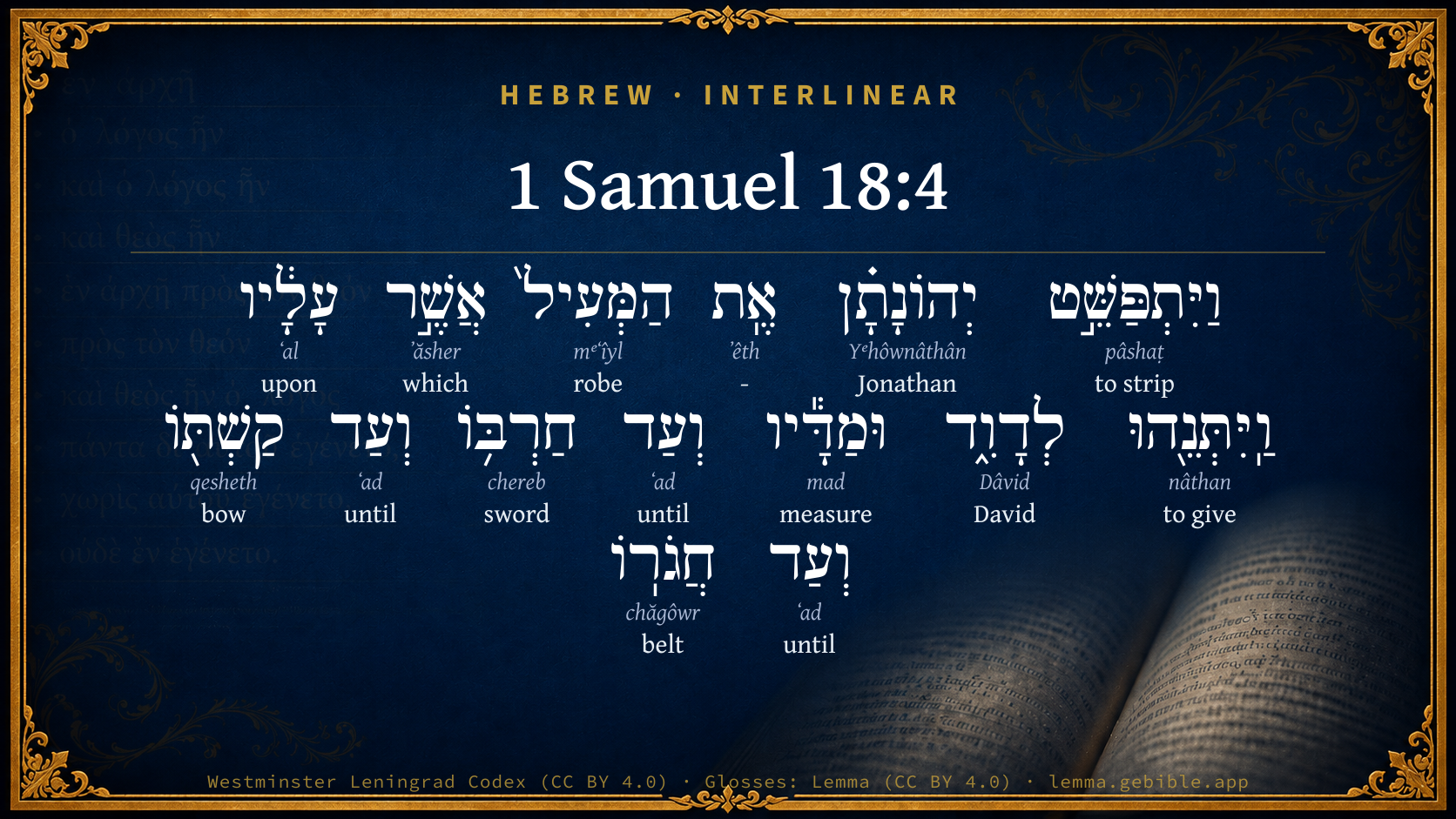
  1. וַיִּתְפַּשֵּׁ֣ט pâshaṭ H6584 “and · to strip” Conjunction + Verb, Hithpael, Sequential Imperfect, 3rd Person, Masculine, Singular
  2. יְהוֹנָתָ֗ן Yᵉhôwnâthân H3083 “Jonathan” Noun, Proper
  3. אֶֽת ʼêth H853 “-” Particle, Direct Object
  4. הַמְּעִיל֙ mᵉʻîyl H4598 “the · robe” Particle, Definite Article + Noun, Common, Masculine, Singular, Absolute
  5. אֲשֶׁ֣ר ʼăsher H834 “which” Particle, Relative
  6. עָלָ֔יו ʻal H5921 “upon · him” Preposition + Suffix, Personal, 3rd Person, Masculine, Singular
  7. וַֽיִּתְּנֵ֖הוּ nâthan H5414 “and · to give · him” Conjunction + Verb, Qal, Sequential Imperfect, 3rd Person, Masculine, Singular + Suffix, Personal, 3rd Person, Masculine, Singular
  8. לְדָוִ֑ד Dâvid H1732 “to/for · David” Preposition + Noun, Proper
  9. וּמַדָּ֕יו mad H4055 “and · measures · his” Conjunction + Noun, Common, Masculine, Plural, Construct + Suffix, Personal, 3rd Person, Masculine, Singular
  10. וְעַד ʻad H5704 “and · until” Conjunction + Preposition
  11. חַרְבּ֥וֹ chereb H2719 “sword · his” Noun, Common, Feminine, Singular, Construct + Suffix, Personal, 3rd Person, Masculine, Singular
  12. וְעַד ʻad H5704 “and · until” Conjunction + Preposition
  13. קַשְׁתּ֖וֹ qesheth H7198 “bow · his” Noun, Common, Feminine, Singular, Construct + Suffix, Personal, 3rd Person, Masculine, Singular
  14. וְעַד ʻad H5704 “and · until” Conjunction + Preposition

About this verse

These counts appear in no published source. They are computed here, from the morphology-tagged text and Lemma’s own curated glosses. What Lemma adds →

15
words
13
distinct lemmas
Historical
section

Notable vocabulary

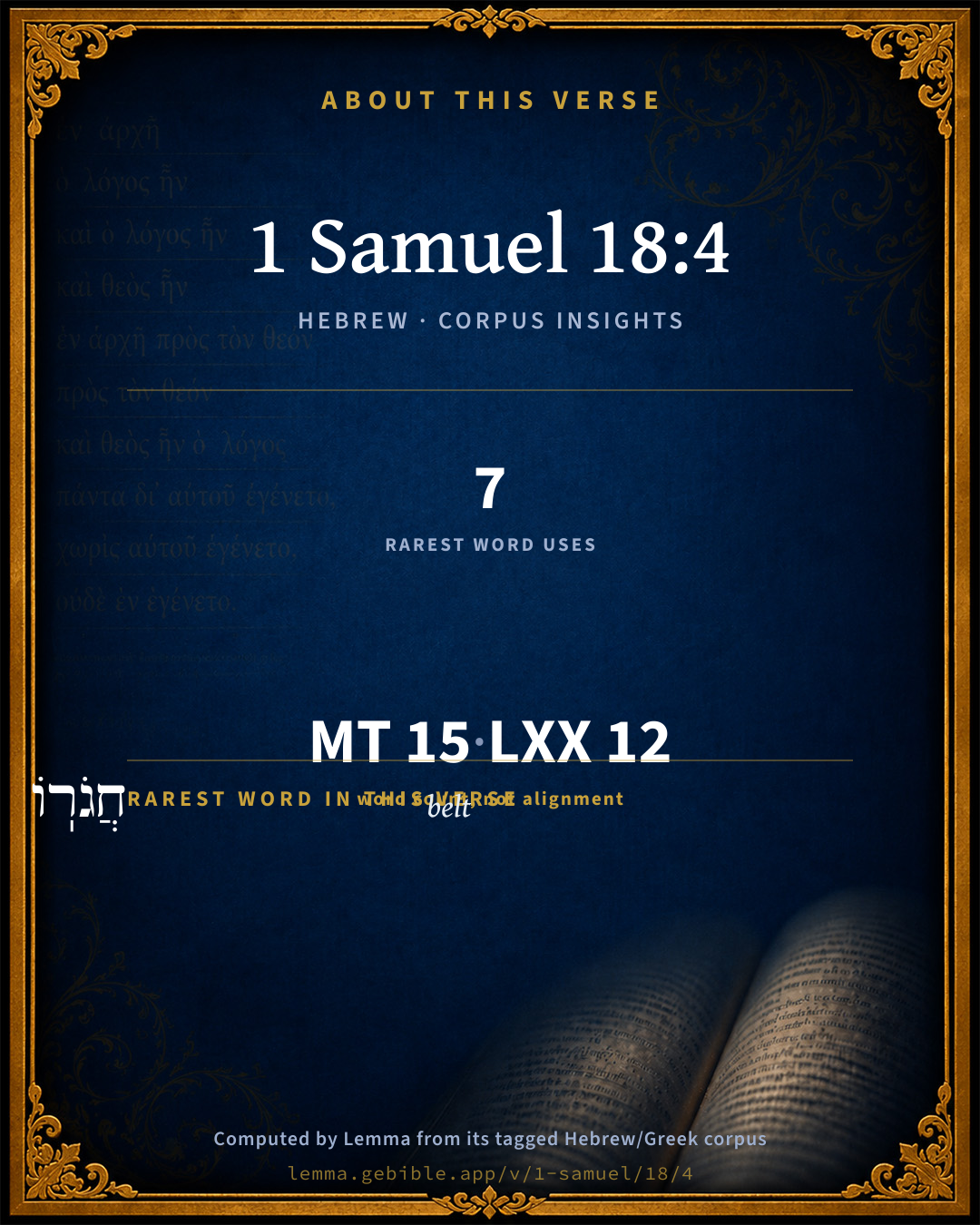
The rarest word here is חֲגֹרֽוֹ belt H2290 — appearing just 7 times in the whole Hebrew Bible.

Shared distinctive vocabulary

חֲגֹרֽוֹ belt H2290 occurs in 7 verses of the Hebrew Bible. Also found in:

Grammatical profile

  • 2 verbs
  • 7 nouns
  • 4 prepositions
  • 2 particles

Verb forms

  • וַיִּתְפַּשֵּׁ֣ט Hithpael · Sequential Imperfect
  • וַֽיִּתְּנֵ֖הוּ Qal · Sequential Imperfect

Repetition

A word recurs within this verse — often emphatic in Hebrew:

  • וְעַד until H5704 ×3

Hebrew & Septuagint length

In English translation the verse runs 30 words from the Hebrew and 34 from the Septuagint (LXX English) — closely comparable.

A rough comparison of the two English renderings, which tokenize alike — not a word-level alignment.

Word counts can differ between the Hebrew and the Greek without any difference in meaning — e.g. the Hebrew direct-object marker אֵת has no separate Greek word, and Greek often adds the article ὁ.

In the original languages it is 15 Hebrew tokens and 12 Greek tokens — but the two are counted differently (Hebrew bundles its prefixes and suffixes into one token; the Greek is in lemma form), so that isn’t a like-for-like length.

Cross-references

6

Topical passages linked to 1 Samuel 18:4 in the Treasury of Scripture Knowledge — connected by theme and wording, ordered by reader-vote popularity; previews shown in the World English Bible.

  • Genesis 41:42 Pharaoh took off his signet ring from his hand, and put it on Joseph's hand, and arrayed him in robes of fine linen, and put a gold chain about his neck,
  • Esther 6:8–9 let royal clothing be brought which the king uses to wear, and the horse that the king rides on, and on the head of which a crown royal is set:
  • Isaiah 61:10 I will greatly rejoice in Yahweh, my soul shall be joyful in my God; for he has clothed me with the garments of salvation, he has covered me with the robe of righteousness, as a bridegroom decks himself with a garland, and as a bride adorns herself with her jewels.
  • Luke 15:22 "But the father said to his servants, 'Bring out the best robe, and put it on him. Put a ring on his hand, and shoes on his feet.
  • 2 Corinthians 5:21 For him who knew no sin he made to be sin on our behalf; so that in him we might become the righteousness of God.
  • Philippians 2:7–8 but emptied himself, taking the form of a servant, being made in the likeness of men.

Cross-references courtesy of OpenBible.info (CC BY 4.0).

Hebrew and Greek witnesses Masoretic Hebrew ↔ Greek Septuagint

The same verse in the two great witnesses to the Old Testament, shown verse-for-verse.

These are two independent witnesses, not word-aligned to each other, and the Septuagint is shown in lemma (dictionary) form.

Hebrew 1 Samuel 18:4 Masoretic · Westminster Leningrad Codex

וַיִּתְפַּשֵּׁ֣ט יְהוֹנָתָ֗ן אֶֽת הַמְּעִיל֙ אֲשֶׁ֣ר עָלָ֔יו וַֽיִּתְּנֵ֖הוּ לְדָוִ֑ד וּמַדָּ֕יו וְעַד חַרְבּ֥וֹ וְעַד קַשְׁתּ֖וֹ וְעַד חֲגֹרֽוֹ

Jonathan stripped himself of the robe that was on him, and gave it to David, and his clothing, even to his sword, and to his bow, and to his sash.

World English Bible · Public Domain

Greek LXX 1 Samuel 18:4 Septuagint · lemma form

καί εἰμί σαούλ ὑποβλέπω ὁ δαυίδ ἀπό ὁ ἡμέρα ἐκεῖνος καί ἐπέκεινα

And Jonathan stripped himself of his upper garment, and gave it to David, and his mantle and all he had upon him, even to his sword and to his bow, and to his girdle.

LXX2012 (modern English Septuagint) · Public Domain

Hebrew: Westminster Leningrad Codex (CC BY 4.0). Greek: Septuagint (public domain); English from LXX2012 (modern English Septuagint) (Public Domain). How the Septuagint differs from the Hebrew →

Targum (Aramaic paraphrase)

1

The Targum is the ancient Jewish Aramaic paraphrase of the Hebrew Scriptures — an interpretive translation, not the Hebrew text itself. Onkelos (literal) and Pseudo-Jonathan (expansive) render the Torah, and Jonathan the Prophets. Coverage is partial: where no permissively-licensed English translation exists for a verse, only the Aramaic is shown. This is verse-level text, not a word-by-word alignment to the Hebrew.

  1. Targum Jonathan Prophets (Joshua–Malachi)
    וְאַשְׁלַח יְהוֹנָתָן יַת מְעִילָא דִי עֲלוֹהִי וְיַהֲבֵיהּ לְדָוִד וּלְבוּשׁוֹהִי וְעַד חַרְבֵּיהּ וְעַד קַשְׁתֵּיהּ וְעַד זְרָזֵיהּ:

    (no public-domain English translation for this verse)

    Targum Jonathan — Aramaic: “Mikraot Gedolot” (public domain). English: “Sefaria Community Translation” (CC0 1.0 (public-domain dedication)); “London "Chaldee Paraphrase," 1871” (public domain). Text via Sefaria.

Commentary

Notes on 1 Samuel 18:4 from classic Christian and Jewish commentators (each source and its license shown beneath its notes). The classic Christian expositions comment on the surrounding passage and are grouped to its opening verse, so a note may address several verses; the Jewish commentaries on the Tanakh (Rashi and others) are per-verse, so they appear only where the commentator wrote on this verse.

Lemma curates 59 commentaries, every one of them public domain or Creative Commons licensed, each selected and text-cleaned for this edition rather than reprinted as found. About our sources →

Trapp's Complete Commentary

John Trapp

1Sa 18:4 And Jonathan stripped himself of the robe that [was] upon him, and gave it to David, and his garments, even to his sword, and to his bow, and to his girdle.

Ver. 4. And Jonathan stripped himself of the robe … and gave it to David, &c.] As a pledge of his dear love, and for a symbol, that now all things were common betwixt them, as it useth to be betwixt dearest friends, and that he would have David looked upon as his Alter Ego.

And his garments, even to his sword, &c.] Love is liberal, and can part with anything. Christ sealed up his great love to his elect by bestowing himself and all his benefits upon them. Neither was it, perhaps, without mystery, saith one, that Saul’s clothes fitted not David, but Jonathan’s fitted him; and these he is as glad to wear, as he was to be disburdened of the other.

John Trapp, A Commentary or Exposition upon All the Books of the Old and New Testament (1647–1656) — public domain. Text from a community e-Sword module.

The Biblical Illustrator

Joseph S. Exell

1Sa_18:4

And Jonathan stripped himself of the robe that was upon him, and gave it to David.

David invested with royal robes

From the days of Homer and the Trojan wars downwards, this has been the method employed by Orientals to denote the bestowment of dignity and distinction. Not more eagerly coveted is the Order of the Garter, or Bath, or Thistle among ourselves than in ancient times was the gift of royal robes. Any portion, indeed, of a kings wardrobe or jewel box was greatly prized; but the voluntary donation of dress, and more particularly in the act of being worn, rendered the tribute doubly valuable. Whenever this latter occurred the cherished memento was transmitted as an heirloom from sire to son. It was equivalent to a patent of nobility. (J. R. Macduff, D. D.)

We find in Homer a minute enumeration of the armour Ulysses received in a gift from Meriones, and in the story of Nisus and Euryalus, in the IX OEneid of Virgil, there occurs a duplicate picture of that presented to us in the tent of Saul. (J. R. Macduff, D. D.)

The Biblical Illustrator, edited by Joseph S. Exell (c. 1880s–1900s) — public domain. Text from a community e-Sword module.

Joseph Benson's Commentary

1Sa 18:4. Jonathan stripped himself of the robe that was upon him — This he did that he might do honour to, as well as show his affection for, David. For it is probable that David was before clothed in a rustic habit, not fit to appear in at court.

Joseph Benson's Commentary on the Old and New Testaments (1811–1818) — public domain. Text from a community e-Sword module.

Jamieson, Fausset & Brown

Robert Jamieson, A. R. Fausset & David Brown

Jonathan stripped himself of the robe that was upon him, and gave it to David--To receive any part of the dress which had been worn by a sovereign, or his eldest son and heir, is deemed, in the East, the highest honor which can be conferred on a subject (see on Est 6:8). The girdle, being connected with the sword and the bow, may be considered as being part of the military dress, and great value is attached to it in the East.

Jamieson, Fausset & Brown — Commentary Critical and Explanatory on the Whole Bible (1871) — public domain (CC PDM 1.0). Text via the HelloAO Bible API.

Adam Clarke's Commentary

Verse 4. Jonathan stripped himself] Presents of clothes or rich robes, in token of respect and friendship, are frequent in the East. And how frequently arms and clothing were presented by warriors to each other in token of friendship, may be seen in Homer and other ancient writers.

Adam Clarke's Commentary on the Bible (1810–1826) — public domain. Text from a community e-Sword/MySword module.

Ellicott's Commentary for English Readers

(4) Gave it to David.—It has been suggested that the reason of this gift was to enable his friend David—then poorly clad—to appear at his father’s court in a fitting dress; but this kind of present was usual among friends in those remote ages. Glaucus and Diomed, for instance, exchanged armour of a very different value.

“Now change we arms, and prove to either host

We guard the friendship of the line we boast.

* * * * * *

For Diomed’s brass arms, of mean device,

For which nine oxen paid (a vulgar price),

He gave his own of gold, divinely wrought:

A hundred beeves the shining purchase bought.”

Iliad, vi. 286–295.

A Bible Commentary for English Readers, edited by Charles John Ellicott (1878–1897) — public domain. Text from a community e-Sword module.

The Cambridge Bible for Schools and Colleges

gen. ed. J. J. S. Perowne

4. Jonathan stript himself, &c.] Jonathan gave David (1) his mĕîl or long outer robe for ordinary wear (see on 1Sa_2:19); (2) his military dress (1Sa_17:38) and girdle: (3) even his sword, and the famous bow which was his special weapon (2Sa_1:22). The act was at once a ratification of their compact and a pubic mark of honour. See Gen_41:42; Est_6:8. We may compare the exchange of armour between Glaucus and Diomede when they met before Troy, as a pledge of old family friendship (Hom. Il. VI. 230).

The Cambridge Bible for Schools and Colleges (gen. ed. J. J. S. Perowne; Cambridge University Press, 1878–1918) — public domain. Text from a community e-Sword module.

John Gill's Exposition

And Jonathan stripped himself of the robe that was upon him,.... As a token of his hearty love and true friendship, and that David might appear at court not in the habit of a shepherd, but in that of a prince:

and gave it to David, and his garments; his other garments besides his robe, and so clothed him from tip to toe, and which fitted him; for as there was a similarity in their souls, and the disposition of them, so in the make and hulk of their bodies, and in the stature of them:

even to his sword, and to his bow, and to his girdle; these he gave him to accoutre himself with, that he might appear as a soldier, as well as like a prince, and as another Jonathan, or rather the same; that they might seem as one, as alike in body, so in garb and habit.

John Gill's Exposition of the Whole Bible (1746–1763) — public domain (CC PDM 1.0). Text via the HelloAO Bible API.

Haydock's Catholic Bible Commentary

Girdle, which perhaps was of great value, Job xii. 18. He wished that David should lay aside his shepherd’s dress, and appear like himself at court, that all might know how much he loved him. (Menochius)

George Leo Haydock (1774–1849), Haydock's Catholic Family Bible and Commentary, 1859 edition — public domain. Excludes Psalms (Douay-Rheims chapter numbering differs from Protestant) and Deuterocanonical books (Catholic canon only).

Matthew Poole's English Annotations

Partly as a pledge of his great respect and affection to him; and partly to vindicate David from that contempt which might cleave to him for his former pastoral habit and condition, and to put him into a habit suitable to his present greatness and glory.

Matthew Poole's English Annotations on the Holy Bible (1683–1685) — public domain. Text from a community e-Sword/MySword module.

Whedon's Commentary on the Bible

Daniel D. Whedon

4. His garments — Rather, his armour, as the word מדis rendered, 1Sa_17:39. This, we are immediately told, consisted of his sword, bow, and girdle. The giving of this robe and armour was the seal of the covenant between them.

Daniel D. Whedon (gen. ed.), Commentary on the Old and New Testaments (1874–1909) — public domain. Text from a community e-Sword module.

The Pulpit Commentary

Divine friendship.

loved him as his own soul" (ver. 3). Human friendship is a shadow of Divine. The greatest and best Friend is God in Christ Jesus. Happy is every one who can say from the heart, "This is my beloved, and this is my friend". (Son_5:16) Consider

I ITS CONDITIONS, on the part of man.

1. Rationality: capacity of thought, voluntary choice, moral esteem. "Amidst the ashes of our collapsed nature there slumber certain sparks of celestial fire" (Owen).

2. Reconciliation; inasmuch as man is alienated from God, and under condemnation.

3. Renewal in righteousness and true holiness, so that we may be "partakers of the Divine nature". (2Pe_1:4) "Friendship is a union of souls, and souls can be united only where there is more or less accord". (Amo_3:3)

II ITS CHARACTERISTICS, on the part of the Lord. All his perfections render it in every respect transcendently excellent. But notice more particularly

1. Its disinterestedness. "He first loved us," with a pure, free, condescending, self-sacrificing love. "Greater love hath no man," etc. (Joh_15:13)

1. Its faithfulness.

2. Its constancy. "The love of friends of this world is defective in three respects they begin to love late, cease early, love little. But the love of God is an unequalled love. He loves us without beginning, without intermission, and without end" (Nouet).

III ITS BENEFITS, or the blessings enjoyed by those who have fellowship with him.

1. Counsel, warning, rebuke. Reproofs are "the graver looks of love.

2. Defence, support, and effectual help.

3. Sympathy, encouragement, and everlasting consolation. "And now," said Jonathan Edwards, on his death bed, turning from his earthly friends toward the approaching darkness, "where is Jesus of Nazareth, my true and never failing Friend?

IV ITS CLAIMS, or the duties of those who enjoy such benefits and desire their continuance.

1. To cherish proper feelings toward him confidence, affection, anddelight in intercourse with him.

2. To do those things that please him. "Ye are my friends if ye dowhatsoever I command you.

3. Not to be ashamed of him, but to confess his name before men; to loveand serve his friends for his sake, and to seek in all things his honour and glory. D.

The Pulpit Commentary (1880–1919), ed. H.D.M. Spence-Jones & Joseph S. Exell — public domain. Text from a community e-Sword module.

Keil & Delitzsch

C. F. Keil & F. Delitzsch

As a sign and pledge of his friendship, Jonathan gave David his clothes and his armour. Meil, the upper coat or cloak. Maddim is probably the armour coat (vid., Sa1 17:39). This is implied in the word ועד, which is repeated three times, and by which the different arms were attached more closely to מדּיו. For the act itself, compare the exchange of armour made by Glaucus and Diomedes (Hom. Il. vi. 230). This seems to have been a common custom in very ancient times, as we meet with it also among the early Celts (see Macpherson's Ossian).

Keil & Delitzsch — Biblical Commentary on the Old Testament (1861–1891) — public domain (CC PDM 1.0). Text via the HelloAO Bible API. (Old Testament only.)

Lesson kit

Teaching starters — assembled from the data on this page, not authored interpretation. Every prompt links to the verse data it draws on. Edit before teaching.

1 Samuel, in the Historical, opens this verse with 15 words (13 distinct Hebrew lemmas). Its most distinctive word is chăgôwr (“belt”). A historical commentator’s framing appears above. Read the whole chapter for the surrounding context.

Discussion questions

  1. What does “belt” (chăgôwr) contribute to the verse as a whole?
  2. How does Genesis 3:7, which shares the word «belt», read alongside this verse?
  3. What does the repetition of “until” (3× in this one verse) do in this verse?
  4. These translations render this verse differently; the difference is in the English rendering, not the original. What questions does that raise?
  5. «וַיִּתְפַּשֵּׁ֣ט» is a Hithpael Sequential Imperfect verb. How does that grammatical form shape the action described?
  6. Compare how Trapp's Complete Commentary and The Biblical Illustrator read this verse. Where do they agree or differ?

Things to notice

Reading settings

Reading text

Shown beneath each verse's original-language words.

Old Testament
Old Testament edition

Read the OT as the Masoretic Hebrew (MT) or the Greek Septuagint (LXX).

English shown for the Greek Septuagint (in the Hebrew ↔ Greek comparison).

Comparing translations? Open the Compare panel on any verse page to stack up to four side by side.