
2 Chronicles 20:9

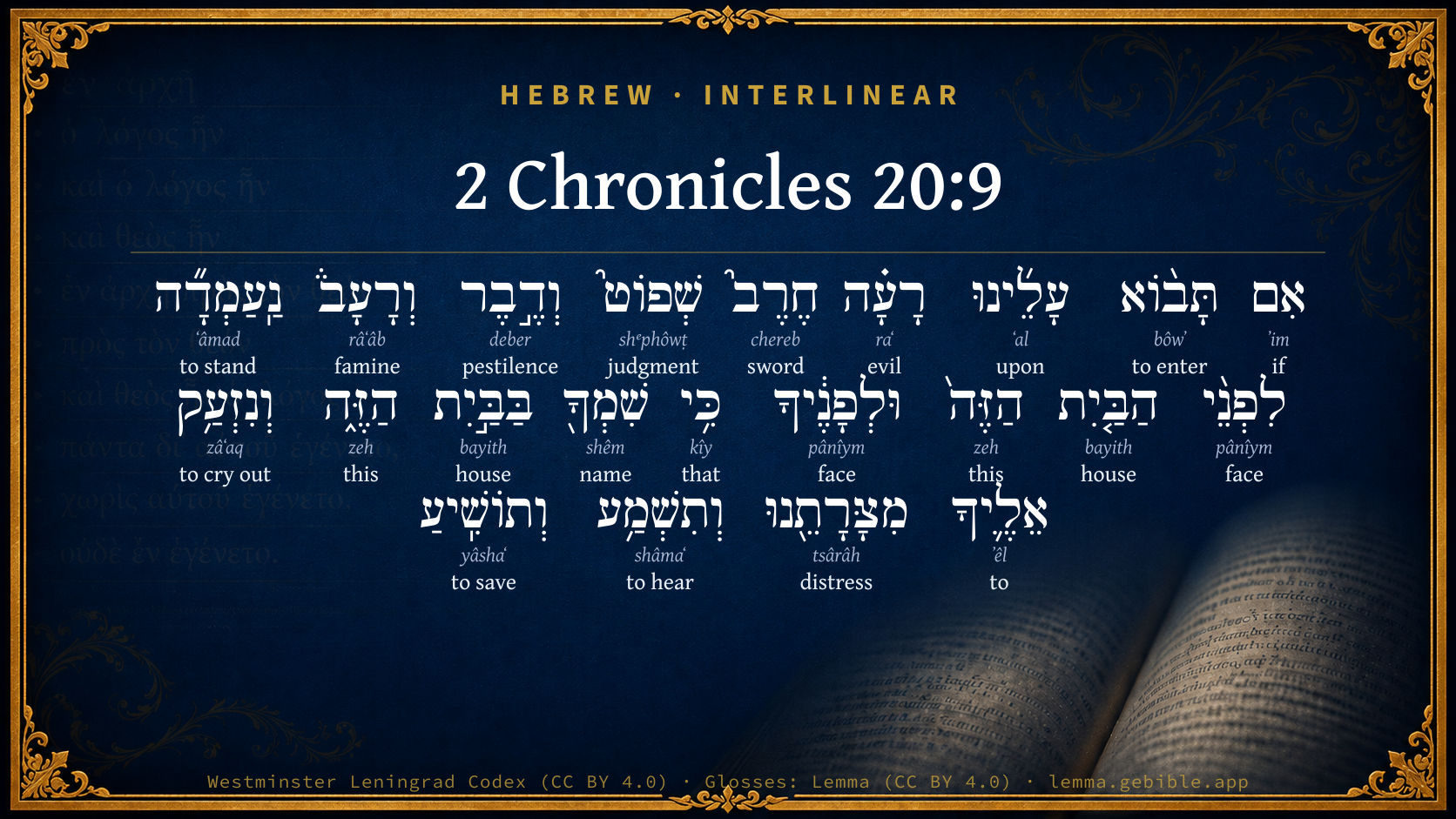
Hebrew (Westminster Leningrad Codex) 2 Chronicles 20:9 appears in the Hebrew Old Testament. The text above is from the Westminster Leningrad Codex. Each word links to its Strong’s number, a concise gloss, and parsing drawn from the Open Scriptures Hebrew Bible morphology. Click any word for its full Brown-Driver-Briggs (BDB) entry.
Download image
Cite this verse

2 Chronicles 20:9 (World English Bible). Public Domain. Lemma interlinear Bible study tool, https://lemma.gebible.app/v/2-chronicles/20/9.

Show BibTeX & RIS
BibTeX
RIS
English Translation
If evil come on us, the sword, judgment, or pestilence, or famine, we will stand before this house, and before you, (for your name is in this house), and cry to you in our affliction, and you will hear and save.
World English Bible · Public Domain
Highlights
  • 1 first appearance in the Hebrew Bible
Full analysis ↓
Download a study sheet

One document with this verse’s original text, its word-by-word gloss line, the meaning frame, cross-references with their text, attributed commentary, and full source and license credits — printable, and it pastes into notes with its structure intact.

This verse Autodidact and up

Study sheet (.html) Plain text (.txt)

A passage Seminary Student

Up to 50 verses in one chapter. A passage sheet keeps up to 6 commentary sources and 12 cross-references per verse, in the order this page ranks them, and says so on the sheet whenever that leaves anything out. Ask for a single verse and you get the Autodidact verse sheet above.

Everything on this page stays free to read, with no account — the sheet is a download of what is already on screen, not access to it.

Want to remove ads? Support Godless Engineer
Compare translations 3

The same verse in 3 English versions, stacked beneath the original-language interlinear above. Click any original word for its lexicon entry.

Each is an independent rendering of the whole verse — the interlinear is not word-aligned to these translations.

Highlighted words mark where these versions differ — a whole-verse word diff, not a word-by-word alignment.

  • World English Bible Public Domain
    If evil come on us, the sword, judgment, or pestilence, or famine, we will stand before this house, and before you, (for your name is in this house), and cry to you in our affliction, and you will hear and save.
  • King James Version Public Domain
    If, when evil cometh upon us, as the sword, judgment, or pestilence, or famine, we stand before this house, and in thy presence, (for thy name is in this house,) and cry unto thee in our affliction, then thou wilt hear and help.
  • unfoldingWord Literal Text CC BY-SA 4.0
    ‘If disaster comes on us—the sword, judgment, or pestilence, or famine—we will stand before this house, and before you for your name is in this house. And we will cry to you from our distress, and you will hear and deliver.’

unfoldingWord Literal Text — © unfoldingWord, licensed CC BY-SA 4.0. Word-aligned USFM3 via Door43 (git.door43.org/unfoldingWord/en_ult).

Versions to compare (up to 4)

3 of 4 selected

Show all 18 translations

Every available English version of this verse, each an independent rendering of the whole verse.

  • World English Bible Public Domain
    If evil come on us, the sword, judgment, or pestilence, or famine, we will stand before this house, and before you, (for your name is in this house), and cry to you in our affliction, and you will hear and save.
  • Berean Standard Bible Public Domain
    ‘If disaster comes upon us—whether sword or judgment, plague or famine—we will stand before this temple and before You, for Your Name is in this temple. We will cry out to You in our distress, and You will hear us and save us.’
  • Majority Standard Bible Public Domain
    ‘If disaster comes upon us—whether sword or judgment, plague or famine—we will stand before this temple and before You, for Your Name is in this temple. We will cry out to You in our distress, and You will hear us and save us.’
  • King James Version Public Domain
    If, when evil cometh upon us, as the sword, judgment, or pestilence, or famine, we stand before this house, and in thy presence, (for thy name is in this house,) and cry unto thee in our affliction, then thou wilt hear and help.
  • American Standard Version (1901) Public Domain
    If evil come upon us, the sword, judgment, or pestilence, or famine, we will stand before this house, and before thee, (for thy name is in this house,) and cry unto thee in our affliction, and thou wilt hear and save.
  • Revised Version (1885) Public Domain
    If evil come upon us, the sword, judgment, or pestilence, or famine, we will stand before this house, and before thee, (for thy name is in this house,) and cry unto thee in our affliction, and thou wilt hear and save.
  • Geneva Bible (1599) Public Domain
    If euill come vpon vs, as the sworde of iudgement, or pestilence, or famine, we will stande before this house and in thy presence (for thy name is in this house) and will crie vnto thee in our tribulation, and thou wilt heare and helpe.
  • Douay-Rheims (1899) Public Domain
    If evils fall upon us, the sword of judgment, or pestilence, or famine, we will stand in thy presence before this house, in which thy name is called upon: and we will cry to thee in our afflictions, and thou wilt hear, and save us.
  • Young's Literal Translation Public Domain
    If evil doth come upon us -- sword, judgment, and pestilence, and famine -- we stand before this house, and before Thee, for Thy name `is' in this house, and cry unto Thee out of our distress, and Thou dost hear and save.
  • Literal Standard Version CC BY-SA 4.0
    If evil comes on us—sword, judgment, and pestilence, and famine—we stand before this house, and before You, for Your Name [is] in this house, and cry to You out of our distress, and You hear and save.
  • Unlocked Literal Bible CC BY-SA 4.0
    'If disaster comes on us—the sword, judgment, or disease, or famine—we will stand before this house, and before you (for your name is in this house), and we will cry to you in our affliction, and you will hear us and save us.'
  • unfoldingWord Literal Text CC BY-SA 4.0
    ‘If disaster comes on us—the sword, judgment, or pestilence, or famine—we will stand before this house, and before you for your name is in this house. And we will cry to you from our distress, and you will hear and deliver.’
  • Darby Bible Public Domain
    If evil come upon us, sword, judgment, or pestilence, or famine, and we stand before this house and before thee -- for thy name is in this house -- and cry unto thee in our distress, then thou wilt hear and save.
  • World Messianic Bible Public Domain
    ‘If evil comes on us—the sword, judgment, pestilence, or famine—we will stand before this house, and before you (for your name is in this house), and cry to you in our affliction, and you will hear and save.’
  • Webster's Bible Public Domain
    If, when evil cometh upon us, as the sword, judgment, or pestilence, or famine, we stand before this house, and in thy presence, (for thy name is in this house,) and cry to thee in our affliction, then thou wilt hear and help.
  • Free Bible Version CC BY-SA 4.0
    ‘If disaster strikes us, whether it's invasion or judgment, disease or famine, we will stand in front of this Temple and before you, for this Temple is yours. We will cry out to you to help us in our suffering, and you will hear us and save us.’
  • Bible in Basic English Public Domain
    If evil comes on us, the sword, or punishment, or disease, or need of food, we will come to this house and to you, (for your name is in this house,) crying to you in our trouble, and you will give us salvation in answer to our cry.
  • JPS Tanakh (1917) Public Domain
    If evil come upon us, the sword, judgment, or pestilence, or famine, we will stand before this house, and before Thee — for Thy name is in this house — and cry unto Thee in our affliction, and Thou wilt hear and save.

Literal Standard Version (2020), Covenant Press — licensed CC BY-SA 4.0. Text via the HelloAO Bible API (eBible.org). Unlocked Literal Bible (unfoldingWord) — licensed CC BY-SA 4.0. Text via the HelloAO Bible API (eBible.org). unfoldingWord Literal Text — © unfoldingWord, licensed CC BY-SA 4.0. Word-aligned USFM3 via Door43 (git.door43.org/unfoldingWord/en_ult). Free Bible Version, Dr. Jonathan Gallagher — licensed CC BY-SA 4.0. Text via the HelloAO Bible API (eBible.org).

Word by word

More ways to search: Search by grammar → Find every occurrence → Compare this word →

Practice this passage: Drill this verse → Learn its vocabulary →

שְׁפוֹט֮
shᵉphôwṭ
H8196
“judgment”
Noun, Common, Masculine, Singular, Absolute
Part of Speech
Noun
Type
Common
Gender
Masculine
Number
Singular
State
Absolute
Full BDB Definition

Origin: from H8199

TWOT: 2443b

judgment, act of judgment
  1. אִם ʼim H518 “if” Conjunction
  2. תָּב֨וֹא bôwʼ H935 “to enter” Verb, Qal, Imperfect, 3rd Person, Feminine, Singular
  3. עָלֵ֜ינוּ ʻal H5921 “upon · us” Preposition + Suffix, Personal, 1st Person, Common, Plural
  4. רָעָ֗ה raʻ H7451 “evil” Noun, Common, Feminine, Singular, Absolute
  5. חֶרֶב֮ chereb H2719 “sword” Noun, Common, Feminine, Singular, Absolute
  6. וְדֶ֣בֶר deber H1698 “and · pestilence” Conjunction + Noun, Common, Masculine, Singular, Absolute
  7. וְרָעָב֒ râʻâb H7458 “and · famine” Conjunction + Noun, Common, Masculine, Singular, Absolute
  8. נַֽעַמְדָ֞ה ʻâmad H5975 “to stand” Verb, Qal, Cohortative, 1st Person, Common, Plural
  9. לִפְנֵ֨י pânîym H6440 “to/for · face(s) of” Preposition + Noun, Common, Both, Plural, Construct
  10. הַבַּ֤יִת bayith H1004 “the · house” Particle, Definite Article + Noun, Common, Masculine, Singular, Absolute
  11. הַזֶּה֙ zeh H2088 “the · this” Particle, Definite Article + Pronoun, Demonstrative, Masculine, Singular
  12. וּלְפָנֶ֔יךָ pânîym H6440 “and · to/for · face(s) · your” Conjunction + Preposition + Noun, Common, Both, Plural, Construct + Suffix, Personal, 2nd Person, Masculine, Singular
  13. כִּ֥י kîy H3588 “that” Conjunction
  14. שִׁמְךָ֖ shêm H8034 “name · your” Noun, Common, Masculine, Singular, Construct + Suffix, Personal, 2nd Person, Masculine, Singular
  15. בַּבַּ֣יִת bayith H1004 “in/at the · house” Preposition, Determined + Noun, Common, Masculine, Singular, Absolute
  16. הַזֶּ֑ה zeh H2088 “the · this” Particle, Definite Article + Pronoun, Demonstrative, Masculine, Singular
  17. וְנִזְעַ֥ק zâʻaq H2199 “and · to cry out” Conjunction + Verb, Qal, Imperfect, 1st Person, Common, Plural
  18. אֵלֶ֛יךָ ʼêl H413 “to · you” Preposition + Suffix, Personal, 2nd Person, Masculine, Singular
  19. מִצָּרָתֵ֖נוּ tsârâh H6869 “from · distress · our” Preposition + Noun, Common, Feminine, Singular, Construct + Suffix, Personal, 1st Person, Common, Plural
  20. וְתִשְׁמַ֥ע shâmaʻ H8085 “and · to hear” Conjunction + Verb, Qal, Imperfect, 2nd Person, Masculine, Singular
  21. וְתוֹשִֽׁיעַ yâshaʻ H3467 “and · to save” Conjunction + Verb, Hiphil, Imperfect, 2nd Person, Masculine, Singular

About this verse

These counts appear in no published source. They are computed here, from the morphology-tagged text and Lemma’s own curated glosses. What Lemma adds →

22
words
19
distinct lemmas
Historical
section

Notable vocabulary

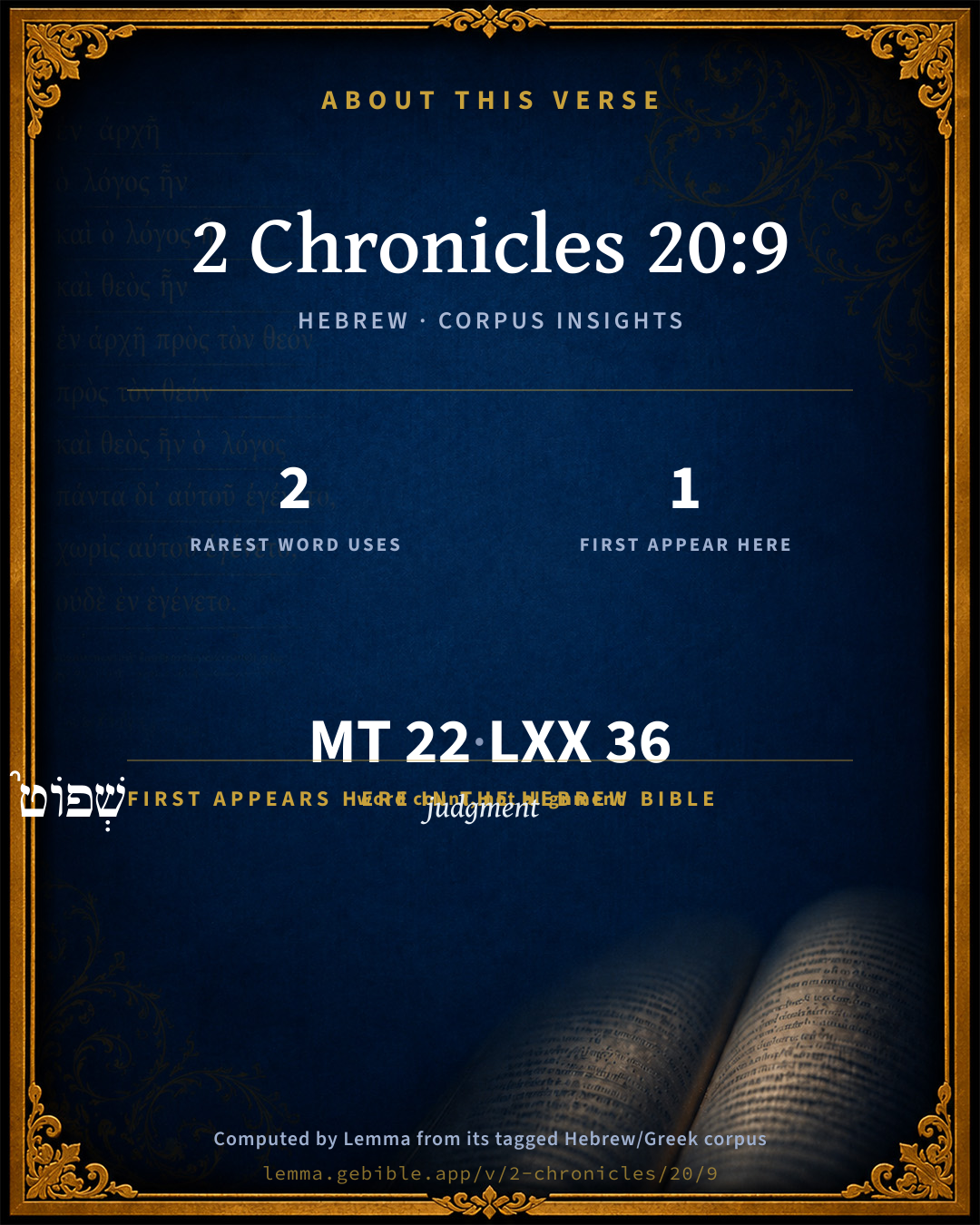
The rarest word here is שְׁפוֹט֮ judgment H8196 — appearing just 2 times in the whole Hebrew Bible.

First appearance in Scripture

This word makes its first canonical appearance in the Hebrew Bible here:

  • שְׁפוֹט֮ judgment H8196

Shared distinctive vocabulary

שְׁפוֹט֮ judgment H8196 occurs in 2 verses of the Hebrew Bible. Also found in:

Grammatical profile

  • 5 verbs
  • 11 nouns
  • 2 pronouns
  • 2 prepositions
  • 2 conjunctions

Verb forms

  • תָּב֨וֹא Qal · Imperfect
  • נַֽעַמְדָ֞ה Qal · Cohortative
  • וְנִזְעַ֥ק Qal · Imperfect
  • וְתִשְׁמַ֥ע Qal · Imperfect
  • וְתוֹשִֽׁיעַ Hiphil · Imperfect

Repetition

Words recur within this verse — often emphatic in Hebrew:

  • לִפְנֵ֨י face H6440 ×2
  • הַבַּ֤יִת house H1004 ×2
  • הַזֶּה֙ this H2088 ×2

Hebrew & Septuagint length

In English translation the verse runs 41 words from the Hebrew and 43 from the Septuagint (LXX English) — closely comparable.

A rough comparison of the two English renderings, which tokenize alike — not a word-level alignment.

Word counts can differ between the Hebrew and the Greek without any difference in meaning — e.g. the Hebrew direct-object marker אֵת has no separate Greek word, and Greek often adds the article ὁ.

In the original languages it is 22 Hebrew tokens and 36 Greek tokens — but the two are counted differently (Hebrew bundles its prefixes and suffixes into one token; the Greek is in lemma form), so that isn’t a like-for-like length.

Cross-references

7

Topical passages linked to 2 Chronicles 20:9 in the Treasury of Scripture Knowledge — connected by theme and wording, ordered by reader-vote popularity; previews shown in the World English Bible.

  • 2 Chronicles 6:28–30 If there be in the land famine, if there be pestilence, if there be blasting or mildew, locust or caterpillar; if their enemies besiege them in the land of their cities; whatever plague or whatever sickness there be;
  • 1 Kings 8:33 When your people Israel are struck down before the enemy, because they have sinned against you; if they turn again to you, and confess your name, and pray and make supplication to you in this house:
  • 2 Chronicles 6:20 that your eyes may be open toward this house day and night, even toward the place where you have said that you would put your name there; to listen to the prayer which your servant shall pray toward this place.
  • Exodus 20:24 You shall make an altar of earth for me, and shall sacrifice on it your burnt offerings and your peace-offerings, your sheep and your oxen. In every place where I record my name I will come to you and I will bless you.
  • 1 Kings 8:37 If there be in the land famine, if there be pestilence, if there be blasting [or] mildew, locust [or] caterpillar; if their enemy besiege them in the land of their cities; whatever plague, whatever sickness there be;
  • Matthew 18:20 For where two or three are gathered together in my name, there I am in the midst of them."
  • Exodus 23:21 Pay attention to him, and listen to his voice. Don't provoke him, for he will not pardon your disobedience, for my name is in him.

Cross-references courtesy of OpenBible.info (CC BY 4.0).

Hebrew and Greek witnesses Masoretic Hebrew ↔ Greek Septuagint

The same verse in the two great witnesses to the Old Testament, shown verse-for-verse.

These are two independent witnesses, not word-aligned to each other, and the Septuagint is shown in lemma (dictionary) form.

Hebrew 2 Chronicles 20:9 Masoretic · Westminster Leningrad Codex

אִם תָּב֨וֹא עָלֵ֜ינוּ רָעָ֗ה חֶרֶב֮ שְׁפוֹט֮ וְדֶ֣בֶר וְרָעָב֒ נַֽעַמְדָ֞ה לִפְנֵ֨י הַבַּ֤יִת הַזֶּה֙ וּלְפָנֶ֔יךָ כִּ֥י שִׁמְךָ֖ בַּבַּ֣יִת הַזֶּ֑ה וְנִזְעַ֥ק אֵלֶ֛יךָ מִצָּרָתֵ֖נוּ וְתִשְׁמַ֥ע וְתוֹשִֽׁיעַ

If evil come on us, the sword, judgment, or pestilence, or famine, we will stand before this house, and before you, (for your name is in this house), and cry to you in our affliction, and you will hear and save.

World English Bible · Public Domain

Greek LXX 2 Chronicles 20:9 Septuagint · lemma form

ἐάν ἐπιἔρχομαι ἐπί ἐγώ κακός ῥομφαία κρίσις θάνατος λιμός ἵστημι ἐναντίον ὁ οἶκος οὗτος καί ἐναντίον σύ ὅτι ὁ ὄνομα σύ ἐπί ὁ οἶκος οὗτος καί βοάω πρός σύ ἀπό ὁ θλῖψις καί ἀκούω καί σώζω

If there should come upon us evils, sword, judgment, pestilence, famine, we will stand before this house, and before you, (for your name is upon this house,) and we will cry to you because of the affliction, and you shall hear, and deliver.

LXX2012 (modern English Septuagint) · Public Domain

Hebrew: Westminster Leningrad Codex (CC BY 4.0). Greek: Septuagint (public domain); English from LXX2012 (modern English Septuagint) (Public Domain). How the Septuagint differs from the Hebrew →

Commentary

Notes on 2 Chronicles 20:9 from classic Christian and Jewish commentators (each source and its license shown beneath its notes). The classic Christian expositions comment on the surrounding passage and are grouped to its opening verse, so a note may address several verses; the Jewish commentaries on the Tanakh (Rashi and others) are per-verse, so they appear only where the commentator wrote on this verse.

Lemma curates 59 commentaries, every one of them public domain or Creative Commons licensed, each selected and text-cleaned for this edition rather than reprinted as found. About our sources →

Trapp's Complete Commentary

John Trapp

2Ch 20:9 If, [when] evil cometh upon us, [as] the sword, judgment, or pestilence, or famine, we stand before this house, and in thy presence, (for thy name [is] in this house,) and cry unto thee in our affliction, then thou wilt hear and help.

Ver. 9. If when evil cometh upon us, as the sword, &c.] Which is called "evil" by a specialty. "I make peace, and create evil," i.e., war. {Isa 45:7} It is here further called a judgment by a specialty.

For thy name is in this house.] And shall it be a mere name? wilt not thou afford us the true signs and effects of thy presence?

John Trapp, A Commentary or Exposition upon All the Books of the Old and New Testament (1647–1656) — public domain. Text from a community e-Sword module.

Geneva Bible (1599)

Geneva Bible translators

Meaning war which cometh by God’s just judgments for our sins.

That is, it is here called upon, and thou declarest thy presence and favor.

Geneva Bible (1599) marginal notes — public domain. Text via Bolls.life.

Adam Clarke's Commentary

Verse 9. For thy name is in this house] "Thy Majesty is in this house." Several of Kennicott's and De Rossi's MSS., with the Vulgate, Syriac, and Arabic, add נקרא nikra, "is invoked;" Thy name is invoked in this house - here thou dwellest, and here thou art worshipped.

Adam Clarke's Commentary on the Bible (1810–1826) — public domain. Text from a community e-Sword/MySword module.

Ellicott's Commentary for English Readers

(9) If when evil cometh upon us.—A summary of part of Solomon’s Prayer of Dedication (2Ch_6:24-30). The reference to this prayer implies a confidence that it had been accepted in heaven, as the sign that followed it indicated (2Ch_7:1-3). Syriac, “When the sanctuary is amongst us, there will not come upon us evil, nor sword, nor judgment, &c., and we will come and stand before this house, and before Thee, because Thy name is invoked in this house; and we will come and pray before Thee in this house and thou wilt hearken to the voice of our prayer, and deliver us.” The Hebrew seems to say, “If there come upon us evil—sword (judgment), and pestilence and famine—we will stand (i.e., come forward) before this house, and before Thee, for Thy name is in this house, and we will cry unto Thee out of our distress, and Thou shalt (or that Thou mayest) hear and save.” The word rendered “judgment” (shĕphôt) is not used as a noun anywhere else; and, lacking a conjunction, it spoils the symmetry of the sentence. It is probably an ancient gloss. All the versions have it; and the Vulg. renders, “sword of judgment.” (Comp. the Syriac in 2Ch_20:12, infra.)

A Bible Commentary for English Readers, edited by Charles John Ellicott (1878–1897) — public domain. Text from a community e-Sword module.

The Cambridge Bible for Schools and Colleges

gen. ed. J. J. S. Perowne

9. If, when evil cometh] R.V. If evil come.

as the sword, judgment] Omit as and render with R.V. mg. the sword of judgement (cp. Eze_14:17).

we stand before this house, and in thy presence] R.V. we will stand before this house, and before thee.

then thou wilt hear and help] R.V. and thou wilt hear and save.

The Cambridge Bible for Schools and Colleges (gen. ed. J. J. S. Perowne; Cambridge University Press, 1878–1918) — public domain. Text from a community e-Sword module.

John Gill's Exposition

If when evil cometh upon us,.... Any calamity:

as the sword, judgment, or pestilence, or famine, God's four sore judgments, if by "judgment" is meant wild beasts:

we stand before this house; in the court before the holy place, and holy of holies:

and in thy presence, for thy name is in this house; called upon in it, and it was called by his name, and in which he dwelt:

and cry unto thee in our affliction; as Solomon prayed at the dedication of it:

then thou wilt hear and help; as the Lord promised, see Kg1 8:33.

John Gill's Exposition of the Whole Bible (1746–1763) — public domain (CC PDM 1.0). Text via the HelloAO Bible API.

Haydock's Catholic Bible Commentary

Sword of. Prot. "as the sword, judgment, or," &c. Sept. "the sword, judgment, death, famine." All these are sent in punishment of sin. H. --- The sword of the enemy is a judgment of God. (M.

George Leo Haydock (1774–1849), Haydock's Catholic Family Bible and Commentary, 1859 edition — public domain. Excludes Psalms (Douay-Rheims chapter numbering differs from Protestant) and Deuterocanonical books (Catholic canon only).

Matthew Poole's English Annotations

The sword, judgment, or rather, the sword of judgment, or of vengeance, i.e. war, whereby thou judgest and punishest thy people for their sins. Compare Lev 26:25.

Matthew Poole's English Annotations on the Holy Bible (1683–1685) — public domain. Text from a community e-Sword/MySword module.

Rashi

Rabbi Shlomo Yitzchaki (Rashi)

and we shall cry out to You from our distress in the Temple.

and You will hear and save as Solomon prayed before You, and You promised him to do so, as is written (above 6:24): “And if Your people is struck down,” continuing with the entire chapter until (verse 30): “and forgive and give to each man according to his ways.” And the Lord accepted his prayer, as it is written (ibid. 7:12): “And the Lord appeared to Solomon, and said to him: I have heard your prayer,” continuing with the entire chapter until (ibid. verse 14) “and forgive their sin and heal their land.” Now I pray that You remember the promise which You promised him, and hear and save us from our enemies who are coming upon us.

Rashi on the Tanakh — English translations: “The Judaica Press complete Tanach with Rashi, translated by A. J. Rosenberg” (CC BY 4.0); “Pentateuch with Rashi's commentary by M. Rosenbaum and A.M. Silbermann, 1929-1934” (public domain); “The Metsudah Tanach series, Lakewood, N.J” (CC BY 4.0); and “The Book of Joshua, Metsudah Publications, 1997” (CC BY 4.0). Text via Sefaria.

Lesson kit

Teaching starters — assembled from the data on this page, not authored interpretation. Every prompt links to the verse data it draws on. Edit before teaching.

2 Chronicles, in the Historical, opens this verse with 22 words (19 distinct Hebrew lemmas). Its most distinctive word is shᵉphôwṭ (“judgment”). A historical commentator’s framing appears above. Read the whole chapter for the surrounding context.

Discussion questions

  1. The word shᵉphôwṭ carries the sense “judgment.” How does it shape the verse?
  2. This is the first place “judgment” appears in Scripture (first appears here). What does its debut here establish?
  3. How does Ezekiel 23:10, which shares the word «judgment», read alongside this verse?
  4. What does the repetition of “face” (2× in this one verse) do in this verse?
  5. The translations on this page render this verse differently — a whole-verse word diff, not a word-by-word alignment. What might account for the different wordings?
  6. «תָּב֨וֹא» is a Qal Imperfect verb. How does that grammatical form shape the action described?
  7. Compare how Trapp's Complete Commentary and Geneva Bible (1599) read this verse. Where do they agree or differ?

Things to notice

Reading settings

Reading text

Shown beneath each verse's original-language words.

Old Testament
Old Testament edition

Read the OT as the Masoretic Hebrew (MT) or the Greek Septuagint (LXX).

English shown for the Greek Septuagint (in the Hebrew ↔ Greek comparison).

Comparing translations? Open the Compare panel on any verse page to stack up to four side by side.