Genesis 27:40

Hebrew (Westminster Leningrad Codex) Genesis 27:40 appears in the Hebrew Old Testament. The text above is from the Westminster Leningrad Codex. Each word links to its Strong’s number, a concise gloss, and parsing drawn from the Open Scriptures Hebrew Bible morphology. Click any word for its full Brown-Driver-Briggs (BDB) entry.
Download image
Cite this verse

Genesis 27:40 (World English Bible). Public Domain. Lemma interlinear Bible study tool, https://lemma.gebible.app/v/genesis/27/40.

Show BibTeX & RIS
BibTeX
RIS
English Translation
By your sword will you live, and you will serve your brother. It will happen, when you will break loose, That you shall shake his yoke from off your neck."
World English Bible · Public Domain
Highlights
  • 3 first appearances in the Hebrew Bible
Full analysis ↓
Download a study sheet

One document with this verse’s original text, its word-by-word gloss line, the meaning frame, cross-references with their text, attributed commentary, and full source and license credits — printable, and it pastes into notes with its structure intact.

This verse Autodidact and up

Study sheet (.html) Plain text (.txt)

A passage Seminary Student

Up to 50 verses in one chapter. A passage sheet keeps up to 6 commentary sources and 12 cross-references per verse, in the order this page ranks them, and says so on the sheet whenever that leaves anything out. Ask for a single verse and you get the Autodidact verse sheet above.

Everything on this page stays free to read, with no account — the sheet is a download of what is already on screen, not access to it.

Want to remove ads? Support Godless Engineer
Compare translations 3

The same verse in 3 English versions, stacked beneath the original-language interlinear above. Click any original word for its lexicon entry.

Each is an independent rendering of the whole verse — the interlinear is not word-aligned to these translations.

Highlighted words mark where these versions differ — a whole-verse word diff, not a word-by-word alignment.

  • World English Bible Public Domain
    By your sword will you live, and you will serve your brother. It will happen, when you will break loose, That you shall shake his yoke from off your neck."
  • King James Version Public Domain
    And by thy sword shalt thou live, and shalt serve thy brother; and it shall come to pass when thou shalt have the dominion, that thou shalt break his yoke from off thy neck.
  • unfoldingWord Literal Text CC BY-SA 4.0
    And you will live by your sword, and you will serve your brother. But it will happen when you become restless, then you will break his yoke off of your neck.” Jacob Flees from Esau 27:41-28:5

unfoldingWord Literal Text — © unfoldingWord, licensed CC BY-SA 4.0. Word-aligned USFM3 via Door43 (git.door43.org/unfoldingWord/en_ult).

Versions to compare (up to 4)

3 of 4 selected

Show all 18 translations

Every available English version of this verse, each an independent rendering of the whole verse.

  • World English Bible Public Domain
    By your sword will you live, and you will serve your brother. It will happen, when you will break loose, That you shall shake his yoke from off your neck."
  • Berean Standard Bible Public Domain
    You shall live by the sword and serve your brother. But when you rebel, you will tear his yoke from your neck.”
  • Majority Standard Bible Public Domain
    You shall live by the sword and serve your brother. But when you rebel, you will tear his yoke from your neck.”
  • King James Version Public Domain
    And by thy sword shalt thou live, and shalt serve thy brother; and it shall come to pass when thou shalt have the dominion, that thou shalt break his yoke from off thy neck.
  • American Standard Version (1901) Public Domain
    And by thy sword shalt thou live, and thou shalt serve thy brother. And it shall come to pass, when thou shalt break loose, That thou shalt shake his yoke from off thy neck.
  • Revised Version (1885) Public Domain
    And by thy sword shalt thou live, and thou shalt serve thy brother; And it shall come to pass when thou shalt break loose, That thou shalt shake his yoke from off thy neck.
  • Geneva Bible (1599) Public Domain
    And by thy sword shalt thou liue, and shalt be thy brothers seruant. But it shall come to passe, when thou shalt get the masterie, that thou shalt breake his yoke from thy necke.
  • Douay-Rheims (1899) Public Domain
    Shall thy blessing be. Thou shalt live by the sword and shalt serve thy brother: and the time shall come, when thou shalt shake off and loose his yoke from thy neck.
  • Young's Literal Translation Public Domain
    and by thy sword dost thou live, and thy brother dost thou serve; and it hath come to pass when thou rulest, that thou hast broken his yoke from off thy neck.'
  • Literal Standard Version CC BY-SA 4.0
    and by your sword you live, and your brother serves you; and it has come to pass, when you rule, that you have broken his yoke from off your neck.”
  • Unlocked Literal Bible CC BY-SA 4.0
    By your sword you will live, and you will serve your brother. But when you rebel, you will shake his yoke from off your neck.”
  • unfoldingWord Literal Text CC BY-SA 4.0
    And you will live by your sword, and you will serve your brother. But it will happen when you become restless, then you will break his yoke off of your neck.” Jacob Flees from Esau 27:41-28:5
  • Darby Bible Public Domain
    And by thy sword shalt thou live; And thou shalt serve thy brother; And it shall come to pass when thou rovest about, That thou shalt break his yoke from off thy neck.
  • World Messianic Bible Public Domain
    You will live by your sword, and you will serve your brother. It will happen, when you will break loose, that you will shake his yoke from off your neck.”
  • Webster's Bible Public Domain
    And by thy sword shalt thou live, and shalt serve thy brother: and it shall come to pass when thou shalt have the dominion, that thou shalt break his yoke from off thy neck.
  • Free Bible Version CC BY-SA 4.0
    You will make a living by using your sword, and you will be your brother's servant. But when you rebel, you will throw off his yoke from your neck.”
  • Bible in Basic English Public Domain
    By your sword will you get your living and you will be your brother's servant; but when your power is increased his yoke will be broken from off your neck.
  • JPS Tanakh (1917) Public Domain
    And by thy sword shalt thou live, and thou shalt serve thy brother; and it shall come to pass when thou shalt break loose, that thou shalt shake his yoke from off thy neck.

Literal Standard Version (2020), Covenant Press — licensed CC BY-SA 4.0. Text via the HelloAO Bible API (eBible.org). Unlocked Literal Bible (unfoldingWord) — licensed CC BY-SA 4.0. Text via the HelloAO Bible API (eBible.org). unfoldingWord Literal Text — © unfoldingWord, licensed CC BY-SA 4.0. Word-aligned USFM3 via Door43 (git.door43.org/unfoldingWord/en_ult). Free Bible Version, Dr. Jonathan Gallagher — licensed CC BY-SA 4.0. Text via the HelloAO Bible API (eBible.org).

Word by word

More ways to search: Search by grammar → Find every occurrence → Compare this word →

Practice this passage: Drill this verse → Learn its vocabulary →

תָּרִ֔יד
rûwd
H7300
“to roam”
Verb, Hiphil, Imperfect, 2nd Person, Masculine, Singular
Part of Speech
Verb
Stem
Hiphil
Form
Imperfect
Person
2nd Person
Gender
Masculine
Number
Singular
Full BDB Definition

Origin: a primitive root

TWOT: 2129

to wander restlessly, roam - (Qal) to roam - (Hiphil) to be restless, show restlessness
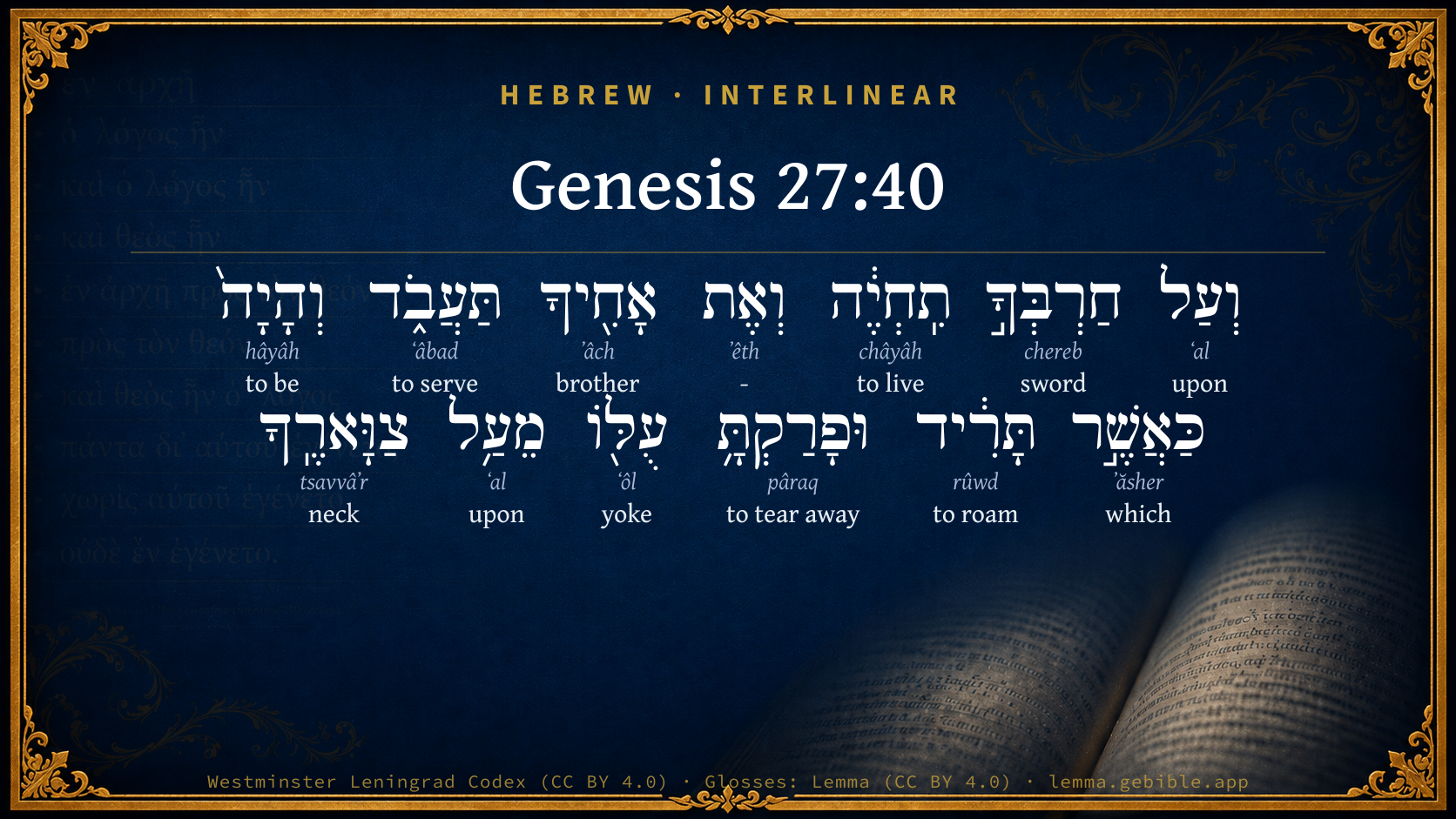
  1. וְעַל ʻal H5921 “and · upon” Conjunction + Preposition
  2. חַרְבְּךָ֣ chereb H2719 “sword · your” Noun, Common, Feminine, Singular, Construct + Suffix, Personal, 2nd Person, Masculine, Singular
  3. תִֽחְיֶ֔ה châyâh H2421 “to live” Verb, Qal, Imperfect, 2nd Person, Masculine, Singular
  4. וְאֶת ʼêth H853 “and · -” Conjunction + Particle, Direct Object
  5. אָחִ֖יךָ ʼâch H251 “brother · your” Noun, Common, Masculine, Singular, Construct + Suffix, Personal, 2nd Person, Masculine, Singular
  6. תַּעֲבֹ֑ד ʻâbad H5647 “to serve” Verb, Qal, Imperfect, 2nd Person, Masculine, Singular
  7. וְהָיָה֙ hâyâh H1961 “and · to be” Conjunction + Verb, Qal, Sequential Perfect, 3rd Person, Masculine, Singular
  8. כַּאֲשֶׁ֣ר ʼăsher H834 “like/as · which” Preposition + Particle, Relative
  9. וּפָרַקְתָּ֥ pâraq H6561 “and · to tear away” Conjunction + Verb, Qal, Sequential Perfect, 2nd Person, Masculine, Singular
  10. עֻלּ֖וֹ ʻôl H5923 “yoke · his” Noun, Common, Masculine, Singular, Construct + Suffix, Personal, 3rd Person, Masculine, Singular
  11. מֵעַ֥ל ʻal H5921 “from · upon” Preposition + Preposition
  12. צַוָּארֶֽךָ tsavvâʼr H6677 “neck · your” Noun, Common, Masculine, Singular, Construct + Suffix, Personal, 2nd Person, Masculine, Singular

About this verse

These counts appear in no published source. They are computed here, from the morphology-tagged text and Lemma’s own curated glosses. What Lemma adds →

13
words
12
distinct lemmas
Pentateuch
section

Notable vocabulary

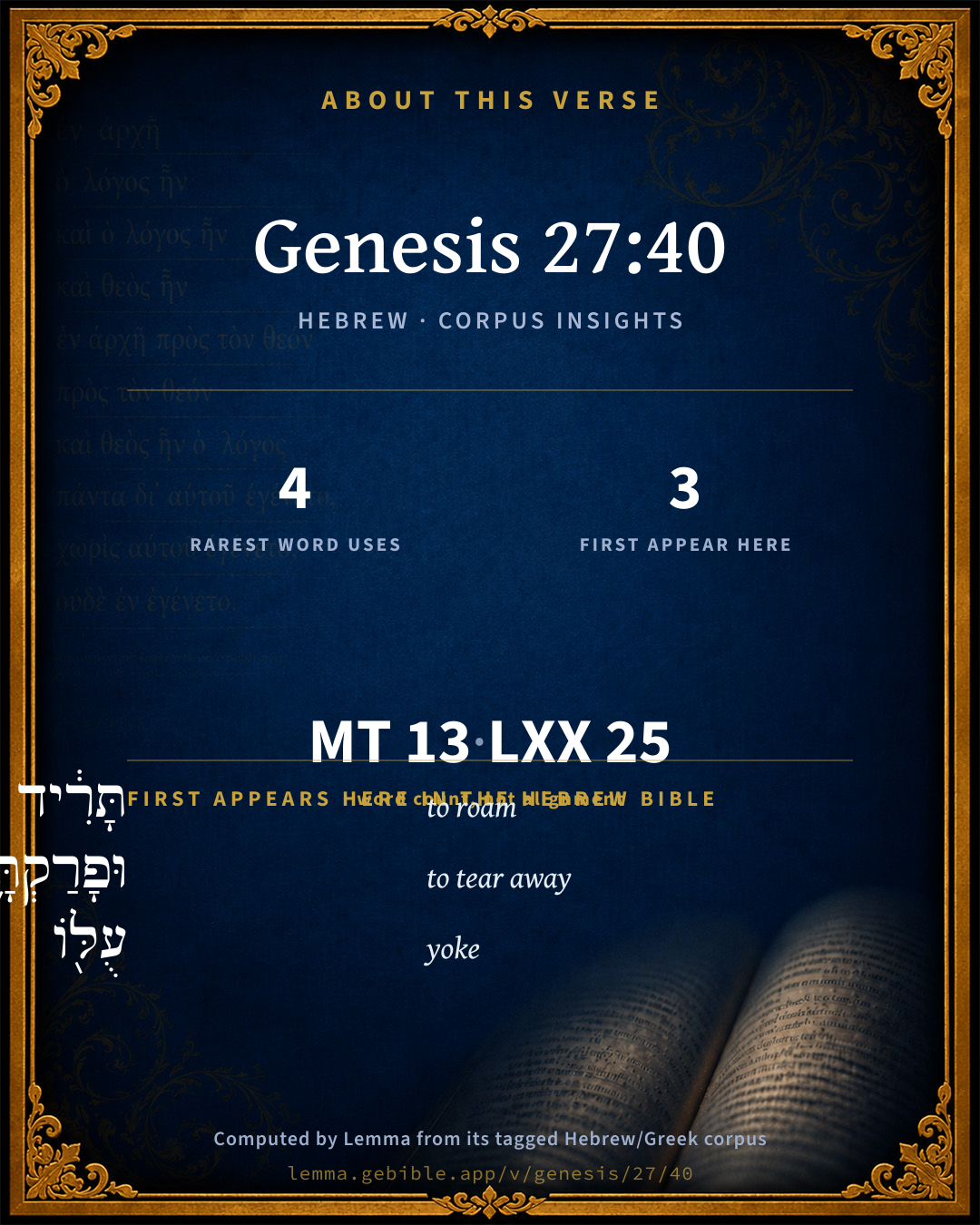
The rarest word here is תָּרִ֔יד to roam H7300 — appearing just 4 times in the whole Hebrew Bible.

First appearance in Scripture

These words make their first canonical appearance in the Hebrew Bible here:

  • תָּרִ֔יד to roam H7300
  • וּפָרַקְתָּ֥ to tear away H6561
  • עֻלּ֖וֹ yoke H5923

Shared distinctive vocabulary

תָּרִ֔יד to roam H7300 occurs in 4 verses of the Hebrew Bible. Also found in:

Grammatical profile

  • 5 verbs
  • 4 nouns
  • 2 prepositions
  • 2 particles

Verb forms

  • תִֽחְיֶ֔ה Qal · Imperfect
  • תַּעֲבֹ֑ד Qal · Imperfect
  • וְהָיָה֙ Qal · Sequential Perfect
  • תָּרִ֔יד Hiphil · Imperfect
  • וּפָרַקְתָּ֥ Qal · Sequential Perfect

Repetition

A word recurs within this verse — often emphatic in Hebrew:

  • וְעַל upon H5921 ×2

Hebrew & Septuagint length

In English translation the verse runs 30 words from the Hebrew and 30 from the Septuagint (LXX English) — the same length.

A rough comparison of the two English renderings, which tokenize alike — not a word-level alignment.

Word counts can differ between the Hebrew and the Greek without any difference in meaning — e.g. the Hebrew direct-object marker אֵת has no separate Greek word, and Greek often adds the article ὁ.

In the original languages it is 13 Hebrew tokens and 25 Greek tokens — but the two are counted differently (Hebrew bundles its prefixes and suffixes into one token; the Greek is in lemma form), so that isn’t a like-for-like length.

Cross-references

15

Topical passages linked to Genesis 27:40 in the Treasury of Scripture Knowledge — connected by theme and wording, ordered by reader-vote popularity; previews shown in the World English Bible.

  • 2 Kings 8:20–22 In his days Edom revolted from under the hand of Judah, and made a king over themselves.
  • Genesis 25:23 Yahweh said to her, Two nations are in your womb, Two peoples will be separated from your body. The one people will be stronger than the other people. The elder will serve the younger.
  • 2 Samuel 8:14 He put garrisons in Edom; throughout all Edom put he garrisons, and all the Edomites became servants to David. Yahweh gave victory to David wherever he went.
  • 2 Chronicles 25:11–12 Amaziah took courage, and led forth his people, and went to the Valley of Salt, and struck of the children of Seir ten thousand.
  • 2 Chronicles 21:8 In his days Edom revolted from under the hand of Judah, and made a king over themselves.
  • 2 Chronicles 21:10 So Edom revolted from under the hand of Judah to this day: then did Libnah revolt at the same time from under his hand, because he had forsaken Yahweh, the God of his fathers.
  • 2 Chronicles 28:17 For again the Edomites had come and struck Judah, and carried away captives.
  • Genesis 32:6 The messengers returned to Jacob, saying, "We came to your brother Esau. Not only that, but he comes to meet you, and four hundred men with him."
  • 1 Kings 11:15–17 For it happened, when David was in Edom, and Joab the captain of the host was gone up to bury the slain, and had struck every male in Edom
  • 2 Kings 14:7 He killed of Edom in the Valley of Salt ten thousand, and took Sela by war, and called the name of it Joktheel, to this day.
  • 2 Kings 14:10 You have indeed struck Edom, and your heart has lifted you up: glory of it, and abide at home; for why should you meddle to [your] hurt, that you should fall, even you, and Judah with you?
  • 1 Chronicles 18:11–13 These also did king David dedicate to Yahweh, with the silver and the gold that he carried away from all the nations; from Edom, and from Moab, and from the children of Ammon, and from the Philistines, and from Amalek.
  • Psalms 60:8 Moab is my wash basin. I will throw my shoe on Edom. I shout in triumph over Philistia."
  • Obadiah 1:17–21 But in Mount Zion, there will be those who escape, and it will be holy. The house of Jacob will possess their possessions.
  • Matthew 10:34 "Don't think that I came to send peace on the earth. I didn't come to send peace, but a sword.

Cross-references courtesy of OpenBible.info (CC BY 4.0).

Hebrew and Greek witnesses Masoretic Hebrew ↔ Greek Septuagint

The same verse in the two great witnesses to the Old Testament, shown verse-for-verse.

These are two independent witnesses, not word-aligned to each other, and the Septuagint is shown in lemma (dictionary) form.

Hebrew Genesis 27:40 Masoretic · Westminster Leningrad Codex

וְעַל חַרְבְּךָ֣ תִֽחְיֶ֔ה וְאֶת אָחִ֖יךָ תַּעֲבֹ֑ד וְהָיָה֙ כַּאֲשֶׁ֣ר תָּרִ֔יד וּפָרַקְתָּ֥ עֻלּ֖וֹ מֵעַ֥ל צַוָּארֶֽךָ

By your sword will you live, and you will serve your brother. It will happen, when you will break loose, That you shall shake his yoke from off your neck."

World English Bible · Public Domain

Greek LXX Genesis 27:40 Septuagint · lemma form

καί ἐπί ὁ μάχαιρα σύ ζάω καί ὁ ἀδελφός σύ δουλεύω εἰμί δέ ἡνίκα ἐάν κατααἱρέω καί ἐκλύω ὁ ζυγόν αὐτός ἀπό ὁ τράχηλος σύ

And you shall live by your sword, and shall serve your brother; and there shall be a time when you shall break and loosen his yoke from off your neck.

LXX2012 (modern English Septuagint) · Public Domain

On this verse, The Pulpit Commentary discusses the Septuagint’s reading. Read the note in Commentary ↓

Hebrew: Westminster Leningrad Codex (CC BY 4.0). Greek: Septuagint (public domain); English from LXX2012 (modern English Septuagint) (Public Domain). How the Septuagint differs from the Hebrew →

Targum (Aramaic paraphrase)

2

The Targum is the ancient Jewish Aramaic paraphrase of the Hebrew Scriptures — an interpretive translation, not the Hebrew text itself. Onkelos (literal) and Pseudo-Jonathan (expansive) render the Torah, and Jonathan the Prophets. Coverage is partial: where no permissively-licensed English translation exists for a verse, only the Aramaic is shown. This is verse-level text, not a word-by-word alignment to the Hebrew.

  1. Targum Onkelos Torah (Genesis–Deuteronomy)
    וְעַל חַרְבָּךְ תֵּיחֵי וְיָת אָחוּךְ תִּפְלָח וִיהֵי כַּד יַעְבְּרוּן בְּנוֹהִי עַל פִּתְגָּמֵי אוֹרַיְתָא וְתַעְדִּי נִירֵהּ מֵעַל צַוְרָךְ

    (no public-domain English translation for this verse)

    Targum Onkelos — Aramaic: “Onkelos Genesis” (public domain); “Onkelos Exodus” (public domain); “Onkelos Leviticus” (public domain); “Onkelos Numbers” (public domain); “Onkelos Deuteronomy” (public domain). English: “Sefaria Community Translation” (CC0 1.0 (public-domain dedication)); “J.W. Etheridge. The Targums of Onkelos and Jonathan Ben Uzziel on the Pentateuch. London: Longmans, Green, 1862” (public domain). Text via Sefaria.

  2. Targum Pseudo-Jonathan Torah (Genesis–Deuteronomy)
    וְעַל סַיְיפָךְ תְּהֵי רָחִיץ עָלִיל לְכָל אָתַר וּמַרְכִיךְ וְתָאִי וּלְאָחִיךְ תְּהֵי מִשְׁתַּעֲבֵּד וִיהֵי אִין רַשִׁיעִי וְתָחִית יַת בְּנוֹי מִלְמִיטַר פִּקוּדֵי אוֹרַיְיתָא בְּכֵן תְּהֵי פָּרִיק נִיר שִׁעְבּוּדֵיהּ מֵעַל צַוְורָךְ

    And upon thy sword shalt thou depend, entering at every place: yet thou shalt be supple and credulous, and be in subjection to thy brother; but it will be that when his sons become evil, and fall from keeping the commandments of the law, thou shalt break his yoke of servitude from off thy neck.

    Targum Pseudo-Jonathan — Aramaic: “Targum Jonathan on Genesis” (public domain); “Targum Jonathan on Exodus” (public domain); “Targum Jonathan on Leviticus” (public domain); “Targum Jonathan on Numbers” (public domain); “Targum Jonathan on Deuteronomy” (public domain). English: “The Targum of Jonathan ben Uzziel, trans. J. W. Etheridge, London, 1862” (public domain). Text via Sefaria.

Commentary

Notes on Genesis 27:40 from classic Christian and Jewish commentators (each source and its license shown beneath its notes). The classic Christian expositions comment on the surrounding passage and are grouped to its opening verse, so a note may address several verses; the Jewish commentaries on the Tanakh (Rashi and others) are per-verse, so they appear only where the commentator wrote on this verse.

Lemma curates 59 commentaries, every one of them public domain or Creative Commons licensed, each selected and text-cleaned for this edition rather than reprinted as found. About our sources →

Trapp's Complete Commentary

John Trapp

Gen 27:40 And by thy sword shalt thou live, and shalt serve thy brother; and it shall come to pass when thou shalt have the dominion, that thou shalt break his yoke from off thy neck.

Ver. 40. When thou shalt have the dominion.] Cum planxeris, saith Junius; when thou hast for some time undergone hard, troublesome, and lamentable servitude, the grief whereof thou dost greatly groan under; as in David’s time, {2Sa 8:14} who "cast his shoe over them". {Psa 60:8} The Sodomites, those worst of men, were the first that we find in Scripture brought in bondage to others. {Gen 14:4} When the Danes and other foreigners domineered in this kingdom, was it not a lamentable time? were not men’s dearest lives sold as cheap as sparrows were among the Jews, five for two farthings? Did we but live a while in Turkey, Persia, yea, or but in France, saith one, a dram of that liberty we yet enjoy, would be as precious as a drop of cold water would have been to the rich man in hell, when he was so grievously tormented with those flames. Take we heed, lest for the abuse of this sweet mercy, God send in the Midianites to thresh out our grain, the Assyrians to drink up our milk, to make a spoil of our cattle, {Jer 49:32} and to cause us to eat the bread of our souls in the peril of our lives, as our fathers did in Queen Mary’s days.

John Trapp, A Commentary or Exposition upon All the Books of the Old and New Testament (1647–1656) — public domain. Text from a community e-Sword module.

Geneva Bible (1599)

Geneva Bible translators

Because thine enemies shall be round about thee.

Which was fulfilled in his posterity the Idumeans: who were tributaries for a time to Israel, and after came to liberty.

Geneva Bible (1599) marginal notes — public domain. Text via Bolls.life.

Adam Clarke's Commentary

Verse 40. By thy sword shalt thou live] This does not absolutely mean that the Edomites should have constant wars; but that they should be of a fierce and warlike disposition, gaining their sustenance by hunting, and by predatory excursions upon the possessions of others. Bishop Newton speaks on this subject with his usual good sense and judgment: "The elder branch, it is here foretold, should delight more in war and violence, but yet should be subdued by the younger. By thy sword shalt thou live, and shalt serve thy brother. Esau might be said to live much by the sword; for he was a cunning hunter, a man of the field. He and his children got possession of Mount Seir by force and violence, expelling from thence the Horites, the former inhabitants. By what means they spread themselves farther among the Arabians is not known; but it appears that upon a sedition and separation several of the Edomites came and seized upon the south-west parts of Judea, during the Babylonish captivity, and settled there ever after. Before and after this they were almost continually at war with the Jews; upon every occasion they were ready to join with their enemies; and when Nebuchadnezzar besieged Jerusalem, they encouraged him utterly to destroy the city, saying, Rase it, rase it, even to the foundations thereof. Ps 137:7. And even long after they were subdued by the Jews, they retained the same martial spirit; for Josephus in his time gives them the character of 'a turbulent and disorderly nation, always erect to commotions, and rejoicing in changes; at the least adulation of those who beseech them, beginning war, and hasting to battles as to a feast.' And a little before the last siege of Jerusalem they came, at the entreaty of the Zealots, to assist them against the priests and people; and there, together with the Zealots, committed unheard-of cruelties, and barbarously murdered Annas, the high priest, from whose death Josephus dates the destruction of the city." See Dr. Dodd.

And - when thou shalt have the dominion] It is here foretold that there was to be a time when the elder was to have dominion and shake off the yoke of the younger. The word תריד tarid, which we translate have dominion, is rather of doubtful meaning, as it may be deduced from three different roots, ירד yarad, to descend, to be brought down or brought low; דרה radah, to obtain rule or have dominion; and רוד rud, to complain; meaning either that when reduced very low God would magnify his power in their behalf, and deliver them from the yoke of their brethren; or when they should be increased so as to venture to set up a king over them, or when they mourned for their transgressions, God would turn their captivity. The Jerusalem Targum gives the words the following turn: "When the sons of Jacob attend to the law and observe the precepts, they shall impose the yoke of servitude upon thy neck; but when they shall turn away themselves from studying the law and neglect the precepts, thou shalt break off the yoke of servitude from thy neck."

"It was David who imposed the yoke, and at that time the Jewish people observed the law; but the yoke was very galling to the Edomites from the first; and towards the end of Solomon's reign Hadad, the Edomite, of the blood royal, who had been carried into Egypt from his childhood, returned into his own country, and raised some disturbances, but was not able to recover his throne, his subjects being over-awed by the garrisons which David had placed among them; but in the reign of Jehoram, the son of Jehoshaphat king of Judah, the Edomites revolted from under the dominion of Judah, and made themselves a king. Jehoram made some attempts to subdue them again, but could not prevail; so the Edomites revolted from under the hand of Judah unto this day, 2Ch 21:8; 2Ch 21:10, and hereby this part of the prophecy was fulfilled about nine hundred years after it was delivered." See Bishop Newton.

"Thus," says Bishop Newton, "have we traced, in our notes on this and the xxvth chapter, the accomplishment of this prophecy from the beginning; and we find that the nation of the Edomites has at several times been conquered by and made tributary to the Jews, but never the nation of the Jews to the Edomites; and the Jews have been the more considerable people, more known in the world, and more famous in history. We know indeed little more of the history of the Edomites than as it is connected with that of the Jews; and where is the name or nation now? They were swallowed up and lost, partly among the Nabathean Arabs, and partly among the Jews; and the very name, as Dr. Prideaux has observed, was abolished and disused about the end of the first century of the Christian era. Thus were they rewarded for insulting and oppressing their brethren the Jews; and hereby other prophecies were fulfilled, viz., Jer 49:7, c. Eze 25:12. c. Joe 3:19; Am 1:11, c. and particularly Obadiah; for at this day we see the Jews subsisting as a distinct people, while Edom is no more, agreeably to the words of Obadiah, Ob 1:10: For thy violence against thy brother Jacob, in the return of his posterity from Egypt, shame shall cover thee, and thou shalt be cut off for ever. And again, Ob 1:18: There shall not be any remaining of the house of Esau, for the Lord hath spoken it. In what a most extensive and circumstantial manner has God fulfilled all these predictions! and what a proof is this of the Divine inspiration of the Pentateuch, and the omniscience of God!"

Adam Clarke's Commentary on the Bible (1810–1826) — public domain. Text from a community e-Sword/MySword module.

John Calvin's Commentaries

40. By thy sword shalt thou live, and shalt serve thy brother. It is to be observed that events are here predicted which were never fulfilled in the person of Esau; and therefore, that the prophecy is concerning things at that time far distant. For Jacob was so far from having obtained dominion over his brother, that on his return from Padan-aram, he suppliantly tendered him his obedience; and the breaking off of the yoke which Isaac here mentions, is referred to a very remote period. He is therefore relating the future condition of Esau’s posterity. And he says first, that they shall live by their sword: which words admit a twofold sense, either that, being surrounded by enemies, they shall pass a warlike and unquiet life; or that they shall be free, and their own masters. For there is no power to use the sword where there is no liberty. The former meaning seems the more suitable; namely, that God would limit his promise, lest Esau should be too much exalted: for nothing is more desirable than peace. The holy people also are warned that there will always be some enemies to infest them. This, however, is a very different thing from living by his own sword; which is as if he had said, that the sons of Esau, like robbers, should maintain their security by arms and violence, rather than by legitimate authority. A second limitation of the promise is, that though armed with the sword, he should still not escape subjection to his brother. For the Idumeans were, at length, made tributary to the chosen people; but the servitude was not long continued; because when the kingdoms were divided, the power by which they had held all their neighbors in subjection and fear, was cut off; yet the Lord would have the Idumeans brought into subjection for a short time, that he might furnish a visible demonstration of this prophecy. As to the rest of the time, the restless and unbridled liberty of Esau was more wretched than any state of subjection.

John Calvin's Commentaries (1540-1563) — public domain. Text from the Calvin Translation Society English edition (1840s-50s) via the Christian Classics Ethereal Library (ccel.org). Calvin's coverage is partial (roughly two-thirds of the Bible); uncommented books and verses are honest gaps, never fabricated. The 19th-century editor's footnotes and remarks are omitted so the notes are faithfully Calvin's own voice.

Ellicott's Commentary for English Readers

(40) When thou shalt have the dominion.—This rendering of a rare and difficult Hebrew word is scarcely more than a guess made by two or three ancient Jewish commentators. Its real meaning here, and in Jer_2:31, Hos_11:12, is to toss the yoke—be restless and unquiet. The prophecy of Edom’s subjection to his brother was literally fulfilled, as Idumæa was for ages a mere dependency upon Judah; but in the days first of Joram, and then of Ahaz, it revolted, and recovered its freedom. It was again conquered by Hyrcanus, the nephew of Judas Maccabaeus; nor was its subject condition altered by the fact that the dynasty of the Herods was of Edomite extraction. In troubled times, then, it broke the yoke from its neck; but generally Edom served his brother.

A Bible Commentary for English Readers, edited by Charles John Ellicott (1878–1897) — public domain. Text from a community e-Sword module.

The Cambridge Bible for Schools and Colleges

gen. ed. J. J. S. Perowne

40. by thy sword] The soil will not furnish means of subsistence. The life of marauders dwelling in mountain fastnesses is here depicted. They will raid their brother’s borders. They will cut off the merchants travelling with caravans and camels between the Red Sea and Syria.

thou shalt serve thy brother] Cf. Gen_25:23. The people of Edom were first subjugated by Israel in the reign of David. Cf. 2Sa_8:14.

break loose] Better, as Driver, “become restless.” The word in the original is obscure, being found elsewhere only in Psa_55:2, “restless”; Jer_2:31, “broken loose”; Hos_11:12 (R.V. marg. is yet unstedfast with). Probably the metaphor is that of an animal shaking itself free from restraint. The A.V. “shalt have dominion” is quite impossible. Dillmann, “when thou shalt make efforts, or strive,” as the Arabian and Ethiopian versions.

Lat. tempusque veniet, cum excutias et solvas jugum ejus.

shake … neck] The metaphor is that of the bull refusing the yoke. Edom successfully threw off the yoke of the kingdom of Judah in the reigns of Jehoram, 2Ki_8:20-22, and Ahaz, 2Ki_16:6. But freedom from the dominion of Israel was followed by submission to Assyria. Edom appears among those who paid tribute to the Assyrian king Tiglath-Pileser III (731 b.c.), the Pul of 2Ki_15:19-20.

The Cambridge Bible for Schools and Colleges (gen. ed. J. J. S. Perowne; Cambridge University Press, 1878–1918) — public domain. Text from a community e-Sword module.

John Gill's Exposition

And by thy sword shalt thou live,.... By what he could get by it; his land being so poor that he could not live upon it, but must be obliged to such methods for a livelihood; or his country being surrounded with enemies, his posterity would be obliged to defend themselves by the sword, and other weapons of war:

and shalt serve thy brother; which is the sense and language of the oracle, Gen 25:23; and which Isaac perhaps now remembered, and had a clear understanding of it, and delivers out his prophetic blessing agreeably to it:

and it shall come to pass, when thou shalt have the dominion; not over the Israelites, the posterity of Jacob, which the Edomites, Esau's posterity, never had; but when they should get a greater degree of strength, power, authority, and dominion in the world:

that thou shalt break his yoke from off thy neck; the Edomites should revolt from the posterity of Jacob, and shake off the yoke of bondage and subjection they had been long under; as they did in the times of Joram, king of Judah, and set up a king of their own, and continued in such a state of freedom a long time, see Kg2 8:20.

John Gill's Exposition of the Whole Bible (1746–1763) — public domain (CC PDM 1.0). Text via the HelloAO Bible API.

Haydock's Catholic Bible Commentary

Thy brother, in the reign of David, 2 Kings viii. 14, and of the Machabees. (Josephus, Antiquities xiii. 17.) --- Yoke. When the house of Juda shall rebel against the Lord, in the days of Joram, then the Idumeans shall regain their liberty for a time; (4 Kings viii. 20.) to be subdued again after 800 years by John Hyrcan, the high priest. (Haydock) --- All the blessing of Esau tends to confirm that already given to his brother; so that the apostle seems to have considered it unworthy of notice. (Calmet) --- Jacob, in the mean time, never asserted his dominion; but still called Esau his lord, (chap. xxxii. 4.) and behaved to him with the greatest deference. (Haydock) --- Yet the Idumeans always hated the Jews, and assisted Titus to destroy Jerusalem. (Josephus) (Tirinus)

George Leo Haydock (1774–1849), Haydock's Catholic Family Bible and Commentary, 1859 edition — public domain. Excludes Psalms (Douay-Rheims chapter numbering differs from Protestant) and Deuterocanonical books (Catholic canon only).

Matthew Poole's English Annotations

By thy sword shalt thou live; by violence and rapine, in an unquiet and military posture, troubling others, and forced to defend thyself. But this, as also the following clause, though spoken to Esau, was not fulfilled in him, but in his posterity the Edomites, whose history makes good this prophecy. Thus things spoken and promised to Abraham were fulfilled in his posterity, as Gen 12:3; 22:18.

When thou shalt have the dominion; when thou shalt grow potent. Some render the words thus, When thou shalt have mourned or groaned, as the same word is used Psa 55:2; when thou hast oppressed as long as I think fit.

Matthew Poole's English Annotations on the Holy Bible (1683–1685) — public domain. Text from a community e-Sword/MySword module.

Whedon's Commentary on the Bible

Daniel D. Whedon

40. By thy sword shalt thou live — By war and rapine. Here note how different from Jacob, whose source of support is abundance of grain and of sweet wine. Gen_27:28.

Shalt serve thy brother — This is not a blessing, but a confirmation of the prophecy already uttered over Jacob.

When thou shalt have the dominion — Rather, When thou shalt rove at large. Thus Gesenius, fittingly pointing to the roving character of the Edomites. Hengstenberg renders: when thou shakest; tossest thy head, like the wild ox. Either rendering more clearly sets forth the true thought than “when thou shalt have the dominion.” This was fulfilled in the days of Ahaz.

2Ki_16:6; 2Ch_28:17. The Edomites were, however, subsequently conquered by John Hyrcanus, and compelled to submit to circumcision. Josephus, Ant. 13:9, 1; 15:7, 9. But afterwards they succeeded in establishing that Idumaean dynasty of the Herods, which continued until the Jewish state was utterly overthrown by the destruction of Jerusalem by the Romans.

Daniel D. Whedon (gen. ed.), Commentary on the Old and New Testaments (1874–1909) — public domain. Text from a community e-Sword module.

The Pulpit Commentary

And by thy sword shalt thou live, literally, upon thy sword shalt thou be, i.e. thy maintenance shall depend on thy sword; a prediction that Esau s descendants should be a warlike and tumultuous people of predatory habits (cf. Josephus, B. 1., 4. 4)and shalt serve thy brother; a prediction afterwards fulfilled. (of 1Sa_14:47; 2Sa_8:14; 1Ki_11:16; 2Ki_14:7-10; 2Ch_20:22-25) and it shall come to pass when thou shalt have the dominion, that thou shalt break his yoke from off thy neck. The verb dWr, used of beasts which have broken the yoke and wander freely about (Gesenius, Furst), appear to hint at an incessant restlessness on the part of Edom while under Israel"s yoke which should eventually terminate in regaining their independence. The exact rendering of the clause is obscure, but perhaps means that when Edom should roam about as a freebooter (Lange), or should revolt (Alford), or should toss, shake, or struggle against the yoke (Vulgate, Keil, Hengstenberg, "Speaker"s Commentary), he should succeed. Other renderings are, when thou shalt bear rule (Kimchi), when thou shalt repent (Jarchi), when thou shalt be strong (Samaritan), when thou prevailest (Murphy), when thou shalt truly desire it (Kalisch), when thou shalt pull down (LXX); because thou art restless (Havernick).

The Pulpit Commentary (1880–1919), ed. H.D.M. Spence-Jones & Joseph S. Exell — public domain. Text from a community e-Sword module.

Rashi

Rabbi Shlomo Yitzchaki (Rashi)

ועל חרבך—The phrase is equivalent to בחרבך BY THY SWORD. The word על is sometimes used instead of the prefix ב, as (Ezekiel 33:26) “Ye stand by your sword (על חרבכם)”, which is the same as בחרבכם; (Exodus 6:26) “by their hosts (על צבאותם), which is the same as בצבאותם.

AND והיה כאשר תריד AND IT SHALL CAME TO PASS THAT WHEN THOU ROVEST ABOUT — The word תריד signifies grief, pain, as (Psalms 40:3) “I am distraught (אריד) in my complaint”. It means: when Israel will transgress the Torah and you will have reason to feel aggrieved with regard to the Blessings, ופרקת עלו וגו THEN THOU SHALT PULL HIS YOKE FROM OFF THY NECK (Genesis Rabbah 67:7).

Rashi on the Tanakh — English translations: “The Judaica Press complete Tanach with Rashi, translated by A. J. Rosenberg” (CC BY 4.0); “Pentateuch with Rashi's commentary by M. Rosenbaum and A.M. Silbermann, 1929-1934” (public domain); “The Metsudah Tanach series, Lakewood, N.J” (CC BY 4.0); and “The Book of Joshua, Metsudah Publications, 1997” (CC BY 4.0). Text via Sefaria.

Ramban (Nachmanides)

Rabbi Moshe ben Nachman (Ramban / Nachmanides)

AND ON THY SWORD (‘VE’AL CHARBECHA’) YOU SHALL LIVE. The meaning of ve’al charbecha is as if it were written, becharbecha (by thy sword). A similar case is the verse, For man does not live ‘al halechem’ (on bread) alone, which means belechem (by bread). Now the blessing is not that he live on the booty he takes from his enemies by the sword, for he has already given him of the fat places of the earth and of the dew of heaven by which he shall live. Instead, the purport of the blessing is that he survive his battles and be victorious, and not fall by the sword of an enemy. It is for this reason that immediately following this he said, And thou shall serve thy brother, meaning, “but you will not prevail over him. Instead, he will prevail over you.”

AND IT SHALL COME TO PASS WHEN THOU SHALL BREAK LOOSE in thy suffering on account of Jacob’s transgression, as is explained further on. THEN THOU SHALT SHAKE HIS YOKE FROM OFF THY NECK. This is an indication to Israel that they should not contend with the children of Esau too much in order to do them evil. This is what Scripture commanded: Take ye good heed, contend not with them, etc. And so did our Rabbis say: “For Joab and all Israel remained there six months, until he had cut off every male in Edom. The Holy One, blessed be He, said to David, ‘I said, Contend not with them, and you did contend. By your life, these six months will not accrue to you and your reign.’ We know this was fulfilled since it is written, And the days that David reigned over Israel were forty years, 2:11. but in truth he reigned six more months, as it is written, In Hebron he reigned over Judah seven years and six months.” for a total of forty years and six months. Yet he is credited with only forty years. The Rabbis also said, “The Holy One, blessed be He, said to David, ‘Thy hands are sharp and pointed, and I seek to rule my world with them, etc’”

Ramban (Nachmanides) on the Tanakh — English translation: “Commentary on the Torah by Ramban (Nachmanides). Translated and annotated by Charles B. Chavel. New York, Shilo Pub. House, 1971-1976” (CC BY 4.0). Text via Sefaria.

Radak

Rabbi David Kimhi (Radak)

ועל חרבך תחיה. This is the one blessing which will be exclusively yours, your ability to survive by means of your sword and the fear you will inspire in your enemies. They will fear your prowess in war.

ואת אחיך תעבוד, this too is a blessing as it is of benefit to you to serve your brother rather than to have to serve others.

והיה כאשר תריד, when the time comes when it is your turn to rule over him,

ופרקת עלו, and then you will not serve him as this (your shaking off his yoke) is his punishment for his sin

Radak on the Tanakh — English translations: “Sefaria Community Translation” (CC0 1.0 (public-domain dedication)); “Eliyahu Munk, HaChut Hameshulash” (CC BY 4.0); “Rabbi Mike Feuer, Jerusalem Anthology” (CC BY 4.0); and “R. David Kimhi on the first book of Psalms, Translated by R.G. Finch, London, 1919” (public domain). Text via Sefaria.

Lesson kit

Teaching starters — assembled from the data on this page, not authored interpretation. Every prompt links to the verse data it draws on. Edit before teaching.

Genesis, in the Pentateuch, opens this verse with 13 words (12 distinct Hebrew lemmas). Its most distinctive word is rûwd (“to roam”). A historical commentator’s framing appears above. Read the whole chapter for the surrounding context.

Discussion questions

  1. How does “to roam” (rûwd) shape what this verse is saying?
  2. 3 words make their first appearance in Scripture here. What does this debut establish?
  3. How does Psalms 55:2, which shares the word «to roam», read alongside this verse?
  4. What does the repetition of “upon” (2× in this one verse) do in this verse?
  5. These translations render this verse differently; the difference is in the English rendering, not the original. What questions does that raise?
  6. «תִֽחְיֶ֔ה» is a Qal Imperfect verb. How does that grammatical form shape the action described?
  7. Compare how Trapp's Complete Commentary and Geneva Bible (1599) read this verse. Where do they agree or differ?

Things to notice

Reading settings

Reading text

Shown beneath each verse's original-language words.

Old Testament
Old Testament edition

Read the OT as the Masoretic Hebrew (MT) or the Greek Septuagint (LXX).

English shown for the Greek Septuagint (in the Hebrew ↔ Greek comparison).

Comparing translations? Open the Compare panel on any verse page to stack up to four side by side.