
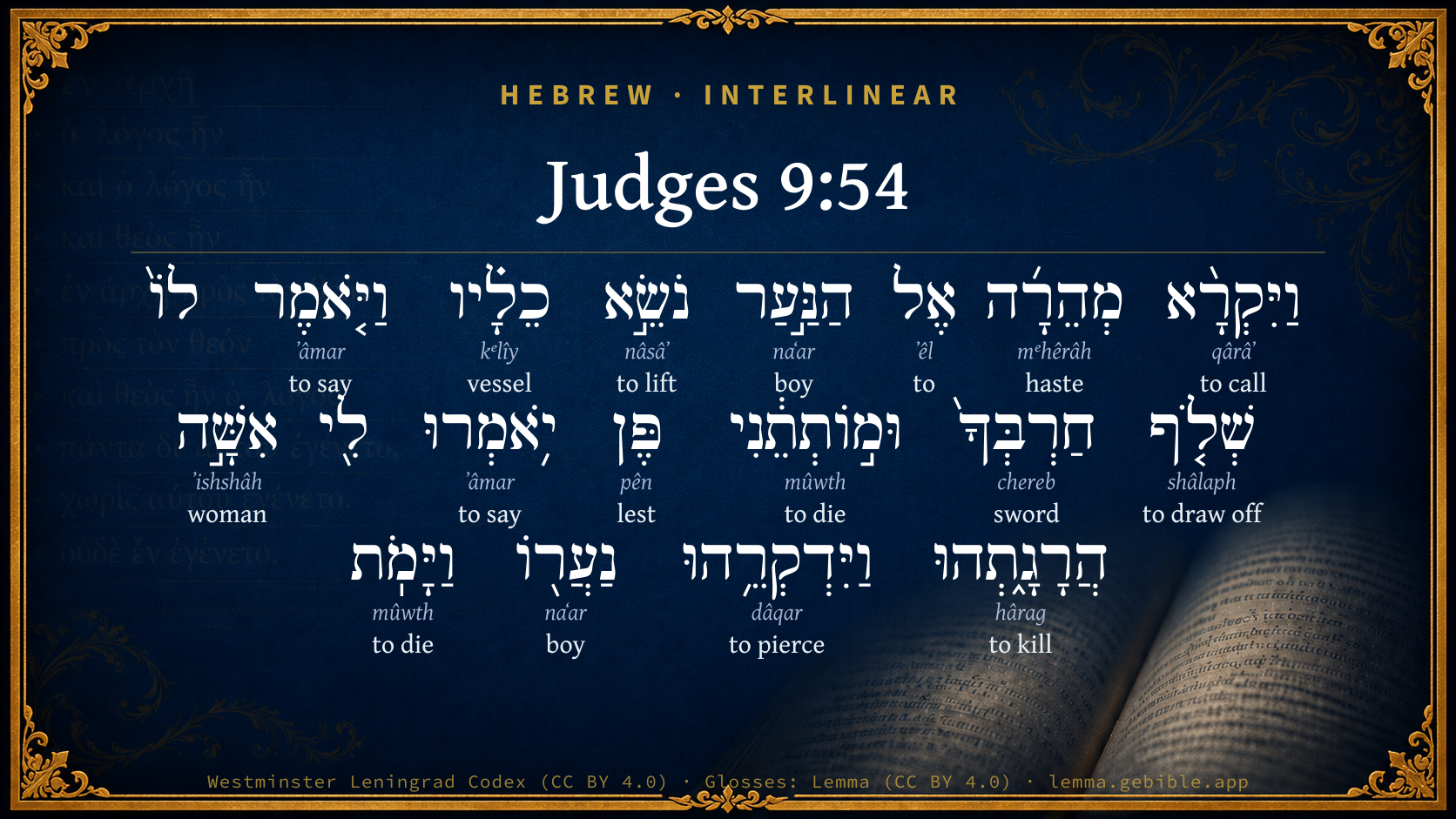
Judges 9:54

Hebrew (Westminster Leningrad Codex) Judges 9:54 appears in the Hebrew Old Testament. The text above is from the Westminster Leningrad Codex. Each word links to its Strong’s number, a concise gloss, and parsing drawn from the Open Scriptures Hebrew Bible morphology. Click any word for its full Brown-Driver-Briggs (BDB) entry.
Download image
Cite this verse

Judges 9:54 (World English Bible). Public Domain. Lemma interlinear Bible study tool, https://lemma.gebible.app/v/judges/9/54.

Show BibTeX & RIS
BibTeX
RIS
English Translation
Then he called hastily to the young man his armor bearer, and said to him, Draw your sword, and kill me, that men not say of me, A woman killed him. His young man thrust him through, and he died.
World English Bible · Public Domain
Download a study sheet

One document with this verse’s original text, its word-by-word gloss line, the meaning frame, cross-references with their text, attributed commentary, and full source and license credits — printable, and it pastes into notes with its structure intact.

This verse Autodidact and up

Study sheet (.html) Plain text (.txt)

A passage Seminary Student

Up to 50 verses in one chapter. A passage sheet keeps up to 6 commentary sources and 12 cross-references per verse, in the order this page ranks them, and says so on the sheet whenever that leaves anything out. Ask for a single verse and you get the Autodidact verse sheet above.

Everything on this page stays free to read, with no account — the sheet is a download of what is already on screen, not access to it.

Want to remove ads? Support Godless Engineer
Compare translations 3

The same verse in 3 English versions, stacked beneath the original-language interlinear above. Click any original word for its lexicon entry.

Each is an independent rendering of the whole verse — the interlinear is not word-aligned to these translations.

Highlighted words mark where these versions differ — a whole-verse word diff, not a word-by-word alignment.

  • World English Bible Public Domain
    Then he called hastily to the young man his armor bearer, and said to him, Draw your sword, and kill me, that men not say of me, A woman killed him. His young man thrust him through, and he died.
  • King James Version Public Domain
    Then he called hastily unto the young man his armourbearer, and said unto him, Draw thy sword, and slay me, that men say not of me, A women slew him. And his young man thrust him through, and he died.
  • unfoldingWord Literal Text CC BY-SA 4.0
    Then he cried hastily to the young man bearing his armor and said to him, “Draw your sword and kill me, lest they say about me, ‘A woman killed him.’” So his young man stabbed him, and he died.

unfoldingWord Literal Text — © unfoldingWord, licensed CC BY-SA 4.0. Word-aligned USFM3 via Door43 (git.door43.org/unfoldingWord/en_ult).

Versions to compare (up to 4)

3 of 4 selected

Show all 18 translations

Every available English version of this verse, each an independent rendering of the whole verse.

  • World English Bible Public Domain
    Then he called hastily to the young man his armor bearer, and said to him, Draw your sword, and kill me, that men not say of me, A woman killed him. His young man thrust him through, and he died.
  • Berean Standard Bible Public Domain
    He quickly called his armor-bearer, saying, “Draw your sword and kill me, lest they say of me, ‘A woman killed him.’” So Abimelech’s armor-bearer ran his sword through him, and he died.
  • Majority Standard Bible Public Domain
    He quickly called his armor-bearer, saying, “Draw your sword and kill me, lest they say of me, ‘A woman killed him.’” So Abimelech’s armor-bearer ran his sword through him, and he died.
  • King James Version Public Domain
    Then he called hastily unto the young man his armourbearer, and said unto him, Draw thy sword, and slay me, that men say not of me, A women slew him. And his young man thrust him through, and he died.
  • American Standard Version (1901) Public Domain
    Then he called hastily unto the young man his armorbearer, and said unto him, Draw thy sword, and kill me, that men say not of me, A woman slew him. And his young man thrust him through, and he died.
  • Revised Version (1885) Public Domain
    Then he called hastily unto the young man his armourbearer, and said unto him, Draw thy sword, and kill me, that men say not of me, A woman slew him. And his young man thrust him through, and he died.
  • Geneva Bible (1599) Public Domain
    Then Abimelech called hastily his page that bare his harneis, and sayde vnto him, Drawe thy sworde and slay me, that men say not of me, A woman slewe him. And his page thrust him thorowe, and he dyed.
  • Douay-Rheims (1899) Public Domain
    And he called hastily to his armourbearer, and said to him: Draw thy sword, and kill me: lest it should be said that I was slain by a woman. He did as he was commanded, and slew him.
  • Young's Literal Translation Public Domain
    and he calleth hastily unto the young man bearing his weapons, and saith to him, `Draw thy sword, and thou hast put me to death, lest they say of me -- A woman slew him;' and his young man pierced him through, and he dieth.
  • Literal Standard Version CC BY-SA 4.0
    and he calls quickly to the young man carrying his weapons and says to him, “Draw your sword, and you have put me to death, lest they say of me—A woman slew him”; and his young man pierced him through, and he dies.
  • Unlocked Literal Bible CC BY-SA 4.0
    Then he called urgently to the young man who was his armor-bearer, and said to him, “Draw your sword and kill me, so no one will say about me, 'A woman killed him.'” So his young man pierced him through, and he died.
  • unfoldingWord Literal Text CC BY-SA 4.0
    Then he cried hastily to the young man bearing his armor and said to him, “Draw your sword and kill me, lest they say about me, ‘A woman killed him.’” So his young man stabbed him, and he died.
  • Darby Bible Public Domain
    Then he called hastily to the young man his armor-bearer, and said to him, "Draw your sword and kill me, lest men say of me, 'A woman killed him.'" And his young man thrust him through, and he died.
  • World Messianic Bible Public Domain
    Then he called hastily to the young man, his armor bearer, and said to him, “Draw your sword and kill me, that men not say of me, ‘A woman killed him.’ His young man thrust him through, and he died.”
  • Webster's Bible Public Domain
    Then he called hastily to the young man his armor-bearer, and said to him, Draw thy sword, and slay me, that men say not of me, A woman slew him. And his young man thrust him through, and he died.
  • Free Bible Version CC BY-SA 4.0
    He quickly called the young man who carried his weapons, and ordered him, “Draw your sword and kill me, so they won't say about me that a woman killed him.” So the young man drove his sword through him, and he died.
  • Bible in Basic English Public Domain
    Then quickly crying out to his body-servant, he said to him, Take out your sword and put an end to me straight away, so that men may not say of me, His death was the work of a woman. So the young man put his sword through him, causing his death.
  • JPS Tanakh (1917) Public Domain
    Then he called hastily unto the young man his armour-bearer, and said unto him: 'Draw thy sword, and kill me, that men say not of me: A woman slew him.' And his young man thrust him through, and he died.

Literal Standard Version (2020), Covenant Press — licensed CC BY-SA 4.0. Text via the HelloAO Bible API (eBible.org). Unlocked Literal Bible (unfoldingWord) — licensed CC BY-SA 4.0. Text via the HelloAO Bible API (eBible.org). unfoldingWord Literal Text — © unfoldingWord, licensed CC BY-SA 4.0. Word-aligned USFM3 via Door43 (git.door43.org/unfoldingWord/en_ult). Free Bible Version, Dr. Jonathan Gallagher — licensed CC BY-SA 4.0. Text via the HelloAO Bible API (eBible.org).

Word by word

More ways to search: Search by grammar → Find every occurrence → Compare this word →

Practice this passage: Drill this verse → Learn its vocabulary →

וַיִּדְקְרֵ֥הוּ
dâqar
H1856
“and · to pierce · him”
Conjunction + Verb, Qal, Sequential Imperfect, 3rd Person, Masculine, Singular + Suffix, Personal, 3rd Person, Masculine, Singular
Part of Speech
Conjunction + Verb
Stem
Qal
Form
Sequential Imperfect
Person
3rd Person
Gender
Masculine
Number
Singular
Full BDB Definition

Origin: a primitive root

TWOT: 449

to pierce, thrust through, pierce through - (Qal) to pierce, run through - (Niphal) to be pierced through - (Pual) pierced, riddled (participle)
  1. וַיִּקְרָ֨א qârâʼ H7121 “and · to call” Conjunction + Verb, Qal, Sequential Imperfect, 3rd Person, Masculine, Singular
  2. מְהֵרָ֜ה mᵉhêrâh H4120 “haste” Noun, Common, Feminine, Singular, Absolute
  3. אֶל ʼêl H413 “to” Preposition
  4. הַנַּ֣עַר naʻar H5288 “the · boy” Particle, Definite Article + Noun, Common, Masculine, Singular, Absolute
  5. נֹשֵׂ֣א nâsâʼ H5375 “lifting” Verb, Qal, Participle Active, Masculine, Singular, Construct
  6. כֵלָ֗יו kᵉlîy H3627 “vessels · his” Noun, Common, Masculine, Plural, Construct + Suffix, Personal, 3rd Person, Masculine, Singular
  7. וַיֹּ֤אמֶר ʼâmar H559 “and · to say” Conjunction + Verb, Qal, Sequential Imperfect, 3rd Person, Masculine, Singular
  8. שְׁלֹ֤ף shâlaph H8025 “draw off” Verb, Qal, Imperative, 2nd Person, Masculine, Singular
  9. חַרְבְּךָ֙ chereb H2719 “sword · your” Noun, Common, Feminine, Singular, Construct + Suffix, Personal, 2nd Person, Masculine, Singular
  10. וּמ֣וֹתְתֵ֔נִי mûwth H4191 “and · die · me” Conjunction + Verb, Polel, Imperative, 2nd Person, Masculine, Singular + Suffix, Personal, 1st Person, Common, Singular
  11. פֶּן pên H6435 “lest” Conjunction
  12. יֹ֥אמְרוּ ʼâmar H559 “to say” Verb, Qal, Imperfect, 3rd Person, Masculine, Plural
  13. אִשָּׁ֣ה ʼishshâh H802 “woman” Noun, Common, Feminine, Singular, Absolute
  14. הֲרָגָ֑תְהוּ hârag H2026 “to kill · him” Verb, Qal, Perfect, 3rd Person, Feminine, Singular + Suffix, Personal, 3rd Person, Masculine, Singular
  15. נַעֲר֖וֹ naʻar H5288 “boy · his” Noun, Common, Masculine, Singular, Construct + Suffix, Personal, 3rd Person, Masculine, Singular
  16. וַיָּמֹֽת mûwth H4191 “and · to die” Conjunction + Verb, Qal, Sequential Imperfect, 3rd Person, Masculine, Singular

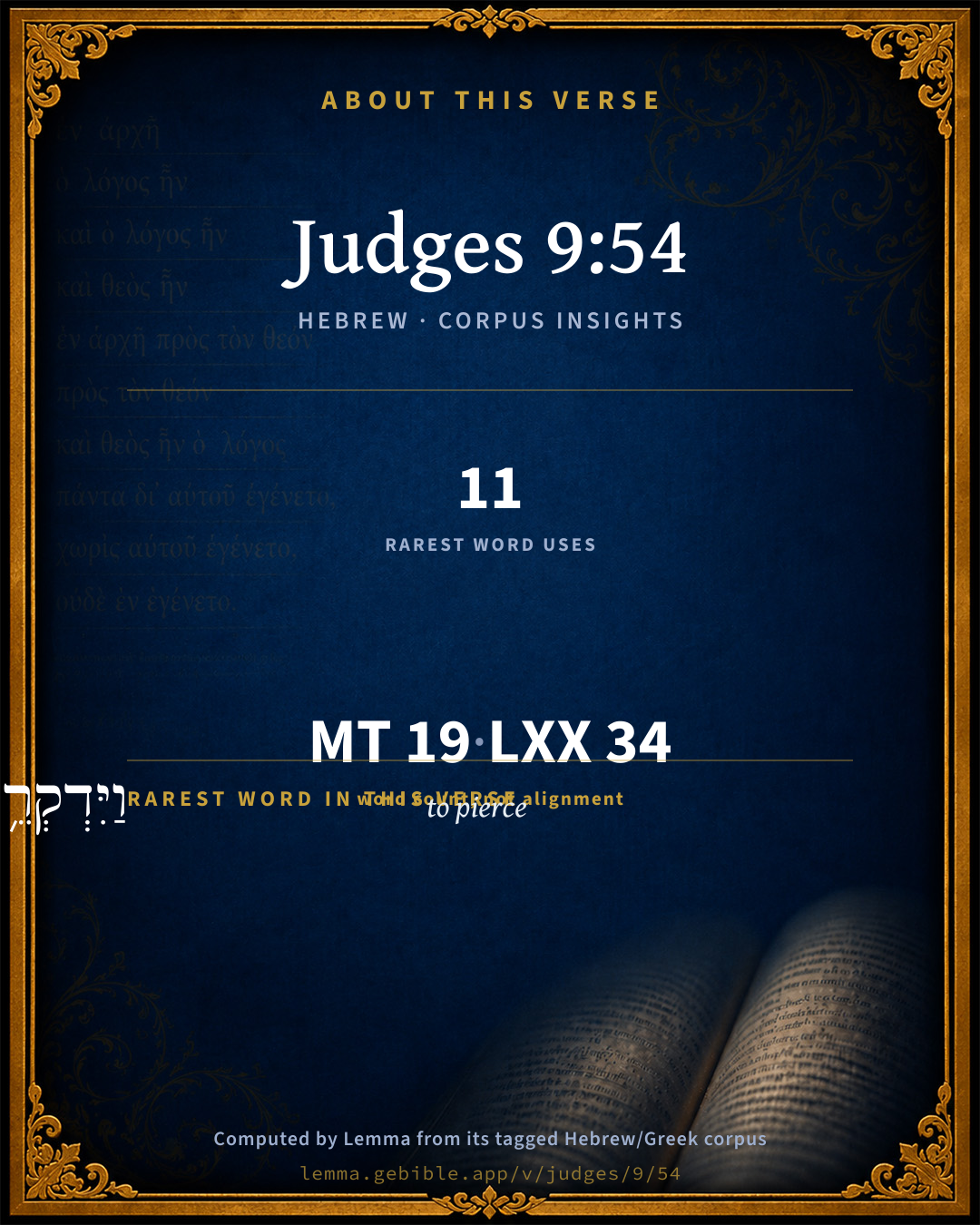
About this verse

These counts appear in no published source. They are computed here, from the morphology-tagged text and Lemma’s own curated glosses. What Lemma adds →

19
words
14
distinct lemmas
Historical
section

Notable vocabulary

The rarest word here is וַיִּדְקְרֵ֥הוּ to pierce H1856 — appearing just 11 times in the whole Hebrew Bible.

Shared distinctive vocabulary

וַיִּדְקְרֵ֥הוּ to pierce H1856 occurs in 10 verses of the Hebrew Bible. Also found in:

Grammatical profile

  • 9 verbs
  • 6 nouns
  • 3 prepositions
  • 1 conjunction

Verb forms

  • וַיִּקְרָ֨א Qal · Sequential Imperfect
  • נֹשֵׂ֣א Qal · Participle Active
  • וַיֹּ֤אמֶר Qal · Sequential Imperfect
  • שְׁלֹ֤ף Qal · Imperative
  • וּמ֣וֹתְתֵ֔נִי Polel · Imperative
  • יֹ֥אמְרוּ Qal · Imperfect
  • הֲרָגָ֑תְהוּ Qal · Perfect
  • וַיִּדְקְרֵ֥הוּ Qal · Sequential Imperfect
  • וַיָּמֹֽת Qal · Sequential Imperfect

Repetition

Words recur within this verse — often emphatic in Hebrew:

  • הַנַּ֣עַר boy H5288 ×2
  • וַיֹּ֤אמֶר to say H559 ×2
  • וּמ֣וֹתְתֵ֔נִי to die H4191 ×2

Hebrew & Septuagint length

In English translation the verse runs 40 words from the Hebrew and 42 from the Septuagint (LXX English) — closely comparable.

A rough comparison of the two English renderings, which tokenize alike — not a word-level alignment.

Word counts can differ between the Hebrew and the Greek without any difference in meaning — e.g. the Hebrew direct-object marker אֵת has no separate Greek word, and Greek often adds the article ὁ.

In the original languages it is 19 Hebrew tokens and 34 Greek tokens — but the two are counted differently (Hebrew bundles its prefixes and suffixes into one token; the Greek is in lemma form), so that isn’t a like-for-like length.

Cross-references

1

Topical passages linked to Judges 9:54 in the Treasury of Scripture Knowledge — connected by theme and wording, ordered by reader-vote popularity; previews shown in the World English Bible.

  • 1 Samuel 31:4–5 Then said Saul to his armor bearer, Draw your sword, and thrust me through therewith, lest these uncircumcised come and thrust me through, and abuse me. But his armor bearer would not; for he was sore afraid. Therefore Saul took his sword, and fell on it.

Cross-references courtesy of OpenBible.info (CC BY 4.0).

Hebrew and Greek witnesses Masoretic Hebrew ↔ Greek Septuagint

The same verse in the two great witnesses to the Old Testament, shown verse-for-verse.

These are two independent witnesses, not word-aligned to each other, and the Septuagint is shown in lemma (dictionary) form.

Hebrew Judges 9:54 Masoretic · Westminster Leningrad Codex

וַיִּקְרָ֨א מְהֵרָ֜ה אֶל הַנַּ֣עַר נֹשֵׂ֣א כֵלָ֗יו וַיֹּ֤אמֶר לוֹ֙ שְׁלֹ֤ף חַרְבְּךָ֙ וּמ֣וֹתְתֵ֔נִי פֶּן יֹ֥אמְרוּ לִ֖י אִשָּׁ֣ה הֲרָגָ֑תְהוּ וַיִּדְקְרֵ֥הוּ נַעֲר֖וֹ וַיָּמֹֽת

Then he called hastily to the young man his armor bearer, and said to him, Draw your sword, and kill me, that men not say of me, A woman killed him. His young man thrust him through, and he died.

World English Bible · Public Domain

Greek LXX Judges 9:54 Septuagint · lemma form

καί βοάω ταχύς πρός ὁ παιδάριον ὁ αἴρω ὁ σκεῦος αὐτός καί εἶπον αὐτός σπάω ὁ ῥομφαία ἐγώ καί θανατόω ἐγώ μήποτε εἶπον γυνή ἀποκτείνω αὐτός καί ἐκκεντέω αὐτός ὁ παιδάριον αὐτός καί ἀποθνήσκω

And he cried out quickly to the young man his armor-bearer, and said to him, Draw your sword, and kill me, lest at any time they should say, A woman killed him: and his young man thrust him through and he died.

LXX2012 (modern English Septuagint) · Public Domain

Hebrew: Westminster Leningrad Codex (CC BY 4.0). Greek: Septuagint (public domain); English from LXX2012 (modern English Septuagint) (Public Domain). How the Septuagint differs from the Hebrew →

Targum (Aramaic paraphrase)

1

The Targum is the ancient Jewish Aramaic paraphrase of the Hebrew Scriptures — an interpretive translation, not the Hebrew text itself. Onkelos (literal) and Pseudo-Jonathan (expansive) render the Torah, and Jonathan the Prophets. Coverage is partial: where no permissively-licensed English translation exists for a verse, only the Aramaic is shown. This is verse-level text, not a word-by-word alignment to the Hebrew.

  1. Targum Jonathan Prophets (Joshua–Malachi)
    וּקְרָא בִּפְרִיעַ לְעוּלֵימָא נָטִיל זְיָנֵיהּ וַאֲמַר לֵיהּ שְׁלוֹף חַרְבָּךְ וּקְטוֹלְנִי דִלְמָא יֵימְרוּן עָלֵי אִתְּתָא קְטַלְתֵּיהּ וְקַטְלֵיהּ עוּלֵימֵיהּ וּמִית:

    (no public-domain English translation for this verse)

    Targum Jonathan — Aramaic: “Mikraot Gedolot” (public domain). English: “Sefaria Community Translation” (CC0 1.0 (public-domain dedication)); “London "Chaldee Paraphrase," 1871” (public domain). Text via Sefaria.

Commentary

Notes on Judges 9:54 from classic Christian and Jewish commentators (each source and its license shown beneath its notes). The classic Christian expositions comment on the surrounding passage and are grouped to its opening verse, so a note may address several verses; the Jewish commentaries on the Tanakh (Rashi and others) are per-verse, so they appear only where the commentator wrote on this verse.

Lemma curates 59 commentaries, every one of them public domain or Creative Commons licensed, each selected and text-cleaned for this edition rather than reprinted as found. About our sources →

Trapp's Complete Commentary

John Trapp

Jdg 9:54 Then he called hastily unto the young man his armourbearer, and said unto him, Draw thy sword, and slay me, that men say not of me, A woman slew him. And his young man thrust him through, and he died.

Ver. 54. Then he called hastily unto the young man.] Exemplum pertinacis ambitionis et impaenitentiae. {a} A fearful example of a man who died in his sins, which is far worse than to die in a ditch, niggardly of his reputation, prodigal of his soul. Do we not sometimes see vain fools running wilfully into the field, into the grave, into hell? and all lest it should be said they have as much fear as wit.

And his young man thrust him through, and he died.] So there lay the greatness of Abimelech, "killed with death," as the phrase is in Rev 2:23. Of him it might be truly said, as it was afterwards of Pope Boniface VIII, that he entered like a fox, reigned as a lion, and died as a dog.

{a} Piscat.

John Trapp, A Commentary or Exposition upon All the Books of the Old and New Testament (1647–1656) — public domain. Text from a community e-Sword module.

Geneva Bible (1599)

Geneva Bible translators

Thus God by such miserable death taketh vengeance on tyrants even in this life.

Geneva Bible (1599) marginal notes — public domain. Text via Bolls.life.

Adam Clarke's Commentary

Verse 54. Draw thy sword, and slay me] It was a disgrace to be killed by a woman; on this account, Seneca the tragedian deplores the death of Hercules: -

O turpe fatum! femina Herculeae necis

Autor feritur.

HERC. OETAEUS, ver. 1177.

"O dishonourable fate! a woman is reported to

have been author of the death of Hercules."

Abimelech was also afraid that if he fell thus mortally wounded into the hands of his enemies they might treat him with cruelty and insult.

Adam Clarke's Commentary on the Bible (1810–1826) — public domain. Text from a community e-Sword/MySword module.

Ellicott's Commentary for English Readers

(54) A woman slew him.—He did not, however, escape the taunt (2Sa_11:21). We see also from the narrative of the death of Saul in 2Sa_1:9, 1Sa_31:4, how sensitive the ancients were about the manner of their death. The same feeling finds ample illustration in Homer and classic writers (Soph. Trach., 1,064). It was a similar feeling which made Deborah exult in the death of Sisera by the hand of a woman, and the Jews in the murder of Holofernes by Judith. It is remarkable that both of the first two Israelite kings die by suicide to avoid a death of greater shame.

A Bible Commentary for English Readers, edited by Charles John Ellicott (1878–1897) — public domain. Text from a community e-Sword module.

The Cambridge Bible for Schools and Colleges

gen. ed. J. J. S. Perowne

54. armourbearer] Cf. Jdg_7:10 f., 1Sa_31:4.

and kill me] and dispatch me, i.e. give the death stroke; cf. 1Sa_14:13; 1Sa_17:51, especially 2Sa_1:9 f. The first aspirant to kingship and the first real king in Israel met their deaths in the same way.

The Cambridge Bible for Schools and Colleges (gen. ed. J. J. S. Perowne; Cambridge University Press, 1878–1918) — public domain. Text from a community e-Sword module.

John Gill's Exposition

And when the men of Israel saw that Abimelech was dead,.... That is, those that were with him, the men of his army, who were all Israelites:

they departed every man to his place; disbanded themselves, and went everyone to their own home, and so the inhabitants of Thebez escaped the vengeance of Abimelech.

John Gill's Exposition of the Whole Bible (1746–1763) — public domain (CC PDM 1.0). Text via the HelloAO Bible API.

Haydock's Catholic Bible Commentary

Slew him. The ancient heroes were always attended by their armour-bearers. (Calmet) --- Marius ordered his servant to run him through, that he might not be exposed to the insults of his enemies; and V. Maximus (vi. 8,) greatly commends the servant for doing so. Nihil eorum pietati cedit, a quibus salus Dominorum protecta est. David was not of the same opinion, since he punished the Amalecite who pretended that he had rendered this service to Saul, 2 Kings i. 16. The Christian religion condemns both those who engage others to take away their life, and those who comply with the impious request. Hercules was affected in the same manner as Abimelech, when he found that he was to die by the malice of a woman. O turpe fatum! femina Herculeæ necis---Auctor feratur. (Seneca) --- The Lacedemonians were not eager to besiege Argos, when they saw that the women were engaged in its defence. (Pausan. ii.) (Calmet) --- Notwithstanding the wicked precaution of Abimelech, what he so much feared took place; for Joab said, Did not a woman cast a piece of a millstone upon him from the wall, and slay him in Thebes? (2 Kings xi. 21.) His skull was so much fractured, that he had received a mortal wound: the sword only hastened his death. Thus was he justly punished with a stone, who had slaughtered 68 or 69 of his brethren upon one stone. (Haydock) --- He can only be considered as an usurper or tyrant, since he was neither chosen by God nor by the Israelites in general. Hence he is only said to have reigned at Sichem. (Cornelius a Lapide) --- He was going to extend his conquests over other cities and tribes, when he was slain at Thebes. (Josephus) (Haydock)

George Leo Haydock (1774–1849), Haydock's Catholic Family Bible and Commentary, 1859 edition — public domain. Excludes Psalms (Douay-Rheims chapter numbering differs from Protestant) and Deuterocanonical books (Catholic canon only).

Matthew Poole's English Annotations

A woman slew him; which was esteemed a matter of disgrace.

Matthew Poole's English Annotations on the Holy Bible (1683–1685) — public domain. Text from a community e-Sword/MySword module.

Whedon's Commentary on the Bible

Daniel D. Whedon

54. A woman slew him — This was reckoned a terrible disgrace to a warrior. Like his next successor in Israelitish royalty, (1Sa_31:4,) he implored his armour-bearer to despatch him; but he did not thereby escape the dreaded ignominy, for the manner of his death was written in history, and long after familiarly associated with his memory. 2Sa_11:21. And thus was ultimately fulfilled the prophetic curse of Jotham.

“Much more beautiful is the otherwise tragical death of Saul. His attendant, influenced by reverence, refuses to kill him, and finally follows him in voluntary death. The songs of David celebrate Saul’s memory; but Abimelech’s epitaph is his brother Jotham’s curse.” — Cassel.

Daniel D. Whedon (gen. ed.), Commentary on the Old and New Testaments (1874–1909) — public domain. Text from a community e-Sword module.

The Pulpit Commentary

His armour-bearer an office of trust, entailing much intimacy. Saul loved David greatly, and he became his armor-bearer. (1Sa_16:21) Compare the similar incident of Saul and his armour-bearer 1Sa_31:4-6.

The Pulpit Commentary (1880–1919), ed. H.D.M. Spence-Jones & Joseph S. Exell — public domain. Text from a community e-Sword module.

John Wesley's Explanatory Notes

A women - Which was esteemed a matter of disgrace.

John Wesley, Explanatory Notes Upon the Whole Bible (1754–1765) — public domain. Text via the GEBible commentary corpus.

Rashi

Rabbi Shlomo Yitzchaki (Rashi)

Lest it be said of me. Lest it be said concerning me.

Rashi on the Tanakh — English translations: “The Judaica Press complete Tanach with Rashi, translated by A. J. Rosenberg” (CC BY 4.0); “Pentateuch with Rashi's commentary by M. Rosenbaum and A.M. Silbermann, 1929-1934” (public domain); “The Metsudah Tanach series, Lakewood, N.J” (CC BY 4.0); and “The Book of Joshua, Metsudah Publications, 1997” (CC BY 4.0). Text via Sefaria.

Lesson kit

Teaching starters — assembled from the data on this page, not authored interpretation. Every prompt links to the verse data it draws on. Edit before teaching.

Judges, in the Historical, opens this verse with 19 words (14 distinct Hebrew lemmas). Its most distinctive word is dâqar (“to pierce”). A historical commentator’s framing appears above. Read the whole chapter for the surrounding context.

Discussion questions

  1. How does “to pierce” (dâqar) shape what this verse is saying?
  2. Numbers 25:8 shares the word «to pierce» with this verse. How do the two illuminate each other?
  3. “boy” occurs 2× in this one verse. What is the effect of the repetition?
  4. The translations on this page render this verse differently — a whole-verse word diff, not a word-by-word alignment. What might account for the different wordings?
  5. The verb «וַיִּקְרָ֨א» is Qal Sequential Imperfect. How does its form color the action?
  6. Reading how Trapp's Complete Commentary and Geneva Bible (1599) read this verse, where do the two commentators agree and where do they part?

Things to notice

Reading settings

Reading text

Shown beneath each verse's original-language words.

Old Testament
Old Testament edition

Read the OT as the Masoretic Hebrew (MT) or the Greek Septuagint (LXX).

English shown for the Greek Septuagint (in the Hebrew ↔ Greek comparison).

Comparing translations? Open the Compare panel on any verse page to stack up to four side by side.