
1 Samuel 17:51

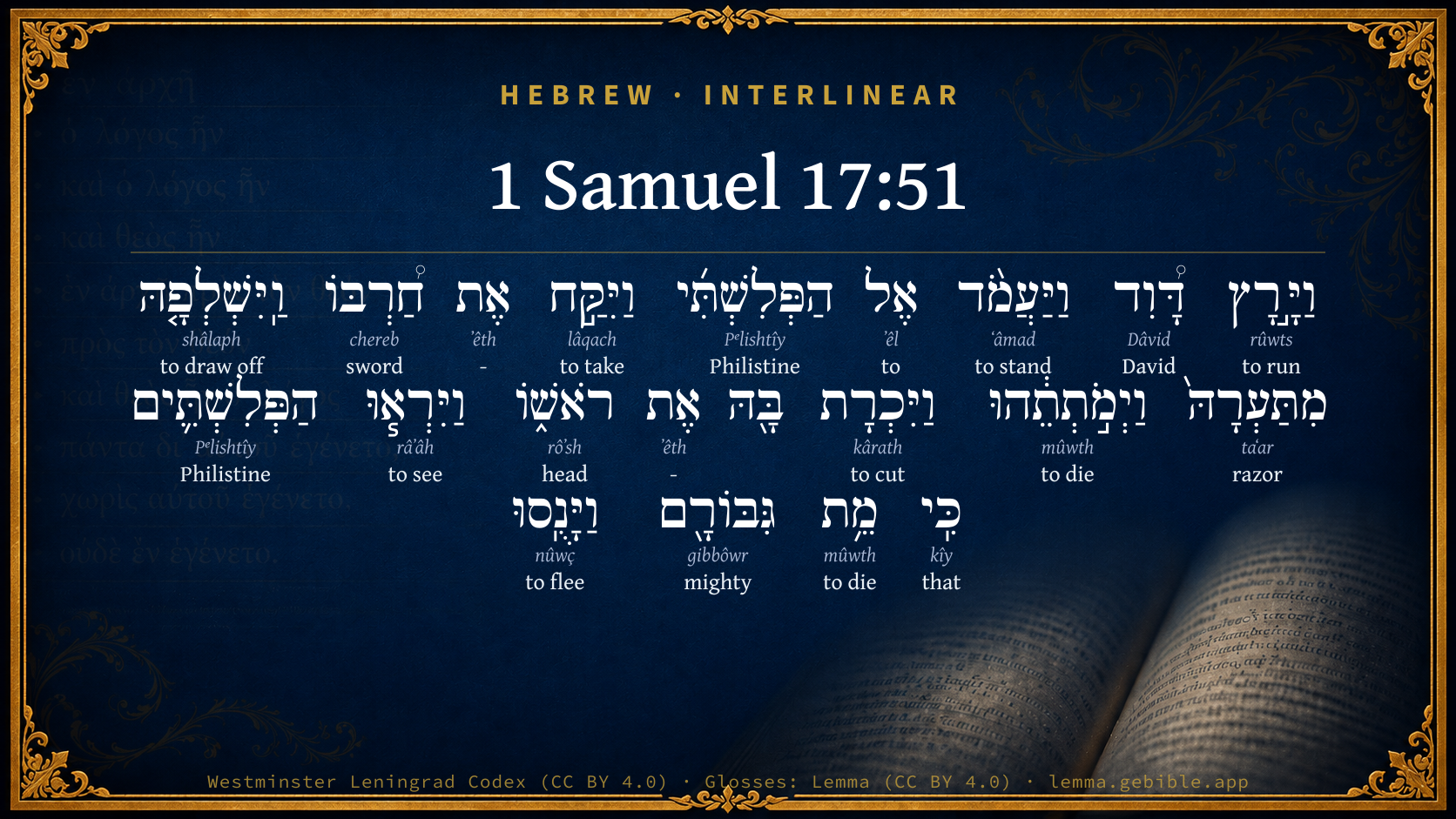
Hebrew (Westminster Leningrad Codex) 1 Samuel 17:51 appears in the Hebrew Old Testament. The text above is from the Westminster Leningrad Codex. Each word links to its Strong’s number, a concise gloss, and parsing drawn from the Open Scriptures Hebrew Bible morphology. Click any word for its full Brown-Driver-Briggs (BDB) entry.
Download image
Cite this verse

1 Samuel 17:51 (World English Bible). Public Domain. Lemma interlinear Bible study tool, https://lemma.gebible.app/v/1-samuel/17/51.

Show BibTeX & RIS
BibTeX
RIS
English Translation
Then David ran, and stood over the Philistine, and took his sword, and drew it out of the sheath of it, and killed him, and cut off his head therewith. When the Philistines saw that their champion was dead, they fled.
World English Bible · Public Domain
Download a study sheet

One document with this verse’s original text, its word-by-word gloss line, the meaning frame, cross-references with their text, attributed commentary, and full source and license credits — printable, and it pastes into notes with its structure intact.

This verse Autodidact and up

Study sheet (.html) Plain text (.txt)

A passage Seminary Student

Up to 50 verses in one chapter. A passage sheet keeps up to 6 commentary sources and 12 cross-references per verse, in the order this page ranks them, and says so on the sheet whenever that leaves anything out. Ask for a single verse and you get the Autodidact verse sheet above.

Everything on this page stays free to read, with no account — the sheet is a download of what is already on screen, not access to it.

Want to remove ads? Support Godless Engineer
Compare translations 3

The same verse in 3 English versions, stacked beneath the original-language interlinear above. Click any original word for its lexicon entry.

Each is an independent rendering of the whole verse — the interlinear is not word-aligned to these translations.

Highlighted words mark where these versions differ — a whole-verse word diff, not a word-by-word alignment.

  • World English Bible Public Domain
    Then David ran, and stood over the Philistine, and took his sword, and drew it out of the sheath of it, and killed him, and cut off his head therewith. When the Philistines saw that their champion was dead, they fled.
  • King James Version Public Domain
    Therefore David ran, and stood upon the Philistine, and took his sword, and drew it out of the sheath thereof, and slew him, and cut off his head therewith. And when the Philistines saw their champion was dead, they fled.
  • unfoldingWord Literal Text CC BY-SA 4.0
    But David ran and stood over the Philistine and took his sword and drew it from its sheath and killed him and cut off his head with it. And the Philistines saw that their warrior had died, and they fled.

unfoldingWord Literal Text — © unfoldingWord, licensed CC BY-SA 4.0. Word-aligned USFM3 via Door43 (git.door43.org/unfoldingWord/en_ult).

Versions to compare (up to 4)

3 of 4 selected

Show all 18 translations

Every available English version of this verse, each an independent rendering of the whole verse.

  • World English Bible Public Domain
    Then David ran, and stood over the Philistine, and took his sword, and drew it out of the sheath of it, and killed him, and cut off his head therewith. When the Philistines saw that their champion was dead, they fled.
  • Berean Standard Bible Public Domain
    David ran and stood over him. He grabbed the Philistine’s sword and pulled it from its sheath and killed him; and he cut off his head with the sword. When the Philistines saw that their hero was dead, they turned and ran.
  • Majority Standard Bible Public Domain
    David ran and stood over him. He grabbed the Philistine’s sword and pulled it from its sheath and killed him, and he cut off his head with the sword. When the Philistines saw that their hero was dead, they turned and ran.
  • King James Version Public Domain
    Therefore David ran, and stood upon the Philistine, and took his sword, and drew it out of the sheath thereof, and slew him, and cut off his head therewith. And when the Philistines saw their champion was dead, they fled.
  • American Standard Version (1901) Public Domain
    Then David ran, and stood over the Philistine, and took his sword, and drew it out of the sheath thereof, and slew him, and cut off his head therewith. And when the Philistines saw that their champion was dead, they fled.
  • Revised Version (1885) Public Domain
    Then David ran, and stood over the Philistine, and took his sword, and drew it out of the sheath thereof, and slew him, and cut off his head therewith. And when the Philistines saw that their champion was dead, they fled.
  • Geneva Bible (1599) Public Domain
    Then Dauid ranne, and stood vpon the Philistim, and tooke his sword and drew it out of his sheath, and slewe him, and cut off his head therewith. So whe the Philistims saw, that their champion was dead, they fled.
  • Douay-Rheims (1899) Public Domain
    He ran, and stood over the Philistine, and took his sword, and drew it out of the sheath, and slew him, and cut off his head. And the Philistines seeing that their champion was dead, fled away.
  • Young's Literal Translation Public Domain
    and David runneth and standeth over the Philistine, and taketh his sword, and draweth it out of its sheath, and putteth him to death, and cutteth off with it his head; and the Philistines see that their hero `is' dead, and flee.
  • Literal Standard Version CC BY-SA 4.0
    and David runs and stands over the Philistine, and takes his sword, and draws it out of its sheath, and puts him to death, and cuts off his head with it; and the Philistines see that their hero [is] dead, and flee.
  • Unlocked Literal Bible CC BY-SA 4.0
    Then David ran and stood over the Philistine and took his sword, drew it out of the sheath, killed him, and cut off his head with it. When the Philistines saw that their strong man was dead, they fled.
  • unfoldingWord Literal Text CC BY-SA 4.0
    But David ran and stood over the Philistine and took his sword and drew it from its sheath and killed him and cut off his head with it. And the Philistines saw that their warrior had died, and they fled.
  • Darby Bible Public Domain
    And David ran, and stood upon the Philistine, and took his sword, and drew it out of its sheath, and killed him completely, and cut off his head with it. And when the Philistines saw that their hero was dead, they fled.
  • World Messianic Bible Public Domain
    Then David ran, stood over the Philistine, took his sword, drew it out of its sheath, killed him, and cut off his head with it. When the Philistines saw that their champion was dead, they fled.
  • Webster's Bible Public Domain
    Therefore David ran and stood upon the Philistine, and took his sword, and drew it out of its sheath, and slew him, and cut off his head with it. And when the Philistines saw their champion was dead, they fled.
  • Free Bible Version CC BY-SA 4.0
    David ran and stood over the Philistine. He took the Philistine's sword and pulled it out of its sheath. He killed him and then he cut off his head with the sword. When the Philistines saw that their champion was dead, they turned and ran away.
  • Bible in Basic English Public Domain
    So running up to the Philistine and putting his foot on him, David took his sword out of its cover, and put him to death, cutting off his head with it. And when the Philistines saw that their fighter was dead, they went in flight.
  • JPS Tanakh (1917) Public Domain
    And David ran, and stood over the Philistine, and took his sword, and drew it out of the sheath thereof, and slew him, and cut off his head therewith. And when the Philistines saw that their mighty man was dead, they fled.

Literal Standard Version (2020), Covenant Press — licensed CC BY-SA 4.0. Text via the HelloAO Bible API (eBible.org). Unlocked Literal Bible (unfoldingWord) — licensed CC BY-SA 4.0. Text via the HelloAO Bible API (eBible.org). unfoldingWord Literal Text — © unfoldingWord, licensed CC BY-SA 4.0. Word-aligned USFM3 via Door43 (git.door43.org/unfoldingWord/en_ult). Free Bible Version, Dr. Jonathan Gallagher — licensed CC BY-SA 4.0. Text via the HelloAO Bible API (eBible.org).

Word by word

More ways to search: Search by grammar → Find every occurrence → Compare this word →

Practice this passage: Drill this verse → Learn its vocabulary →

מִתַּעְרָהּ֙
taʻar
H8593
“from · razor · her”
Preposition + Noun, Common, Both, Singular, Construct + Suffix, Personal, 3rd Person, Feminine, Singular
Part of Speech
Preposition + Noun
Type
Common
Gender
Both
Number
Singular
State
Construct
Full BDB Definition

Origin: from H6168

TWOT: 1692e

razor, sheath (making naked) - razor - sheath (of sword)
  1. וַיָּ֣רָץ rûwts H7323 “and · to run” Conjunction + Verb, Qal, Sequential Imperfect, 3rd Person, Masculine, Singular
  2. דָּ֠וִד Dâvid H1732 “David” Noun, Proper
  3. וַיַּעֲמֹ֨ד ʻâmad H5975 “and · to stand” Conjunction + Verb, Qal, Sequential Imperfect, 3rd Person, Masculine, Singular
  4. אֶל ʼêl H413 “to” Preposition
  5. הַפְּלִשְׁתִּ֜י Pᵉlishtîy H6430 “the · Philistine” Particle, Definite Article + Noun, Gentilic, Masculine, Singular, Absolute
  6. וַיִּקַּ֣ח lâqach H3947 “and · to take” Conjunction + Verb, Qal, Sequential Imperfect, 3rd Person, Masculine, Singular
  7. אֶת ʼêth H853 “-” Particle, Direct Object
  8. חַ֠רְבּוֹ chereb H2719 “sword · his” Noun, Common, Feminine, Singular, Construct + Suffix, Personal, 3rd Person, Masculine, Singular
  9. וַֽיִּשְׁלְפָ֤הּ shâlaph H8025 “and · to draw off · her” Conjunction + Verb, Qal, Sequential Imperfect, 3rd Person, Masculine, Singular + Suffix, Personal, 3rd Person, Feminine, Singular
  10. וַיְמֹ֣תְתֵ֔הוּ mûwth H4191 “and · to die · him” Conjunction + Verb, Polel, Sequential Imperfect, 3rd Person, Masculine, Singular + Suffix, Personal, 3rd Person, Masculine, Singular
  11. וַיִּכְרָת kârath H3772 “and · to cut” Conjunction + Verb, Qal, Sequential Imperfect, 3rd Person, Masculine, Singular
  12. אֶת ʼêth H853 “-” Particle, Direct Object
  13. רֹאשׁ֑וֹ rôʼsh H7218 “head · his” Noun, Common, Masculine, Singular, Construct + Suffix, Personal, 3rd Person, Masculine, Singular
  14. וַיִּרְא֧וּ râʼâh H7200 “and · to see” Conjunction + Verb, Qal, Sequential Imperfect, 3rd Person, Masculine, Plural
  15. הַפְּלִשְׁתִּ֛ים Pᵉlishtîy H6430 “the · Philistines” Particle, Definite Article + Noun, Gentilic, Masculine, Plural, Absolute
  16. כִּֽי kîy H3588 “that” Conjunction
  17. מֵ֥ת mûwth H4191 “to die” Verb, Qal, Perfect, 3rd Person, Masculine, Singular
  18. גִּבּוֹרָ֖ם gibbôwr H1368 “mighty · their” Adjective, Adjective, Masculine, Singular, Construct + Suffix, Personal, 3rd Person, Masculine, Plural
  19. וַיָּנֻֽסוּ nûwç H5127 “and · to flee” Conjunction + Verb, Qal, Sequential Imperfect, 3rd Person, Masculine, Plural

About this verse

These counts appear in no published source. They are computed here, from the morphology-tagged text and Lemma’s own curated glosses. What Lemma adds →

21
words
17
distinct lemmas
Historical
section

Notable vocabulary

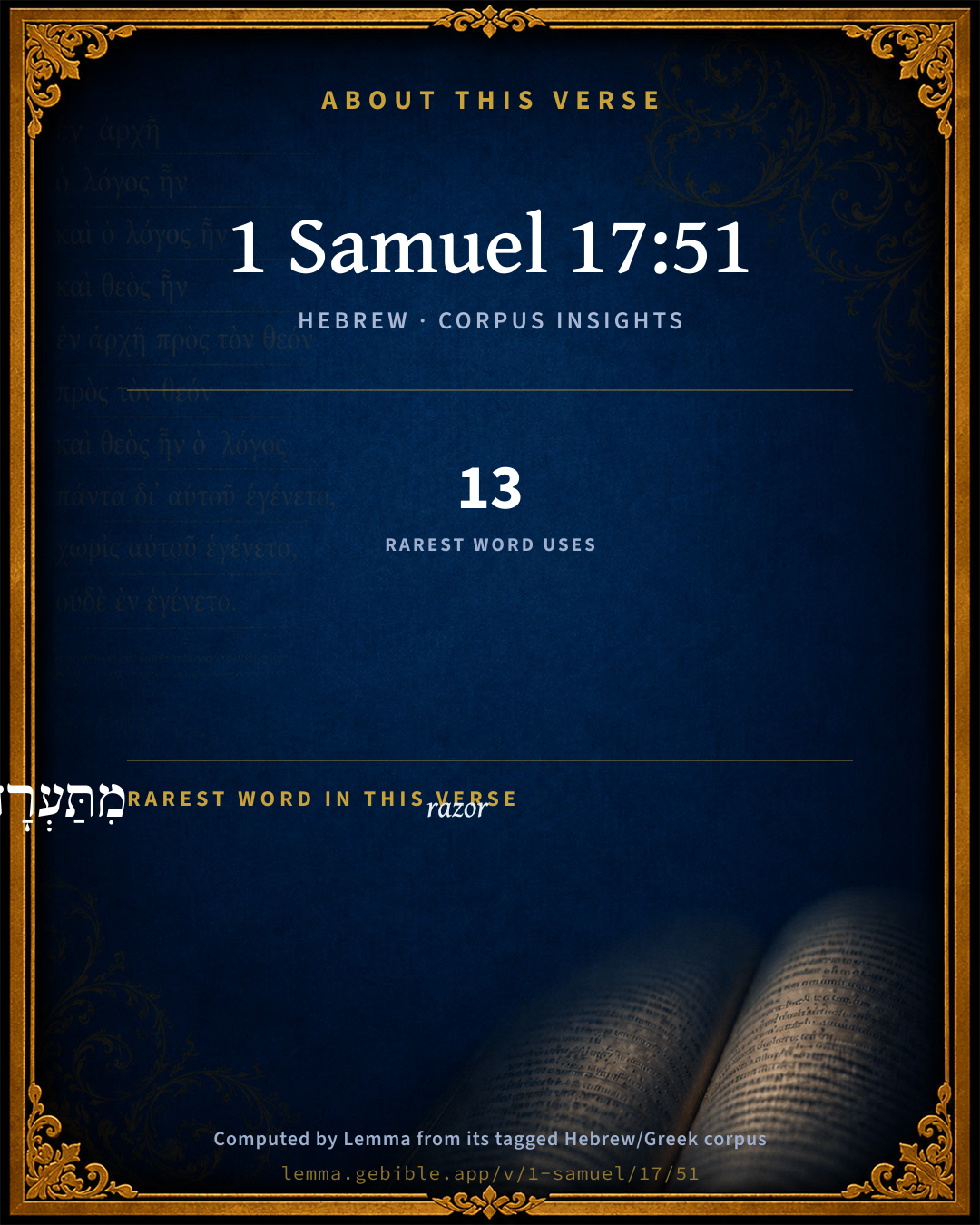
The rarest word here is מִתַּעְרָהּ֙ razor H8593 — appearing just 13 times in the whole Hebrew Bible.

Shared distinctive vocabulary

מִתַּעְרָהּ֙ razor H8593 occurs in 13 verses of the Hebrew Bible. Also found in:

Grammatical profile

  • 9 verbs
  • 6 nouns
  • 1 adjective
  • 2 prepositions
  • 1 conjunction
  • 2 particles

Verb forms

  • וַיָּ֣רָץ Qal · Sequential Imperfect
  • וַיַּעֲמֹ֨ד Qal · Sequential Imperfect
  • וַיִּקַּ֣ח Qal · Sequential Imperfect
  • וַֽיִּשְׁלְפָ֤הּ Qal · Sequential Imperfect
  • וַיְמֹ֣תְתֵ֔הוּ Polel · Sequential Imperfect
  • וַיִּכְרָת Qal · Sequential Imperfect
  • וַיִּרְא֧וּ Qal · Sequential Imperfect
  • מֵ֥ת Qal · Perfect
  • וַיָּנֻֽסוּ Qal · Sequential Imperfect

Repetition

Words recur within this verse — often emphatic in Hebrew:

  • הַפְּלִשְׁתִּ֜י Philistine H6430 ×2
  • וַיְמֹ֣תְתֵ֔הוּ to die H4191 ×2

Hebrew & Septuagint length

In English translation the verse runs 41 words from the Hebrew and 31 from the Septuagint (LXX English) — closely comparable.

A rough comparison of the two English renderings, which tokenize alike — not a word-level alignment.

Word counts can differ between the Hebrew and the Greek without any difference in meaning — e.g. the Hebrew direct-object marker אֵת has no separate Greek word, and Greek often adds the article ὁ.

Cross-references

6

Topical passages linked to 1 Samuel 17:51 in the Treasury of Scripture Knowledge — connected by theme and wording, ordered by reader-vote popularity; previews shown in the World English Bible.

  • 1 Samuel 21:9 The priest said, The sword of Goliath the Philistine, whom you killed in the valley of Elah, behold, it is here wrapped in a cloth behind the ephod: if you will take that, take it; for there is no other except that here. David said, There is none like that; give it me.
  • Hebrews 11:34 quenched the power of fire, escaped the edge of the sword, from weakness were made strong, grew mighty in war, and turned to flight armies of aliens.
  • 2 Samuel 23:21 He killed an Egyptian, a goodly man: and the Egyptian had a spear in his hand; but he went down to him with a staff, and plucked the spear out of the Egyptian's hand, and killed him with his own spear.
  • Esther 7:10 So they hanged Haman on the gallows that he had prepared for Mordecai. Then was the king's wrath pacified.
  • Psalms 7:15–16 He has dug a hole, And has fallen into the pit which he made.
  • Hebrews 2:14 Since then the children have shared in flesh and blood, he also himself in like manner partook of the same, that through death he might bring to nothing him who had the power of death, that is, the devil,

Cross-references courtesy of OpenBible.info (CC BY 4.0).

Hebrew and Greek witnesses Masoretic Hebrew ↔ Greek Septuagint

The same verse in the two great witnesses to the Old Testament, shown verse-for-verse.

These are two independent witnesses, not word-aligned to each other, and the Septuagint is shown in lemma (dictionary) form.

Hebrew 1 Samuel 17:51 Masoretic · Westminster Leningrad Codex

וַיָּ֣רָץ דָּ֠וִד וַיַּעֲמֹ֨ד אֶל הַפְּלִשְׁתִּ֜י וַיִּקַּ֣ח אֶת חַ֠רְבּוֹ וַֽיִּשְׁלְפָ֤הּ מִתַּעְרָהּ֙ וַיְמֹ֣תְתֵ֔הוּ וַיִּכְרָת בָּ֖הּ אֶת רֹאשׁ֑וֹ וַיִּרְא֧וּ הַפְּלִשְׁתִּ֛ים כִּֽי מֵ֥ת גִּבּוֹרָ֖ם וַיָּנֻֽסוּ

Then David ran, and stood over the Philistine, and took his sword, and drew it out of the sheath of it, and killed him, and cut off his head therewith. When the Philistines saw that their champion was dead, they fled.

World English Bible · Public Domain

Greek LXX 1 Samuel 17:51 Septuagint · lemma form
And David ran, and stood upon him, and took his sword, and killed him, and cut off his head: and the Philistines saw that their champion was dead, and they fled.

LXX2012 (modern English Septuagint) · Public Domain

Hebrew: Westminster Leningrad Codex (CC BY 4.0). Greek: Septuagint (public domain); English from LXX2012 (modern English Septuagint) (Public Domain). How the Septuagint differs from the Hebrew →

Targum (Aramaic paraphrase)

1

The Targum is the ancient Jewish Aramaic paraphrase of the Hebrew Scriptures — an interpretive translation, not the Hebrew text itself. Onkelos (literal) and Pseudo-Jonathan (expansive) render the Torah, and Jonathan the Prophets. Coverage is partial: where no permissively-licensed English translation exists for a verse, only the Aramaic is shown. This is verse-level text, not a word-by-word alignment to the Hebrew.

  1. Targum Jonathan Prophets (Joshua–Malachi)
    וּרְהַט דָוִד וְקָם עַל פְּלִשְׁתָּאָה וּנְסִיב יַת חַרְבֵּיהּ וְשַׁלְפָא מִנְדָנָהּ וְקַטְלֵיהּ וּפְסַק בֵּיהּ יַת רֵישֵׁיהּ וַחֲזוֹ פְּלִשְׁתָּאֵי אֲרֵי מִית גִבַּרְהוֹן וְאַפִּיכוּ:

    (no public-domain English translation for this verse)

    Targum Jonathan — Aramaic: “Mikraot Gedolot” (public domain). English: “Sefaria Community Translation” (CC0 1.0 (public-domain dedication)); “London "Chaldee Paraphrase," 1871” (public domain). Text via Sefaria.

Commentary

Notes on 1 Samuel 17:51 from classic Christian and Jewish commentators (each source and its license shown beneath its notes). The classic Christian expositions comment on the surrounding passage and are grouped to its opening verse, so a note may address several verses; the Jewish commentaries on the Tanakh (Rashi and others) are per-verse, so they appear only where the commentator wrote on this verse.

Lemma curates 59 commentaries, every one of them public domain or Creative Commons licensed, each selected and text-cleaned for this edition rather than reprinted as found. About our sources →

Trapp's Complete Commentary

John Trapp

1Sa 17:51 Therefore David ran, and stood upon the Philistine, and took his sword, and drew it out of the sheath thereof, and slew him, and cut off his head therewith. And when the Philistines saw their champion was dead, they fled.

Ver. 51. And cut off his head therewith.] Propriis pennis configimur, said Julian the apostate, when the Christians confuted the heathens by their own arts and authors. The Papists may say as much when we bring the canons, decrees, and testimonies of the Fathers against them. Learned Whitaker tells Campian - the Pope’s champion - very truly, Patres in maximis sunt nostri; in multis varii; in minimis, vestri. The Fathers are, mostly what, on our side.

And when the Philistines saw their champion was dead, they fled.] Facti sunt a corde suo fugitivi. {a} God struck them with terror, as he did also the Guisians after that their duke was slain by the command of the French king, Henry III; {b} and as, before that, the French army, at the battle of Terwin, being beaten by our Henry VIII, they fled away for fear of the English, that this conflict was called, The battle of Spurs. {c}

{a} Tertul.

{b} Hist. Gallic.

{c} Paul. Jov.

John Trapp, A Commentary or Exposition upon All the Books of the Old and New Testament (1647–1656) — public domain. Text from a community e-Sword module.

Joseph Benson's Commentary

1Sa 17:51. David took his sword — Hence it appears that David was not a little man, as many fancy, but a man of considerable bulk and strength, because he was able to manage a giant’s sword. The stone threw him down to the earth, and bereaved him of sense and motion; but there remained some life in him, which the sword took away, and so completed the work. God is greatly glorified when his proud enemies are cut off with their own sword.

Joseph Benson's Commentary on the Old and New Testaments (1811–1818) — public domain. Text from a community e-Sword module.

Jamieson, Fausset & Brown

Robert Jamieson, A. R. Fausset & David Brown

cut off his head--not as an evidence of the giant's death, for his slaughter had been effected in presence of the whole army, but as a trophy to be borne to Saul. The heads of slain enemies are always regarded in the East as the most welcome tokens of victory.

Jamieson, Fausset & Brown — Commentary Critical and Explanatory on the Whole Bible (1871) — public domain (CC PDM 1.0). Text via the HelloAO Bible API.

Adam Clarke's Commentary

Verse 51. When the Philistines saw their champion was dead, they fled.] They were panic-struck; and not being willing to fulfil the condition which was stipulated by Goliath, they precipitately left the field. The Israelites took a proper advantage of these circumstances, and totally routed their enemies.

Adam Clarke's Commentary on the Bible (1810–1826) — public domain. Text from a community e-Sword/MySword module.

Ellicott's Commentary for English Readers

(51) And when the Philistines saw their champion was dead, they fled.—The Philistines had agreed to consider this single combat as decisive. They had no fears as to its result, and when they saw their boasted champion fall they were seized with a sudden panic. Their adversaries, the children of Israel, on the other hand, seeing the unarmed shepherd boy with the head of the great warrior who had so long defied them in his hand, felt that the old power had come back to them, and that once more their Invisible King was with them, so they at once, with an irresistible shout, charged their dismayed foes, and the battle, as far as the Philistines were concerned, became a total rout.

A Bible Commentary for English Readers, edited by Charles John Ellicott (1878–1897) — public domain. Text from a community e-Sword module.

The Cambridge Bible for Schools and Colleges

gen. ed. J. J. S. Perowne

51. their champion] Their mighty man: a different word from that in 1Sa_17:4; 1Sa_17:23.

The Cambridge Bible for Schools and Colleges (gen. ed. J. J. S. Perowne; Cambridge University Press, 1878–1918) — public domain. Text from a community e-Sword module.

John Gill's Exposition

Therefore David ran and stood upon the Philistine,.... Upon his carcass, as it lay prostrate on the ground, and trampled on him, in just contempt of him who had defied, reproached, and despised the armies of Israel:

and took his sword, and drew it out of the sheath thereof; which no doubt was a very large one, and required a good deal of strength to unsheathe it, and use it; and therefore either David, though so very young, was naturally very strong, or he had at this time a more than ordinary measure of strength given him:

and slew him; for it seems that by the blow of the stone he was only stunned, and fell to the ground, but still had life in him, which David soon put an end to by his own sword:

and cut off his head therewith; by which it would appear to both armies looking on that his business was done, and he was thoroughly dispatched:

and when the Philistines saw their champion was dead; of which the cutting off his head was a demonstrative proof, and which they could discern at a distance:

they fled; being struck with a panic at this unexpected event, and no doubt by the Lord; for otherwise, had they given themselves the least time to reflect on their own numbers and strength, they had no just occasion to flee; their safety not depending on a single man, though ever so strong: upon this occasion David penned the ninth psalm; see Psa 9:1.

John Gill's Exposition of the Whole Bible (1746–1763) — public domain (CC PDM 1.0). Text via the HelloAO Bible API.

Albert Barnes' Notes on the Bible

Champion - Quite a different word from that so rendered in 1Sa 17:4, 1Sa 17:23; better “warrior.”

Albert Barnes' Notes on the Bible (1834–1885) — public domain. Text from a community e-Sword/MySword module.

Matthew Poole's English Annotations

David took his sword; hence it appears that David was not a little man, as many fancy; but a man of considerable bulk and strength, because he was able to manage a giant’s sword; which also he did, both here and below, 1Sa 21:9.

Slew him.

Quest. How could this be, when he slew him before with the stone? 1Sa 17:50.

Answ. There he gives a general account of the event of the battle, and of the giant’s death; but here he gives a particular relation of the manner and instrument of his death. The stone threw him down to the earth, and bereaved him of the use of his sense and motion; but there remained some life in him, (as frequently doth in such cases,) which the sword took away, and so completed the work.

Matthew Poole's English Annotations on the Holy Bible (1683–1685) — public domain. Text from a community e-Sword/MySword module.

John Wesley's Explanatory Notes

David took - Hence it appears, that David was not a little man, as many fancy; but a man of considerable bulk and strength, because he was able to manage a giant's sword. The stone threw him down to the earth, and bereaved him of sense and motion; but there remained some life in him, which the sword took away, and so compleated the work. God is greatly glorified, when his proud enemies are cut off with their own sword.

John Wesley, Explanatory Notes Upon the Whole Bible (1754–1765) — public domain. Text via the GEBible commentary corpus.

Lesson kit

Teaching starters — assembled from the data on this page, not authored interpretation. Every prompt links to the verse data it draws on. Edit before teaching.

1 Samuel, in the Historical, opens this verse with 21 words (17 distinct Hebrew lemmas). Its most distinctive word is taʻar (“razor”). A historical commentator’s framing appears above. Read the whole chapter for the surrounding context.

Discussion questions

  1. What does “razor” (taʻar) contribute to the verse as a whole?
  2. Numbers 6:5 shares the word «razor» with this verse. How do the two illuminate each other?
  3. “Philistine” occurs 2× in this one verse. What is the effect of the repetition?
  4. The translations on this page render this verse differently — a whole-verse word diff, not a word-by-word alignment. What might account for the different wordings?
  5. The verb «וַיָּ֣רָץ» is Qal Sequential Imperfect. How does its form color the action?
  6. Reading how Trapp's Complete Commentary and Joseph Benson's Commentary read this verse, where do the two commentators agree and where do they part?

Things to notice

Reading settings

Reading text

Shown beneath each verse's original-language words.

Old Testament
Old Testament edition

Read the OT as the Masoretic Hebrew (MT) or the Greek Septuagint (LXX).

English shown for the Greek Septuagint (in the Hebrew ↔ Greek comparison).

Comparing translations? Open the Compare panel on any verse page to stack up to four side by side.