Genesis 31:26

Hebrew (Westminster Leningrad Codex) Genesis 31:26 appears in the Hebrew Old Testament. The text above is from the Westminster Leningrad Codex. Each word links to its Strong’s number, a concise gloss, and parsing drawn from the Open Scriptures Hebrew Bible morphology. Click any word for its full Brown-Driver-Briggs (BDB) entry.
Download image
Cite this verse

Genesis 31:26 (World English Bible). Public Domain. Lemma interlinear Bible study tool, https://lemma.gebible.app/v/genesis/31/26.

Show BibTeX & RIS
BibTeX
RIS
English Translation
Laban said to Jacob, "What have you done, that you have deceived me, and carried away my daughters like captives of the sword?
World English Bible · Public Domain
Download a study sheet

One document with this verse’s original text, its word-by-word gloss line, the meaning frame, cross-references with their text, attributed commentary, and full source and license credits — printable, and it pastes into notes with its structure intact.

This verse Autodidact and up

Study sheet (.html) Plain text (.txt)

A passage Seminary Student

Up to 50 verses in one chapter. A passage sheet keeps up to 6 commentary sources and 12 cross-references per verse, in the order this page ranks them, and says so on the sheet whenever that leaves anything out. Ask for a single verse and you get the Autodidact verse sheet above.

Everything on this page stays free to read, with no account — the sheet is a download of what is already on screen, not access to it.

Want to remove ads? Support Godless Engineer
Compare translations 3

The same verse in 3 English versions, stacked beneath the original-language interlinear above. Click any original word for its lexicon entry.

Each is an independent rendering of the whole verse — the interlinear is not word-aligned to these translations.

Highlighted words mark where these versions differ — a whole-verse word diff, not a word-by-word alignment.

  • World English Bible Public Domain
    Laban said to Jacob, "What have you done, that you have deceived me, and carried away my daughters like captives of the sword?
  • King James Version Public Domain
    And Laban said to Jacob, What hast thou done, that thou hast stolen away unawares to me, and carried away my daughters, as captives taken with the sword?
  • unfoldingWord Literal Text CC BY-SA 4.0
    Then Laban said to Jacob, “What have you done? And you have stolen my heart and carried away my daughters like captives of the sword!

unfoldingWord Literal Text — © unfoldingWord, licensed CC BY-SA 4.0. Word-aligned USFM3 via Door43 (git.door43.org/unfoldingWord/en_ult).

Versions to compare (up to 4)

3 of 4 selected

Show all 18 translations

Every available English version of this verse, each an independent rendering of the whole verse.

  • World English Bible Public Domain
    Laban said to Jacob, "What have you done, that you have deceived me, and carried away my daughters like captives of the sword?
  • Berean Standard Bible Public Domain
    Then Laban said to Jacob, “What have you done? You have deceived me and carried off my daughters like captives of war!
  • Majority Standard Bible Public Domain
    Then Laban said to Jacob, “What have you done? You have deceived me and carried off my daughters like captives of war!
  • King James Version Public Domain
    And Laban said to Jacob, What hast thou done, that thou hast stolen away unawares to me, and carried away my daughters, as captives taken with the sword?
  • American Standard Version (1901) Public Domain
    And Laban said to Jacob, What hast thou done, that thou hast stolen away unawares to me, and carried away my daughters as captives of the sword?
  • Revised Version (1885) Public Domain
    And Laban said to Jacob, What hast thou done, that thou hast stolen away unawares to me, and carried away my daughters as captives of the sword?
  • Geneva Bible (1599) Public Domain
    Then Laban sayde to Iaakob, What hast thou done? thou hast euen stolen away mine heart and caried away my daughters as though they had bene taken captiues with the sworde.
  • Douay-Rheims (1899) Public Domain
    And he said to Jacob: Why hast thou done thus, to carry away, without my knowledge, my daughters, as captives taken with the sword.
  • Young's Literal Translation Public Domain
    And Laban saith to Jacob, `What hast thou done that thou dost deceive my heart, and lead away my daughters as captives of the sword?
  • Literal Standard Version CC BY-SA 4.0
    And Laban says to Jacob, “What have you done that you deceive my heart, and lead away my daughters as captives of the sword?
  • Unlocked Literal Bible CC BY-SA 4.0
    Laban said to Jacob, “What have you done, that you deceived me and carried away my daughters like prisoners of war?
  • unfoldingWord Literal Text CC BY-SA 4.0
    Then Laban said to Jacob, “What have you done? And you have stolen my heart and carried away my daughters like captives of the sword!
  • Darby Bible Public Domain
    And Laban said to Jacob, What hast thou done, that thou hast deceived me, and hast carried away my daughters as captives of war?
  • World Messianic Bible Public Domain
    Laban said to Jacob, “What have you done, that you have deceived me, and carried away my daughters like captives of the sword?
  • Webster's Bible Public Domain
    And Laban said to Jacob, What hast thou done, that thou hast stolen away unawares to me, and carried away my daughters, as captives taken with the sword?
  • Free Bible Version CC BY-SA 4.0
    “Why did you deceive me like this?” Laban asked Jacob. “You carried off my daughters as if they were some prisoners captured by the sword!
  • Bible in Basic English Public Domain
    And Laban said to Jacob, Why did you go away secretly, taking my daughters away like prisoners of war?
  • JPS Tanakh (1917) Public Domain
    And Laban said to Jacob: 'What hast thou done, that thou hast outwitted me, and carried away my daughters as though captives of the sword?

Literal Standard Version (2020), Covenant Press — licensed CC BY-SA 4.0. Text via the HelloAO Bible API (eBible.org). Unlocked Literal Bible (unfoldingWord) — licensed CC BY-SA 4.0. Text via the HelloAO Bible API (eBible.org). unfoldingWord Literal Text — © unfoldingWord, licensed CC BY-SA 4.0. Word-aligned USFM3 via Door43 (git.door43.org/unfoldingWord/en_ult). Free Bible Version, Dr. Jonathan Gallagher — licensed CC BY-SA 4.0. Text via the HelloAO Bible API (eBible.org).

Word by word

More ways to search: Search by grammar → Find every occurrence → Compare this word →

Practice this passage: Drill this verse → Learn its vocabulary →

וַתְּנַהֵג֙
nâhag
H5090
“and · to drive”
Conjunction + Verb, Piel, Sequential Imperfect, 2nd Person, Masculine, Singular
Part of Speech
Conjunction + Verb
Stem
Piel
Form
Sequential Imperfect
Person
2nd Person
Gender
Masculine
Number
Singular
Full BDB Definition

Origin: a primitive root

TWOT: 1309 , 1310

to drive, lead, guide, conduct - (Qal) - to drive, lead on, drive away, drive off - to behave itself (figuratively) (of heart) - (Piel) - to drive away, lead off - to lead on, guide, guide on - to cause to drive - (Piel) to moan, lament
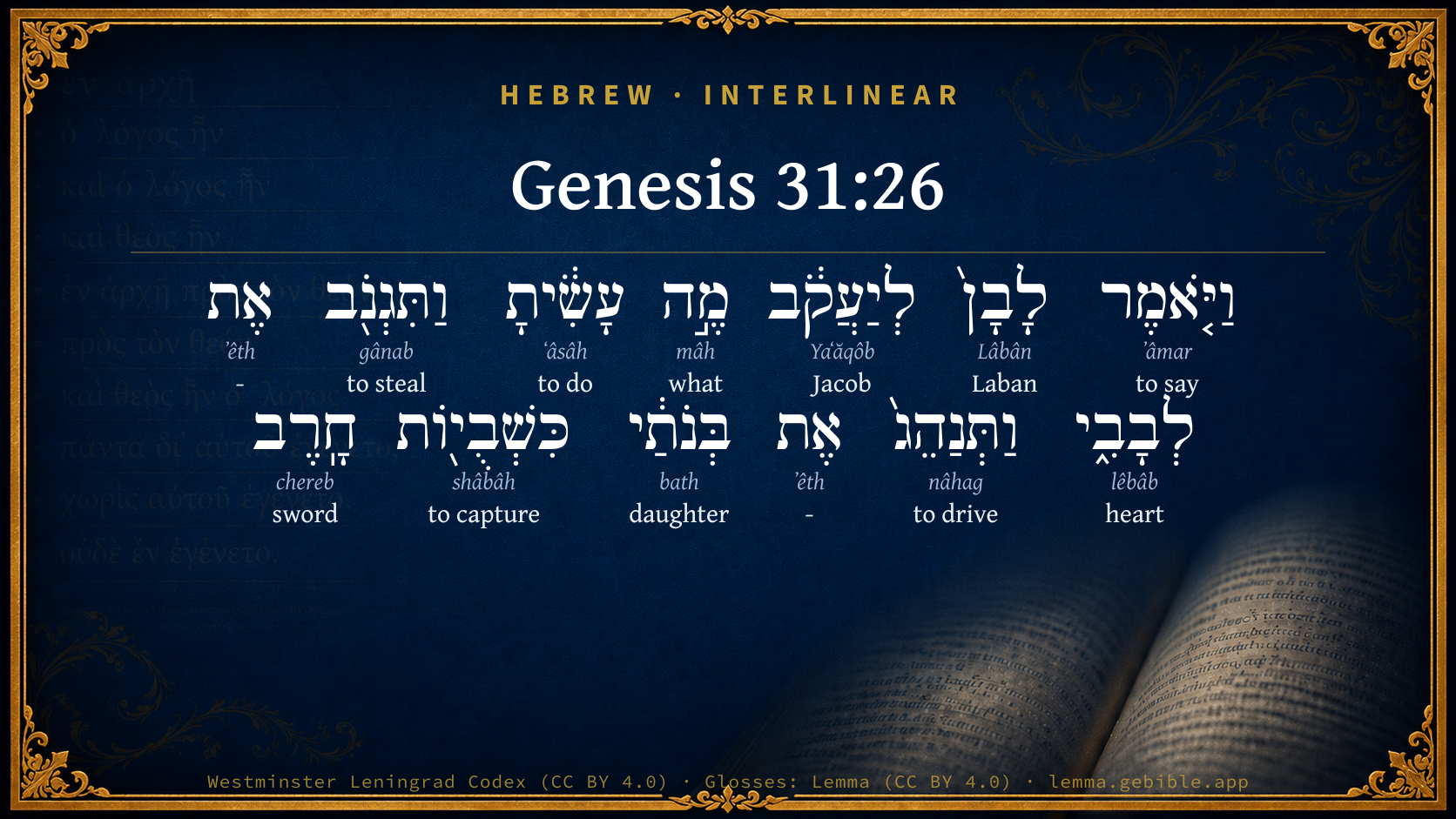
  1. וַיֹּ֤אמֶר ʼâmar H559 “and · to say” Conjunction + Verb, Qal, Sequential Imperfect, 3rd Person, Masculine, Singular
  2. לָבָן֙ Lâbân H3837 “Laban” Noun, Proper
  3. לְיַעֲקֹ֔ב Yaʻăqôb H3290 “to/for · Jacob” Preposition + Noun, Proper
  4. מֶ֣ה mâh H4100 “what” Particle, Interrogative
  5. עָשִׂ֔יתָ ʻâsâh H6213 “to do” Verb, Qal, Perfect, 2nd Person, Masculine, Singular
  6. וַתִּגְנֹ֖ב gânab H1589 “and · to steal” Conjunction + Verb, Qal, Sequential Imperfect, 2nd Person, Masculine, Singular
  7. אֶת ʼêth H853 “-” Particle, Direct Object
  8. לְבָבִ֑י lêbâb H3824 “heart · my” Noun, Common, Masculine, Singular, Construct + Suffix, Personal, 1st Person, Common, Singular
  9. אֶת ʼêth H853 “-” Particle, Direct Object
  10. בְּנֹתַ֔י bath H1323 “daughters · my” Noun, Common, Feminine, Plural, Construct + Suffix, Personal, 1st Person, Common, Singular
  11. כִּשְׁבֻי֖וֹת shâbâh H7617 “like/as · captured” Preposition + Verb, Qal, Participle Passive, Feminine, Plural, Construct
  12. חָֽרֶב chereb H2719 “sword” Noun, Common, Feminine, Singular, Absolute

About this verse

These counts appear in no published source. They are computed here, from the morphology-tagged text and Lemma’s own curated glosses. What Lemma adds →

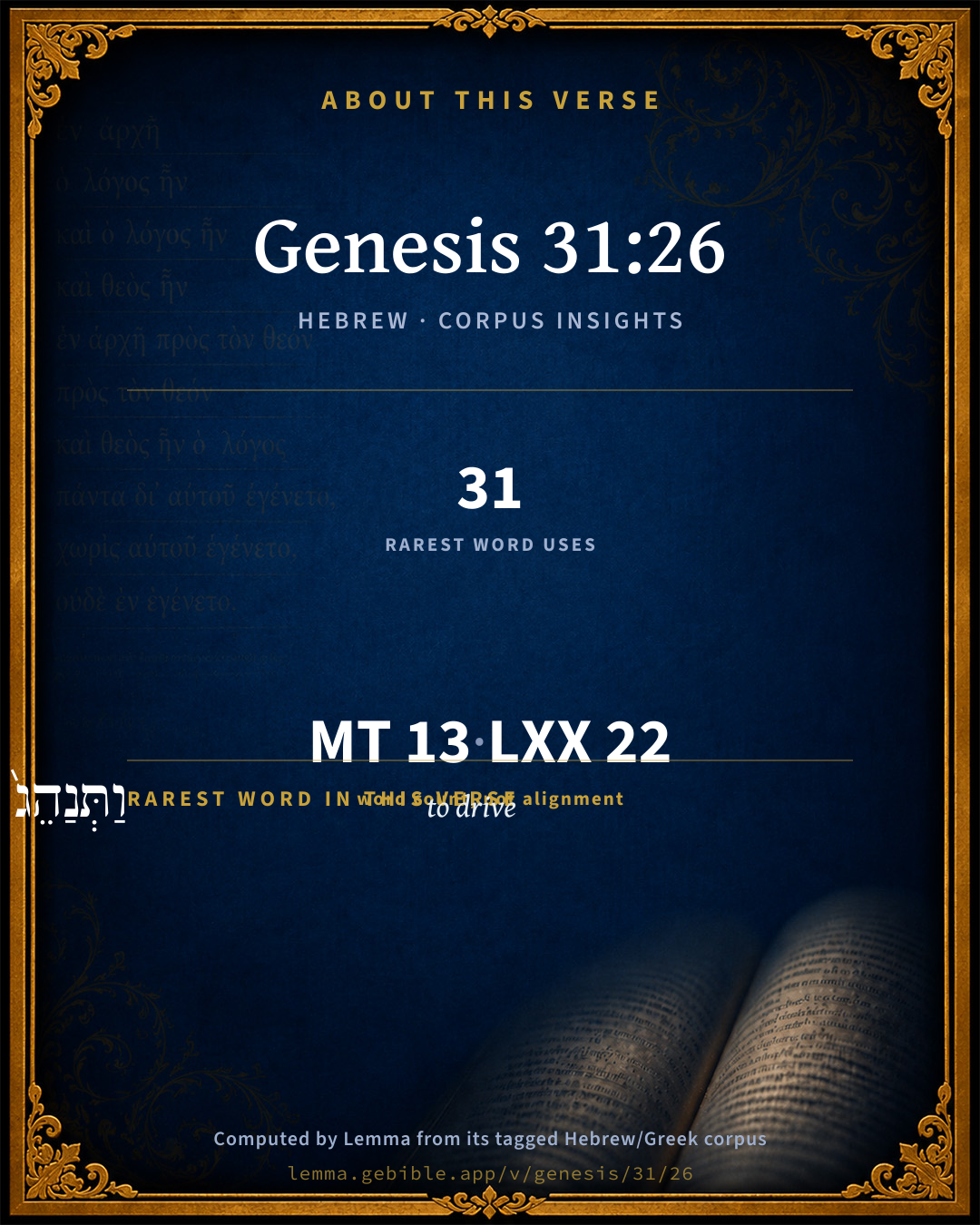
13
words
12
distinct lemmas
Pentateuch
section

Shared distinctive vocabulary

וַתְּנַהֵג֙ to drive H5090 occurs in 31 verses of the Hebrew Bible. Also found in:

Grammatical profile

  • 5 verbs
  • 5 nouns
  • 3 particles

Verb forms

  • וַיֹּ֤אמֶר Qal · Sequential Imperfect
  • עָשִׂ֔יתָ Qal · Perfect
  • וַתִּגְנֹ֖ב Qal · Sequential Imperfect
  • וַתְּנַהֵג֙ Piel · Sequential Imperfect
  • כִּשְׁבֻי֖וֹת Qal · Participle Passive

Hebrew & Septuagint length

In English translation the verse runs 23 words from the Hebrew and 29 from the Septuagint (LXX English) — closely comparable.

A rough comparison of the two English renderings, which tokenize alike — not a word-level alignment.

Word counts can differ between the Hebrew and the Greek without any difference in meaning — e.g. the Hebrew direct-object marker אֵת has no separate Greek word, and Greek often adds the article ὁ.

In the original languages it is 13 Hebrew tokens and 22 Greek tokens — but the two are counted differently (Hebrew bundles its prefixes and suffixes into one token; the Greek is in lemma form), so that isn’t a like-for-like length.

Cross-references

14

Topical passages linked to Genesis 31:26 in the Treasury of Scripture Knowledge — connected by theme and wording, ordered by reader-vote popularity; previews shown in the World English Bible.

  • 1 Samuel 30:2 and had taken captive the women [and all] who were therein, both small and great: they didn't kill any, but carried them off, and went their way.
  • Genesis 2:24 Therefore a man will leave his father and his mother, and will join with his wife, and they will be one flesh.
  • Genesis 3:13 Yahweh God said to the woman, "What is this you have done?" The woman said, "The serpent deceived me, and I ate."
  • Genesis 4:10 Yahweh said, "What have you done? The voice of your brother's blood cries to me from the ground.
  • Genesis 12:18 Pharaoh called Abram, and said, "What is this that you have done to me? Why didn't you tell me that she was your wife?
  • Genesis 20:9–10 Then Abimelech called Abraham, and said to him, "What have you done to us? How have I sinned against you, that you have brought on me and on my kingdom a great sin? You have done deeds to me that ought not to be done!"
  • Genesis 26:10 Abimelech said, "What is this you have done to us? One of the people might easily have lain with your wife, and you would have brought guilt on us!"
  • Genesis 31:16 For all the riches which God has taken away from our father, that is ours and our children's. Now then, whatever God has said to you, do."
  • Genesis 31:36 Jacob was angry, and argued with Laban. Jacob answered Laban, "What is my trespass? What is my sin, that you have hotly pursued after me?
  • Genesis 34:29 and all their wealth. They took captive all their little ones and their wives, and took as plunder everything that was in the house.
  • Joshua 7:19 Joshua said to Achan, My son, please give glory to Yahweh, the God of Israel, and make confession to him; and tell me now what you have done; don't hide it from me.
  • 1 Samuel 14:43 Then Saul said to Jonathan, Tell me what you have done. Jonathan told him, and said, I did certainly taste a little honey with the end of the rod that was in my hand; and, behold, I must die.
  • 1 Samuel 17:29 David said, What have I now done? Is there not a cause?
  • John 18:35 Pilate answered, "I'm not a Jew, am I? Your own nation and the chief priests delivered you to me. What have you done?"

Cross-references courtesy of OpenBible.info (CC BY 4.0).

Hebrew and Greek witnesses Masoretic Hebrew ↔ Greek Septuagint

The same verse in the two great witnesses to the Old Testament, shown verse-for-verse.

These are two independent witnesses, not word-aligned to each other, and the Septuagint is shown in lemma (dictionary) form.

Hebrew Genesis 31:26 Masoretic · Westminster Leningrad Codex

וַיֹּ֤אמֶר לָבָן֙ לְיַעֲקֹ֔ב מֶ֣ה עָשִׂ֔יתָ וַתִּגְנֹ֖ב אֶת לְבָבִ֑י וַתְּנַהֵג֙ אֶת בְּנֹתַ֔י כִּשְׁבֻי֖וֹת חָֽרֶב

Laban said to Jacob, "What have you done, that you have deceived me, and carried away my daughters like captives of the sword?

World English Bible · Public Domain

Greek LXX Genesis 31:26 Septuagint · lemma form

εἶπον δέ λαβαν ὁ ἰακώβ τίς ποιέω ἵνα τίς κρυφῇ ἀποδιδράσκω καί κλοποφορέω ἐγώ καί ἀποἄγω ὁ θυγάτηρ ἐγώ ὡς αἰχμαλωτίς μάχαιρα

And Laban said to Jacob, What have you done? therefore did you run away secretly, and pillage me, and lead away my daughters as captives taken with the sword?

LXX2012 (modern English Septuagint) · Public Domain

On this verse, The Pulpit Commentary discusses the Septuagint’s reading. Read the note in Commentary ↓

Hebrew: Westminster Leningrad Codex (CC BY 4.0). Greek: Septuagint (public domain); English from LXX2012 (modern English Septuagint) (Public Domain). How the Septuagint differs from the Hebrew →

Targum (Aramaic paraphrase)

2

The Targum is the ancient Jewish Aramaic paraphrase of the Hebrew Scriptures — an interpretive translation, not the Hebrew text itself. Onkelos (literal) and Pseudo-Jonathan (expansive) render the Torah, and Jonathan the Prophets. Coverage is partial: where no permissively-licensed English translation exists for a verse, only the Aramaic is shown. This is verse-level text, not a word-by-word alignment to the Hebrew.

  1. Targum Onkelos Torah (Genesis–Deuteronomy)
    וַאֲמַר לָבָן לְיַעֲקֹב מָה עֲבַדְתָּ וְכַסֵּיתָא מִנִּי וּדְבַרְתָּא יָת בְּנָתַי כְּשַׁבְיוֹת חַרְבָּא

    (no public-domain English translation for this verse)

    Targum Onkelos — Aramaic: “Onkelos Genesis” (public domain); “Onkelos Exodus” (public domain); “Onkelos Leviticus” (public domain); “Onkelos Numbers” (public domain); “Onkelos Deuteronomy” (public domain). English: “Sefaria Community Translation” (CC0 1.0 (public-domain dedication)); “J.W. Etheridge. The Targums of Onkelos and Jonathan Ben Uzziel on the Pentateuch. London: Longmans, Green, 1862” (public domain). Text via Sefaria.

  2. Targum Pseudo-Jonathan Torah (Genesis–Deuteronomy)
    וַאֲמַר לָבָן לְיַעֲקב מַה עָבַדְתְּ וְגָנַבְתְּ דַעְתִּי וּדְבָרַת יַת בְּנָתַי הֵי כְּשִׁבְיַת חַרְבָּא

    And Laban said to Jakob, What hast thou done? Thou hast stolen my knowledge, and led away my daughters like captives of the sword.

    Targum Pseudo-Jonathan — Aramaic: “Targum Jonathan on Genesis” (public domain); “Targum Jonathan on Exodus” (public domain); “Targum Jonathan on Leviticus” (public domain); “Targum Jonathan on Numbers” (public domain); “Targum Jonathan on Deuteronomy” (public domain). English: “The Targum of Jonathan ben Uzziel, trans. J. W. Etheridge, London, 1862” (public domain). Text via Sefaria.

Commentary

Notes on Genesis 31:26 from classic Christian and Jewish commentators (each source and its license shown beneath its notes). The classic Christian expositions comment on the surrounding passage and are grouped to its opening verse, so a note may address several verses; the Jewish commentaries on the Tanakh (Rashi and others) are per-verse, so they appear only where the commentator wrote on this verse.

Lemma curates 59 commentaries, every one of them public domain or Creative Commons licensed, each selected and text-cleaned for this edition rather than reprinted as found. About our sources →

Ellicott's Commentary for English Readers

(26-30) Laban said . . . —Laban reproaches Jacob, first, for carrying away his daughters secretly, which was an affront to them (Gen_31:26) and an injury to his own feelings (Gen_31:28); secondly, he tells him that he should have punished him but for the Divine warning; lastly, he accuses him of stealing his teraphim.

Captives . . . —Heb., captives of the sword, women carried off in war as spoil.

A Bible Commentary for English Readers, edited by Charles John Ellicott (1878–1897) — public domain. Text from a community e-Sword module.

The Cambridge Bible for Schools and Colleges

gen. ed. J. J. S. Perowne

26. What hast thou done?] Cf. Gen_4:10. Laban’s reproach in Gen_31:26-30 is expressed in terms of forbearance and injured innocence: why had Jacob fled secretly? why not suffer himself to be dismissed with dignity? For the sake of the God of Isaac Laban will say no more, but he must protest against the theft of his household gods.

The Cambridge Bible for Schools and Colleges (gen. ed. J. J. S. Perowne; Cambridge University Press, 1878–1918) — public domain. Text from a community e-Sword module.

Trapp's Complete Commentary

John Trapp

Gen 31:26 And Laban said to Jacob, What hast thou done, that thou hast stolen away unawares to me, and carried away my daughters, as captives [taken] with the sword?

Ver. 26. As captives taken with the sword.] No such matter; but that the old churl must have somewhat to say: for Jacob had their goodwills to go with him: and besides, they were now his more than Laban’s. Jacob had them in marriage, and not in bondage: he carried them not as his captives, but companions.

John Trapp, A Commentary or Exposition upon All the Books of the Old and New Testament (1647–1656) — public domain. Text from a community e-Sword module.

Whedon's Commentary on the Bible

Daniel D. Whedon

26. Laban said — Laban opens the controversy, and his speech, both here (Gen_31:26-30) and afterwards, (Gen_31:43-44; Gen_31:48-53,) and Jacob’s also, (in Gen_31:36-42,) read like the fragments of an ancient poem. They have the rhythm and passion of poetry, and should be put in the poetic form.

We render Laban’s speech thus: What hast thou done?

And thou hast stolen my heart, And hast carried off my daughters As captives of the sword.

Why didst thou hide thyself to flee? And thou hast stolen me, And didst not inform me, And I would have sent thee away with joy, And with songs, with timbrel, and with harp. And thou didst not permit me To kiss my sons and my daughters, Now hast thou played the fool — to do! It is to the God of my hand To do with you an evil.

But the God of your father Yesternight said to me, saying, Guard thyself from speaking with Jacob From good to evil.

And now going thou hast gone; For longing thou hast longed For the house of thy father. — Why hast thou stolen my gods?

Daniel D. Whedon (gen. ed.), Commentary on the Old and New Testaments (1874–1909) — public domain. Text from a community e-Sword module.

Geneva Bible (1599)

Geneva Bible translators

Or, conveyed thyself away privily.

Geneva Bible (1599) marginal notes — public domain. Text via Bolls.life.

Jamieson, Fausset & Brown

Robert Jamieson, A. R. Fausset & David Brown

Laban said . . . What hast thou done?--Not a word is said of the charge (Gen 31:1). His reproaches were of a different kind. His first charge was for depriving him of the satisfaction of giving Jacob and his family the usual salutations at parting. In the East it is customary, when any are setting out to a great distance, for their relatives and friends to accompany them a considerable way with music and valedictory songs. Considering the past conduct of Laban, his complaint on this ground was hypocritical cant. But his second charge was a grave one--the carrying off his gods--Hebrew, "teraphim," small images of human figures, used not as idols or objects of worship, but as talismans, for superstitious purposes.

Jamieson, Fausset & Brown — Commentary Critical and Explanatory on the Whole Bible (1871) — public domain (CC PDM 1.0). Text via the HelloAO Bible API.

John Gill's Exposition

And hast not suffered me to kiss my sons and my daughters?.... Did not give him an opportunity of taking his farewell, which used to be done with a kiss, as it is with us at this day: by his sons he means his grandsons, and so the Targum of Jonathan, my daughters' sons; and by his daughters Rachel and Leah, and Dinah his granddaughter:

thou hast done foolishly in so doing: since, as he would have him believe that he was both a loser by this step he took, and exposed himself to danger, seeing it was in the power of Laban to do him hurt, as in Gen 31:29; but Jacob knew what he did, and that it was the wisest part to follow the direction of God.

John Gill's Exposition of the Whole Bible (1746–1763) — public domain (CC PDM 1.0). Text via the HelloAO Bible API.

Matthew Poole's English Annotations

By force and violence. A false accusation; for they freely consented, Gen 31:14-16.

Matthew Poole's English Annotations on the Holy Bible (1683–1685) — public domain. Text from a community e-Sword/MySword module.

The Pulpit Commentary

Vers. 26-30. And Laban (assuming a tone of injured innocence) said to Jacob, What hast thou done, that thou hast stolen away unawares to me, literally, and (meaning, in that) thou hast stolen my heart ( vide supra, ver. 20; and cf. ver. 27)and carried away (vide ver. 18) my daughters, as captives taken with the sword? Literally, as captives of the sword, i.e. invitis parentibus (Rosenm language which, if not hypocritical on Laban"s part, was certainly hyperbolical, since he had already evinced the strength of his parental affection by selling his daughters to Jacob; and besides, so far as it concerned either Jacob or his wives, it was quite untrue, Rachel and Leah having voluntarily accompanied their husband in his flight. Wherefore didst thou floe away secretly, literally, wherefore didst thou hide thyself to flee away; abj; (niph.), with an inf. following, corresponding to the similar construction in Greek of lanqanein with a part, and being correctly rendered in English by an adverb (vide Gesenius, "Gram.," and steal away from me (literally, and steal me, ut supra); and didst not tell me, that I might (literally, and I would) have sent thee away with mirth, and with songs, in Oriental countries those about to make a long journey are still sentaway cantionibus et musicorum instrumentorum concentu (Rosenm with tabret, the toph was a drum or timbrel, consisting of a wooden circle covered with membrane, and furnished with brass bells (like the modern tambourine), which Oriental women beat when dancing (cf. Exo_15:20; Jud_1:11:34; Jer_31:4) and with harp! For a description of the kinnor see Gen_4:21. And hast not suffered me to kiss my sons (i.e. the children of Leah and Rachel) and my daughters! It is perhaps judging Laban too severely to pronounce this complete hypocrisy and cant (Alford, Bush, Candlish, Gerlach), but equally wide of the truth is it to see in Laban"s conduct nothing but generosity of feeling (Kalisch); probably there was a mixture of both paternal affection and crafty dissimulation (Delitzsch). Thou hast now done foolishly in so doing. The charge of folly in Old Testament Scriptures commonly carries with it an imputation of wrong-doing. (cf. 1Sa_13:13 2Sa_14:10) It is in the power of my hand so the phrase laelAvy, ydiy; (cf. Deu_28:32; Neh_5:5; Mic_2:1) is rendered by competent authorities (Gesenius, Furst, Rosenm Kalisch, Murphy, et alii), with which agree laxly, hJ ceir mou (LXX), and valet manus men (Vulgate), though the translation "My hand is for God," i.e. my hand serves me as God (cf. Job_12:6; Heb_1:11) is by some preferred (Keil, Knobel, Jacobus)to do you hurt: but the God of your father the use of this expression can be rightly regarded neither as a proof ofElohistic authorship (Tuch, Bleek, Colenso, Davidson) nor as a sign of Laban"s spiritual degeneracy (Hengstenberg, Wordsworth), since it is practically equivalent to Jehovah, (vide Gen_28:13) but is probably to be viewed as a play upon the sound and sense of the preceding clause, as thus: is in the El of my hand to do you evil, but the Elohim of your father spake to me." Another instance of this play upon the sound and sense is to be found in vers. 19, 20 stole the teraphim that were her father"s; and Jacob stole the heart of Laban the Syrian" (cf. Quarry on Genesis, p. 498)spake unto me yester night, saying, Take thou heed that thou speak not to Jacob literally, guard or keep thee for thyself (the pleon, pron. being added ut supra, ver. 24) from speaking with Jacob either good or bad (vide on ver. 24). And now, though thou wouldest needs be gone (literally, going thou didst go thou hast indeed gone), because thou sore longedst after thy father"s house (literally, because desiring thou didst desire. The verb psK to be pale (whence psK, silver, so called from its pale color), expresses the idea of pining away and languishing through strong inward longing), yet wherefore hast thou stolen my gods? Laban had probably gone to consult his teraphim and so discovered their loss. Augustine calls attention to this as the first Scripture reference to heathen gods, and Calvin probably supplies the right explanation of the sense in which they were so styled by Laban, non quia deitatem illie putaret esse inclusam, sed quia in honorem deorum imagines illas colebat; vel potius quod Deo sacra facturus, vertebat se ad illas imagines. (of Exo_32:4; 1Ki_12:28) "This complaint of Laban, that his "gods were stolen, show-eth the vanity of such idolatry" (Ainsworth). Cf. Jud_1:6:31 16:24; Jer_10:5, Jer_10:11, Jer_10:15.

The Pulpit Commentary (1880–1919), ed. H.D.M. Spence-Jones & Joseph S. Exell — public domain. Text from a community e-Sword module.

Keil & Delitzsch

C. F. Keil & F. Delitzsch

"Like sword-booty;" i.e., like prisoners of war (Kg2 6:22) carried away unwillingly and by force.

Keil & Delitzsch — Biblical Commentary on the Old Testament (1861–1891) — public domain (CC PDM 1.0). Text via the HelloAO Bible API. (Old Testament only.)

unfoldingWord translationNotes

Door43 World Missions Community

carried away my daughters like prisoners of war

Laban speaks about Jacob taking his family with him back to the land of Canaan as if Jacob took them as prisoners after a battle and is forcing them to go with him. Laban is exaggerating because he is angry and is trying to make Jacob feel guilty for what he did. (See: Simile and Hyperbole and Generalization)

flee secretly

"run away in secret"

with celebration

"with joy"

with tambourine and with harps

These instruments stand for music. AT: "and with music" (See: Metonymy)

tambourine

a musical instrument with a head like a drum that can be hit and with pieces of metal around the side that sound when the instrument is shaken (See: Translate Unknowns)

to kiss my grandsons

Here "grandsons" would include all grandchildren whether male or female. AT: "to kiss my grandchildren" (See: When Masculine Words Include Women)

Now you have done foolishly

"You have acted foolishly"

Now

This does not mean "at this moment," but is used to draw attention to the important point that follows.

translationWords

deceive

prison

harp

kiss

fool

unfoldingWord translationNotes — © Distant Shores Media and the Door43 World Missions Community, licensed CC BY-SA 4.0. Source: git.door43.org/Door43/en_tn.

Rashi

Rabbi Shlomo Yitzchaki (Rashi)

כשביות חרב AS CAPTIVES TAKEN BY THE SWORD — an army going to war is termed “sword”.

Rashi on the Tanakh — English translations: “The Judaica Press complete Tanach with Rashi, translated by A. J. Rosenberg” (CC BY 4.0); “Pentateuch with Rashi's commentary by M. Rosenbaum and A.M. Silbermann, 1929-1934” (public domain); “The Metsudah Tanach series, Lakewood, N.J” (CC BY 4.0); and “The Book of Joshua, Metsudah Publications, 1997” (CC BY 4.0). Text via Sefaria.

Radak

Rabbi David Kimhi (Radak)

ויאמר...כשבויות, like women taken captives by creditors that are kidnapped without their husbands being informed. This is how you treated my daughters.

Radak on the Tanakh — English translations: “Sefaria Community Translation” (CC0 1.0 (public-domain dedication)); “Eliyahu Munk, HaChut Hameshulash” (CC BY 4.0); “Rabbi Mike Feuer, Jerusalem Anthology” (CC BY 4.0); and “R. David Kimhi on the first book of Psalms, Translated by R.G. Finch, London, 1919” (public domain). Text via Sefaria.

Lesson kit

Teaching starters — assembled from the data on this page, not authored interpretation. Every prompt links to the verse data it draws on. Edit before teaching.

Genesis, in the Pentateuch, opens this verse with 13 words (12 distinct Hebrew lemmas). Its most distinctive word is nâhag (“to drive”). A historical commentator’s framing appears above. Read the whole chapter for the surrounding context.

Discussion questions

  1. The word nâhag carries the sense “to drive.” How does it shape the verse?
  2. Genesis 31:18 shares the word «to drive» with this verse. How do the two illuminate each other?
  3. The translations on this page render this verse differently — a whole-verse word diff, not a word-by-word alignment. What might account for the different wordings?
  4. The verb «וַיֹּ֤אמֶר» is Qal Sequential Imperfect. How does its form color the action?
  5. Reading how Ellicott's Commentary for English Readers and The Cambridge Bible for Schools and Colleges read this verse, where do the two commentators agree and where do they part?

Things to notice

Reading settings

Reading text

Shown beneath each verse's original-language words.

Old Testament
Old Testament edition

Read the OT as the Masoretic Hebrew (MT) or the Greek Septuagint (LXX).

English shown for the Greek Septuagint (in the Hebrew ↔ Greek comparison).

Comparing translations? Open the Compare panel on any verse page to stack up to four side by side.