
Psalms 78:62

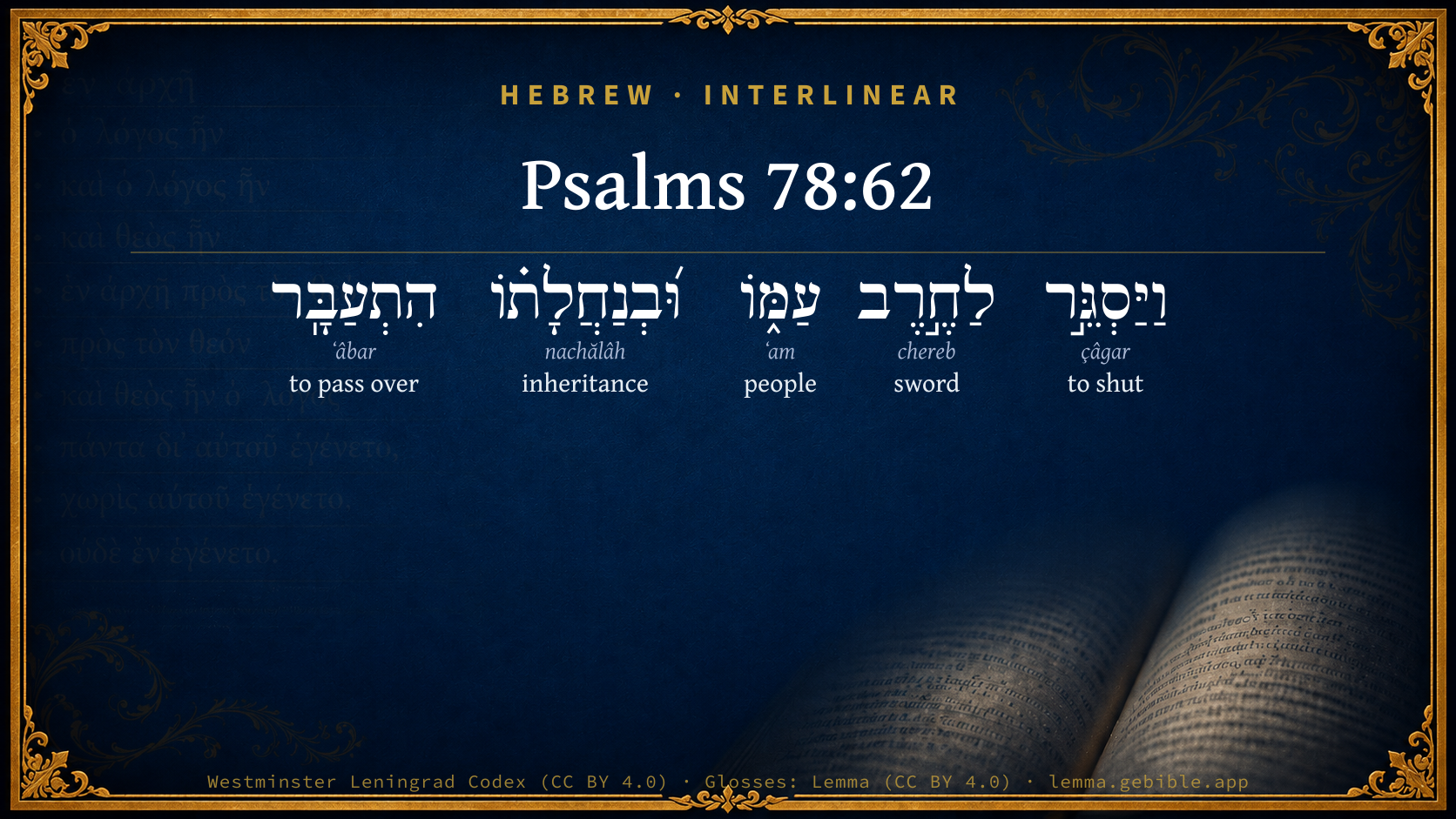
Hebrew (Westminster Leningrad Codex) Psalms 78:62 appears in the Hebrew Old Testament. The text above is from the Westminster Leningrad Codex. Each word links to its Strong’s number, a concise gloss, and parsing drawn from the Open Scriptures Hebrew Bible morphology. Click any word for its full Brown-Driver-Briggs (BDB) entry.
Download image
Cite this verse

Psalms 78:62 (World English Bible). Public Domain. Lemma interlinear Bible study tool, https://lemma.gebible.app/v/psalms/78/62.

Show BibTeX & RIS
BibTeX
RIS
English Translation
He also gave his people over to the sword, And was angry with his inheritance.
World English Bible · Public Domain
Download a study sheet

One document with this verse’s original text, its word-by-word gloss line, the meaning frame, cross-references with their text, attributed commentary, and full source and license credits — printable, and it pastes into notes with its structure intact.

This verse Autodidact and up

Study sheet (.html) Plain text (.txt)

A passage Seminary Student

Up to 50 verses in one chapter. A passage sheet keeps up to 6 commentary sources and 12 cross-references per verse, in the order this page ranks them, and says so on the sheet whenever that leaves anything out. Ask for a single verse and you get the Autodidact verse sheet above.

Everything on this page stays free to read, with no account — the sheet is a download of what is already on screen, not access to it.

Want to remove ads? Support Godless Engineer
Compare translations 3

The same verse in 3 English versions, stacked beneath the original-language interlinear above. Click any original word for its lexicon entry.

Each is an independent rendering of the whole verse — the interlinear is not word-aligned to these translations.

Highlighted words mark where these versions differ — a whole-verse word diff, not a word-by-word alignment.

  • World English Bible Public Domain
    He also gave his people over to the sword, And was angry with his inheritance.
  • King James Version Public Domain
    He gave his people over also unto the sword; and was wroth with his inheritance.
  • unfoldingWord Literal Text CC BY-SA 4.0
    And he delivered his people over to the sword, and he was furious with his inheritance.

unfoldingWord Literal Text — © unfoldingWord, licensed CC BY-SA 4.0. Word-aligned USFM3 via Door43 (git.door43.org/unfoldingWord/en_ult).

Versions to compare (up to 4)

3 of 4 selected

Show all 18 translations

Every available English version of this verse, each an independent rendering of the whole verse.

  • World English Bible Public Domain
    He also gave his people over to the sword, And was angry with his inheritance.
  • Berean Standard Bible Public Domain
    He surrendered His people to the sword because He was enraged by His heritage.
  • Majority Standard Bible Public Domain
    He surrendered His people to the sword because He was enraged by His heritage.
  • King James Version Public Domain
    He gave his people over also unto the sword; and was wroth with his inheritance.
  • American Standard Version (1901) Public Domain
    He gave his people over also unto the sword, And was wroth with his inheritance.
  • Revised Version (1885) Public Domain
    He gave his people over also unto the sword; and was wroth with his inheritance.
  • Geneva Bible (1599) Public Domain
    And hee gaue vp his people to the sworde, and was angrie with his inheritance.
  • Douay-Rheims (1899) Public Domain
    And he shut up his people under the sword: and he despised his inheritance.
  • Young's Literal Translation Public Domain
    And delivereth up to the sword His people, And with His inheritance shewed Himself angry.
  • Literal Standard Version CC BY-SA 4.0
    And delivers His people up to the sword, || And showed Himself angry with His inheritance.
  • Unlocked Literal Bible CC BY-SA 4.0
    He handed his people over to the sword, and he was angry with his heritage.
  • unfoldingWord Literal Text CC BY-SA 4.0
    And he delivered his people over to the sword, and he was furious with his inheritance.
  • Darby Bible Public Domain
    And delivered up his people unto the sword, and was very wroth with his inheritance:
  • World Messianic Bible Public Domain
    He also gave his people over to the sword, and was angry with his inheritance.
  • Webster's Bible Public Domain
    He gave over his people also to the sword; and was wroth with his inheritance.
  • Free Bible Version CC BY-SA 4.0
    He handed over his people to be slaughtered by the sword; he was furious with his chosen people.
  • Bible in Basic English Public Domain
    He gave his people up to the sword, and was angry with his heritage.
  • JPS Tanakh (1917) Public Domain
    He gave His people over also unto the sword; and was wroth with His inheritance.

Literal Standard Version (2020), Covenant Press — licensed CC BY-SA 4.0. Text via the HelloAO Bible API (eBible.org). Unlocked Literal Bible (unfoldingWord) — licensed CC BY-SA 4.0. Text via the HelloAO Bible API (eBible.org). unfoldingWord Literal Text — © unfoldingWord, licensed CC BY-SA 4.0. Word-aligned USFM3 via Door43 (git.door43.org/unfoldingWord/en_ult). Free Bible Version, Dr. Jonathan Gallagher — licensed CC BY-SA 4.0. Text via the HelloAO Bible API (eBible.org).

Word by word

More ways to search: Search by grammar → Find every occurrence → Compare this word →

Practice this passage: Drill this verse → Learn its vocabulary →

וַיַּסְגֵּ֣ר
çâgar
H5462
“and · to shut”
Conjunction + Verb, Hiphil, Sequential Imperfect, 3rd Person, Masculine, Singular
Part of Speech
Conjunction + Verb
Stem
Hiphil
Form
Sequential Imperfect
Person
3rd Person
Gender
Masculine
Number
Singular
Full BDB Definition

Origin: a primitive root

TWOT: 1462

to shut, close - (Qal) - to shut - to close, close up - closed up, closely joined, shut up - (Niphal) - to be shut up - to be shut or closed - (Piel) to shut up, deliver up - (Pual) to be shut up - (Hiphil) - to deliver up - to shut up, imprison
  1. לַחֶ֣רֶב chereb H2719 “to/for the · sword” Preposition, Determined + Noun, Common, Feminine, Singular, Absolute
  2. עַמּ֑וֹ ʻam H5971 “people · his” Noun, Common, Masculine, Singular, Construct + Suffix, Personal, 3rd Person, Masculine, Singular
  3. וּ֝בְנַחֲלָת֗וֹ nachălâh H5159 “and · in/at · inheritance · his” Conjunction + Preposition + Noun, Common, Feminine, Singular, Construct + Suffix, Personal, 3rd Person, Masculine, Singular
  4. הִתְעַבָּֽר ʻâbar H5674 “to pass over” Verb, Hithpael, Perfect, 3rd Person, Masculine, Singular

About this verse

These counts appear in no published source. They are computed here, from the morphology-tagged text and Lemma’s own curated glosses. What Lemma adds →

5
words
5
distinct lemmas
Wisdom
section

Grammatical profile

  • 2 verbs
  • 3 nouns

Verb forms

  • וַיַּסְגֵּ֣ר Hiphil · Sequential Imperfect
  • הִתְעַבָּֽר Hithpael · Perfect

Hebrew & Septuagint length

In English translation the verse runs 15 words from the Hebrew and 12 from the Septuagint (LXX English) — closely comparable.

A rough comparison of the two English renderings, which tokenize alike — not a word-level alignment.

Word counts can differ between the Hebrew and the Greek without any difference in meaning — e.g. the Hebrew direct-object marker אֵת has no separate Greek word, and Greek often adds the article ὁ.

Cross-references

4

Topical passages linked to Psalms 78:62 in the Treasury of Scripture Knowledge — connected by theme and wording, ordered by reader-vote popularity; previews shown in the World English Bible.

  • Psalms 89:38 But you have rejected and spurned. You have been angry with your anointed.
  • 1 Samuel 4:2 The Philistines put themselves in array against Israel: and when they joined battle, Israel was struck before the Philistines; and they killed of the army in the field about four thousand men.
  • 1 Samuel 4:10–11 The Philistines fought, and Israel was struck, and they fled every man to his tent: and there was a very great slaughter; for there fell of Israel thirty thousand footmen.
  • Isaiah 64:9 Don't be angry very sore, Yahweh, neither remember iniquity forever: see, look, we beg you, we are all your people.

Cross-references courtesy of OpenBible.info (CC BY 4.0).

Hebrew and Greek witnesses Masoretic Hebrew ↔ Greek Septuagint

The same verse in the two great witnesses to the Old Testament, shown verse-for-verse.

You’re reading Greek Psalm 77 (Hebrew Psalm 78). The Septuagint counts the superscription, so verse numbers can differ from the Hebrew — chapter-level alignment, not verse-by-verse. Numbering follows Rahlfs.

These are two independent witnesses, not word-aligned to each other, and the Septuagint is shown in lemma (dictionary) form.

Hebrew Psalms 78:62 Masoretic · Westminster Leningrad Codex

וַיַּסְגֵּ֣ר לַחֶ֣רֶב עַמּ֑וֹ וּ֝בְנַחֲלָת֗וֹ הִתְעַבָּֽר

He also gave his people over to the sword, And was angry with his inheritance.

World English Bible · Public Domain

Greek LXX Greek Psalm 77:62 Septuagint · lemma form

καί συνκλείω εἰς ῥομφαία ὁ λαός αὐτός καί ὁ κληρονομία αὐτός ὑπερὁράω

And he gave his people to the sword; and disdained his inheritance.

LXX2012 (modern English Septuagint) · Public Domain

Hebrew: Westminster Leningrad Codex (CC BY 4.0). Greek: Septuagint (public domain); English from LXX2012 (modern English Septuagint) (Public Domain). How the Septuagint differs from the Hebrew →

Commentary

Notes on Psalms 78:62 from classic Christian and Jewish commentators (each source and its license shown beneath its notes). The classic Christian expositions comment on the surrounding passage and are grouped to its opening verse, so a note may address several verses; the Jewish commentaries on the Tanakh (Rashi and others) are per-verse, so they appear only where the commentator wrote on this verse.

Lemma curates 59 commentaries, every one of them public domain or Creative Commons licensed, each selected and text-cleaned for this edition rather than reprinted as found. About our sources →

Trapp's Complete Commentary

John Trapp

Psa 78:62 He gave his people over also unto the sword; and was wroth with his inheritance.

Ver. 62. He gave his people also unto the sword] sc. Of the Philistines, who slew thirty thousand of them in one battle, 1Sa 4:10, they lost him and themselves too; the ark having been a far better defence to them than the Palladium to the Trojans.

John Trapp, A Commentary or Exposition upon All the Books of the Old and New Testament (1647–1656) — public domain. Text from a community e-Sword module.

Joseph Benson's Commentary

Psa 78:62-64. He gave his people over unto the sword — To the sword of his own justice, and of the enemies’ rage, for he was wroth with his inheritance; and that wrath of his was the fire which consumed their young men in the prime of their time, by the sword or sickness, and made such devastation of them, that their maidens were not given in marriage — Because the young men, who should have married them, were slain, and there were few or none left to whom they could be given, and because the distresses and calamities of Israel were so great, that the joys of marriage solemnities were judged unseasonable; and it was said, Blessed is the womb that beareth not. Hebrew, בתולתיו לא הוללו, their maidens were not praised; namely, with marriage songs, which was usual at marriage solemnities among the Jews: see Jer 7:34; Jer 16:9; Jer 25:10. Their priests fell by the sword — Hophni and Phinehas, and others. And their widows made no lamentation — No funeral solemnities; either because they were prevented by their own death, as the wife of Phinehas was, who, instead of lamenting her husband’s death, died herself, when she had called her son Ichabod; or because they were so overwhelmed with a sense of public calamities, that the resentment of their private losses was swallowed up by it, and all the ceremonies of mourning were lost and buried in substantial grief.

Joseph Benson's Commentary on the Old and New Testaments (1811–1818) — public domain. Text from a community e-Sword module.

J. A. Alexander on Psalms

Joseph Addison Alexander

62. (Psa 78:62) And abandoned to the sword his people, and at his heritage was wroth. For the meaning of the first verb, see above on Psa 78:48, and for that of the second, on Psa 78:21. To the sword, to defeat and destruction in war, with particular reference to 1Sa 4:10. The severity of these judgments is enhanced by their having been inflicted on his people and his heritage.

Joseph Addison Alexander, The Psalms Translated and Explained (1850) — public domain. Text from a community e-Sword module.

John Calvin's Commentaries

62. And he shut up his people to the sword. Other parts of the calamity which befell Israel in the time of the high priest Eli are here mentioned. God, in permitting the ark to be carried away, showed that he had withdrawn his favor from them. This was also demonstrated from the fact, that all the flower of the people — those who were in the prime and blush of manhood — were consumed by the wrath of God: which is expressed by the fire devouring them. But this language is metaphorical, as is evident from the history of the event referred to, which informs us, that those that perished who were of the chosen of Israel, to the number of thirty thousand men, fell by the sword of the enemy, and not by fire, (1 Samuel 4:10.) This figure points out the suddenness of the dreadful calamity. It is as if it had been said, They were destroyed in a moment, even as fire quickly consumes chaff and the dry leaves of trees.

The great extent of this slaughter is heightened by another figure, which is, that for want of men, the maidens continued unmarried. This is the meaning of the clause, Their virgins were not applauded; the reference being to the nuptial songs which were wont to be sung at marriages in praise of the bride. To aggravate still more the unwonted and appalling nature of the calamity, it is added, that even the priests, whom God had taken under his special protection, perished indiscriminately with others. When it is said, that the widows made no lamentation, I would explain it as denoting, either that they themselves died first for sorrow, so that they had no opportunity of mourning for others, or else, that when led captive by their enemies, they were prohibited to mourn. By all these expressions, the object is to show, in a few words, that all kinds of calamities were heaped upon them.

John Calvin's Commentaries (1540-1563) — public domain. Text from the Calvin Translation Society English edition (1840s-50s) via the Christian Classics Ethereal Library (ccel.org). Calvin's coverage is partial (roughly two-thirds of the Bible); uncommented books and verses are honest gaps, never fabricated. The 19th-century editor's footnotes and remarks are omitted so the notes are faithfully Calvin's own voice.

The Cambridge Bible for Schools and Colleges

gen. ed. J. J. S. Perowne

62. See 1Sa_4:2; 1Sa_4:10; 1Sa_4:17.

The Cambridge Bible for Schools and Colleges (gen. ed. J. J. S. Perowne; Cambridge University Press, 1878–1918) — public domain. Text from a community e-Sword module.

John Gill's Exposition

The fire consumed their young men,.... Not Nadab and Abihu, as some of the Jewish Rabbins interpret it, of which Jarchi makes mention; but the young men, the choice, the flower, of the Israelitish army, which engaged with the Philistines in the times of Eli; and the fire that consumed them is not to be understood of material fire, or of extraordinary fire from heaven, but either of the wrath of God, as Jarchi, or of the flaming glittering sword of the enemy, which consumed them like fire; see Num 21:28.

and their maidens were not given to marriage; the young men to whom they should have been married, and to whom they might have been espoused, being slain in battle: or, "were not honoured" (a); that with marriage, which is honourable to all, Heb 13:4, or "were not praised" (b); were not attended with epithalamies and nuptial songs, such as used to be sung at the time of marriage; hence, as Kimchi observes, the nuptial chamber is called , "the house of praise"; and so frequently, when a great calamity is threatened or described, it is said, the voice of the bride and bridegroom is not heard; see Jer 16:9.

(a) "honoratae", Munster; so some in Vatablus. (b) "Celebratae epithalamio", Montanus; "laudatae", Tigurine version, Amama, so Ainsworth; "laudarentur", Junius & Tremellius, Michaelis; "laudabantur", Piscator; "commendabantur", Gejerus.

John Gill's Exposition of the Whole Bible (1746–1763) — public domain (CC PDM 1.0). Text via the HelloAO Bible API.

Albert Barnes' Notes on the Bible

He gave his people over also unto the sword - When the ark was taken, 1Sa 4:10. Thirty thousand of the children of Israel fell on that occasion.

And was wroth with his inheritance - Was angry with his people, considered as his inheritance; that is, considered as his own special people, or his possession.

Albert Barnes' Notes on the Bible (1834–1885) — public domain. Text from a community e-Sword/MySword module.

The Treasury of David

Charles H. Spurgeon

Ver. 62. He gave his people over also unto the sword. They fell in battle because they were no longer aided by the divine strength. Sharp was the sword, but sharper still the cause of its being unsheathed.

And was wroth with his inheritance. They were his still, and twice in this verse they are called so; yet his regard for them did not prevent his chastening them, even with a rod of steel. Where the love is most fervent, the jealousy is most cruel. Sin cannot be tolerated in those who are a people near unto God.

None.

Ver. 59-72.

1. A gloomy sunset, Ps 78:59-60.

2. A baleful might, Ps 78:60-64.

3. A blessed sunrise, Ps 78:65-72. C. D.

Charles H. Spurgeon's The Treasury of David (1869–1885) — public domain. Psalms only. Text from a community e-Sword/MySword module.

Whedon's Commentary on the Bible

Daniel D. Whedon

62. He gave his people… unto the sword—Thirty thousand fell in the battle. 1Sa_4:10

Daniel D. Whedon (gen. ed.), Commentary on the Old and New Testaments (1874–1909) — public domain. Text from a community e-Sword module.

The Pulpit Commentary

He gave his people over also unto the sword. Thirty thousand Israelites were slain in the battle in which the ark was captured. (see 1Sa_4:10) And was wroth with his inheritance. (comp. Psa_28:9 Psa_33:12 Psa_106:5, Psa_106:40)

The Pulpit Commentary (1880–1919), ed. H.D.M. Spence-Jones & Joseph S. Exell — public domain. Text from a community e-Sword module.

unfoldingWord translationNotes

Door43 World Missions Community

General Information:

The writer continues to describe what God did for the people of Israel.

He handed his people over to the sword

Asaph speaks of God's people as if they were a small object God would give as a gift, and of the sword, a metonym for death in war, as if it were a person who could receive a gift. AT: "He allowed people to kill all his people in war" (See: Metaphor and Personification and Metonymy)

he was angry with his heritage

"he was angry with the people he had said would be his forever"

Fire devoured their young men

Possible meanings are 1) "The enemy used fire to kill all their young men" or 2) "Their young men died quickly in battle like a fire burns dry grass." Do not communicate that these people used guns. (See: Metaphor)

devoured

To "devour" is to eat everything very quickly.

wedding

the celebration when people marry

translationWords

sword

inherit

fire

devour

unfoldingWord translationNotes — © Distant Shores Media and the Door43 World Missions Community, licensed CC BY-SA 4.0. Source: git.door43.org/Door43/en_tn.

Lesson kit

Teaching starters — assembled from the data on this page, not authored interpretation. Every prompt links to the verse data it draws on. Edit before teaching.

Psalms, in the Wisdom, opens this verse with 5 words (5 distinct Hebrew lemmas). Its most distinctive word is çâgar (“to shut”). A historical commentator’s framing appears above. Read the whole chapter for the surrounding context.

Discussion questions

  1. What does “to shut” (çâgar) contribute to the verse as a whole?
  2. How does Psalms 89:38, which shares this passage’s theme, read alongside this verse?
  3. These translations render this verse differently. What is at stake in choosing one wording over another?
  4. «וַיַּסְגֵּ֣ר» is a Hiphil Sequential Imperfect verb. How does that grammatical form shape the action described?
  5. Compare how Trapp's Complete Commentary and Joseph Benson's Commentary read this verse. Where do they agree or differ?

Things to notice

Reading settings

Reading text

Shown beneath each verse's original-language words.

Old Testament
Old Testament edition

Read the OT as the Masoretic Hebrew (MT) or the Greek Septuagint (LXX).

English shown for the Greek Septuagint (in the Hebrew ↔ Greek comparison).

Comparing translations? Open the Compare panel on any verse page to stack up to four side by side.