Leviticus 26:37

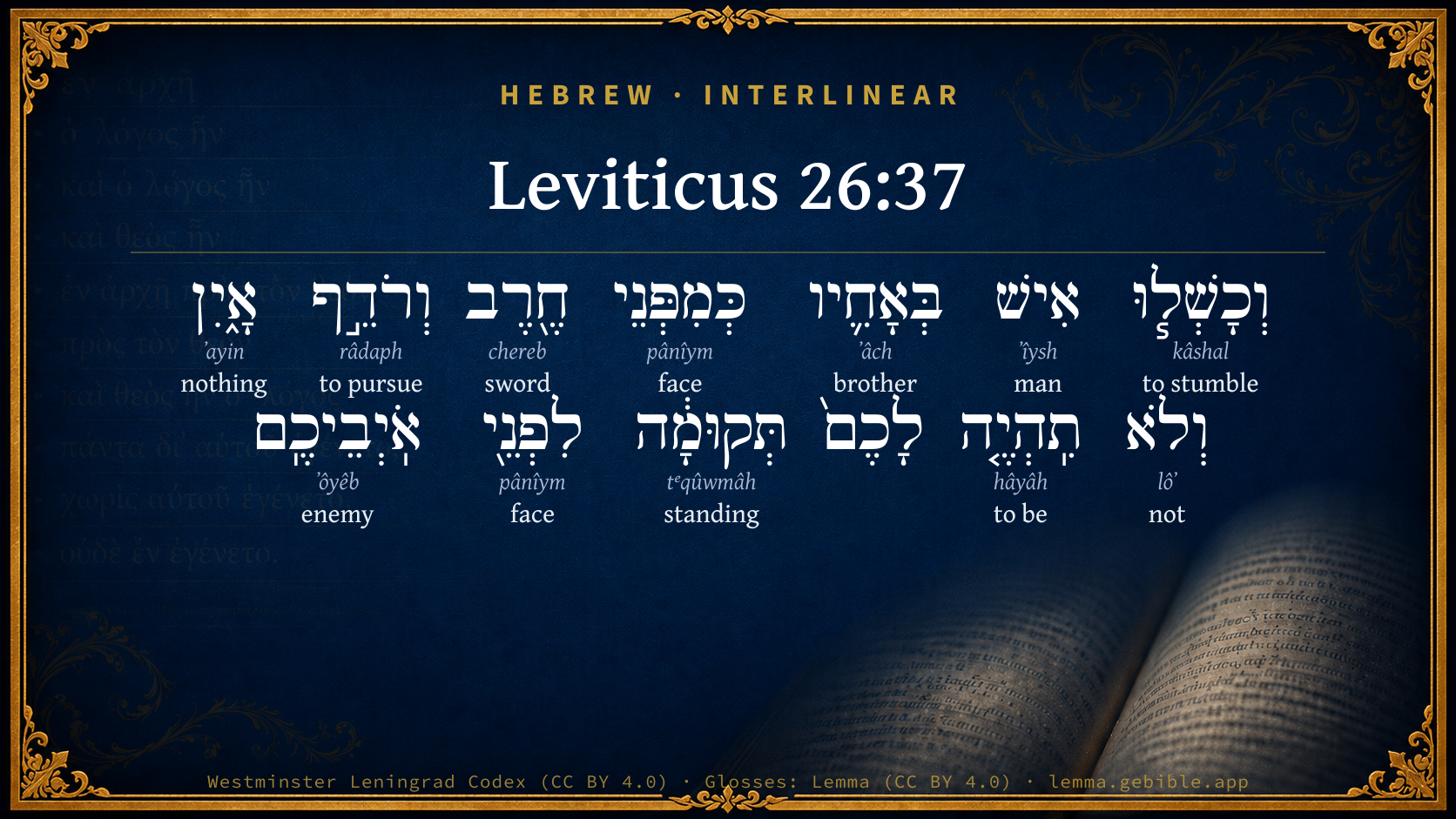
Hebrew (Westminster Leningrad Codex) Leviticus 26:37 appears in the Hebrew Old Testament. The text above is from the Westminster Leningrad Codex. Each word links to its Strong’s number, a concise gloss, and parsing drawn from the Open Scriptures Hebrew Bible morphology. Click any word for its full Brown-Driver-Briggs (BDB) entry.
Download image
Cite this verse

Leviticus 26:37 (World English Bible). Public Domain. Lemma interlinear Bible study tool, https://lemma.gebible.app/v/leviticus/26/37.

Show BibTeX & RIS
BibTeX
RIS
English Translation
They will stumble over one another, as it were before the sword, when no one pursues: and you will have no power to stand before your enemies.
World English Bible · Public Domain
Highlights
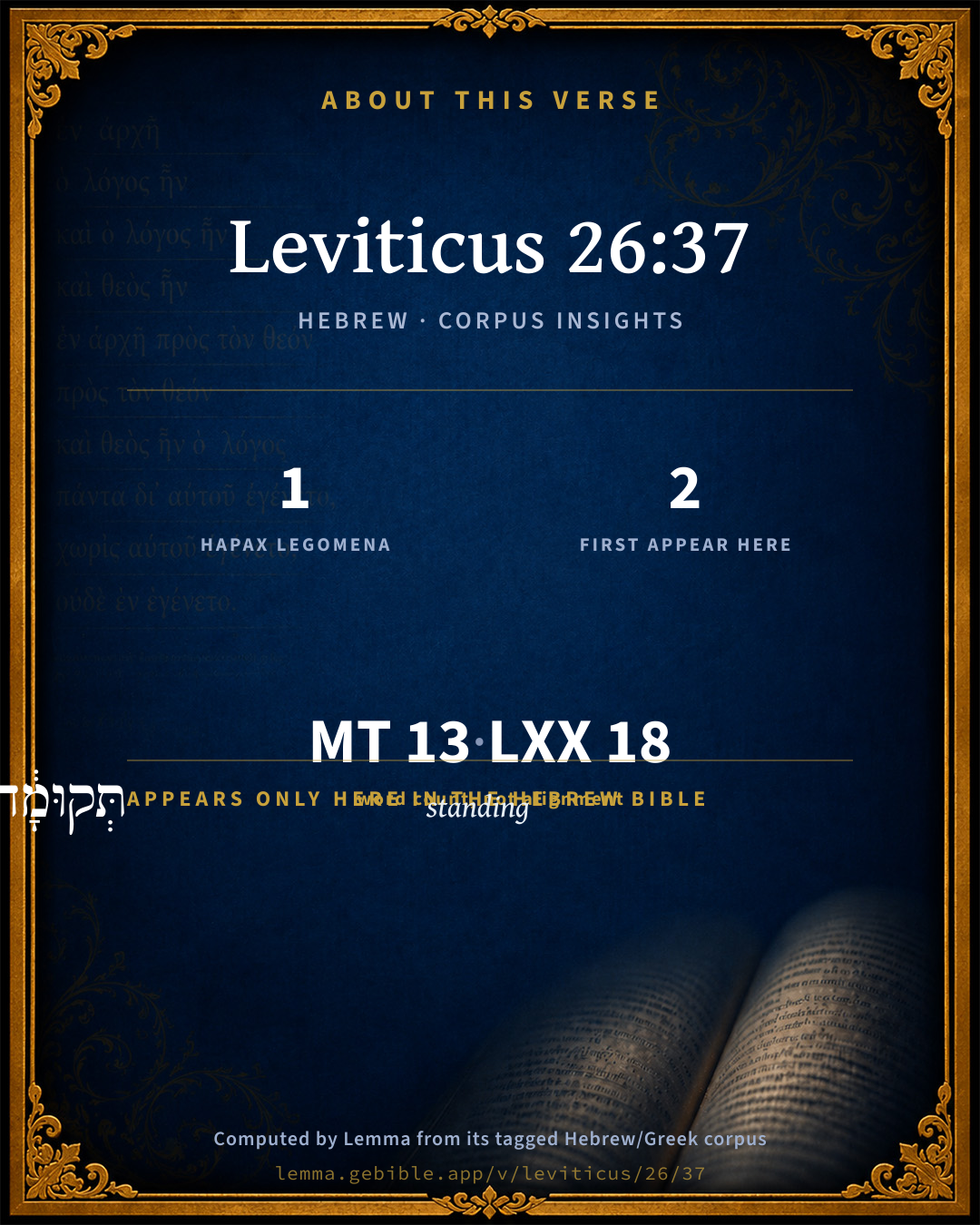
  • 1 hapax legomenon — only here in the Hebrew Bible
  • 2 first appearances in the Hebrew Bible
Full analysis ↓
Download a study sheet

One document with this verse’s original text, its word-by-word gloss line, the meaning frame, cross-references with their text, attributed commentary, and full source and license credits — printable, and it pastes into notes with its structure intact.

This verse Autodidact and up

Study sheet (.html) Plain text (.txt)

A passage Seminary Student

Up to 50 verses in one chapter. A passage sheet keeps up to 6 commentary sources and 12 cross-references per verse, in the order this page ranks them, and says so on the sheet whenever that leaves anything out. Ask for a single verse and you get the Autodidact verse sheet above.

Everything on this page stays free to read, with no account — the sheet is a download of what is already on screen, not access to it.

Want to remove ads? Support Godless Engineer
Compare translations 3

The same verse in 3 English versions, stacked beneath the original-language interlinear above. Click any original word for its lexicon entry.

Each is an independent rendering of the whole verse — the interlinear is not word-aligned to these translations.

Highlighted words mark where these versions differ — a whole-verse word diff, not a word-by-word alignment.

  • World English Bible Public Domain
    They will stumble over one another, as it were before the sword, when no one pursues: and you will have no power to stand before your enemies.
  • King James Version Public Domain
    And they shall fall one upon another, as it were before a sword, when none pursueth: and ye shall have no power to stand before your enemies.
  • unfoldingWord Literal Text CC BY-SA 4.0
    And they will stumble, one on his brother, as from the face of a sword but there is no pursuer, and to you there will be no power to stand to the face of your enemies.

unfoldingWord Literal Text — © unfoldingWord, licensed CC BY-SA 4.0. Word-aligned USFM3 via Door43 (git.door43.org/unfoldingWord/en_ult).

Versions to compare (up to 4)

3 of 4 selected

Show all 18 translations

Every available English version of this verse, each an independent rendering of the whole verse.

  • World English Bible Public Domain
    They will stumble over one another, as it were before the sword, when no one pursues: and you will have no power to stand before your enemies.
  • Berean Standard Bible Public Domain
    They will stumble over one another as before the sword, though no one is behind them. So you will not be able to stand against your enemies.
  • Majority Standard Bible Public Domain
    They will stumble over one another as before the sword, though no one is behind them. So you will not be able to stand against your enemies.
  • King James Version Public Domain
    And they shall fall one upon another, as it were before a sword, when none pursueth: and ye shall have no power to stand before your enemies.
  • American Standard Version (1901) Public Domain
    And they shall stumble one upon another, as it were before the sword, when none pursueth: and ye shall have no power to stand before your enemies.
  • Revised Version (1885) Public Domain
    And they shall stumble one upon another, as it were before the sword, when none pursueth: and ye shall have no power to stand before your enemies.
  • Geneva Bible (1599) Public Domain
    They shall fall also one vpon another, as before a sword, though none pursue them, and ye shall not be able to stand before your enemies:
  • Douay-Rheims (1899) Public Domain
    And they shall every one fall upon their brethren as fleeing from wars, none of you shall dare to resist your enemies.
  • Young's Literal Translation Public Domain
    And they have stumbled one on another, as from the face of a sword, and there is none pursuing, and ye have no standing before your enemies,
  • Literal Standard Version CC BY-SA 4.0
    And they have stumbled on one another, as from the face of a sword, and there is none pursuing, and you have no standing before your enemies,
  • Unlocked Literal Bible CC BY-SA 4.0
    You will stumble over each other as though you were running from the sword, even though no one is chasing you. You will have no power to stand before your enemies.
  • unfoldingWord Literal Text CC BY-SA 4.0
    And they will stumble, one on his brother, as from the face of a sword but there is no pursuer, and to you there will be no power to stand to the face of your enemies.
  • Darby Bible Public Domain
    and they shall stumble one over another, as it were before a sword, when none pursueth; and ye shall have no power to stand before your enemies.
  • World Messianic Bible Public Domain
    They will stumble over one another, as it were before the sword, when no one pursues. You will have no power to stand before your enemies.
  • Webster's Bible Public Domain
    And they shall fall one upon another, as it were before a sword, when none pursueth: and ye shall have no power to stand before your enemies.
  • Free Bible Version CC BY-SA 4.0
    You'll trip over each other as you run away from the attack, even though no one's there. You'll have no power to resist your enemies.
  • Bible in Basic English Public Domain
    Falling on one another, as before the sword, when no one comes after them; you will give way before your haters.
  • JPS Tanakh (1917) Public Domain
    And they shall stumble one upon another, as it were before the sword, when none pursueth; and ye shall have no power to stand before your enemies.

Literal Standard Version (2020), Covenant Press — licensed CC BY-SA 4.0. Text via the HelloAO Bible API (eBible.org). Unlocked Literal Bible (unfoldingWord) — licensed CC BY-SA 4.0. Text via the HelloAO Bible API (eBible.org). unfoldingWord Literal Text — © unfoldingWord, licensed CC BY-SA 4.0. Word-aligned USFM3 via Door43 (git.door43.org/unfoldingWord/en_ult). Free Bible Version, Dr. Jonathan Gallagher — licensed CC BY-SA 4.0. Text via the HelloAO Bible API (eBible.org).

Word by word

More ways to search: Search by grammar → Find every occurrence → Compare this word →

Practice this passage: Drill this verse → Learn its vocabulary →

תְּקוּמָ֔ה
tᵉqûwmâh
H8617
“standing”
Noun, Common, Feminine, Singular, Absolute
Part of Speech
Noun
Type
Common
Gender
Feminine
Number
Singular
State
Absolute
Full BDB Definition

Origin: from H6965

TWOT: 1999g

standing, ability or power to stand
  1. וְכָשְׁל֧וּ kâshal H3782 “and · to stumble” Conjunction + Verb, Qal, Sequential Perfect, 3rd Person, Common, Plural
  2. אִישׁ ʼîysh H376 “man” Noun, Common, Masculine, Singular, Absolute
  3. בְּאָחִ֛יו ʼâch H251 “in/at · brother · his” Preposition + Noun, Common, Masculine, Singular, Construct + Suffix, Personal, 3rd Person, Masculine, Singular
  4. כְּמִפְּנֵי pânîym H6440 “like/as · from · face(s) of” Preposition + Preposition + Noun, Common, Both, Plural, Construct
  5. חֶ֖רֶב chereb H2719 “sword” Noun, Common, Feminine, Singular, Absolute
  6. וְרֹדֵ֣ף râdaph H7291 “and · pursuing” Conjunction + Verb, Qal, Participle Active, Masculine, Singular, Absolute
  7. אָ֑יִן ʼayin H369 “nothing” Particle, Negative
  8. וְלֹא lôʼ H3808 “and · not” Conjunction + Particle, Negative
  9. תִֽהְיֶ֤ה hâyâh H1961 “to be” Verb, Qal, Imperfect, 3rd Person, Feminine, Singular
  10. לִפְנֵ֖י pânîym H6440 “to/for · face(s) of” Preposition + Noun, Common, Both, Plural, Construct
  11. אֹֽיְבֵיכֶֽם ʼôyêb H341 “enemy · you” Verb, Qal, Participle Active, Masculine, Plural, Construct + Suffix, Personal, 2nd Person, Masculine, Plural

About this verse

These counts appear in no published source. They are computed here, from the morphology-tagged text and Lemma’s own curated glosses. What Lemma adds →

13
words
11
distinct lemmas
Pentateuch
section

Notable vocabulary

1 hapax legomenon — a word that appears only here in the entire Hebrew Bible:

  • תְּקוּמָ֔ה standing H8617

First appearance in Scripture

These words make their first canonical appearance in the Hebrew Bible here:

  • וְכָשְׁל֧וּ to stumble H3782
  • תְּקוּמָ֔ה standing H8617

Grammatical profile

  • 4 verbs
  • 6 nouns
  • 1 preposition
  • 2 particles

Verb forms

  • וְכָשְׁל֧וּ Qal · Sequential Perfect
  • וְרֹדֵ֣ף Qal · Participle Active
  • תִֽהְיֶ֤ה Qal · Imperfect
  • אֹֽיְבֵיכֶֽם Qal · Participle Active

Repetition

A word recurs within this verse — often emphatic in Hebrew:

  • כְּמִפְּנֵי face H6440 ×2

Hebrew & Septuagint length

In English translation the verse runs 27 words from the Hebrew and 21 from the Septuagint (LXX English) — closely comparable.

A rough comparison of the two English renderings, which tokenize alike — not a word-level alignment.

Word counts can differ between the Hebrew and the Greek without any difference in meaning — e.g. the Hebrew direct-object marker אֵת has no separate Greek word, and Greek often adds the article ὁ.

In the original languages it is 13 Hebrew tokens and 18 Greek tokens — but the two are counted differently (Hebrew bundles its prefixes and suffixes into one token; the Greek is in lemma form), so that isn’t a like-for-like length.

Cross-references

7

Topical passages linked to Leviticus 26:37 in the Treasury of Scripture Knowledge — connected by theme and wording, ordered by reader-vote popularity; previews shown in the World English Bible.

  • Joshua 7:12–13 Therefore the children of Israel can't stand before their enemies; they turn their backs before their enemies, because they are become accursed: I will not be with you any more, except you destroy the devoted thing from among you.
  • Judges 2:14 The anger of Yahweh was kindled against Israel, and he delivered them into the hands of spoilers who despoiled them; and he sold them into the hands of their enemies round about, so that they could not any longer stand before their enemies.
  • Numbers 14:42 Don't go up, for Yahweh isn't among you; that you not be struck down before your enemies.
  • Judges 7:22 They blew the three hundred trumpets, and Yahweh set every man's sword against his fellow, and against all the host; and the host fled as far as Beth-shittah toward Zererah, as far as the border of Abel Meholah, by Tabbath.
  • 1 Samuel 14:15–16 There was a trembling in the camp, in the field, and among all the people; the garrison, and the spoilers, they also trembled; and the earth quaked: so there was an exceeding great trembling.
  • Isaiah 10:4 They shall only bow down under the prisoners, and shall fall under the slain. For all this his anger is not turned away, but his hand is stretched out still.
  • Jeremiah 37:10 For though you had struck the whole army of the Chaldeans who fight against you, and there remained but wounded men among them, yes would they rise up every man in his tent, and burn this city with fire.

Cross-references courtesy of OpenBible.info (CC BY 4.0).

Hebrew and Greek witnesses Masoretic Hebrew ↔ Greek Septuagint

The same verse in the two great witnesses to the Old Testament, shown verse-for-verse.

These are two independent witnesses, not word-aligned to each other, and the Septuagint is shown in lemma (dictionary) form.

Hebrew Leviticus 26:37 Masoretic · Westminster Leningrad Codex

וְכָשְׁל֧וּ אִישׁ בְּאָחִ֛יו כְּמִפְּנֵי חֶ֖רֶב וְרֹדֵ֣ף אָ֑יִן וְלֹא תִֽהְיֶ֤ה לָכֶם֙ תְּקוּמָ֔ה לִפְנֵ֖י אֹֽיְבֵיכֶֽם

They will stumble over one another, as it were before the sword, when no one pursues: and you will have no power to stand before your enemies.

World English Bible · Public Domain

Greek LXX Leviticus 26:37 Septuagint · lemma form

καί ὑπερὁράω ὁ ἀδελφός ὁ ἀδελφός ὡσεί ἐν πόλεμος οὐδείς κατατρέχω καί οὐ δύναμαι ἀντιἵστημι ὁ ἐχθρός σύ

And brother shall disregard brother as in war, when none pursues; and you⌃ shall not be able to withstand your enemies.

LXX2012 (modern English Septuagint) · Public Domain

Hebrew: Westminster Leningrad Codex (CC BY 4.0). Greek: Septuagint (public domain); English from LXX2012 (modern English Septuagint) (Public Domain). How the Septuagint differs from the Hebrew →

Targum (Aramaic paraphrase)

2

The Targum is the ancient Jewish Aramaic paraphrase of the Hebrew Scriptures — an interpretive translation, not the Hebrew text itself. Onkelos (literal) and Pseudo-Jonathan (expansive) render the Torah, and Jonathan the Prophets. Coverage is partial: where no permissively-licensed English translation exists for a verse, only the Aramaic is shown. This is verse-level text, not a word-by-word alignment to the Hebrew.

  1. Targum Onkelos Torah (Genesis–Deuteronomy)
    וְיִתַּקְלוּן גְבַר בְּאָחוּהִי כְּמִקֳדָם דְקָטְלִין בְּחַרְבָּא וְרָדִיף לָיִת וְלָא תְהֵי לְכוֹן תְּקוּמָה קֳדָם בַּעֲלֵי דְבָבֵיכוֹן

    (no public-domain English translation for this verse)

    Targum Onkelos — Aramaic: “Onkelos Genesis” (public domain); “Onkelos Exodus” (public domain); “Onkelos Leviticus” (public domain); “Onkelos Numbers” (public domain); “Onkelos Deuteronomy” (public domain). English: “Sefaria Community Translation” (CC0 1.0 (public-domain dedication)); “J.W. Etheridge. The Targums of Onkelos and Jonathan Ben Uzziel on the Pentateuch. London: Longmans, Green, 1862” (public domain). Text via Sefaria.

  2. Targum Pseudo-Jonathan Torah (Genesis–Deuteronomy)
    וִיתַקְלוּן גְבַר בְּאָחוֹי הֵי כְּמִן קֳדָם שְׁלוּפֵי חַרְבָּא וְרָדִיף לָא אִית וְלָא תְהֵי לְכוֹן תְּיָקָא לְמֵקוּם קֳדָם בַּעֲלֵי דְבָבֵיכוֹן

    And they shall thrust each man his brother, as before them who draw the sword, though none pursue; and you shall have no power of resistance to stand before your adversaries.

    Targum Pseudo-Jonathan — Aramaic: “Targum Jonathan on Genesis” (public domain); “Targum Jonathan on Exodus” (public domain); “Targum Jonathan on Leviticus” (public domain); “Targum Jonathan on Numbers” (public domain); “Targum Jonathan on Deuteronomy” (public domain). English: “The Targum of Jonathan ben Uzziel, trans. J. W. Etheridge, London, 1862” (public domain). Text via Sefaria.

Commentary

Notes on Leviticus 26:37 from classic Christian and Jewish commentators (each source and its license shown beneath its notes). The classic Christian expositions comment on the surrounding passage and are grouped to its opening verse, so a note may address several verses; the Jewish commentaries on the Tanakh (Rashi and others) are per-verse, so they appear only where the commentator wrote on this verse.

Lemma curates 59 commentaries, every one of them public domain or Creative Commons licensed, each selected and text-cleaned for this edition rather than reprinted as found. About our sources →

Trapp's Complete Commentary

John Trapp

Lev 26:37 And they shall fall one upon another, as it were before a sword, when none pursueth: and ye shall have no power to stand before your enemies.

Ver. 37. And they shallfall.] Through feebleness or prefestination.

John Trapp, A Commentary or Exposition upon All the Books of the Old and New Testament (1647–1656) — public domain. Text from a community e-Sword module.

John Gill's Exposition

And ye shall perish among the Heathen,.... Not utterly, but great numbers of them, through change of air, and different diet, as Aben Ezra, and through the cruel usage of their enemies; for there is a body of them which continues unto this day; unless this is to be understood of the ten tribes, as R. Akiba (b) interprets it, who are supposed to be entirely lost and swallowed up among the nations where they were carried captive:

and the land of your enemies shall eat you up; they should die in it through one disease or another; by the pestilence, as the Targum of Jonathan, and so be buried in it; in which sense it may be said to eat them up, or consume them, for the grave swallows up and consumes all that are put into it; Jarchi says, this is to be understood of those that die in captivity.

(b) In Torat Cohanim, ut supra. (par. 1. fol. 197. 2.)

John Gill's Exposition of the Whole Bible (1746–1763) — public domain (CC PDM 1.0). Text via the HelloAO Bible API.

Haydock's Catholic Bible Commentary

Brethren, in their flight; while each one is endeavouring to save himself. The Rabbins say they shall be punished for the sins of their brethren, if they have not endeavoured to prevent them.

George Leo Haydock (1774–1849), Haydock's Catholic Family Bible and Commentary, 1859 edition — public domain. Excludes Psalms (Douay-Rheims chapter numbering differs from Protestant) and Deuterocanonical books (Catholic canon only).

Matthew Poole's English Annotations

They shall fall one upon another, as soldiers use to do when their ranks are broken, and they forced to flee away hastily from their pursuers.

When non pursueth; your guilt and fear causing you to imagine that they do pursue you when indeed they do not.

Matthew Poole's English Annotations on the Holy Bible (1683–1685) — public domain. Text from a community e-Sword/MySword module.

John Wesley's Explanatory Notes

When none pursueth - Your guilt and fear causing you to imagine that they do pursue when indeed they do not.

John Wesley, Explanatory Notes Upon the Whole Bible (1754–1765) — public domain. Text via the GEBible commentary corpus.

unfoldingWord translationNotes

Door43 World Missions Community

General Information:

Yahweh continues describing what will happen to the Israelites when they are forced to go to their enemies' countries.

as though you were running from the sword

The sword represents either someone who is ready to kill using a sword or an attack from an enemy army. AT: "as though you were running away from someone who was chasing you with a sword" or "as though you were running away from an enemy army" (See: Metonymy)

to stand before your enemies

Standing before the enemies represents not falling when the enemies attack and fighting against them. AT: "to resist your enemies when they attack you" or "to fight back against your enemies" (See: Metonymy)

your enemies' land will itself devour you

Yahweh speaks about the enemies' land as if it were a wild animal that would eat the Israelites. The word "devour" emphasizes that most of the Israelites will die there. AT: "you will die in your enemies' land" (See: Personification)

Those who are left among you

"Those of you who do not die"

waste away in their sins

Wasting away in their sins represents wasting away because of their sins.

their fathers' sins

Here "their fathers" represents their ancestors. (See: Metonymy)

translationWords

power

perish

devour

waste

sin

unfoldingWord translationNotes — © Distant Shores Media and the Door43 World Missions Community, licensed CC BY-SA 4.0. Source: git.door43.org/Door43/en_tn.

Rashi

Rabbi Shlomo Yitzchaki (Rashi)

וכשלו איש באחיו AND THEY SHALL STUMBLE ONE UPON ANOTHER — When they are running in order to escape they will stumble one against the other because they will be in a hurry to run away.

כמפני חרב AS IT WERE BEFORE THE SWORD — i. e. as though they were fleeing from before murderers. It means that in their heart there will be timidity, and at every moment they will think that somebody is pursuing them. A Midrashic explanation of וכשלו איש באחיו is: one will stumble by reason of the sin of the other (באחיו is taken in the sense of: on account of the other), for all Israelites are held responsible for one another (Sifra, Bechukotai, Chapter 7 5; Sanhedrin 27b).

Rashi on the Tanakh — English translations: “The Judaica Press complete Tanach with Rashi, translated by A. J. Rosenberg” (CC BY 4.0); “Pentateuch with Rashi's commentary by M. Rosenbaum and A.M. Silbermann, 1929-1934” (public domain); “The Metsudah Tanach series, Lakewood, N.J” (CC BY 4.0); and “The Book of Joshua, Metsudah Publications, 1997” (CC BY 4.0). Text via Sefaria.

Lesson kit

Teaching starters — assembled from the data on this page, not authored interpretation. Every prompt links to the verse data it draws on. Edit before teaching.

Leviticus, in the Pentateuch, opens this verse with 13 words (11 distinct Hebrew lemmas). Its most distinctive word is tᵉqûwmâh (“standing”). A historical commentator’s framing appears above. Read the whole chapter for the surrounding context.

Discussion questions

  1. How does “standing” (tᵉqûwmâh) shape what this verse is saying?
  2. This verse holds 1 word here found nowhere else in the Hebrew Bible. What might the rare word draw attention to?
  3. 2 words here appear for the first time in Scripture. What is being introduced at this debut?
  4. Joshua 7:12–13 shares this passage’s theme. How do the two illuminate each other?
  5. “face” occurs 2× in this one verse. What is the effect of the repetition?
  6. These translations render this verse differently. What is at stake in choosing one wording over another?
  7. The verb «וְכָשְׁל֧וּ» is Qal Sequential Perfect. How does its form color the action?
  8. Reading how Trapp's Complete Commentary and John Gill's Exposition read this verse, where do the two commentators agree and where do they part?

Things to notice

  • 1 word in this verse appears nowhere else in the Hebrew Bible.
  • 2 words make their first canonical appearance in Scripture here.
  • This verse counts 13 Hebrew ↔ 18 Greek words.
  • These translations choose different wording for 18 words in this verse.
  • “face” occurs 2× in this single verse.

Reading settings

Reading text

Shown beneath each verse's original-language words.

Old Testament
Old Testament edition

Read the OT as the Masoretic Hebrew (MT) or the Greek Septuagint (LXX).

English shown for the Greek Septuagint (in the Hebrew ↔ Greek comparison).

Comparing translations? Open the Compare panel on any verse page to stack up to four side by side.