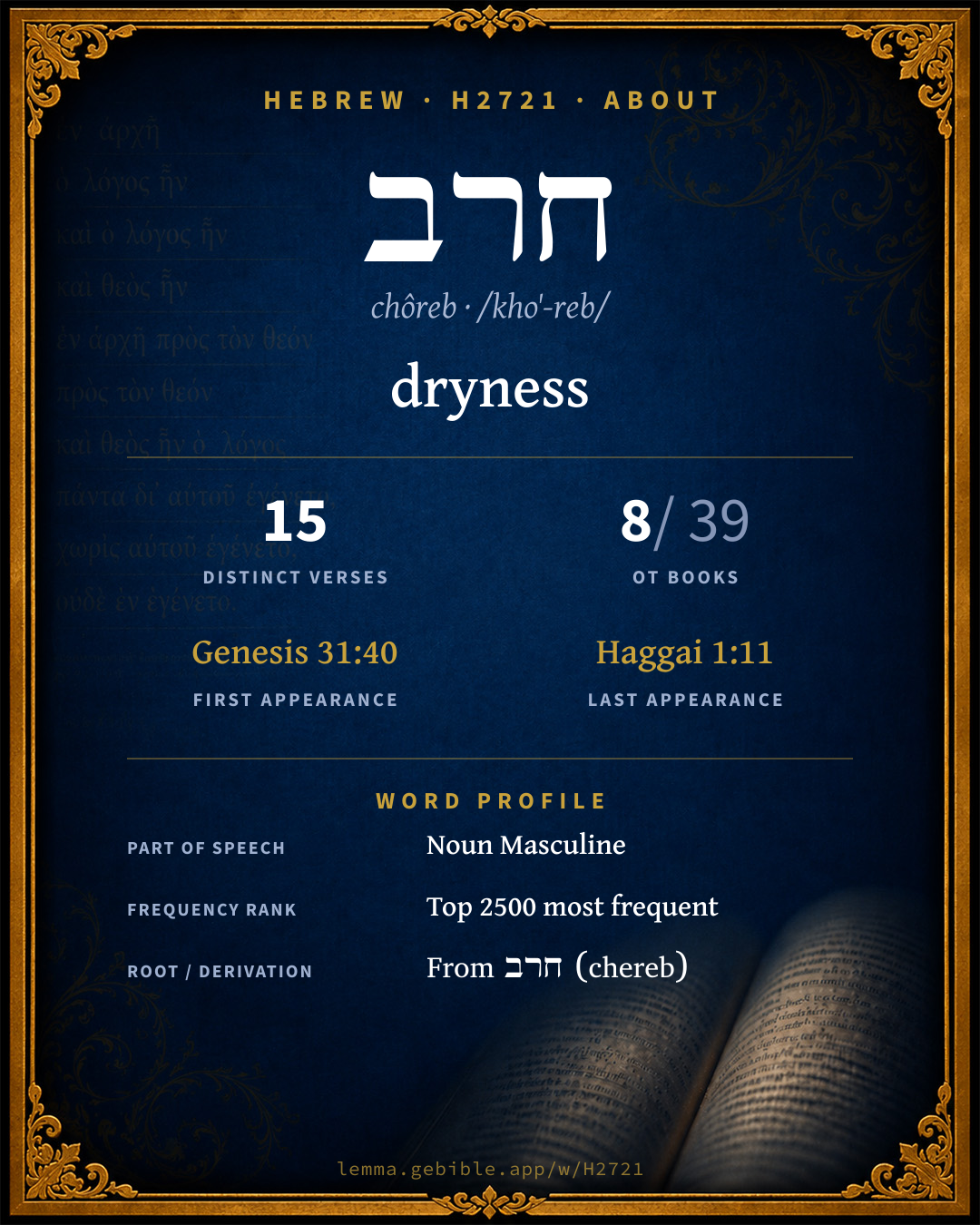
חֹ֫רֶב
dryness
also: desolation, drought, heat fuller range ↓
Full lexicon entry — Brown-Driver-Briggs (BDB)
From Brown-Driver-Briggs (BDB)
Where this word appears
Grammar key — what these labels mean
Part of speech
- Noun
- A naming word — a person, place, thing, or idea.
Noun type
- Common
- A common noun — a general class of person, place, or thing (“king,” “city,” “water”), not a specific name.
State
- Absolute
- The independent form of a noun, not bound to a following word.
Gender
- Masculine
- Grammatically masculine.
Number
- Singular
- One.
Every verse where H2721 appears — 15 distinct verses across 8 books. Click any verse to open its interlinear word-by-word view. Verse text shown in the World English Bible for context — . Each verse’s Hebrew form is shown with its reference; the English is not keyword-highlighted, since the data carries no word-level English alignment. Use “Compare translations” on any verse to read it across multiple English versions. This concordance covers the Hebrew Bible; Septuagint (Greek Old Testament) occurrences are not indexed here.
Genesis 1 verse
Judges 3 verses
- Judges 6:37 חֹ֔רֶב n c ms behold, I will put a fleece of wool on the threshing floor; if there be dew on the fleece only, and it be dry on all the ground, then shall I know that you will save Israel by my hand, as you have spoken.
- Judges 6:39 חֹ֤רֶב n c ms Gideon said to God, Don't let your anger be kindled against me, and I will speak but this once: Please let me make a trial just this once with the fleece; let it now be dry only on the fleece, and on all the ground let there be dew.
- Judges 6:40 חֹ֤רֶב n c ms God did so that night: for it was dry on the fleece only, and there was dew on all the ground.
Job 1 verse
Isaiah 4 verses
- Isaiah 4:6 מֵ/חֹ֑רֶב prep + n c ms There will be a pavilion for a shade in the daytime from the heat, and for a refuge and for a shelter from storm and from rain.
- Isaiah 25:4 מֵ/חֹ֔רֶב prep + n c ms For you have been a stronghold to the poor, a stronghold to the needy in his distress, a refuge from the storm, a shade from the heat, when the blast of the awesome ones is as a storm against the wall.
- Isaiah 25:5 כְּ/חֹ֣רֶב חֹ֚רֶב prep + n c ms n c ms As the heat in a dry place will you bring down the noise of strangers; as the heat by the shade of a cloud, the song of the awesome ones shall be brought low.
- Isaiah 61:4 חֹ֔רֶב n c ms They shall build the old wastes, they shall raise up the former desolations, and they shall repair the waste cities, the desolations of many generations.
Jeremiah 3 verses
- Jeremiah 36:30 לַ/חֹ֥רֶב prep det + n c ms Therefore thus says Yahweh concerning Jehoiakim king of Judah: He shall have none to sit on the throne of David; and his dead body shall be cast out in the day to the heat, and in the night to the frost.
- Jeremiah 49:13 לְ/חֹ֥רֶב prep + n c ms For I have sworn by myself, says Yahweh, that Bozrah shall become an astonishment, a reproach, a waste, and a curse; and all the cities of it shall be perpetual wastes.
- Jeremiah 50:38 חֹ֥רֶב n c ms A drought is on her waters, and they shall be dried up; for it is a land of engraved images, and they are mad over idols.
Ezekiel 1 verse
Zephaniah 1 verse
Haggai 1 verse
About this entry
At a glance — auto-summarized from this page’s data, not written by a person. Every figure links to its source below. This summary describes the numbers; it doesn’t interpret them.
The Hebrew noun חרב centers on the idea of “dryness.” Beyond “dryness” it also covers “desolation”, “drought”, and “heat” — see its full sense range. It turns up in 15 verses across 8 books, an uncommon footprint. The word gravitates to Isaiah (27%), then Judges and Jeremiah. First canonically at Genesis 31:40, it enters the text early. For the data behind this summary, explore the sense tree and the renderings breakdown below.
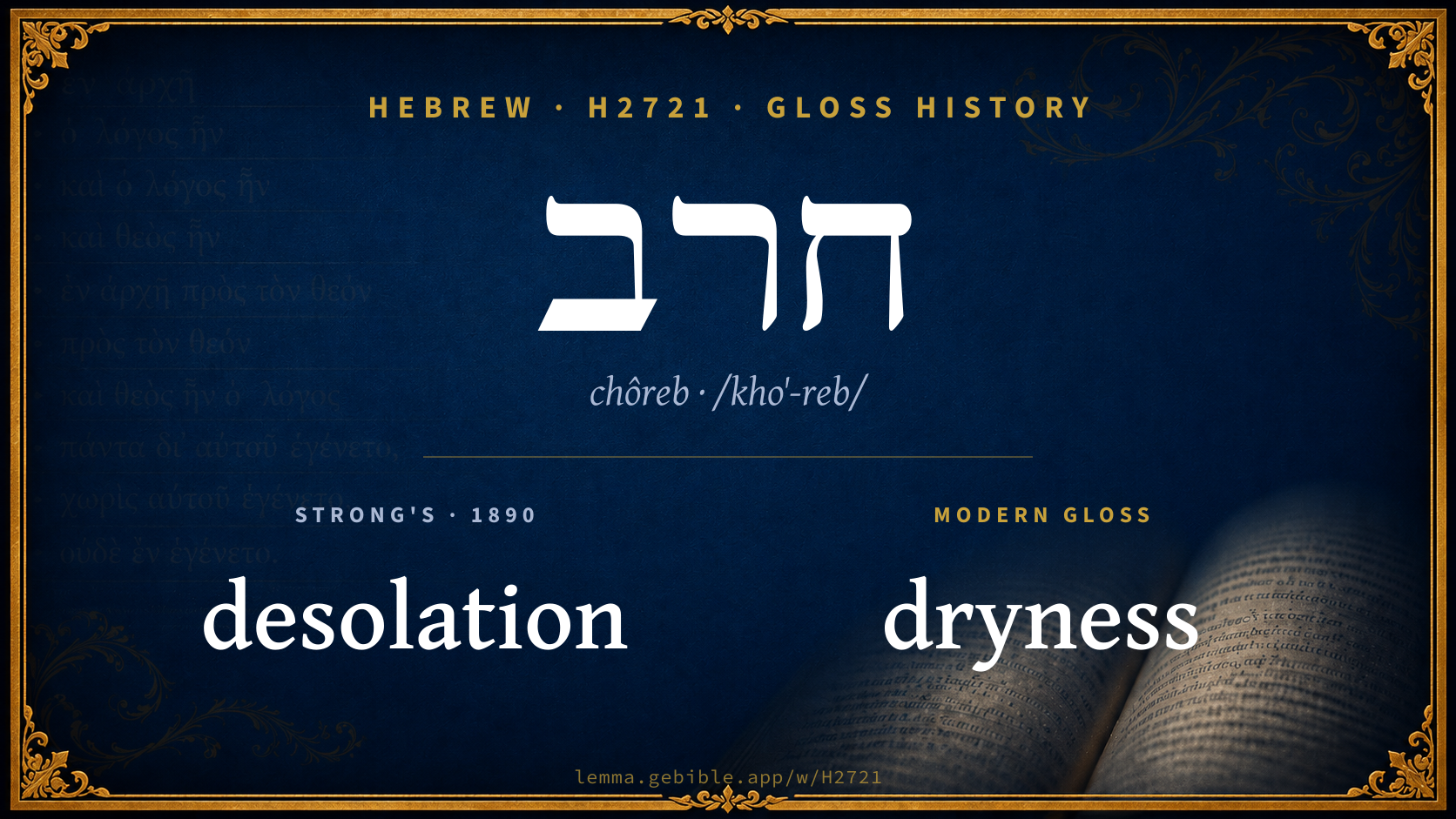
Gloss history
Strong's 1890 vs modern scholarship
About this word
Strong's H2721 catalogs a Hebrew word from the Hebrew Old Testament.
These counts are not copied from any lexicon or concordance. They are computed here, from the morphology-tagged Hebrew Old Testament. What Lemma adds →
- 15
- distinct verses
- The word appears in 15 distinct verses.
- 8 / 39
- OT books
- The word appears in 8 of 39 Old Testament books.
- #1,752
- by frequency
- Top 2500 most frequent Hebrew words (rank 1,752 of 8,640 Hebrew words by occurrence).
View all 15 occurrences in the concordance →
By section of the Old Testament
By traditional corpus
Conventional, traditional groupings — biblical authorship is debated, so this is a traditional corpus grouping, not an authorship claim. Each share is this word’s portion of its verses in that division of the Hebrew canon. Each figure is a share of the word’s 15 distinct verses.
- Prophets (Nevi'im) 13 verses · 87%
- Torah (Pentateuch) 1 verse · 7%
- Writings (Ketuvim) 1 verse · 7%
How translations render this word
Counts come from each version’s own published word-to-Strong’s tagging or interlinear alignment — an approximate guide to how each version renders this word, not a word-level alignment the data otherwise carries. Because each total is that version’s own tagged count, the per-version totals vary from one another and need not match the appearance or distinct-verse counts above. These counts may also differ from a printed concordance because Lemma counts each distinctly tagged rendering and does not collapse phrase taggings into a single head-word total. This is a fixed set of word-tagged versions (KJV, ASV, BSB, ULT) and does not change with the reading translation you choose elsewhere. Each version’s license is shown beside its name below (and on Sources).
BDB lists this Strong’s number as 2 distinct words (homographs). Each count above pools all of them and is not split by sense — see the Senses section below. A low-frequency rendering may belong to a different one of those words, not the primary meaning.
- King James Version†: Heat 6×, Drought 3×, Waste 2×
- American Standard Version†: Heat 6×, Drought 2×, Waste 2×
- Berean Standard Bible†: Heat 3×, Drought 2×, Dry 2×
- unfoldingWord Literal Text†: Heat 5×, Desolation 2×, Dryness 2×
King James Version Public Domain
Renders H2721 across 16† tagged occurrences — most commonly:
Plus 5 renderings that appear only once — usually multi-word phrases or single function words the recovered tagging swept in, not distinct renderings.
American Standard Version Public Domain
Renders H2721 across 16† tagged occurrences — most commonly:
Plus 6 renderings that appear only once — usually multi-word phrases or single function words the recovered tagging swept in, not distinct renderings.
Berean Standard Bible Public Domain
Renders H2721 across 16† tagged occurrences — most commonly:
Plus 9 renderings that appear only once — usually multi-word phrases or single function words the recovered tagging swept in, not distinct renderings.
unfoldingWord Literal Text CC BY-SA 4.0
Renders H2721 across 13† tagged occurrences — most commonly:
Plus 4 renderings that appear only once — usually multi-word phrases or single function words the recovered tagging swept in, not distinct renderings.
Senses in the full BDB
What do BDB’s symbols mean?
BDB uses these scholarly abbreviations:
| Symbol | Meaning |
|---|---|
| 𝔊 | the Septuagint (the ancient Greek translation, LXX) |
| 𝔙 | the Vulgate (the Latin translation) |
| 𝔖 | the Syriac version (the Peshitta) |
| 𝔗 | the Targum (the Aramaic translation) |
| ψ | the Psalms |
| √ | root (the underlying root or stem) |
| ‖ | parallel passage (a synonymous or contrasted parallel) |
| † | the dagger: every passage where the word occurs is cited |
The 3 senses and sub-senses the full Brown-Driver-Briggs lexicon distinguishes for this word, in lexicon order (not ranked by frequency), with BDB’s own verbatim wording and sub-sense lettering. Shown in Hebrew script with BDB’s own scholarly abbreviations. The condensed entry is in the Lexicon Entry tab. See also the Forms in the corpus table below.
חרב I
- 1. dryness Ju 6:37, 39, 40 (all of absence of dew); Je 50:38 (‖ יָבֵשׁ); so read also Zc 11:17 (for MT חֶרֶב, see v b and StaZAW i. 1881, 29), a drying up upon his arm (i. e. a withering) and upon his right eye. e.g. Judges 6:37
- 2. drought Hg 1:11 + Dt 28:22 v. supr. e.g. Haggai 1:11
- 3. parching heat (of sun) Gn 31:40 (opp. קֶ֫רַח), Je 36:30 (opp. id.); Is 4:6; 25:4, 5(×2) of fever Jb 30:30. e.g. Genesis 31:40
חרב II [m.] desolation
Senses from the full Brown-Driver-Briggs lexicon (Brown, Driver, Briggs; Oxford 1906 — public domain), digitized via Sefaria, supplemented by the OpenScriptures HebrewLexicon (CC BY 4.0). Full attribution on Sources.
Word origin
I. n.m. Gn 31:40 dryness, drought, heat, abs. ח׳ Gn 31:40 + 11 times + Dt 28:22 (for MT חֶרֶב; v. Di, sq. 𝔙; 𝔊 and 𝔊L om.);—
II. n.[m.] desolation;—עָרֵי ח׳ Is 61:4 cities of desolation (‖ שֹׁמֲמוֹת, and, in v a, חָרְבוֹת); cf. Zp 2:14 (but read עֹרֵב, 𝔊 We al.) Je 49:13; מִצְרַיִם חָרְבוֹת ח׳ Ez 29:10 Egypt shall be wastes of desolation (but 𝔊 𝔙 Co wastes of the sword, חֶרֶב for חֹרֶב); + Ez 38:8 Co, who reads מֵחֹרֶב (or מֵחָרְבָּה).
— Brown-Driver-Briggs (Oxford 1906, public domain), digitized via Sefaria, supplemented by the OpenScriptures HebrewLexicon (CC BY 4.0). See Sources.
Derived from חרב (chereb) (H2719) — sword.
Jastrow Dictionary
A second Hebrew/Aramaic lexicon for comparison, covering Aramaic and post-biblical (Talmudic, Targumic, Midrashic) usage that the biblical-Hebrew BDB does not. Matched by lemma rather than by Strong’s number, so a lemma may carry more than one Jastrow headword (shown separately below), and the entries cover usage well beyond the Bible.
חָרִב I
- (b. h.) to be burned, dried up, ruined, waste. Snh. 22ᵃ כאלו ח׳ בה"מ וכ׳ as if the Temple had been destroyed in his days. Tosef. Men. XIII, 22 מפני מה חָרְבָה וכ׳ why was Shiloh destroyed?; Yoma 9ᵃ. Kil. IV, 1 (expl. קרחת הכרם) כרם שח׳ באמצעו a vineyard the central part of which is laid waste. Ib. V, 1; a. fr. [Num. R. s. 7, end בבל ח׳ מקדש, read: החריב. Taan. 29ᵃ כשח׳ טורנוס, read: כשחרש, v. Rabb. D. S. a. l.]
- to be destroyed. Erub. 18ᵇ. Yoma 39ᵇ שסופך עתיד לֵיחָרֵב that it is thy final destiny to be destroyed; a. fr.
- same. Pesik. R. s. 31 שיִתְחָרֵב. [Pirké d’R. El. ch. XXXIII, v. חָרַךְ.]
- to destroy, lay waste. Tosef. M. Kat. I, 5 מַחֲרִיבִין חורי וכ׳ you may destroy ant-stores (during the festive week). Num. R. s. 7, end שהֶחֱרִיבוּ בה"מ for they (the Romans) destroyed the Temple; a. fr.
- to be destroyed. Pes. 42ᵇ (ref. to Ez. XXVI, 2) אי מלאה זו הָחְרְבָה זו Ms. M. (ed. חרבה, v. Rabb. D. S. a. l. note 9) when the one (Jerusalem) is populated, the other (Caesarea) is laid waste; Yalk. Gen. 110 חֲרֵיבָה. e.g. Ezekiel 26:2
חֲרֵב
- Targ. Ez. XXVI, 2. Targ. Hos. XIII, 15. Targ. Is. XIX, 5; a. fr.—Naz. 32ᵇ דח׳ בה"מ that the Temple has been destroyed. Ib. דיִחְרוֹב that it will be destroyed. Gitt. 56ᵃ דלא לִיחֲרוֹב וכ׳ that Jerusalem may not be destroyed. Y. Ber. II, 5ᵃ top דברגליה חריב with whose arrival it was destroyed; a. fr.
- to destroy, lay waste. Targ. Is. XLII, 15. Targ. Jud. XVI, 24; a. fr.—Yoma 69ᵇ דאַחְרְבֵיה וכ׳ who destroyed the Temple. Taan. 29ᵃ top לאַחְרוּבֵי Ms. M. a. Rashi (ed. לַחְרוּבֵי); Gitt. 56ᵃ לַחְרוּבֵי; a. fr.
- to be destroyed. Y. Ber. l. c.
חָרֵב II
- preced. wds.)
- 1. ruined. Y. Ber. IV, 8ᵃ. Yalk. Gen. 110, p. חָרֵב I; a. fr.—Pl. חֲרֵבִים, חֲרֵי׳; f. חֲרֵבוֹת, חֲרֵי׳. Ex. R. s. 31 (ref. to Num. XXIV, 5) ומַשְׁכנותיך כשהם ח׳ thy pledges, when they are in ruins, v. מַשְׁכּוֹן; a. fr. e.g. Numbers 24:5
- 2. dry. Y. Sot. III, beg. 18ᶜ ח׳ של חטין the dry (oil-less) offering of wheat, opp. בלול. Kidd. 62ᵃ top; a. e.
חָרֵב
- ch., v. חָרוֹב
חֶרֶב
- 1. sword. Ḥull. 3ᵃ, v. חָלָל I. B. Bath. 8ᵇ ח׳ קשה וכ׳ death in war is a greater affliction than natural death. Snh. 116ᵃ מהם הרגו בח׳ some of them they put to death by the sword. Tanḥ. Balak 8; Num. R. s. 20 אא"כ שלף חַרְבּוֹ without drawing his sword. Ib. בח׳ חייהם live on their sword. Taan. III, 5 על הח׳ on the sword, i.e. when armies are passing the country. Ib. 22ᵃ ח׳ של שלום a friendly army passing; a. fr.
- 2. the sword-shaped handle of a plough. Kel. XXI, 2. Tosef. Kel. B. Bath. I, 7.—Pl. חֲרָבוֹת. Pesik. R. s. 21 ח׳ מכאן וכ׳ (soldiers with) swords here &c.; a. e.
חָרֶב
- same. Targ. Gen. XXXIV, 26. Ib. III, 24; a. fr.—Sabb. 123ᵇ, v. אוּשְׁכָּפָא; (Ar. scraping knife).
חָרֶב ²
- (חרב) dry eruption. Targ. Y. Deut. XXVIII, 27 Ar. ed. Koh. חרב (oth. ed. חרבא, חרבונא; Targ. ed. גרבא; h. text גרב).
A Dictionary of the Targumim, the Talmud Babli and Yerushalmi, and the Midrashic Literature (Marcus Jastrow; London, Luzac, 1903) — Public Domain. Digitized via Sefaria. Digitized via Sefaria. Full attribution on Sources.
Forms in the corpus
The 13 distinct written forms H2721 takes in the Hebrew Bible, most frequent first — each parse links to that state’s occurrences in the concordance. Hebrew forms include their vowel points and cantillation, so a single lemma takes many written forms.
| Form | Parsing | Example | Uses |
|---|---|---|---|
| חֹ֔רֶב | Noun, Common, Masculine, Singular, Absolute | Isaiah 61:4 | 2 |
| חֹ֣רֶב | Noun, Common, Masculine, Singular, Absolute | Ezekiel 29:10 | 2 |
| חֹ֤רֶב | Noun, Common, Masculine, Singular, Absolute | Judges 6:39 | 2 |
| חֹ֖רֶב | Noun, Common, Masculine, Singular, Absolute | Genesis 31:40 | 1 |
| חֹ֚רֶב | Noun, Common, Masculine, Singular, Absolute | Isaiah 25:5 | 1 |
| חֹ֜רֶב | Noun, Common, Masculine, Singular, Absolute | Haggai 1:11 | 1 |
| חֹ֥רֶב | Noun, Common, Masculine, Singular, Absolute | Jeremiah 50:38 | 1 |
| חֹֽרֶב | Noun, Common, Masculine, Singular, Absolute | Job 30:30 | 1 |
| כְּ/חֹ֣רֶב | Noun, Common, Masculine, Singular, Absolute | Isaiah 25:5 | 1 |
| לְ/חֹ֥רֶב | Noun, Common, Masculine, Singular, Absolute | Jeremiah 49:13 | 1 |
| לַ/חֹ֥רֶב | Noun, Common, Masculine, Singular, Absolute | Jeremiah 36:30 | 1 |
| מֵ/חֹ֑רֶב | Noun, Common, Masculine, Singular, Absolute | Isaiah 4:6 | 1 |
| מֵ/חֹ֔רֶב | Noun, Common, Masculine, Singular, Absolute | Isaiah 25:4 | 1 |
Same root — word family
Other BDB entries built from the same root as H2721, grouped by Strong’s listed origin. These share a root / origin per the lexicon — not necessarily a shared meaning. Each links to that word’s own entry.
Derives from
Derived from this word
Compare all same-root words → They share a root, not necessarily a meaning.
Septuagint verse parallels
This word appears in 13 verses that also exist in the Greek Old Testament (Septuagint), out of the 15 Hebrew verses it occurs in. You can read those verses in Greek by switching the Old Testament edition to the Septuagint.
Read these verses in the Septuagint
- Genesis 31:40
- Judges 6:37
- Job 30:30
- Isaiah 4:6
- Jeremiah 49:13
- Ezekiel 29:10
- Zephaniah 2:14
- Haggai 1:11
This is a verse-level parallel only — the same verses exist in both the Hebrew and Greek Old Testaments. No word-level Hebrew↔Greek correspondence is claimed: the data carries no such alignment, so no Greek word is shown as this Hebrew word’s translation. Coverage is not total — the Septuagint omits the deuterocanon and renumbers the Psalms, so some Hebrew verses have no direct Greek parallel.