Judges 1:25

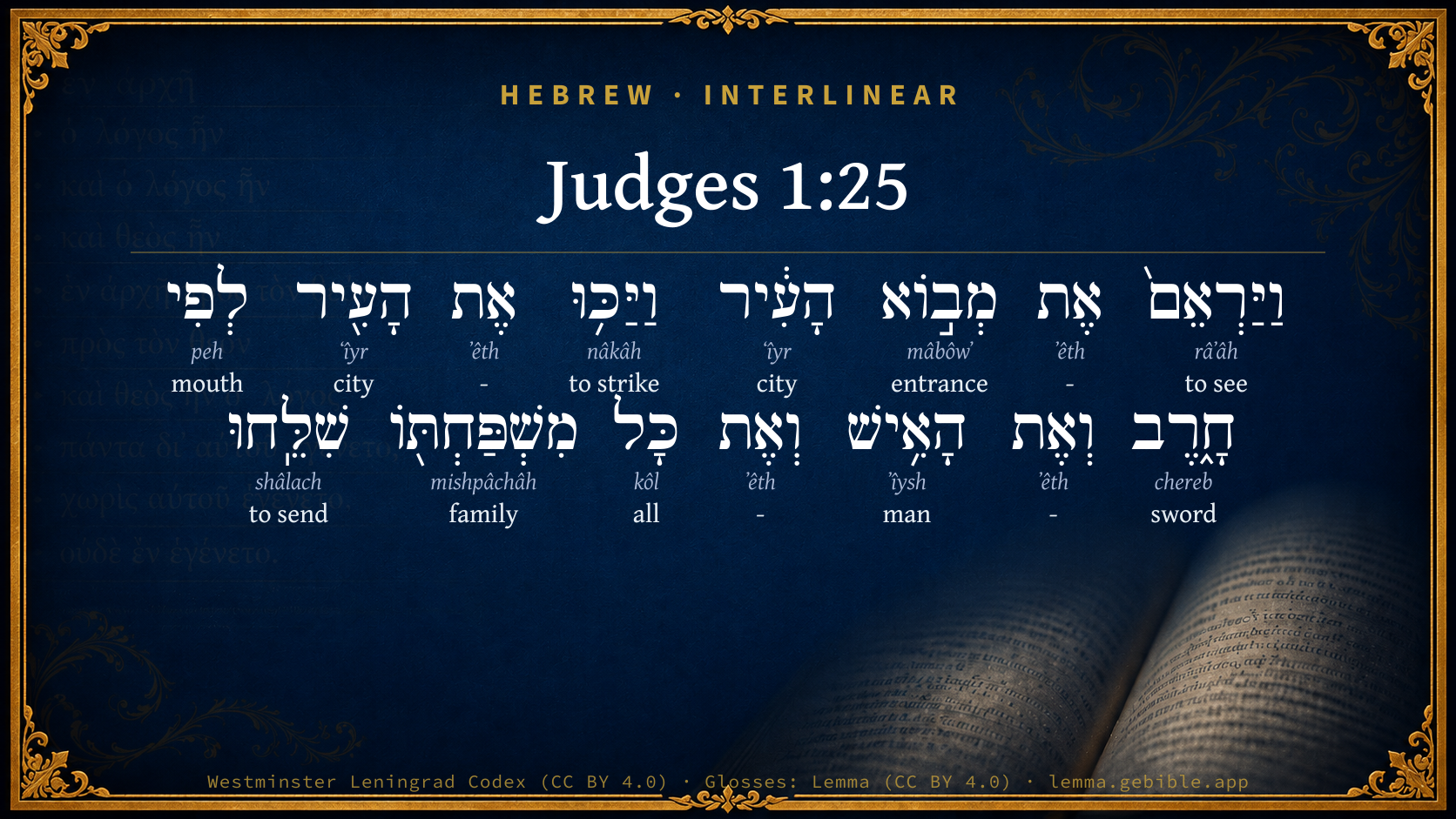
Hebrew (Westminster Leningrad Codex) Judges 1:25 appears in the Hebrew Old Testament. The text above is from the Westminster Leningrad Codex. Each word links to its Strong’s number, a concise gloss, and parsing drawn from the Open Scriptures Hebrew Bible morphology. Click any word for its full Brown-Driver-Briggs (BDB) entry.
Download image
Cite this verse

Judges 1:25 (World English Bible). Public Domain. Lemma interlinear Bible study tool, https://lemma.gebible.app/v/judges/1/25.

Show BibTeX & RIS
BibTeX
RIS
English Translation
He shown them the entrance into the city; and they struck the city with the edge of the sword; but they let the man go and all his family.
World English Bible · Public Domain
Download a study sheet

One document with this verse’s original text, its word-by-word gloss line, the meaning frame, cross-references with their text, attributed commentary, and full source and license credits — printable, and it pastes into notes with its structure intact.

This verse Autodidact and up

Study sheet (.html) Plain text (.txt)

A passage Seminary Student

Up to 50 verses in one chapter. A passage sheet keeps up to 6 commentary sources and 12 cross-references per verse, in the order this page ranks them, and says so on the sheet whenever that leaves anything out. Ask for a single verse and you get the Autodidact verse sheet above.

Everything on this page stays free to read, with no account — the sheet is a download of what is already on screen, not access to it.

Want to remove ads? Support Godless Engineer
Compare translations 3

The same verse in 3 English versions, stacked beneath the original-language interlinear above. Click any original word for its lexicon entry.

Each is an independent rendering of the whole verse — the interlinear is not word-aligned to these translations.

Highlighted words mark where these versions differ — a whole-verse word diff, not a word-by-word alignment.

  • World English Bible Public Domain
    He shown them the entrance into the city; and they struck the city with the edge of the sword; but they let the man go and all his family.
  • King James Version Public Domain
    And when he showed them the entrance into the city, they smote the city with the edge of the sword; but they let go the man and all his family.
  • unfoldingWord Literal Text CC BY-SA 4.0
    So he showed them the entrance of the city, and they struck the city to the mouth of the sword, but the man and all of his family they sent.

unfoldingWord Literal Text — © unfoldingWord, licensed CC BY-SA 4.0. Word-aligned USFM3 via Door43 (git.door43.org/unfoldingWord/en_ult).

Versions to compare (up to 4)

3 of 4 selected

Show all 18 translations

Every available English version of this verse, each an independent rendering of the whole verse.

  • World English Bible Public Domain
    He shown them the entrance into the city; and they struck the city with the edge of the sword; but they let the man go and all his family.
  • Berean Standard Bible Public Domain
    So the man showed them the entrance to the city, and they put the city to the sword but released that man and all his family.
  • Majority Standard Bible Public Domain
    So the man showed them the entrance to the city, and they put the city to the sword but released that man and all his family.
  • King James Version Public Domain
    And when he showed them the entrance into the city, they smote the city with the edge of the sword; but they let go the man and all his family.
  • American Standard Version (1901) Public Domain
    And he showed them the entrance into the city; and they smote the city with the edge of the sword; but they let the man go and all his family.
  • Revised Version (1885) Public Domain
    And he shewed them the entrance into the city, and they smote the city with the edge of the sword; but they let the man go and all his family.
  • Geneva Bible (1599) Public Domain
    And when hee had shewed them the waie into the citie, they smote the citie with the edge of the sworde, but they let the man and all his housholde depart.
  • Douay-Rheims (1899) Public Domain
    And when he had shewn them, they smote the city with the edge of the sword: but that man and all his kindred they let go:
  • Young's Literal Translation Public Domain
    And he sheweth them the entrance of the city, and they smite the city by the mouth of the sword, and the man and all his family they have sent away;
  • Literal Standard Version CC BY-SA 4.0
    And he shows them the entrance of the city, and they strike the city by the mouth of the sword, and they have sent the man and all his family away;
  • Unlocked Literal Bible CC BY-SA 4.0
    He showed them a way into the city, and so they attacked the city with the edge of the sword, but they let the man and all his family get away.
  • unfoldingWord Literal Text CC BY-SA 4.0
    So he showed them the entrance of the city, and they struck the city to the mouth of the sword, but the man and all of his family they sent.
  • Darby Bible Public Domain
    And he showed them the way into the city; and they smote the city with the edge of the sword, but they let the man and all his family go.
  • World Messianic Bible Public Domain
    He showed them the entrance into the city, and they struck the city with the edge of the sword; but they let the man and all his family go.
  • Webster's Bible Public Domain
    And when he showed them the entrance into the city, they smote the city with the edge of the sword: but they let go the man and all his family.
  • Free Bible Version CC BY-SA 4.0
    The man showed them the way into the town, and they killed all the inhabitants except the man and his family, whom they let go.
  • Bible in Basic English Public Domain
    So he made clear to them the way into the town, and they put it to the sword; but they let the man and all his family get away safe.
  • JPS Tanakh (1917) Public Domain
    And he showed them the entrance into the city, and they smote the city with the edge of the sword; but they let the man go and all his family.

Literal Standard Version (2020), Covenant Press — licensed CC BY-SA 4.0. Text via the HelloAO Bible API (eBible.org). Unlocked Literal Bible (unfoldingWord) — licensed CC BY-SA 4.0. Text via the HelloAO Bible API (eBible.org). unfoldingWord Literal Text — © unfoldingWord, licensed CC BY-SA 4.0. Word-aligned USFM3 via Door43 (git.door43.org/unfoldingWord/en_ult). Free Bible Version, Dr. Jonathan Gallagher — licensed CC BY-SA 4.0. Text via the HelloAO Bible API (eBible.org).

Word by word

More ways to search: Search by grammar → Find every occurrence → Compare this word →

Practice this passage: Drill this verse → Learn its vocabulary →

מְב֣וֹא
mâbôwʼ
H3996
“entrance of”
Noun, Common, Masculine, Singular, Construct
Part of Speech
Noun
Type
Common
Gender
Masculine
Number
Singular
State
Construct
Full BDB Definition

Origin: from H935

TWOT: 212b

entrance, a coming in, entering - sunset - sunset - sunset, west
  1. וַיַּרְאֵם֙ râʼâh H7200 “and · to see · them” Conjunction + Verb, Hiphil, Sequential Imperfect, 3rd Person, Masculine, Singular + Suffix, Personal, 3rd Person, Masculine, Plural
  2. אֶת ʼêth H853 “-” Particle, Direct Object
  3. הָעִ֔יר ʻîyr H5892 “the · city” Particle, Definite Article + Noun, Common, Feminine, Singular, Absolute
  4. וַיַּכּ֥וּ nâkâh H5221 “and · to strike” Conjunction + Verb, Hiphil, Sequential Imperfect, 3rd Person, Masculine, Plural
  5. אֶת ʼêth H853 “-” Particle, Direct Object
  6. הָעִ֖יר ʻîyr H5892 “the · city” Particle, Definite Article + Noun, Common, Feminine, Singular, Absolute
  7. לְפִי peh H6310 “to/for · mouth of” Preposition + Noun, Common, Masculine, Singular, Construct
  8. חָ֑רֶב chereb H2719 “sword” Noun, Common, Feminine, Singular, Absolute
  9. וְאֶת ʼêth H853 “and · -” Conjunction + Particle, Direct Object
  10. הָאִ֥ישׁ ʼîysh H376 “the · man” Particle, Definite Article + Noun, Common, Masculine, Singular, Absolute
  11. וְאֶת ʼêth H853 “and · -” Conjunction + Particle, Direct Object
  12. כָּל kôl H3605 “all of” Noun, Common, Masculine, Singular, Construct
  13. מִשְׁפַּחְתּ֖וֹ mishpâchâh H4940 “family · his” Noun, Common, Feminine, Singular, Construct + Suffix, Personal, 3rd Person, Masculine, Singular
  14. שִׁלֵּֽחוּ shâlach H7971 “to send” Verb, Piel, Perfect, 3rd Person, Common, Plural

About this verse

These counts appear in no published source. They are computed here, from the morphology-tagged text and Lemma’s own curated glosses. What Lemma adds →

15
words
11
distinct lemmas
Historical
section

Notable vocabulary

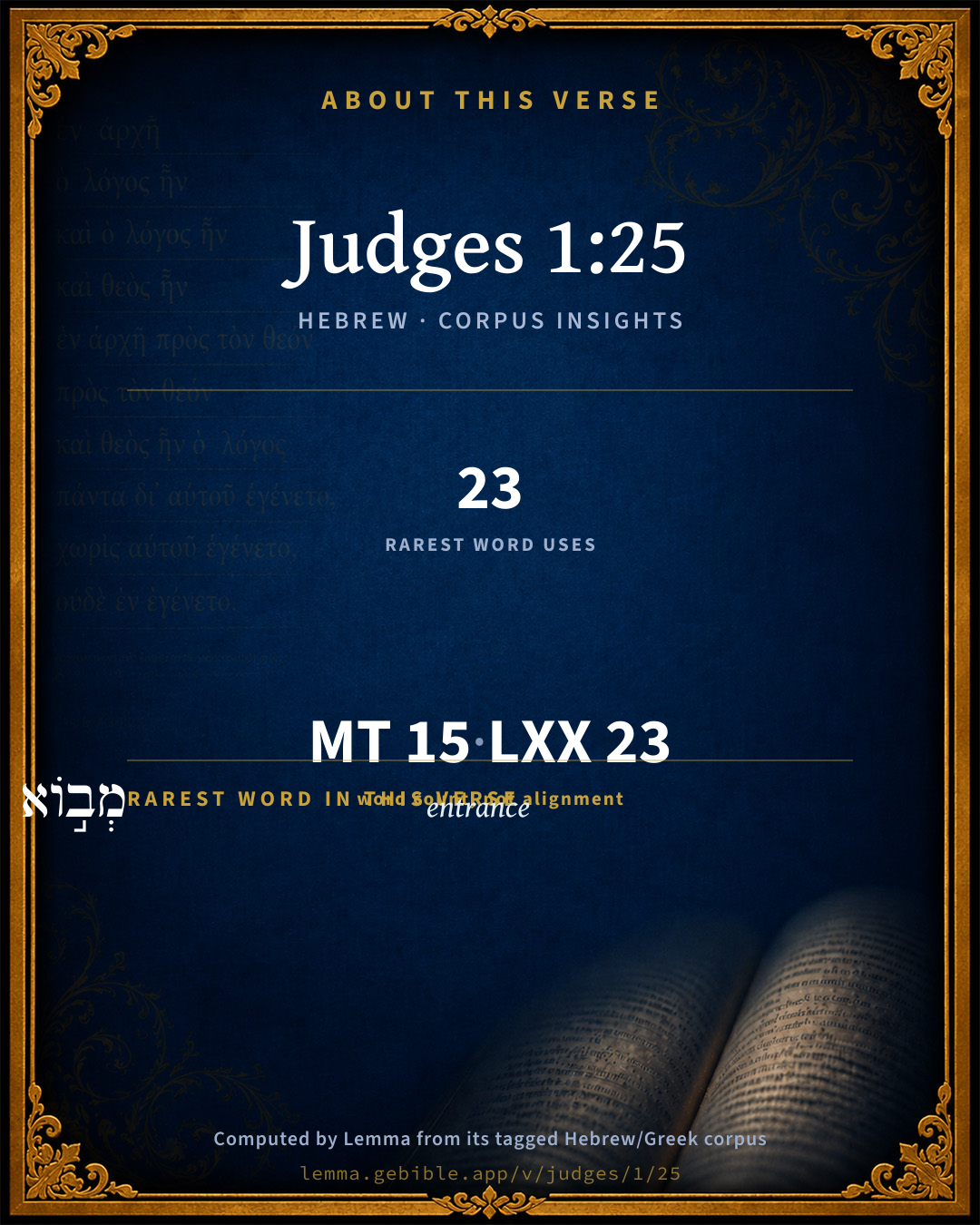
The rarest word here is מְב֣וֹא entrance H3996 — appearing just 23 times in the whole Hebrew Bible.

Shared distinctive vocabulary

מְב֣וֹא entrance H3996 occurs in 23 verses of the Hebrew Bible. Also found in:

Grammatical profile

  • 3 verbs
  • 8 nouns
  • 4 particles

Verb forms

  • וַיַּרְאֵם֙ Hiphil · Sequential Imperfect
  • וַיַּכּ֥וּ Hiphil · Sequential Imperfect
  • שִׁלֵּֽחוּ Piel · Perfect

Repetition

A word recurs within this verse — often emphatic in Hebrew:

  • הָעִ֔יר city H5892 ×2

Hebrew & Septuagint length

In English translation the verse runs 29 words from the Hebrew and 29 from the Septuagint (LXX English) — the same length.

A rough comparison of the two English renderings, which tokenize alike — not a word-level alignment.

Word counts can differ between the Hebrew and the Greek without any difference in meaning — e.g. the Hebrew direct-object marker אֵת has no separate Greek word, and Greek often adds the article ὁ.

In the original languages it is 15 Hebrew tokens and 23 Greek tokens — but the two are counted differently (Hebrew bundles its prefixes and suffixes into one token; the Greek is in lemma form), so that isn’t a like-for-like length.

Cross-references

1

Topical passages linked to Judges 1:25 in the Treasury of Scripture Knowledge — connected by theme and wording, ordered by reader-vote popularity; previews shown in the World English Bible.

  • Joshua 6:22–25 Joshua said to the two men who had spied out the land, Go into the prostitute's house, and bring out there the woman, and all that she has, as you swore to her.

Cross-references courtesy of OpenBible.info (CC BY 4.0).

Hebrew and Greek witnesses Masoretic Hebrew ↔ Greek Septuagint

The same verse in the two great witnesses to the Old Testament, shown verse-for-verse.

These are two independent witnesses, not word-aligned to each other, and the Septuagint is shown in lemma (dictionary) form.

Hebrew Judges 1:25 Masoretic · Westminster Leningrad Codex

וַיַּרְאֵם֙ אֶת מְב֣וֹא הָעִ֔יר וַיַּכּ֥וּ אֶת הָעִ֖יר לְפִי חָ֑רֶב וְאֶת הָאִ֥ישׁ וְאֶת כָּל מִשְׁפַּחְתּ֖וֹ שִׁלֵּֽחוּ

He shown them the entrance into the city; and they struck the city with the edge of the sword; but they let the man go and all his family.

World English Bible · Public Domain

Greek LXX Judges 1:25 Septuagint · lemma form

καί δεικνύω αὐτός ὁ εἴσοδος ὁ πόλις καί πατάσσω ὁ πόλις ἐν στόμα ῥομφαία ὁ δέ ἀνήρ καί ὁ συγγένεια αὐτός ἐκ ἀποστέλλω

And he showed them the way into the city; and they struck the city with the edge of the sword; but they let go the man and his family.

LXX2012 (modern English Septuagint) · Public Domain

Hebrew: Westminster Leningrad Codex (CC BY 4.0). Greek: Septuagint (public domain); English from LXX2012 (modern English Septuagint) (Public Domain). How the Septuagint differs from the Hebrew →

Targum (Aramaic paraphrase)

1

The Targum is the ancient Jewish Aramaic paraphrase of the Hebrew Scriptures — an interpretive translation, not the Hebrew text itself. Onkelos (literal) and Pseudo-Jonathan (expansive) render the Torah, and Jonathan the Prophets. Coverage is partial: where no permissively-licensed English translation exists for a verse, only the Aramaic is shown. This is verse-level text, not a word-by-word alignment to the Hebrew.

  1. Targum Jonathan Prophets (Joshua–Malachi)
    וְאַחֲזִינוּן יַת מַעֲלָנָא דְקַרְתָּא וּמְחוֹ יַת קַרְתָּא לְפִתְגַם דְחָרֶב וְיַת גַבְרָא וְיַת כָּל זַרְעִיתֵיהּ שֵׁזִיבוּ:

    (no public-domain English translation for this verse)

    Targum Jonathan — Aramaic: “Mikraot Gedolot” (public domain). English: “Sefaria Community Translation” (CC0 1.0 (public-domain dedication)); “London "Chaldee Paraphrase," 1871” (public domain). Text via Sefaria.

Commentary

Notes on Judges 1:25 from classic Christian and Jewish commentators (each source and its license shown beneath its notes). The classic Christian expositions comment on the surrounding passage and are grouped to its opening verse, so a note may address several verses; the Jewish commentaries on the Tanakh (Rashi and others) are per-verse, so they appear only where the commentator wrote on this verse.

Lemma curates 59 commentaries, every one of them public domain or Creative Commons licensed, each selected and text-cleaned for this edition rather than reprinted as found. About our sources →

Trapp's Complete Commentary

John Trapp

Jdg 1:25 And when he shewed them the entrance into the city, they smote the city with the edge of the sword; but they let go the man and all his family.

Ver. 25. And when he showed them the entrance,] i.e., Where and how they might best take it.

But they let go the man and all his family.] Who if he did this out of true faith, as Rahab did, {Jos 2:1-24} he is to be excused: but if for selfish ends and sinister respects, he is to be esteemed a traitor, and might have met with such reward as Metius Suffetius did, who was drawn in pieces with wild horses by Tullus Hostilius for his treachery. Or as John Justinian of Genua did, who let Mohammed the great Turk enter Constantinople upon promise to make him king. He made him so; but after three days put him to death. Or, lastly, as he that betrayed the Rhodes; for he had his promised wife and portion presented; but the Turk told him that he would not have a Christian to be his son-in-law; he must needs be a Moslem, that is, a believing Turk both within and without. And therefore he caused his baptized skin, as he called it, to be taken off, and him to be cast in a bed strowed with salt, that he might get a new skin, and so he should be his son-in-law. But the wicked wretch ended his life with shame and torment.

25 To the only wise God our Saviour, be glory and majesty, dominion and power, both now and ever. Amen.

Ver. 25. {See Trapp on "1Ti 1:17"}

John Trapp, A Commentary or Exposition upon All the Books of the Old and New Testament (1647–1656) — public domain. Text from a community e-Sword module.

The Cambridge Bible for Schools and Colleges

gen. ed. J. J. S. Perowne

25. but they let … go] As Rahab and her kindred were spared, Jos_6:25.

The Cambridge Bible for Schools and Colleges (gen. ed. J. J. S. Perowne; Cambridge University Press, 1878–1918) — public domain. Text from a community e-Sword module.

John Gill's Exposition

And when he showed them the entrance, into the city,.... Pointing to it with his fingers, as the same writers observe:

they smote the city with the edge of the sword; they gave notice of what intelligence they had got to the body of the army, who came up, entered the city, took it, and put the inhabitants of it to the sword, as they were ordered to do with all the Canaanites:

but they let go the man and all his family; who had returned to it, encouraged by the promise made him, and for the sake of saving of his family; which though not expressed, he might have asked the favour of sparing them, which might be promised, as was in the case of Rahab; provided he would either renounce Heathenism, and embrace the true religion, or depart to another country, the latter of which he chose.

John Gill's Exposition of the Whole Bible (1746–1763) — public domain (CC PDM 1.0). Text via the HelloAO Bible API.

Matthew Poole's English Annotations

Together with his estate, as the following verse manifests.

Matthew Poole's English Annotations on the Holy Bible (1683–1685) — public domain. Text from a community e-Sword/MySword module.

Whedon's Commentary on the Bible

Daniel D. Whedon

25. When he showed them — This unpatriotic act is not to be stigmatized as a betrayal of his country, since he did it under duress. The agitation of mind produced by a sudden threat of immediate death disqualifies an ordinary man for responsible action. A very cool and heroic man would have refused a compliance with this request, and would have suffered the consequences. But heroism, though an elevated virtue, cannot be strictly enjoined as a duty. Hence its absence cannot be regarded as a crime.

Daniel D. Whedon (gen. ed.), Commentary on the Old and New Testaments (1874–1909) — public domain. Text from a community e-Sword module.

John Wesley's Explanatory Notes

His family - Together with his estate, as the following verse manifests.

John Wesley, Explanatory Notes Upon the Whole Bible (1754–1765) — public domain. Text via the GEBible commentary corpus.

unfoldingWord translationNotes

Door43 World Missions Community

they attacked the city

Here "city" represents the people. AT: "they attacked the people of the city" (See: Metonymy)

with the edge of the sword

"with the point of the sword." Here "sword" represents the swords and other weapons that the soldiers used in battle. AT: "with their swords" or "with their weapons" (See: Synecdoche)

get away

This is an idiom. AT: "escape" (See: Idiom)

Luz

This new town started in the land of the Hittites was named after the town of Luz, near Bethel, that the man had left.

which is its name to this day

"which is still its name." Here "to this day" refers to the time when the book of Judges was written.

translationWords

sword

family

Hittite

name

unfoldingWord translationNotes — © Distant Shores Media and the Door43 World Missions Community, licensed CC BY-SA 4.0. Source: git.door43.org/Door43/en_tn.

Rashi

Rabbi Shlomo Yitzchaki (Rashi)

He showed them with his finger.

Rashi on the Tanakh — English translations: “The Judaica Press complete Tanach with Rashi, translated by A. J. Rosenberg” (CC BY 4.0); “Pentateuch with Rashi's commentary by M. Rosenbaum and A.M. Silbermann, 1929-1934” (public domain); “The Metsudah Tanach series, Lakewood, N.J” (CC BY 4.0); and “The Book of Joshua, Metsudah Publications, 1997” (CC BY 4.0). Text via Sefaria.

Lesson kit

Teaching starters — assembled from the data on this page, not authored interpretation. Every prompt links to the verse data it draws on. Edit before teaching.

Judges, in the Historical, opens this verse with 15 words (11 distinct Hebrew lemmas). Its most distinctive word is mâbôwʼ (“entrance”). A historical commentator’s framing appears above. Read the whole chapter for the surrounding context.

Discussion questions

  1. What does “entrance” (mâbôwʼ) contribute to the verse as a whole?
  2. Deuteronomy 11:30 shares the word «entrance» with this verse. How do the two illuminate each other?
  3. “city” occurs 2× in this one verse. What is the effect of the repetition?
  4. These translations render this verse differently. What is at stake in choosing one wording over another?
  5. The verb «וַיַּרְאֵם֙» is Hiphil Sequential Imperfect. How does its form color the action?
  6. Reading how Trapp's Complete Commentary and The Cambridge Bible for Schools and Colleges read this verse, where do the two commentators agree and where do they part?

Things to notice

Reading settings

Reading text

Shown beneath each verse's original-language words.

Old Testament
Old Testament edition

Read the OT as the Masoretic Hebrew (MT) or the Greek Septuagint (LXX).

English shown for the Greek Septuagint (in the Hebrew ↔ Greek comparison).

Comparing translations? Open the Compare panel on any verse page to stack up to four side by side.