
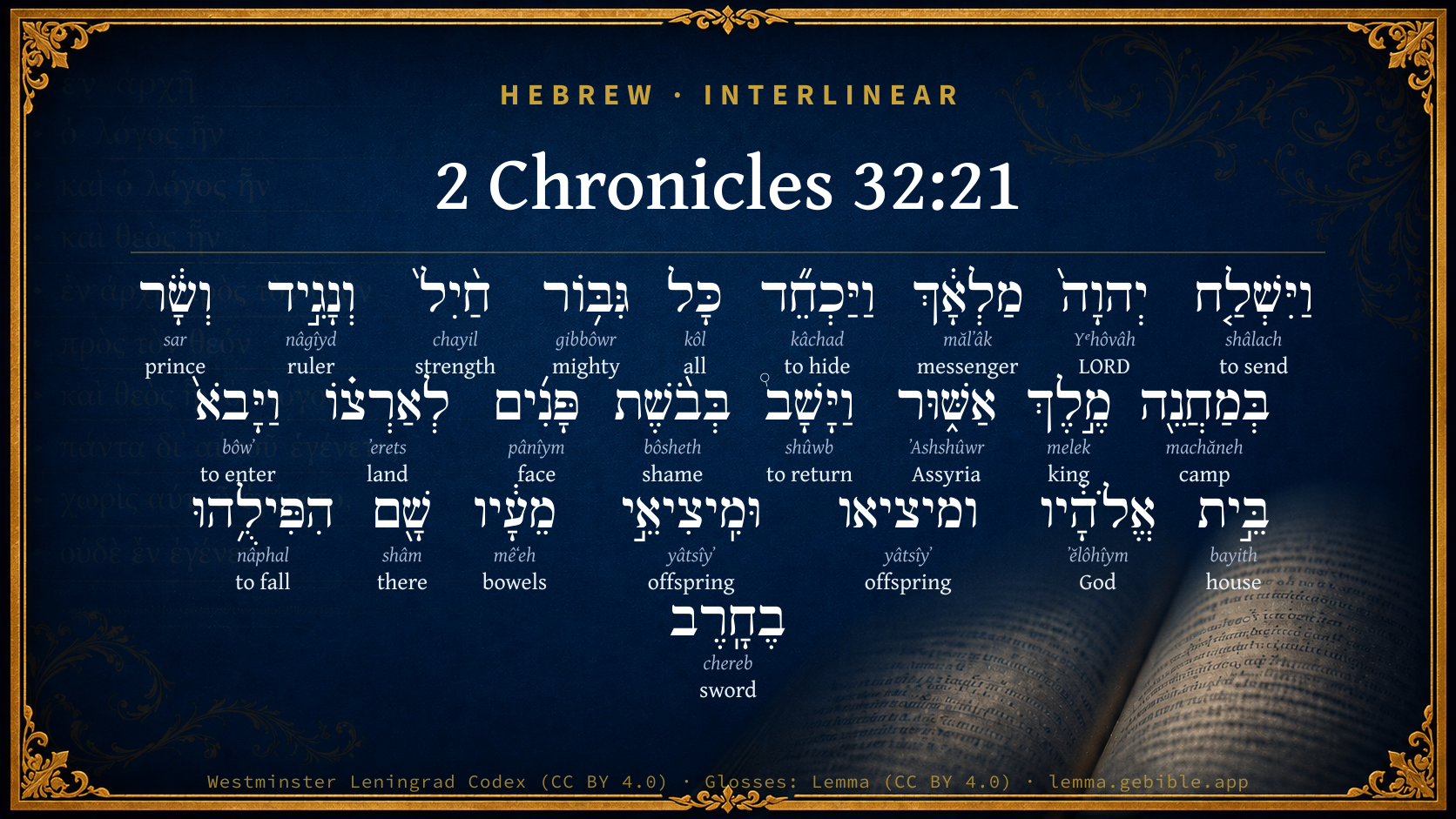
2 Chronicles 32:21

Hebrew (Westminster Leningrad Codex) 2 Chronicles 32:21 appears in the Hebrew Old Testament. The text above is from the Westminster Leningrad Codex. Each word links to its Strong’s number, a concise gloss, and parsing drawn from the Open Scriptures Hebrew Bible morphology. Click any word for its full Brown-Driver-Briggs (BDB) entry.
Download image
Cite this verse

2 Chronicles 32:21 (World English Bible). Public Domain. Lemma interlinear Bible study tool, https://lemma.gebible.app/v/2-chronicles/32/21.

Show BibTeX & RIS
BibTeX
RIS
English Translation
Yahweh sent an angel, who cut off all the mighty men of valor, and the leaders and captains, in the camp of the king of Assyria. So he returned with shame of face to his own land. When he was come into the house of his god, those who came forth from his own bowels killed him there with the sword.
World English Bible · Public Domain
Highlights
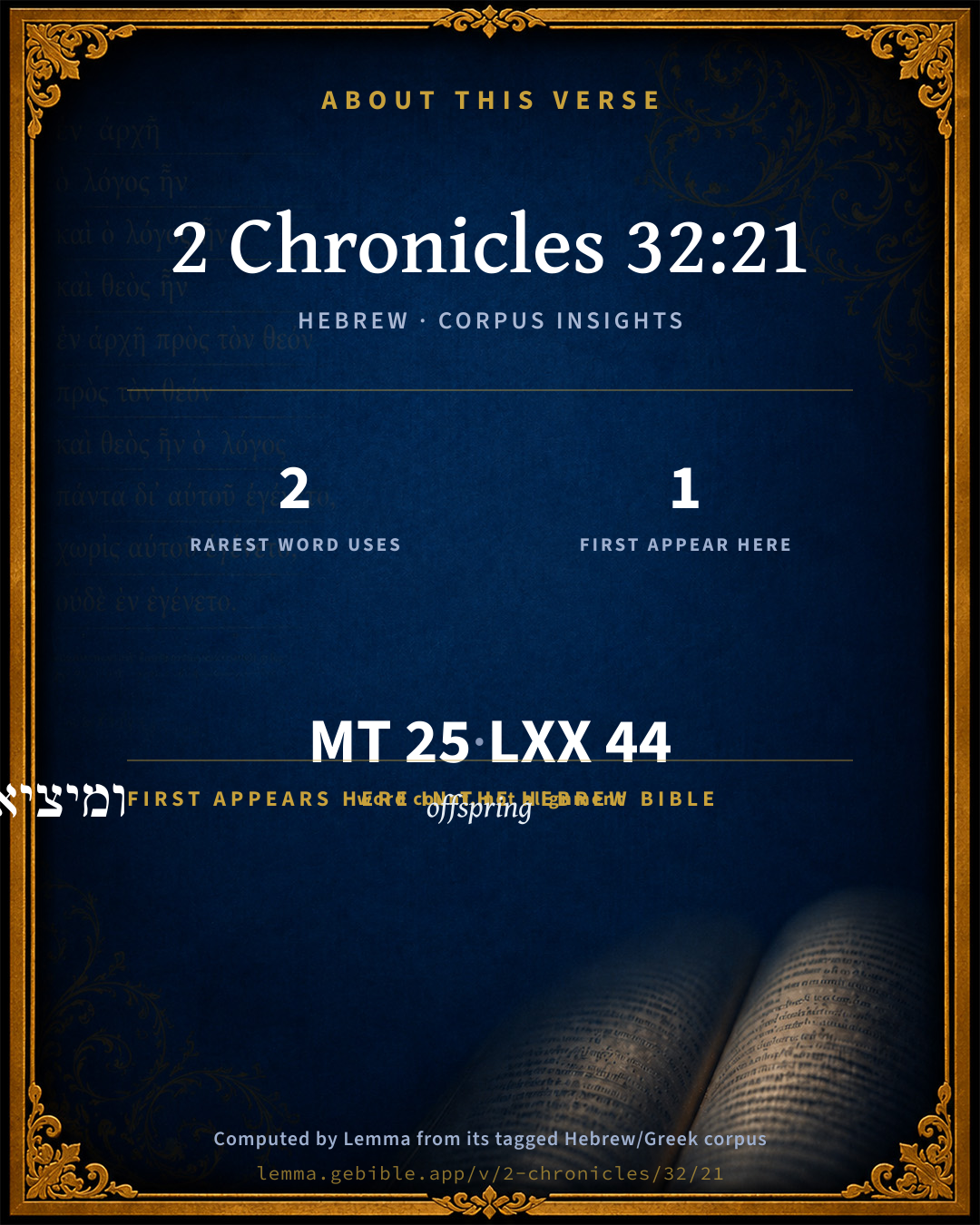
  • 1 first appearance in the Hebrew Bible
Full analysis ↓
Download a study sheet

One document with this verse’s original text, its word-by-word gloss line, the meaning frame, cross-references with their text, attributed commentary, and full source and license credits — printable, and it pastes into notes with its structure intact.

This verse Autodidact and up

Study sheet (.html) Plain text (.txt)

A passage Seminary Student

Up to 50 verses in one chapter. A passage sheet keeps up to 6 commentary sources and 12 cross-references per verse, in the order this page ranks them, and says so on the sheet whenever that leaves anything out. Ask for a single verse and you get the Autodidact verse sheet above.

Everything on this page stays free to read, with no account — the sheet is a download of what is already on screen, not access to it.

Want to remove ads? Support Godless Engineer
Compare translations 3

The same verse in 3 English versions, stacked beneath the original-language interlinear above. Click any original word for its lexicon entry.

Each is an independent rendering of the whole verse — the interlinear is not word-aligned to these translations.

Highlighted words mark where these versions differ — a whole-verse word diff, not a word-by-word alignment.

  • World English Bible Public Domain
    Yahweh sent an angel, who cut off all the mighty men of valor, and the leaders and captains, in the camp of the king of Assyria. So he returned with shame of face to his own land. When he was come into the house of his god, those who came forth from his own bowels killed him there with the sword.
  • King James Version Public Domain
    And the LORD sent an angel, which cut off all the mighty men of valor, and the leaders and captains in the camp of the king of Assyria. So he returned with shame of face to his own land. And when he was come into the house of his god, they that came forth of his own bowels slew him there with the sword.
  • unfoldingWord Literal Text CC BY-SA 4.0
    And Yahweh sent an angel, and he wiped out all the mighty ones of the army and leaders and chiefs in the camp of the king of Assyria. And he returned with shame on faces to his land. And he came to the house of his god, and some of the ones coming forth from his inward parts, there they caused him to fall by the sword.

unfoldingWord Literal Text — © unfoldingWord, licensed CC BY-SA 4.0. Word-aligned USFM3 via Door43 (git.door43.org/unfoldingWord/en_ult).

Versions to compare (up to 4)

3 of 4 selected

Show all 18 translations

Every available English version of this verse, each an independent rendering of the whole verse.

  • World English Bible Public Domain
    Yahweh sent an angel, who cut off all the mighty men of valor, and the leaders and captains, in the camp of the king of Assyria. So he returned with shame of face to his own land. When he was come into the house of his god, those who came forth from his own bowels killed him there with the sword.
  • Berean Standard Bible Public Domain
    and the LORD sent an angel who annihilated every mighty man of valor and every leader and commander in the camp of the king of Assyria. So he withdrew to his own land in disgrace. And when he entered the temple of his god, some of his own sons struck him down with the sword.
  • Majority Standard Bible Public Domain
    and the LORD sent an angel who annihilated every mighty man of valor and every leader and commander in the camp of the king of Assyria. So he withdrew to his own land in disgrace. And when he entered the temple of his god, some of his own sons struck him down with the sword.
  • King James Version Public Domain
    And the LORD sent an angel, which cut off all the mighty men of valor, and the leaders and captains in the camp of the king of Assyria. So he returned with shame of face to his own land. And when he was come into the house of his god, they that came forth of his own bowels slew him there with the sword.
  • American Standard Version (1901) Public Domain
    And Jehovah sent an angel, who cut off all the mighty men of valor, and the leaders and captains, in the camp of the king of Assyria. So he returned with shame of face to his own land. And when he was come into the house of his god, they that came forth from his own bowels slew him there with the sword.
  • Revised Version (1885) Public Domain
    And the LORD sent an angel, which cut off all the mighty men of valour, and the leaders and captains, in the camp of the king of Assyria. So he returned with shame of face to his own land. And when he was come into the house of his god, they that came forth of his own bowels slew him there with the sword.
  • Geneva Bible (1599) Public Domain
    And the Lord sent an Angel which destroyed all the valiant men, and the princes and captaines of the hoste of the King of Asshur: so he returned with shame to his owne lande. And when he was come into the house of his god, they that came foorth of his owne bowels, slewe him there with the sworde.
  • Douay-Rheims (1899) Public Domain
    And the Lord sent an angel who cut off all the stout men and the warriors, and the captains of the army of the king of the Assyrians: and he returned with disgrace into his own country. And when he was come into the house of his god, his sons that came out of his bowels, slew him with the sword.
  • Young's Literal Translation Public Domain
    and Jehovah sendeth a messenger, and cutteth off every mighty one of valour -- both leader and head -- in the camp of the king of Asshur, and he turneth back with shame of face to his land, and entereth the house of his god, and those coming out of his bowels have caused him to fall there by the sword.
  • Literal Standard Version CC BY-SA 4.0
    and YHWH sends a messenger and cuts off every mighty man of valor—both leader and head—in the camp of the king of Asshur, and he turns back with shame of face to his land and enters the house of his god, and those coming out of his bowels have caused him to fall there by the sword.
  • Unlocked Literal Bible CC BY-SA 4.0
    Yahweh sent an angel, who killed the fighting men, the commanders, and the officers of the king in the camp. So Sennacherib returned to his own land with shame on his face. When he had gone into the house of his god, some of his own children killed him there with the sword.
  • unfoldingWord Literal Text CC BY-SA 4.0
    And Yahweh sent an angel, and he wiped out all the mighty ones of the army and leaders and chiefs in the camp of the king of Assyria. And he returned with shame on faces to his land. And he came to the house of his god, and some of the ones coming forth from his inward parts, there they caused him to fall by the sword.
  • Darby Bible Public Domain
    And Jehovah sent an angel, who cut off all the mighty men of valour, and the princes and the captains in the camp of the king of Assyria. And he returned with shame of face to his own land. And when he was come into the house of his god, they that came forth of his own bowels made him fall there with the sword.
  • World Messianic Bible Public Domain
    The LORD sent an angel, who cut off all the mighty men of valor, the leaders, and captains in the camp of the king of Assyria. So he returned with shame of face to his own land. When he had come into the house of his god, those who came out of his own body killed him there with the sword.
  • Webster's Bible Public Domain
    And the LORD sent an angel, who cut off all the mighty men of valor, and the leaders and captains in the camp of the king of Assyria. So he returned with shame of face to his own land. And when he had come into the house of his god, they that came forth from his own bowels slew him there with the sword.
  • Free Bible Version CC BY-SA 4.0
    The Lord sent an angel who wiped out every warrior, leader, and commander in the camp of the Assyrian king. So he returned home in disgrace. When he went into the temple of his god, some of his own sons killed him with their swords.
  • Bible in Basic English Public Domain
    And the Lord sent an angel who put to death all the men of war and the chiefs and the captains in the army of the king of Assyria. So he went back to his country in shame. And when he came into the house of his god, his sons, the offspring of his body, put him to death there with the sword.
  • JPS Tanakh (1917) Public Domain
    And the LORD sent an angel, who cut off all the mighty men of valour, and the leaders and captains, in the camp of the king of Assyria. So he returned with shame of face to his own land. And when he was come into the house of his god, they that came forth of his own bowels slew him there with the sword.

Literal Standard Version (2020), Covenant Press — licensed CC BY-SA 4.0. Text via the HelloAO Bible API (eBible.org). Unlocked Literal Bible (unfoldingWord) — licensed CC BY-SA 4.0. Text via the HelloAO Bible API (eBible.org). unfoldingWord Literal Text — © unfoldingWord, licensed CC BY-SA 4.0. Word-aligned USFM3 via Door43 (git.door43.org/unfoldingWord/en_ult). Free Bible Version, Dr. Jonathan Gallagher — licensed CC BY-SA 4.0. Text via the HelloAO Bible API (eBible.org).

Word by word

More ways to search: Search by grammar → Find every occurrence → Compare this word →

Practice this passage: Drill this verse → Learn its vocabulary →

ומיציאו
yâtsîyʼ
H3329
“and · from · offspring · his”
Conjunction + Preposition + Noun, Common, Masculine, Singular, Construct + Suffix, Personal, 3rd Person, Masculine, Singular
Part of Speech
Conjunction + Preposition + Noun
Type
Common
Gender
Masculine
Number
Singular
State
Construct
Full BDB Definition

Origin: from H3318

TWOT: 893a

coming forth - offspring (substantive)
  1. וַיִּשְׁלַ֤ח shâlach H7971 “and · to send” Conjunction + Verb, Qal, Sequential Imperfect, 3rd Person, Masculine, Singular
  2. יְהוָה֙ Yᵉhôvâh H3068 “LORD” Noun, Proper
  3. מַלְאָ֔ךְ mălʼâk H4397 “messenger” Noun, Common, Masculine, Singular, Absolute
  4. וַיַּכְחֵ֞ד kâchad H3582 “and · to hide” Conjunction + Verb, Hiphil, Sequential Imperfect, 3rd Person, Masculine, Singular
  5. כָּל kôl H3605 “all of” Noun, Common, Masculine, Singular, Construct
  6. גִּבּ֥וֹר gibbôwr H1368 “mighty of” Adjective, Adjective, Masculine, Singular, Construct
  7. חַ֨יִל֙ chayil H2428 “strength” Noun, Common, Masculine, Singular, Absolute
  8. וְנָגִ֣יד nâgîyd H5057 “and · ruler” Conjunction + Noun, Common, Masculine, Singular, Absolute
  9. וְשָׂ֔ר sar H8269 “and · prince” Conjunction + Noun, Common, Masculine, Singular, Absolute
  10. בְּמַחֲנֵ֖ה machăneh H4264 “in/at · camp of” Preposition + Noun, Common, Both, Singular, Construct
  11. מֶ֣לֶךְ melek H4428 “king of” Noun, Common, Masculine, Singular, Construct
  12. אַשּׁ֑וּר ʼAshshûwr H804 “Assyria” Noun, Proper
  13. וַיָּשָׁב֩ shûwb H7725 “and · to return” Conjunction + Verb, Qal, Sequential Imperfect, 3rd Person, Masculine, Singular
  14. בְּבֹ֨שֶׁת bôsheth H1322 “in/at · shame of” Preposition + Noun, Common, Feminine, Singular, Construct
  15. פָּנִ֜ים pânîym H6440 “face(s)” Noun, Common, Both, Plural, Absolute
  16. לְאַרְצ֗וֹ ʼerets H776 “to/for · land · his” Preposition + Noun, Common, Both, Singular, Construct + Suffix, Personal, 3rd Person, Masculine, Singular
  17. וַיָּבֹא֙ bôwʼ H935 “and · to enter” Conjunction + Verb, Qal, Sequential Imperfect, 3rd Person, Masculine, Singular
  18. בֵּ֣ית bayith H1004 “house of” Noun, Common, Masculine, Singular, Construct
  19. אֱלֹהָ֔יו ʼĕlôhîym H430 “God(s) · his” Noun, Common, Masculine, Plural, Construct + Suffix, Personal, 3rd Person, Masculine, Singular
  20. וּמִֽיצִיאֵ֣י yâtsîyʼ H3329 “and · from · offspring of” Conjunction + Preposition + Noun, Common, Masculine, Plural, Construct
  21. מֵעָ֔יו mêʻeh H4578 “bowels · his” Noun, Common, Masculine, Plural, Construct + Suffix, Personal, 3rd Person, Masculine, Singular
  22. שָׁ֖ם shâm H8033 “there” Adverb
  23. הִפִּילֻ֥הוּ nâphal H5307 “to fall · him” Verb, Hiphil, Perfect, 3rd Person, Common, Plural + Suffix, Personal, 3rd Person, Masculine, Singular
  24. בֶחָֽרֶב chereb H2719 “in/at the · sword” Preposition, Determined + Noun, Common, Feminine, Singular, Absolute

About this verse

These counts appear in no published source. They are computed here, from the morphology-tagged text and Lemma’s own curated glosses. What Lemma adds →

25
words
24
distinct lemmas
Historical
section

Notable vocabulary

The rarest word here is ומיציאו offspring H3329 — appearing just 2 times in the whole Hebrew Bible.

First appearance in Scripture

This word makes its first canonical appearance in the Hebrew Bible here:

  • ומיציאו offspring H3329

Grammatical profile

  • 5 verbs
  • 18 nouns
  • 1 adjective
  • 1 adverb

Verb forms

  • וַיִּשְׁלַ֤ח Qal · Sequential Imperfect
  • וַיַּכְחֵ֞ד Hiphil · Sequential Imperfect
  • וַיָּשָׁב֩ Qal · Sequential Imperfect
  • וַיָּבֹא֙ Qal · Sequential Imperfect
  • הִפִּילֻ֥הוּ Hiphil · Perfect

Repetition

A word recurs within this verse — often emphatic in Hebrew:

  • ומיציאו offspring H3329 ×2

Hebrew & Septuagint length

In English translation the verse runs 61 words from the Hebrew and 60 from the Septuagint (LXX English) — closely comparable.

A rough comparison of the two English renderings, which tokenize alike — not a word-level alignment.

Word counts can differ between the Hebrew and the Greek without any difference in meaning — e.g. the Hebrew direct-object marker אֵת has no separate Greek word, and Greek often adds the article ὁ.

In the original languages it is 25 Hebrew tokens and 44 Greek tokens — but the two are counted differently (Hebrew bundles its prefixes and suffixes into one token; the Greek is in lemma form), so that isn’t a like-for-like length.

Cross-references

28

Topical passages linked to 2 Chronicles 32:21 in the Treasury of Scripture Knowledge — connected by theme and wording, ordered by reader-vote popularity; previews shown in the World English Bible.

  • Psalms 76:5 Valiant men lie plundered, They have slept their last sleep. None of the men of war can lift their hands.
  • Isaiah 37:36–38 The angel of Yahweh went forth, and struck in the camp of the Assyrians one hundred and eighty-five thousand; and when men arose early in the morning, behold, these were all dead bodies.
  • 2 Samuel 24:16 When the angel stretched out his hand toward Jerusalem to destroy it, Yahweh repented him of the evil, and said to the angel who destroyed the people, It is enough; now stay your hand. The angel of Yahweh was by the threshing floor of Araunah the Jebusite.
  • 2 Kings 19:20 Then Isaiah the son of Amoz sent to Hezekiah, saying, Thus says Yahweh, the God of Israel, Whereas you have prayed to me against Sennacherib king of Assyria, I have heard [you].
  • 2 Kings 19:35–37 It happened that night, that the angel of Yahweh went forth, and struck in the camp of the Assyrians one hundred eighty-five thousand: and when men arose early in the morning, behold, these were all dead bodies.
  • Job 9:4 God who is wise in heart, and mighty in strength: Who has hardened himself against him, and prospered?
  • Psalms 18:50 He gives great deliverance to his king, And shows loving kindness to his anointed, To David and to his seed, forevermore.
  • Psalms 76:7 You, even you, are to be feared. Who can stand in your sight when you are angry?
  • Psalms 76:12 He will cut off the spirit of princes. He is feared by the kings of the earth.
  • Psalms 132:18 I will clothe his enemies with shame, But on himself, his crown will be resplendant."
  • Proverbs 11:2 When pride comes, then comes shame, But with humility comes wisdom.
  • Proverbs 16:18 Pride goes before destruction, And a haughty spirit before a fall.
  • Isaiah 10:8 For he says, Aren't my princes all of them kings?
  • Isaiah 10:16–19 Therefore will the Lord, Yahweh of Hosts, send among his fat ones leanness; and under his glory there shall be kindled a burning like the burning of fire.
  • Isaiah 10:33–34 Behold, the Lord, Yahweh of Hosts, will lop the boughs with terror: and the high of stature shall be hewn down, and the lofty shall be brought low.
  • Isaiah 17:12–14 Ah, the uproar of many peoples, who roar like the roaring of the seas; and the rushing of nations, that rush like the rushing of mighty waters!
  • Isaiah 30:30–33 Yahweh will cause his glorious voice to be heard, and will show the lighting down of his arm, with the indignation of [his] anger, and the flame of a devouring fire, with a blast, and tempest, and hailstones.
  • Isaiah 33:10–12 Now will I arise, says Yahweh; now will I lift up myself; now will I be exalted.
  • Isaiah 36:9 How then can you turn away the face of one captain of the least of my master's servants, and put your trust on Egypt for chariots and for horsemen?
  • Isaiah 37:21 Then Isaiah the son of Amoz sent to Hezekiah, saying, Thus says Yahweh, the God of Israel, Whereas you have prayed to me against Sennacherib king of Assyria,
  • Isaiah 42:8 I am Yahweh, that is my name; and my glory will I not give to another, neither my praise to engraved images.
  • Daniel 6:22 My God has sent his angel, and has shut the lions' mouths, and they have not hurt me; because as before him innocence was found in me; and also before you, O king, have I done no hurt.
  • Matthew 13:49–50 So will it be in the end of the world. The angels will come forth, and separate the wicked from among the righteous,
  • Acts 12:23 Immediately an angel of the Lord struck him, because he didn't give God the glory, and he was eaten by worms and died.
  • Revelation 6:15–16 The kings of the earth, the princes, the commanding officers, the rich, the strong, and every slave and free person, hid themselves in the caves and in the rocks of the mountains.
  • Isaiah 29:5–8 But the multitude of your foes shall be like small dust, and the multitude of the awesome ones as chaff that passes away: yes, it shall be in an instant suddenly.
  • Daniel 3:28 Nebuchadnezzar spoke and said, Blessed be the God of Shadrach, Meshach, and Abednego, who has sent his angel, and delivered his servants who trusted in him, and have changed the king's word, and have yielded their bodies, that they might not serve nor worship any god, except their own God.
  • Revelation 19:17–18 I saw an angel standing in the sun. He cried with a loud voice, saying to all the birds that fly in the sky, "Come! Be gathered together to the great supper of God,

Cross-references courtesy of OpenBible.info (CC BY 4.0).

Hebrew and Greek witnesses Masoretic Hebrew ↔ Greek Septuagint

The same verse in the two great witnesses to the Old Testament, shown verse-for-verse.

These are two independent witnesses, not word-aligned to each other, and the Septuagint is shown in lemma (dictionary) form.

Hebrew 2 Chronicles 32:21 Masoretic · Westminster Leningrad Codex

וַיִּשְׁלַ֤ח יְהוָה֙ מַלְאָ֔ךְ וַיַּכְחֵ֞ד כָּל גִּבּ֥וֹר חַ֨יִל֙ וְנָגִ֣יד וְשָׂ֔ר בְּמַחֲנֵ֖ה מֶ֣לֶךְ אַשּׁ֑וּר וַיָּשָׁב֩ בְּבֹ֨שֶׁת פָּנִ֜ים לְאַרְצ֗וֹ וַיָּבֹא֙ בֵּ֣ית אֱלֹהָ֔יו ומיציאו וּמִֽיצִיאֵ֣י מֵעָ֔יו שָׁ֖ם הִפִּילֻ֥הוּ בֶחָֽרֶב

Yahweh sent an angel, who cut off all the mighty men of valor, and the leaders and captains, in the camp of the king of Assyria. So he returned with shame of face to his own land. When he was come into the house of his god, those who came forth from his own bowels killed him there with the sword.

World English Bible · Public Domain

Greek LXX 2 Chronicles 32:21 Septuagint · lemma form

καί ἀποστέλλω κύριος ἄγγελος καί ἐκτρίβω πᾶς δυνατός πολεμιστής καί ἄρχων καί στρατηγός ἐν ὁ παρεμβολή βασιλεύς ασσουρ καί ἀποστρέφω μετά αἰσχύνη πρόσωπον εἰς ὁ γῆ αὐτός καί ἔρχομαι εἰς οἶκος ὁ θεός αὐτός καί ὁ ἐκἔρχομαι ἐκ κοιλία αὐτός καταβάλλω αὐτός ἐν ῥομφαία

And the Lord sent an angel, and he destroyed every mighty man and warrior, and leader and captain in the camp of the king of Assyria: and he returned with shame of face to his own land and came into the house of his god: and some of them that came out of his bowels killed him with the sword.

LXX2012 (modern English Septuagint) · Public Domain

On this verse, Ellicott's Commentary for English Readers discusses the Septuagint’s reading. Read the note in Commentary ↓

Hebrew: Westminster Leningrad Codex (CC BY 4.0). Greek: Septuagint (public domain); English from LXX2012 (modern English Septuagint) (Public Domain). How the Septuagint differs from the Hebrew →

Commentary

Notes on 2 Chronicles 32:21 from classic Christian and Jewish commentators (each source and its license shown beneath its notes). The classic Christian expositions comment on the surrounding passage and are grouped to its opening verse, so a note may address several verses; the Jewish commentaries on the Tanakh (Rashi and others) are per-verse, so they appear only where the commentator wrote on this verse.

Lemma curates 59 commentaries, every one of them public domain or Creative Commons licensed, each selected and text-cleaned for this edition rather than reprinted as found. About our sources →

Jamieson, Fausset & Brown

Robert Jamieson, A. R. Fausset & David Brown

AN ANGEL DESTROYS THE ASSYRIANS. (Ch2 32:21-23)

an angel . . . cut off all the mighty men--(See on Kg2 19:35-37).

Jamieson, Fausset & Brown — Commentary Critical and Explanatory on the Whole Bible (1871) — public domain (CC PDM 1.0). Text via the HelloAO Bible API.

Trapp's Complete Commentary

John Trapp

2Ch 32:21 And the LORD sent an angel, which cut off all the mighty men of valour, and the leaders and captains in the camp of the king of Assyria. So he returned with shame of face to his own land. And when he was come into the house of his god, they that came forth of his own bowels slew him there with the sword.

Ver. 21. And the Lord sent an angel.] See 2Ki 19:35.

So he returned with shame of face.] He was not so much preserved, as reserved to a greater mischief

And when he was come.] See 2Ki 19:36-37.

John Trapp, A Commentary or Exposition upon All the Books of the Old and New Testament (1647–1656) — public domain. Text from a community e-Sword module.

Joseph Benson's Commentary

2Ch 32:21. The Lord sent an angel — The Jewish comment, termed the Targum, says, The Word of the Lord (the Eternal Word) sent Gabriel to do this execution, and that it was done with lightning, and in the passover night, the same night wherein the firstborn in Egypt were slain. Which cut off the mighty men, and the leaders and captains — With a vast number of common soldiers, 2Ki 19:35. They that came forth of his own bowels slew him — See 2Ki 19:37. And with him the Assyrian empire began to fall, and never recovered its former strength. For the next year after Sennacherib’s death, the Medes revolted, being encouraged to it, no doubt, by this great loss at Jerusalem. And by their example, several other nations fell off from the Assyrians and asserted their independence.

Joseph Benson's Commentary on the Old and New Testaments (1811–1818) — public domain. Text from a community e-Sword module.

Tyndale Open Study Notes

Tyndale Open Resources

32:21 The fate of Sennacherib is reported similarly to the account in Kings (see 2 Kgs 19:35-37).

Tyndale Open Study Notes — © Tyndale Open Resources, licensed CC BY-SA 4.0. Text via the HelloAO Bible API.

Geneva Bible (1599)

Geneva Bible translators

To the number of an hundred fourscore and five thousand, as 2 Kings 19:35, 36.

Hebrew, with shame of face.

Meaning, Adrammelech and Sharezer his sons.

Geneva Bible (1599) marginal notes — public domain. Text via Bolls.life.

Adam Clarke's Commentary

Verse 21. The Lord sent an angel] See 2Kg 19:36, and the note there.

House of his god] Nisroch.

They that came forth of his own bowels] His sons Adrammelech and Sharezer.

Adam Clarke's Commentary on the Bible (1810–1826) — public domain. Text from a community e-Sword/MySword module.

Ellicott's Commentary for English Readers

(21) And the Lord sent an angel.—See 2Ki_19:35, seq.; Isa_37:36, seq. Hitzig thinks that Psalms 46-48. were composed by Isaiah to commemorate this great natural miracle, an hypothesis which is borne out by the similarity observable between the language and ideas of these psalms and those of Isaiah’s prophecies.

Which cut off . . . valour.—Literally, and he hid (i.e., caused to disappear, destroyed; the Greek άφανίζειν; Exo_23:23) every valiant warrior, and leader and captain. (Comp. Psa_76:5, a psalm which in the LXX. bears the title ᾠδὴ πρὸς τὸν Ἀσσύριον.) Kings gives the number of those who perished as 185,000.

With shame of face.—Psa_44:15, “The shame of my face hath covered me.” (Ezr_9:7.)

And when he was come . . . with the sword.—And he went into the house of his god, and certain of his own offspring there felled him with the sword. 2Ki_19:37 gives the names of the parricides—viz., Adrammelech and Sharezer; and the name of the god—viz., Nisroch—which is probably corrupt. It is added that the assassins “escaped into the land of Ararat.” The chronicler as usual suppresses unfamiliar foreign’names.

They that came forth.—Some of the issue (yâçî, a verbal noun only found here). (For the whole phrase, comp. Gen_15:4; 2Sa_7:12.)

A Bible Commentary for English Readers, edited by Charles John Ellicott (1878–1897) — public domain. Text from a community e-Sword module.

The Cambridge Bible for Schools and Colleges

gen. ed. J. J. S. Perowne

21. all the mighty men] In number 185,000 according to 2Ki_19:35 and Isa_37:36. The agency was probably the plague, which is pictured as a destroying angel in 2Sa_24:16.

And when he was come] The murder of Sennacherib did not occur till some 20 years after his Judæan expedition (circ. 701 b.c.), i.e. not till 681 b.c.

they that came forth] Render, some (or one) that came forth. The Chronicler no doubt follows Isa_37:38, “Adrammelech and Sharezer his sons smote him”; but the accuracy of the present text of this passage of Isaiah is doubtful, for in the parallel passage (2Ki_19:37, C’thib) the words his sons are missing. The only notice of Sennacherib’s death known to us at present from the Inscriptions is simply “Sennacherib king of Assyria his son (sing.) slew him in a revolt.” No name is given to this son. (Schrader, Keilinschriftliche Bibliothek, vol. 11., p. 281).

The Cambridge Bible for Schools and Colleges (gen. ed. J. J. S. Perowne; Cambridge University Press, 1878–1918) — public domain. Text from a community e-Sword module.

John Gill's Exposition

Notwithstanding, Hezekiah humbled himself for the pride of his heart, both he and the inhabitants of Jerusalem,.... In what manner is not said; perhaps by putting on sackcloth, and by fasting and prayer, and making confession of sin, and declaring repentance for it:

so that the wrath of the Lord came not upon them in the days of Hezekiah; but in the days of his son's sons, Isa 39:7.

John Gill's Exposition of the Whole Bible (1746–1763) — public domain (CC PDM 1.0). Text via the HelloAO Bible API.

Haydock's Catholic Bible Commentary

Army. Heb. "camp." --- Disgrace. The Jews pretend that he was deprived of his beard and hair, (S. Jerom, Trad.) misapplying the text of Isaias vii. 20. C. --- Sword, to prevent their being offered as victims, to appease the idol and the people. R. Solomon) Lyranus --- This happened some months after the king’s return to Ninive, when he had cruelly oppressed the captive Jews and Tobias, i. 24. T.

George Leo Haydock (1774–1849), Haydock's Catholic Family Bible and Commentary, 1859 edition — public domain. Excludes Psalms (Douay-Rheims chapter numbering differs from Protestant) and Deuterocanonical books (Catholic canon only).

The Pulpit Commentary

The exact matter corresponding with this one verse is embraced by vers. 35-37 in the parallel. (2Ki 19) It gives the number of slain as a hundred and eighty-five thousand. It does not speak of the heavy proportion of leaders and captains lost. It leads us to suppose that for all survivers it was a surprise in the morning that silent vision of the dead in such vast array. Stating, on the other hand, in mere historic dry detail, the return of Sennacherib to his own land, his dwelling at Nineveh, and assassination, in the house of Nisroch "his god," at the hands of his own two sons, mentioned by name Adrammelech and Sharezer, who had to fly for it to Armenia (Ararat), it does not show the obviously designed moral touch of our compiler, so he returned with shame of face to his own land, nor the similarly complexioned description of the time, place, and agents of his assassination. Lastly, it gives Esarhaddon as the name of his successor on the throne.

The Pulpit Commentary (1880–1919), ed. H.D.M. Spence-Jones & Joseph S. Exell — public domain. Text from a community e-Sword module.

John Wesley's Explanatory Notes

The Lord sent an angel - The Jewish comment says the word of the Lord sent Gabriel to do this execution, and that it done with lightning, and in the passover night, the same night wherein the first-born in Egypt were slain.

John Wesley, Explanatory Notes Upon the Whole Bible (1754–1765) — public domain. Text via the GEBible commentary corpus.

Kretzmann's Popular Commentary

Paul E. Kretzmann

The Assyrians Destroyed. The End of Hezekiah’s Reign.

v. 21. And the Lord sent an angel, which cut off all the mighty men of valor, the veteran soldiers, and the leaders and captains in the camp of the king of Assyria, 2Ki 19:35-37. So he, who had boasted so inordinately of his invincible army, returned with shame of face to his own land, utterly humiliated, even in the eyes of his own subjects. And when he was come into the house of his god, when, after some time, he was worshiping in the temple of his chief idol, they that came forth of his own bowels, his own sons, slew him there with the sword.

v. 22. Thus the Lord saved Hezekiah and the inhabitants of Jerusalem from the hand of Sennacherib, the king of Assyria, and from the hand of all other, whatever other enemies had designs against him, and guided them on every side, giving to His people the full measure of protection.

v. 23. And many, including members of the neighboring nations, brought gifts unto the Lord to Jerusalem, for they also had received the benefit of Jehovah’s interposition, and presents to Hezekiah, king of Judah, so that he was magnified in the sight of all nations from thenceforth.

v. 24. In those days Hezekiah was sick to the death, and prayed unto the Lord; and He spake unto him, and He gave him a sign, wrought a miracle in making him well. Cf 2Ki 20:1-11; Isaiah 38.

v. 25. But Hezekiah rendered not again according to the benefit done unto him; for his heart was lifted up, he yielded to a degree of pride in boastfully exhibiting his treasures to the ambassadors of the king of Babylon, 2Ki 20:15; therefore there was wrath upon him and upon Judah and Jerusalem.

v. 26. Notwithstanding, Hezekiah humbled himself for the pride of his heart, both he and the inhabitants of Jerusalem, so that the wrath of the Lord came not upon them in the days of Hezekiah, Isa 39:8; 2Ki 20:19.

v. 27. And Hezekiah had exceeding much riches, in personal possessions and in gifts brought to him by neighboring nations, and honor; and he made himself treasuries for silver, and for gold, and for precious stones, and for spices, and for shields, costly gilded weapons, and for all manner of pleasant jewels, various articles which were highly prized in those days;

v. 28. storehouses also for the increase of corn and wine and oil, and stalls for all manner of beasts, and cotes for flocks, folds for his small cattle.

v. 29. Moreover, he provided him cities, probably to be understood of the watch-towers erected for the use of the shepherds, and possessions of flocks and herds in abundance; for God, the Giver of all good gifts, had given him substance very much.

v. 30. This same Hezekiah also stopped the upper watercourse of Gihon, namely, at the approach of Sennacherib’s army, and brought it straight down to the west side of the City of David, in a special subterranean canal. And Hezekiah prospered in all his works. Hezekiah’s Pool, or reservoir, in the northwest part of Jerusalem still remains, and at least a part of the subterranean channel dug by him has been laid open. 2)

v. 31. Howbeit, in the business of the ambassadors of the princes of Babylon who sent unto him to enquire of the wonder that was done in the land, very likely the king’s miraculous recovery, God left him, to try him, that He might know all that was in his heart; it was a test of Hezekiah’s faith and sincerity, especially in the matter of giving all glory to God alone, both for his health and for his possessions.

v. 32. Now, the rest of the acts of Hezekiah and his goodness, all the various displays of his kindness, behold, they are written in the vision of Isaiah, the prophet, the son of Amoz, Isaiah 36-39, and in the Book of the Kings of Judah and Israel, 2 Kings 18-20.

v. 33. And Hezekiah slept with his fathers, and they buried him in the chiefest of the sepulchers of the sons of David, in a place higher on the slope than the tombs then occupied. And all Judah and the inhabitants of Jerusalem did him honor at his death, by the usual burning of spices, as in the case of Asa, 2Ch 16:14. And Manasseh, his son, reigned in his stead. Hezekiah died in the true faith and was given the testimony that he was a king after the Lord’s heart. Blessed is everyone that heeds the warning of the Lord’s servants in time and willingly returns from the way of error.

Paul E. Kretzmann, Popular Commentary of the Bible (1921–1924) — public domain. Text from a community e-Sword module.

Rashi

Rabbi Shlomo Yitzchaki (Rashi)

and some of his own issue as it is written (Isa. 37:38): “and his sons slew him with the sword.”

Rashi on the Tanakh — English translations: “The Judaica Press complete Tanach with Rashi, translated by A. J. Rosenberg” (CC BY 4.0); “Pentateuch with Rashi's commentary by M. Rosenbaum and A.M. Silbermann, 1929-1934” (public domain); “The Metsudah Tanach series, Lakewood, N.J” (CC BY 4.0); and “The Book of Joshua, Metsudah Publications, 1997” (CC BY 4.0). Text via Sefaria.

Lesson kit

Teaching starters — assembled from the data on this page, not authored interpretation. Every prompt links to the verse data it draws on. Edit before teaching.

2 Chronicles, in the Historical, opens this verse with 25 words (24 distinct Hebrew lemmas). Its most distinctive word is yâtsîyʼ (“offspring”). A historical commentator’s framing appears above. Read the whole chapter for the surrounding context.

Discussion questions

  1. What does “offspring” (yâtsîyʼ) contribute to the verse as a whole?
  2. The word “offspring” first appears here in Scripture. What is being introduced at this debut?
  3. Psalms 76:5 shares this passage’s theme. How do the two illuminate each other?
  4. “offspring” occurs 2× in this one verse. What is the effect of the repetition?
  5. The translations on this page render this verse differently — a whole-verse word diff, not a word-by-word alignment. What might account for the different wordings?
  6. The verb «וַיִּשְׁלַ֤ח» is Qal Sequential Imperfect. How does its form color the action?
  7. Reading how Jamieson, Fausset & Brown and Trapp's Complete Commentary read this verse, where do the two commentators agree and where do they part?

Things to notice

Reading settings

Reading text

Shown beneath each verse's original-language words.

Old Testament
Old Testament edition

Read the OT as the Masoretic Hebrew (MT) or the Greek Septuagint (LXX).

English shown for the Greek Septuagint (in the Hebrew ↔ Greek comparison).

Comparing translations? Open the Compare panel on any verse page to stack up to four side by side.