2 Chronicles 34:6

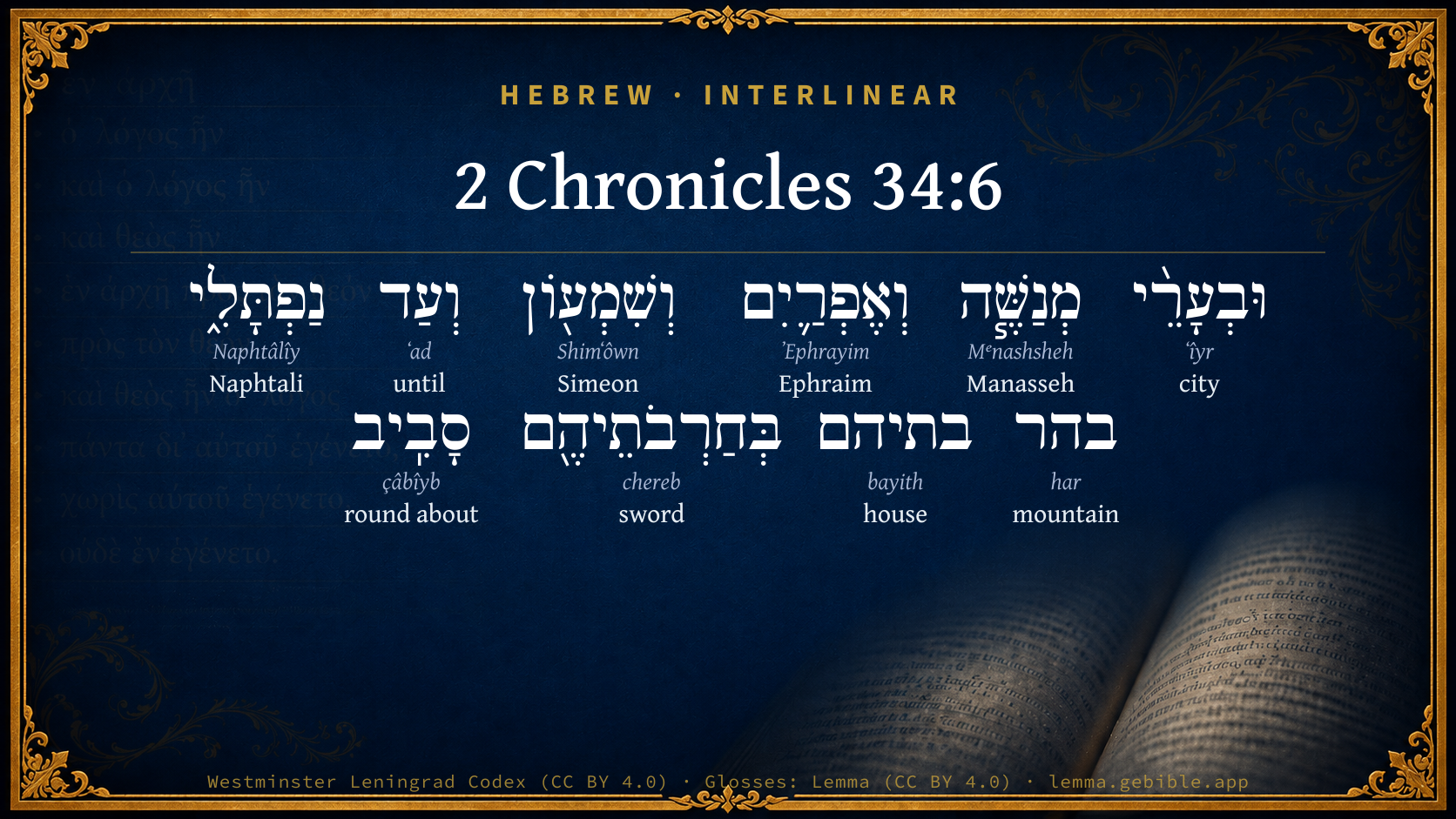
Hebrew (Westminster Leningrad Codex) 2 Chronicles 34:6 appears in the Hebrew Old Testament. The text above is from the Westminster Leningrad Codex. Each word links to its Strong’s number, a concise gloss, and parsing drawn from the Open Scriptures Hebrew Bible morphology. Click any word for its full Brown-Driver-Briggs (BDB) entry.
Download image
Cite this verse

2 Chronicles 34:6 (World English Bible). Public Domain. Lemma interlinear Bible study tool, https://lemma.gebible.app/v/2-chronicles/34/6.

Show BibTeX & RIS
BibTeX
RIS
English Translation
[So did he] in the cities of Manasseh and Ephraim and Simeon, even to Naphtali, in their ruins round about.
World English Bible · Public Domain
Download a study sheet

One document with this verse’s original text, its word-by-word gloss line, the meaning frame, cross-references with their text, attributed commentary, and full source and license credits — printable, and it pastes into notes with its structure intact.

This verse Autodidact and up

Study sheet (.html) Plain text (.txt)

A passage Seminary Student

Up to 50 verses in one chapter. A passage sheet keeps up to 6 commentary sources and 12 cross-references per verse, in the order this page ranks them, and says so on the sheet whenever that leaves anything out. Ask for a single verse and you get the Autodidact verse sheet above.

Everything on this page stays free to read, with no account — the sheet is a download of what is already on screen, not access to it.

Want to remove ads? Support Godless Engineer
Compare translations 3

The same verse in 3 English versions, stacked beneath the original-language interlinear above. Click any original word for its lexicon entry.

Each is an independent rendering of the whole verse — the interlinear is not word-aligned to these translations.

Highlighted words mark where these versions differ — a whole-verse word diff, not a word-by-word alignment.

  • World English Bible Public Domain
    [So did he] in the cities of Manasseh and Ephraim and Simeon, even to Naphtali, in their ruins round about.
  • King James Version Public Domain
    And so did he in the cities of Manasseh, and Ephraim, and Simeon, even unto Naphtali, with their mattocks round about.
  • unfoldingWord Literal Text CC BY-SA 4.0
    and in the cities of Manasseh, and Ephraim, and Simeon, and until Naphtali, in the hills of their houses all around.

unfoldingWord Literal Text — © unfoldingWord, licensed CC BY-SA 4.0. Word-aligned USFM3 via Door43 (git.door43.org/unfoldingWord/en_ult).

Versions to compare (up to 4)

3 of 4 selected

Show all 18 translations

Every available English version of this verse, each an independent rendering of the whole verse.

  • World English Bible Public Domain
    [So did he] in the cities of Manasseh and Ephraim and Simeon, even to Naphtali, in their ruins round about.
  • Berean Standard Bible Public Domain
    Josiah did the same in the cities of Manasseh, Ephraim, and Simeon, as far as Naphtali, and in the ruins around them.
  • Majority Standard Bible Public Domain
    Josiah did the same in the cities of Manasseh, Ephraim, and Simeon, as far as Naphtali, and in the ruins around them.
  • King James Version Public Domain
    And so did he in the cities of Manasseh, and Ephraim, and Simeon, even unto Naphtali, with their mattocks round about.
  • American Standard Version (1901) Public Domain
    And `so did he' in the cities of Manasseh and Ephraim and Simeon, even unto Naphtali, in their ruins round about.
  • Revised Version (1885) Public Domain
    And so did he in the cities of Manasseh and Ephraim and Simeon, even unto Napthali, in their ruins round about.
  • Geneva Bible (1599) Public Domain
    And in the cities of Manasseh, and Ephraim, and Simeon, euen vnto Naphtali, with their maules they brake all round about.
  • Douay-Rheims (1899) Public Domain
    And in the cities of Manasses, and of Ephraim, and of Simeon, even to Nephtali he demolished all.
  • Young's Literal Translation Public Domain
    and in the cities of Manasseh, and Ephraim, and Simeon, even unto Naphtali, with their tools, round about.
  • Literal Standard Version CC BY-SA 4.0
    and in the cities of Manasseh, and Ephraim, and Simeon, even to Naphtali, with their tools, all around.
  • Unlocked Literal Bible CC BY-SA 4.0
    He did the same in the cities of Manasseh, Ephraim, and Simeon, all the way to Naphtali, and in the ruins that surrounded them.
  • unfoldingWord Literal Text CC BY-SA 4.0
    and in the cities of Manasseh, and Ephraim, and Simeon, and until Naphtali, in the hills of their houses all around.
  • Darby Bible Public Domain
    And [so did he] in the cities of Manasseh and Ephraim and Simeon, even to Naphtali, in their ruins round about;
  • World Messianic Bible Public Domain
    He did this in the cities of Manasseh, Ephraim, and Simeon, even to Naphtali, around in their ruins.
  • Webster's Bible Public Domain
    And so did he in the cities of Manasseh, and Ephraim, and Simeon, even to Naphtali, with their mattocks around.
  • Free Bible Version CC BY-SA 4.0
    Josiah repeated this in the towns of Manasseh, Ephraim, and Simeon, all the way to Naphtali, and in their surrounding areas.
  • Bible in Basic English Public Domain
    And in all the towns of Manasseh and Ephraim and Simeon as far as Naphtali, he made waste their houses round about.
  • JPS Tanakh (1917) Public Domain
    And so did he in the cities of Manasseh and Ephraim and Simeon, even unto Naphtali, with their axes round about.

Literal Standard Version (2020), Covenant Press — licensed CC BY-SA 4.0. Text via the HelloAO Bible API (eBible.org). Unlocked Literal Bible (unfoldingWord) — licensed CC BY-SA 4.0. Text via the HelloAO Bible API (eBible.org). unfoldingWord Literal Text — © unfoldingWord, licensed CC BY-SA 4.0. Word-aligned USFM3 via Door43 (git.door43.org/unfoldingWord/en_ult). Free Bible Version, Dr. Jonathan Gallagher — licensed CC BY-SA 4.0. Text via the HelloAO Bible API (eBible.org).

Word by word

More ways to search: Search by grammar → Find every occurrence → Compare this word →

Practice this passage: Drill this verse → Learn its vocabulary →

וְשִׁמְע֖וֹן
Shimʻôwn
H8095
“and · Simeon”
Conjunction + Noun, Proper
Part of Speech
Conjunction + Noun
Type
Proper
Full BDB Definition

Origin: from H8085

TWOT: None

Simeon or Shimeon = "heard" - the 2nd son of Jacob by his wife Leah and progenitor of the tribe of Simeon - an Israelite of the sons of Bani who had a foreign wife in the time of Ezra
  1. וּבְעָרֵ֨י ʻîyr H5892 “and · in/at · cities of” Conjunction + Preposition + Noun, Common, Feminine, Plural, Construct
  2. מְנַשֶּׁ֧ה Mᵉnashsheh H4519 “Manasseh” Noun, Proper
  3. וְאֶפְרַ֛יִם ʼEphrayim H669 “and · Ephraim” Conjunction + Noun, Proper
  4. וְעַד ʻad H5704 “and · until” Conjunction + Preposition
  5. נַפְתָּלִ֑י Naphtâlîy H5321 “Naphtali” Noun, Proper
  6. בהר har H2022 “in/at · mountain of” Preposition + Noun, Common, Masculine, Singular, Construct
  7. בתיהם bayith H1004 “houses · their” Noun, Common, Masculine, Plural, Construct + Suffix, Personal, 3rd Person, Masculine, Plural
  8. בְּחַרְבֹתֵיהֶ֖ם chereb H2719 “in/at · swords · their” Preposition + Noun, Common, Feminine, Plural, Construct + Suffix, Personal, 3rd Person, Masculine, Plural
  9. סָבִֽיב çâbîyb H5439 “round about” Noun, Common, Both, Singular, Absolute

About this verse

These counts appear in no published source. They are computed here, from the morphology-tagged text and Lemma’s own curated glosses. What Lemma adds →

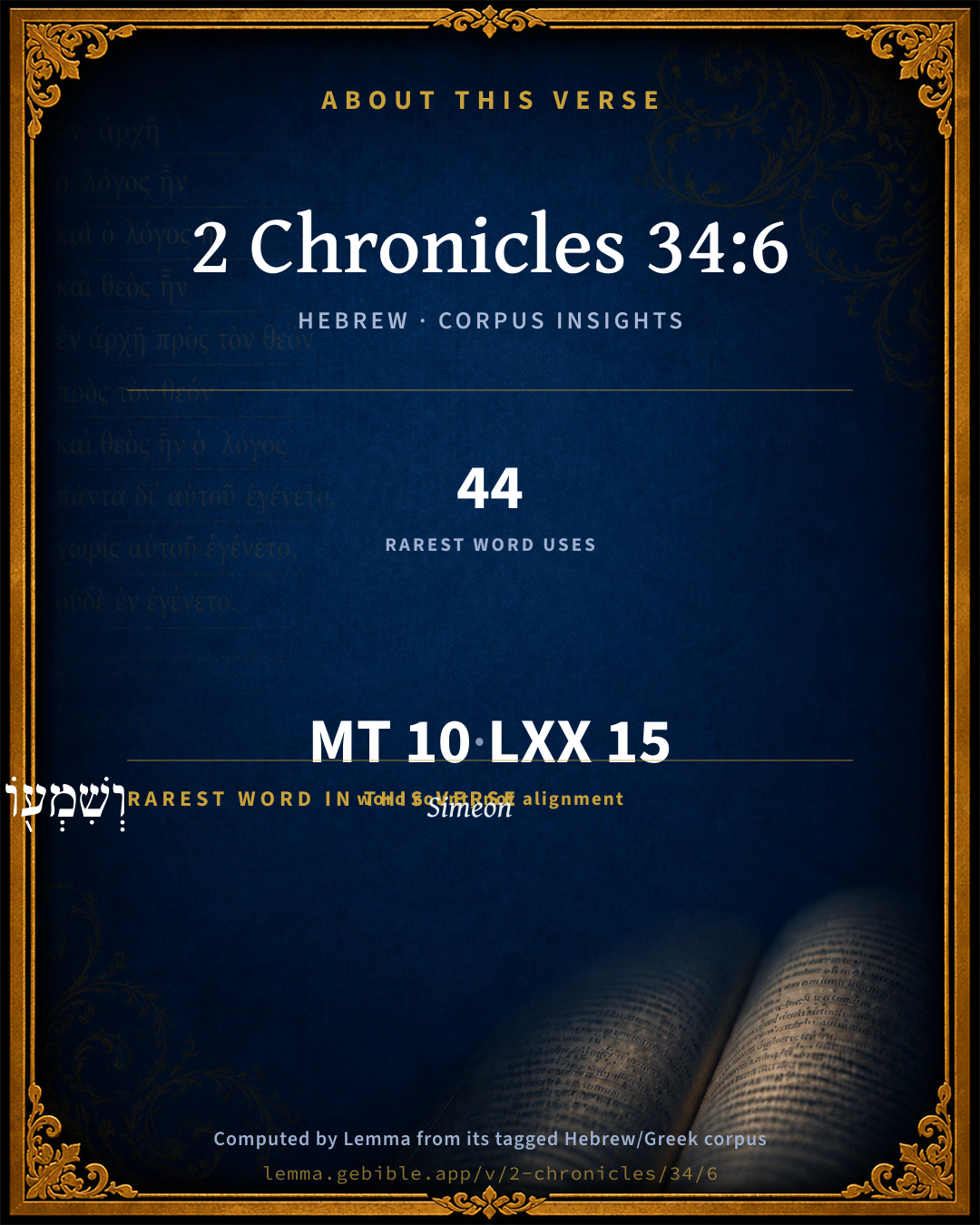
10
words
10
distinct lemmas
Historical
section

Shared distinctive vocabulary

וְשִׁמְע֖וֹן Simeon H8095 occurs in 39 verses of the Hebrew Bible. Also found in:

Grammatical profile

  • 9 nouns
  • 1 preposition

Hebrew & Septuagint length

In English translation the verse runs 20 words from the Hebrew and 21 from the Septuagint (LXX English) — closely comparable.

A rough comparison of the two English renderings, which tokenize alike — not a word-level alignment.

Word counts can differ between the Hebrew and the Greek without any difference in meaning — e.g. the Hebrew direct-object marker אֵת has no separate Greek word, and Greek often adds the article ὁ.

In the original languages it is 10 Hebrew tokens and 15 Greek tokens — but the two are counted differently (Hebrew bundles its prefixes and suffixes into one token; the Greek is in lemma form), so that isn’t a like-for-like length.

Cross-references

7

Topical passages linked to 2 Chronicles 34:6 in the Treasury of Scripture Knowledge — connected by theme and wording, ordered by reader-vote popularity; previews shown in the World English Bible.

  • 1 Samuel 13:20–21 but all the Israelites went down to the Philistines, to sharpen every man his plowshare, mattock, axe, and sickle;
  • 2 Kings 23:15–20 Moreover the altar that was at Bethel, and the high place which Jeroboam the son of Nebat, who made Israel to sin, had made, even that altar and the high place he broke down; and he burned the high place and beat it to dust, and burned the Asherah.
  • 2 Chronicles 30:1 Hezekiah sent to all Israel and Judah, and wrote letters also to Ephraim and Manasseh, that they should come to the house of Yahweh at Jerusalem, to keep the Passover to Yahweh, the God of Israel.
  • 2 Chronicles 30:10–11 So the posts passed from city to city through the country of Ephraim and Manasseh, even to Zebulun: but they ridiculed them, and mocked them.
  • 2 Chronicles 31:1 Now when all this was finished, all Israel who were present went out to the cities of Judah, and broke in pieces the pillars, and hewed down the Asherim, and broke down the high places and the altars out of all Judah and Benjamin, in Ephraim also and Manasseh, until they had destroyed them all. Then all the children of Israel returned, every man to his possession, into their own cities.
  • Proverbs 25:18 A man who gives false testimony against his neighbor Is like a club, a sword, or a sharp arrow.
  • Isaiah 7:25 All the hills that were cultivated with the hoe, you shall not come there for fear of briers and thorns; but it shall be for the sending forth of oxen, and for the treading of sheep."

Cross-references courtesy of OpenBible.info (CC BY 4.0).

Hebrew and Greek witnesses Masoretic Hebrew ↔ Greek Septuagint

The same verse in the two great witnesses to the Old Testament, shown verse-for-verse.

These are two independent witnesses, not word-aligned to each other, and the Septuagint is shown in lemma (dictionary) form.

Hebrew 2 Chronicles 34:6 Masoretic · Westminster Leningrad Codex

וּבְעָרֵ֨י מְנַשֶּׁ֧ה וְאֶפְרַ֛יִם וְשִׁמְע֖וֹן וְעַד נַפְתָּלִ֑י בהר בתיהם בְּחַרְבֹתֵיהֶ֖ם סָבִֽיב

[So did he] in the cities of Manasseh and Ephraim and Simeon, even to Naphtali, in their ruins round about.

World English Bible · Public Domain

Greek LXX 2 Chronicles 34:6 Septuagint · lemma form

καί ἐν πόλις ἐφράιμ καί μανασσή καί συμεων καί νεφθαλι καί ὁ τόπος αὐτός κύκλος

And he did so in the cities of Manasse, and Ephraim, and Symeon, and Nephthali, and the places round about them.

LXX2012 (modern English Septuagint) · Public Domain

On this verse, Keil & Delitzsch discusses the Septuagint’s reading. Read the note in Commentary ↓

Hebrew: Westminster Leningrad Codex (CC BY 4.0). Greek: Septuagint (public domain); English from LXX2012 (modern English Septuagint) (Public Domain). How the Septuagint differs from the Hebrew →

Commentary

Notes on 2 Chronicles 34:6 from classic Christian and Jewish commentators (each source and its license shown beneath its notes). The classic Christian expositions comment on the surrounding passage and are grouped to its opening verse, so a note may address several verses; the Jewish commentaries on the Tanakh (Rashi and others) are per-verse, so they appear only where the commentator wrote on this verse.

Lemma curates 59 commentaries, every one of them public domain or Creative Commons licensed, each selected and text-cleaned for this edition rather than reprinted as found. About our sources →

Trapp's Complete Commentary

John Trapp

2Ch 34:6 And [so did he] in the cities of Manasseh, and Ephraim, and Simeon, even unto Naphtali, with their mattocks round about.

Ver. 6. And so did he in the cities of Manasseh.] Wherever he had to do; and in all places else where he could come; so great was his zeal, so diffusive his charity.

John Trapp, A Commentary or Exposition upon All the Books of the Old and New Testament (1647–1656) — public domain. Text from a community e-Sword module.

Joseph Benson's Commentary

2Ch 34:6. Even unto Naphtali — Which was in the utmost borders of the kingdom of Israel. For it must be remembered, that the ten tribes were now gone into captivity; and those who were come in their stead were weak and few, and not able to withstand the power of Josiah.

Joseph Benson's Commentary on the Old and New Testaments (1811–1818) — public domain. Text from a community e-Sword module.

Keil & Delitzsch

C. F. Keil & F. Delitzsch

Ch2 34:6 and Ch2 34:7 form a connected sentence: And in the cities of Manasseh ..., in their ruins round about, there he pulled down the altars, etc. The tribe of Simeon is here, as in Ch2 15:9, reckoned among the tribes of the kingdom of Israel, because the Simeonites, although they belonged geographically to the kingdom of Judah, yet in religion remained attached to the worship on the high places practised by the ten tribes; see on Ch2 15:9. "And unto Naphtali" is added, to designate the kingdom of Israel in its whole extent to the northern frontier of Canaan. The form בתיהם בּחר (in the Keth. divided into two words) gives no suitable sense. R. Sal. explains, timentes in planitie habitare, sed fixerunt in monte domicilia, rendering it "in their mountain-dwellings." This the words cannot mean.

(Note: The lxx translate ἐν τοῖς τόποις αὐτῶν, expressing merely the בתיהם. The Targ. has צדיוּתהון בבית, in domo (s. loco) desolationis eorum.)

The Keri בּחרבתיהם, "with their swords," is suggested by Eze 26:9, and is accepted by D. Kimchi, Abu Melech, and others, and understood to denote instruments with which the altars, groves, and images were cut down. But this interpretation also is certainly incorrect. The word is rather to be pointed בּחרבתיהם, in their wastes (ruins) (cf. Psa 109:10), and to be taken as an explanatory apposition to בּערי: in the cities of Manasseh ..., namely, in their ruins round about; for the land had been deserted since the times of Shalmaneser, and its cities were in great part in ruins. The statement as to the locality precedes in the form of an absolute sentence, and that which is predicated of it follows in the form of an apodosis with ו consec. (וינתּץ). להדק כּתּת, he dashed to pieces to crush; the form הדק is not a perfect after ל, but an infinitive which has retained the vowel of the perfect; cf. Ew. 238, d.

Keil & Delitzsch — Biblical Commentary on the Old Testament (1861–1891) — public domain (CC PDM 1.0). Text via the HelloAO Bible API. (Old Testament only.)

Tyndale Open Study Notes

Tyndale Open Resources

34:6 By Josiah’s twelfth year as king (628 BC), the Assyrian Empire had largely disintegrated. During this time, the north of Israel was virtually deserted, making it possible for Josiah to extend his influence and control into Manasseh, Ephraim, and Simeon, even as far as Naphtali.

Tyndale Open Study Notes — © Tyndale Open Resources, licensed CC BY-SA 4.0. Text via the HelloAO Bible API.

Jamieson, Fausset & Brown

Robert Jamieson, A. R. Fausset & David Brown

with their mattocks--or, "in their deserts"--so that the verse will stand thus: "And so did [namely, break the altars and burn the bones of priests] he in the cities of Manasseh, and Ephraim, and Simeon, even unto Naphtali, in their deserted suburbs." The reader is apt to be surprised on finding that Josiah, whose hereditary possessions were confined to the kingdom of Judah, exercised as much authority among the tribes of Ephraim, Manasseh, Simeon, and others as far as Naphtali, as he did within his own dominion. Therefore, it is necessary to observe that, after the destruction of Samaria by Shalmaneser, the remnant that continued on the mountains of Israel maintained a close intercourse with Judah, and looked to the sovereigns of that kingdom as their natural protectors. Those kings acquired great influence over them, which Josiah exercised in removing every vestige of idolatry from the land. He could not have done this without the acquiescence of the people in the propriety of this proceeding, conscious that this was conformable to their ancient laws and institutions. The Assyrian kings, who were now masters of the country, might have been displeased at the liberties Josiah took beyond his own territories. But either they were not informed of his doings, or they did not trouble themselves about his religious proceedings, relating, as they would think, to the god of the land, especially as he did not attempt to seize upon any place or to disturb the allegiance of the people [CALMET].

Jamieson, Fausset & Brown — Commentary Critical and Explanatory on the Whole Bible (1871) — public domain (CC PDM 1.0). Text via the HelloAO Bible API.

Adam Clarke's Commentary

Verse 6. The cities of Manasseh] Even those who were under the government of the Israelitish king permitted their idols and places of idolatry to be hewn down and destroyed: after the truth was declared and acknowledged, the spade and the axe were employed to complete the reformation.

Adam Clarke's Commentary on the Bible (1810–1826) — public domain. Text from a community e-Sword/MySword module.

Ellicott's Commentary for English Readers

(6) And so did he in the cities . . . unto Naphtali.—Sec 2Ki_23:15; 2Ki_23:19, according to which Josiah destroyed the sanctuary of Bethel, and the high places “in the cities of Samaria,” i.e., the northern kingdom.

Simeon is again mentioned somewhat strangely, as in 2Ch_15:9, no doubt because Beersheba, a famous sanctuary within its territory, was a place of pilgrimage for the northern tribes.

Manasseh and Ephraim, i.e., the northern kingdom, as in 2Ch_31:1; Isa_9:21.

With their mattocks.—Rather, in their ruins; reading behorbuthêhem, instead of behorbôthêhem, which means “with their swords.” (Comp. Eze_26:9.) The phrase qualifies the word “cities.” The cities of Israel had been ruined by the Assyrians, Sargon. and Shalmaneser, the latter of whom took Samaria, after a three years’ siege, and carried the people captive to Assyria, in 721 B.C., replacing them by foreign colonists. This explains how it was that Josiah was able to desecrate the northern sanctuaries, and slay their priests (2Ki_23:20). The ordinary Hebrew text divides the word thus: behar bûtthêhem, so as to suggest the reading behar bûtthêhem, “in the hill of their houses.” The LXX. has “in their places round about”; the Vulg. omits the phrase; and the Syriac reads “in their streets around.” The whole verse should be connected with 2Ch_34:7, thus: “And in the cities of Manasseh and Ephraim and Simeon, even unto Naphtali, to wit, in their ruins round about, he pulled down the altars and the Asherim; and the carven images he dashed into pieces unto pulverising.” Hedaq is an unusual form of the infinitive, not a perfect, as Bertheau supposes.

A Bible Commentary for English Readers, edited by Charles John Ellicott (1878–1897) — public domain. Text from a community e-Sword module.

The Cambridge Bible for Schools and Colleges

gen. ed. J. J. S. Perowne

6. Simeon] Here as in 2Ch_15:9 regarded as belonging to the Northern tribes, but their cities were in the south; cp. 1Ch_4:28 ff.

with their mattocks] R.V. in their ruins (with marginal note, “The text is probably corrupt”). LXX. ἐν … τοῖς τόποις αὐτῶν i.e. “in their places.” Pesh. reads, in their broad places, and this is probably correct.

The Cambridge Bible for Schools and Colleges (gen. ed. J. J. S. Perowne; Cambridge University Press, 1878–1918) — public domain. Text from a community e-Sword module.

John Gill's Exposition

And when he had broken down the altars and the groves,.... The statues or images in them:

and had beaten the graven images into powder; and strewed it on the graves of the idolaters:

and cut down all the idols throughout all the land of Israel; the sun images as in Ch2 34:4,

he returned to Jerusalem; this tour of his throughout the whole land, and the things done by him, which are represented as done before the repairs of the temple were made, and the book of the law found and read, and the covenant he and his people made with the Lord, are spoken of in Kg2 23:4, as if done after.

John Gill's Exposition of the Whole Bible (1746–1763) — public domain (CC PDM 1.0). Text via the HelloAO Bible API.

Albert Barnes' Notes on the Bible

The power of Assyria being now (629-624 B.C.) greatly weakened, if not completely broken, Josiah aimed not merely at a religious reformation, but at a restoration of the kingdom to its ancient limits (see the 2Ki 23:19 note).

With their mattocks ... - Or “in their desolate places” (compare Psa 109:10). Another reading gives the sense, “he proved their house round about.”

Albert Barnes' Notes on the Bible (1834–1885) — public domain. Text from a community e-Sword/MySword module.

Haydock's Catholic Bible Commentary

He. Heb. "with their swords, (C.; Protestants, mattocks) round about;" (H.) or, "and in their deserts," the inhabitants being removed. Sept. "in their places around." Syriac and Arabic, "in their public places." All the interpreters have read differently from what we find in Hebrew at present. Some may wonder that Josias should act thus, out of his own dominions. But the few Israelites who were left, had placed themselves under his protection; and as he made no ravages, and the Cuthites did not adopt the former superstitious practices of the country, they were not concerned to see the altars destroyed; nor were the kings of Assyria informed of, or interested to stop, these proceedings. C. --- Josias followed the directions of the priests and prophets; (M.) and many believe that the Assyrian monarch had given these territories to him, to hold, as his vassal; (T.) or God restored them to the lawful king, (v. 9) having promised all those countries to the family of David, for the express purpose of keeping up his own worship among his chosen people, and for exterminating idolatry. H.

George Leo Haydock (1774–1849), Haydock's Catholic Family Bible and Commentary, 1859 edition — public domain. Excludes Psalms (Douay-Rheims chapter numbering differs from Protestant) and Deuterocanonical books (Catholic canon only).

Matthew Poole's English Annotations

Even unto Naphtali; which was in the utmost and northern borders of the kingdom of Israel. For it must be remembered that the ten tribes were now gone into captivity; and those who were come in their stead were weak and few, and not able to withstand the power of Josiah.

Matthew Poole's English Annotations on the Holy Bible (1683–1685) — public domain. Text from a community e-Sword/MySword module.

Whedon's Commentary on the Bible

Daniel D. Whedon

6. Cities of Manasseh, and Ephraim, and Simeon, even unto Naphtali — The northern kingdom having been long since broken up, and the new colonists from the East having no power or special care to hinder him, Josiah probably met with no great opposition in overthrowing “all the idols throughout all the land of Israel.” 2Ch_34:7.

With their mattocks — Margin, with their mauls; others, with their swords. Furst connects the phrase with “burnt the bones” in the preceding verse, and then renders the phrase “in their palatial resting-places,” that is, their princely graves or mausoleums. Gesenius adopts the Kethib, and renders “he proved their houses,” that is, examined the houses of the idolaters. But we incline to the view of Bertheau, who adopts the Keri, and points it thus בהרבתיהם: the meaning then is, as the same word is translated in Psa_109:10, in their desolate places, or, in their ruins. Josiah overthrew idolatry in the cities named, which were many of them in ruins, and all of them, perhaps, might have been spoken of as desolate places. But notwithstanding their ruin, many signs of their old idolatry remained.

The remainder of the chapter (2Ch_34:8-33) is substantially identical with 2Ki_22:3-20; 2Ki_23:1-3, where see notes.

Daniel D. Whedon (gen. ed.), Commentary on the Old and New Testaments (1874–1909) — public domain. Text from a community e-Sword module.

The Pulpit Commentary

In the cities of Manasseh, Ephraim, Simeon, even unto Naphtali. Manasseh and Ephraim lay very nearly in the centre of the whole land, while Simeon and Naphtali were respectively at the southern and northern extremities. With their mattocks. This rendering may be correct, and cannot be said to be foreign to the sense and connection of the passage, the Hebrew word in that ease being the feminine plural of brj. Perhaps, however, the word is one with that found in Psa_109:10, and may be rendered "in their ruined," i.e. semi-ruined, "condition." Note Keri also, which favours the latter reading; the Septuagint shows simply words which may best translate, and in their neighbourhoods respectively.

The Pulpit Commentary (1880–1919), ed. H.D.M. Spence-Jones & Joseph S. Exell — public domain. Text from a community e-Sword module.

John Wesley's Explanatory Notes

Naphtali - Which was in the utmost borders of the kingdom of Israel. For it must be remembered, that the ten tribes were now gone into captivity; and those who were come in their stead were weak and few, and not able to withstand the power of Josiah.

John Wesley, Explanatory Notes Upon the Whole Bible (1754–1765) — public domain. Text via the GEBible commentary corpus.

unfoldingWord translationNotes

Door43 World Missions Community

He broke down the altars, beat ... cut apart

Josiah would have commanded his workers to do these things. AT: "He commanded his workers to break down the altars, to beat ... to cut apart" (See: Metonymy)

into powder

"into dust." This means to smash them until they have become powder.

translationWords

Manasseh

Ephraim

Simeon

Naphtali

ruin

Israel

unfoldingWord translationNotes — © Distant Shores Media and the Door43 World Missions Community, licensed CC BY-SA 4.0. Source: git.door43.org/Door43/en_tn.

Rashi

Rabbi Shlomo Yitzchaki (Rashi)

And in the cities of Manasseh and Ephraim, etc. from those “gleanings” [survivors] who survived the sword and the captivity of Sennacherib.

with their instruments of destruction Since they were but few “gleanings,” they feared to live in the lowland and established their houses on the mountain (בְּחַר בָּתֵּיהֶם).

Rashi on the Tanakh — English translations: “The Judaica Press complete Tanach with Rashi, translated by A. J. Rosenberg” (CC BY 4.0); “Pentateuch with Rashi's commentary by M. Rosenbaum and A.M. Silbermann, 1929-1934” (public domain); “The Metsudah Tanach series, Lakewood, N.J” (CC BY 4.0); and “The Book of Joshua, Metsudah Publications, 1997” (CC BY 4.0). Text via Sefaria.

Lesson kit

Teaching starters — assembled from the data on this page, not authored interpretation. Every prompt links to the verse data it draws on. Edit before teaching.

2 Chronicles, in the Historical, opens this verse with 10 words (10 distinct Hebrew lemmas). Its most distinctive word is Shimʻôwn (“Simeon”). A historical commentator’s framing appears above. Read the whole chapter for the surrounding context.

Discussion questions

  1. What does “Simeon” (Shimʻôwn) contribute to the verse as a whole?
  2. How does Genesis 29:33, which shares the word «Simeon», read alongside this verse?
  3. The translations on this page render this verse differently — a whole-verse word diff, not a word-by-word alignment. What might account for the different wordings?
  4. Compare how Trapp's Complete Commentary and Joseph Benson's Commentary read this verse. Where do they agree or differ?

Things to notice

Reading settings

Reading text

Shown beneath each verse's original-language words.

Old Testament
Old Testament edition

Read the OT as the Masoretic Hebrew (MT) or the Greek Septuagint (LXX).

English shown for the Greek Septuagint (in the Hebrew ↔ Greek comparison).

Comparing translations? Open the Compare panel on any verse page to stack up to four side by side.