
1 Chronicles 21:5

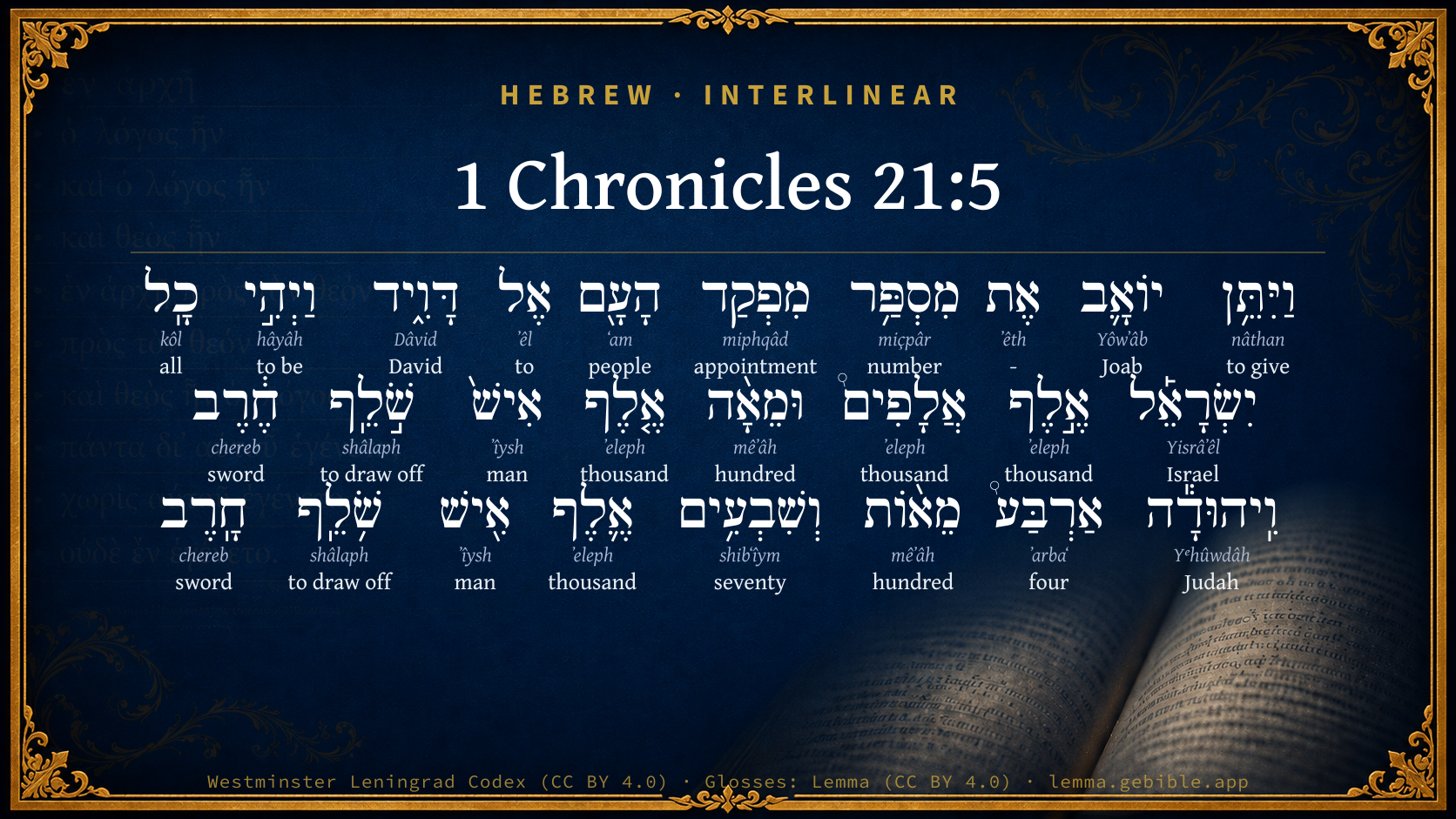
Hebrew (Westminster Leningrad Codex) 1 Chronicles 21:5 appears in the Hebrew Old Testament. The text above is from the Westminster Leningrad Codex. Each word links to its Strong’s number, a concise gloss, and parsing drawn from the Open Scriptures Hebrew Bible morphology. Click any word for its full Brown-Driver-Briggs (BDB) entry.
Download image
Cite this verse

1 Chronicles 21:5 (World English Bible). Public Domain. Lemma interlinear Bible study tool, https://lemma.gebible.app/v/1-chronicles/21/5.

Show BibTeX & RIS
BibTeX
RIS
English Translation
Joab gave up the sum of the numbering of the people to David. All those of Israel were one million one hundred thousand men who drew sword: and in Judah were four hundred seventy thousand men who drew sword.
World English Bible · Public Domain
Download a study sheet

One document with this verse’s original text, its word-by-word gloss line, the meaning frame, cross-references with their text, attributed commentary, and full source and license credits — printable, and it pastes into notes with its structure intact.

This verse Autodidact and up

Study sheet (.html) Plain text (.txt)

A passage Seminary Student

Up to 50 verses in one chapter. A passage sheet keeps up to 6 commentary sources and 12 cross-references per verse, in the order this page ranks them, and says so on the sheet whenever that leaves anything out. Ask for a single verse and you get the Autodidact verse sheet above.

Everything on this page stays free to read, with no account — the sheet is a download of what is already on screen, not access to it.

Want to remove ads? Support Godless Engineer
Compare translations 3

The same verse in 3 English versions, stacked beneath the original-language interlinear above. Click any original word for its lexicon entry.

Each is an independent rendering of the whole verse — the interlinear is not word-aligned to these translations.

Highlighted words mark where these versions differ — a whole-verse word diff, not a word-by-word alignment.

  • World English Bible Public Domain
    Joab gave up the sum of the numbering of the people to David. All those of Israel were one million one hundred thousand men who drew sword: and in Judah were four hundred seventy thousand men who drew sword.
  • King James Version Public Domain
    And Joab gave the sum of the number of the people unto David. And all they of Israel were a thousand thousand and an hundred thousand men that drew sword: and Judah was four hundred threescore and ten thousand men that drew sword.
  • unfoldingWord Literal Text CC BY-SA 4.0
    And Joab gave the number of the mustering of the people to David. And all of Israel was 1,100,000 men drawing the sword, and Judah, 470,000 men drawing the sword.

unfoldingWord Literal Text — © unfoldingWord, licensed CC BY-SA 4.0. Word-aligned USFM3 via Door43 (git.door43.org/unfoldingWord/en_ult).

Versions to compare (up to 4)

3 of 4 selected

Show all 18 translations

Every available English version of this verse, each an independent rendering of the whole verse.

  • World English Bible Public Domain
    Joab gave up the sum of the numbering of the people to David. All those of Israel were one million one hundred thousand men who drew sword: and in Judah were four hundred seventy thousand men who drew sword.
  • Berean Standard Bible Public Domain
    And Joab reported to David the total number of the troops. In all Israel there were 1,100,000 men who drew the sword, including 470,000 in Judah.
  • Majority Standard Bible Public Domain
    And Joab reported to David the total number of the troops. In all Israel there were 1,100,000 men who drew the sword, including 470,000 in Judah.
  • King James Version Public Domain
    And Joab gave the sum of the number of the people unto David. And all they of Israel were a thousand thousand and an hundred thousand men that drew sword: and Judah was four hundred threescore and ten thousand men that drew sword.
  • American Standard Version (1901) Public Domain
    And Joab gave up the sum of the numbering of the people unto David. And all they of Israel were a thousand thousand and a hundred thousand men that drew sword: and Judah was four hundred threescore and ten thousand men that drew sword.
  • Revised Version (1885) Public Domain
    And Joab gave up the sum of the numbering of the people unto David. And all they of Israel were a thousand thousand and an hundred thousand men that drew sword: and Judah was four hundred threescore and ten thousand men that drew sword;
  • Geneva Bible (1599) Public Domain
    And Ioab gaue the nomber and summe of the people vnto Dauid: and all Israel were eleuen hundreth thousande men that drewe sword: and Iudah was foure hundreth and seuentie thousande men that drewe sword.
  • Douay-Rheims (1899) Public Domain
    And he gave David the number of them, whom he had surveyed: and all the number of Israel was found to be eleven hundred thousand men that drew the sword: and of Juda four hundred and seventy thousand fighting men.
  • Young's Literal Translation Public Domain
    And Joab giveth the account of the numbering of the people unto David, and all Israel is a thousand thousand and a hundred thousand, each drawing sword, and Judah `is' four hundred and seventy thousand, each drawing sword.
  • Literal Standard Version CC BY-SA 4.0
    And Joab gives the account of the numbering of the people to David, and all Israel is one million and one hundred thousand, each drawing sword, and Judah [is] four hundred and seventy thousand, each drawing sword.
  • Unlocked Literal Bible CC BY-SA 4.0
    Then Joab reported the total of the count of the fighting men to David. There were in Israel 1,100,000 men who drew the sword. Judah alone had 470,000 soldiers.
  • unfoldingWord Literal Text CC BY-SA 4.0
    And Joab gave the number of the mustering of the people to David. And all of Israel was 1,100,000 men drawing the sword, and Judah, 470,000 men drawing the sword.
  • Darby Bible Public Domain
    And Joab gave the sum of the number of the people to David. And all they of Israel were eleven hundred thousand men that drew sword; and of Judah, four hundred and seventy thousand men that drew sword.
  • World Messianic Bible Public Domain
    Joab gave the sum of the census of the people to David. All those of Israel were one million one hundred thousand men who drew a sword; and in Judah were four hundred seventy thousand men who drew a sword.
  • Webster's Bible Public Domain
    And Joab gave the sum of the number of the people to David. And all they of Israel were a thousand thousand and a hundred thousand men that drew sword: and Judah was four hundred and seventy thousand men that drew sword.
  • Free Bible Version CC BY-SA 4.0
    and he gave David the number of people censused. In Israel there were 1,100,000 fighting men who could handle a sword, and 470,000 in Judah.
  • Bible in Basic English Public Domain
    And Joab gave David the number of all the people; all the men of Israel, able to take up arms, were one million, one hundred thousand men; and those of Judah were four hundred and seventy thousand men, able to take up arms.
  • JPS Tanakh (1917) Public Domain
    And Joab gave up the sum of the numbering of the people unto David. And all they of Israel were a thousand thousand and a hundred thousand men that drew sword; and Judah was four hundred three-score and ten thousand men that drew sword.

Literal Standard Version (2020), Covenant Press — licensed CC BY-SA 4.0. Text via the HelloAO Bible API (eBible.org). Unlocked Literal Bible (unfoldingWord) — licensed CC BY-SA 4.0. Text via the HelloAO Bible API (eBible.org). unfoldingWord Literal Text — © unfoldingWord, licensed CC BY-SA 4.0. Word-aligned USFM3 via Door43 (git.door43.org/unfoldingWord/en_ult). Free Bible Version, Dr. Jonathan Gallagher — licensed CC BY-SA 4.0. Text via the HelloAO Bible API (eBible.org).

Word by word

More ways to search: Search by grammar → Find every occurrence → Compare this word →

Practice this passage: Drill this verse → Learn its vocabulary →

מִפְקַד
miphqâd
H4662
“appointment of”
Noun, Common, Masculine, Singular, Construct
Part of Speech
Noun
Type
Common
Gender
Masculine
Number
Singular
State
Construct
Full BDB Definition

Origin: from H6485

TWOT: 1802g

muster, appointment, appointed place - muster (of people) - appointment - appointed place - (TWOT) number
  1. וַיִּתֵּ֥ן nâthan H5414 “and · to give” Conjunction + Verb, Qal, Sequential Imperfect, 3rd Person, Masculine, Singular
  2. יוֹאָ֛ב Yôwʼâb H3097 “Joab” Noun, Proper
  3. אֶת ʼêth H853 “-” Particle, Direct Object
  4. מִסְפַּ֥ר miçpâr H4557 “number of” Noun, Common, Masculine, Singular, Construct
  5. הָעָ֖ם ʻam H5971 “the · people” Particle, Definite Article + Noun, Common, Masculine, Singular, Absolute
  6. אֶל ʼêl H413 “to” Preposition
  7. דָּוִ֑יד Dâvid H1732 “David” Noun, Proper
  8. וַיְהִ֣י hâyâh H1961 “and · to be” Conjunction + Verb, Qal, Sequential Imperfect, 3rd Person, Masculine, Singular
  9. כָֽל kôl H3605 “all of” Noun, Common, Masculine, Singular, Construct
  10. יִשְׂרָאֵ֡ל Yisrâʼêl H3478 “Israel” Noun, Proper
  11. אֶ֣לֶף ʼeleph H505 “thousand” Adjective, Cardinal number, Both, Singular, Absolute
  12. אֲלָפִים֩ ʼeleph H505 “thousand” Adjective, Cardinal number, Both, Plural, Absolute
  13. וּמֵאָ֨ה mêʼâh H3967 “and · hundred” Conjunction + Adjective, Cardinal number, Both, Singular, Absolute
  14. אֶ֤לֶף ʼeleph H505 “thousand” Adjective, Cardinal number, Both, Singular, Absolute
  15. אִישׁ֙ ʼîysh H376 “man” Noun, Common, Masculine, Singular, Absolute
  16. שֹׁ֣לֵֽף shâlaph H8025 “drawing off” Verb, Qal, Participle Active, Masculine, Singular, Absolute
  17. חֶ֔רֶב chereb H2719 “sword” Noun, Common, Feminine, Singular, Absolute
  18. וִֽיהוּדָ֕ה Yᵉhûwdâh H3063 “and · Judah” Conjunction + Noun, Proper
  19. אַרְבַּע֩ ʼarbaʻ H702 “four” Adjective, Cardinal number, Feminine, Singular, Absolute
  20. מֵא֨וֹת mêʼâh H3967 “hundred” Adjective, Cardinal number, Both, Plural, Absolute
  21. וְשִׁבְעִ֥ים shibʻîym H7657 “and · seventy” Conjunction + Adjective, Cardinal number, Both, Plural, Absolute
  22. אֶ֛לֶף ʼeleph H505 “thousand” Adjective, Cardinal number, Both, Singular, Absolute
  23. אִ֖ישׁ ʼîysh H376 “man” Noun, Common, Masculine, Singular, Absolute
  24. שֹׁ֥לֵֽף shâlaph H8025 “drawing off” Verb, Qal, Participle Active, Masculine, Singular, Absolute
  25. חָֽרֶב chereb H2719 “sword” Noun, Common, Feminine, Singular, Absolute

About this verse

These counts appear in no published source. They are computed here, from the morphology-tagged text and Lemma’s own curated glosses. What Lemma adds →

26
words
19
distinct lemmas
Historical
section

Notable vocabulary

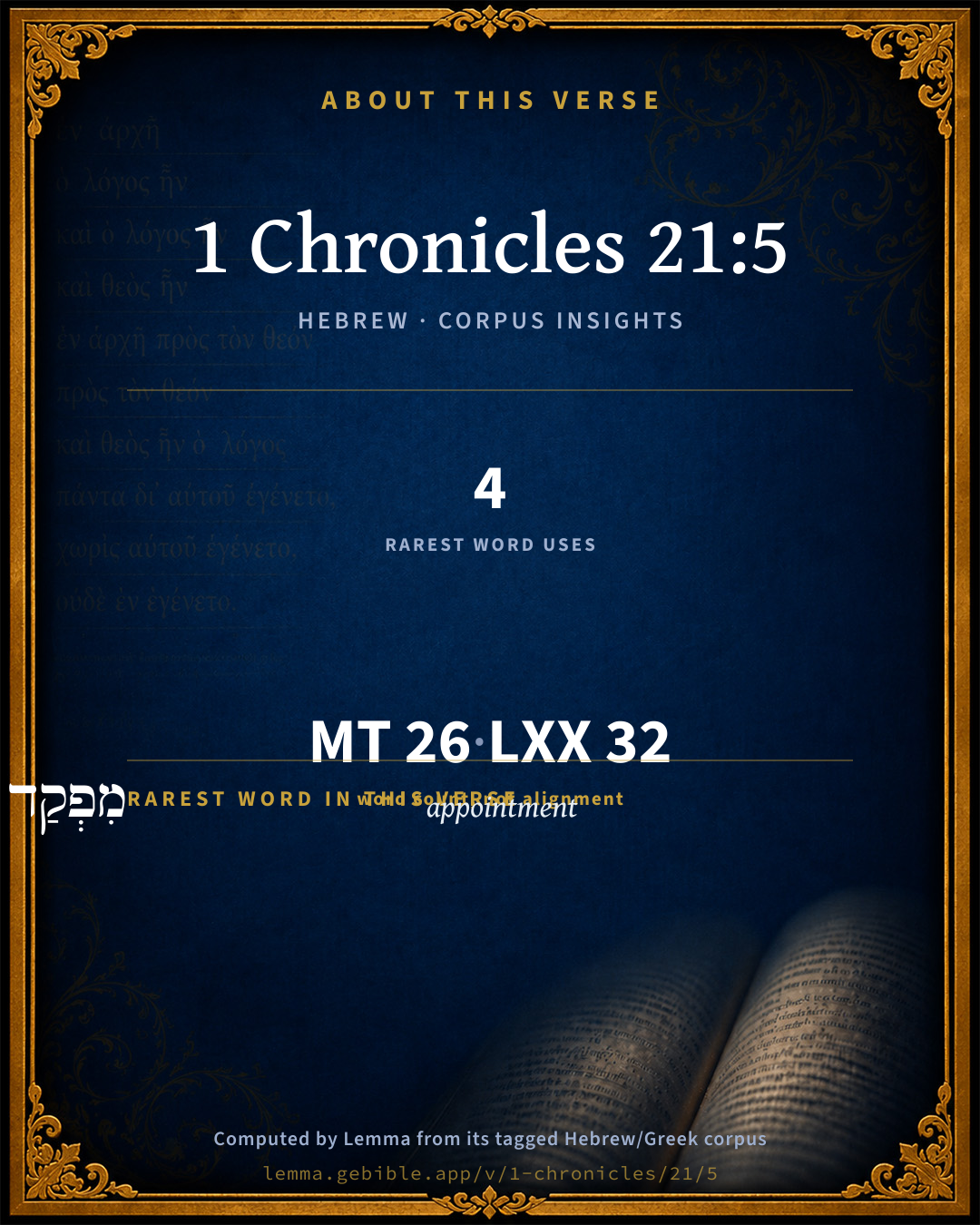
The rarest word here is מִפְקַד appointment H4662 — appearing just 4 times in the whole Hebrew Bible.

Shared distinctive vocabulary

מִפְקַד appointment H4662 occurs in 4 verses of the Hebrew Bible. Also found in:

Grammatical profile

  • 4 verbs
  • 12 nouns
  • 8 adjectives
  • 1 preposition
  • 1 particle

Verb forms

  • וַיִּתֵּ֥ן Qal · Sequential Imperfect
  • וַיְהִ֣י Qal · Sequential Imperfect
  • שֹׁ֣לֵֽף Qal · Participle Active
  • שֹׁ֥לֵֽף Qal · Participle Active

Repetition

Words recur within this verse — often emphatic in Hebrew:

  • אֶ֣לֶף thousand H505 ×4
  • וּמֵאָ֨ה hundred H3967 ×2
  • אִישׁ֙ man H376 ×2
  • שֹׁ֣לֵֽף to draw off H8025 ×2
  • חֶ֔רֶב sword H2719 ×2

Hebrew & Septuagint length

In English translation the verse runs 39 words from the Hebrew and 42 from the Septuagint (LXX English) — closely comparable.

A rough comparison of the two English renderings, which tokenize alike — not a word-level alignment.

Word counts can differ between the Hebrew and the Greek without any difference in meaning — e.g. the Hebrew direct-object marker אֵת has no separate Greek word, and Greek often adds the article ὁ.

In the original languages it is 26 Hebrew tokens and 32 Greek tokens — but the two are counted differently (Hebrew bundles its prefixes and suffixes into one token; the Greek is in lemma form), so that isn’t a like-for-like length.

Cross-references

2

Topical passages linked to 1 Chronicles 21:5 in the Treasury of Scripture Knowledge — connected by theme and wording, ordered by reader-vote popularity; previews shown in the World English Bible.

  • 2 Samuel 24:9 Joab gave up the sum of the numbering of the people to the king: and there were in Israel eight hundred thousand valiant men who drew the sword; and the men of Judah were five hundred thousand men.
  • 1 Chronicles 27:23 But David didn't take the number of them from twenty years old and under, because Yahweh had said he would increase Israel like the stars of the sky.

Cross-references courtesy of OpenBible.info (CC BY 4.0).

Hebrew and Greek witnesses Masoretic Hebrew ↔ Greek Septuagint

The same verse in the two great witnesses to the Old Testament, shown verse-for-verse.

These are two independent witnesses, not word-aligned to each other, and the Septuagint is shown in lemma (dictionary) form.

Hebrew 1 Chronicles 21:5 Masoretic · Westminster Leningrad Codex

וַיִּתֵּ֥ן יוֹאָ֛ב אֶת מִסְפַּ֥ר מִפְקַד הָעָ֖ם אֶל דָּוִ֑יד וַיְהִ֣י כָֽל יִשְׂרָאֵ֡ל אֶ֣לֶף אֲלָפִים֩ וּמֵאָ֨ה אֶ֤לֶף אִישׁ֙ שֹׁ֣לֵֽף חֶ֔רֶב וִֽיהוּדָ֕ה אַרְבַּע֩ מֵא֨וֹת וְשִׁבְעִ֥ים אֶ֛לֶף אִ֖ישׁ שֹׁ֥לֵֽף חָֽרֶב

Joab gave up the sum of the numbering of the people to David. All those of Israel were one million one hundred thousand men who drew sword: and in Judah were four hundred seventy thousand men who drew sword.

World English Bible · Public Domain

Greek LXX 1 Chronicles 21:5 Septuagint · lemma form

καί δίδωμι ιωαβ ὁ ἀριθμός ὁ ἐπίσκεψις ὁ λαός ὁ δαυίδ καί εἰμί πᾶς ἰσραήλ χίλιοι χιλιάς καί ἑκατόν χιλιάς ἀνήρ σπάω μάχαιρα καί ἰούδας τετρακόσιοι καί ὀγδοήκοντα χιλιάς ἀνήρ σπάω μάχαιρα

And Joab gave the number of the mustering of the people to David: and all Israel was a million and one hundred thousand men that drew sword: and the sons of Juda were four hundred and seventy thousand men that drew sword.

LXX2012 (modern English Septuagint) · Public Domain

Hebrew: Westminster Leningrad Codex (CC BY 4.0). Greek: Septuagint (public domain); English from LXX2012 (modern English Septuagint) (Public Domain). How the Septuagint differs from the Hebrew →

Commentary

Notes on 1 Chronicles 21:5 from classic Christian and Jewish commentators (each source and its license shown beneath its notes). The classic Christian expositions comment on the surrounding passage and are grouped to its opening verse, so a note may address several verses; the Jewish commentaries on the Tanakh (Rashi and others) are per-verse, so they appear only where the commentator wrote on this verse.

Lemma curates 59 commentaries, every one of them public domain or Creative Commons licensed, each selected and text-cleaned for this edition rather than reprinted as found. About our sources →

Trapp's Complete Commentary

John Trapp

1Ch 21:5 And Joab gave the sum of the number of the people unto David. And all [they of] Israel were a thousand thousand and an hundred thousand men that drew sword: and Judah [was] four hundred threescore and ten thousand men that drew sword.

Ver. 5. {See Trapp on "2Sa 24:9"}

John Trapp, A Commentary or Exposition upon All the Books of the Old and New Testament (1647–1656) — public domain. Text from a community e-Sword module.

Geneva Bible (1599)

Geneva Bible translators

Joab partly for grief, and partly through negligence, gathered not the whole sum as it is here declared.

In Samuel is mention of thirty thousand more, which was either by joining to them some of the Benjamites which were mixed with Judah, or as the Hebrews write, here the chief and princes are left out.

Geneva Bible (1599) marginal notes — public domain. Text via Bolls.life.

Jamieson, Fausset & Brown

Robert Jamieson, A. R. Fausset & David Brown

Joab gave the sum of the number of the children of Israel--It amounted to one million one hundred thousand men in Israel, capable of bearing arms, inclusive of the three hundred thousand military (Ch1 27:1-9), which, being already enlisted in the royal service, were not reckoned (Sa2 24:9), and to four hundred seventy thousand men in Judah, omitting thirty thousand which formed an army of observation stationed on the Philistine frontier (Sa2 6:1). So large a population at this early period, considering the limited extent of the country and comparing it with the earlier census (Num. 26:1-65), is a striking proof of the fulfilment of the promise (Gen 15:5).

Jamieson, Fausset & Brown — Commentary Critical and Explanatory on the Whole Bible (1871) — public domain (CC PDM 1.0). Text via the HelloAO Bible API.

Adam Clarke's Commentary

Verse 5. All they of Israel were a thousand thousand - Judah was four hundred threescore and ten thousand] In the parallel place, 2Sa 24:9, the men of Israel are reckoned eight hundred thousand, and the men of Judah five hundred thousand: see the note there.

Adam Clarke's Commentary on the Bible (1810–1826) — public domain. Text from a community e-Sword/MySword module.

Ellicott's Commentary for English Readers

(5) The number.—Muster, or census (miphqãd). The first clause is identical with Samuel, but has “David” for “the king,” as elsewhere.

And all they of Israel.—And all Israel became (came to). The numbers are different in Samuel, which states them as 800,000 for Israel and 500,000 for Judah. The latter may fairly be regarded as a round number (500,000), our text giving the more exact total (470,000). As to the former, we may assume that the 1,100,000 of our text is an error of transcription, or, more probably, that the traditions respecting this census varied, as may easily have happened, inasmuch as the numbers were not registered in the royal archives (1Ch_27:24). Perhaps, however, our estimate includes the standing army of David, reckoned (1Ch_27:1-15) at a total of 288,000 men (in round numbers, 300,000); thus 800,000 (Sam.) + 300,000 = 1,100.000 (Chron.).

A Bible Commentary for English Readers, edited by Charles John Ellicott (1878–1897) — public domain. Text from a community e-Sword module.

The Cambridge Bible for Schools and Colleges

gen. ed. J. J. S. Perowne

5. they of Israel] Chron. gives Israel as 1,100,000 and Judah as 470,000; 2 Sam. gives Israel as 800,000 and Judah as 500,000.

that drew sword] All males over twenty years of age would be so described; cp. Num_1:20.

The Cambridge Bible for Schools and Colleges (gen. ed. J. J. S. Perowne; Cambridge University Press, 1878–1918) — public domain. Text from a community e-Sword module.

Albert Barnes' Notes on the Bible

In 2Sa 24:9 the numbers are different. The explanation there given is not so generally accepted as the supposition that the numbers have, in one passage or the other (or possibly in both), suffered corruption.

Albert Barnes' Notes on the Bible (1834–1885) — public domain. Text from a community e-Sword/MySword module.

Haydock's Catholic Bible Commentary

The number, &c. The difference of the numbers here and [in] 2 Kings xxiv. 9., is to be accounted for, by supposing the greater number to be that which was really found, and the lesser to be that which Joab gave in; (Challoner) or the transcribers of this place have been inaccurate. (Calmet)

George Leo Haydock (1774–1849), Haydock's Catholic Family Bible and Commentary, 1859 edition — public domain. Excludes Psalms (Douay-Rheims chapter numbering differs from Protestant) and Deuterocanonical books (Catholic canon only).

The Pulpit Commentary

The report of the numbers as given in this verse does not tally with that of the parallel place. Here they are three hundred thousand more for Israel, and thirty thousand fewer for Judah, than there. No really satisfactory explanation of these discrepancies has yet appeared. The somewhat ingenious suggestion that the Chronicle-compiler counted in the standing army (two hundred and eighty-eight thousand, 1Ch_27:1-15) for Israel, and omitted from Judah a supposed "thirty thousand," under the head of "the thirty" of our ch. 11.; while the writer of the Book of Samuel did exactly the converse, can scarcely pass muster, although it must be noticed that it would meet in the main the exigencies of the case. A likelier suggestion might be found in a comparison of the statements of our ver. 6 compared with 1Ch_27:22-24. Indeed, the last sentence of this last-quoted verse (1Ch_27:24) may possibly contain the explanation of all. (cutup Num_1:47-50 Num_2:33) That Joab utterly refused to number Levi, because this was a thing most distinctly prohibited (and further because it was not material to David"s presumable objects), was quite to be expected. And though Joab is said in the following verse not to have numbered Benjamin, it is possible enough that he may have known this number. (1Ch_7:6-11) Yet see what follows.

The Pulpit Commentary (1880–1919), ed. H.D.M. Spence-Jones & Joseph S. Exell — public domain. Text from a community e-Sword module.

Scofield Reference Notes

C. I. Scofield

were a thousand

Cf. (See Scofield "2Sa 24:9").

The Scofield Reference Bible (1917 edition), notes by C. I. Scofield — public domain. Text from a community e-Sword module.

Rashi

Rabbi Shlomo Yitzchaki (Rashi)

the number of the census lit., the number of the number. A similar expression is (Num. 14:29): “... and all your numbered ones at all your numberings.”

and all Israel were a thousand thousand and a hundred thousand, etc. and Judah was four hundred seventy thousand But in Samuel (II 24:9) it is written: “eight hundred thousand, etc., and the men of Judah were five hundred thousand men,” which apparently means that there were not so many of Israel as are stated here. The truth is that because the anger of the Holy One, blessed be He, was upon David, Scripture did not write there the number of all of those whom he had counted. Neither did Joab count all the tribes, as it is written (verse 6): “... because the word of the king was repugnant to Joab.” But here, because of David’s honor, he does mention the number and the reckoning that he counted, because it is his honor that such a massive army was in his tribe. And the following is proof to what I explained: that even that small part of Israel that he counted, he did not write their entire number in Samuel, but here, [the Chronicler] did write the entire number that he counted, because it is written here: “and all Israel were,” whereas in Samuel it is not written: “all.” And it is explicitly proven here before us, as it is written: (below 27:24): “Joab the son of Zeruiah began to count but did not finish, and with this there was anger upon Israel, and the number did not reach the number of the chronicles of King David.”

Rashi on the Tanakh — English translations: “The Judaica Press complete Tanach with Rashi, translated by A. J. Rosenberg” (CC BY 4.0); “Pentateuch with Rashi's commentary by M. Rosenbaum and A.M. Silbermann, 1929-1934” (public domain); “The Metsudah Tanach series, Lakewood, N.J” (CC BY 4.0); and “The Book of Joshua, Metsudah Publications, 1997” (CC BY 4.0). Text via Sefaria.

Lesson kit

Teaching starters — assembled from the data on this page, not authored interpretation. Every prompt links to the verse data it draws on. Edit before teaching.

1 Chronicles, in the Historical, opens this verse with 26 words (19 distinct Hebrew lemmas). Its most distinctive word is miphqâd (“appointment”). A historical commentator’s framing appears above. Read the whole chapter for the surrounding context.

Discussion questions

  1. What does “appointment” (miphqâd) contribute to the verse as a whole?
  2. How does 2 Samuel 24:9, which shares the word «appointment», read alongside this verse?
  3. What does the repetition of “thousand” (4× in this one verse) do in this verse?
  4. These translations render this verse differently. What is at stake in choosing one wording over another?
  5. «וַיִּתֵּ֥ן» is a Qal Sequential Imperfect verb. How does that grammatical form shape the action described?
  6. Compare how Trapp's Complete Commentary and Geneva Bible (1599) read this verse. Where do they agree or differ?

Things to notice

Reading settings

Reading text

Shown beneath each verse's original-language words.

Old Testament
Old Testament edition

Read the OT as the Masoretic Hebrew (MT) or the Greek Septuagint (LXX).

English shown for the Greek Septuagint (in the Hebrew ↔ Greek comparison).

Comparing translations? Open the Compare panel on any verse page to stack up to four side by side.