
Numbers 22:23

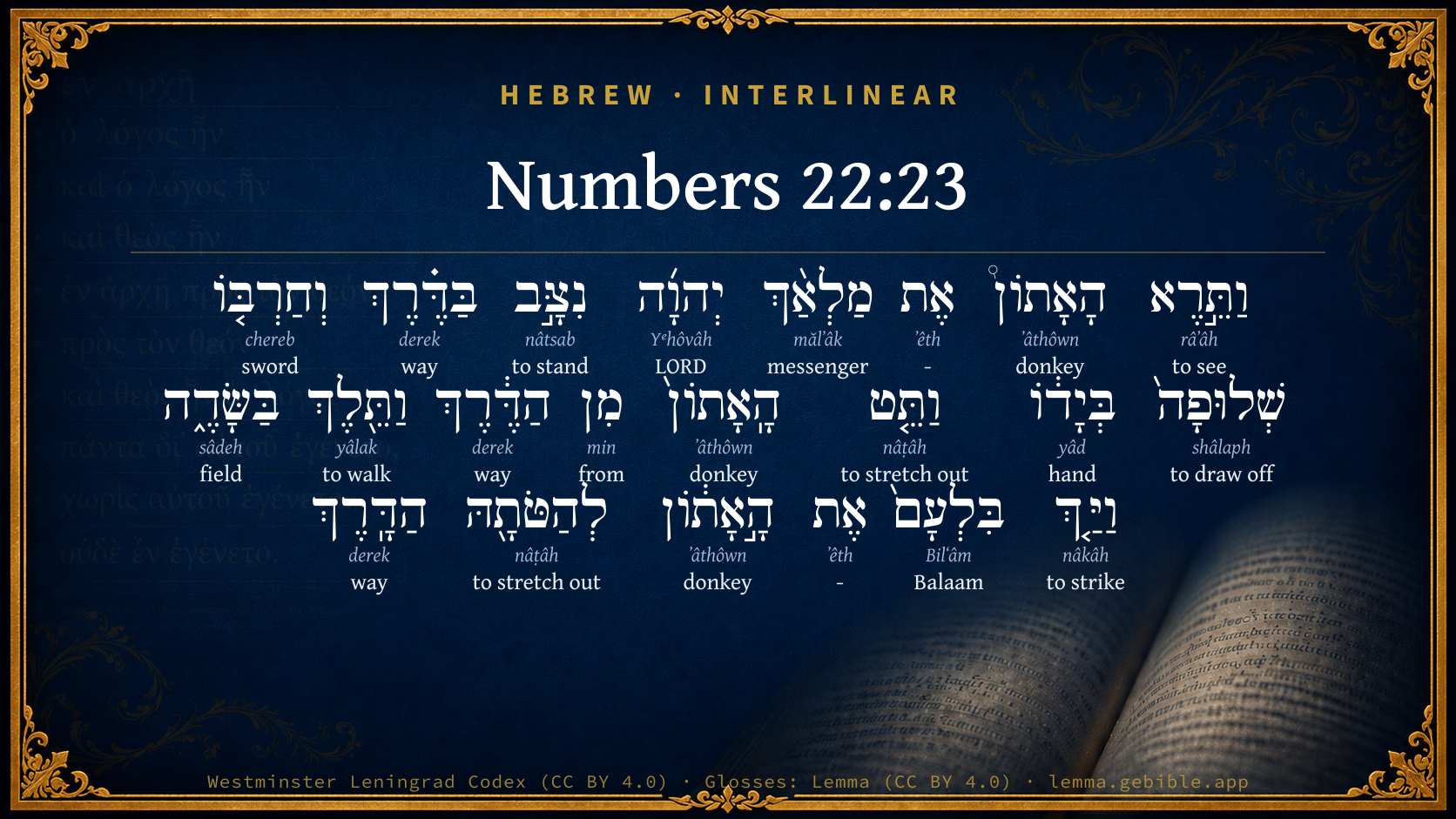
Hebrew (Westminster Leningrad Codex) Numbers 22:23 appears in the Hebrew Old Testament. The text above is from the Westminster Leningrad Codex. Each word links to its Strong’s number, a concise gloss, and parsing drawn from the Open Scriptures Hebrew Bible morphology. Click any word for its full Brown-Driver-Briggs (BDB) entry.
Download image
Cite this verse

Numbers 22:23 (World English Bible). Public Domain. Lemma interlinear Bible study tool, https://lemma.gebible.app/v/numbers/22/23.

Show BibTeX & RIS
BibTeX
RIS
English Translation
The donkey saw the angel of Yahweh standing in the way, with his sword drawn in his hand; and the donkey turned aside out of the way, and went into the field: and Balaam struck the donkey, to turn her into the way.
World English Bible · Public Domain
Highlights
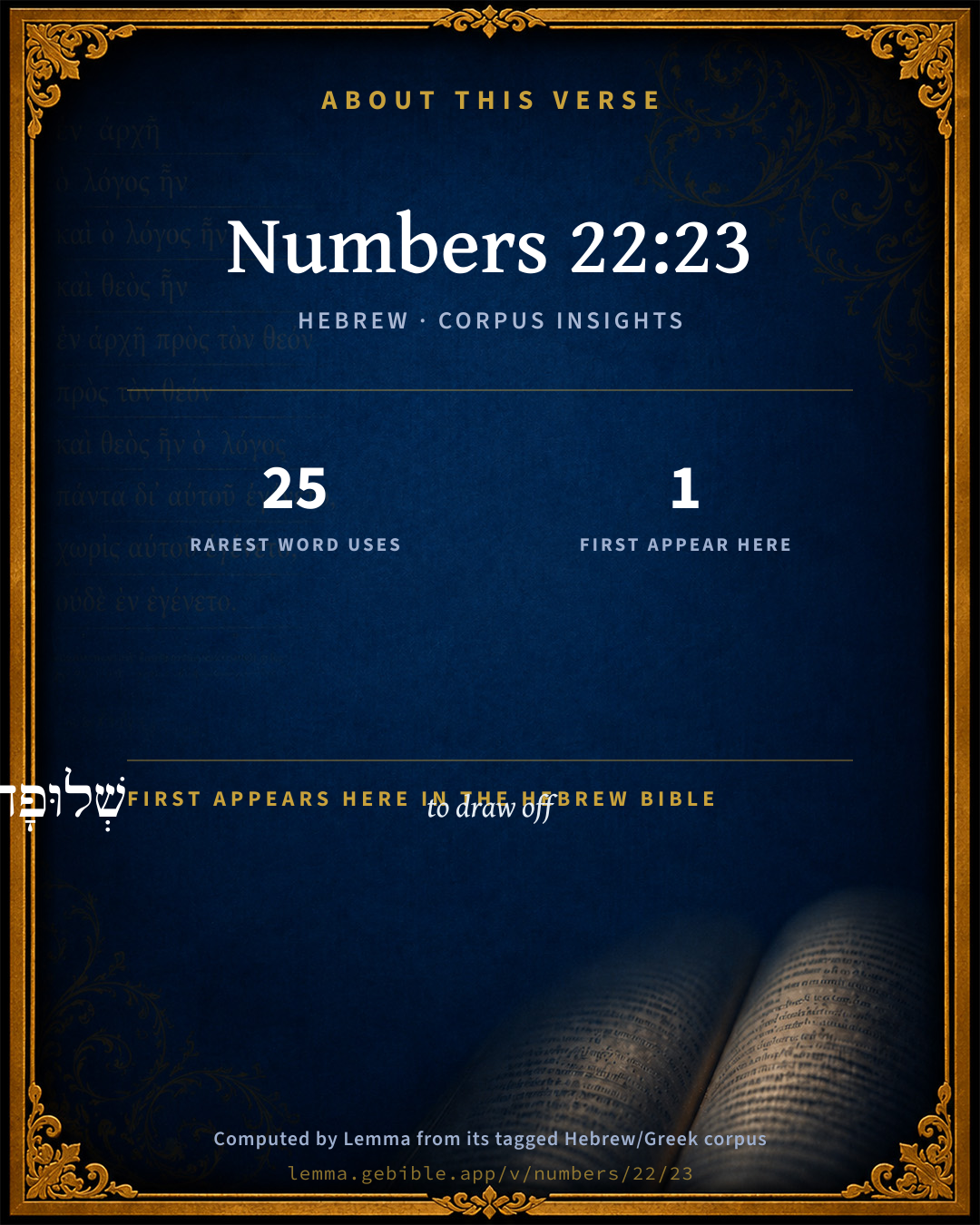
  • 1 first appearance in the Hebrew Bible
Full analysis ↓
Download a study sheet

One document with this verse’s original text, its word-by-word gloss line, the meaning frame, cross-references with their text, attributed commentary, and full source and license credits — printable, and it pastes into notes with its structure intact.

This verse Autodidact and up

Study sheet (.html) Plain text (.txt)

A passage Seminary Student

Up to 50 verses in one chapter. A passage sheet keeps up to 6 commentary sources and 12 cross-references per verse, in the order this page ranks them, and says so on the sheet whenever that leaves anything out. Ask for a single verse and you get the Autodidact verse sheet above.

Everything on this page stays free to read, with no account — the sheet is a download of what is already on screen, not access to it.

Want to remove ads? Support Godless Engineer
Compare translations 3

The same verse in 3 English versions, stacked beneath the original-language interlinear above. Click any original word for its lexicon entry.

Each is an independent rendering of the whole verse — the interlinear is not word-aligned to these translations.

Highlighted words mark where these versions differ — a whole-verse word diff, not a word-by-word alignment.

  • World English Bible Public Domain
    The donkey saw the angel of Yahweh standing in the way, with his sword drawn in his hand; and the donkey turned aside out of the way, and went into the field: and Balaam struck the donkey, to turn her into the way.
  • King James Version Public Domain
    And the ass saw the angel of the LORD standing in the way, and his sword drawn in his hand: and the ass turned aside out of the way, and went into the field: and Balaam smote the ass, to turn her into the way.
  • unfoldingWord Literal Text CC BY-SA 4.0
    And the female donkey saw the angel of Yahweh stationed in the road, and his sword drawn in his hand. And the female donkey turned aside from the road and went into the field. And Balaam struck the female donkey to turn her back to the road.

unfoldingWord Literal Text — © unfoldingWord, licensed CC BY-SA 4.0. Word-aligned USFM3 via Door43 (git.door43.org/unfoldingWord/en_ult).

Versions to compare (up to 4)

3 of 4 selected

Show all 18 translations

Every available English version of this verse, each an independent rendering of the whole verse.

  • World English Bible Public Domain
    The donkey saw the angel of Yahweh standing in the way, with his sword drawn in his hand; and the donkey turned aside out of the way, and went into the field: and Balaam struck the donkey, to turn her into the way.
  • Berean Standard Bible Public Domain
    When the donkey saw the angel of the LORD standing in the road with a drawn sword in his hand, she turned off the path and went into a field. So Balaam beat her to return her to the path.
  • Majority Standard Bible Public Domain
    When the donkey saw the angel of the LORD standing in the road with a drawn sword in his hand, she turned off the path and went into a field. So Balaam beat her to return her to the path.
  • King James Version Public Domain
    And the ass saw the angel of the LORD standing in the way, and his sword drawn in his hand: and the ass turned aside out of the way, and went into the field: and Balaam smote the ass, to turn her into the way.
  • American Standard Version (1901) Public Domain
    And the ass saw the angel of Jehovah standing in the way, with his sword drawn in his hand; and the ass turned aside out of the way, and went into the field: and Balaam smote the ass, to turn her into the way.
  • Revised Version (1885) Public Domain
    And the ass saw the angel of the LORD standing in the way, with his sword drawn in his hand: and the ass turned aside out of the way, and went into the field: and Balaam smote the ass, to turn her into the way.
  • Geneva Bible (1599) Public Domain
    And when the asse saw the Angel of the Lord stand in the way, and his sworde drawen in his hand, the asse turned out of the way and went into the field, but Balaam smote the asse, to turne her into the way.
  • Douay-Rheims (1899) Public Domain
    The ass seeing the angel standing in the way, with a drawn sword, turned herself out of the way, and went into the field. And when Balaam beat her, and had a mind to bring her again to the way,
  • Young's Literal Translation Public Domain
    and the ass seeth the messenger of Jehovah standing in the way, and his drawn sword in his hand, and the ass turneth aside out of the way, and goeth into a field, and Balaam smiteth the ass to turn it aside into the way.
  • Literal Standard Version CC BY-SA 4.0
    and the donkey sees the Messenger of YHWH standing in the way with His drawn sword in His hand, and the donkey turns aside out of the way and goes into a field, and Balaam strikes the donkey to turn it aside into the way.
  • Unlocked Literal Bible CC BY-SA 4.0
    The donkey saw the angel of Yahweh standing in the road with his drawn sword in his hand. The donkey turned off the road and went into a field. Balaam struck the donkey to turn her back to the road.
  • unfoldingWord Literal Text CC BY-SA 4.0
    And the female donkey saw the angel of Yahweh stationed in the road, and his sword drawn in his hand. And the female donkey turned aside from the road and went into the field. And Balaam struck the female donkey to turn her back to the road.
  • Darby Bible Public Domain
    And the ass saw the Angel of Jehovah standing in the way, and his sword drawn in his hand; and the ass turned aside out of the way, and went into the field, and Balaam smote the ass to turn her into the way.
  • World Messianic Bible Public Domain
    The donkey saw the LORD’s angel standing in the way, with his sword drawn in his hand; and the donkey turned out of the path, and went into the field. Balaam struck the donkey, to turn her into the path.
  • Webster's Bible Public Domain
    And the ass saw the angel of the LORD standing in the way, and his sword drawn in his hand: and the ass turned aside out of the way, and went into the field: and Balaam smote the ass, to turn her into the way.
  • Free Bible Version CC BY-SA 4.0
    The donkey saw the angel of the Lord standing in the road holding a drawn sword, so it turned from the road and went into a field. So Balaam beat it to make it go back to the road.
  • Bible in Basic English Public Domain
    And the ass saw the angel of the Lord waiting in the road with his sword in his hand; and turning from the road, the ass went into the field; and Balaam gave the ass blows, to get her back on to the road.
  • JPS Tanakh (1917) Public Domain
    And the ass saw the angel of the LORD standing in the way, with his sword drawn in his hand; and the ass turned aside out of the way, and went into the field; and Balaam smote the ass, to turn her into the way.

Literal Standard Version (2020), Covenant Press — licensed CC BY-SA 4.0. Text via the HelloAO Bible API (eBible.org). Unlocked Literal Bible (unfoldingWord) — licensed CC BY-SA 4.0. Text via the HelloAO Bible API (eBible.org). unfoldingWord Literal Text — © unfoldingWord, licensed CC BY-SA 4.0. Word-aligned USFM3 via Door43 (git.door43.org/unfoldingWord/en_ult). Free Bible Version, Dr. Jonathan Gallagher — licensed CC BY-SA 4.0. Text via the HelloAO Bible API (eBible.org).

Word by word

More ways to search: Search by grammar → Find every occurrence → Compare this word →

Practice this passage: Drill this verse → Learn its vocabulary →

שְׁלוּפָה֙
shâlaph
H8025
“drawn off”
Verb, Qal, Participle Passive, Feminine, Singular, Absolute
Part of Speech
Verb
Stem
Qal
Form
Participle Passive
Gender
Feminine
Number
Singular
State
Absolute
Full BDB Definition

Origin: a primitive root

TWOT: 2402

to draw out or off, take off - (Qal) - to draw out - to draw off - to shoot up, draw out (of blade of grass on roof)
  1. וַתֵּ֣רֶא râʼâh H7200 “and · to see” Conjunction + Verb, Qal, Sequential Imperfect, 3rd Person, Feminine, Singular
  2. הָאָתוֹן֩ ʼâthôwn H860 “the · donkey” Particle, Definite Article + Noun, Common, Feminine, Singular, Absolute
  3. אֶת ʼêth H853 “-” Particle, Direct Object
  4. מַלְאַ֨ךְ mălʼâk H4397 “messenger of” Noun, Common, Masculine, Singular, Construct
  5. יְהוָ֜ה Yᵉhôvâh H3068 “LORD” Noun, Proper
  6. נִצָּ֣ב nâtsab H5324 “standing” Verb, Niphal, Participle Active, Masculine, Singular, Absolute
  7. בַּדֶּ֗רֶךְ derek H1870 “in/at the · way” Preposition, Determined + Noun, Common, Both, Singular, Absolute
  8. וְחַרְבּ֤וֹ chereb H2719 “and · sword · his” Conjunction + Noun, Common, Feminine, Singular, Construct + Suffix, Personal, 3rd Person, Masculine, Singular
  9. בְּיָד֔וֹ yâd H3027 “in/at · hand · his” Preposition + Noun, Common, Both, Singular, Construct + Suffix, Personal, 3rd Person, Masculine, Singular
  10. וַתֵּ֤ט nâṭâh H5186 “and · to stretch out” Conjunction + Verb, Qal, Sequential Imperfect, 3rd Person, Feminine, Singular
  11. הָֽאָתוֹן֙ ʼâthôwn H860 “the · donkey” Particle, Definite Article + Noun, Common, Feminine, Singular, Absolute
  12. מִן min H4480 “from” Preposition
  13. הַדֶּ֔רֶךְ derek H1870 “the · way” Particle, Definite Article + Noun, Common, Both, Singular, Absolute
  14. וַתֵּ֖לֶךְ yâlak H3212 “and · to walk” Conjunction + Verb, Qal, Sequential Imperfect, 3rd Person, Feminine, Singular
  15. בַּשָּׂדֶ֑ה sâdeh H7704 “in/at the · field” Preposition, Determined + Noun, Common, Masculine, Singular, Absolute
  16. וַיַּ֤ךְ nâkâh H5221 “and · to strike” Conjunction + Verb, Hiphil, Sequential Imperfect, 3rd Person, Masculine, Singular
  17. בִּלְעָם֙ Bilʻâm H1109 “Balaam” Noun, Proper
  18. אֶת ʼêth H853 “-” Particle, Direct Object
  19. הָ֣אָת֔וֹן ʼâthôwn H860 “the · donkey” Particle, Definite Article + Noun, Common, Feminine, Singular, Absolute
  20. לְהַטֹּתָ֖הּ nâṭâh H5186 “to stretch out · her” Preposition + Verb, Hiphil, Infinitive Construct + Suffix, Personal, 3rd Person, Feminine, Singular
  21. הַדָּֽרֶךְ derek H1870 “the · way” Particle, Definite Article + Noun, Common, Both, Singular, Absolute

About this verse

These counts appear in no published source. They are computed here, from the morphology-tagged text and Lemma’s own curated glosses. What Lemma adds →

22
words
16
distinct lemmas
Pentateuch
section

Notable vocabulary

The rarest word here is שְׁלוּפָה֙ to draw off H8025 — appearing just 25 times in the whole Hebrew Bible.

First appearance in Scripture

This word makes its first canonical appearance in the Hebrew Bible here:

  • שְׁלוּפָה֙ to draw off H8025

Shared distinctive vocabulary

שְׁלוּפָה֙ to draw off H8025 occurs in 24 verses of the Hebrew Bible. Also found in:

Grammatical profile

  • 7 verbs
  • 12 nouns
  • 1 preposition
  • 2 particles

Verb forms

  • וַתֵּ֣רֶא Qal · Sequential Imperfect
  • נִצָּ֣ב Niphal · Participle Active
  • שְׁלוּפָה֙ Qal · Participle Passive
  • וַתֵּ֤ט Qal · Sequential Imperfect
  • וַתֵּ֖לֶךְ Qal · Sequential Imperfect
  • וַיַּ֤ךְ Hiphil · Sequential Imperfect
  • לְהַטֹּתָ֖הּ Hiphil · Infinitive Construct

Repetition

Words recur within this verse — often emphatic in Hebrew:

  • הָאָתוֹן֩ donkey H860 ×3
  • בַּדֶּ֗רֶךְ way H1870 ×3
  • וַתֵּ֤ט to stretch out H5186 ×2

Hebrew & Septuagint length

In English translation the verse runs 43 words from the Hebrew and 49 from the Septuagint (LXX English) — closely comparable.

A rough comparison of the two English renderings, which tokenize alike — not a word-level alignment.

Word counts can differ between the Hebrew and the Greek without any difference in meaning — e.g. the Hebrew direct-object marker אֵת has no separate Greek word, and Greek often adds the article ὁ.

Cross-references

8

Topical passages linked to Numbers 22:23 in the Treasury of Scripture Knowledge — connected by theme and wording, ordered by reader-vote popularity; previews shown in the World English Bible.

  • Jude 1:11 Woe to them! For they went in the way of Cain, and ran riotously in the error of Balaam for hire, and perished in Korah's rebellion.
  • 1 Corinthians 1:27–29 but God chose the foolish things of the world that he might put to shame those who are wise. God chose the weak things of the world, that he might put to shame the things that are strong;
  • 2 Peter 2:16 but he was rebuked for his own disobedience. A mute donkey spoke with man's voice and stopped the madness of the prophet.
  • 2 Kings 6:17 Elisha prayed, and said, Yahweh, Please open his eyes, that he may see. Yahweh opened the eyes of the young man; and he saw: and, behold, the mountain was full of horses and chariots of fire round about Elisha.
  • 1 Chronicles 21:16 David lifted up his eyes, and saw the angel of Yahweh standing between earth and the sky, having a drawn sword in his hand stretched out over Jerusalem. Then David and the elders, clothed in sackcloth, fell on their faces.
  • Jeremiah 8:7 Yes, the stork in the sky knows her appointed times; and the turtle-dove and the swallow and the crane observe the time of their coming; but my people don't know Yahweh's law.
  • Daniel 10:7 I, Daniel, alone saw the vision; for the men who were with me didn't see the vision; but a great quaking fell on them, and they fled to hide themselves.
  • Acts 22:9 "Those who were with me indeed saw the light and were afraid, but they didn't understand the voice of him who spoke to me.

Cross-references courtesy of OpenBible.info (CC BY 4.0).

Hebrew and Greek witnesses Masoretic Hebrew ↔ Greek Septuagint

The same verse in the two great witnesses to the Old Testament, shown verse-for-verse.

These are two independent witnesses, not word-aligned to each other, and the Septuagint is shown in lemma (dictionary) form.

Hebrew Numbers 22:23 Masoretic · Westminster Leningrad Codex

וַתֵּ֣רֶא הָאָתוֹן֩ אֶת מַלְאַ֨ךְ יְהוָ֜ה נִצָּ֣ב בַּדֶּ֗רֶךְ וְחַרְבּ֤וֹ שְׁלוּפָה֙ בְּיָד֔וֹ וַתֵּ֤ט הָֽאָתוֹן֙ מִן הַדֶּ֔רֶךְ וַתֵּ֖לֶךְ בַּשָּׂדֶ֑ה וַיַּ֤ךְ בִּלְעָם֙ אֶת הָ֣אָת֔וֹן לְהַטֹּתָ֖הּ הַדָּֽרֶךְ

The donkey saw the angel of Yahweh standing in the way, with his sword drawn in his hand; and the donkey turned aside out of the way, and went into the field: and Balaam struck the donkey, to turn her into the way.

World English Bible · Public Domain

Greek LXX Numbers 22:23 Septuagint · lemma form

καί ὁράω ὁ ὄνος ὁ ἄγγελος ὁ θεός ἀντιἵστημι ἐν ὁ ὁδός καί ὁ ῥομφαία σπάω ἐν ὁ χείρ αὐτός καί ἐκκλίνω ὁ ὄνος ἐκ ὁ ὁδός καί πορεύομαι εἰς ὁ πεδίον καί πατάσσω ὁ ὄνος ὁ ῥάβδος ὁ εὐθύνω αὐτός ἐν ὁ ὁδός

And when the ass saw the angel of God standing opposite in the way, and his sword drawn in his hand, then the ass turned aside out of the way, and went into the field; and Balaam struck the ass with his staff to direct her in the way.

LXX2012 (modern English Septuagint) · Public Domain

Hebrew: Westminster Leningrad Codex (CC BY 4.0). Greek: Septuagint (public domain); English from LXX2012 (modern English Septuagint) (Public Domain). How the Septuagint differs from the Hebrew →

Targum (Aramaic paraphrase)

2

The Targum is the ancient Jewish Aramaic paraphrase of the Hebrew Scriptures — an interpretive translation, not the Hebrew text itself. Onkelos (literal) and Pseudo-Jonathan (expansive) render the Torah, and Jonathan the Prophets. Coverage is partial: where no permissively-licensed English translation exists for a verse, only the Aramaic is shown. This is verse-level text, not a word-by-word alignment to the Hebrew.

  1. Targum Onkelos Torah (Genesis–Deuteronomy)
    וַחֲזַת אֲתָּנָא יַת מַלְאָכָא דַיְיָ מְעַתַּד בְּאָרְחָא וְחַרְבֵּיהּ שְׁלִיפָא בִּידֵיהּ וּסְטַת אֲתָּנָא מִן אוֹרְחָא וַאֲזָלַת בְּחַקְלָא וּמְחָא בִּלְעָם יַת אֲתָּנָא לְאַסְטָיוּתַהּ לְאָרְחָא

    (no public-domain English translation for this verse)

    Targum Onkelos — Aramaic: “Onkelos Genesis” (public domain); “Onkelos Exodus” (public domain); “Onkelos Leviticus” (public domain); “Onkelos Numbers” (public domain); “Onkelos Deuteronomy” (public domain). English: “Sefaria Community Translation” (CC0 1.0 (public-domain dedication)); “J.W. Etheridge. The Targums of Onkelos and Jonathan Ben Uzziel on the Pentateuch. London: Longmans, Green, 1862” (public domain). Text via Sefaria.

  2. Targum Pseudo-Jonathan Torah (Genesis–Deuteronomy)
    וַחֲמַת אַתְנָא יַת מַלְאָכָא דַיְיָ מְעַתַּד בְּאִיסְרָטָא וְחַרְבֵּיהּ שְׁלִיפָא בִּידֵיהּ וּסְטַת אַתְנָא מִן אָרְחָא וַאֲזָלַת בְּחַקְלָא וּמְחָא בִלְעָם יַת אַתְנָא לִמְכַוְונָא יָתָהּ לְאִיסְרָטָא

    And the ass discerned the angel of the Lord standing in the way with a drawn sword in his hand, and the ass turned aside out of the road, to go into the field. And Bileam smote the ass to make her return unto the way.

    Targum Pseudo-Jonathan — Aramaic: “Targum Jonathan on Genesis” (public domain); “Targum Jonathan on Exodus” (public domain); “Targum Jonathan on Leviticus” (public domain); “Targum Jonathan on Numbers” (public domain); “Targum Jonathan on Deuteronomy” (public domain). English: “The Targum of Jonathan ben Uzziel, trans. J. W. Etheridge, London, 1862” (public domain). Text via Sefaria.

Commentary

Notes on Numbers 22:23 from classic Christian and Jewish commentators (each source and its license shown beneath its notes). The classic Christian expositions comment on the surrounding passage and are grouped to its opening verse, so a note may address several verses; the Jewish commentaries on the Tanakh (Rashi and others) are per-verse, so they appear only where the commentator wrote on this verse.

Lemma curates 59 commentaries, every one of them public domain or Creative Commons licensed, each selected and text-cleaned for this edition rather than reprinted as found. About our sources →

Trapp's Complete Commentary

John Trapp

Num 22:23 And the ass saw the angel of the LORD standing in the way, and his sword drawn in his hand: and the ass turned aside out of the way, and went into the field: and Balaam smote the ass, to turn her into the way.

Ver. 23. And the ass saw the angel.] Which Balaam saw not; his eyes were put out with the dust of covetousness, or dazzled at least with the glittering of the promised promotions.

John Trapp, A Commentary or Exposition upon All the Books of the Old and New Testament (1647–1656) — public domain. Text from a community e-Sword module.

Adam Clarke's Commentary

Verse 23. And the ass saw the angel] When God granted visions those alone who were particularly interested saw them while others in the same company saw nothing; see Da 10:7; Ac 9:7.

Adam Clarke's Commentary on the Bible (1810–1826) — public domain. Text from a community e-Sword/MySword module.

The Cambridge Bible for Schools and Colleges

gen. ed. J. J. S. Perowne

23. with his sword drawn in his hand] Num_22:31. Jos_5:13.

and went into the field] The road would run through the open country (‘the field’), without walls or fences. These would only be employed between vineyards, to keep out animals.

The Cambridge Bible for Schools and Colleges (gen. ed. J. J. S. Perowne; Cambridge University Press, 1878–1918) — public domain. Text from a community e-Sword module.

John Gill's Exposition

And the angel of the Lord went further, and stood in a narrow place,.... More narrow than the other, at a further distance:

where was no way to turn, either to the right hand or to the left; it was so strait and close a place that the angel filled the whole breadth of it, that there was no passing him; so that there was no getting forward nor backward; not forward, because the angel filled up the way, and there was no slipping by him; nor backward, because it could not turn itself to the right or left.

John Gill's Exposition of the Whole Bible (1746–1763) — public domain (CC PDM 1.0). Text via the HelloAO Bible API.

Haydock's Catholic Bible Commentary

Ass. The angel appeared thrice to the ass, before he was perceived by Balaam, chap. xxix. 3, 4. The second time, St. Augustine (q. 50) thinks he was standing in the vineyard. (Calmet)

George Leo Haydock (1774–1849), Haydock's Catholic Family Bible and Commentary, 1859 edition — public domain. Excludes Psalms (Douay-Rheims chapter numbering differs from Protestant) and Deuterocanonical books (Catholic canon only).

Matthew Poole's English Annotations

Balaam saw not the angel because God withheld his eyes, as he did the eyes of Daniel’s companions, Dan 10:7. It is a truth, which mere philosophers own, that when God withdraws his concourse or help from any of his creatures, they cannot perform their natural acts and offices; the eye cannot see, as Ge 19, nor the ear hear, nor the fire burn, as Da 3.

Matthew Poole's English Annotations on the Holy Bible (1683–1685) — public domain. Text from a community e-Sword/MySword module.

Whedon's Commentary on the Bible

Daniel D. Whedon

23. And the ass saw the angel — “To the great disgrace of the prophet, the glory of the angel was first of all apparent to the ass.… He had been boasting before this of extraordinary visions, and now what was visible to the eyes of a beast was invisible to him! Whence came this blindness, but from the avarice by which he had been so stupified that he preferred filthy lucre to the holy calling of God?” — Calvin. All who are versed in natural history agree that irrational animals have a much keener instinctive presentiment of many natural phenomena, such as earthquakes, storms, etc., than man has with his five senses. “The fact is equally undeniable,”

says Keil, “that many animals, as horses and cows, see the so-called second sight.”

Sword drawn — A symbol of the wrath of Jehovah. 1Ch_21:16; Jos_5:13, note.

Daniel D. Whedon (gen. ed.), Commentary on the Old and New Testaments (1874–1909) — public domain. Text from a community e-Sword module.

The Pulpit Commentary

And the ass saw the angel of the Lord. This was clearly part of the miracle, the shmeion which was to exhibit in such a striking manner the stupidity and blindness of the most brilliant and gifted intellect when clouded by greed and selfishness. It is nothing to the point that the lower animals have a quicker perception of some natural phenomena than men, for this was not a natural phenomenon; it is nothing to the point that the lower animals are credited by some with possessing "the second sight," for all that belongs to the fantastic and legendary. If the ass saw the angel, it was because the Lord opened her eyes then, as he did her mouth afterwards.

The Pulpit Commentary (1880–1919), ed. H.D.M. Spence-Jones & Joseph S. Exell — public domain. Text from a community e-Sword module.

Rashi

Rabbi Shlomo Yitzchaki (Rashi)

ותרא האתון AND THE SHE-ASS SAW [THE ANGEL] — but he did not see him, for the Holy One, blessed be He, gave an animal power to see more than the man, for just because he possesses sense his mind would become perturbed if he sees noxious beings.

וחרבו שלופה בידו AND HIS SWORD DRAWN IN HIS HAND — He (God) said: This wicked man has abandoned the tools of his own craft, — for the offensive weapons of the heathen peoples consist in the sword, — and he is attacking them with his mouth which is their metier; I will take his implement and come against him with his own metier. Thus, indeed, was his end (Numbers 31:8): “And Balaam the son of Beor they slew by the sword” (Midrash Tanchuma 4:7:23).

Rashi on the Tanakh — English translations: “The Judaica Press complete Tanach with Rashi, translated by A. J. Rosenberg” (CC BY 4.0); “Pentateuch with Rashi's commentary by M. Rosenbaum and A.M. Silbermann, 1929-1934” (public domain); “The Metsudah Tanach series, Lakewood, N.J” (CC BY 4.0); and “The Book of Joshua, Metsudah Publications, 1997” (CC BY 4.0). Text via Sefaria.

Ramban (Nachmanides)

Rabbi Moshe ben Nachman (Ramban / Nachmanides)

AND THE ASS SAW THE ANGEL OF THE ETERNAL. Angels of G-d — which are Separate Intelligences, pp. 228-231, where Ramban discusses at length the subject of angels in relation to prophecy. — cannot be perceived by the [human] sense of sight, for they are not physical beings which can be apprehended by sight. And when they become visible to prophets or to men possessed of Ruach Hakodesh, Note 71 and Ramban ibid. such as Daniel, worthy of receiving Ruach Hakodesh. they are apprehended by them through the perception of the rational soul which reaches the degree of prophecy or some lower degree, but that they [the angels] should be perceived by the eyes of an animal — that is impossible! Therefore you could explain [the phrase] and the ass saw [the angel of the Eternal] to mean that she felt the presence of something which frightened her off from passing on, namely the angel that had gone forth for an adversary. This is a similar expression [to that which says]: yea, my heart ‘ra’ah’ [literally: “had seen”] much wisdom and knowledge, [the term “seeing” here] being used [in the sense of] perception, and not [in the sense of] physical sight [since the heart does not “see”]. Now when this miracle occurred to the ass, and the Creator gave her [the power of] speech, she said to Balaam, Was I ever wont to do so unto thee?, but [nonetheless] she did not know why she did so now, because she was forced to do so. Therefore she did not say to him: “Behold the angel of G-d stands over against me with his sword drawn in his hand,” since her perception did not reach this knowledge at all. [Our verse] saying: And the ass saw the angel of the Eternal standing in the way, with his sword drawn in his hand does not mean that she [actually] saw the sword, let alone the angel; but the verse is hinting that since the angel was ready to strike them, she trembled very exceedingly, because she felt as if people were coming to slaughter her. [We must explain that the ass merely felt the angel’s presence, but did not actually see him, because] if we were to say that those angels that appear in human form — as I have mentioned in the section of Vayeira — can be seen even by the eyes of an animal, then how was it that Balaam did not see him, since he was not smitten with blindness! It is, however, possible that He Who gave the ass the power of speech, also bestowed upon her an additional power of vision, so that she saw the likeness of a human being, although Scripture does not mention it. Thus G-d opened the eyes of the ass [and she indeed saw the angel], just as Scripture mentions [later] in regard to her master, [And the Eternal opened the eyes of Balaam, and he saw the angel of the Eternal]. For the whole matter of the ass was a great miracle, being a “new creation” like those that were created at twilight [on the eve of the first Sabbath], matter of the ass — beginning with her seeing the angel, and culminating in her speech — were like “a new creation” similar to those things created “at twilight on the eve of the first Sabbath.” — Various interpretations have been suggested on the necessity for these special creations. Rambam in his commentary to the Mishnah explains it as follows: Since the law of nature was established by G-d, it was His wish that it be not interfered with under any circumstance. But since He foresaw certain emergencies in the history of His people that would require special intervention in the normal operation of nature He made provision for them at the final completion of creation before the nightfall which ushered in the first Sabbath. and it is not merely called “an opening of eyes.” However, our Rabbis have only mentioned matter of the ass — beginning with her seeing the angel, and culminating in her speech — were like “a new creation” similar to those things created “at twilight on the eve of the first Sabbath.” — Various interpretations have been suggested on the necessity for these special creations. Rambam in his commentary to the Mishnah explains it as follows: Since the law of nature was established by G-d, it was His wish that it be not interfered with under any circumstance. But since He foresaw certain emergencies in the history of His people that would require special intervention in the normal operation of nature He made provision for them at the final completion of creation before the nightfall which ushered in the first Sabbath. amongst the miracles the opening of the mouth [of the ass, although the whole matter — and especially her seeing the angel — was miraculous in nature]. The reason for this miracle was to show Balaam Who hath made man’s mouth, or Who maketh a man dumb? and to make him realize that it is G-d Who opens the mouth for the dumb, and [since He can make the dumb speak], how much more so can He make dumb at His Will the mouth of those who can speak, and can also put words into their mouths, so that they speak in accordance with His Will, for everything is in His power. It was [thus] a warning to him [Balaam] not to follow enchantments and soothsaying, and [not] to curse Israel thereby, because he was [primarily] an enchanter and soothsayer.

Ramban (Nachmanides) on the Tanakh — English translation: “Commentary on the Torah by Ramban (Nachmanides). Translated and annotated by Charles B. Chavel. New York, Shilo Pub. House, 1971-1976” (CC BY 4.0). Text via Sefaria.

Lesson kit

Teaching starters — assembled from the data on this page, not authored interpretation. Every prompt links to the verse data it draws on. Edit before teaching.

Numbers, in the Pentateuch, opens this verse with 22 words (16 distinct Hebrew lemmas). Its most distinctive word is shâlaph (“to draw off”). A historical commentator’s framing appears above. Read the whole chapter for the surrounding context.

Discussion questions

  1. The word shâlaph carries the sense “to draw off.” How does it shape the verse?
  2. This is the first place “to draw off” appears in Scripture (first appears here). What does its debut here establish?
  3. How does Numbers 22:31, which shares the word «to draw off», read alongside this verse?
  4. What does the repetition of “donkey” (3× in this one verse) do in this verse?
  5. These translations render this verse differently; the difference is in the English rendering, not the original. What questions does that raise?
  6. «וַתֵּ֣רֶא» is a Qal Sequential Imperfect verb. How does that grammatical form shape the action described?
  7. Compare how Trapp's Complete Commentary and Adam Clarke's Commentary read this verse. Where do they agree or differ?

Things to notice

  • 1 word makes its first canonical appearance in Scripture here.
  • These translations choose different wording for 13 words in this verse.
  • “donkey” occurs 3× in this single verse.
  • 16 distinct Hebrew lemmas span 22 words in this verse.

Reading settings

Reading text

Shown beneath each verse's original-language words.

Old Testament
Old Testament edition

Read the OT as the Masoretic Hebrew (MT) or the Greek Septuagint (LXX).

English shown for the Greek Septuagint (in the Hebrew ↔ Greek comparison).

Comparing translations? Open the Compare panel on any verse page to stack up to four side by side.