Isaiah 21:15

Hebrew (Westminster Leningrad Codex) Isaiah 21:15 appears in the Hebrew Old Testament. The text above is from the Westminster Leningrad Codex. Each word links to its Strong’s number, a concise gloss, and parsing drawn from the Open Scriptures Hebrew Bible morphology. Click any word for its full Brown-Driver-Briggs (BDB) entry.
Download image
Cite this verse

Isaiah 21:15 (World English Bible). Public Domain. Lemma interlinear Bible study tool, https://lemma.gebible.app/v/isaiah/21/15.

Show BibTeX & RIS
BibTeX
RIS
English Translation
For they fled away from the swords, from the drawn sword, and from the bent bow, and from the heat of battle.
World English Bible · Public Domain
Download a study sheet

One document with this verse’s original text, its word-by-word gloss line, the meaning frame, cross-references with their text, attributed commentary, and full source and license credits — printable, and it pastes into notes with its structure intact.

This verse Autodidact and up

Study sheet (.html) Plain text (.txt)

A passage Seminary Student

Up to 50 verses in one chapter. A passage sheet keeps up to 6 commentary sources and 12 cross-references per verse, in the order this page ranks them, and says so on the sheet whenever that leaves anything out. Ask for a single verse and you get the Autodidact verse sheet above.

Everything on this page stays free to read, with no account — the sheet is a download of what is already on screen, not access to it.

Want to remove ads? Support Godless Engineer
Compare translations 3

The same verse in 3 English versions, stacked beneath the original-language interlinear above. Click any original word for its lexicon entry.

Each is an independent rendering of the whole verse — the interlinear is not word-aligned to these translations.

Highlighted words mark where these versions differ — a whole-verse word diff, not a word-by-word alignment.

  • World English Bible Public Domain
    For they fled away from the swords, from the drawn sword, and from the bent bow, and from the heat of battle.
  • King James Version Public Domain
    For they fled from the swords, from the drawn sword, and from the bent bow, and from the grievousness of war.
  • unfoldingWord Literal Text CC BY-SA 4.0
    For from the face of swords they have fled, from the face of a drawn sword and from the face of a tread bow and from the face of the heaviness of war.

unfoldingWord Literal Text — © unfoldingWord, licensed CC BY-SA 4.0. Word-aligned USFM3 via Door43 (git.door43.org/unfoldingWord/en_ult).

Versions to compare (up to 4)

3 of 4 selected

Show all 18 translations

Every available English version of this verse, each an independent rendering of the whole verse.

  • World English Bible Public Domain
    For they fled away from the swords, from the drawn sword, and from the bent bow, and from the heat of battle.
  • Berean Standard Bible Public Domain
    For they flee from the sword—the sword that is drawn—from the bow that is bent, and from the stress of battle.
  • Majority Standard Bible Public Domain
    For they flee from the sword—the sword that is drawn—from the bow that is bent, and from the stress of battle.
  • King James Version Public Domain
    For they fled from the swords, from the drawn sword, and from the bent bow, and from the grievousness of war.
  • American Standard Version (1901) Public Domain
    For they fled away from the swords, from the drawn sword, and from the bent bow, and from the grievousness of war.
  • Revised Version (1885) Public Domain
    For they fled away from the swords, from the drawn sword, and from the bent bow, and from the grievousness of war.
  • Geneva Bible (1599) Public Domain
    For they flee from the drawen swords, euen from the drawen sword, and from the bent bowe, and from the grieuousnesse of warre.
  • Douay-Rheims (1899) Public Domain
    For they are fled from before the swords, from the sword that hung over them, from the bent bow, from the face of a grievous battle.
  • Young's Literal Translation Public Domain
    For from the face of destructions they fled, From the face of a stretched-out sword, And from the face of a trodden bow, And from the face of the grievousness of battle.
  • Literal Standard Version CC BY-SA 4.0
    For they fled from the face of destructions, || From the face of an outstretched sword, || And from the face of a trodden bow, || And from the face of the grievousness of battle.
  • Unlocked Literal Bible CC BY-SA 4.0
    For they have fled from the sword, from the drawn sword, from the bent bow, and from the weight of war.
  • unfoldingWord Literal Text CC BY-SA 4.0
    For from the face of swords they have fled, from the face of a drawn sword and from the face of a tread bow and from the face of the heaviness of war.
  • Darby Bible Public Domain
    For they flee from the swords, from the drawn sword, and from the bent bow, and from the grievousness of war.
  • World Messianic Bible Public Domain
    For they fled away from the swords, from the drawn sword, from the bent bow, and from the heat of battle.
  • Webster's Bible Public Domain
    For they fled from the swords, from the drawn sword, and from the bent bow, and from the grievousness of war.
  • Free Bible Version CC BY-SA 4.0
    They're running away from a fierce battle, from swords, drawn swords, from bows and arrows.
  • Bible in Basic English Public Domain
    For they are in flight from the sharp sword, and the bent bow, and from the trouble of war.
  • JPS Tanakh (1917) Public Domain
    For they fled away from the swords, from the drawn sword, and from the bent bow, and from the grievousness of war.

Literal Standard Version (2020), Covenant Press — licensed CC BY-SA 4.0. Text via the HelloAO Bible API (eBible.org). Unlocked Literal Bible (unfoldingWord) — licensed CC BY-SA 4.0. Text via the HelloAO Bible API (eBible.org). unfoldingWord Literal Text — © unfoldingWord, licensed CC BY-SA 4.0. Word-aligned USFM3 via Door43 (git.door43.org/unfoldingWord/en_ult). Free Bible Version, Dr. Jonathan Gallagher — licensed CC BY-SA 4.0. Text via the HelloAO Bible API (eBible.org).

Word by word

More ways to search: Search by grammar → Find every occurrence → Compare this word →

Practice this passage: Drill this verse → Learn its vocabulary →

כֹּ֥בֶד
kôbed
H3514
“weight of”
Noun, Common, Masculine, Singular, Construct
Part of Speech
Noun
Type
Common
Gender
Masculine
Number
Singular
State
Construct
Full BDB Definition

Origin: from H3513

TWOT: 943c

weight, heaviness, mass, great - heaviness, weight - mass, abundance - vehemence, heaviness
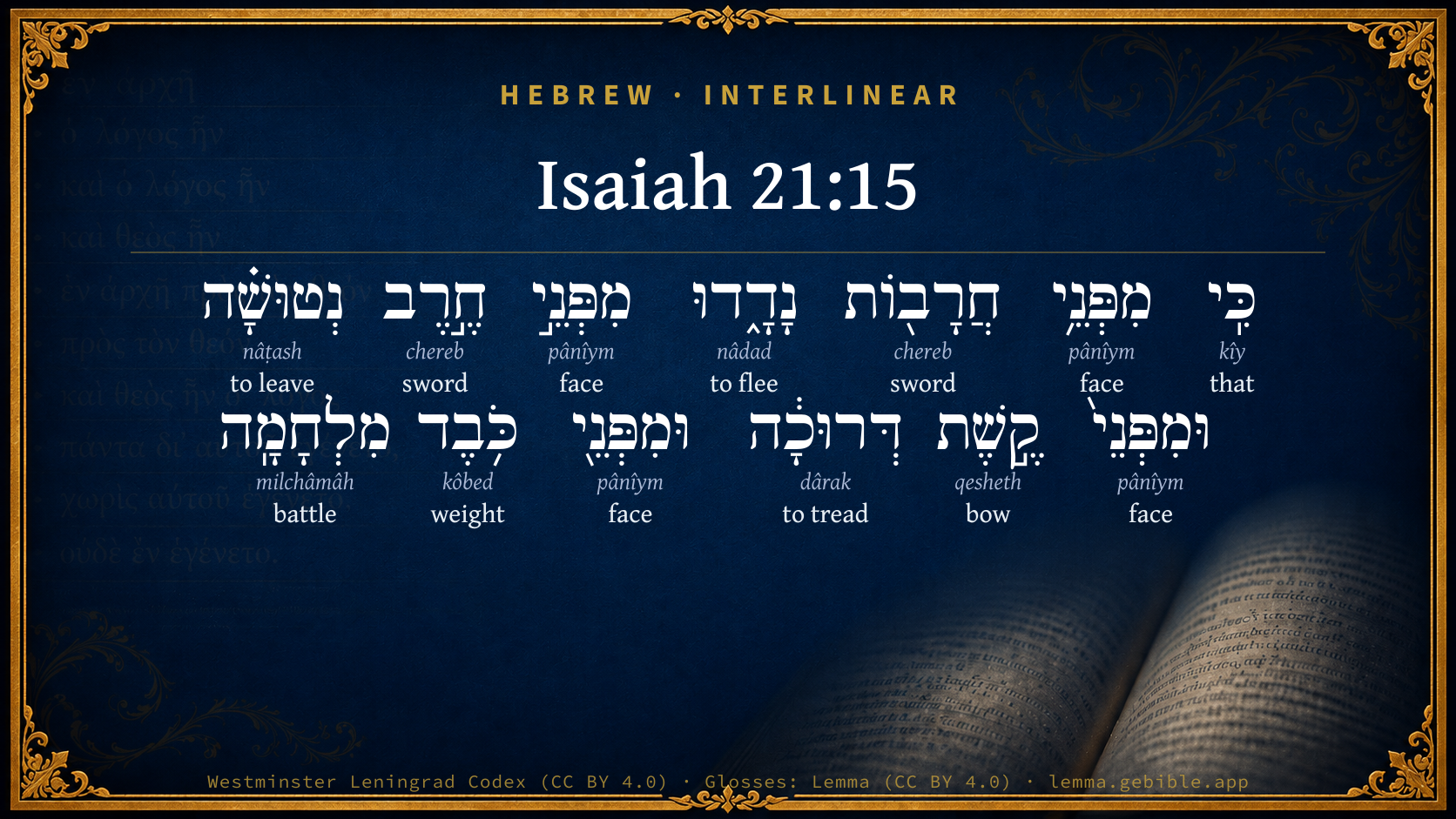
  1. כִּֽי kîy H3588 “that” Conjunction
  2. מִפְּנֵ֥י pânîym H6440 “from · face(s) of” Preposition + Noun, Common, Both, Plural, Construct
  3. חֲרָב֖וֹת chereb H2719 “swords” Noun, Common, Feminine, Plural, Absolute
  4. נָדָ֑דוּ nâdad H5074 “to flee” Verb, Qal, Perfect, 3rd Person, Common, Plural
  5. מִפְּנֵ֣י pânîym H6440 “from · face(s) of” Preposition + Noun, Common, Both, Plural, Construct
  6. חֶ֣רֶב chereb H2719 “sword” Noun, Common, Feminine, Singular, Absolute
  7. נְטוּשָׁ֗ה nâṭash H5203 “left” Verb, Qal, Participle Passive, Feminine, Singular, Absolute
  8. וּמִפְּנֵי֙ pânîym H6440 “and · from · face(s) of” Conjunction + Preposition + Noun, Common, Both, Plural, Construct
  9. קֶ֣שֶׁת qesheth H7198 “bow” Noun, Common, Feminine, Singular, Absolute
  10. דְּרוּכָ֔ה dârak H1869 “trodden” Verb, Qal, Participle Passive, Feminine, Singular, Absolute
  11. וּמִפְּנֵ֖י pânîym H6440 “and · from · face(s) of” Conjunction + Preposition + Noun, Common, Both, Plural, Construct
  12. מִלְחָמָֽה milchâmâh H4421 “battle” Noun, Common, Feminine, Singular, Absolute

About this verse

These counts appear in no published source. They are computed here, from the morphology-tagged text and Lemma’s own curated glosses. What Lemma adds →

13
words
9
distinct lemmas
Prophets
section

Notable vocabulary

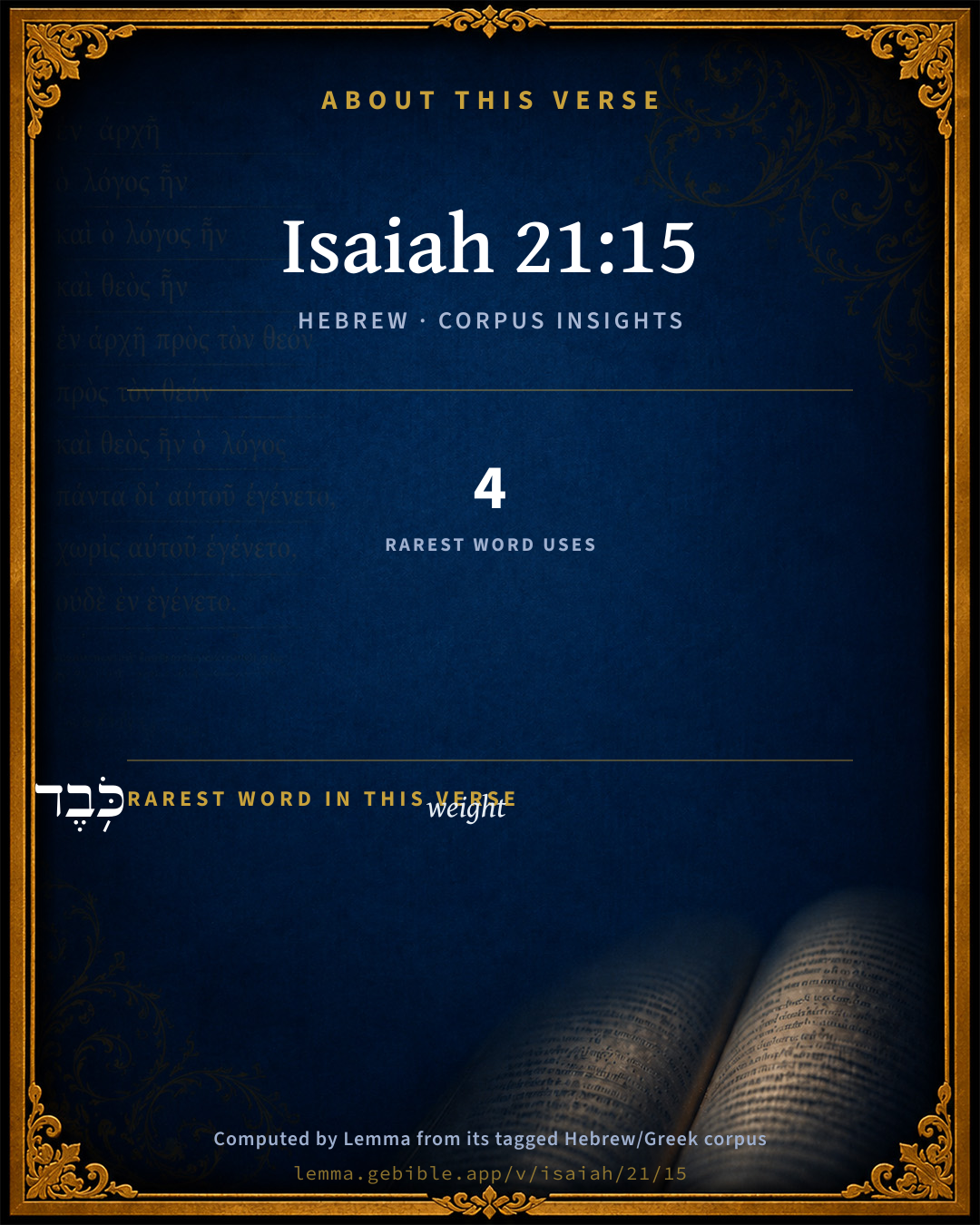
The rarest word here is כֹּ֥בֶד weight H3514 — appearing just 4 times in the whole Hebrew Bible.

Shared distinctive vocabulary

כֹּ֥בֶד weight H3514 occurs in 4 verses of the Hebrew Bible. Also found in:

Grammatical profile

  • 3 verbs
  • 9 nouns
  • 1 conjunction

Verb forms

  • נָדָ֑דוּ Qal · Perfect
  • נְטוּשָׁ֗ה Qal · Participle Passive
  • דְּרוּכָ֔ה Qal · Participle Passive

Repetition

Words recur within this verse — often emphatic in Hebrew:

  • מִפְּנֵ֥י face H6440 ×4
  • חֲרָב֖וֹת sword H2719 ×2

Hebrew & Septuagint length

In English translation the verse runs 22 words from the Hebrew and 50 from the Septuagint (LXX English) — the Septuagint runs noticeably longer here. See the side-by-side →

A rough comparison of the two English renderings, which tokenize alike — not a word-level alignment.

Word counts can differ between the Hebrew and the Greek without any difference in meaning — e.g. the Hebrew direct-object marker אֵת has no separate Greek word, and Greek often adds the article ὁ.

Cross-references

2

Topical passages linked to Isaiah 21:15 in the Treasury of Scripture Knowledge — connected by theme and wording, ordered by reader-vote popularity; previews shown in the World English Bible.

  • Job 6:19–20 The caravans of Tema looked, The companies of Sheba waited for them.
  • Isaiah 13:14 It shall happen, that as the chased roe, and as sheep that no man gathers, they shall turn every man to his own people, and shall flee every man to his own land.

Cross-references courtesy of OpenBible.info (CC BY 4.0).

Hebrew and Greek witnesses Masoretic Hebrew ↔ Greek Septuagint

The same verse in the two great witnesses to the Old Testament, shown verse-for-verse.

Here the Septuagint runs noticeably longer than the Hebrew — LXX2012 (modern English Septuagint) 50 words vs World English Bible 22. A rough length comparison of the two English translations, not a word-level alignment — read both below.

These are two independent witnesses, not word-aligned to each other, and the Septuagint is shown in lemma (dictionary) form.

Hebrew Isaiah 21:15 Masoretic · Westminster Leningrad Codex

כִּֽי מִפְּנֵ֥י חֲרָב֖וֹת נָדָ֑דוּ מִפְּנֵ֣י חֶ֣רֶב נְטוּשָׁ֗ה וּמִפְּנֵי֙ קֶ֣שֶׁת דְּרוּכָ֔ה וּמִפְּנֵ֖י כֹּ֥בֶד מִלְחָמָֽה

For they fled away from the swords, from the drawn sword, and from the bent bow, and from the heat of battle.

World English Bible · Public Domain

Greek LXX Isaiah 21:15 Septuagint · lemma form

διά ὁ πλῆθος ὁ φεύγω καί διά ὁ πλῆθος ὁ πλανάω καί διά ὁ πλῆθος ὁ μάχαιρα καί διά ὁ πλῆθος ὁ τόξευμα ὁ διατείνω καί διά ὁ πλῆθος ὁ πίπτω ἐν ὁ πόλεμος

meet the fugitives with bread, because of the multitude of the slain, and because of the multitude of them that lose their way, and because of the multitude of swords, and because of the multitude of bent bows, and because of the multitude of them that have fallen in war.

LXX2012 (modern English Septuagint) · Public Domain

Hebrew: Westminster Leningrad Codex (CC BY 4.0). Greek: Septuagint (public domain); English from LXX2012 (modern English Septuagint) (Public Domain). How the Septuagint differs from the Hebrew →

Targum (Aramaic paraphrase)

1

The Targum is the ancient Jewish Aramaic paraphrase of the Hebrew Scriptures — an interpretive translation, not the Hebrew text itself. Onkelos (literal) and Pseudo-Jonathan (expansive) render the Torah, and Jonathan the Prophets. Coverage is partial: where no permissively-licensed English translation exists for a verse, only the Aramaic is shown. This is verse-level text, not a word-by-word alignment to the Hebrew.

  1. Targum Jonathan Prophets (Joshua–Malachi)
    אֲרֵי מִן קֳדָם קְטוֹל עֲרָקוּ מִן קֳדָם חַרְבָּא שְׁלִיפָא וּמִן קֳדָם קֶשֶׁת מְתִיחָא וּמִן קֳדָם תְּקוֹף קְרָבָא:

    Because, on account of the slaughter they have fled: from the face of the drawn sword; and from the face of the bent bow; and from the face of the strength of the battle.

    Targum Jonathan — Aramaic: “Mikraot Gedolot” (public domain). English: “Sefaria Community Translation” (CC0 1.0 (public-domain dedication)); “London "Chaldee Paraphrase," 1871” (public domain). Text via Sefaria.

Commentary

Notes on Isaiah 21:15 from classic Christian and Jewish commentators (each source and its license shown beneath its notes). The classic Christian expositions comment on the surrounding passage and are grouped to its opening verse, so a note may address several verses; the Jewish commentaries on the Tanakh (Rashi and others) are per-verse, so they appear only where the commentator wrote on this verse.

Lemma curates 59 commentaries, every one of them public domain or Creative Commons licensed, each selected and text-cleaned for this edition rather than reprinted as found. About our sources →

Trapp's Complete Commentary

John Trapp

Isa 21:15 For they fled from the swords, from the drawn sword, and from the bent bow, and from the grievousness of war.

Ver. 15. For they fled from the swords, &c.] Swords, bows, battle to all the rest. Crosses seldom come single. See on Jas 1:2.

John Trapp, A Commentary or Exposition upon All the Books of the Old and New Testament (1647–1656) — public domain. Text from a community e-Sword module.

The Preacher's Complete Homiletical Commentary

Joseph S. Exell (gen. ed.)

THE GRIEVOUSNESS OF WAR

Isa_21:15. The grievousness of war.

In our quiet sanctuary, so full of holy and peaceful memories, let us think about war; the more deeply we do so, the more will the aptness of the phrase which forms our text become apparent to us.

I. The grievousness of war is seen in its causes. War is grievous in its origin and in all the things that foster it. It has its origin in the unholy lusts and pitiful mistakes of mankind (Jas_4:1). These lusts and mistakes, what are they?

1. The lust for increased possessions and for power (P. D., 143, 150).

2. The false glory with which war has been invested. To steal and kill on a small scale is infamous, but to do so on a huge scale is heroic! The wholesale butcher surrounds himself with pomp and pageantry that dazzle the eye and enslave the mind (P. D., 3470, 3476).

3. Blindness to the real fields on which true courage and heroism are manifested. The Christian courage which can meet and overcome the assaults of wickedness, which can turn aside the edge of scorn, and hurl back the weapons of temptation; that can urge men through living martyrdoms which do not keep time to music or song, which carries Moffat into South Africa, &c.,—this is too ethereal for most men to discern or admire. They have no suspicion of the moral victories that might be theirs on the fields of humble service and self-sacrifice.

4. Insensibility to the worth of human souls. A suspicion of the value of life would unnerve the warrior for his task; he could not then, as he does now, regard men as mere food for powder.

II. The grievousness of war is seen in its effects. These are twofold:—

1. Physical. “The grievousness of war” cannot be exaggerated, if we look at it from this point of view alone. Think—

(1) of the physical and mental suffering that is caused by it (P. D., 3468, 3469, 3472, 3476);

(2) of the far-reaching and crushing desolation caused by it (P. D., 3466);

(3) of the frightful cost of preparation for war; of the armed truce in which the nations of Europe live.

2. Moral. These are still more terrible.

(1.) War brutalises those actually engaged in it (P. D., 3464).

(2.) War makes criminals by producing a state of want.

(3.) War aggravates national animosities, and leaves to unborn generations a legacy of hatred. Every war sows the seeds of future conflict.

(4.) War and preparation for war check the progress of those agencies by which the misery of our race would be abated, and its happiness indefinitely increased. The cause of education, of missions, of the Gospel, languishes under the blight of the war-spirit. The cost of a very few wars would evangelise the world (P. D., 3476).

Let this meditation move us to action.

1. Let us exert our utmost influence to bring it to pass that national power shall be wielded by men who love peace.

2. Let us encourage everything that tends to facilitate international intercourse (P. D., 3461).

3. Let us on every possible occasion exalt moral qualities above mere physical daring (P. D., 1798, 1801–1803).

4. Let us put forth every effort to diffuse the principles of Christianity. The Gospel is the only true and effectual peacemaker; only in Christ will men ever be lastingly reconciled to each other.—William Manning.

The Preacher's Complete Homiletical Commentary (gen. ed. Joseph S. Exell; Funk & Wagnalls, c. 1892) — public domain (pre-1929). A full-Bible homiletical/sermon-outline anthology covering 65 of 66 books (2 John is absent from the source module). Text from a community e-Sword module.

Tyndale Open Study Notes

Tyndale Open Resources

21:15 Assyrian weapons of war such as the drawn sword and the bent bow were highly advanced compared to the primitive weapons used by desert peoples.

Tyndale Open Study Notes — © Tyndale Open Resources, licensed CC BY-SA 4.0. Text via the HelloAO Bible API.

Jamieson, Fausset & Brown

Robert Jamieson, A. R. Fausset & David Brown

they--the fugitive Dedanites and other Arabs.

Jamieson, Fausset & Brown — Commentary Critical and Explanatory on the Whole Bible (1871) — public domain (CC PDM 1.0). Text via the HelloAO Bible API.

Ellicott's Commentary for English Readers

(15) For they fled from the swords.—The fourfold repetition of the somewhat full form of the Hebrew preposition (literally, from the face of) seems as if intended to emphasise the several stages of retreat.

A Bible Commentary for English Readers, edited by Charles John Ellicott (1878–1897) — public domain. Text from a community e-Sword module.

The Cambridge Bible for Schools and Colleges

gen. ed. J. J. S. Perowne

15. The caravans have deserted the frequented paths, because of armed bands scouring the country.

16 f. The interpretation of the vision is regarded by many commentators as a later appendix similar to ch. Isa_16:13 f. There is certainly a surprising resemblance between the two passages, which may suggest that they are both from the same hand.

The Cambridge Bible for Schools and Colleges (gen. ed. J. J. S. Perowne; Cambridge University Press, 1878–1918) — public domain. Text from a community e-Sword module.

John Gill's Exposition

For they fled from the swords,.... Of their enemy, whom they could not withstand; perhaps the Assyrian army:

from the drawn sword; just ready to be sheathed in them:

and from the bent bow; just going to let the arrow fly at them:

and from the grievousness of war: too heavy for them to bear.

John Gill's Exposition of the Whole Bible (1746–1763) — public domain (CC PDM 1.0). Text via the HelloAO Bible API.

Albert Barnes' Notes on the Bible

For they fled - The inhabitants of one part of the land.

The grievousness of war - Hebrew, כבד kobed - “the weight, the heaviness, the oppression” of war; probably from the calamities that would result from the march of the Assyrian through their land, either on his way to Judea or to Egypt.

Albert Barnes' Notes on the Bible (1834–1885) — public domain. Text from a community e-Sword/MySword module.

The Pulpit Commentary

For they fled; rather, they have fled. The Dedanites have been attacked with sword and bow, and have fled from their assailants. Probably the enemy was Assyria, but no trace of the war has been found on the Assyrian monuments.

The grievousness of war.

The grievousness of war is especially felt in defeat. Kedar was the most turbulent of the sons of Ishmael. (Gen_25:13) "His hand" like that of his father, "was against every man, and every man"s hand against him". (Gen_16:12) So long as his "mighty men," armed with their formidable bows, could ravage and plunder the inhabitants of more peaceable districts at their pleasure, and carry off plenty of spoil to their fastnesses in the rocky parts of the desert, (Isa_42:11) the "grievousness of war" was not felt. Rather, "the inhabitants of the rock sang, and shouted from the top of the mountain". (Isa_42:11) But at length the tide of battle had turned. Kedar was itself attacked, invaded, plundered. The "drawn sword" and the "bent bow" of the men of Asshur were seen in the recesses of Arabia itself, and the assailants, becoming the assailed, discovered, apparently to their surprise, that war was a "grievous" thing. Does not history "repeat itself?" Have we not heard in our own day aggressive nations, that have carried the flames of war over half Europe or half Asia, complain bitterly, when their turn to be attacked came, of the "grievousness" of invasion? The Greeks said, "To suffer that which one has done, is strictest, straitest right;" but this is not often distinctly perceived by the sufferers. It is only "God"s ways" that are "equal;" man"s are apt always to be "unequal". (Eze_18:25)

The grievousness of war.

"For before the swords have they fled, before the drawn sword, and before the bent bow, and before the pressure of war." The figures imply that the people are conquered, their camp or city taken, and they pursued and cut down by a relentless, blood-thirsty enemy. As this subject is a familiar one, and illustrations lie ready to hand, only divisions need be given. The grievousness of war may be shown.

I IN THE SACRIFICES IT DEMANDS.

II IN THE LIVES IT DESTROYS.

III IN THE TREASURE IT WASTES. The Franco-German War of 1870 cost France 000, 000, and Germany at least 000, 000. The American Civil War cost 000, 000. The Crimean War cost England 000, 000.

IV IN THE PASSIONS IT ENGENDERS,

V IN THE NATIONAL ALIENATIONS IT LEAVES BEHIND,

VI IN THE SUFFERINGS IT ENTAILS. In the Franco-German War, one hundred and thirty thousand soldiers died on the battle-fields or in the hospitals, and thousands more lost limbs and health. What a wail of sorrow from thousands of homes and hearts such facts bring to our ears!

VII IN THE RESULTS IT SECURES. Which are usually most insignificant when compared with the expenditure and loss. Talk of the glory of war! The Bible reminds us how much wiser and how much truer it is to talk of its grievousness. R.T.

Ver. 16. Within a year, according to the years of an hireling. (see the comment on Isa_16:14) All the glory of Kedar shall fail. "Kedar" is a name of greater note than either Dedan or Tome. It seems to be used here as inclusive of Dedan, perhaps as a designation of the northern Arabians generally. The people of Kedar, like those of Dedan, carried on trade with Tyro. (Eze_27:21) They dwelt partly in tents, (Psa_120:5 Jer_49:29) partly in villages, (Isa_42:11) and were rich in flocks and herds and in camels. Though not mentioned in the inscriptions of Sargon, Sennacherib, or Esarhaddon, the contemporaries of Isaiah, they hold a prominent place in those of Esarhaddon"s son and successor, Asshurbanipal, with whom they carried on a war of some considerable duration in conjunction with the Nabathaeans (G. Smith, "History of Asshur-bani-pal," pp. 261-290).

Ver. 17. The security of the Divine Word.

"They shall, for the Lord God of Israel hath spoken it." This sentence intimates that God, as the God of Israel, has a quarrel with Kedar, and at; the same time that his power and omniscience will secure the fulfillment of the threatening.

I THE DIVINE FOREKNOWLEDGE. "All things are naked and opened unto the eyes of him with whom we have to do;" "He knoweth the end from the beginning." God may be pleased to leave man his freedom, and yet he may so know man, and each man, as to see beforehand how each wilt act in given circumstances; and the Divine plans can be based on such foreknowings and fore-estimatings.

II THE DIVINE UTTERANCES ARE RASED ON SUCH FOREKNOWLEDGE. God may not be pleased to tell us all he knows, but we may have perfect confidence in what he tells. Revelation is limited, but it is absolutely true within its limitation, because based on complete, adequate knowledge.

III TIME PROVES THE HARMONY OF THE UTTERANCE AND THE EVENTS. Because the utterance was made in full view of the event. To God the unexpected never happens, and his Word never fails. Men do, in their freedom, just exactly what God, surveying their work, anticipated that they would do. "He will let none of his words fall to the ground.

IV THE CONFIDENCE IN GOD"S UTTERANCES INVOLVES THE PRACTICAL ORDERING OF OUR CONDUCT. This applies to prophetic anticipations; but how much more to announcements of ever-working principles! There are no exceptions to the great laws of righteousness, which are Jehovah"s Word to men. "God has said," is enough for us, and it may shape out lives. It will come to pass, if the "Lord God of Israel hath spoken it. R.T.

The Pulpit Commentary (1880–1919), ed. H.D.M. Spence-Jones & Joseph S. Exell — public domain. Text from a community e-Sword module.

J. A. Alexander on Isaiah

Joseph Addison Alexander

“Because (or when) from the presence of swords they fled, from the presence of a drawn sword and from the presence of a bended bow, and from the presence of a weight of war.” This verse describes them as not only plundered but pursued by a bloodthirsty enemy.

Joseph Addison Alexander, The Prophecies of Isaiah (1846–1847; New York: Scribner, 1870–1878) — public domain. Text from a community e-Sword module.

Rashi

Rabbi Shlomo Yitzchaki (Rashi)

Since because of the swords they wandered (I.e.,) my people (wandered).

the outstretched sword (נְטוּשָׁה), spread over the surface of the earth, as (I Sam. 30:16) “And behold, they were scattered (נְטוּשִׁים) over the entire landscape,” (II Sam. 5: 18) “And spread out (וַיִּנָּטְשׁוּ) in the Valley of Rephaim.” Another explanation is that נְטוּשָׁה is like לְטוּשָׁה, sharp. All letters whose sources are close to being from one place, (i.e., from one speech organ,) are interchangeable with one another, the ‘nun’ with the ‘lamed,’ as in the case stated (in Nehemiah 13: 7): “To make him a chamber (נִשְׁכָּה),” like לִשְׁכָּה.

Rashi on the Tanakh — English translations: “The Judaica Press complete Tanach with Rashi, translated by A. J. Rosenberg” (CC BY 4.0); “Pentateuch with Rashi's commentary by M. Rosenbaum and A.M. Silbermann, 1929-1934” (public domain); “The Metsudah Tanach series, Lakewood, N.J” (CC BY 4.0); and “The Book of Joshua, Metsudah Publications, 1997” (CC BY 4.0). Text via Sefaria.

Ibn Ezra

Rabbi Abraham ibn Ezra

For they fled from the swords. They, that are wandering about, are fleeing because of the king of Assyria.

נטושה. According to some, sharp, the נ being put instead of ל, (לטושה ═ נטושה); this is wrong; נטושה means spread; comp. 1 Sam. 30:16

Ibn Ezra on the Tanakh — English translations: “Sefaria Community Translation” (CC0 1.0 (public-domain dedication)); “Yalkut, Sifsei Chachomim Chumash, Metsudah Publications, 2009” (CC BY 4.0); and “Commentary of Ibn Ezra on Isaiah - trans. by M. Friedlander, 1873” (public domain). Text via Sefaria.

Lesson kit

Teaching starters — assembled from the data on this page, not authored interpretation. Every prompt links to the verse data it draws on. Edit before teaching.

Isaiah, in the Prophets, opens this verse with 13 words (9 distinct Hebrew lemmas). Its most distinctive word is kôbed (“weight”). The Greek Septuagint runs longer here. A historical commentator’s framing appears above. Read the whole chapter for the surrounding context.

Discussion questions

  1. What does “weight” (kôbed) contribute to the verse as a whole?
  2. Proverbs 27:3 shares the word «weight» with this verse. How do the two illuminate each other?
  3. “face” occurs 4× in this one verse. What is the effect of the repetition?
  4. Compared with the Hebrew, the Septuagint runs longer here. What questions does that raise?
  5. These translations render this verse differently. What is at stake in choosing one wording over another?
  6. The verb «נָדָ֑דוּ» is Qal Perfect. How does its form color the action?
  7. Reading how Trapp's Complete Commentary and The Preacher's Complete Homiletical Commentary read this verse, where do the two commentators agree and where do they part?

Things to notice

Reading settings

Reading text

Shown beneath each verse's original-language words.

Old Testament
Old Testament edition

Read the OT as the Masoretic Hebrew (MT) or the Greek Septuagint (LXX).

English shown for the Greek Septuagint (in the Hebrew ↔ Greek comparison).

Comparing translations? Open the Compare panel on any verse page to stack up to four side by side.