
Deuteronomy 33:29

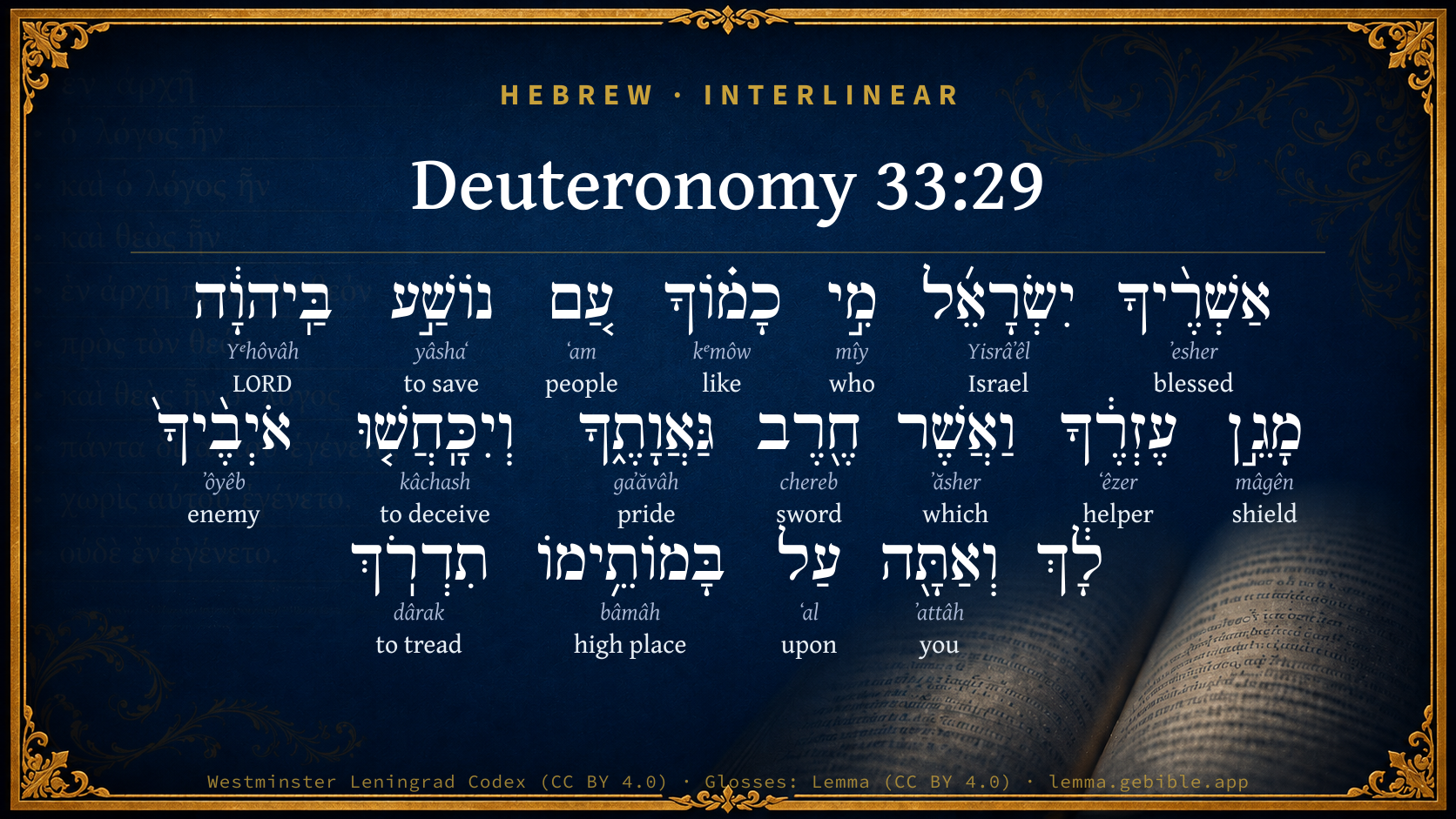
Hebrew (Westminster Leningrad Codex) Deuteronomy 33:29 appears in the Hebrew Old Testament. The text above is from the Westminster Leningrad Codex. Each word links to its Strong’s number, a concise gloss, and parsing drawn from the Open Scriptures Hebrew Bible morphology. Click any word for its full Brown-Driver-Briggs (BDB) entry.
Download image
Cite this verse

Deuteronomy 33:29 (World English Bible). Public Domain. Lemma interlinear Bible study tool, https://lemma.gebible.app/v/deuteronomy/33/29.

Show BibTeX & RIS
BibTeX
RIS
English Translation
Happy are you, Israel: Who is like you, a people saved by Yahweh, The shield of your help, The sword of your excellency! Your enemies shall submit themselves to you; You shall tread on their high places.
World English Bible · Public Domain
Highlights
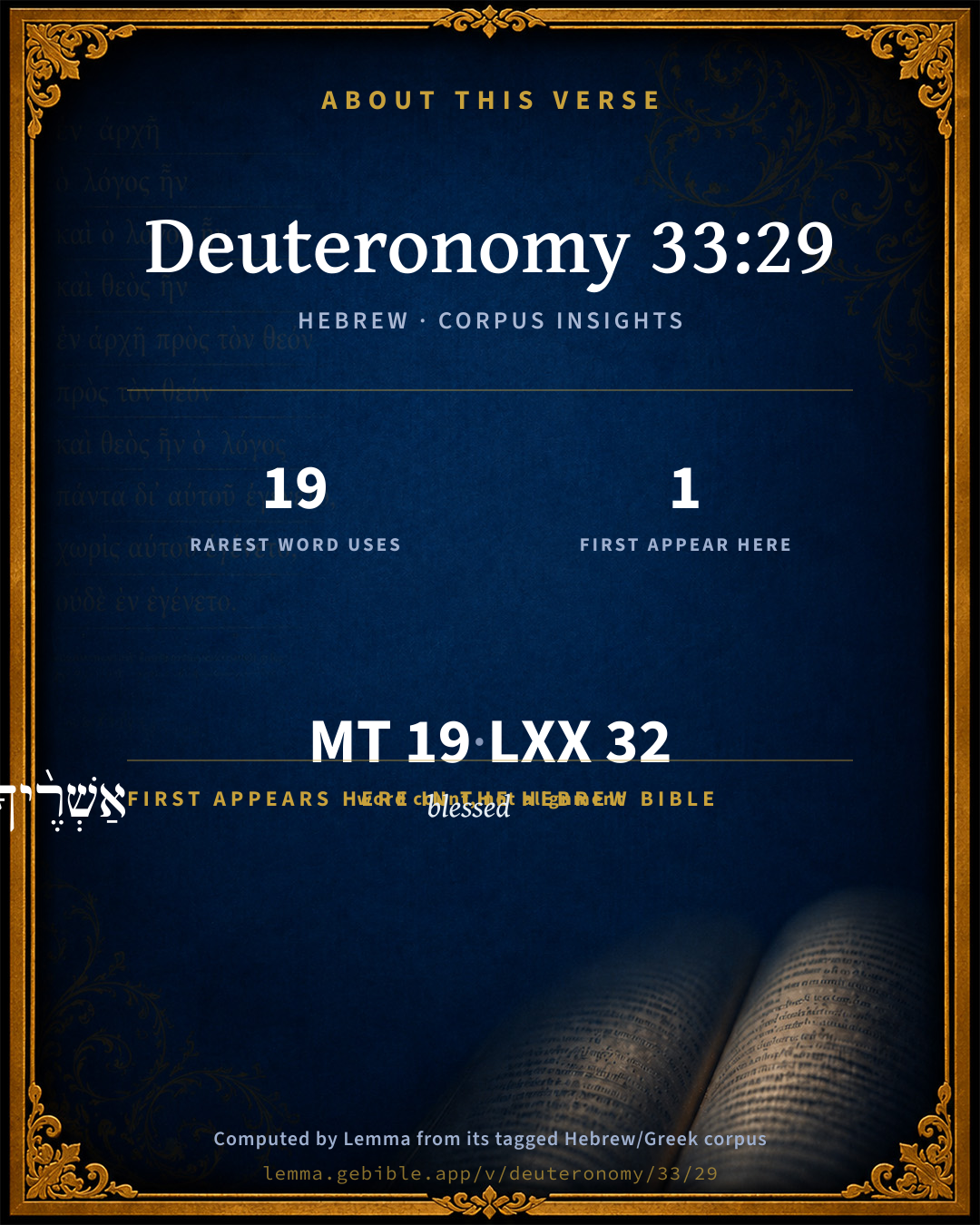
  • 1 first appearance in the Hebrew Bible
Full analysis ↓
Download a study sheet

One document with this verse’s original text, its word-by-word gloss line, the meaning frame, cross-references with their text, attributed commentary, and full source and license credits — printable, and it pastes into notes with its structure intact.

This verse Autodidact and up

Study sheet (.html) Plain text (.txt)

A passage Seminary Student

Up to 50 verses in one chapter. A passage sheet keeps up to 6 commentary sources and 12 cross-references per verse, in the order this page ranks them, and says so on the sheet whenever that leaves anything out. Ask for a single verse and you get the Autodidact verse sheet above.

Everything on this page stays free to read, with no account — the sheet is a download of what is already on screen, not access to it.

Want to remove ads? Support Godless Engineer
Compare translations 3

The same verse in 3 English versions, stacked beneath the original-language interlinear above. Click any original word for its lexicon entry.

Each is an independent rendering of the whole verse — the interlinear is not word-aligned to these translations.

Highlighted words mark where these versions differ — a whole-verse word diff, not a word-by-word alignment.

  • World English Bible Public Domain
    Happy are you, Israel: Who is like you, a people saved by Yahweh, The shield of your help, The sword of your excellency! Your enemies shall submit themselves to you; You shall tread on their high places.
  • King James Version Public Domain
    Happy art thou, O Israel: who is like unto thee, O people saved by the LORD, the shield of thy help, and who is the sword of thy excellency! and thine enemies shall be found liars unto thee; and thou shalt tread upon their high places.
  • unfoldingWord Literal Text CC BY-SA 4.0
    Your happiness, Israel! Who like you, a people saved by Yahweh, the shield of your help, and who the sword of your majesty? And your enemies will fawn over you, but you, on their backs will trample.”

unfoldingWord Literal Text — © unfoldingWord, licensed CC BY-SA 4.0. Word-aligned USFM3 via Door43 (git.door43.org/unfoldingWord/en_ult).

Versions to compare (up to 4)

3 of 4 selected

Show all 18 translations

Every available English version of this verse, each an independent rendering of the whole verse.

  • World English Bible Public Domain
    Happy are you, Israel: Who is like you, a people saved by Yahweh, The shield of your help, The sword of your excellency! Your enemies shall submit themselves to you; You shall tread on their high places.
  • Berean Standard Bible Public Domain
    Blessed are you, O Israel! Who is like you, a people saved by the LORD? He is the shield that protects you, the sword in which you boast. Your enemies will cower before you, and you shall trample their high places.”
  • Majority Standard Bible Public Domain
    Blessed are you, O Israel! Who is like you, a people saved by the LORD? He is the shield that protects you, the sword in which you boast. Your enemies will cower before you, and you shall trample their high places.”
  • King James Version Public Domain
    Happy art thou, O Israel: who is like unto thee, O people saved by the LORD, the shield of thy help, and who is the sword of thy excellency! and thine enemies shall be found liars unto thee; and thou shalt tread upon their high places.
  • American Standard Version (1901) Public Domain
    Happy art thou, O Israel: Who is like unto thee, a people saved by Jehovah, The shield of thy help, And the sword of thy excellency! And thine enemies shall submit themselves unto thee; And thou shalt tread upon their high places.
  • Revised Version (1885) Public Domain
    Happy art thou, O Israel: Who is like unto thee, a people saved by the LORD, The shield of thy help, And that is the sword of thy excellency! And thine enemies shall submit themselves unto thee; And thou shalt tread upon their high places.
  • Geneva Bible (1599) Public Domain
    Blessed art thou, O Israel: who is like vnto thee, O people saued by the Lord, the shielde of thine helpe, and which is the sword of thy glorie? therefore thine enemies shall bee in subiection to thee, and thou shalt tread vpon their hie places.
  • Douay-Rheims (1899) Public Domain
    Blessed are thou, Israel: who is like to thee, O people, that art saved by the Lord? the shield of thy help, and the sword of thy glory: thy enemies shall deny thee, and thou shalt tread upon their necks.
  • Young's Literal Translation Public Domain
    O thy happiness, O Israel! who is like thee? A people saved by Jehovah, The shield of thy help, And He who `is' the sword of thine excellency: And thine enemies are subdued for thee, And thou on their high places dost tread.'
  • Literal Standard Version CC BY-SA 4.0
    O your blessedness, O Israel! Who is like you? A people saved by YHWH, || The shield of your help, || And He who [is] the sword of your excellence! And your enemies are subdued for you, || And you tread on their high places.”
  • Unlocked Literal Bible CC BY-SA 4.0
    Your blessings are many, Israel! Who is like you, a people saved by Yahweh, the shield of your help, and the sword of your majesty? Your enemies will come trembling to you; you will trample down their high places.
  • unfoldingWord Literal Text CC BY-SA 4.0
    Your happiness, Israel! Who like you, a people saved by Yahweh, the shield of your help, and who the sword of your majesty? And your enemies will fawn over you, but you, on their backs will trample.”
  • Darby Bible Public Domain
    Happy art thou, Israel! Who is like unto thee, a people saved by Jehovah, The shield of thy help, And the sword of thine excellency? And thine enemies shall come cringing to thee; And thou shalt tread upon their high places.
  • World Messianic Bible Public Domain
    You are happy, Israel! Who is like you, a people saved by the LORD, the shield of your help, the sword of your excellency? Your enemies will submit themselves to you. You will tread on their high places.”
  • Webster's Bible Public Domain
    Happy art thou, O Israel: who is like to thee, O people saved by the LORD, the shield of thy help, and who is the sword of thy excellence! and thy enemies shall be found liars to thee; and thou shalt tread upon their high places.
  • Free Bible Version CC BY-SA 4.0
    How blessed you are, Israel! Is there anyone like you, a people saved by the Lord? He is the shield that protects you, the sword that gives you confidence. Your enemies will tremble before you, and you shall tread them underfoot.
  • Bible in Basic English Public Domain
    Happy are you, O Israel: who is like you, a people whose saviour is the Lord, whose help is your cover, whose sword is your strength! All those who are against you will put themselves under your rule, and your feet will be planted on their high places.
  • JPS Tanakh (1917) Public Domain
    Happy art thou, O Israel, who is like unto thee? a people saved by the LORD, the shield of thy help, and that is the sword of thy excellency! And thine enemies shall dwindle away before thee; and thou shalt tread upon their high places.

Literal Standard Version (2020), Covenant Press — licensed CC BY-SA 4.0. Text via the HelloAO Bible API (eBible.org). Unlocked Literal Bible (unfoldingWord) — licensed CC BY-SA 4.0. Text via the HelloAO Bible API (eBible.org). unfoldingWord Literal Text — © unfoldingWord, licensed CC BY-SA 4.0. Word-aligned USFM3 via Door43 (git.door43.org/unfoldingWord/en_ult). Free Bible Version, Dr. Jonathan Gallagher — licensed CC BY-SA 4.0. Text via the HelloAO Bible API (eBible.org).

Word by word

More ways to search: Search by grammar → Find every occurrence → Compare this word →

Practice this passage: Drill this verse → Learn its vocabulary →

גַּאֲוָתֶ֑ךָ
gaʼăvâh
H1346
“pride · your”
Noun, Common, Feminine, Singular, Construct + Suffix, Personal, 2nd Person, Masculine, Singular
Part of Speech
Noun
Type
Common
Gender
Feminine
Number
Singular
State
Construct
Full BDB Definition

Origin: from H1342

TWOT: 299d

pride, majesty, a rising up - a rising up, swelling (of the sea) - majesty (of Israel) - pride, haughtiness
  1. אַשְׁרֶ֨יךָ ʼesher H835 “blessed · your” Noun, Common, Masculine, Plural, Construct + Suffix, Personal, 2nd Person, Masculine, Singular
  2. יִשְׂרָאֵ֜ל Yisrâʼêl H3478 “Israel” Noun, Proper
  3. מִ֣י mîy H4310 “who” Particle, Interrogative
  4. כָמ֗וֹךָ kᵉmôw H3644 “like · you” Preposition + Suffix, Personal, 2nd Person, Masculine, Singular
  5. עַ֚ם ʻam H5971 “people” Noun, Common, Masculine, Singular, Absolute
  6. נוֹשַׁ֣ע yâshaʻ H3467 “to save” Verb, Niphal, Perfect, 3rd Person, Masculine, Singular
  7. בַּֽיהוָ֔ה Yᵉhôvâh H3068 “in/at · LORD” Preposition + Noun, Proper
  8. מָגֵ֣ן mâgên H4043 “shield of” Noun, Common, Both, Singular, Construct
  9. עֶזְרֶ֔ךָ ʻêzer H5828 “helper · your” Noun, Common, Masculine, Singular, Construct + Suffix, Personal, 2nd Person, Masculine, Singular
  10. וַאֲשֶׁר ʼăsher H834 “and · which” Conjunction + Particle, Relative
  11. חֶ֖רֶב chereb H2719 “sword of” Noun, Common, Feminine, Singular, Construct
  12. וְיִכָּֽחֲשׁ֤וּ kâchash H3584 “and · to deceive” Conjunction + Verb, Niphal, Imperfect, 3rd Person, Masculine, Plural
  13. אֹיְבֶ֨יךָ֙ ʼôyêb H341 “enemy · you” Verb, Qal, Participle Active, Masculine, Plural, Construct + Suffix, Personal, 2nd Person, Masculine, Singular
  14. וְאַתָּ֖ה ʼattâh H859 “and · you” Conjunction + Pronoun, Personal, 2nd Person, Masculine, Singular
  15. עַל ʻal H5921 “upon” Preposition
  16. בָּמוֹתֵ֥ימוֹ bâmâh H1116 “high places · their” Noun, Common, Feminine, Plural, Construct + Suffix, Personal, 3rd Person, Masculine, Plural
  17. תִדְרֹֽךְ dârak H1869 “to tread” Verb, Qal, Imperfect, 2nd Person, Masculine, Singular

About this verse

These counts appear in no published source. They are computed here, from the morphology-tagged text and Lemma’s own curated glosses. What Lemma adds →

19
words
18
distinct lemmas
Pentateuch
section

Notable vocabulary

The rarest word here is גַּאֲוָתֶ֑ךָ pride H1346 — appearing just 19 times in the whole Hebrew Bible.

First appearance in Scripture

This word makes its first canonical appearance in the Hebrew Bible here:

  • אַשְׁרֶ֨יךָ blessed H835

Shared distinctive vocabulary

גַּאֲוָתֶ֑ךָ pride H1346 occurs in 19 verses of the Hebrew Bible. Also found in:

Grammatical profile

  • 4 verbs
  • 9 nouns
  • 1 pronoun
  • 3 prepositions
  • 2 particles

Verb forms

  • נוֹשַׁ֣ע Niphal · Perfect
  • וְיִכָּֽחֲשׁ֤וּ Niphal · Imperfect
  • אֹיְבֶ֨יךָ֙ Qal · Participle Active
  • תִדְרֹֽךְ Qal · Imperfect

Hebrew & Septuagint length

In English translation the verse runs 37 words from the Hebrew and 45 from the Septuagint (LXX English) — closely comparable.

A rough comparison of the two English renderings, which tokenize alike — not a word-level alignment.

Word counts can differ between the Hebrew and the Greek without any difference in meaning — e.g. the Hebrew direct-object marker אֵת has no separate Greek word, and Greek often adds the article ὁ.

In the original languages it is 19 Hebrew tokens and 32 Greek tokens — but the two are counted differently (Hebrew bundles its prefixes and suffixes into one token; the Greek is in lemma form), so that isn’t a like-for-like length.

Cross-references

29

Topical passages linked to Deuteronomy 33:29 in the Treasury of Scripture Knowledge — connected by theme and wording, ordered by reader-vote popularity; previews shown in the World English Bible.

  • Isaiah 12:2 Behold, God is my salvation. I will trust, and will not be afraid; for Yah, Yahweh, is my strength and song; and he has become my salvation."
  • Isaiah 45:17 [But] Israel shall be saved by Yahweh with an everlasting salvation: you shall not be disappointed nor confounded world without end.
  • Deuteronomy 4:7–8 For what great nation is there, that has a god so near to them, as Yahweh our God is whenever we call on him?
  • Psalms 115:9–11 Israel, trust in Yahweh! He is their help and their shield.
  • Genesis 15:1 After these things the word of Yahweh came to Abram in a vision, saying, "Don't be afraid, Abram. I am your shield, your exceedingly great reward."
  • Numbers 23:20–24 Behold, I have received [commandment] to bless: He has blessed, and I can't reverse it.
  • 2 Samuel 7:23 What one nation in the earth is like your people, even like Israel, whom God went to redeem to himself for a people, and to make him a name, and to do great things for you, and awesome things for your land, before your people, whom you redeem to you out of Egypt, [from] the nations and their gods?
  • 2 Samuel 22:45 The foreigners shall submit themselves to me: As soon as they hear of me, they shall obey me.
  • Psalms 84:11 For Yahweh God is a sun and a shield. Yahweh will give grace and glory. He withholds no good thing from those who walk blamelessly.
  • Isaiah 34:5–6 For my sword has drunk its fill in the sky: behold, it shall come down on Edom, and on the people of my curse, to judgment.
  • Deuteronomy 32:13 He made him ride on the high places of the earth, He ate the increase of the field; He made him to suck honey out of the rock, Oil out of the flinty rock;
  • Judges 7:20 The three companies blew the trumpets, and broke the pitchers, and held the torches in their left hands, and the trumpets in their right hands with which to blow; and they cried, The sword of Yahweh and of Gideon.
  • Psalms 18:44 As soon as they hear of me they shall obey me. The foreigners shall submit themselves to me.
  • Psalms 33:20 Our soul has waited for Yahweh. He is our help and our shield.
  • Psalms 66:3 Tell God, "How awesome are your deeds! Through the greatness of your power, your enemies submit themselves to you.
  • Psalms 144:15 Happy are the people who are in such a situation. Happy are the people whose God is Yahweh.
  • Habakkuk 3:19 Yahweh, the Lord, is my strength. He makes my feet like deer's feet, And enables me to go in high places. For the music director, on my stringed instruments.
  • Numbers 24:5 How goodly are your tents, Jacob, Your tents, Israel!
  • Joshua 10:24–25 It happened, when they brought forth those kings to Joshua, that Joshua called for all the men of Israel, and said to the chiefs of the men of war who went with him, Come near, put your feet on the necks of these kings. They came near, and put their feet on the necks of them.
  • Psalms 7:12 If a man doesn't relent, he will sharpen his sword; He has bent and strung his bow.
  • Psalms 33:12 Blessed is the nation whose God is Yahweh, The people whom he has chosen for his own inheritance.
  • Psalms 45:3 Gird your sword on your thigh, mighty one: Your splendor and your majesty.
  • Isaiah 27:1 In that day Yahweh with his hard and great and strong sword will punish leviathan the swift serpent, and leviathan the crooked serpent; and he will kill the monster that is in the sea.
  • Jeremiah 12:12 Destroyers are come on all the bare heights in the wilderness; for the sword of Yahweh devours from the one end of the land even to the other end of the land: no flesh has peace.
  • 1 Timothy 4:10 For to this end we both labor and suffer reproach, because we have set our trust in the living God, who is the Savior of all men, especially of those who believe.
  • Revelation 1:16 He had seven stars in his right hand. Out of his mouth proceeded a sharp two-edged sword. His face was like the sun shining at its brightest.
  • Revelation 19:21 The rest were killed with the sword of him who sat on the horse, the sword which came forth out of his mouth. All the birds were filled with their flesh.
  • Psalms 81:15 The haters of Yahweh would cringe before him, And their punishment would last forever.
  • Jeremiah 47:6 You sword of Yahweh, how long will it be before you be quiet? put up yourself into your scabbard; rest, and be still.

Cross-references courtesy of OpenBible.info (CC BY 4.0).

Hebrew and Greek witnesses Masoretic Hebrew ↔ Greek Septuagint

The same verse in the two great witnesses to the Old Testament, shown verse-for-verse.

These are two independent witnesses, not word-aligned to each other, and the Septuagint is shown in lemma (dictionary) form.

Hebrew Deuteronomy 33:29 Masoretic · Westminster Leningrad Codex

אַשְׁרֶ֨יךָ יִשְׂרָאֵ֜ל מִ֣י כָמ֗וֹךָ עַ֚ם נוֹשַׁ֣ע בַּֽיהוָ֔ה מָגֵ֣ן עֶזְרֶ֔ךָ וַאֲשֶׁר חֶ֖רֶב גַּאֲוָתֶ֑ךָ וְיִכָּֽחֲשׁ֤וּ אֹיְבֶ֨יךָ֙ לָ֔ךְ וְאַתָּ֖ה עַל בָּמוֹתֵ֥ימוֹ תִדְרֹֽךְ

Happy are you, Israel: Who is like you, a people saved by Yahweh, The shield of your help, The sword of your excellency! Your enemies shall submit themselves to you; You shall tread on their high places.

World English Bible · Public Domain

Greek LXX Deuteronomy 33:29 Septuagint · lemma form

μακάριος σύ ἰσραήλ τίς ὅμοιος σύ λαός σώζω ὑπό κύριος ὑπερἀσπίζω ὁ βοηθός σύ καί ὁ μάχαιρα καύχημα σύ καί ψεύδω σύ ὁ ἐχθρός σύ καί σύ ἐπί ὁ τράχηλος αὐτός ἐπιβαίνω

Blessed are you, O Israel; who is like to you, O people saved by the Lord? your helper shall hold his shield over you, and his sword is your boast; and your enemies shall speak falsely to you, and you shall tread upon their neck.

LXX2012 (modern English Septuagint) · Public Domain

On this verse, The Cambridge Bible for Schools and Colleges discusses the Septuagint’s reading. Read the note in Commentary ↓

Hebrew: Westminster Leningrad Codex (CC BY 4.0). Greek: Septuagint (public domain); English from LXX2012 (modern English Septuagint) (Public Domain). How the Septuagint differs from the Hebrew →

Targum (Aramaic paraphrase)

2

The Targum is the ancient Jewish Aramaic paraphrase of the Hebrew Scriptures — an interpretive translation, not the Hebrew text itself. Onkelos (literal) and Pseudo-Jonathan (expansive) render the Torah, and Jonathan the Prophets. Coverage is partial: where no permissively-licensed English translation exists for a verse, only the Aramaic is shown. This is verse-level text, not a word-by-word alignment to the Hebrew.

  1. Targum Onkelos Torah (Genesis–Deuteronomy)
    טוּבָּךְ יִשְׂרָאֵל לֵית דִכְוָתָךְ עַמָא דְפֻרְקָנֵהּ מִן קֳדָם יְיָ תַּקִיף בְּסַעְדָךְ וּדְמִן קֳדָמוֹהִי נִצְחָן גִבַּרְוָתָךְ וִיכַדְבוּן סָנְאָךְ לָךְ וְאַתְּ עַל פְּרִיקַת צַוָארֵי מַלְכֵיהוֹן תִּדְרֹךְ

    (no public-domain English translation for this verse)

    Targum Onkelos — Aramaic: “Onkelos Genesis” (public domain); “Onkelos Exodus” (public domain); “Onkelos Leviticus” (public domain); “Onkelos Numbers” (public domain); “Onkelos Deuteronomy” (public domain). English: “Sefaria Community Translation” (CC0 1.0 (public-domain dedication)); “J.W. Etheridge. The Targums of Onkelos and Jonathan Ben Uzziel on the Pentateuch. London: Longmans, Green, 1862” (public domain). Text via Sefaria.

  2. Targum Pseudo-Jonathan Torah (Genesis–Deuteronomy)
    טוּבְכוֹן יִשְרָאֵל מַן כְּוַותְכוֹן בְּכָל עַמְמַיָא עַמָא דְמִתְפָּרְקִין בְּשׁוּם מֵימְרָא דַיְיָ וְהוּא תְּרִיס סְעוּדְכוֹן וְדִי חַרְבֵּיהּ תְּקוֹף גֵיוְתָנוּתְכוֹן וְיִתְכַּדְבוּן סַנְאֵיכוֹן לְקוּבְלֵיכוֹן מִן רְתֵיתָא וְאַתּוּן עַל פִּירְקַת צַוְורֵי מַלְכֵיהוֹן תִּדְרוֹךְ

    Happy are you, O Israel: who of all the nations are like you, a people saved in the Name of the Word of the Lord? He is the shield of your help, and His sword, the strength of your excellency. And your enemies shall be found liars against you from terror, and you shall tread upon the necks of their kings.

    Targum Pseudo-Jonathan — Aramaic: “Targum Jonathan on Genesis” (public domain); “Targum Jonathan on Exodus” (public domain); “Targum Jonathan on Leviticus” (public domain); “Targum Jonathan on Numbers” (public domain); “Targum Jonathan on Deuteronomy” (public domain). English: “The Targum of Jonathan ben Uzziel, trans. J. W. Etheridge, London, 1862” (public domain). Text via Sefaria.

Commentary

Notes on Deuteronomy 33:29 from classic Christian and Jewish commentators (each source and its license shown beneath its notes). The classic Christian expositions comment on the surrounding passage and are grouped to its opening verse, so a note may address several verses; the Jewish commentaries on the Tanakh (Rashi and others) are per-verse, so they appear only where the commentator wrote on this verse.

Lemma curates 59 commentaries, every one of them public domain or Creative Commons licensed, each selected and text-cleaned for this edition rather than reprinted as found. About our sources →

Trapp's Complete Commentary

John Trapp

Deu 33:29 Happy [art] thou, O Israel: who [is] like unto thee, O people saved by the LORD, the shield of thy help, and who [is] the sword of thy excellency! and thine enemies shall be found liars unto thee; and thou shalt tread upon their high places.

Ver. 29. Happy art thou, O Israel.] Or, Oh the happinesses of thee, O Israel! the μυριομακαριοτης, the heaped up happiness!

Who is like unto thee!] The saints are the world’s paragons, yea, such as the world is not worthy of; {Heb 11:1-40} that is, saith Chrysostom, Take all the men of the world, they are not worth one of the people of God, though never so mean in regard of outwards.

Shall be found liars.] Shall feign to be friends for fear, and shall yield a forced obedience. See Psa 18:45.

John Trapp, A Commentary or Exposition upon All the Books of the Old and New Testament (1647–1656) — public domain. Text from a community e-Sword module.

The Biblical Illustrator

Joseph S. Exell

Deu_33:29

Happy art thou, O Israel.

The peerless nation

The word Israel never grows old. It is a name that, though it figures on the page of history as a name of long, long ago, still lives, and lives to represent a living people at this day. When Daniel interpreted Nebuchadnezzars dream, he said (Dan_2:44). That kingdom is the kingdom of Immanuel It is composed of those who love and trust and serve the once despised Jesus. These are the true Israel. The true Israel, like the Israel of old, have been saved out of Egypt. Egypt represents darkness, bondage, misery, idolatry, the whip of the taskmaster, the toilsome mockery of vain labour--bricks without straw. Again Israel today, like the Israel of old, is a separate and distinctive people. Those ancient people were altogether different from the various nations who dwelt around them, and through whose territories they passed. They were subjected to singular laws, such as none other people would acknowledge or obey. They had a religion, had customs unlike those of any other race or tribe. Their fashion of dress, their mode of speech, their manner of worship, their acknowledgment of a King unseen, a sceptre superhuman--all these proclaimed them to be peculiar, separate, distinct, alone. All the world besides were Gentiles; they alone were Jews. That is the unchanging characteristic of the real, spiritual Israel of God today. This distinction does not now refer to any special external sign. It is not a matter of dress, of language, or of manners. It is a difference in moral allegiance, a difference in heart, a difference in motives, a difference in aims and ends; a difference made evident by a godly and a consecrated life. Come ye out from among them! says the Book, prompt and peremptory. Where it is so, then, happiest is Israel, saved of the Lord. Our Israel, like Israel of old, is a pilgrim people. From the Egypt of bondage the former marched, without long-abiding resting place, to the land of promise that lay beyond. So the Saviours Israel goes forward, forward towards holiness, forward towards heaven. This is not their rest, and they know it; and so they will not set their affections on things of the earth; will not clog and trammel themselves with aught that will hinder their march, or risk their ultimate inheritance. Each one grips his staff, and girds his loins and goes on his pilgrim way, Westward ho, and often sees the distant hills of Canaan tinged with the glow of the setting sun. Happy thus, I tell you, is Israel, for he is the saved of the Lord, and the crowning glory of that salvation shines brightly on before. Again, Israel, like the Israel of old, is a tried and tempted people. They had hardships and sufferings, they had perils and pains. The more they were loyal to God and their leader, the more they were plagued by the hostilities of men. It is so with Israel still. They can buy a little transient ease, by cringing to custom, toying with expediency, shirking duty and coquetting with the world; but it is dearly bought; and as with the former Israel, such alliances bring a harvest of thorns. In the world ye shall have tribulation, but in Me shall ye have peace, and with that compensation, the very trials of the way become triumphs, and the crosses are transformed to crowns. Behold, we count them happy that endure. Count it all joy when ye fall into divers temptations. O yes, Moses speaks the simple truth, Israel, Immanuels Israel is happy I He is chosen of God. I have loved thee, He says, with an everlasting love. With loving kindness have I chosen thee, my jewel, my portion, my delight! He is redeemed! Out of what bondage, what darkness, what slavish toil his God hath brought him! Out of what deadly peril He hath snatched him! Out of what dread and doubt and fear and sad distress He hath uplifted, him! His own right hand and holy arm hath gotten Him the victory! Besides, Israel is led by His hand, guarded by His arm, cheered by His presence. He appoints Israels every place and circumstance. He marks out all their way. He keeps their foot from perilous byways, and like Greatheart with the pilgrims, goeth with drawn sword before them all the way. (J. J. Wray.)

The happiness of Gods chosen people

I. The guidance of a Divine Leader. Two elements here meet in the special knowledge which is supplied for the guidance of the Christian Israel; elements which in knowledge are of supreme value. There is the element of importance and the element of certainty, Christ has not come into the world to lead His Israel, without the need and the capacity to make the most important of all questions known. The pardon of sin and the way in which it is to be secured; the standard of duty and the means of being raised up to it; the existence of a life beyond the grave and the possibility of reaching it; these, and all that is included in these, are the points on which the God of Israel through His Son has showed His people light; and therefore the glad strain is everywhere heard, Blessed are the people that know the joyful sound! But the certainty of this knowledge is equal to its importance. It is often said, How can a professed revelation which deals with matters of history, and history too, now hundreds of years old, bring with it certainty, original and soul satisfying certainty? Now I am prepared to take up this challenge, and to show that Christians have an original and soul satisfying certainty in regard to Christ and His salvation, such as men have not in regard to many of the operations of their daily life. How much of your most needful knowledge in ordinary life is second hand! But in regard to salvation, the highest and saving knowledge must be repeated by everyone in direct contact with the living God, who carries the testimony of His Word home to the soul by the voice of conscience and of the Holy Spirit. Surely, then, those are blessed to whom a fountain of certainty is thus opened, which flows with ever-increasing stream.

II. The memory of a great deliverance. The Christian, awakened to the ruin of his state through sin, has stood as on the brink of a Red Sea of guilt, formed by the swelling of his own trespasses, with the avenger behind, and no possible escape before. But behold, the Cross of Christ, stretched out with a mightier power than the rod of Moses, has opened a way through the depths, and he has passed safely over into the land where the ransomed and pardoned dwell, and shall never come into condemnation. He sees his grand enemy and all his host defeated and destroyed, while the prey is taken from the mighty, and the lawful captive delivered. It is a rescue not for time only, but for eternity; and, with unutterable joy mingled with trembling, he sings, not the song of Moses, but of the Lamb: O Lord, I will praise Thee with all my heart, and I will glorify Thy name forever, for great is Thy mercy towards me, and Thou hast delivered my soul from the lowest hell! The rescue is once for all; but as Israel by disobedience entailed repeated enslavement, so do Christians, alas! by renewed sin, incur once and again the painful sense of loss and danger; and as deliverance again comes, with the assurance of pardon: I have blotted out as a thick cloud thy transgressions, and as a cloud thy sins; return unto Me, for I have redeemed thee! the voice of penitent Israel renews the grateful strain: Sing, O ye heavens, etc. (Isa_44:23).

III. The prospect of certain victory. Our warfare is on Gods side with rebellion against God, with the temples of idolatry, superstition, and false religion, with the dark embattled hosts of pride and lust, of avarice and cruelty from one end of the world to the other. Wherever the Canaanite is still in the land; wherever there is that within us or without us, that exalts itself against God, there must our deadly strife be to bring it down; and every high thought must be brought into captivity to the obedience of Christ. The range of our spiritual geography is very limited. There remains much land to be possessed. But this is our great, our arduous, our worldwide mission, impossible to ourselves, but possible with God, and made by Him at once our duty and our happiness.

IV. A glorious inheritance. The conquests of Israel became their own possessions. The warrior was turned into the colonist. The army of invasion was turned into a peaceful army of occupation, dispersed amidst the scenes of their exploits over hill and valley, sitting each under his vine and fig tree with none to make him afraid. In the centre was the tabernacle of Jehovah; and the pillar which had led them to battle, and sent out its guiding light on their path, now diffused its mild and gracious beams over the abodes of rest and worship to the extremities of the land. Here was an emblem of the Christian Church translated to heaven. But how feeble and defective a figure after all are these sweet fields beyond the swelling flood, of the heavenly Canaan! With the outward victory of Israel, redemption was still incomplete and waited for a higher stage; God was still distant, dwelling in one selected spot, and leaving the rest in comparative shadow; Canaan itself, the joy of all lands, might be deteriorated, as it has been, to sterility and barrenness; and the people, them divinely settled, might for their sins be rooted up and scattered among the nations! What a contrast have we here to that inheritance, yet future, on which the hope of the Christian rests, and by which all the toils and conflicts of earth are to be crowned! Redemption has now reached its limit. The great Captain has come, temple. In conclusion, let me urge, that the blessedness of Israel, though guarded and defined, is not exclusive. The question Who is like unto thee? does not indicate anything restricted and unattainable. Even in ancient days, the sons of the stranger might come bending to take hold on Israels God, and claim the blessings of His covenant; and how much more in Gospel times, when every wall of partition is broken down, and all, who see Christ with Abrahams faith, are Abrahams seed, and heirs according to the promise. Yes l however far off you may have been, you may now be made nigh by the blood of Christ! (John Cairns, D. D.)

Happiness: the privilege and duty of Christians

When you praise a mans position, it is the next thing to flattering the man himself, for most men do not divide between themselves and their condition, but read a commendation of their condition as a commendation of themselves, though it be not so. Hence one has sometimes to be very chary of calling men happy; and all the more so because we cannot generally be sure that they are happy; external circumstances being but a poor means of judgment. Yet Moses speaks thus openly to Israel without a word of qualification. We are sure he did not speak ignorantly or rashly. Israel was happy. The people were favoured, and it was right for them to be told so. I think that Moses eulogised the nation to console them for his departure. I climb the mount to go away to God, but happy art thou, O Israel: whether Moses be with thee or not, God is with thee. I think also that he had in his minds eye the fact that they were now about to face new difficulties. Happy art thou, O Israel: thou art about to throw thyself into the midst of ferocious tribes who will all conspire to cut thee off; but thou art a people saved of the Lord; thine enemies shall be found liars unto thee, and thou shalt tread upon their high places. So, then, it is right to commend a mans condition, if you have a wise motive for it, and can either console him under trouble or inspire him for future service.

I. The happy condition of Gods people. If you have been born again and saved, you are the pick and choice of all Gods creatures, and He has indulged you with a measure of love and kindness such as He has shown to none else. Would you barter grace for gain? Gold cannot lighten the heavy heart or cool the burning brow; far oftener it cankers the soul, and lies like a weight upon the spirit. Turn you, if you will, to those famous for knowledge, men of skill, and wit, and research; yet among these there are none to be found comparable in happiness to Christians. Wealth, rank, learning fame pleasure, and all else that man holds dear, we would gladly renounce for the joy of our Lord. Israel knew what it was to be saved in many ways, and so do we. We have been blessed with all spiritual blessings in Christ Jesus, fed with the bread of heaven, and made to drink of water from the Rock of Ages; and as for our adversaries, they have not been able to harm us, for the Lord has saved us unto this day.

II. The result of realising our blessed estate. Upon this subject there ought to be no need to dilate, for each heir of heaven should live in the hourly enjoyment of his divine inheritance; but, alas, few are doing so. Surely spiritual blessings are the only ones men decline to enjoy. You should enjoy your privileges and be happy, because--

1. It tends to keep our allegiance to God unshaken. It is because you lose the sweet flavour of the waters of the flowing fountain that you dabble in those muddy, stagnant gatherings which linger in the broken cisterns.

2. It will create enthusiasm and a grateful love within your bosom.

3. It will give you confidence to expect other blessings. Gratitude for the past inspires with courage for the future.

4. It will give you strength for bearing all your burdens and courage for facing all your enemies.

5. For Christians to be happy is one of the surest ways to set them seeking the salvation of others. (C. H. Spurgeon.)

.

The Biblical Illustrator, edited by Joseph S. Exell (c. 1880s–1900s) — public domain. Text from a community e-Sword module.

Joseph Benson's Commentary

Deu 33:29. Happy art thou, O Israel — Wanting words sufficiently to express their happiness, he breaks out into admiration of it. Who is like unto thee? — So highly favoured as thou art? O people, saved of the Lord — Preserved, protected, and provided for by Omnipotence. Surely this is a privilege of which no nation can boast but yourselves. The shield of thy help — By whom thou art sufficiently guarded against all assailants; and the sword of thy excellency — Or, thy most excellent sword; that is, thy strength, and the author of all thy past or approaching victories. Those in whose hearts is the excellence of holiness, have God himself for their shield and sword. They are defended by the whole armour of God: his word is their sword, and faith their shield. And thine enemies shall be found liars unto thee — Who said they would destroy thee: or, at least, that they would never submit: and thou shalt tread upon their high places — Their strongholds, palaces, and temples. Thus shall the God of peace tread Satan under the feet of all believers, and that shortly.

Joseph Benson's Commentary on the Old and New Testaments (1811–1818) — public domain. Text from a community e-Sword module.

Tyndale Open Study Notes

Tyndale Open Resources

33:29 stomp on their backs: Treading on an enemy’s back figuratively meant having complete victory over him. The word backs can also be translated “high places,” meaning the heights of the land and the traditional places of pagan worship—a way of suggesting total physical and spiritual conquest. The Lord promised to lead the way and guaranteed success in the forthcoming conquest (see 11:24-25; Josh 1:3; 14:9; cp. Amos 4:13; Mic 1:3; Hab 3:15).

Tyndale Open Study Notes — © Tyndale Open Resources, licensed CC BY-SA 4.0. Text via the HelloAO Bible API.

Geneva Bible (1599)

Geneva Bible translators

Thine enemies for fear shall lie and fain to be in subjection.

Geneva Bible (1599) marginal notes — public domain. Text via Bolls.life.

Adam Clarke's Commentary

Verse 29. Happy art thou, c.] אשרי ashrey. O the happiness of Israel! it is ineffable, inconceivable, because they are a people saved by the Lord - have such a salvation as it becomes the infinite perfections of God to bestow he is their help - their never-failing strength, and the shield of that help - he defends their defence, saves them and preserves them in the state of salvation.

Sword of thy excellency] Or whose sword - his all-conquering WORD, is thine excellency, in its promises, threatenings, precepts, c., c. St. Paul, in his exhortation to the Christians at Ephesus, uses the same metaphor, Take unto you the SWORD of the SPIRIT, which is the WORD of GOD.

Thine enemies shall be found liars] Who said thou shouldst never be able to gain the possession of this good land for thou shalt tread on - subdue, their high places - even their best fortified cities.

THE blessings contained in this chapter belong also to the spiritual Israel of God, who, according to the Divine promise, shall have a complete victory over all their spiritual foes, shall have all their inward enemies, the whole of the carnal mind, destroyed, (for the blood of Jesus Christ, applied by the energy of the eternal Spirit, shall not only blot out all their sin, but purify their hearts from all unrighteousness) and thus, being delivered from their enemies, they shall love God with all their heart, and serve him in righteousness and true holiness, without fear before him all the days of their life. There are many circumstances and expressions in this ode similar to several in the prophetical blessing pronounced by Jacob on his twelve sons, Gen. xlix., for the subject is the same in both chapters, the reader is therefore requested to compare the two places, and to consider the notes on each, as they have some tendency to cast light on each other. Both these chapters constitute a part of those Scriptures which, according to St. Paul, Ro 15:4, were written for our learning; and, as to instruct the reader and make him wise unto salvation was the gracious design of God, we should particularly beg of him "that we may in such wise hear them, read, mark, learn, and inwardly digest them, that, by patience and comfort of his holy word, we may embrace and ever hold fast the blessed hope of everlasting life which he has given us in our Saviour Jesus Christ" - Collect for the second Sunday in Advent.

Adam Clarke's Commentary on the Bible (1810–1826) — public domain. Text from a community e-Sword/MySword module.

Ellicott's Commentary for English Readers

(29) Thine enemies shall be found liars unto thee.—See Psa_66:3 : “Through the greatness of thy power shall thine enemies submit themselves (i.e., lie) unto thee.” The idea is, that the enemies of the conqueror will hasten to throw themselves at his feet, protesting that they were always his friends. (Compare Shimei’s repentance on the occasion of David’s return to Jerusalem, 2Sa_19:18.)

A Bible Commentary for English Readers, edited by Charles John Ellicott (1878–1897) — public domain. Text from a community e-Sword module.

The Cambridge Bible for Schools and Colleges

gen. ed. J. J. S. Perowne

29. The metre here is irregular, the first line is overloaded, the third too short, but the text is mostly confirmed by the Versions.

shield] God as shield, Gen_15:1, Psa_3:3 (4), Psa_18:2; Psa_18:30 (3, 31), Psa_84:11 (12).

that is] So Heb.; but omit with Sam. LXX.

excellency] The same word as in Deu_33:26, but here in the passive sense of being exalted.

come to thee fawning] Or cringing. Psa_18:44 (45), Psa_66:3, Psa_81:15 (16).

The Cambridge Bible for Schools and Colleges (gen. ed. J. J. S. Perowne; Cambridge University Press, 1878–1918) — public domain. Text from a community e-Sword module.

Albert Barnes' Notes on the Bible

Be found liars unto thee - Perhaps rather, “cringe before thee.” The verb means to show a feigned or forced obedience: see the marginal references.

Tread upon their high places - i. e., occupy the commanding positions in their land, and so have it in subjection.

Albert Barnes' Notes on the Bible (1834–1885) — public domain. Text from a community e-Sword/MySword module.

Haydock's Catholic Bible Commentary

Deny thee. Break their word and most solemn treaties. Hebrew, "shall lie unto thee," which will afford thee a just reason to seize their effects. (Haydock) --- Some translate, "the efforts of thy enemies shall be frustrated." --- Necks. Thus Josue ordered the five kings to be treated, (Josue x. 24.) and Tamerlane used Bajazet as a footstool, when he had to mount his horse. (Calmet) --- This fierce Tartarian conqueror, the enemy of the Christian name, humbled the pride of the Turkish emperor, by confining him in a cage of iron, A.D. 1403. (Haydock)

George Leo Haydock (1774–1849), Haydock's Catholic Family Bible and Commentary, 1859 edition — public domain. Excludes Psalms (Douay-Rheims chapter numbering differs from Protestant) and Deuterocanonical books (Catholic canon only).

Matthew Poole's English Annotations

Saved by the Lord, the giver and preserver of all that excellency, that glory, safety, and happiness, which thou hast above all other people, which thou dost not obtain either by or for thy own wisdom, or strength, or goodness.

The sword of thy excellency, or, thy most excellent sword, i.e. thy strength and the author of all this, past or approaching victories.

Shall be found liars unto thee, i.e. shall be deceived, as to all their vain hopes and confidences of destroying thee or saving themselves, whether grounded upon their own numbers, and valour, and strong holds, or upon old prophecies and predictions of success, or upon their idols. Or, shall lie unto thee, i.e. shall submit themselves to thee, though it be done but feignedly and by constraint, as this phrase is used, Psa 18:44; 66:3; 81:15. Possibly this may design the lies and frauds which the Gibeonites would use to deceive them, Jos 9:4.

Thou shalt tread upon their high places, i.e. thou shalt subdue their greatest princes, and their strongest holds, Deu 32:13, and their idols, temples, and worship.

Matthew Poole's English Annotations on the Holy Bible (1683–1685) — public domain. Text from a community e-Sword/MySword module.

Whedon's Commentary on the Bible

Daniel D. Whedon

29. Thine enemies shall be found liars unto thee — They will appear openly as enemies. Their fear will cause them to dissemble. As in the case of the Gibeonites. Joshua 9.

And thou shalt tread upon their high places — Israel shall tread as a conqueror.

Daniel D. Whedon (gen. ed.), Commentary on the Old and New Testaments (1874–1909) — public domain. Text from a community e-Sword module.

The Pulpit Commentary

"This concluding verse comprehends the whole blessing. Israel is to be congratulated and praised because, through the true God, it has unparalleled protection, salvation, and triumph" (Herxheimer). Thine enemies shall be found liars unto thee; literally, shall feign unto thee; i.e. shall pretend to be thy friends, in order to obtain favor with thee. The verb conveys the idea of fawning upon a person with a feigned humility and submissiveness. (cf. Psa_18:44 Psa_66:2 Psa_81:15) Thou shalt tread upon their high places; i.e. shalt wholly subdue them and triumph over them; (Deu_32:13) "crees eorum in montibus positas, loca eorum inaccessa victor calcabis, its potieris; qua ipsa phrasi Amo_4:13; Mic_1:3, superbe incedens victor describitur" (Rosenm

The Pulpit Commentary (1880–1919), ed. H.D.M. Spence-Jones & Joseph S. Exell — public domain. Text from a community e-Sword module.

John Wesley's Explanatory Notes

The shield of they help - By whom thou are sufficiently guarded against all assailants; and the sword of thy excellency - Or, thy most excellent sword, that is, thy strength and the author of all thy past or approaching victories. Those in whose hearts is the excellency of holiness, have God himself for their shield and sword. They are defended by the whole armour of God: His word is their sword, and faith their shield. And thine enemies shall be found liars unto thee - Who said they would destroy thee: or at least, that they would never submit: and thou shalt tread upon their high places - Their strong holds, palaces and temples. Thus shall the God of peace tread Satan under the feet of all believers, and that shortly.

John Wesley, Explanatory Notes Upon the Whole Bible (1754–1765) — public domain. Text via the GEBible commentary corpus.

unfoldingWord translationNotes

Door43 World Missions Community

General Information:

Moses speaks to the Israelites as if they were one man, so the words "you" and "your" here are singular. (See: Forms of You)

Who is like you, a people saved by Yahweh ... majesty?

This rhetorical question can be translated as a statement. It can also be stated in active form. AT: "There is no other people group like you, a people whom Yahweh has saved ... majesty." (See: Rhetorical Question and Active or Passive)

the shield ... the sword

This merism speaks of Yahweh defending the Israelites from their enemies and enabling them to attack their enemies. (See: Merism)

the shield of your help

The word "shield" is a metaphor for Yahweh protecting and defending the Israelites. The abstract noun "help" can be translated as a verb. AT: "the one who protects you and helps you" (See: Metaphor and Abstract Nouns)

the sword of your majesty

The word "sword" is a metaphor for the power to kill with the sword in order to win battles. AT: "the one who enables you to win battles and so have majesty" (See: Metaphor)

you will trample down their high places

Possible meanings are 1) the Israelites will destroy the places where the other people worship false gods or 2) the Israelites will walk on the backs of their enemies when the Israelites defeat them.

translationWords

bless

save

shield

sword

majesty

adversary

high place

unfoldingWord translationNotes — © Distant Shores Media and the Door43 World Missions Community, licensed CC BY-SA 4.0. Source: git.door43.org/Door43/en_tn.

Rashi

Rabbi Shlomo Yitzchaki (Rashi)

אשריך ישראל HAPPY ART THOU, O ISRAEL — After he had recited unto them all these blessings in detail, he said to them. “Why should I detail everything to you? Everything is yours.

אשריך … מי כמוך HAPPY ART THOU … WHO IS LIKE UNTO THEE! Thy help is in God (נושע בה׳), Who is מגן עזרך THE SHIELD OF THY HELP and חרב גאותך THE SWORD OF THY EXCELLENCY;

ויכחשו איביך לך AND THY ENEMIES SHALL DENY THEMSELVES AS SUCH UNTO THEE, e.g., the Gibeonites who said, (Joshua 9:9) “Thy servants have come from a far land, etc.”

ואתה על במותימו תדרך AND THOU SHALT TREAD UPON THEIR HIGH PLACES, just as it is said, (Joshua 10:24) “Put your feet upon the necks of these kings” (cf. Onkelos).

Rashi on the Tanakh — English translations: “The Judaica Press complete Tanach with Rashi, translated by A. J. Rosenberg” (CC BY 4.0); “Pentateuch with Rashi's commentary by M. Rosenbaum and A.M. Silbermann, 1929-1934” (public domain); “The Metsudah Tanach series, Lakewood, N.J” (CC BY 4.0); and “The Book of Joshua, Metsudah Publications, 1997” (CC BY 4.0). Text via Sefaria.

Lesson kit

Teaching starters — assembled from the data on this page, not authored interpretation. Every prompt links to the verse data it draws on. Edit before teaching.

Deuteronomy, in the Pentateuch, opens this verse with 19 words (18 distinct Hebrew lemmas). Its most distinctive word is gaʼăvâh (“pride”). A historical commentator’s framing appears above. Read the whole chapter for the surrounding context.

Discussion questions

  1. The word gaʼăvâh carries the sense “pride.” How does it shape the verse?
  2. The word “blessed” first appears here in Scripture. What is being introduced at this debut?
  3. Deuteronomy 33:26 shares the word «pride» with this verse. How do the two illuminate each other?
  4. The translations on this page render this verse differently — a whole-verse word diff, not a word-by-word alignment. What might account for the different wordings?
  5. The verb «נוֹשַׁ֣ע» is Niphal Perfect. How does its form color the action?
  6. Reading how Trapp's Complete Commentary and The Biblical Illustrator read this verse, where do the two commentators agree and where do they part?

Things to notice

Reading settings

Reading text

Shown beneath each verse's original-language words.

Old Testament
Old Testament edition

Read the OT as the Masoretic Hebrew (MT) or the Greek Septuagint (LXX).

English shown for the Greek Septuagint (in the Hebrew ↔ Greek comparison).

Comparing translations? Open the Compare panel on any verse page to stack up to four side by side.