Amos 7:11

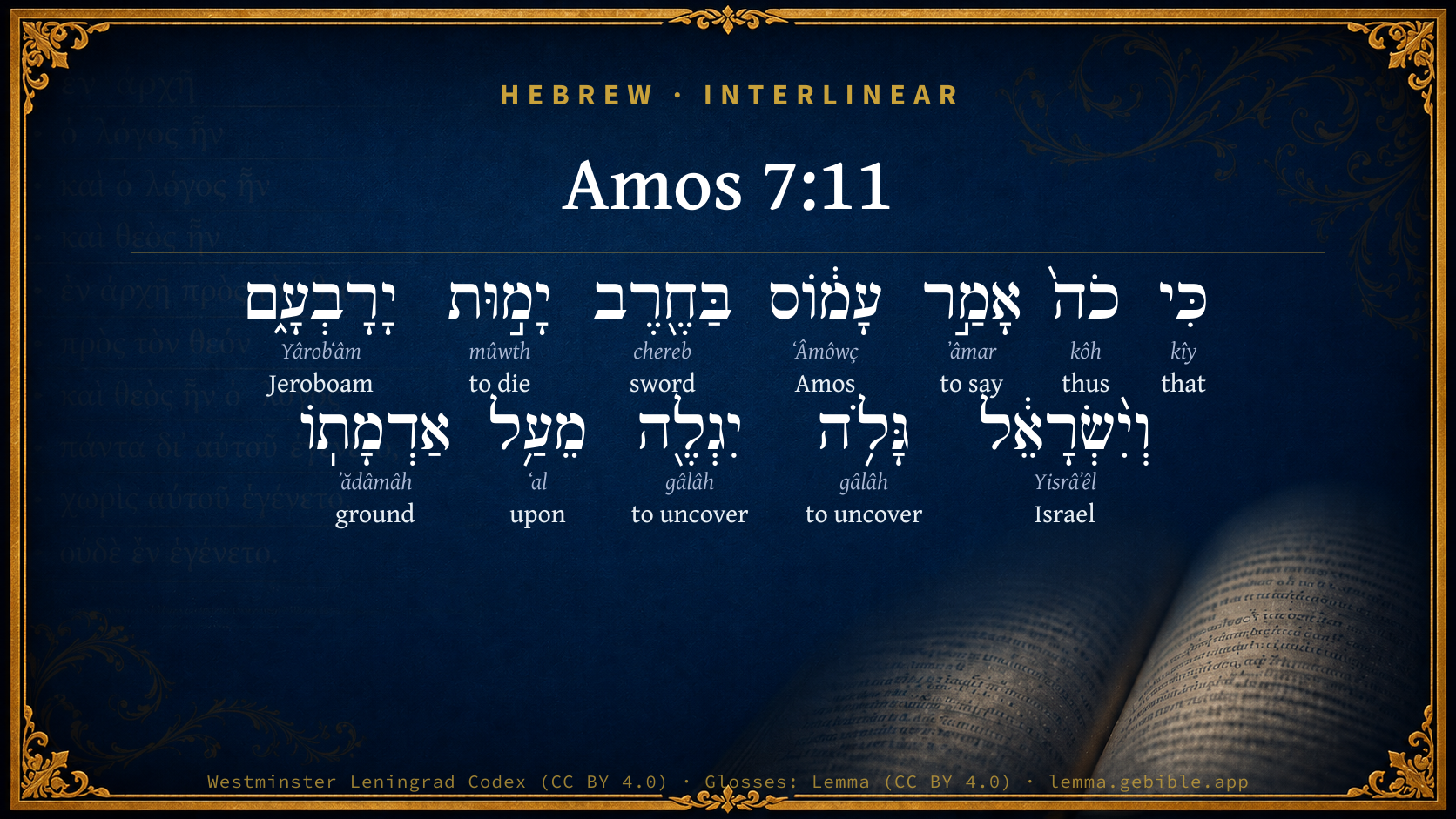
Hebrew (Westminster Leningrad Codex) Amos 7:11 appears in the Hebrew Old Testament. The text above is from the Westminster Leningrad Codex. Each word links to its Strong’s number, a concise gloss, and parsing drawn from the Open Scriptures Hebrew Bible morphology. Click any word for its full Brown-Driver-Briggs (BDB) entry.
Download image
Cite this verse

Amos 7:11 (World English Bible). Public Domain. Lemma interlinear Bible study tool, https://lemma.gebible.app/v/amos/7/11.

Show BibTeX & RIS
BibTeX
RIS
English Translation
For Amos says, 'Jeroboam will die by the sword, and Israel shall surely be led away captive out of his land.'"
World English Bible · Public Domain
Download a study sheet

One document with this verse’s original text, its word-by-word gloss line, the meaning frame, cross-references with their text, attributed commentary, and full source and license credits — printable, and it pastes into notes with its structure intact.

This verse Autodidact and up

Study sheet (.html) Plain text (.txt)

A passage Seminary Student

Up to 50 verses in one chapter. A passage sheet keeps up to 6 commentary sources and 12 cross-references per verse, in the order this page ranks them, and says so on the sheet whenever that leaves anything out. Ask for a single verse and you get the Autodidact verse sheet above.

Everything on this page stays free to read, with no account — the sheet is a download of what is already on screen, not access to it.

Want to remove ads? Support Godless Engineer
Compare translations 3

The same verse in 3 English versions, stacked beneath the original-language interlinear above. Click any original word for its lexicon entry.

Each is an independent rendering of the whole verse — the interlinear is not word-aligned to these translations.

Highlighted words mark where these versions differ — a whole-verse word diff, not a word-by-word alignment.

  • World English Bible Public Domain
    For Amos says, 'Jeroboam will die by the sword, and Israel shall surely be led away captive out of his land.'"
  • King James Version Public Domain
    For thus Amos saith, Jeroboam shall die by the sword, and Israel shall surely be led away captive out of their own land.
  • unfoldingWord Literal Text CC BY-SA 4.0
    For this is what Amos said, ‘Jeroboam will die by the sword, and Israel will surely go into exile away from his land.’”

unfoldingWord Literal Text — © unfoldingWord, licensed CC BY-SA 4.0. Word-aligned USFM3 via Door43 (git.door43.org/unfoldingWord/en_ult).

Versions to compare (up to 4)

3 of 4 selected

Show all 18 translations

Every available English version of this verse, each an independent rendering of the whole verse.

  • World English Bible Public Domain
    For Amos says, 'Jeroboam will die by the sword, and Israel shall surely be led away captive out of his land.'"
  • Berean Standard Bible Public Domain
    for this is what Amos has said: ‘Jeroboam will die by the sword, and Israel will surely go into exile, away from their homeland.’”
  • Majority Standard Bible Public Domain
    for this is what Amos has said: ‘Jeroboam will die by the sword, and Israel will surely go into exile, away from their homeland.’”
  • King James Version Public Domain
    For thus Amos saith, Jeroboam shall die by the sword, and Israel shall surely be led away captive out of their own land.
  • American Standard Version (1901) Public Domain
    For thus Amos saith, Jeroboam shall die by the sword, and Israel shall surely be led away captive out of his land.
  • Revised Version (1885) Public Domain
    For thus Amos saith, Jeroboam shall die by the sword, and Israel shall surely be led away captive out of his land.
  • Geneva Bible (1599) Public Domain
    For thus Amos saith, Ieroboam shall die by the sworde, and Israel shalbe led away captiue out of their owne land.
  • Douay-Rheims (1899) Public Domain
    For thus saith Amos: Jeroboam shall die by the sword, and Israel shall be carried away captive out of their own land.
  • Young's Literal Translation Public Domain
    for thus said Amos: By sword die doth Jeroboam, And Israel certainly removeth from off its land.'
  • Literal Standard Version CC BY-SA 4.0
    for thus said Amos: Jeroboam dies by sword, || And Israel certainly removes from off its land.”
  • Unlocked Literal Bible CC BY-SA 4.0
    For this is what Amos said, 'Jeroboam will die by the sword, and Israel will surely go into exile away from his land.'”
  • unfoldingWord Literal Text CC BY-SA 4.0
    For this is what Amos said, ‘Jeroboam will die by the sword, and Israel will surely go into exile away from his land.’”
  • Darby Bible Public Domain
    For thus Amos saith: Jeroboam shall die by the sword, and Israel shall certainly go into captivity out of his land.
  • World Messianic Bible Public Domain
    For Amos says, ‘Jeroboam will die by the sword, and Israel shall surely be led away captive out of his land.’”
  • Webster's Bible Public Domain
    For thus Amos saith, Jeroboam shall die by the sword, and Israel shall surely be led away captive out of their own land.
  • Free Bible Version CC BY-SA 4.0
    For he's saying Jeroboam will be killed by the sword, and the people will be taken away from their land into exile.”
  • Bible in Basic English Public Domain
    For Amos has said, Jeroboam will be put to the sword, and Israel will certainly be taken away as a prisoner out of his land.
  • JPS Tanakh (1917) Public Domain
    For thus Amos saith: Jeroboam shall die by the sword, and Israel shall surely be led away captive out of his land.'

Literal Standard Version (2020), Covenant Press — licensed CC BY-SA 4.0. Text via the HelloAO Bible API (eBible.org). Unlocked Literal Bible (unfoldingWord) — licensed CC BY-SA 4.0. Text via the HelloAO Bible API (eBible.org). unfoldingWord Literal Text — © unfoldingWord, licensed CC BY-SA 4.0. Word-aligned USFM3 via Door43 (git.door43.org/unfoldingWord/en_ult). Free Bible Version, Dr. Jonathan Gallagher — licensed CC BY-SA 4.0. Text via the HelloAO Bible API (eBible.org).

Word by word

More ways to search: Search by grammar → Find every occurrence → Compare this word →

Practice this passage: Drill this verse → Learn its vocabulary →

עָמ֔וֹס
ʻÂmôwç
H5986
“Amos”
Noun, Proper
Part of Speech
Noun
Type
Proper
Full BDB Definition

Origin: from H6006

TWOT: None

Amos = "burden" - a prophet of the Lord who prophesied in the northern kingdom; native of Tekoa in Judah near Bethlehem and a shepherd by trade; author of the prophetic book by his name
  1. כִּי kîy H3588 “that” Conjunction
  2. כֹה֙ kôh H3541 “thus” Adverb
  3. אָמַ֣ר ʼâmar H559 “to say” Verb, Qal, Perfect, 3rd Person, Masculine, Singular
  4. בַּחֶ֖רֶב chereb H2719 “in/at the · sword” Preposition, Determined + Noun, Common, Feminine, Singular, Absolute
  5. יָמ֣וּת mûwth H4191 “to die” Verb, Qal, Imperfect, 3rd Person, Masculine, Singular
  6. יָרָבְעָ֑ם Yârobʻâm H3379 “Jeroboam” Noun, Proper
  7. וְיִ֨שְׂרָאֵ֔ל Yisrâʼêl H3478 “and · Israel” Conjunction + Noun, Proper
  8. גָּלֹ֥ה gâlâh H1540 “to uncover” Verb, Qal, Infinitive Absolute
  9. יִגְלֶ֖ה gâlâh H1540 “to uncover” Verb, Qal, Imperfect, 3rd Person, Masculine, Singular
  10. מֵעַ֥ל ʻal H5921 “from · upon” Preposition + Preposition
  11. אַדְמָתֽוֹ ʼădâmâh H127 “ground · his” Noun, Common, Feminine, Singular, Construct + Suffix, Personal, 3rd Person, Masculine, Singular

About this verse

These counts appear in no published source. They are computed here, from the morphology-tagged text and Lemma’s own curated glosses. What Lemma adds →

12
words
11
distinct lemmas
Prophets
section

Notable vocabulary

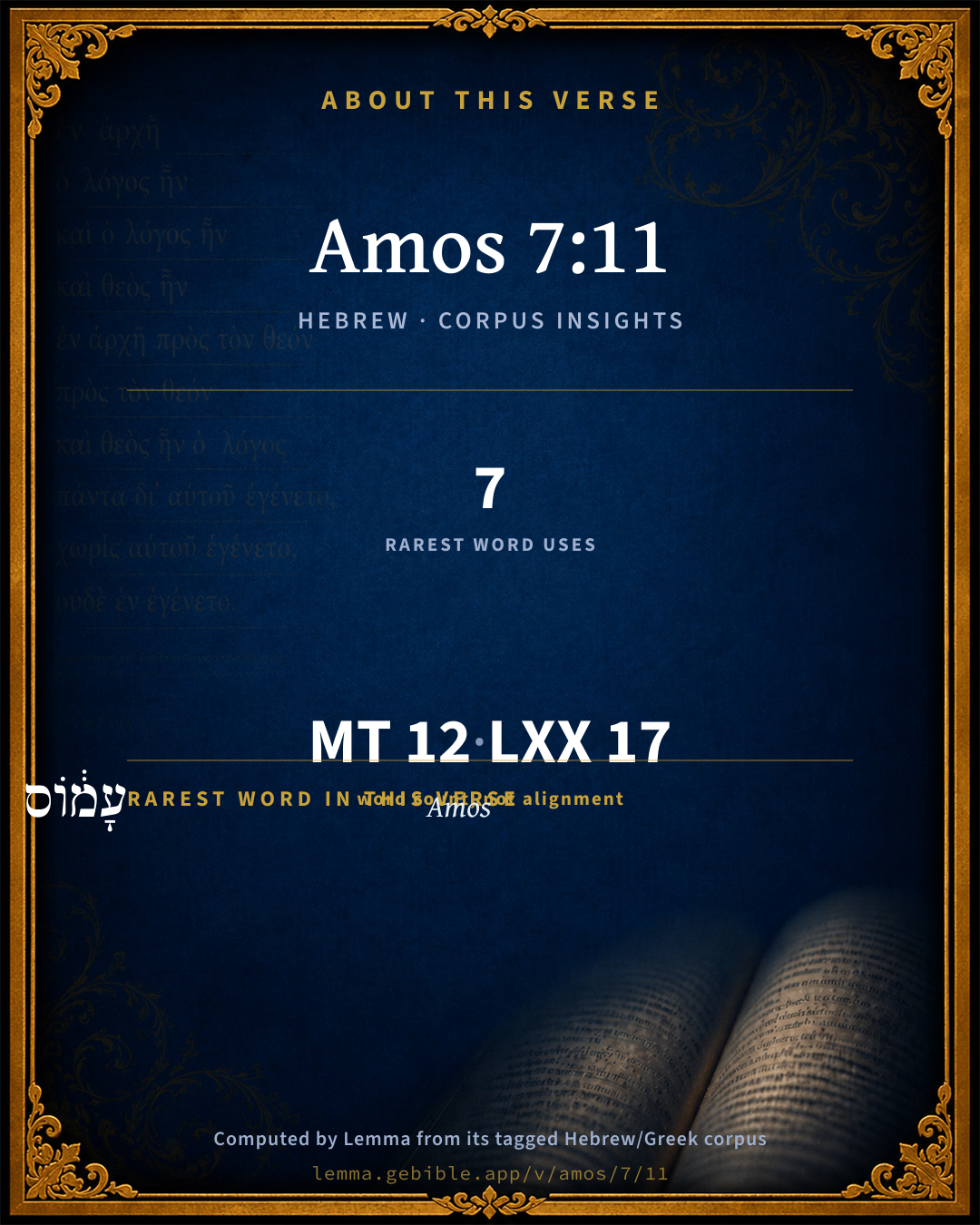
The rarest word here is עָמ֔וֹס Amos H5986 — appearing just 7 times in the whole Hebrew Bible.

Shared distinctive vocabulary

עָמ֔וֹס Amos H5986 occurs in 7 verses of the Hebrew Bible. Also found in:

Grammatical profile

  • 4 verbs
  • 5 nouns
  • 1 preposition
  • 1 conjunction
  • 1 adverb

Verb forms

  • אָמַ֣ר Qal · Perfect
  • יָמ֣וּת Qal · Imperfect
  • גָּלֹ֥ה Qal · Infinitive Absolute
  • יִגְלֶ֖ה Qal · Imperfect

Repetition

A word recurs within this verse — often emphatic in Hebrew:

  • גָּלֹ֥ה to uncover H1540 ×2

Hebrew & Septuagint length

In English translation the verse runs 21 words from the Hebrew and 20 from the Septuagint (LXX English) — closely comparable.

A rough comparison of the two English renderings, which tokenize alike — not a word-level alignment.

Word counts can differ between the Hebrew and the Greek without any difference in meaning — e.g. the Hebrew direct-object marker אֵת has no separate Greek word, and Greek often adds the article ὁ.

In the original languages it is 12 Hebrew tokens and 17 Greek tokens — but the two are counted differently (Hebrew bundles its prefixes and suffixes into one token; the Greek is in lemma form), so that isn’t a like-for-like length.

Cross-references

7

Topical passages linked to Amos 7:11 in the Treasury of Scripture Knowledge — connected by theme and wording, ordered by reader-vote popularity; previews shown in the World English Bible.

  • 2 Kings 17:6 In the ninth year of Hoshea the king of Assyria took Samaria, and carried Israel away to Assyria, and placed them in Halah, and on the Habor, the river of Gozan, and in the cities of the Medes.
  • Amos 6:7–8 Therefore they will now go captive with the first who go captive; And the feasting and lounging will end.
  • Psalms 56:5 All day long they twist my words. All their thoughts are against me for evil.
  • Amos 7:9 The high places of Isaac will be desolate, the sanctuaries of Israel will be laid waste; and I will rise against the house of Jeroboam with the sword."
  • Jeremiah 28:10–11 Then Hananiah the prophet took the bar from off the prophet Jeremiah's neck, and broke it.
  • Matthew 26:61 and said, "This man said, 'I am able to destroy the temple of God, and to build it in three days.'"
  • Acts 6:14 For we have heard him say that this Jesus of Nazareth will destroy this place, and will change the customs which Moses delivered to us."

Cross-references courtesy of OpenBible.info (CC BY 4.0).

Hebrew and Greek witnesses Masoretic Hebrew ↔ Greek Septuagint

The same verse in the two great witnesses to the Old Testament, shown verse-for-verse.

These are two independent witnesses, not word-aligned to each other, and the Septuagint is shown in lemma (dictionary) form.

Hebrew Amos 7:11 Masoretic · Westminster Leningrad Codex

כִּי כֹה֙ אָמַ֣ר עָמ֔וֹס בַּחֶ֖רֶב יָמ֣וּת יָרָבְעָ֑ם וְיִ֨שְׂרָאֵ֔ל גָּלֹ֥ה יִגְלֶ֖ה מֵעַ֥ל אַדְמָתֽוֹ

For Amos says, 'Jeroboam will die by the sword, and Israel shall surely be led away captive out of his land.'"

World English Bible · Public Domain

Greek LXX Amos 7:11 Septuagint · lemma form

διότι ὅδε λέγω αμως ἐν ῥομφαία τελευτάω ιεροβοαμ ὁ δέ ἰσραήλ αἰχμάλωτος ἄγω ἀπό ὁ γῆ αὐτός

For thus says Amos, Jeroboam shall die by the sword, and Israel shall be led away captive from his land.

LXX2012 (modern English Septuagint) · Public Domain

Hebrew: Westminster Leningrad Codex (CC BY 4.0). Greek: Septuagint (public domain); English from LXX2012 (modern English Septuagint) (Public Domain). How the Septuagint differs from the Hebrew →

Targum (Aramaic paraphrase)

1

The Targum is the ancient Jewish Aramaic paraphrase of the Hebrew Scriptures — an interpretive translation, not the Hebrew text itself. Onkelos (literal) and Pseudo-Jonathan (expansive) render the Torah, and Jonathan the Prophets. Coverage is partial: where no permissively-licensed English translation exists for a verse, only the Aramaic is shown. This is verse-level text, not a word-by-word alignment to the Hebrew.

  1. Targum Jonathan Prophets (Joshua–Malachi)
    אֲרֵי כִּדְנַן אֲמַר עָמוֹס בְּחַרְבָּא יִתְקְטֵל יְרָבְעָם וְיִשְׂרָאֵל מִגְלָא יִגְלוֹן מְעַל אַרְעֵהוֹן:

    (no public-domain English translation for this verse)

    Targum Jonathan — Aramaic: “Mikraot Gedolot” (public domain). English: “Sefaria Community Translation” (CC0 1.0 (public-domain dedication)); “London "Chaldee Paraphrase," 1871” (public domain). Text via Sefaria.

Commentary

Notes on Amos 7:11 from classic Christian and Jewish commentators (each source and its license shown beneath its notes). The classic Christian expositions comment on the surrounding passage and are grouped to its opening verse, so a note may address several verses; the Jewish commentaries on the Tanakh (Rashi and others) are per-verse, so they appear only where the commentator wrote on this verse.

Lemma curates 59 commentaries, every one of them public domain or Creative Commons licensed, each selected and text-cleaned for this edition rather than reprinted as found. About our sources →

Trapp's Complete Commentary

John Trapp

Amo 7:11 For thus Amos saith, Jeroboam shall die by the sword, and Israel shall surely be led away captive out of their own land.

Ver. 11. For thus Amos saith, Jeroboam shall die by the sword, &c.] When did Amos say so? He said indeed that the house of Jeroboam should be smitten with the sword, Amo 7:9, and this Amaziah maliciously transferreth to the person of Jeroboam, the more to enrage him against the prophet; whom therefore he nameth once and again, to create him the more displeasure. That Jeroboam died by the sword we read not, but that his son Zachariah was slain, and his house destroyed in the next generation, we find 2Ki 15:10, according to Amos’s prophecy. But to colour this calumny, some truth shall be admingled.

And Israel shall surely be led away captive] This indeed the prophet had often affirmed (though not in any of those three last visions), and it proved too true: but because Amos saith so he must pass for a traitor against the majesty both of the king and of the people. What an impudent informer was this! The king and people are pretended; and what good subject can endure it? but that which irked him was, that his own authority was by this plain dealing prophet impaired, and his gain like to be lessened, if the superstition of Bethel were thus decried. It is said of Phlugius and Sidonius (authors of the Interim in Germany) that, among other points of Popery therein defended, they spake much for chrism and extreme unction, ut ipsi discederent unctores, that thereby they might hold fat bishoprics. Such arguments prevail much with all self-seekers, whose covetousness and ambition usually ride without reins, and over whose neck it mattereth not.

John Trapp, A Commentary or Exposition upon All the Books of the Old and New Testament (1647–1656) — public domain. Text from a community e-Sword module.

Tyndale Open Study Notes

Tyndale Open Resources

7:11 Amaziah misinterpreted Amos’s words as a threat on Jeroboam’s life. Amos was calling the people to repentance, not sedition.

Tyndale Open Study Notes — © Tyndale Open Resources, licensed CC BY-SA 4.0. Text via the HelloAO Bible API.

Jamieson, Fausset & Brown

Robert Jamieson, A. R. Fausset & David Brown

Jeroboam shall die, &c.--Amos had not said this: but that "the house of Jeroboam" should fall "with the sword" (Amo 7:9). But Amaziah exaggerates the charge, to excite Jeroboam against him. The king, however, did not give ear to Amaziah, probably from religious awe of the prophet of Jehovah.

Jamieson, Fausset & Brown — Commentary Critical and Explanatory on the Whole Bible (1871) — public domain (CC PDM 1.0). Text via the HelloAO Bible API.

John Calvin's Commentaries

Now our Prophet is wholly silent as to the answer of the king: it is therefore probable, either that the king was not much excited, — or that he dared not openly to take away the life of Amos; for he had probably obtained some authority among the people; and though he was hated, yet his name as a Prophet and his office were had in reverence, — or that the matter was by agreement arranged between the two enemies of sound doctrine, as flatterers often gratify kings by putting themselves in their place, and by bearing all the ill will. However this might have been, it is certainly a probable conjecture, that the king did not interfere, because he was so persuaded by the priest Amaziah, or because he feared the people, or because religion restrained him, as even the ungodly are sometimes wont to contain themselves within the bounds of moderation; not that they are touched by real fear towards God, or that they desire to embrace his true worship: they wish God to be thrust down from heaven, they wish all knowledge of religion to be obliterated; but yet they dare not pour forth their fury. Such fear then might have seized the mind of Jeroboam, that he did not tyrannically rage against the Prophet Amos. But if we regard the tendency of the words of Amaziah, he certainly wished the Prophet Amos to be immediately visited with capital punishment; for conspiracy is a crime worthy of death; and then, fear might have impelled the king to put the holy Prophet immediately to death. Amaziah therefore expected more than what he attained: and then appeared his vulpine wiliness, for he sent for the Prophet and advised him to withdraw to the land of Judah. Hence, as I said at the beginning, it is very probable that Jeroboam was not excited according to the expectation of the ungodly priest of Bethel, who at first was a cruel wild beast; but when he could not proceed openly to destroy Amos, he put on a new character; he became a fox, because he could do nothing as a raging lion. Hence follows his second attempt, And Amaziah said to Amos, etc.

I have passed over one clause in the last verse: Amos says, By the sword shall Jeroboam die, and Israel, by migrating, shall migrate from their own land. These, in short, are two heads of accusation. Some interpreters think that Amaziah had slanderously perverted the words of the Prophet Amos; for he did not denounce death on king Jeroboam, but only on his people and posterity: but I do not insist on this. It might then be, that Amaziah did not designedly pervert the words of Amos, but only wished to excite the ill will of the king. Die then shall Jeroboam or his posterity with the sword, and Israel also, by migrating, shall migrate from their own land. We hence learn, that Amaziah was not impelled only by the last address of the Prophet Amos, but that he then discovered the hatred which he had long harbored. Amaziah therefore had been, no doubt, on his watch, and had heard what Amos daily taught, and when he thought the matter ripe, he sent to the king. Having tried this way, and found that it did not answer, he came to his second attempt, which we are now to consider.

John Calvin's Commentaries (1540-1563) — public domain. Text from the Calvin Translation Society English edition (1840s-50s) via the Christian Classics Ethereal Library (ccel.org). Calvin's coverage is partial (roughly two-thirds of the Bible); uncommented books and verses are honest gaps, never fabricated. The 19th-century editor's footnotes and remarks are omitted so the notes are faithfully Calvin's own voice.

Ellicott's Commentary for English Readers

(11) Die by the sword.—So far as the words of the prophecy are concerned, it was not accurate to say that Amos had threatened Jeroboam with the sword.

A Bible Commentary for English Readers, edited by Charles John Ellicott (1878–1897) — public domain. Text from a community e-Sword module.

The Cambridge Bible for Schools and Colleges

gen. ed. J. J. S. Perowne

11. Jeroboam shall die by the sword] This had not been said by Amos,—at least, if the extant book of his prophecies contains all that he said upon the subject. It was the house of Jeroboam which Amos had threatened in Amo_7:9 : but Amaziah, it seems, gives the prophecy a more personal character, hoping thereby to produce a more powerful effect upon the king.

go into exile away from his land] See Amo_5:5; Amo_5:27, Amo_6:7.

The Cambridge Bible for Schools and Colleges (gen. ed. J. J. S. Perowne; Cambridge University Press, 1878–1918) — public domain. Text from a community e-Sword module.

John Gill's Exposition

For thus Amos saith, Jeroboam shall die by the sword,.... Which was not saying truth; for Amos said not that Jeroboam should die by the sword, but that God would raise up the sword against his house or family; nor did Jeroboam die by the sword, but his son Zachariah did:

and Israel shall surely be led away captive out of their own land; this was true; Amos did say this, and he afterwards confirms it. This is the amount of the charge brought against the prophet, which has some truth and some falsehood mixed together; and by which method the priest hoped to gain his point, and get the prophet either banished or put to death.

John Gill's Exposition of the Whole Bible (1746–1763) — public domain (CC PDM 1.0). Text via the HelloAO Bible API.

Albert Barnes' Notes on the Bible

For thus Amos saith - Amos had said, “Thus saith the Lord;” he never fails to impress on them, whose words he is speaking. Amaziah, himself bound up in a system of falsehood and imposture, which, being a creature-worship, gave itself out as the worship of the true God, believed all besides to be fraud. Fraud always suspects fraud; the irreligious think devotion, holiness, saintliness to be hypocrisy: vice imagines virtue to be well-masked vice. The false priest, by a sort of law of corrupt nature, supposed that Amos also was false, and treats his words as the produce of his own mind.

Jeroboam shall die by the sword - Amos had not said this. The false prophet distorts the last words of Amos, which were yet in his ears, and reports to Jeroboam, as said of himself, what Amos had just said of his “house.” Amos “was” opposed to the popular religion or irreligion of which Jeroboam was the head, to the headship over which he had succeeded. Jeroboam, like the Roman Emperors, was high priest, Pontifex Maximus, in order to get the popular worship under his control. The first Jeroboam had himself consecrated the calf-priests 1Sa 22:8, 1Sa 22:13; 1Ki 15:27; 1Ki 16:9, 1Ki 16:16; 2Ki 10:9; 2Ki 14:19; 2Ki 15:10, 2Ki 15:15, 2Ki 15:25; 2Ki 21:23. Amos bore also the message from God, that the reprieve, given to the house of Jehu, would not be extended, but would end. Amaziah would act on the personal fears of the king, as though there had been some present active conspiracy against him. A lie, mixed with truth, is the most deadly form of falsehood, the truth serving to gain admittance for the lie, and color it, and seeming to require explanation, and being something to full back upon. Since thus much is certainly true, why should not the rest be so? In slander, and heresy which is slander against God, truth is used to commend the falsehood; and falsehood, to destroy the truth. The poison is received the more fearlessly because wrapt up in truth, but loses none of its deadliness.

And Israel shall surely be led away captive - This was a suppression of truth, as the other was a falsification of it. Amaziah omits both the ground of the threat, and the hope of escape urged and impressed upon them. On the one side he omits all mention of what even such a king as Jeroboam would respect, the denunciation of oppression of the poor, injustice, violence, robbery, and all their other sins against man. On the other hand, he omits the call to repentance and promises on it, “seek ye the Lord and live.” He omits too the prophet’s intercession for his people, and selects the one prophecy, which could give a mere political character to the whole. Suppression of truth is a yet subtler character of falsehood. Hence, witnesses on oath are required to tell, not the truth only., but the whole truth. Yet in daily life, or in accusation of others, in detraction, or evil-speaking, people daily act, as though, suppression were no lie.

Albert Barnes' Notes on the Bible (1834–1885) — public domain. Text from a community e-Sword/MySword module.

Haydock's Catholic Bible Commentary

Sword. the prophet did not say this, but that the Lord would rise up against the house of Jeroboam with the sword; which was verified when Zacharias, the son and successor of Jeroboam, was slain by the sword, 4 Kings xv. 10. (Challoner) --- The false prophet was therefore guilty of a lie. They accuse the preachers of truth as traitors. (Worthington) --- Thus many missionary priests have been traduced in England. (Haydock)

George Leo Haydock (1774–1849), Haydock's Catholic Family Bible and Commentary, 1859 edition — public domain. Excludes Psalms (Douay-Rheims chapter numbering differs from Protestant) and Deuterocanonical books (Catholic canon only).

Matthew Poole's English Annotations

Thus Amos saith; so Amaziah falsely reports the prophet.

Jeroboam shall die by the sword: he no where said so, nor did he insinuate so much, but spake of his house distinguished from his person, as Amo 7:9.

Israel shall surely be led away captive: this indeed he foretold, but did no more contribute to it, or contrive it, than the physician doth who foretells the death of an uncounsellable patient, sick of a mortal disease.

Out of their own land: this is added to signify the greatness of the captivity.

Matthew Poole's English Annotations on the Holy Bible (1683–1685) — public domain. Text from a community e-Sword/MySword module.

The Pulpit Commentary

This is a partly correct account of what the prophet had said, but it differed in some important particulars. Amaziah carefully omits the fact that Amos had merely been the mouthpiece of God in all his announcements; he says falsely that a violent death had been predicted for Jeroboam himself; and, in stating that Amos had foretold the captivity of Israel, he says nothing of the sins which led to this doom, or of the hope held out to repentance, or of the prophet"s intercession.

The Pulpit Commentary (1880–1919), ed. H.D.M. Spence-Jones & Joseph S. Exell — public domain. Text from a community e-Sword module.

John Wesley's Explanatory Notes

Jeroboam shall die - He nowhere said so, but spake of his house distinguished from his person, as ver. 9.

John Wesley, Explanatory Notes Upon the Whole Bible (1754–1765) — public domain. Text via the GEBible commentary corpus.

Rashi

Rabbi Shlomo Yitzchaki (Rashi)

Jeroboam shall die by the sword—But he did not say that, only, “And I will rise upon the house of Jeroboam,” and that refers to his son, Zechariah, who was assassinated by Shallum son of Jabesh (II Kings 15).

Rashi on the Tanakh — English translations: “The Judaica Press complete Tanach with Rashi, translated by A. J. Rosenberg” (CC BY 4.0); “Pentateuch with Rashi's commentary by M. Rosenbaum and A.M. Silbermann, 1929-1934” (public domain); “The Metsudah Tanach series, Lakewood, N.J” (CC BY 4.0); and “The Book of Joshua, Metsudah Publications, 1997” (CC BY 4.0). Text via Sefaria.

Lesson kit

Teaching starters — assembled from the data on this page, not authored interpretation. Every prompt links to the verse data it draws on. Edit before teaching.

Amos, in the Prophets, opens this verse with 12 words (11 distinct Hebrew lemmas). Its most distinctive word is ʻÂmôwç (“Amos”). A historical commentator’s framing appears above. Read the whole chapter for the surrounding context.

Discussion questions

  1. What does “Amos” (ʻÂmôwç) contribute to the verse as a whole?
  2. How does Amos 1:1, which shares the word «Amos», read alongside this verse?
  3. What does the repetition of “to uncover” (2× in this one verse) do in this verse?
  4. These translations render this verse differently; the difference is in the English rendering, not the original. What questions does that raise?
  5. «אָמַ֣ר» is a Qal Perfect verb. How does that grammatical form shape the action described?
  6. Compare how Trapp's Complete Commentary and Tyndale Open Study Notes read this verse. Where do they agree or differ?

Things to notice

Reading settings

Reading text

Shown beneath each verse's original-language words.

Old Testament
Old Testament edition

Read the OT as the Masoretic Hebrew (MT) or the Greek Septuagint (LXX).

English shown for the Greek Septuagint (in the Hebrew ↔ Greek comparison).

Comparing translations? Open the Compare panel on any verse page to stack up to four side by side.