
Ezekiel 39:23

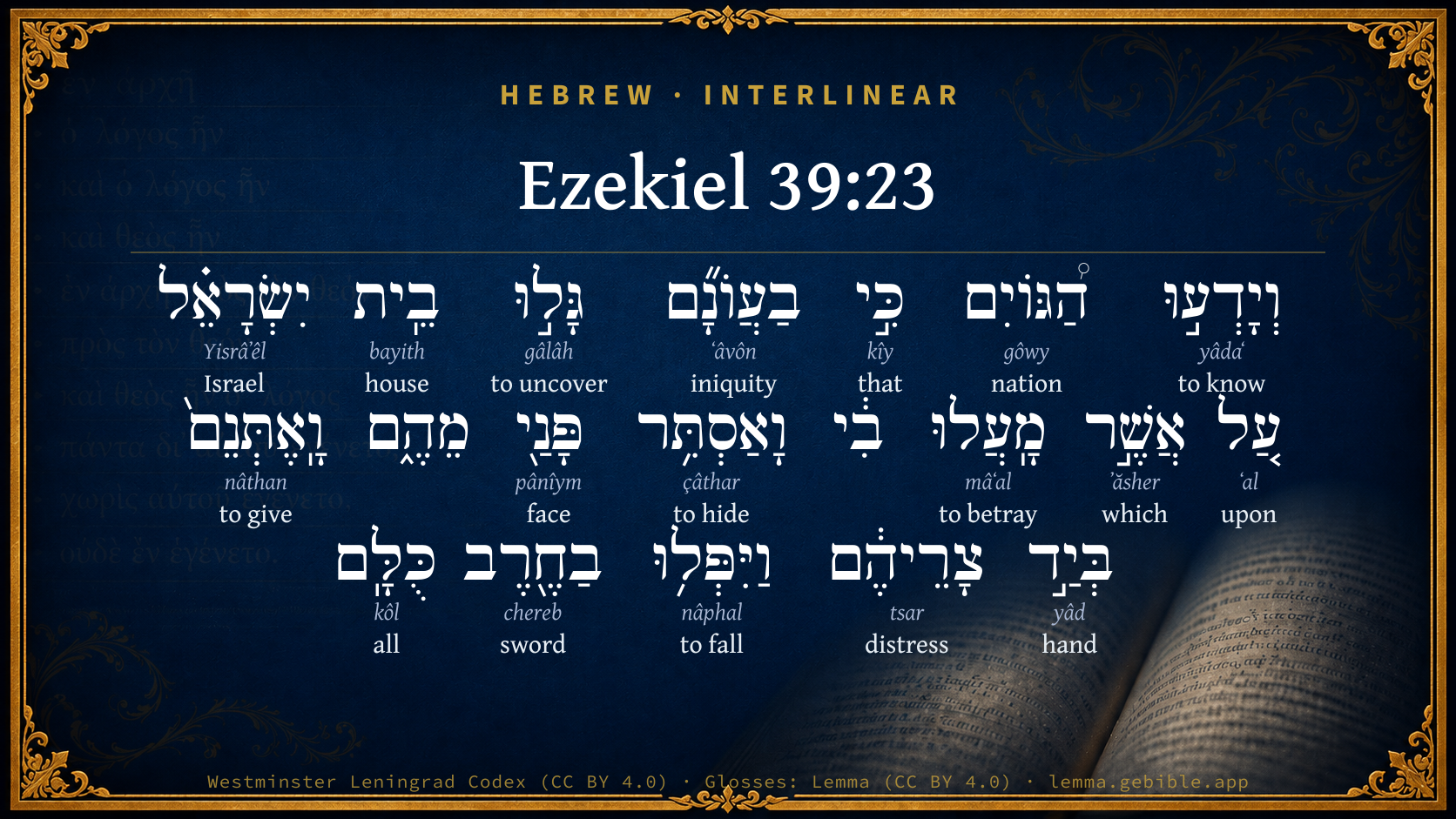
Hebrew (Westminster Leningrad Codex) Ezekiel 39:23 appears in the Hebrew Old Testament. The text above is from the Westminster Leningrad Codex. Each word links to its Strong’s number, a concise gloss, and parsing drawn from the Open Scriptures Hebrew Bible morphology. Click any word for its full Brown-Driver-Briggs (BDB) entry.
Download image
Cite this verse

Ezekiel 39:23 (World English Bible). Public Domain. Lemma interlinear Bible study tool, https://lemma.gebible.app/v/ezekiel/39/23.

Show BibTeX & RIS
BibTeX
RIS
English Translation
The nations shall know that the house of Israel went into captivity for their iniquity; because they trespassed against me, and I hid my face from them: so I gave them into the hand of their adversaries, and they fell all of them by the sword.
World English Bible · Public Domain
Download a study sheet

One document with this verse’s original text, its word-by-word gloss line, the meaning frame, cross-references with their text, attributed commentary, and full source and license credits — printable, and it pastes into notes with its structure intact.

This verse Autodidact and up

Study sheet (.html) Plain text (.txt)

A passage Seminary Student

Up to 50 verses in one chapter. A passage sheet keeps up to 6 commentary sources and 12 cross-references per verse, in the order this page ranks them, and says so on the sheet whenever that leaves anything out. Ask for a single verse and you get the Autodidact verse sheet above.

Everything on this page stays free to read, with no account — the sheet is a download of what is already on screen, not access to it.

Want to remove ads? Support Godless Engineer
Compare translations 3

The same verse in 3 English versions, stacked beneath the original-language interlinear above. Click any original word for its lexicon entry.

Each is an independent rendering of the whole verse — the interlinear is not word-aligned to these translations.

Highlighted words mark where these versions differ — a whole-verse word diff, not a word-by-word alignment.

  • World English Bible Public Domain
    The nations shall know that the house of Israel went into captivity for their iniquity; because they trespassed against me, and I hid my face from them: so I gave them into the hand of their adversaries, and they fell all of them by the sword.
  • King James Version Public Domain
    And the heathen shall know that the house of Israel went into captivity for their iniquity: because they trespassed against me, therefore hid I my face from them, and gave them into the hand of their enemies: so fell they all by the sword.
  • unfoldingWord Literal Text CC BY-SA 4.0
    The nations will know that the house of Israel went into captivity because of their iniquity by which they betrayed me, so I hid my face from them and gave them into the hand of their adversaries so that all of them fell by the sword.

unfoldingWord Literal Text — © unfoldingWord, licensed CC BY-SA 4.0. Word-aligned USFM3 via Door43 (git.door43.org/unfoldingWord/en_ult).

Versions to compare (up to 4)

3 of 4 selected

Show all 18 translations

Every available English version of this verse, each an independent rendering of the whole verse.

  • World English Bible Public Domain
    The nations shall know that the house of Israel went into captivity for their iniquity; because they trespassed against me, and I hid my face from them: so I gave them into the hand of their adversaries, and they fell all of them by the sword.
  • Berean Standard Bible Public Domain
    And the nations will know that the house of Israel went into exile for their iniquity, because they were unfaithful to Me. So I hid My face from them and delivered them into the hands of their enemies, so that they all fell by the sword.
  • Majority Standard Bible Public Domain
    And the nations will know that the house of Israel went into exile for their iniquity, because they were unfaithful to Me. So I hid My face from them and delivered them into the hands of their enemies, so that they all fell by the sword.
  • King James Version Public Domain
    And the heathen shall know that the house of Israel went into captivity for their iniquity: because they trespassed against me, therefore hid I my face from them, and gave them into the hand of their enemies: so fell they all by the sword.
  • American Standard Version (1901) Public Domain
    And the nations shall know that the house of Israel went into captivity for their iniquity; because they trespassed against me, and I hid my face from them: so I gave them into the hand of their adversaries, and they fell all of them by the sword.
  • Revised Version (1885) Public Domain
    And the nations shall know that the house of Israel went into captivity for their iniquity; because they trespassed against me, and I hid my face from them: so I gave them into the hand of their adversaries, and they fell all of them by the sword.
  • Geneva Bible (1599) Public Domain
    And the heathen shall knowe, that ye house of Israel went into captiuitie for their iniquitie, because they trespassed against me: therefore hid I my face from them, and gaue them into ye hand of their enemies: so fell they all by the sword.
  • Douay-Rheims (1899) Public Domain
    And the nations shall know that the house of Israel were made captives for their iniquity, because they forsook me, and I hid my face from them: and I delivered them into the hands of their enemies, and they fell all by the sword.
  • Young's Literal Translation Public Domain
    And known have the nations that for their iniquity, Removed have the house of Israel, Because they have trespassed against Me, And I do hide My face from them, And give them into the hand of their adversaries, And they fall by sword -- all of them.
  • Literal Standard Version CC BY-SA 4.0
    And the nations have known || That the house of Israel was removed for their iniquity, || Because they have trespassed against Me, || And I hide My face from them, || And give them into the hand of their adversaries, || And they fall by sword—all of them.
  • Unlocked Literal Bible CC BY-SA 4.0
    The nations will know that the house of Israel went into captivity because of their iniquity by which they betrayed me, so I hid my face from them and gave them into the hand of their adversaries so that all of them fell by the sword.
  • unfoldingWord Literal Text CC BY-SA 4.0
    The nations will know that the house of Israel went into captivity because of their iniquity by which they betrayed me, so I hid my face from them and gave them into the hand of their adversaries so that all of them fell by the sword.
  • Darby Bible Public Domain
    And the nations shall know that the house of Israel went into captivity for their iniquity, because they were unfaithful against me; and I hid my face from them, and gave them into the hand of their enemies, so that they fell all of them by the sword.
  • World Messianic Bible Public Domain
    The nations will know that the house of Israel went into captivity for their iniquity, because they trespassed against me, and I hid my face from them; so I gave them into the hand of their adversaries, and they all fell by the sword.
  • Webster's Bible Public Domain
    And the heathen shall know that the house of Israel went into captivity for their iniquity: because they trespassed against me, therefore I hid my face from them, and gave them into the hand of their enemies: so they all fell by the sword.
  • Free Bible Version CC BY-SA 4.0
    The nations will realize that the people of Israel were taken prisoner because of their sins, because they were unfaithful to me. So I gave up on them and handed them over to their enemies, so that they were all killed by the sword.
  • Bible in Basic English Public Domain
    And it will be clear to the nations that the children of Israel were taken away prisoners for their evil-doing; because they did wrong against me, and my face was covered from them: so I gave them up into the hands of their attackers, and they all came to their end by the sword.
  • JPS Tanakh (1917) Public Domain
    And the nations shall know that the house of Israel went into captivity for their iniquity, because they broke faith with Me, and I hid My face from them; so I gave them into the hand of their adversaries, and they fell all of them by the sword.

Literal Standard Version (2020), Covenant Press — licensed CC BY-SA 4.0. Text via the HelloAO Bible API (eBible.org). Unlocked Literal Bible (unfoldingWord) — licensed CC BY-SA 4.0. Text via the HelloAO Bible API (eBible.org). unfoldingWord Literal Text — © unfoldingWord, licensed CC BY-SA 4.0. Word-aligned USFM3 via Door43 (git.door43.org/unfoldingWord/en_ult). Free Bible Version, Dr. Jonathan Gallagher — licensed CC BY-SA 4.0. Text via the HelloAO Bible API (eBible.org).

Word by word

More ways to search: Search by grammar → Find every occurrence → Compare this word →

Practice this passage: Drill this verse → Learn its vocabulary →

מָֽעֲלוּ
mâʻal
H4603
“to betray”
Verb, Qal, Perfect, 3rd Person, Common, Plural
Part of Speech
Verb
Stem
Qal
Form
Perfect
Person
3rd Person
Gender
Common
Number
Plural
Full BDB Definition

Origin: a primitive root

TWOT: 1230

to act unfaithfully, act treacherously, transgress, commit a trespass - (Qal) to act unfaithfully or treacherously - against man - against God - against devoted thing - against husband
  1. וְיָדְע֣וּ yâdaʻ H3045 “and · to know” Conjunction + Verb, Qal, Sequential Perfect, 3rd Person, Common, Plural
  2. הַ֠גּוֹיִם gôwy H1471 “the · nations” Particle, Definite Article + Noun, Common, Masculine, Plural, Absolute
  3. כִּ֣י kîy H3588 “that” Conjunction
  4. בַעֲוֺנָ֞ם ʻâvôn H5771 “in/at · iniquity · their” Preposition + Noun, Common, Both, Singular, Construct + Suffix, Personal, 3rd Person, Masculine, Plural
  5. גָּל֣וּ gâlâh H1540 “to uncover” Verb, Qal, Perfect, 3rd Person, Common, Plural
  6. בֵֽית bayith H1004 “house of” Noun, Common, Masculine, Singular, Construct
  7. יִשְׂרָאֵ֗ל Yisrâʼêl H3478 “Israel” Noun, Proper
  8. עַ֚ל ʻal H5921 “upon” Preposition
  9. אֲשֶׁ֣ר ʼăsher H834 “which” Particle, Relative
  10. וָאַסְתִּ֥ר çâthar H5641 “and · to hide” Conjunction + Verb, Hiphil, Sequential Imperfect, 1st Person, Common, Singular
  11. פָּנַ֖י pânîym H6440 “face(s) · my” Noun, Common, Both, Plural, Construct + Suffix, Personal, 1st Person, Common, Singular
  12. וָֽאֶתְּנֵם֙ nâthan H5414 “and · to give · them” Conjunction + Verb, Qal, Sequential Imperfect, 1st Person, Common, Singular + Suffix, Personal, 3rd Person, Masculine, Plural
  13. בְּיַ֣ד yâd H3027 “in/at · hand of” Preposition + Noun, Common, Both, Singular, Construct
  14. צָרֵיהֶ֔ם tsar H6862 “distresses · their” Noun, Common, Masculine, Plural, Construct + Suffix, Personal, 3rd Person, Masculine, Plural
  15. וַיִּפְּל֥וּ nâphal H5307 “and · to fall” Conjunction + Verb, Qal, Sequential Imperfect, 3rd Person, Masculine, Plural
  16. בַחֶ֖רֶב chereb H2719 “in/at the · sword” Preposition, Determined + Noun, Common, Feminine, Singular, Absolute
  17. כֻּלָּֽם kôl H3605 “all · their” Noun, Common, Masculine, Singular, Construct + Suffix, Personal, 3rd Person, Masculine, Plural

About this verse

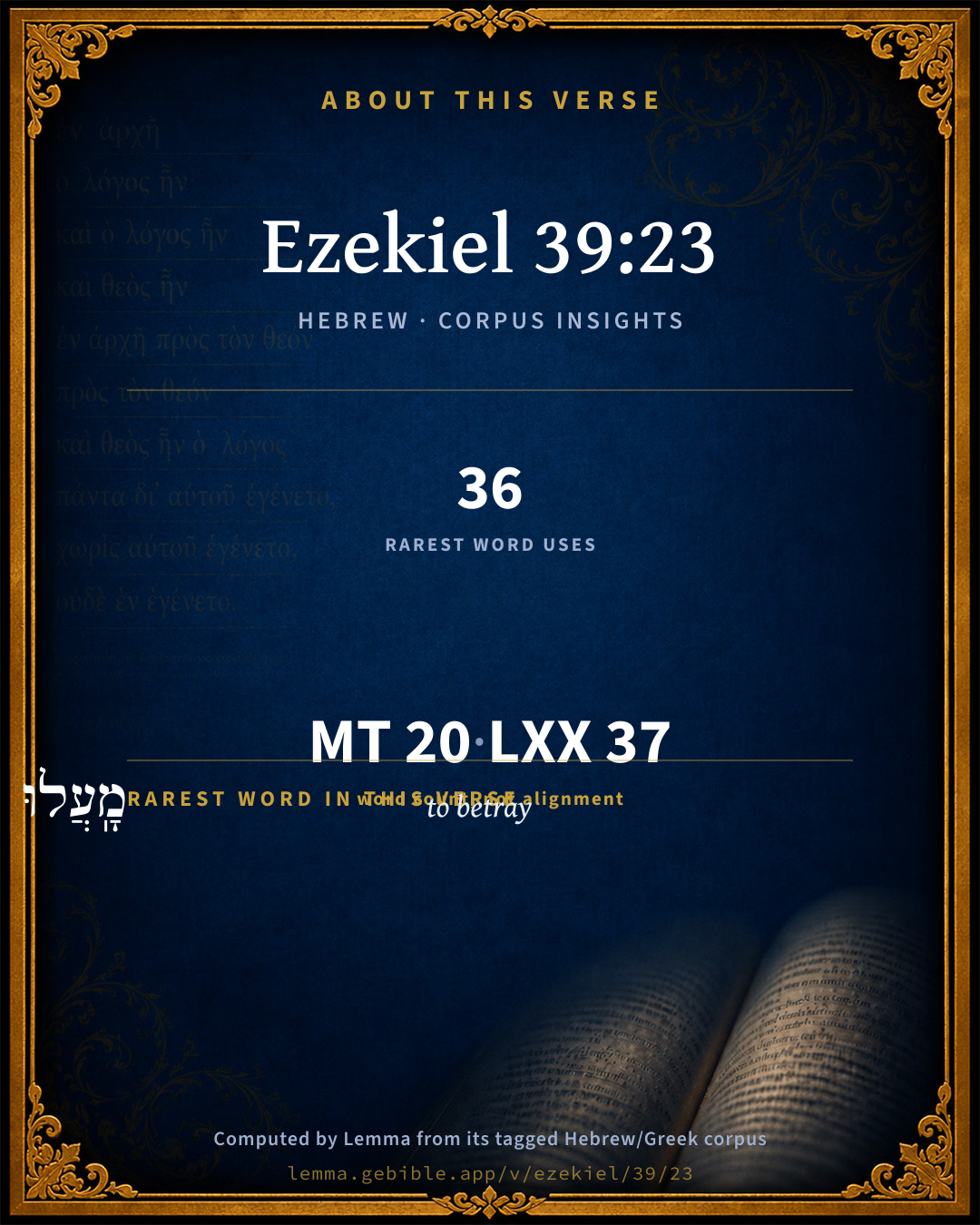
These counts appear in no published source. They are computed here, from the morphology-tagged text and Lemma’s own curated glosses. What Lemma adds →

20
words
18
distinct lemmas
Prophets
section

Shared distinctive vocabulary

מָֽעֲלוּ to betray H4603 occurs in 35 verses of the Hebrew Bible. Also found in:

Grammatical profile

  • 6 verbs
  • 9 nouns
  • 3 prepositions
  • 1 conjunction
  • 1 particle

Verb forms

  • וְיָדְע֣וּ Qal · Sequential Perfect
  • גָּל֣וּ Qal · Perfect
  • מָֽעֲלוּ Qal · Perfect
  • וָאַסְתִּ֥ר Hiphil · Sequential Imperfect
  • וָֽאֶתְּנֵם֙ Qal · Sequential Imperfect
  • וַיִּפְּל֥וּ Qal · Sequential Imperfect

Hebrew & Septuagint length

In English translation the verse runs 46 words from the Hebrew and 47 from the Septuagint (LXX English) — closely comparable.

A rough comparison of the two English renderings, which tokenize alike — not a word-level alignment.

Word counts can differ between the Hebrew and the Greek without any difference in meaning — e.g. the Hebrew direct-object marker אֵת has no separate Greek word, and Greek often adds the article ὁ.

In the original languages it is 20 Hebrew tokens and 37 Greek tokens — but the two are counted differently (Hebrew bundles its prefixes and suffixes into one token; the Greek is in lemma form), so that isn’t a like-for-like length.

Cross-references

23

Topical passages linked to Ezekiel 39:23 in the Treasury of Scripture Knowledge — connected by theme and wording, ordered by reader-vote popularity; previews shown in the World English Bible.

  • Jeremiah 22:8–9 Many nations shall pass by this city, and they shall say every man to his neighbor, Why has Yahweh done thus to this great city?
  • Isaiah 1:15 When you spread forth your hands, I will hide my eyes from you; Yes, when you make many prayers, I will not hear. Your hands are full of blood.
  • Isaiah 59:2 but your iniquities have separated between you and your God, and your sins have hidden his face from you, so that he will not hear.
  • Ezekiel 39:29 neither will I hide my face any more from them; for I have poured out my Spirit on the house of Israel, says the Lord Yahweh.
  • Leviticus 26:25 I will bring a sword upon you, that will execute the vengeance of the covenant; and you will be gathered together within your cities: and I will send the pestilence among you; and you will be delivered into the hand of the enemy.
  • Deuteronomy 31:17–18 Then my anger shall be kindled against them in that day, and I will forsake them, and I will hide my face from them, and they shall be devoured, and many evils and troubles shall come on them; so that they will say in that day, Haven't these evils come on us because our God is not among us?
  • Deuteronomy 32:20 He said, I will hide my face from them, I will see what their end shall be: For they are a very perverse generation, Children in whom is no faithfulness.
  • Deuteronomy 32:30 How should one chase a thousand, Two put ten thousand to flight, Except their Rock had sold them, Yahweh had delivered them up?
  • Isaiah 42:24 Who gave Jacob for a spoil, and Israel to the robbers? Didn't Yahweh? he against whom we have sinned, and in whose ways they would not walk, neither were they obedient to his law.
  • Jeremiah 40:2–3 The captain of the guard took Jeremiah, and said to him, Yahweh your God pronounced this evil on this place;
  • Judges 2:14 The anger of Yahweh was kindled against Israel, and he delivered them into the hands of spoilers who despoiled them; and he sold them into the hands of their enemies round about, so that they could not any longer stand before their enemies.
  • Judges 3:8 Therefore the anger of Yahweh was kindled against Israel, and he sold them into the hand of Cushan Rishathaim king of Mesopotamia: and the children of Israel served Cushan Rishathaim eight years.
  • 2 Chronicles 7:21–22 This house, which is so high, everyone who passes by it shall be astonished, and shall say, Why has Yahweh done thus to this land, and to this house?
  • Psalms 10:1 Why do you stand far off, Yahweh? Why do you hide yourself in times of trouble?
  • Psalms 30:7 You, Yahweh, when you favored me, made my mountain to stand strong. But when you hid your face, I was troubled.
  • Psalms 106:41 He gave them into the hand of the nations. Those who hated them ruled over them.
  • Isaiah 8:17 I will wait for Yahweh, who hides his face from the house of Jacob, and I will look for him.
  • Isaiah 64:7 There is none who calls on your name, who stirs up himself to take hold of you; for you have hid your face from us, and have consumed us by means of our iniquities.
  • Jeremiah 33:5 while [men] come to fight with the Chaldeans, and to fill them with the dead bodies of men, whom I have killed in my anger and in my wrath, and for all whose wickedness I have hid my face from this city:
  • Lamentations 1:8 Jerusalem has grievously sinned; therefore she is become as an unclean thing; All who honored her despise her, because they have seen her nakedness: Yes, she sighs, and turns backward.
  • Lamentations 2:15–17 All that pass by clap their hands at you; They hiss and wag their head at the daughter of Jerusalem, [saying], Is this the city that men called The perfection of beauty, The joy of the whole earth?
  • Ezekiel 36:18–23 Therefore I poured out my wrath on them for the blood which they had poured out on the land, and because they had defiled it with their idols;
  • Ezekiel 36:36 Then the nations that are left round about you shall know that I, Yahweh, have built the ruined places, and planted that which was desolate: I, Yahweh, have spoken it, and I will do it.

Cross-references courtesy of OpenBible.info (CC BY 4.0).

Hebrew and Greek witnesses Masoretic Hebrew ↔ Greek Septuagint

The same verse in the two great witnesses to the Old Testament, shown verse-for-verse.

These are two independent witnesses, not word-aligned to each other, and the Septuagint is shown in lemma (dictionary) form.

Hebrew Ezekiel 39:23 Masoretic · Westminster Leningrad Codex

וְיָדְע֣וּ הַ֠גּוֹיִם כִּ֣י בַעֲוֺנָ֞ם גָּל֣וּ בֵֽית יִשְׂרָאֵ֗ל עַ֚ל אֲשֶׁ֣ר מָֽעֲלוּ בִ֔י וָאַסְתִּ֥ר פָּנַ֖י מֵהֶ֑ם וָֽאֶתְּנֵם֙ בְּיַ֣ד צָרֵיהֶ֔ם וַיִּפְּל֥וּ בַחֶ֖רֶב כֻּלָּֽם

The nations shall know that the house of Israel went into captivity for their iniquity; because they trespassed against me, and I hid my face from them: so I gave them into the hand of their adversaries, and they fell all of them by the sword.

World English Bible · Public Domain

Greek LXX Ezekiel 39:23 Septuagint · lemma form

καί γιγνώσκω πᾶς ὁ ἔθνος ὅτι διά ὁ ἁμαρτία αὐτός αἰχμαλωτεύω οἶκος ἰσραήλ ἀντί ὅς ἀθετέω εἰς ἐγώ καί ἀποστρέφω ὁ πρόσωπον ἐγώ ἀπό αὐτός καί παραδίδωμι αὐτός εἰς χείρ ὁ ἐχθρός αὐτός καί πίπτω πᾶς μάχαιρα

And all the nations shall know that the house of Israel were led captive because of their sins, because they rebelled against me, and I turned away my face from them, and delivered them into the hands of their enemies, and they all fell by the sword.

LXX2012 (modern English Septuagint) · Public Domain

Hebrew: Westminster Leningrad Codex (CC BY 4.0). Greek: Septuagint (public domain); English from LXX2012 (modern English Septuagint) (Public Domain). How the Septuagint differs from the Hebrew →

Targum (Aramaic paraphrase)

1

The Targum is the ancient Jewish Aramaic paraphrase of the Hebrew Scriptures — an interpretive translation, not the Hebrew text itself. Onkelos (literal) and Pseudo-Jonathan (expansive) render the Torah, and Jonathan the Prophets. Coverage is partial: where no permissively-licensed English translation exists for a verse, only the Aramaic is shown. This is verse-level text, not a word-by-word alignment to the Hebrew.

  1. Targum Jonathan Prophets (Joshua–Malachi)
    וְיֵדְעוּן עַמְמַיָא אֲרֵי בְּחוֹבֵיהוֹן גְלוֹ בֵית יִשְׂרָאֵל עַל דְשַׁקָרוּ בְמֵימְרִי וְסַלִיקֵית שְׁכִנְתִּי מִנְהוֹן וּמְסַרְתִּינוּן בְּיַד סָנְאֵיהוֹן וְאִתְקַטָלוּ בְחַרְבָּא כּוּלְהוֹן:

    (no public-domain English translation for this verse)

    Targum Jonathan — Aramaic: “Mikraot Gedolot” (public domain). English: “Sefaria Community Translation” (CC0 1.0 (public-domain dedication)); “London "Chaldee Paraphrase," 1871” (public domain). Text via Sefaria.

Commentary

Notes on Ezekiel 39:23 from classic Christian and Jewish commentators (each source and its license shown beneath its notes). The classic Christian expositions comment on the surrounding passage and are grouped to its opening verse, so a note may address several verses; the Jewish commentaries on the Tanakh (Rashi and others) are per-verse, so they appear only where the commentator wrote on this verse.

Lemma curates 59 commentaries, every one of them public domain or Creative Commons licensed, each selected and text-cleaned for this edition rather than reprinted as found. About our sources →

Matthew Henry's Commentary

This is the conclusion of the whole matter going before, and has reference not only to the predictions concerning Gog and Magog, but to all the prophecies of this book concerning the captivity of the house of Israel, and then concerning their restoration and return out of their captivity.

I. God will let the heathen know the meaning of his people's troubles, and rectify the mistake of those concerning them who took occasion from the troubles of Israel to reproach the God of Israel, as unable to protect them and untrue to his covenant with them. When God, upon their reformation and return to him, turned again their captivity, and brought them back to their own land, and, upon their perseverance in their reformation, wrought such great salvations for them as that from the attempts of Gog upon them, then it would be made to appear, even to the heathen that would but consider and compare things, that there was no ground at all for their reflection, that Israel went into captivity, not because God could not protect them, but because they had by sin forfeited his favour and thrown themselves out of his protection (Eze 39:23, Eze 39:24): The heathen shall know that the house of Israel went into captivity for their iniquity, that iniquity which they learned from the heathen their neighbours, because they trespassed against God. That was the true reason why God hid his face from them and gave them into the hand of their enemies. It was according to their uncleanness and according to their transgressions. Now the evincing of this will not only silence their reflections on God, but will redound greatly to his honour; when the troubles of God's people are over, and we see the end of them, we shall better understand them than we did at first. And it will appear much for the glory of God when the world is made to know, 1. That God punishes sin even in his own people, because he hates it most in those that are nearest and dearest to him, Amo 3:2. It is the praise of justice to be impartial. 2. That, when God gives up his people for a prey, it is to correct them and reform them, not to gratify their enemies, Isa 10:7; Isa 42:24. Let not them therefore exalt themselves. 3. That no sooner do God's people humble themselves under the rod than he returns in mercy to them.

II. God will give his own people to know what great favour he has in store for them notwithstanding the troubles he had brought them into (Eze 39:25, Eze 39:26): Now will I bring again the captivity of Jacob.

1. Why now? Now God will have mercy upon the whole house of Israel, (1.) Because it is time for him to stand up for his own glory, which suffers in their sufferings: Now will I be jealous for my holy name, that that may no longer be reproached. (2.) Because now they repent of their sins: They have borne their shame, and all their trespasses. When sinners repent, and take shame to themselves, God will be reconciled and put honour upon them. It is particularly pleasing to God that these penitents look a great way back in their penitential reflections, and are ashamed of all their trespasses which they were guilty of when they dwelt safely in their land and none made them afraid. The remembrance of the mercies they enjoyed in their own land, and the divine protection they were under there, shall be improved as an aggravation of the sins they committed in that land; they dwelt safely, and might have continued to dwell so, and none should have given them any disquiet or disturbance if they had continued in the way of their duty. Nay, therefore they trespassed because they dwelt safely. Outward safety is often a cause of inward security, and that is an inlet to all sin, Ps. 73. Now this they are willing to bear the shame of, and acknowledge that God has justly brought them into a land of trouble, where every one makes them afraid, because they had trespassed against him in a land of peace, where none made them afraid. And, when they thus humble themselves under humbling providences, God will bring again their captivity: and,

2. What then? When God has gathered them out of their enemies' hands, and brought them home again, (1.) Then God will have the praise of it: I will be sanctified in them in the sight of many nations, Eze 39:27. As God was reproached in the reproach they were under during their captivity, so he will be sanctified in their reformation and the making of them a holy people again, and will be glorified in their restoration and the making of them a happy glorious people again. (2.) Then they shall have the benefit of it (Eze 39:28): They shall know that I am the Lord their God. Note, The providences of God concerning his people, that are designed for their good, have the grace of God going along with them to teach them to eye God as the Lord, and their God, in all; and then they do them good. They shall eye him as the Lord and their God, [1.] In their calamities, that it was he who caused them to be led into captivity; and therefore they must not only submit to his will, but endeavour to answer his end in it. [2.] In their comfort, that it is he who has gathered them to their own land, and left none of them among the heathen. Note, By the variety of events that befal us, if we look up to God in all, we may come to acquaint ourselves better with his various attributes and designs. (3.) Then God and they will never part, Eze 39:29. [1.] God will pour out his Spirit upon them, to prevent their departures from him and returns to folly again, and to keep them close to their duty. And then, [2.] He will never hide his face any more from them, will never suspend his favour as he had done; he will never turn from doing them good, and, in order to that, he will effectually provide that they shall never turn from doing him service. Note, The indwelling of the Spirit is an infallible pledge of the continuance of God's favour. He will hide his face no more from those on whom he has poured out his Spirit. When therefore we pray that God would never cast us away from his presence we must as earnestly pray that, in order to that, he would never take his Holy Spirit away from us, Psa 51:11.

Matthew Henry's Commentary on the Whole Bible (1708–1710) — public domain (CC PDM 1.0). Text via the HelloAO Bible API.

Trapp's Complete Commentary

John Trapp

Eze 39:23 And the heathen shall know that the house of Israel went into captivity for their iniquity: because they trespassed against me, therefore hid I my face from them, and gave them into the hand of their enemies: so fell they all by the sword.

Ver. 23. And the heathen shall know.] They shall be convinced of the equability of my proceedings, and the truth of my menaces.

John Trapp, A Commentary or Exposition upon All the Books of the Old and New Testament (1647–1656) — public domain. Text from a community e-Sword module.

Joseph Benson's Commentary

Eze 39:23. And the heathen shall know, &c. — The heathen nations shall be made sensible that my people were not carried away by their enemies because I wanted power to save them, but as a just punishment of their sins. Because they trespassed against me — Committed sin with a high hand. Therefore hid I my face from them — Withdrew my favour and protection; and gave them into the hand of their enemies — Who could not have hurt them if they had not first forsaken me their God, and exposed themselves to my displeasure. So fell they all by the sword — My defence being withdrawn, they fell under the sword of the enemy.

Joseph Benson's Commentary on the Old and New Testaments (1811–1818) — public domain. Text from a community e-Sword module.

Geneva Bible (1599)

Geneva Bible translators

The heathen shall know that they overcame not my people by their strength, neither yet by the weakness of mine arm, but that this was for my people’s sins.

Geneva Bible (1599) marginal notes — public domain. Text via Bolls.life.

Jamieson, Fausset & Brown

Robert Jamieson, A. R. Fausset & David Brown

hid I my face-- (Deu 31:17; Isa 59:2).

Jamieson, Fausset & Brown — Commentary Critical and Explanatory on the Whole Bible (1871) — public domain (CC PDM 1.0). Text via the HelloAO Bible API.

Ellicott's Commentary for English Readers

(23) For their iniquity.—In the times foretold God’s dealings shall no longer be misunderstood, nor the sufferings of Israel considered as the result of His want of power to protect them. All the world shall so far understand His righteousness, that they shall see the reasonableness and necessity of His punishing even His chosen people for their sins, and purifying them that they may become His indeed.

A Bible Commentary for English Readers, edited by Charles John Ellicott (1878–1897) — public domain. Text from a community e-Sword module.

The Cambridge Bible for Schools and Colleges

gen. ed. J. J. S. Perowne

23. Jehovah’s dealing with his people Israel is the great lesson which he reads to the heathen; it is the history of Israel in the hand of Jehovah their God that reveals to the nations what Jehovah is. For the nations knew Jehovah only as God of Israel, and it was thus only through Israel that he could reveal himself to them. This last great event in the history of Israel, Jehovah’s signal defence of them now that they are his people in truth, casts light on his former hiding of his face from them. Deeper elements than mere power enter into his rule of his people; a conception of God is suggested to the nations unlike any they had hitherto entertained—there is a God who is omnipotent and who rules the nations in righteousness, the God of Israel.

The Cambridge Bible for Schools and Colleges (gen. ed. J. J. S. Perowne; Cambridge University Press, 1878–1918) — public domain. Text from a community e-Sword module.

John Gill's Exposition

And the Heathen shall know that the house of Israel went into captivity for their iniquity,.... Before this they thought the captivity of the Jews, and all their distresses, were owing to their own weakness, and the weakness of the God they served, and to the superior strength of their enemies, and the power of their gods; but now, by this strange and amazing destruction of Gog and his army, they will see that it was not owing to those things, but to the sins and transgressions of the people of the Jews:

because they transgressed against me; prevaricated with him, acted a perfidious and treacherous part to him, as the word (i) signifies; which they did, when they delivered Jesus of Nazareth, the true Messiah, into the hands of the Gentiles, to be crucified; it is their disbelief of Christ, and rejection of him, and maltreatment of him, that is here more especially pointed at; and which is the cause of their present long captivity and exile, and of all the afflictions and troubles they have since met with: so the Targum renders it,

"they dealt falsely with my Word;''

the Word made flesh, the incarnate Saviour:

therefore hid I my face from them; took no notice of them, showed them no favour, took no care of them; disregarded their prayers and cries, and removed his presence from them, and all the tokens of it. So the Targum,

"I caused my Shechaniah (or majesty) to remove from them;''

and thus it has been ever since, and now is:

and gave them into the hand of their enemies; the Romans, who took away their place and nation; which they feared would be the case, should many believe in Christ; but the true reason of it was because they did not believe in him, Joh 11:48,

so fell they all by the sword; that is, through the sword of the conquering Romans; they fell into their hands; some perished by the sword, and others were carried into captivity; and all were punished for their iniquity, trespass, and perfidy.

(i) "praevaricati essent contra me", Pagninus, Junius & Tremellius, Piscator, Polanus, Cocceius, Starckius.

John Gill's Exposition of the Whole Bible (1746–1763) — public domain (CC PDM 1.0). Text via the HelloAO Bible API.

Haydock's Catholic Bible Commentary

Sword. I could as easily have protected them against the Chaldeans as against this prince, if their sins had not been in the way. (Calmet) --- These bring on the ruin of God’s people more than the power of the enemy. (Worthington)

George Leo Haydock (1774–1849), Haydock's Catholic Family Bible and Commentary, 1859 edition — public domain. Excludes Psalms (Douay-Rheims chapter numbering differs from Protestant) and Deuterocanonical books (Catholic canon only).

Matthew Poole's English Annotations

The sottish heathen thought meanly of the God of Israel, and reckoned they came into captivity because the people of some greater god had by the’ power of their god prevailed against Israel’s God and his people; but by this overthrow given to Gog, they shall see it was not impotence in Israel’s God, but iniquity in Israel’s people, that brought them into captivity.

Trespassed; committed sin perversely, continually, and with a high hand.

Hid my face; withdrew my favour, would no more regard them, and then it was soon a night of trouble to them.

Into the hand, into the power,

of their enemies, which could not have hurt Israel if Israel had not first forsaken his God, but then God forsook them. When God withdrew his defence, as fenceless, they fell under the sword of the enemy; for it is he that subdueth enemies and giveth victory.

Matthew Poole's English Annotations on the Holy Bible (1683–1685) — public domain. Text from a community e-Sword/MySword module.

The Pulpit Commentary

Vers. 23, 24Sin and its consequences.

I THE DREADFUL EVIL OF SIN. Pain is a mystery, but sin is a darker mystery. We instinctively shrink from death as the last dread enemy, but death is not so great a foe as sin. We must go to the Bible for a revelation of sin in its extent and its depth. The Greeks were acute thinkers on most subjects connected with human experience, but they were singularly obtuse to moral distinctions. In the Bible we see a true mirror held up to the world"s sin. There we discover that events, which the secular historians would ascribe to political causes, have moral causes behind them. Thus the Captivity would seem to the eye of ordinary observers to be a natural result of the fanatical patriotism of a little mountain kingdom the Montenegro of antiquity when opposed to the irresistible march of a great conquering empire. But more lay behind. The corruption of the Jews made them an easy prey to their enemy, and their sin deprived them of the providential protection of God. This sin is seen in four aspects.

1. In relation to righteousness. It is iniquity. It is falling short of what is right, an unjust treatment of life, a living lie. The sinner is unequal. He does not truly balance his life. His whole being is corrupted and distorted.

2. In relation to God. It is a trespass against him. The prodigal confesses that he has sinned against Heaven, as well as in his father"s sight. (Luk_15:21) David even describes the murder of Uriah as a sin against God only, so utterly does the transgression of God"s Law swallow up all other considerations. (Psa_51:4) Whenever we sin we directly rebel against our Father. Sin always has this ugly personal feature.

3. In relation to purity. Uncleanness.

4. In relation to law. Transgression.

II THE DISMAL CONSEQUENCES OF SIN.

1. The loss of the vision of God. "Therefore hid I my face from them." This is the first consequence of sin. It is reaped immediately the soul falls away from God. Without holiness it is impossible to see him. (Mat_5:8) To some it may seem a light penalty. Like Adam and Eve, they may even try to hide themselves from God. But the attempt is vain, because, though we may easily lose sight of God, he never ceases to behold us. Moreover, though we may not be aware of our loss, it is not the less great. But to the sensitive soul this spiritual consequence of sin is most bitter to endure. Such a one will beseech God not to hide his countenance, and will cry, "Take not thy Holy Spirit from me". (Psa_51:11) All joy and hope vanish from the Christian life when the sweet vision of God is darkened by sin.

2. Fearful external ruin. "And gave them into the hand of their enemies: so fell they all by the sword." If men do not care for the present spiritual consequences of sin, other more easily recognized consequences will follow. The most blunt and hardened soul can be made to quake under the wrath of God.

In conclusion, observe that all this was to be known to the heathen,

(1) that they might not boast themselves as though the result were directly due to their prowess;

(2) that they might not despise God as though his designs were frustrated;

(3) that they might take warning. God warns us by the history of the past punishment of sin. But he also points out a way of escape in Jesus Christ, who came to save his people from their sins.

Vers. 23, 24The Divine reason for Israel"s captivity.

Israel is in prophecy the representative of mankind, of the "new humanity" that God has redeemed to himself and appointed to everlasting life. In every dispensation, in all God"s dealings with men, there has been the manifestation of wisdom. Nothing that God has done has been done without a purpose, an intention. Faith convinces us of this. And Scripture sometimes, as in this passage, gives us an insight into the Divine counsels, and points out to us the particular reasons by which the action of Eternal Wisdom has been actuated in the treatment which we have received, especially in so far as we have sinned against God and done wickedly.

I THE FACT OF ISRAEL"S SIN. Various terms are employed to set this forth: "iniquity," "trespass," "uncleanness," "transgression." By these various terms the Lord, speaking by his prophet, denotes our attitude in respect to God, in respect to moral law, in respect to the ideal of perfect human conduct. Nationally and individually, Israel transgressed and sinned.

II THE DIVINE DISPLEASURE WITH ISRAEL. The Lord expresses this by a remarkable idiom: "I hid my face from them." The metaphor is simple. As favor is denoted by an open, radiant, smiling countenance, so the veiling or averting of the face which is clouded with a frown denotes censure and dissatisfaction. Making proper allowance for the imperfections of human speech, and the impossibility of using adequate language when referring to the Supreme, we may assuredly say that there is nothing in this representation derogatory to God. It is no infirmity, but a perfection of our Divine Ruler, that he is not indifferent to the moral conduct of his subjects. He is angry with the" wicked every day. He cannot look upon sin.

III ISRAEL"S ENEMIES THE MINISTERS OF DIVINE RETRIBUTION. "I gave them into the hands of their adversaries;" "According to their transgressions did I unto them." There were many forms of chastisement from which Israel suffered. This was perhaps the sorest. David entreated the Lord that, whatever might happen to him, he might not be delivered into the hands of his enemies. It was an enfeebling and a humiliating form of chastisement which God"s people were called upon to endure The attacks of the foe may not have been in themselves justifiable, but the Ruler of nations (as is shown nowhere more effectively than in this book) employs instruments to fulfill his purposes that are animated by no desire for justice and for the kingdom of God. The surrounding nations were employed as the scourge by which the culprits were chastised.

IV ISRAEL"S CAPTIVITY AS PUNITIVE DISCIPLINE. It is remarkable that the chosen people of Jehovah, whose nationality was cradled (so to speak) in the bondage of Egypt, were called upon, centuries afterwards, to endure the hitter humiliation of exile and captivity in the East. They "went into captivity for their iniquity." Punishment is thus declared to be a characteristic of Divine government when dealing with the sinful and rebellious. There were certain ends answered by the special form which Israel"s punishment and humiliation assumed; it is well known that, when the people returned, they returned free from the taint of idolatry and from all temptation to return to the heathen practices into which they had been misled. Still, it was punishment which they endured punishment for past offences, as well as correction with a view to future Obedience and subjection. They learned by bitter experience that "the way of transgressors is hard. T.

The Pulpit Commentary (1880–1919), ed. H.D.M. Spence-Jones & Joseph S. Exell — public domain. Text from a community e-Sword module.

unfoldingWord translationNotes

Door43 World Missions Community

Connecting Statement:

Yahweh continues to give Ezekiel a message about what will happen to Israel.

the house of Israel

The word "house" is a metonym for the family that lives in the house, in this case the Israelites, the descendants of Jacob over many years. See how you translated this in Ezekiel 3:1. AT: "the Israelites" or "the Israelite people group" (See: Metonymy)

because of their iniquity by which they betrayed me

The abstract noun "iniquity" can be stated as a verb. AT: "because they sinned and betrayed me" (See: Abstract Nouns)

I hid my face from them

Here "face" refers to Yahweh's help and protection. AT: "I stopped protecting them and taking care of them" (See: Idiom)

gave them into the hand of their adversaries

Here the metonym "hand" refers to power. AT: "gave their enemies power over them" (See: Metonymy)

all of them fell by the sword

Here falling represents being killed, and the sword represents battle. See how you translated this in Ezekiel 32:23. AT: "their enemies killed them all in battle" (See: Metonymy)

their uncleanness and their sins

This speaks of the people's disgusting behavior as if they were physically unclean. Here "uncleanness" means basically the same as "sins." AT: "their disgusting behavior and their sins" or "their sins" (See: Metaphor and Doublet)

translationWords

know

captive

iniquity

betray

face

hand

adversary

sword

clean

sin

unfoldingWord translationNotes — © Distant Shores Media and the Door43 World Missions Community, licensed CC BY-SA 4.0. Source: git.door43.org/Door43/en_tn.

Rashi

Rabbi Shlomo Yitzchaki (Rashi)

And the nations will know that for their iniquity they were exiled [i.e.,] the Children of Israel. When they see My might, they will recognize that it was not because of inability that I did not save them but because of their iniquity that I hid My face from them, and they were exiled.

Rashi on the Tanakh — English translations: “The Judaica Press complete Tanach with Rashi, translated by A. J. Rosenberg” (CC BY 4.0); “Pentateuch with Rashi's commentary by M. Rosenbaum and A.M. Silbermann, 1929-1934” (public domain); “The Metsudah Tanach series, Lakewood, N.J” (CC BY 4.0); and “The Book of Joshua, Metsudah Publications, 1997” (CC BY 4.0). Text via Sefaria.

Lesson kit

Teaching starters — assembled from the data on this page, not authored interpretation. Every prompt links to the verse data it draws on. Edit before teaching.

Ezekiel, in the Prophets, opens this verse with 20 words (18 distinct Hebrew lemmas). Its most distinctive word is mâʻal (“to betray”). A historical commentator’s framing appears above. Read the whole chapter for the surrounding context.

Discussion questions

  1. How does “to betray” (mâʻal) shape what this verse is saying?
  2. Leviticus 5:15 shares the word «to betray» with this verse. How do the two illuminate each other?
  3. These translations render this verse differently; the difference is in the English rendering, not the original. What questions does that raise?
  4. The verb «וְיָדְע֣וּ» is Qal Sequential Perfect. How does its form color the action?
  5. Reading how Matthew Henry's Commentary and Trapp's Complete Commentary read this verse, where do the two commentators agree and where do they part?

Things to notice

Reading settings

Reading text

Shown beneath each verse's original-language words.

Old Testament
Old Testament edition

Read the OT as the Masoretic Hebrew (MT) or the Greek Septuagint (LXX).

English shown for the Greek Septuagint (in the Hebrew ↔ Greek comparison).

Comparing translations? Open the Compare panel on any verse page to stack up to four side by side.