
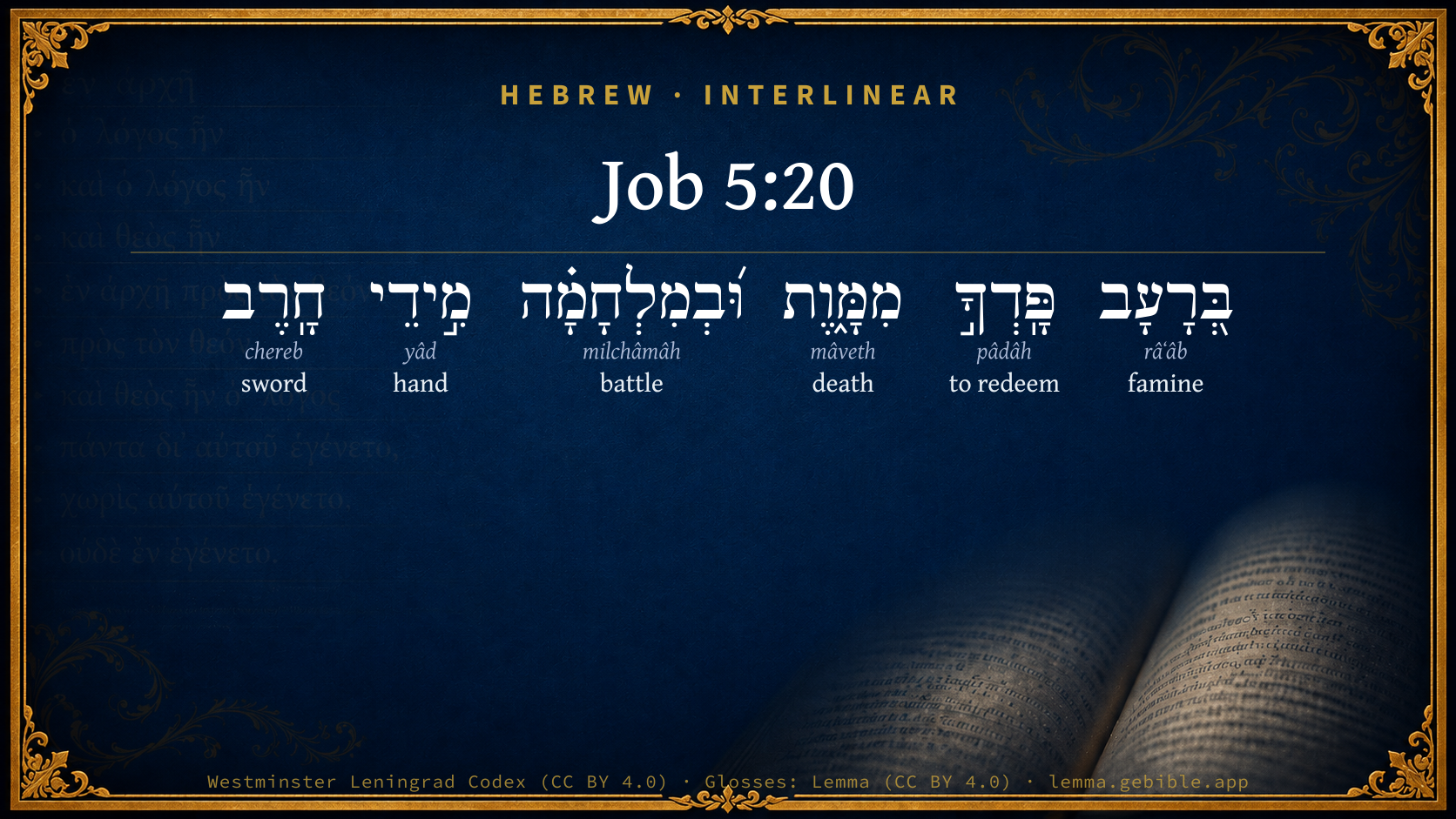
Job 5:20

Hebrew (Westminster Leningrad Codex) Job 5:20 appears in the Hebrew Old Testament. The text above is from the Westminster Leningrad Codex. Each word links to its Strong’s number, a concise gloss, and parsing drawn from the Open Scriptures Hebrew Bible morphology. Click any word for its full Brown-Driver-Briggs (BDB) entry.
Download image
Cite this verse

Job 5:20 (World English Bible). Public Domain. Lemma interlinear Bible study tool, https://lemma.gebible.app/v/job/5/20.

Show BibTeX & RIS
BibTeX
RIS
English Translation
In famine he will redeem you from death; In war, from the power of the sword.
World English Bible · Public Domain
Download a study sheet

One document with this verse’s original text, its word-by-word gloss line, the meaning frame, cross-references with their text, attributed commentary, and full source and license credits — printable, and it pastes into notes with its structure intact.

This verse Autodidact and up

Study sheet (.html) Plain text (.txt)

A passage Seminary Student

Up to 50 verses in one chapter. A passage sheet keeps up to 6 commentary sources and 12 cross-references per verse, in the order this page ranks them, and says so on the sheet whenever that leaves anything out. Ask for a single verse and you get the Autodidact verse sheet above.

Everything on this page stays free to read, with no account — the sheet is a download of what is already on screen, not access to it.

Want to remove ads? Support Godless Engineer
Compare translations 3

The same verse in 3 English versions, stacked beneath the original-language interlinear above. Click any original word for its lexicon entry.

Each is an independent rendering of the whole verse — the interlinear is not word-aligned to these translations.

Highlighted words mark where these versions differ — a whole-verse word diff, not a word-by-word alignment.

  • World English Bible Public Domain
    In famine he will redeem you from death; In war, from the power of the sword.
  • King James Version Public Domain
    In famine he shall redeem thee from death: and in war from the power of the sword.
  • unfoldingWord Literal Text CC BY-SA 4.0
    In famine he will redeem you from death, and in war, from the hands of the sword.

unfoldingWord Literal Text — © unfoldingWord, licensed CC BY-SA 4.0. Word-aligned USFM3 via Door43 (git.door43.org/unfoldingWord/en_ult).

Versions to compare (up to 4)

3 of 4 selected

Show all 18 translations

Every available English version of this verse, each an independent rendering of the whole verse.

  • World English Bible Public Domain
    In famine he will redeem you from death; In war, from the power of the sword.
  • Berean Standard Bible Public Domain
    In famine He will redeem you from death, and in battle from the stroke of the sword.
  • Majority Standard Bible Public Domain
    In famine He will redeem you from death, and in battle from the stroke of the sword.
  • King James Version Public Domain
    In famine he shall redeem thee from death: and in war from the power of the sword.
  • American Standard Version (1901) Public Domain
    In famine he will redeem thee from death; And in war from the power of the sword.
  • Revised Version (1885) Public Domain
    In famine he shall redeem thee from death; and in war from the power of the sword.
  • Geneva Bible (1599) Public Domain
    In famine he shall deliuer thee from death: and in battel from the power of the sworde.
  • Douay-Rheims (1899) Public Domain
    In famine he shall deliver thee from death: and in battle, from the hand of the sword.
  • Young's Literal Translation Public Domain
    In famine He hath redeemed thee from death, And in battle from the hands of the sword.
  • Literal Standard Version CC BY-SA 4.0
    In famine He has redeemed you from death, || And in battle from the hands of the sword.
  • Unlocked Literal Bible CC BY-SA 4.0
    In famine he will ransom you from death, and in war from the hands of the sword.
  • unfoldingWord Literal Text CC BY-SA 4.0
    In famine he will redeem you from death, and in war, from the hands of the sword.
  • Darby Bible Public Domain
    In famine he will redeem thee from death, and in war from the power of the sword.
  • World Messianic Bible Public Domain
    In famine he will redeem you from death; in war, from the power of the sword.
  • Webster's Bible Public Domain
    In famine he will redeem thee from death: and in war from the power of the sword.
  • Free Bible Version CC BY-SA 4.0
    In times of famine he will rescue you from death, and in times of war he will save you from the power of the sword.
  • Bible in Basic English Public Domain
    When there is need of food he will keep you from death, and in war from the power of the sword.
  • JPS Tanakh (1917) Public Domain
    In famine He will redeem thee from death; and in war from the power of the sword.

Literal Standard Version (2020), Covenant Press — licensed CC BY-SA 4.0. Text via the HelloAO Bible API (eBible.org). Unlocked Literal Bible (unfoldingWord) — licensed CC BY-SA 4.0. Text via the HelloAO Bible API (eBible.org). unfoldingWord Literal Text — © unfoldingWord, licensed CC BY-SA 4.0. Word-aligned USFM3 via Door43 (git.door43.org/unfoldingWord/en_ult). Free Bible Version, Dr. Jonathan Gallagher — licensed CC BY-SA 4.0. Text via the HelloAO Bible API (eBible.org).

Word by word

More ways to search: Search by grammar → Find every occurrence → Compare this word →

Practice this passage: Drill this verse → Learn its vocabulary →

About this verse

These counts appear in no published source. They are computed here, from the morphology-tagged text and Lemma’s own curated glosses. What Lemma adds →

6
words
6
distinct lemmas
Wisdom
section

Shared distinctive vocabulary

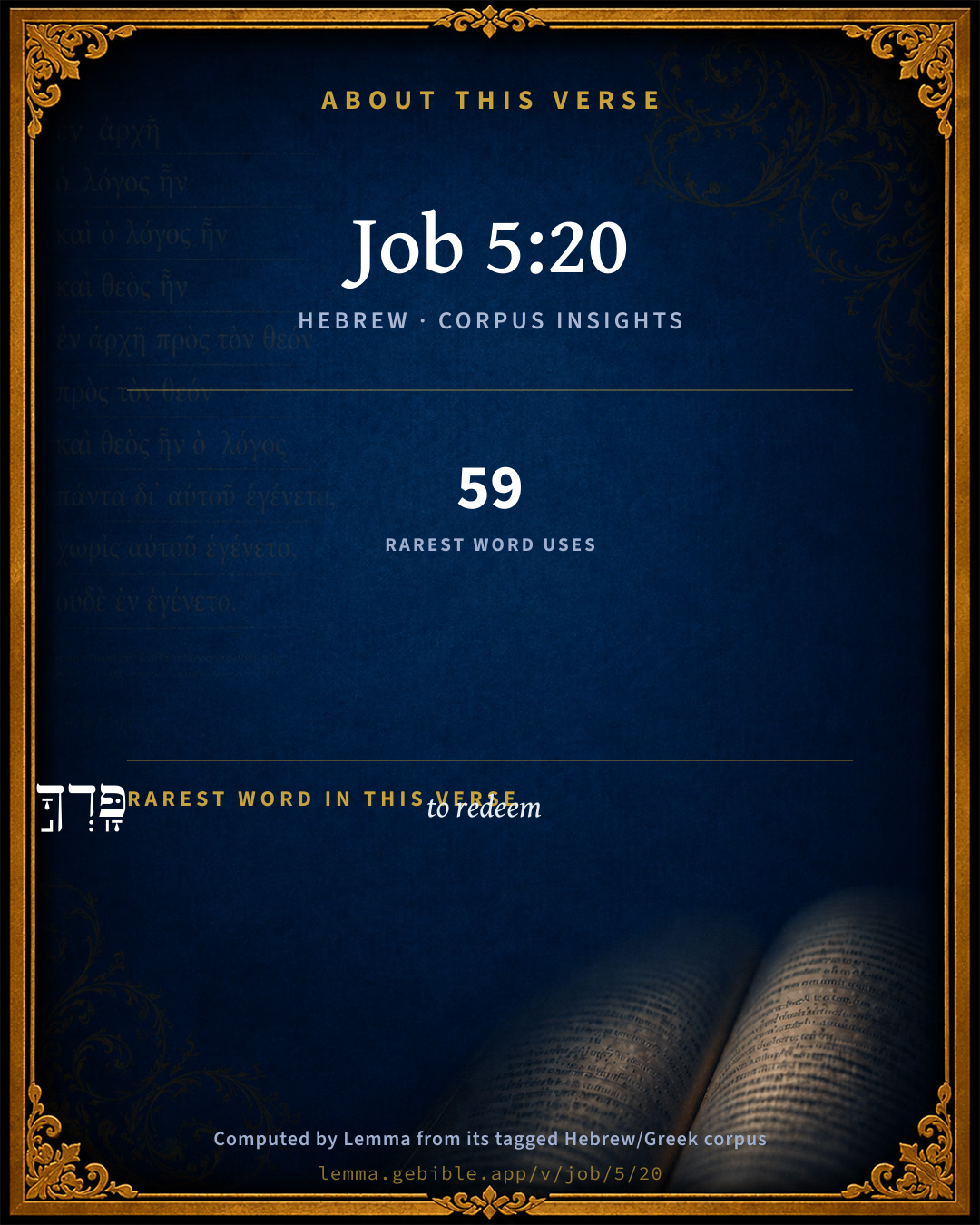
פָּֽדְךָ֣ to redeem H6299 occurs in 48 verses of the Hebrew Bible. Also found in:

Grammatical profile

  • 1 verb
  • 5 nouns

Verb forms

  • פָּֽדְךָ֣ Qal · Perfect

Hebrew & Septuagint length

In English translation the verse runs 16 words from the Hebrew and 21 from the Septuagint (LXX English) — closely comparable.

A rough comparison of the two English renderings, which tokenize alike — not a word-level alignment.

Word counts can differ between the Hebrew and the Greek without any difference in meaning — e.g. the Hebrew direct-object marker אֵת has no separate Greek word, and Greek often adds the article ὁ.

Cross-references

12

Topical passages linked to Job 5:20 in the Treasury of Scripture Knowledge — connected by theme and wording, ordered by reader-vote popularity; previews shown in the World English Bible.

  • Psalms 33:19 To deliver their soul from death, To keep them alive in famine.
  • Hosea 13:14 I will ransom them from the power of Sheol. I will redeem them from death! Death, where are your plagues? Sheol, where is your destruction? Compassion will be hidden from my eyes.
  • Genesis 45:7 God sent me before you to preserve you a remnant in the earth, and to save you alive by a great deliverance.
  • Psalms 37:19 They shall not be disappointed in the time of evil. In the days of famine they shall be satisfied.
  • 1 Kings 17:6 The ravens brought him bread and flesh in the morning, and bread and flesh in the evening; and he drank of the brook.
  • Proverbs 10:3 Yahweh will not allow the soul of the righteous to go hungry, But he thrusts away the desire of the wicked.
  • Habakkuk 3:17 For though the fig tree doesn't flourish, Nor fruit be in the vines; The labor of the olive fails, The fields yield no food; The flocks are cut off from the fold, And there is no herd in the stalls:
  • Psalms 27:3 Though a host should encamp against me, My heart shall not fear. Though war should rise against me, Even then I will be confident.
  • Psalms 144:10 You are he who gives salvation to kings, Who rescues David, his servant, from the deadly sword.
  • Matthew 24:6 You will hear of wars and rumors of wars. See that you aren't troubled, for all this must happen, but the end is not yet.
  • Isaiah 33:16 He shall dwell on high; his place of defense shall be the munitions of rocks; his bread shall be given [him]; his waters shall be sure.
  • Psalms 49:7 None of them can by any means redeem his brother, Nor give God a ransom for him.

Cross-references courtesy of OpenBible.info (CC BY 4.0).

Hebrew and Greek witnesses Masoretic Hebrew ↔ Greek Septuagint

The same verse in the two great witnesses to the Old Testament, shown verse-for-verse.

These are two independent witnesses, not word-aligned to each other, and the Septuagint is shown in lemma (dictionary) form.

Hebrew Job 5:20 Masoretic · Westminster Leningrad Codex

בְּ֭רָעָב פָּֽדְךָ֣ מִמָּ֑וֶת וּ֝בְמִלְחָמָ֗ה מִ֣ידֵי חָֽרֶב

In famine he will redeem you from death; In war, from the power of the sword.

World English Bible · Public Domain

Greek LXX Job 5:20 Septuagint · lemma form

ἐν λιμός ῥύομαι σύ ἐκ θάνατος ἐν πόλεμος δέ ἐκ χείρ σίδηρος λύω σύ

In famine he shall deliver you from death: and in war he shall free you from the power of the sword.

LXX2012 (modern English Septuagint) · Public Domain

Hebrew: Westminster Leningrad Codex (CC BY 4.0). Greek: Septuagint (public domain); English from LXX2012 (modern English Septuagint) (Public Domain). How the Septuagint differs from the Hebrew →

Commentary

Notes on Job 5:20 from classic Christian and Jewish commentators (each source and its license shown beneath its notes). The classic Christian expositions comment on the surrounding passage and are grouped to its opening verse, so a note may address several verses; the Jewish commentaries on the Tanakh (Rashi and others) are per-verse, so they appear only where the commentator wrote on this verse.

Lemma curates 59 commentaries, every one of them public domain or Creative Commons licensed, each selected and text-cleaned for this edition rather than reprinted as found. About our sources →

Trapp's Complete Commentary

John Trapp

Job 5:20 In famine he shall redeem thee from death: and in war from the power of the sword.

Ver. 20. In famine he shall redeem thee from death] They that be slain with the sword are better than they that be slain with hunger, Lam 4:9. Famine, therefore, is here set as the first and greatest of the six ensuing evils, the forest of God’s judgments, Eze 6:11 Jer 24:10; the certain harbinger of death, as here. From this so great a death God delivered Abraham, Gen 12:12-20; Isaac, Gen 26:6-12; Jacob and his family, Gen 47:11-12; the poor widow, 1Ki 17:9-16; the Israelites in the wilderness by quails; the Rochellers by a miraculous shoal of shellfish, cast up into their town in a strait siege, &c. There is a promise that the lions shall lack and suffer hunger, but so shall not any such as seek the Lord, Psa 34:10. There shall be special provision made for such, and God shall redeem them from this evil by a wonderful separation, as he did in another case, Exo 8:22 : either he will send them in meat or take away their stomachs, as she once said. Fides famem non formidat, Faith feareth no famine; having trusted God for a crown, she will not distrust him for a crust.

And in war from the power of the sword] Here is the saints’ safety, or their writ of protection. True it is, that the sword devoureth one as well as another, 2Sa 11:25, and pale death cutteth its way oftentimes through a wood of men, out of the mouth of a murdering piece, without distinction. But though the saints, with Josiah, be slain in battle, yet they die in peace, 2Ki 23:29, with Job 22:20, for their eyes see not the evil that God bringeth upon others that outlive them, as it followeth there. Besides, they are gathered to their fathers, who enjoyed peace. Redeemed they are from the power or hands of the sword, which may kill them, but cannot hurt them; take away their head, but not their crown, αποκτειναι δυναται, βχαφαι δε ου.

John Trapp, A Commentary or Exposition upon All the Books of the Old and New Testament (1647–1656) — public domain. Text from a community e-Sword module.

Joseph Benson's Commentary

Job 5:20. In famine he shall redeem thee from death — From that terrible kind of death. Eliphaz might think that Job feared perishing by want, as being so poor, that he needed the contributions of his friends for his relief. And in war from the sword — These things he utters with more confidence, because the rewards or punishments of this life were more constantly distributed to men in the Old Testament, according to their good or bad behaviour, than they are now: and, because it was his opinion, that great afflictions were the certain evidences of wickedness; and, consequently, that great deliverances would infallibly follow upon true repentance.

Joseph Benson's Commentary on the Old and New Testaments (1811–1818) — public domain. Text from a community e-Sword module.

Jamieson, Fausset & Brown

Robert Jamieson, A. R. Fausset & David Brown

power-- (Jer 5:12). Hebrew, "hands."

of the sword-- (Eze 35:5, Margin). Hands are given to the sword personified as a living agent.

Jamieson, Fausset & Brown — Commentary Critical and Explanatory on the Whole Bible (1871) — public domain (CC PDM 1.0). Text via the HelloAO Bible API.

Adam Clarke's Commentary

Verse 20. In famine he shall redeem thee] The Chaldee, which understands this chapter as speaking of the troubles and deliverances of the Israelites in Egypt and the wilderness, renders this verse as follows: "In the famine of Egypt he redeemed thee from death; and in the war of Amalek, from the slaying of the sword."

Adam Clarke's Commentary on the Bible (1810–1826) — public domain. Text from a community e-Sword/MySword module.

Ellicott's Commentary for English Readers

(20) He shall redeem thee.—It is rather, he hath redeemed thee, as though the speaker could appeal to Job’s own experience in the matter which itself became a ground of confident hope for the future.

A Bible Commentary for English Readers, edited by Charles John Ellicott (1878–1897) — public domain. Text from a community e-Sword module.

John Gill's Exposition

In famine he shall redeem thee from death,.... In a time of extreme want of provisions, God so cares for his own dear people, that they shall not be starved to death by the famine; so in the famine in Egypt, which the Targum takes notice of, in the times of Abraham, and of Isaac, and of Jacob, and the patriarchs, there was food provided for them, so that they and their families were sustained, and perished not for lack of the necessaries of life: God sometimes goes out of his ordinary way, and works wonders for his poor and needy in distress, when they cry unto him; see Isa 41:17,

and in war from the power of the sword; or, "from the hands of the sword" (f): from swords in hand, when drawn, and men are ready to push with them with all their force; as he delivered and preserved Abraham from the sword of the four kings, when he waged war with them, Gen 14:20; and the Israelites, in the war of Amalek, in the times of Moses, Exo 17:8, which the Targum here refers to; and David from the harmful sword of Goliath, Sa1 17:46, and others with whom he was concerned in war: and so the Lord covers the heads of his people in the day of battle oftentimes, when multitudes fall on their right hand and on their left.

(f) "de manu gladii", V. L. "e manibus gladii", Pagninus & Montanus, &c.

John Gill's Exposition of the Whole Bible (1746–1763) — public domain (CC PDM 1.0). Text via the HelloAO Bible API.

Albert Barnes' Notes on the Bible

In famine he shall redeem thee - That is, will deliver thee from death. On the meaning of the word “redeem,” see the notes at Isa 43:1, Isa 43:3.

From the power of the sword - Margin, as in Hebrew “hands.” That is, he should not be slain by armed men. A mouth is often attributed to the sword in the Scriptures, because it devours; “hands” are attributed to it here, because it is by the hand that we perform an undertaking, and the sword is personified, and represented as acting as a conscious agent; compare Eze 35:5, margin. The meaning is that God would protect those who put their trust in him, in times of calamity and war. Doubtless Eliphaz had seen instances enough of this kind to lead him to this general conclusion, where the pious poor had been protected in a remarkable manner, and where signal deliverances had been vouchsafed to the righteous in danger.

Albert Barnes' Notes on the Bible (1834–1885) — public domain. Text from a community e-Sword/MySword module.

Matthew Poole's English Annotations

In famine; which Job might be thought to fear, as being so poor that he needed his friends’ contributions for his relief.

From death; from that terrible kind of death.

These things he utters with more confidence, partly because the rewards or punishments of this life were more constantly distributed to men in the Old Testament according to their good or bad behaviour than now they are; and partly because it was his particular opinion, that great afflictions were the constant fruits and certain evidences of a man’s wickedness; and consequently, that great mercies and deliverances should infallibly follow upon true repentance and godliness.

Matthew Poole's English Annotations on the Holy Bible (1683–1685) — public domain. Text from a community e-Sword/MySword module.

Whedon's Commentary on the Bible

Daniel D. Whedon

20. The power of the sword — Literally, The hands of the sword. The Scriptures attribute hands to other destructive agencies: to the tongue, Pro_18:21; to the flame, Isa_47:14; to lions, Dan_6:27; and to the grave, Psa_49:15; as if, poetically, their destructive power could be accounted for only by their being endowed with man’s most formidable members of destruction.

Daniel D. Whedon (gen. ed.), Commentary on the Old and New Testaments (1874–1909) — public domain. Text from a community e-Sword module.

The Pulpit Commentary

In famine he shall redeem thee from death. Famine appears throughout the whole of Scripture as one of God"s severest chastisements. (Lev_26:19, 20 Deu_28:22-24 2Sa_21:1 2Sa_24:13 2Ki_8:1 Psa_105:16 Isa_14:30 Jer_24:10 Rev_18:8) Ezekiel speaks of "the sword, the famine"the noisome beast, and the pestilence," as God"s "four sore judgments". (Eze_14:21) Miraculous deliverances from famine are related in Gen_41:29-36 1Ki_17:10-16 2Ki_7:1-16. And in war from the power of the sword. In war God protects whom he will, and they seem to have charmed lives. They are covered with his feathers, and safe under his wings. (Psa_91:4)

The Pulpit Commentary (1880–1919), ed. H.D.M. Spence-Jones & Joseph S. Exell — public domain. Text from a community e-Sword module.

John Wesley's Explanatory Notes

He shall - These things he utters with more confidence, because the rewards or punishments of this life, were more constantly distributed to men in the Old Testament according to their good or bad behaviour, than they are now: and because it was his opinion, that great afflictions were the certain evidences of wickedness; and consequently, that great deliverances would infallibly follow upon true repentance.

John Wesley, Explanatory Notes Upon the Whole Bible (1754–1765) — public domain. Text via the GEBible commentary corpus.

Scofield Reference Notes

C. I. Scofield

redeem (See Scofield "Exo 14:30"), See Scofield "Isa 59:20".

The Scofield Reference Bible (1917 edition), notes by C. I. Scofield — public domain. Text from a community e-Sword module.

unfoldingWord translationNotes

Door43 World Missions Community

General Information:

The shift in pronoun from "he" to "you" which began in Job 5:19 continues through the end of Eliphaz's speech in Job 5:27.

In famine he will ransom you

Here rescuing is spoken of as if it were ransoming, buying back. AT: "In famine God will rescue you from danger" (See: Metaphor)

the hands of the sword

Here "hands" probably represents the people who attack with weapons, including swords. AT: "violent people" or "people who attack you" (See: Synecdoche)

of destruction

Here "destruction" refers to the danger of being destroyed by enemies. AT: "that any enemy will destroy you" (See: Abstract Nouns)

You will laugh at destruction and famine

Here "laugh" represents that the person is not afraid. AT: "You will not be afraid of any danger of destruction or famine" (See: Symbolic Language)

beasts of the earth

This refers to wild animals. AT: "wild animals" (See: Metaphor)

translationWords

famine

die

sword

tongue

fear

famine

unfoldingWord translationNotes — © Distant Shores Media and the Door43 World Missions Community, licensed CC BY-SA 4.0. Source: git.door43.org/Door43/en_tn.

Lesson kit

Teaching starters — assembled from the data on this page, not authored interpretation. Every prompt links to the verse data it draws on. Edit before teaching.

Job, in the Wisdom, opens this verse with 6 words (6 distinct Hebrew lemmas). Its most distinctive word is pâdâh (“to redeem”). A historical commentator’s framing appears above. Read the whole chapter for the surrounding context.

Discussion questions

  1. The word pâdâh carries the sense “to redeem.” How does it shape the verse?
  2. Exodus 13:13 shares the word «to redeem» with this verse. How do the two illuminate each other?
  3. The translations on this page render this verse differently — a whole-verse word diff, not a word-by-word alignment. What might account for the different wordings?
  4. The verb «פָּֽדְךָ֣» is Qal Perfect. How does its form color the action?
  5. Reading how Trapp's Complete Commentary and Joseph Benson's Commentary read this verse, where do the two commentators agree and where do they part?

Things to notice

Reading settings

Reading text

Shown beneath each verse's original-language words.

Old Testament
Old Testament edition

Read the OT as the Masoretic Hebrew (MT) or the Greek Septuagint (LXX).

English shown for the Greek Septuagint (in the Hebrew ↔ Greek comparison).

Comparing translations? Open the Compare panel on any verse page to stack up to four side by side.