
Isaiah 65:12

Hebrew (Westminster Leningrad Codex) Isaiah 65:12 appears in the Hebrew Old Testament. The text above is from the Westminster Leningrad Codex. Each word links to its Strong’s number, a concise gloss, and parsing drawn from the Open Scriptures Hebrew Bible morphology. Click any word for its full Brown-Driver-Briggs (BDB) entry.
Download image
Cite this verse

Isaiah 65:12 (World English Bible). Public Domain. Lemma interlinear Bible study tool, https://lemma.gebible.app/v/isaiah/65/12.

Show BibTeX & RIS
BibTeX
RIS
English Translation
I will destine you to the sword, and you shall all bow down to the slaughter; because when I called, you did not answer; when I spoke, you did not hear; but you did that which was evil in my eyes, and chose that in which I didn't delight.
World English Bible · Public Domain
Download a study sheet

One document with this verse’s original text, its word-by-word gloss line, the meaning frame, cross-references with their text, attributed commentary, and full source and license credits — printable, and it pastes into notes with its structure intact.

This verse Autodidact and up

Study sheet (.html) Plain text (.txt)

A passage Seminary Student

Up to 50 verses in one chapter. A passage sheet keeps up to 6 commentary sources and 12 cross-references per verse, in the order this page ranks them, and says so on the sheet whenever that leaves anything out. Ask for a single verse and you get the Autodidact verse sheet above.

Everything on this page stays free to read, with no account — the sheet is a download of what is already on screen, not access to it.

Want to remove ads? Support Godless Engineer
Compare translations 3

The same verse in 3 English versions, stacked beneath the original-language interlinear above. Click any original word for its lexicon entry.

Each is an independent rendering of the whole verse — the interlinear is not word-aligned to these translations.

Highlighted words mark where these versions differ — a whole-verse word diff, not a word-by-word alignment.

  • World English Bible Public Domain
    I will destine you to the sword, and you shall all bow down to the slaughter; because when I called, you did not answer; when I spoke, you did not hear; but you did that which was evil in my eyes, and chose that in which I didn't delight.
  • King James Version Public Domain
    Therefore will I number you to the sword, and ye shall all bow down to the slaughter: because when I called, ye did not answer; when I spake, ye did not hear; but did evil before mine eyes, and did choose that wherein I delighted not.
  • unfoldingWord Literal Text CC BY-SA 4.0
    indeed, I will appoint you for the sword, and all of you will bow down to the slaughter, because I called, but you did not answer; I spoke, but you did not listen. And you did evil in my eyes, and in what I do not delight, you chose.” q1

unfoldingWord Literal Text — © unfoldingWord, licensed CC BY-SA 4.0. Word-aligned USFM3 via Door43 (git.door43.org/unfoldingWord/en_ult).

Versions to compare (up to 4)

3 of 4 selected

Show all 18 translations

Every available English version of this verse, each an independent rendering of the whole verse.

  • World English Bible Public Domain
    I will destine you to the sword, and you shall all bow down to the slaughter; because when I called, you did not answer; when I spoke, you did not hear; but you did that which was evil in my eyes, and chose that in which I didn't delight.
  • Berean Standard Bible Public Domain
    I will destine you for the sword, and you will all kneel down to be slaughtered, because I called and you did not answer, I spoke and you did not listen; you did evil in My sight and chose that in which I did not delight.”
  • Majority Standard Bible Public Domain
    I will destine you for the sword, and you will all kneel down to be slaughtered, because I called and you did not answer, I spoke and you did not listen; you did evil in My sight and chose that in which I did not delight.”
  • King James Version Public Domain
    Therefore will I number you to the sword, and ye shall all bow down to the slaughter: because when I called, ye did not answer; when I spake, ye did not hear; but did evil before mine eyes, and did choose that wherein I delighted not.
  • American Standard Version (1901) Public Domain
    I will destine you to the sword, and ye shall all bow down to the slaughter; because when I called, ye did not answer; when I spake, ye did not hear; but ye did that which was evil in mine eyes, and chose that wherein I delighted not.
  • Revised Version (1885) Public Domain
    I will destine you to the sword, and ye shall all bow down to the slaughter: because when I called, ye did not answer; when I spake, ye did not hear; but ye did that which was evil in mine eyes, and chose that wherein I delighted not.
  • Geneva Bible (1599) Public Domain
    Therefore wil I number you to the sword, and all you shall bowe downe to the slaughter, because I called, and ye did not answere: I spake, and ye heard not, but did euil in my sight, and did chuse that thing which I would not.
  • Douay-Rheims (1899) Public Domain
    I will number you in the sword, and you shall all fall by slaughter: because I called and you did not answer: I spoke, and you did not hear: and you did evil in my eyes, and you have chosen the things that displease me.
  • Young's Literal Translation Public Domain
    And I have numbered you for the sword, And all of you for slaughter bow down, Because I called, and ye have not answered, I have spoken, and ye have not hearkened, And ye do the evil thing in Mine eyes, And on that which I desired not -- fixed.
  • Literal Standard Version CC BY-SA 4.0
    And I have numbered you for the sword, || And all of you bow down for slaughter, || Because I called, and you have not answered, || I have spoken, and you have not listened, || And you do evil in My eyes, || And on that which I did not desire—fixed.”
  • Unlocked Literal Bible CC BY-SA 4.0
    I will appoint you for the sword, and you will all bow down to the slaughter, because when I called, you did not answer; when I spoke, you did not listen. But you did what was evil in my sight and and chose to do what displeases me.”
  • unfoldingWord Literal Text CC BY-SA 4.0
    indeed, I will appoint you for the sword, and all of you will bow down to the slaughter, because I called, but you did not answer; I spoke, but you did not listen. And you did evil in my eyes, and in what I do not delight, you chose.” q1
  • Darby Bible Public Domain
    I will even assign you to the sword, and ye shall all bow down in the slaughter; because I called, and ye did not answer, I spoke, and ye did not hear; but ye did what was evil in mine eyes, and chose that wherein I delight not.
  • World Messianic Bible Public Domain
    I will destine you to the sword, and you will all bow down to the slaughter; because when I called, you didn’t answer. When I spoke, you didn’t listen; but you did that which was evil in my eyes, and chose that in which I didn’t delight.”
  • Webster's Bible Public Domain
    Therefore will I number you to the sword, and ye shall all bow down to the slaughter: because when I called, ye did not answer; when I spoke, ye did not hear; but did evil before my eyes, and did choose that in which I delighted not.
  • Free Bible Version CC BY-SA 4.0
    I will make sure your destiny is to be killed by the sword. All of you will bow down to be slaughtered, because I called out to you but you didn't answer; I spoke to you, but you didn't listen. Instead you did what's evil in my sight, choosing to do what I hate.
  • Bible in Basic English Public Domain
    Your fate will be the sword, and you will all go down to death: because when my voice came to you, you made no answer; you did not give ear to my word; but you did what was evil in my eyes, desiring what was not pleasing to me.
  • JPS Tanakh (1917) Public Domain
    I will destine you to the sword, and ye shall all bow down to the slaughter; because when I called, ye did not answer, when I spoke, ye did not hear; but ye did that which was evil in Mine eyes, and chose that wherein I delighted not.

Literal Standard Version (2020), Covenant Press — licensed CC BY-SA 4.0. Text via the HelloAO Bible API (eBible.org). Unlocked Literal Bible (unfoldingWord) — licensed CC BY-SA 4.0. Text via the HelloAO Bible API (eBible.org). unfoldingWord Literal Text — © unfoldingWord, licensed CC BY-SA 4.0. Word-aligned USFM3 via Door43 (git.door43.org/unfoldingWord/en_ult). Free Bible Version, Dr. Jonathan Gallagher — licensed CC BY-SA 4.0. Text via the HelloAO Bible API (eBible.org).

Word by word

More ways to search: Search by grammar → Find every occurrence → Compare this word →

Practice this passage: Drill this verse → Learn its vocabulary →

לַטֶּ֣בַח
ṭebach
H2874
“to/for the · slaughter”
Preposition, Determined + Noun, Common, Masculine, Singular, Absolute
Part of Speech
Preposition + Noun
Type
Common
Gender
Masculine
Number
Singular
State
Absolute
Full BDB Definition

Origin: from H2873

TWOT: 786a

slaughter, slaughtering, animal - slaughtering, slaughter (of animals) - slaughter (figuratively)
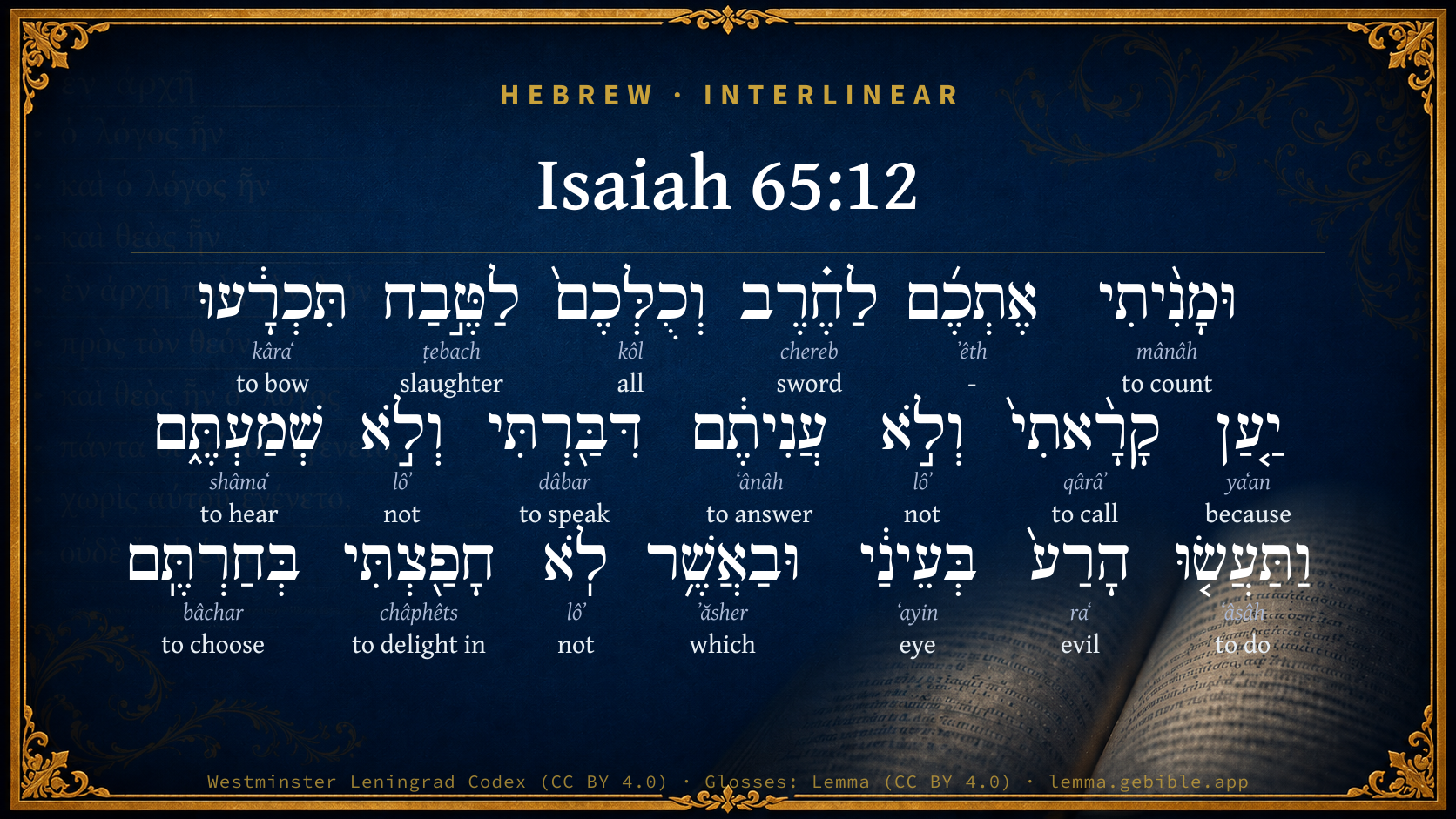
  1. וּמָנִ֨יתִי mânâh H4487 “and · to count” Conjunction + Verb, Qal, Perfect, 1st Person, Common, Singular
  2. אֶתְכֶ֜ם ʼêth H853 “- · you” Particle, Direct Object + Suffix, Personal, 2nd Person, Masculine, Plural
  3. לַחֶ֗רֶב chereb H2719 “to/for the · sword” Preposition, Determined + Noun, Common, Feminine, Singular, Absolute
  4. וְכֻלְּכֶם֙ kôl H3605 “and · all · your” Conjunction + Noun, Common, Masculine, Singular, Construct + Suffix, Personal, 2nd Person, Masculine, Plural
  5. תִּכְרָ֔עוּ kâraʻ H3766 “to bow” Verb, Qal, Imperfect, 2nd Person, Masculine, Plural
  6. יַ֤עַן yaʻan H3282 “because” Conjunction
  7. קָרָ֨אתִי֙ qârâʼ H7121 “to call” Verb, Qal, Perfect, 1st Person, Common, Singular
  8. וְלֹ֣א lôʼ H3808 “and · not” Conjunction + Particle, Negative
  9. עֲנִיתֶ֔ם ʻânâh H6030 “to answer” Verb, Qal, Perfect, 2nd Person, Masculine, Plural
  10. דִּבַּ֖רְתִּי dâbar H1696 “to speak” Verb, Piel, Perfect, 1st Person, Common, Singular
  11. וְלֹ֣א lôʼ H3808 “and · not” Conjunction + Particle, Negative
  12. שְׁמַעְתֶּ֑ם shâmaʻ H8085 “to hear” Verb, Qal, Perfect, 2nd Person, Masculine, Plural
  13. וַתַּעֲשׂ֤וּ ʻâsâh H6213 “and · to do” Conjunction + Verb, Qal, Sequential Imperfect, 2nd Person, Masculine, Plural
  14. הָרַע֙ raʻ H7451 “the · evil” Particle, Definite Article + Adjective, Adjective, Masculine, Singular, Absolute
  15. בְּעֵינַ֔י ʻayin H5869 “in/at · eyes · my” Preposition + Noun, Common, Both, Dual, Construct + Suffix, Personal, 1st Person, Common, Singular
  16. וּבַאֲשֶׁ֥ר ʼăsher H834 “and · in/at · which” Conjunction + Preposition + Particle, Relative
  17. לֹֽא lôʼ H3808 “not” Particle, Negative
  18. חָפַ֖צְתִּי châphêts H2654 “to delight in” Verb, Qal, Perfect, 1st Person, Common, Singular
  19. בְּחַרְתֶּֽם bâchar H977 “to choose” Verb, Qal, Perfect, 2nd Person, Masculine, Plural

About this verse

These counts appear in no published source. They are computed here, from the morphology-tagged text and Lemma’s own curated glosses. What Lemma adds →

20
words
18
distinct lemmas
Prophets
section

Notable vocabulary

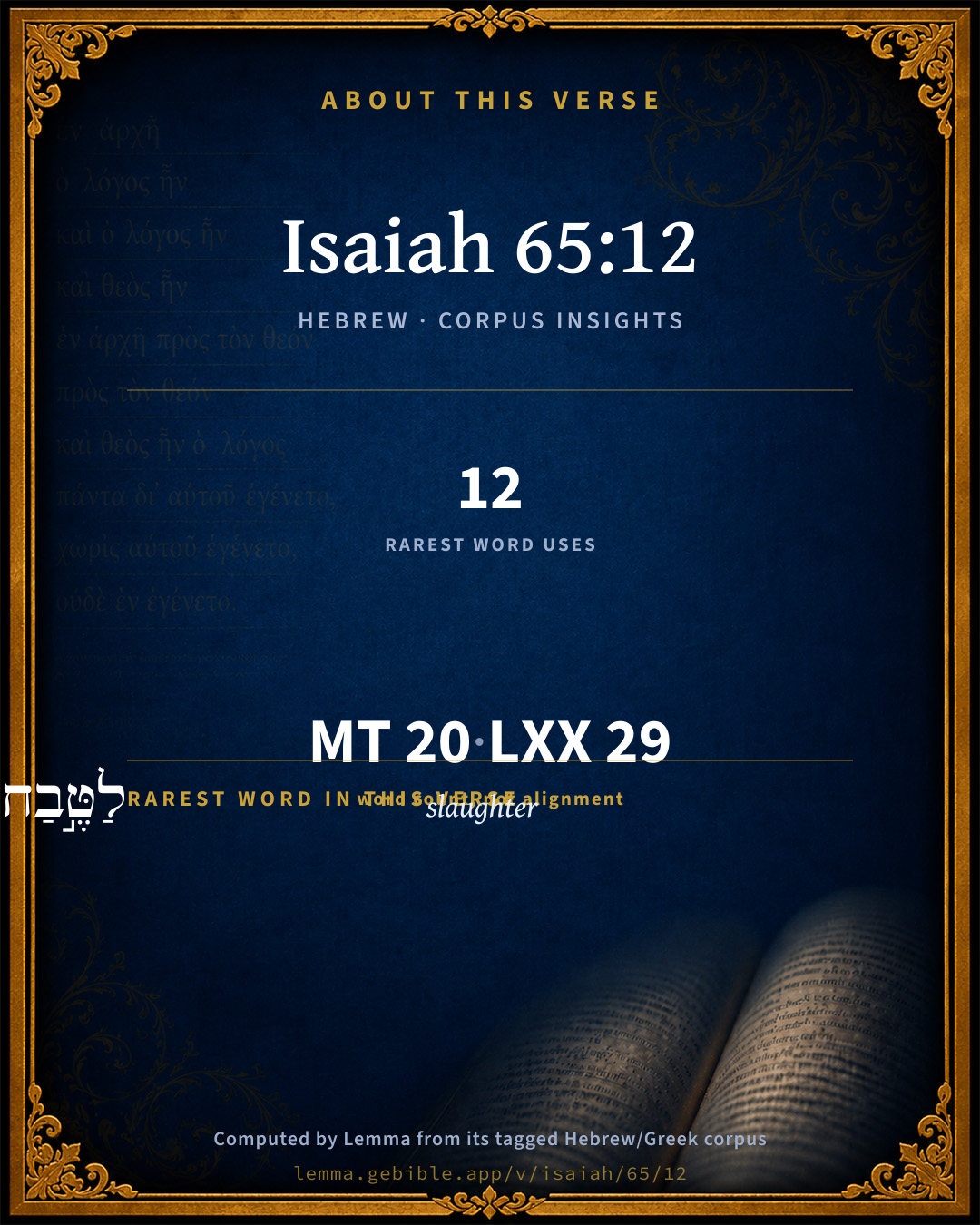
The rarest word here is לַטֶּ֣בַח slaughter H2874 — appearing just 12 times in the whole Hebrew Bible.

Shared distinctive vocabulary

לַטֶּ֣בַח slaughter H2874 occurs in 12 verses of the Hebrew Bible. Also found in:

Grammatical profile

  • 9 verbs
  • 4 nouns
  • 1 adjective
  • 1 conjunction
  • 5 particles

Verb forms

  • וּמָנִ֨יתִי Qal · Perfect
  • תִּכְרָ֔עוּ Qal · Imperfect
  • קָרָ֨אתִי֙ Qal · Perfect
  • עֲנִיתֶ֔ם Qal · Perfect
  • דִּבַּ֖רְתִּי Piel · Perfect
  • שְׁמַעְתֶּ֑ם Qal · Perfect
  • וַתַּעֲשׂ֤וּ Qal · Sequential Imperfect
  • חָפַ֖צְתִּי Qal · Perfect
  • בְּחַרְתֶּֽם Qal · Perfect

Repetition

A word recurs within this verse — often emphatic in Hebrew:

  • וְלֹ֣א not H3808 ×3

Hebrew & Septuagint length

In English translation the verse runs 49 words from the Hebrew and 44 from the Septuagint (LXX English) — closely comparable.

A rough comparison of the two English renderings, which tokenize alike — not a word-level alignment.

Word counts can differ between the Hebrew and the Greek without any difference in meaning — e.g. the Hebrew direct-object marker אֵת has no separate Greek word, and Greek often adds the article ὁ.

In the original languages it is 20 Hebrew tokens and 29 Greek tokens — but the two are counted differently (Hebrew bundles its prefixes and suffixes into one token; the Greek is in lemma form), so that isn’t a like-for-like length.

Cross-references

24

Topical passages linked to Isaiah 65:12 in the Treasury of Scripture Knowledge — connected by theme and wording, ordered by reader-vote popularity; previews shown in the World English Bible.

  • Jeremiah 7:13 Now, because you have done all these works, says Yahweh, and I spoke to you, rising up early and speaking, but you didn't hear; and I called you, but you didn't answer:
  • 2 Chronicles 36:15–16 Yahweh, the God of their fathers, sent to them by his messengers, rising up early and sending, because he had compassion on his people, and on his dwelling-place:
  • Isaiah 50:2 Why, when I came, was there no man? when I called, was there none to answer? Is my hand shortened at all, that it can't redeem? or have I no power to deliver? Behold, at my rebuke I dry up the sea, I make the rivers a wilderness: their fish stink, because there is no water, and die for thirst.
  • Zechariah 7:11–13 But they refused to listen, and turned their backs, and stopped their ears, that they might not hear.
  • Matthew 21:34–43 When the season for the fruit drew near, he sent his servants to the farmers, to receive his fruit.
  • Leviticus 26:25 I will bring a sword upon you, that will execute the vengeance of the covenant; and you will be gathered together within your cities: and I will send the pestilence among you; and you will be delivered into the hand of the enemy.
  • Deuteronomy 32:25 Outside shall the sword bereave, In the chambers terror; [It shall destroy] both young man and virgin, The suckling with the man of gray hairs.
  • Proverbs 1:24–33 Because I have called, and you have refused; I have stretched out my hand, and no one has paid attention;
  • Isaiah 1:16 Wash yourselves, make yourself clean. Put away the evil of your doings from before my eyes; Cease to do evil.
  • Isaiah 3:25 Your men shall fall by the sword, And your mighty in the war.
  • Isaiah 10:4 They shall only bow down under the prisoners, and shall fall under the slain. For all this his anger is not turned away, but his hand is stretched out still.
  • Isaiah 27:1 In that day Yahweh with his hard and great and strong sword will punish leviathan the swift serpent, and leviathan the crooked serpent; and he will kill the monster that is in the sea.
  • Isaiah 41:28 When I look, there is no man: even among them there is no counselor who, when I ask of them, can answer a word.
  • Isaiah 65:3 a people who provoke me to my face continually, sacrificing in gardens, and burning incense on bricks;
  • Isaiah 66:3–4 He who kills an ox is as he who kills a man; he who sacrifices a lamb, as he who breaks a dog's neck; he who offers an offering, [as he who offers] pig's blood; he who burns frankincense, as he who blesses an idol. Yes, they have chosen their own ways, and their soul delights in their abominations:
  • Jeremiah 16:17 For my eyes are on all their ways; they are not hidden from my face, neither is their iniquity concealed from my eyes.
  • Jeremiah 18:21 Therefore deliver up their children to the famine, and give them over to the power of the sword; and let their wives become childless, and widows; and let their men be slain of death, [and] their young men struck of the sword in battle.
  • Jeremiah 34:17 Therefore thus says Yahweh: you have not listened to me, to proclaim liberty, every man to his brother, and every man to his neighbor: behold, I proclaim to you a liberty, says Yahweh, to the sword, to the pestilence, and to the famine; and I will make you to be tossed back and forth among all the kingdoms of the earth.
  • Ezekiel 14:17–21 Or if I bring a sword on that land, and say, Sword, go through the land; so that I cut off from it man and animal;
  • Zephaniah 1:4–6 I will stretch out my hand against Judah, and against all the inhabitants of Jerusalem. I will cut off the remnant of Baal from this place: the name of the idolatrous and pagan priests,
  • Zechariah 7:7 Aren't these the words which Yahweh proclaimed by the former prophets, when Jerusalem was inhabited and in prosperity, and its cities around her, and the South and the lowland were inhabited?'"
  • Matthew 22:3 and sent out his servants to call those who were invited to the marriage feast, but they would not come.
  • Matthew 22:7 When the king heard that, he was angry, and he sent his armies, destroyed those murderers, and burned their city.
  • John 1:11 He came to his own, and those who were his own didn't receive him.

Cross-references courtesy of OpenBible.info (CC BY 4.0).

Hebrew and Greek witnesses Masoretic Hebrew ↔ Greek Septuagint

The same verse in the two great witnesses to the Old Testament, shown verse-for-verse.

These are two independent witnesses, not word-aligned to each other, and the Septuagint is shown in lemma (dictionary) form.

Hebrew Isaiah 65:12 Masoretic · Westminster Leningrad Codex

וּמָנִ֨יתִי אֶתְכֶ֜ם לַחֶ֗רֶב וְכֻלְּכֶם֙ לַטֶּ֣בַח תִּכְרָ֔עוּ יַ֤עַן קָרָ֨אתִי֙ וְלֹ֣א עֲנִיתֶ֔ם דִּבַּ֖רְתִּי וְלֹ֣א שְׁמַעְתֶּ֑ם וַתַּעֲשׂ֤וּ הָרַע֙ בְּעֵינַ֔י וּבַאֲשֶׁ֥ר לֹֽא חָפַ֖צְתִּי בְּחַרְתֶּֽם

I will destine you to the sword, and you shall all bow down to the slaughter; because when I called, you did not answer; when I spoke, you did not hear; but you did that which was evil in my eyes, and chose that in which I didn't delight.

World English Bible · Public Domain

Greek LXX Isaiah 65:12 Septuagint · lemma form

ἐγώ παραδίδωμι σύ εἰς μάχαιρα πᾶς ἐν σφαγή πίπτω ὅτι καλέω σύ καί οὐ ὑποἀκούω λαλέω καί παραἀκούω καί ποιέω ὁ πονηρός ἐναντίον ἐγώ καί ὅς οὐ βούλομαι ἐκλέγω

I will deliver you up to the sword, you⌃ shall all fall by slaughter: for I called you, and you⌃ listened not; I spoke, and you⌃ refused to hear; and you⌃ did evil in my sight, and chose the things wherein I delighted not.

LXX2012 (modern English Septuagint) · Public Domain

Hebrew: Westminster Leningrad Codex (CC BY 4.0). Greek: Septuagint (public domain); English from LXX2012 (modern English Septuagint) (Public Domain). How the Septuagint differs from the Hebrew →

Targum (Aramaic paraphrase)

1

The Targum is the ancient Jewish Aramaic paraphrase of the Hebrew Scriptures — an interpretive translation, not the Hebrew text itself. Onkelos (literal) and Pseudo-Jonathan (expansive) render the Torah, and Jonathan the Prophets. Coverage is partial: where no permissively-licensed English translation exists for a verse, only the Aramaic is shown. This is verse-level text, not a word-by-word alignment to the Hebrew.

  1. Targum Jonathan Prophets (Joshua–Malachi)
    וְאֶמְסַר יַתְכוֹן לְחַרְבָּא וְכוּלְכוֹן לְקַטָלָא תִתְמַסְרוּן חֲלַף דִשְׁלָחֵית נְבִיֵי וְלָא תַבְתּוּן אִתְנַבִּיאוּ וְלָא קַבֵּילְתּוּן וַעֲבַדְתּוּן דְבִישׁ קֳדָמַי וּבִדְלָא צְבִינָא אִתְרְעֵיתוּן:

    Therefore will I deliver them to the sword, yea, all of you shall be delivered to the slaughter; because I sent my prophets, and ye repented' not; they prophesied, and ye did not receive them; but did evil before me, and delighted yourselves in that I would not.

    Targum Jonathan — Aramaic: “Mikraot Gedolot” (public domain). English: “Sefaria Community Translation” (CC0 1.0 (public-domain dedication)); “London "Chaldee Paraphrase," 1871” (public domain). Text via Sefaria.

Commentary

Notes on Isaiah 65:12 from classic Christian and Jewish commentators (each source and its license shown beneath its notes). The classic Christian expositions comment on the surrounding passage and are grouped to its opening verse, so a note may address several verses; the Jewish commentaries on the Tanakh (Rashi and others) are per-verse, so they appear only where the commentator wrote on this verse.

Lemma curates 59 commentaries, every one of them public domain or Creative Commons licensed, each selected and text-cleaned for this edition rather than reprinted as found. About our sources →

Trapp's Complete Commentary

John Trapp

Isa 65:12 Therefore will I number you to the sword, and ye shall all bow down to the slaughter: because when I called, ye did not answer; when I spake, ye did not hear; but did evil before mine eyes, and did choose [that] wherein I delighted not.

Ver. 12. Therefore I will number you to the sword.] Est elegans paronomasia: I will give you up to the sword by number and tale, to the end that none of you may escape. God usually retaliateth, and proportioneth number to number. So, choice to choice; {Isa 66:3-4} jealousy to jealousy, provocation to provocation; {Deu 32:21} device to device; {Mic 2:1; Mic 2:3} frowardness to frowardness. {Psa 18:26}

And ye shall all bow down to the slaughter.] As you used to bow down to your idols.

Because when I called, ye did not answer.] See on Pro 1:24.

But did evil before mine eyes.] Did evil things as you could; {Jer 3:5} with both hands earnestly. {Mic 7:3}

John Trapp, A Commentary or Exposition upon All the Books of the Old and New Testament (1647–1656) — public domain. Text from a community e-Sword module.

The Biblical Illustrator

Joseph S. Exell

Isa_65:12-14

Therefore will I number you to the sword.

-

The declaration of God against the disobedience of Israel

I. THE ACCUSATION. A guilty inattention to the voice of God.

II. THE THREAT (Isa_65:13-14). (R. G. Buddicomb, M. A.)

Gods call despised

I. THE GRACIOUS CALL OF GOD.

II. THE IMPENITENCE OF MANY.

III. THE INEVITABLE RESULT. (J. Lyth, D. D.)

The Biblical Illustrator, edited by Joseph S. Exell (c. 1880s–1900s) — public domain. Text from a community e-Sword module.

Joseph Benson's Commentary

Isa 65:12. Therefore will I number you to the sword — “Here the allusion to meni, which signifies number, is obvious.” And you shall all bow down to the slaughter — As you have bowed down to idols, which are my enemies, I will make you bow down to your enemies’ swords; because when I called — Namely, by my prophets, you did not answer by doing the things that I enjoined. But did evil before mine eyes — You sinned deliberately, choosing sinful courses, the things which I hated. It must be observed here, that though the Jews, in the time of Christ and his apostles, (the period, it seems, referred to,) were not guilty of such idolatries as those above mentioned, yet, as they manifested the same spirit of rebellion, perverseness, and enmity to God, he therefore threatens that he would number them to the sword, as criminals ordered for execution, which he accordingly did, sending the Roman armies to desolate their country, lay their cities level with the ground, and almost extirpate their whole nation.

Joseph Benson's Commentary on the Old and New Testaments (1811–1818) — public domain. Text from a community e-Sword module.

Tyndale Open Study Notes

Tyndale Open Resources

65:12 ‘destine’: This verb (Hebrew manithi) is a wordplay on Meni (see study note on 65:11). God alone controls human and national destinies.

Tyndale Open Study Notes — © Tyndale Open Resources, licensed CC BY-SA 4.0. Text via the HelloAO Bible API.

Geneva Bible (1599)

Geneva Bible translators

By my Prophets, whom ye would not obey.

Seeing you cannot number your gods, I will number you with the sword.

Geneva Bible (1599) marginal notes — public domain. Text via Bolls.life.

Jamieson, Fausset & Brown

Robert Jamieson, A. R. Fausset & David Brown

number--"doom" you. Alluding to the "number," as Meni (Isa 65:11) means. Retribution in kind, the punishment answering to the sin (compare Ch2 36:14-17).

I called, ye . . . not answer--"I called," though "none had called" upon Me (Isa 64:7); yet even then none "answered" (Pro 1:24). Contrast with this God and His people's mutual fellowship in prayer (Isa 65:24).

Jamieson, Fausset & Brown — Commentary Critical and Explanatory on the Whole Bible (1871) — public domain (CC PDM 1.0). Text via the HelloAO Bible API.

Adam Clarke's Commentary

Verse 12. Therefore will I number you] Referring to Meni, which signifies number. "Rabbi Eliezar said to his disciples, Turn to God one day before you die. His disciples said, How can a man know the day of his death? He answered, Therefore it is necessary that you should turn to God to-day, for possibly ye may die to-morrow."

Adam Clarke's Commentary on the Bible (1810–1826) — public domain. Text from a community e-Sword/MySword module.

The Cambridge Bible for Schools and Colleges

gen. ed. J. J. S. Perowne

12. Render with R.V. I will destine you to the sword &c. There is a play upon words between the verb for “destine” (mânâh) and Mìnî in Isa_65:11.

because when I called &c.] Cf. Isa_65:1-2.

but did evil before mine eyes &c.] Exactly as ch. Isa_66:4.

The Cambridge Bible for Schools and Colleges (gen. ed. J. J. S. Perowne; Cambridge University Press, 1878–1918) — public domain. Text from a community e-Sword module.

John Gill's Exposition

Therefore will I number you to the sword,.... There is an elegancy in the expression, alluding to Meni, that number, they furnished a drink offering for, or trusted in; and since they did, God would number them, or appoint a number of them to the sword; or suffer them to be slain in great numbers, even from one end of their land to another, Jer 12:12, they should be numbered and told out, or care taken that none of them should escape the sword of the Romans, or not be taken by them:

and ye shall all bow down to the slaughter; be obliged to submit to the conqueror, and lay down their necks to be sacrificed by him:

because, when I called, ye did not answer; when I spoke, ye did not hear; when Christ called unto them personally, to come and hear him, they turned a deaf ear to this charmer, charming so wisely, and would not attend upon his ministry, Pro 1:24, and when he called to them in the ministry of his apostles, they rejected him and his word with contempt; they put it away from them, contradicting and blaspheming it, Act 13:45. The Targum is,

"because I sent my prophets, and ye turned not; they prophesied, and ye did not receive them:''

but did evil before mine eyes, and did choose that wherein I delighted not; adhered to the traditions of the elders, and taught for doctrines the commandments of men; and which they chose and preferred to the word of God, and the Gospel of Christ; and these were things the Lord delighted not in, yea, abhorred; and their embracing and cleaving to them were evil in his sight; see Mat 15:3.

John Gill's Exposition of the Whole Bible (1746–1763) — public domain (CC PDM 1.0). Text via the HelloAO Bible API.

Albert Barnes' Notes on the Bible

Therefore will I number you to the sword - There is undoubtedly an allusion here to the idol Meni mentioned in Isa 65:11, and a play upon the name, in accordance with a custom quite common in the sacred Scriptures. The word מניתי mâniytiy, ‘I will number,’ is derived from מנה mânâh, the same word from which מני menı̂y, is derived. The idea is, since they worshipped a god whose name denoted number - perhaps one who was supposed to number or appoint the fates of people - God would number them. He would determine their destiny. It would not be done by any idol that was supposed to preside over the destinies of people; not by blind fate, or by anyone of the heavenly bodies, but it would be by an intelligent and holy God. And thus numbering or determining their lot would not be in accordance with their expectations, imparting to them a happy fortune, but would be devoting them to the sword; that is, to destruction. The allusion is, probably, to the calamities which God afterward brought on them by the invasion of the Chaldeans.

And ye shall all bow down to the slaughter - This is evidently strong, and probably hyperbolic language, meaning that a large portion of the nation would be cut off by the sword. The allusion here is, I think, to the slaughter of the Jewish people in the invasion of the Chaldeans. The evil of idolatry prevailed, in the time of Isaiah, under the reign of Manasseh; and in the time of Zedekiah it had increased so much even in Jerusalem, that it was said, ‘All the chief priests and the people transgressed very much after all the abominations of the pagan; and polluted the house of the Lord which he had hallowed in Jerusalem .... And they mocked the messengers of God, and despised his words, and misused his prophets, until the wrath of the Lord arose against his people, until there was no remedy. Therefore he brought upon them the king of the Chaldeans, who killed their young people with the sword, in the house of their sanctuary, and had no compassion upon young man or maiden, old man or him that stooped for age; he gave them all into their hand 2Ch 36:14, 2Ch 36:16-17. It is possible, also, that this is intended to express a more general truth, and to intimate that when his people forsake him he will punish them; but the primary reference, it is proable, was to the slaughter caused by the Babylonians when they destroyed Jerusalem.

Because when I called - When I called you by the prophets to repentance and to my service (see Pro 1:24 ff.)

Ye did not answer - You showed the same disregard and contempt which a child does who suffers a parent to call him, and who pays no attention to it. One of the chief aggravations of human guilt is, that the sinner pays no attention to the calls of God. He pretends not to hear; or he hears to disregard it. No more decided contempt can be shown to the Almighty; no deeper proof of the stupidity and guilt of people can be furnished.

But did evil before mine eyes - (See the notes at Isa 65:3).

Albert Barnes' Notes on the Bible (1834–1885) — public domain. Text from a community e-Sword/MySword module.

Haydock's Catholic Bible Commentary

Chosen. Free-will is clearly expressed, as rewards are, ver. 13. (Worthington)

George Leo Haydock (1774–1849), Haydock's Catholic Family Bible and Commentary, 1859 edition — public domain. Excludes Psalms (Douay-Rheims chapter numbering differs from Protestant) and Deuterocanonical books (Catholic canon only).

Matthew Poole's English Annotations

You have offended in number, worshipping a multitude, a troop of idols; there shall be a great number of you perish by the sword; or possibly the term

number may refer to all in the next phrase, to let them know that none of them should escape. God saith he will number them, tell them out one by one to the sword.

You shall all bow down to the slaughter; as you have bowed down to idols, Isa 44:17, (which are mine enemies,) I will make you bow down to your enemy’s swords. I called you by my prophets, Zec 7:7,11,12; you did not answer by doing the things which I by them spoke to you for; but not considering that I saw you, or if considering it, yet not regarding it, you impudently did evil; yea, you sinned deliberately, choosing sinful courses, the things which I hated, which are (here as often) expressed by it meiosis, and called the things in which God delighteth not. In matters of worship we ought to choose nothing wherein God delighteth not; and reason as well as Scripture will assure us he can delight in nothing of that nature which himself hath not directed. It is observable, that ruin is here threatened to this people, not for their immoralities or lewd lives, but for their errors and superstitions in Divine worship. Other sins provoke God to wrath, but those of this nature alone are enough to ruin souls and nations.

Matthew Poole's English Annotations on the Holy Bible (1683–1685) — public domain. Text from a community e-Sword/MySword module.

The Pulpit Commentary

Therefore will I number you; or, apportion you (maaithi)a play upon the name of M"ni. The sword... slaughter. Not, perhaps, intended literally. Wicked men are God"s sword, (Psa_17:13) and deliverance into their hand would be deliverance to the sword and slaughter. The exiles suffered grievously at the hands of their Babylonian masters. (Isa_47:6 Isa_49:17, etc.) The character of their sufferings isgiven in the ensuing verses (vers. 13, 14). When I called, ye did not answer. (see 2Ch_36:15, 16 Pro_1:20-25 Isa_66:4)

The Pulpit Commentary (1880–1919), ed. H.D.M. Spence-Jones & Joseph S. Exell — public domain. Text from a community e-Sword module.

John Wesley's Explanatory Notes

To the sword - A great number of you shall perish by the sword; or possibly the term number may refer to all in the next phrase, so that none of them should escape. God saith he will number them, tell them out one by one to the sword. Bow down - As you have bowed down to idols. I called - By my prophets, you did not answer by doing the things which I enjoined. Chuse - You sinned deliberately chusing sinful courses, the things which I hated.

John Wesley, Explanatory Notes Upon the Whole Bible (1754–1765) — public domain. Text via the GEBible commentary corpus.

J. A. Alexander on Isaiah

Joseph Addison Alexander

“And I have numbered you to the sword, and all of you, to the slaughter shall bow; because I called and ye did not answer, I spake and ye did not hear, and ye did the (thing that was) evil in my eyes, and that which I desired not ye chose.” The strict sense of numbering or counting is not only admissible, but necessary to express a portion of the writer’s meaning, namely, the idea that they should be cut off one by one, or rather one with another, (i.e., all without exception. (See Isa 27:12)). In the use of the Hebrew verb to number there is evident allusion to its derivative in the preceding verse, which some of the German writers try to make perceptible to German readers by combining cognate nouns and verbs. The same effect, if it were worth the while, might be produced in English by the use of destiny and destine. ‘Bowing or stooping to the slaughter’ is submitting to it either willingly or by compulsion. The remainder of the verse assigns the reason of the threatened punishment. The first expression bears a strong resemblance to the words of Wisdom, in Pro 1:24-31. As to the application of the words, there is the usual confidence and contradiction; but the most probable explanation is that which understands the passage as predicting the excision of the Jewish nation from the Church, not only for the crowning sin of rejecting Christ, but for their aggregate offences as idolaters and hypocrites, as rebels against God and despisers of His mercy, with which sins they are often charged in the Old Testament (e.g. Isa 50:2; Isa 65:2; Isa 66:4; Jer 7:13; Jeremiah 26), and still more pointedly by Christ Himself in several of His parables and other discourses, some of which remarkably resemble that before us both in sentiment and language. (See Mat 23:37; Mat 22:7; Luk 19:27, and compare Act 13:46). Besides the countenance which this analogy affords to this exposition, it is strongly recommended by its strict agreement with what we have determined, independently of this place, to be the true sense of the whole foregoing context. Interpreted by these harmonious analogies, the verse, instead of threatening the destruction of the Babylonish Jews before the advent, or of the wicked Jews and Antichrist hereafter, is a distinct prediction of a far more critical event than either, the judicial separation of the Jewish nation and the Israel of God, which had for ages seemed inseparable, not to say identical.

Joseph Addison Alexander, The Prophecies of Isaiah (1846–1847; New York: Scribner, 1870–1878) — public domain. Text from a community e-Sword module.

unfoldingWord translationNotes

Door43 World Missions Community

General Information:

Yahweh continues speaking to those in Israel who worship idols.

appoint you for the sword

"The sword" represents various weapons of war that Yahweh will use to punish those who do not respond to Yahweh's call. (See: Synecdoche)

when I called, you did not answer; when I spoke, you did not listen

Both clauses mean the same and are repeated for emphasis. (See: Parallelism)

translationWords

destine

sword

bow

call

evil

unfoldingWord translationNotes — © Distant Shores Media and the Door43 World Missions Community, licensed CC BY-SA 4.0. Source: git.door43.org/Door43/en_tn.

Ibn Ezra

Rabbi Abraham ibn Ezra

ומניתי And I will number. The repetition of the same root is considered as an elegance in Hebrew. Comp. גד גדוד עודנו Gad, a troop shall overcome him (Gen. 49:19); דן ידין Dan shall judge (ibid. 16). Thus the verb ומניתי is used because of מני at the end of the preceding verse; it means I shall number; comp. מונה that telleth (Jer. 33:13)

Ibn Ezra on the Tanakh — English translations: “Sefaria Community Translation” (CC0 1.0 (public-domain dedication)); “Yalkut, Sifsei Chachomim Chumash, Metsudah Publications, 2009” (CC BY 4.0); and “Commentary of Ibn Ezra on Isaiah - trans. by M. Friedlander, 1873” (public domain). Text via Sefaria.

Lesson kit

Teaching starters — assembled from the data on this page, not authored interpretation. Every prompt links to the verse data it draws on. Edit before teaching.

Isaiah, in the Prophets, opens this verse with 20 words (18 distinct Hebrew lemmas). Its most distinctive word is ṭebach (“slaughter”). A historical commentator’s framing appears above. Read the whole chapter for the surrounding context.

Discussion questions

  1. What does “slaughter” (ṭebach) contribute to the verse as a whole?
  2. How does Genesis 43:16, which shares the word «slaughter», read alongside this verse?
  3. What does the repetition of “not” (3× in this one verse) do in this verse?
  4. The translations on this page render this verse differently — a whole-verse word diff, not a word-by-word alignment. What might account for the different wordings?
  5. «וּמָנִ֨יתִי» is a Qal Perfect verb. How does that grammatical form shape the action described?
  6. Compare how Trapp's Complete Commentary and The Biblical Illustrator read this verse. Where do they agree or differ?

Things to notice

Reading settings

Reading text

Shown beneath each verse's original-language words.

Old Testament
Old Testament edition

Read the OT as the Masoretic Hebrew (MT) or the Greek Septuagint (LXX).

English shown for the Greek Septuagint (in the Hebrew ↔ Greek comparison).

Comparing translations? Open the Compare panel on any verse page to stack up to four side by side.