
2 Kings 3:26

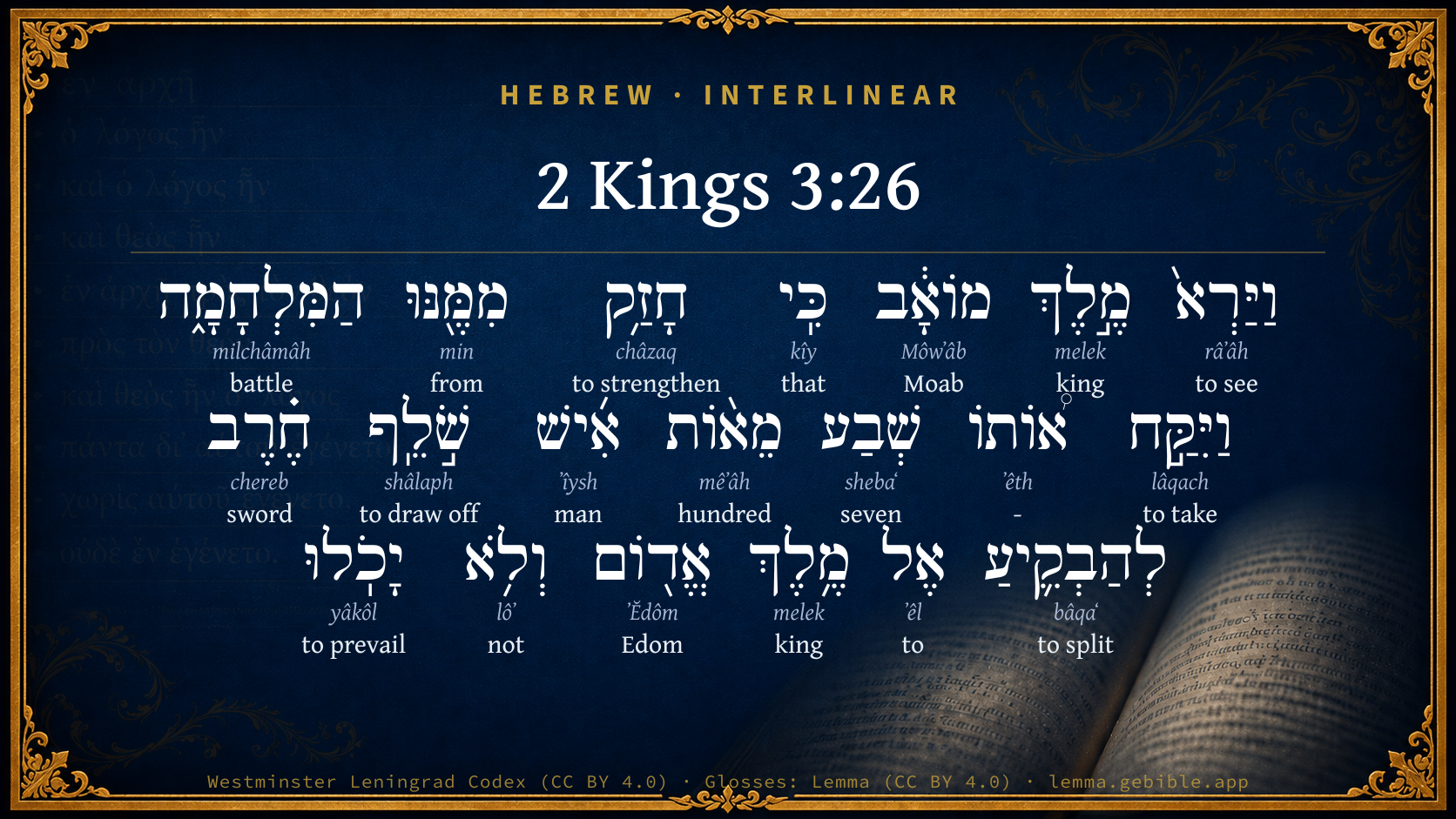
Hebrew (Westminster Leningrad Codex) 2 Kings 3:26 appears in the Hebrew Old Testament. The text above is from the Westminster Leningrad Codex. Each word links to its Strong’s number, a concise gloss, and parsing drawn from the Open Scriptures Hebrew Bible morphology. Click any word for its full Brown-Driver-Briggs (BDB) entry.
Download image
Cite this verse

2 Kings 3:26 (World English Bible). Public Domain. Lemma interlinear Bible study tool, https://lemma.gebible.app/v/2-kings/3/26.

Show BibTeX & RIS
BibTeX
RIS
English Translation
When the king of Moab saw that the battle was too severe for him, he took with him seven hundred men who drew sword, to break through to the king of Edom; but they could not.
World English Bible · Public Domain
Download a study sheet

One document with this verse’s original text, its word-by-word gloss line, the meaning frame, cross-references with their text, attributed commentary, and full source and license credits — printable, and it pastes into notes with its structure intact.

This verse Autodidact and up

Study sheet (.html) Plain text (.txt)

A passage Seminary Student

Up to 50 verses in one chapter. A passage sheet keeps up to 6 commentary sources and 12 cross-references per verse, in the order this page ranks them, and says so on the sheet whenever that leaves anything out. Ask for a single verse and you get the Autodidact verse sheet above.

Everything on this page stays free to read, with no account — the sheet is a download of what is already on screen, not access to it.

Want to remove ads? Support Godless Engineer
Compare translations 3

The same verse in 3 English versions, stacked beneath the original-language interlinear above. Click any original word for its lexicon entry.

Each is an independent rendering of the whole verse — the interlinear is not word-aligned to these translations.

Highlighted words mark where these versions differ — a whole-verse word diff, not a word-by-word alignment.

  • World English Bible Public Domain
    When the king of Moab saw that the battle was too severe for him, he took with him seven hundred men who drew sword, to break through to the king of Edom; but they could not.
  • King James Version Public Domain
    And when the king of Moab saw that the battle was too sore for him, he took with him seven hundred men that drew swords, to break through even unto the king of Edom: but they could not.
  • unfoldingWord Literal Text CC BY-SA 4.0
    And the king of Moab saw that the battle was stronger than him. And he took with him 700 men drawing a sword to break through to the king of Edom, but they were not able.

unfoldingWord Literal Text — © unfoldingWord, licensed CC BY-SA 4.0. Word-aligned USFM3 via Door43 (git.door43.org/unfoldingWord/en_ult).

Versions to compare (up to 4)

3 of 4 selected

Show all 18 translations

Every available English version of this verse, each an independent rendering of the whole verse.

  • World English Bible Public Domain
    When the king of Moab saw that the battle was too severe for him, he took with him seven hundred men who drew sword, to break through to the king of Edom; but they could not.
  • Berean Standard Bible Public Domain
    When the king of Moab saw that the battle was too fierce for him, he took with him seven hundred swordsmen to break through to the king of Edom, but they could not prevail.
  • Majority Standard Bible Public Domain
    When the king of Moab saw that the battle was too fierce for him, he took with him seven hundred swordsmen to break through to the king of Edom, but they could not prevail.
  • King James Version Public Domain
    And when the king of Moab saw that the battle was too sore for him, he took with him seven hundred men that drew swords, to break through even unto the king of Edom: but they could not.
  • American Standard Version (1901) Public Domain
    And when the king of Moab saw that the battle was too sore for him, he took with him seven hundred men that drew sword, to break through unto the king of Edom; but they could not.
  • Revised Version (1885) Public Domain
    And when the king of Moab saw that the battle was too sore for him, he took with him seven hundred men that drew sword, to break through unto the king of Edom: but they could not.
  • Geneva Bible (1599) Public Domain
    And when the King of Moab saw that the battel was too sore for him, he tooke with him seuen hudreth men that drew the sword, to break through vnto the King of Edom: but they could not.
  • Douay-Rheims (1899) Public Domain
    And when the king of Moab saw this, to wit, that the enemies had prevailed, he took with him seven hundred men that drew the sword, to break in upon the king of Edom: but they could not.
  • Young's Literal Translation Public Domain
    And the king of Moab seeth that the battle has been too strong for him, and he taketh with him seven hundred men, drawing sword, to cleave through unto the king of Edom, and they have not been able,
  • Literal Standard Version CC BY-SA 4.0
    And the king of Moab sees that the battle has been too strong for him, and he takes with him seven hundred men drawing sword, to cleave through to the king of Edom, and they have not been able,
  • Unlocked Literal Bible CC BY-SA 4.0
    When King Mesha of Moab saw that the battle was lost, he took with him seven hundred swordsmen to break through to the king of Edom, but they failed.
  • unfoldingWord Literal Text CC BY-SA 4.0
    And the king of Moab saw that the battle was stronger than him. And he took with him 700 men drawing a sword to break through to the king of Edom, but they were not able.
  • Darby Bible Public Domain
    And the king of Moab saw that the battle was too severe for him, and he took with him seven hundred men that drew swords, to break through to the king of Edom, but they could not.
  • World Messianic Bible Public Domain
    When the king of Moab saw that the battle was too severe for him, he took with him seven hundred men who drew a sword, to break through to the king of Edom; but they could not.
  • Webster's Bible Public Domain
    And when the king of Moab saw that the battle was too severe for him, he took with him seven hundred men that drew swords, to break through to the king of Edom: but they could not.
  • Free Bible Version CC BY-SA 4.0
    When the king of Moab realized he'd lost the battle, he led seven hundred swordsmen in an attempt to break through and attack the king of Edom, but they weren't able to do so.
  • Bible in Basic English Public Domain
    And when the king of Moab saw that the fight was going against him, he took with him seven hundred men armed with swords, with the idea of forcing a way through to the king of Aram, but they were not able to do so.
  • JPS Tanakh (1917) Public Domain
    And when the king of Moab saw that the battle was too sore for him, he took with him seven hundred men that drew sword, to break through unto the king of Edom; but they could not.

Literal Standard Version (2020), Covenant Press — licensed CC BY-SA 4.0. Text via the HelloAO Bible API (eBible.org). Unlocked Literal Bible (unfoldingWord) — licensed CC BY-SA 4.0. Text via the HelloAO Bible API (eBible.org). unfoldingWord Literal Text — © unfoldingWord, licensed CC BY-SA 4.0. Word-aligned USFM3 via Door43 (git.door43.org/unfoldingWord/en_ult). Free Bible Version, Dr. Jonathan Gallagher — licensed CC BY-SA 4.0. Text via the HelloAO Bible API (eBible.org).

Word by word

More ways to search: Search by grammar → Find every occurrence → Compare this word →

Practice this passage: Drill this verse → Learn its vocabulary →

שֹׁ֣לֵֽף
shâlaph
H8025
“drawing off”
Verb, Qal, Participle Active, Masculine, Singular, Construct
Part of Speech
Verb
Stem
Qal
Form
Participle Active
Gender
Masculine
Number
Singular
State
Construct
Full BDB Definition

Origin: a primitive root

TWOT: 2402

to draw out or off, take off - (Qal) - to draw out - to draw off - to shoot up, draw out (of blade of grass on roof)
  1. וַיַּרְא֙ râʼâh H7200 “and · to see” Conjunction + Verb, Qal, Sequential Imperfect, 3rd Person, Masculine, Singular
  2. מֶ֣לֶךְ melek H4428 “king of” Noun, Common, Masculine, Singular, Construct
  3. מוֹאָ֔ב Môwʼâb H4124 “Moab” Noun, Proper
  4. כִּֽי kîy H3588 “that” Conjunction
  5. חָזַ֥ק châzaq H2388 “to strengthen” Verb, Qal, Perfect, 3rd Person, Masculine, Singular
  6. מִמֶּ֖נּוּ min H4480 “from · us” Preposition + Suffix, Personal, 1st Person, Common, Plural
  7. הַמִּלְחָמָ֑ה milchâmâh H4421 “the · battle” Particle, Definite Article + Noun, Common, Feminine, Singular, Absolute
  8. וַיִּקַּ֣ח lâqach H3947 “and · to take” Conjunction + Verb, Qal, Sequential Imperfect, 3rd Person, Masculine, Singular
  9. א֠וֹתוֹ ʼêth H853 “- · him” Particle, Direct Object + Suffix, Personal, 3rd Person, Masculine, Singular
  10. שְׁבַע shebaʻ H7651 “seven” Adjective, Cardinal number, Feminine, Singular, Absolute
  11. מֵא֨וֹת mêʼâh H3967 “hundred” Adjective, Cardinal number, Both, Plural, Absolute
  12. אִ֜ישׁ ʼîysh H376 “man” Noun, Common, Masculine, Singular, Absolute
  13. חֶ֗רֶב chereb H2719 “sword” Noun, Common, Feminine, Singular, Absolute
  14. לְהַבְקִ֛יעַ bâqaʻ H1234 “to split” Preposition + Verb, Hiphil, Infinitive Construct
  15. אֶל ʼêl H413 “to” Preposition
  16. מֶ֥לֶךְ melek H4428 “king of” Noun, Common, Masculine, Singular, Construct
  17. אֱד֖וֹם ʼĔdôm H123 “Edom” Noun, Proper
  18. וְלֹ֥א lôʼ H3808 “and · not” Conjunction + Particle, Negative
  19. יָכֹֽלוּ yâkôl H3201 “to prevail” Verb, Qal, Perfect, 3rd Person, Common, Plural

About this verse

These counts appear in no published source. They are computed here, from the morphology-tagged text and Lemma’s own curated glosses. What Lemma adds →

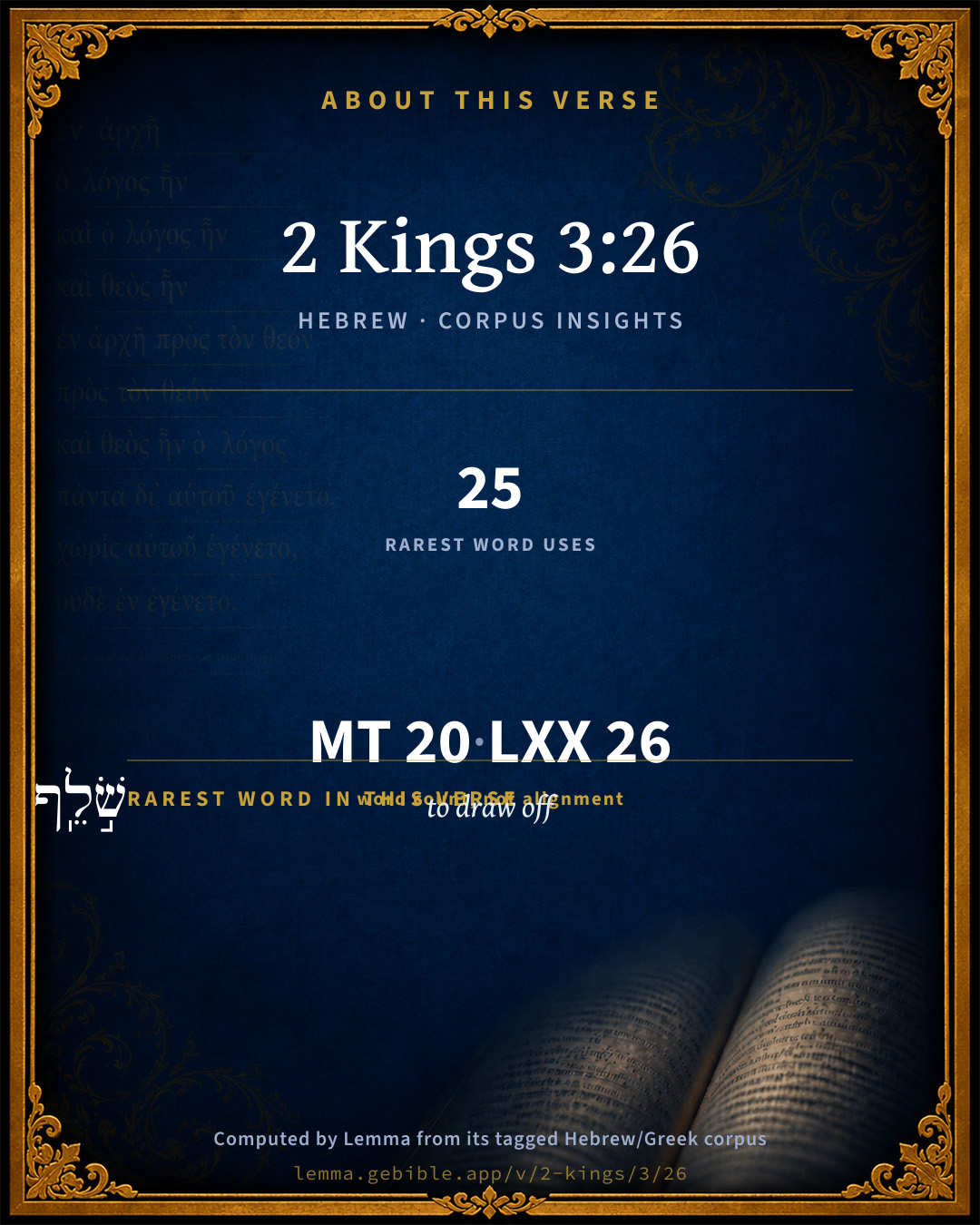
20
words
19
distinct lemmas
Historical
section

Notable vocabulary

The rarest word here is שֹׁ֣לֵֽף to draw off H8025 — appearing just 25 times in the whole Hebrew Bible.

Shared distinctive vocabulary

שֹׁ֣לֵֽף to draw off H8025 occurs in 24 verses of the Hebrew Bible. Also found in:

Grammatical profile

  • 6 verbs
  • 7 nouns
  • 2 adjectives
  • 2 prepositions
  • 1 conjunction
  • 2 particles

Verb forms

  • וַיַּרְא֙ Qal · Sequential Imperfect
  • חָזַ֥ק Qal · Perfect
  • וַיִּקַּ֣ח Qal · Sequential Imperfect
  • שֹׁ֣לֵֽף Qal · Participle Active
  • לְהַבְקִ֛יעַ Hiphil · Infinitive Construct
  • יָכֹֽלוּ Qal · Perfect

Repetition

A word recurs within this verse — often emphatic in Hebrew:

  • מֶ֣לֶךְ king H4428 ×2

Hebrew & Septuagint length

In English translation the verse runs 36 words from the Hebrew and 35 from the Septuagint (LXX English) — closely comparable.

A rough comparison of the two English renderings, which tokenize alike — not a word-level alignment.

Word counts can differ between the Hebrew and the Greek without any difference in meaning — e.g. the Hebrew direct-object marker אֵת has no separate Greek word, and Greek often adds the article ὁ.

In the original languages it is 20 Hebrew tokens and 26 Greek tokens — but the two are counted differently (Hebrew bundles its prefixes and suffixes into one token; the Greek is in lemma form), so that isn’t a like-for-like length.

Cross-references

2

Topical passages linked to 2 Kings 3:26 in the Treasury of Scripture Knowledge — connected by theme and wording, ordered by reader-vote popularity; previews shown in the World English Bible.

  • 2 Kings 3:9 So the king of Israel went, and the king of Judah, and the king of Edom; and they made a circuit of seven days' journey: and there was no water for the host, nor for the animals that followed them.
  • Amos 2:1 Thus says Yahweh: "For three transgressions of Moab, yes, for four, I will not turn away its punishment; Because he burned the bones of the king of Edom into lime;

Cross-references courtesy of OpenBible.info (CC BY 4.0).

Hebrew and Greek witnesses Masoretic Hebrew ↔ Greek Septuagint

The same verse in the two great witnesses to the Old Testament, shown verse-for-verse.

These are two independent witnesses, not word-aligned to each other, and the Septuagint is shown in lemma (dictionary) form.

Hebrew 2 Kings 3:26 Masoretic · Westminster Leningrad Codex

וַיַּרְא֙ מֶ֣לֶךְ מוֹאָ֔ב כִּֽי חָזַ֥ק מִמֶּ֖נּוּ הַמִּלְחָמָ֑ה וַיִּקַּ֣ח א֠וֹתוֹ שְׁבַע מֵא֨וֹת אִ֜ישׁ שֹׁ֣לֵֽף חֶ֗רֶב לְהַבְקִ֛יעַ אֶל מֶ֥לֶךְ אֱד֖וֹם וְלֹ֥א יָכֹֽלוּ

When the king of Moab saw that the battle was too severe for him, he took with him seven hundred men who drew sword, to break through to the king of Edom; but they could not.

World English Bible · Public Domain

Greek LXX 2 Kings 3:26 Septuagint · lemma form

καί ὁράω ὁ βασιλεύς μωαβ ὅτι κραταιόω ὑπέρ αὐτός ὁ πόλεμος καί λαμβάνω μετά ἑαυτοῦ ἑπτακόσιοι ἀνήρ σπάω ῥομφαία διακόπτω πρός βασιλεύς εδωμ καί οὐ δύναμαι

And the king of Moab saw that the battle prevailed against him; and he took with him seven hundred men that drew sword, to cut through to the king of Edom: and they could not.

LXX2012 (modern English Septuagint) · Public Domain

Hebrew: Westminster Leningrad Codex (CC BY 4.0). Greek: Septuagint (public domain); English from LXX2012 (modern English Septuagint) (Public Domain). How the Septuagint differs from the Hebrew →

Targum (Aramaic paraphrase)

1

The Targum is the ancient Jewish Aramaic paraphrase of the Hebrew Scriptures — an interpretive translation, not the Hebrew text itself. Onkelos (literal) and Pseudo-Jonathan (expansive) render the Torah, and Jonathan the Prophets. Coverage is partial: where no permissively-licensed English translation exists for a verse, only the Aramaic is shown. This is verse-level text, not a word-by-word alignment to the Hebrew.

  1. Targum Jonathan Prophets (Joshua–Malachi)
    וַחֲזָא מַלְכָּא דְמוֹאָב אֲרֵי תַקִיפוּ מִנֵיהּ עָבְדֵי קְרָבָא וּדְבַר עִמֵיהּ שְׁבַע מְאָה גַבְרָא שַׁלְפֵי סַיְפָא לְאַפְנָאָה לְוַת מַלְכָּא דֶאֱדוֹם וְלָא יָכִילוּ:

    (no public-domain English translation for this verse)

    Targum Jonathan — Aramaic: “Mikraot Gedolot” (public domain). English: “Sefaria Community Translation” (CC0 1.0 (public-domain dedication)); “London "Chaldee Paraphrase," 1871” (public domain). Text via Sefaria.

Commentary

Notes on 2 Kings 3:26 from classic Christian and Jewish commentators (each source and its license shown beneath its notes). The classic Christian expositions comment on the surrounding passage and are grouped to its opening verse, so a note may address several verses; the Jewish commentaries on the Tanakh (Rashi and others) are per-verse, so they appear only where the commentator wrote on this verse.

Lemma curates 59 commentaries, every one of them public domain or Creative Commons licensed, each selected and text-cleaned for this edition rather than reprinted as found. About our sources →

Trapp's Complete Commentary

John Trapp

2Ki 3:26 And when the king of Moab saw that the battle was too sore for him, he took with him seven hundred men that drew swords, to break through [even] unto the king of Edom: but they could not.

Ver. 26. To break through even unto the king of Edom.] Either because that quarter was weakest, or because his rage was most against the Edomites for helping the Israelites against him.

John Trapp, A Commentary or Exposition upon All the Books of the Old and New Testament (1647–1656) — public domain. Text from a community e-Sword module.

Joseph Benson's Commentary

2Ki 3:26. He took with him seven hundred men — to break through, &c. — He made a sally with seven hundred stout men, upon the quarter of the king of Edom, which he thought the weakest side, hoping to break through and escape. But they were repulsed, and compelled to retreat.

Joseph Benson's Commentary on the Old and New Testaments (1811–1818) — public domain. Text from a community e-Sword module.

Tyndale Open Study Notes

Tyndale Open Resources

3:26 The reason for the Moabite king’s attempt to break through the enemy lines might have been to avenge himself against the Edomite king or to escape through a perceived weakness in the allied lines.

Tyndale Open Study Notes — © Tyndale Open Resources, licensed CC BY-SA 4.0. Text via the HelloAO Bible API.

Adam Clarke's Commentary

Verse 26. Seven hundred men] These were no doubt the choice of all his troops, and being afraid of being hemmed up and perhaps taken by his enemies, whom he found on the eve of gaining possession of the city, he made a desperate sortie in order to regain the open country; and supposing that the quarter of the Edomites was weakest, or less carefully guarded, he endeavoured to make his impression there; but they were so warmly received by the king of Edom that they failed in the attempt, and were driven back into the city. Hence he was led to that desperate act mentioned in the following verse.

Adam Clarke's Commentary on the Bible (1810–1826) — public domain. Text from a community e-Sword/MySword module.

Ellicott's Commentary for English Readers

(26) The battle was too sore for him.—The garrison was giving way under the destructive fire of the slingers.

To break through even unto the king of Edom.—Because the Edomite contingent seemed to be the most vulnerable point in the allied army, or because he hoped that these unwilling allies of Israel would allow him to escape through their ranks.

A Bible Commentary for English Readers, edited by Charles John Ellicott (1878–1897) — public domain. Text from a community e-Sword module.

The Cambridge Bible for Schools and Colleges

gen. ed. J. J. S. Perowne

26. he took with him seven hundred men that drew swords] R.V. sword. In this phrase the singular is of the more frequent occurrence in A.V. The Moabite king desired to cut his way through the besiegers and so to escape, and he made the attempt in the direction of the king of Edom’s troops, either because that was the weaker side of the allied host, or else because he thought he might be received by the Edomite king, and that they together might turn against the combined forces of Israel and Judah. Josephus suggests the former reason, saying he made his sally where the guard was relaxed. The expression ‘break through unto the king of Edom’ seems to hint that he thought to find there an ally.

The Cambridge Bible for Schools and Colleges (gen. ed. J. J. S. Perowne; Cambridge University Press, 1878–1918) — public domain. Text from a community e-Sword module.

Albert Barnes' Notes on the Bible

To break through, even unto the king of Edom - Either because he thought that the king of Edom would connive at his escape or to take vengeance on him for having deserted his former allies (2Ki 3:8 note).

Albert Barnes' Notes on the Bible (1834–1885) — public domain. Text from a community e-Sword/MySword module.

Haydock's Catholic Bible Commentary

Edom, hoping that he would favour their escape, or because that part seemed the weakest.

George Leo Haydock (1774–1849), Haydock's Catholic Family Bible and Commentary, 1859 edition — public domain. Excludes Psalms (Douay-Rheims chapter numbering differs from Protestant) and Deuterocanonical books (Catholic canon only).

Matthew Poole's English Annotations

That being unable to defend the city longer, he might make an escape; which he chose to do on the king of Edom’s quarter, because he thought either that his was the weakest side, or that he would more willingly suffer him to escape, because he was not so hearty in the war as the rest, but only forced to it, and he might hereafter have some occasion of the king of Moab to join with him, as before he had, 2Ch 20:22.

Matthew Poole's English Annotations on the Holy Bible (1683–1685) — public domain. Text from a community e-Sword/MySword module.

Whedon's Commentary on the Bible

Daniel D. Whedon

26. To break through unto the king of Edom — He probably expected to receive less opposition from the king of Edom than from the other kings, and the Edomite forces were probably the weakest of the three armies that were encamped against the city.

Daniel D. Whedon (gen. ed.), Commentary on the Old and New Testaments (1874–1909) — public domain. Text from a community e-Sword module.

The Pulpit Commentary

And when the King of Moab saw that the battle was too sore for himi.e. that he could not hope to maintain the defense much longer, but would be forced to surrender the fortresshe took with him seven hundred men that drew swords, to break through even unto the King of Edom. Perhaps he regarded the King of Edom as the weakest of the three confederates, and the least likely to offer effectual resistance; perhaps he viewed him as a traitor, since Edom had been his ally a little earlier, (2Ch_20:10, 2Ch_20:22) and wished to wreak his vengeance on him. But they could not. The attempt failed; Edom was too strong, and he was forced to throw himself once more into the beleaguered town.

Vers. 26, 27.

The heartlessness of heathenism.

1. Heathenism blights the natural affections. Christianity honors and sanctifies them.

2. Heathenism disregards human life. What sacrifice of life by cannibalism, under the car of Juggernaut, in the suttees of India! What disregard of human life in the exposure of Chinese infants, in the aged and the sick left alone to die on the banks of the Indian rivers! Christianity has changed all this. It takes high views of human life. The body is the dwelling-place of an immortal soul. Care for the sick and for the dying is due to the influences of the gospel. Where are the hospitals, the philanthropic movements, of heathenism or of agnosticism? Even for the comforts of the present life we owe much to Christianity. C.H.I.

The Pulpit Commentary (1880–1919), ed. H.D.M. Spence-Jones & Joseph S. Exell — public domain. Text from a community e-Sword module.

John Wesley's Explanatory Notes

To break thro' - That he might make an escape: which he chose to do on the king of Edom's quarter; because he thought his was the weakest side.

John Wesley, Explanatory Notes Upon the Whole Bible (1754–1765) — public domain. Text via the GEBible commentary corpus.

unfoldingWord translationNotes

Door43 World Missions Community

King Mesha

Translate the name of this king the same as you did in 2 Kings 3:4.

that the battle was lost

"that his army was being defeated"

seven hundred swordsmen

"700 swordsmen" (See: Numbers)

swordsmen

soldiers who fight with swords

break through

"force their way through." There were many soldiers fighting on the battlefield which made it difficult to move though the crowd.

offered him as a burnt offering

King Mesha burned his son with fire until he died. He did this as an offering to Chemosh, the false god of Moab. The full meaning of this statement can be made explicit. (See: Assumed Knowledge and Implicit Information)

So there was great anger against Israel

Here the word "anger" can be expressed as a verb. There are two possibilities for who is angry here: 1) The Moabite soldiers. AT: "So the Moabite soldiers were very angry with Israel" or 2) God. AT: "So God was very angry with Israel" (See: Abstract Nouns)

translationWords

reign

sacrifice

anger

unfoldingWord translationNotes — © Distant Shores Media and the Door43 World Missions Community, licensed CC BY-SA 4.0. Source: git.door43.org/Door43/en_tn.

Lesson kit

Teaching starters — assembled from the data on this page, not authored interpretation. Every prompt links to the verse data it draws on. Edit before teaching.

2 Kings, in the Historical, opens this verse with 20 words (19 distinct Hebrew lemmas). Its most distinctive word is shâlaph (“to draw off”). A historical commentator’s framing appears above. Read the whole chapter for the surrounding context.

Discussion questions

  1. How does “to draw off” (shâlaph) shape what this verse is saying?
  2. How does Numbers 22:23, which shares the word «to draw off», read alongside this verse?
  3. What does the repetition of “king” (2× in this one verse) do in this verse?
  4. These translations render this verse differently; the difference is in the English rendering, not the original. What questions does that raise?
  5. «וַיַּרְא֙» is a Qal Sequential Imperfect verb. How does that grammatical form shape the action described?
  6. Compare how Trapp's Complete Commentary and Joseph Benson's Commentary read this verse. Where do they agree or differ?

Things to notice

Reading settings

Reading text

Shown beneath each verse's original-language words.

Old Testament
Old Testament edition

Read the OT as the Masoretic Hebrew (MT) or the Greek Septuagint (LXX).

English shown for the Greek Septuagint (in the Hebrew ↔ Greek comparison).

Comparing translations? Open the Compare panel on any verse page to stack up to four side by side.