2 Kings 11:20

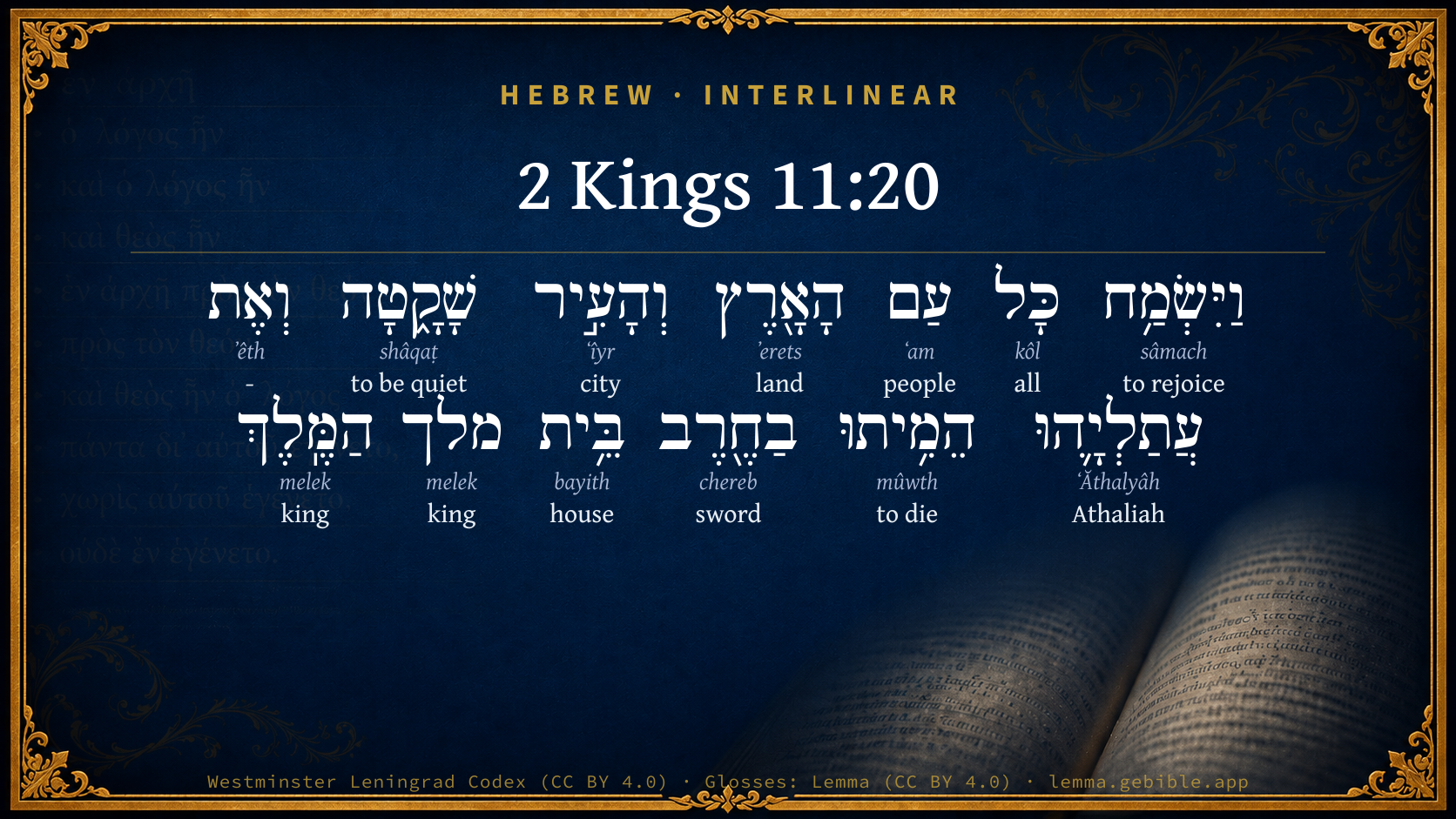
Hebrew (Westminster Leningrad Codex) 2 Kings 11:20 appears in the Hebrew Old Testament. The text above is from the Westminster Leningrad Codex. Each word links to its Strong’s number, a concise gloss, and parsing drawn from the Open Scriptures Hebrew Bible morphology. Click any word for its full Brown-Driver-Briggs (BDB) entry.
Download image
Cite this verse

2 Kings 11:20 (World English Bible). Public Domain. Lemma interlinear Bible study tool, https://lemma.gebible.app/v/2-kings/11/20.

Show BibTeX & RIS
BibTeX
RIS
English Translation
So all the people of the land rejoiced, and the city was quiet. Athaliah they had slain with the sword at the king's house.
World English Bible · Public Domain
Download a study sheet

One document with this verse’s original text, its word-by-word gloss line, the meaning frame, cross-references with their text, attributed commentary, and full source and license credits — printable, and it pastes into notes with its structure intact.

This verse Autodidact and up

Study sheet (.html) Plain text (.txt)

A passage Seminary Student

Up to 50 verses in one chapter. A passage sheet keeps up to 6 commentary sources and 12 cross-references per verse, in the order this page ranks them, and says so on the sheet whenever that leaves anything out. Ask for a single verse and you get the Autodidact verse sheet above.

Everything on this page stays free to read, with no account — the sheet is a download of what is already on screen, not access to it.

Want to remove ads? Support Godless Engineer
Compare translations 3

The same verse in 3 English versions, stacked beneath the original-language interlinear above. Click any original word for its lexicon entry.

Each is an independent rendering of the whole verse — the interlinear is not word-aligned to these translations.

Highlighted words mark where these versions differ — a whole-verse word diff, not a word-by-word alignment.

  • World English Bible Public Domain
    So all the people of the land rejoiced, and the city was quiet. Athaliah they had slain with the sword at the king's house.
  • King James Version Public Domain
    And all the people of the land rejoiced, and the city was in quiet: and they slew Athaliah with the sword beside the king's house.
  • unfoldingWord Literal Text CC BY-SA 4.0
    And all of the people of the land rejoiced, and the city was quiet, for they had killed Athaliah with the sword the house of the king.

unfoldingWord Literal Text — © unfoldingWord, licensed CC BY-SA 4.0. Word-aligned USFM3 via Door43 (git.door43.org/unfoldingWord/en_ult).

Versions to compare (up to 4)

3 of 4 selected

Show all 18 translations

Every available English version of this verse, each an independent rendering of the whole verse.

  • World English Bible Public Domain
    So all the people of the land rejoiced, and the city was quiet. Athaliah they had slain with the sword at the king's house.
  • Berean Standard Bible Public Domain
    and all the people of the land rejoiced. And the city was quiet, because Athaliah had been put to the sword at the royal palace.
  • Majority Standard Bible Public Domain
    and all the people of the land rejoiced. And the city was quiet, because Athaliah had been put to the sword at the royal palace.
  • King James Version Public Domain
    And all the people of the land rejoiced, and the city was in quiet: and they slew Athaliah with the sword beside the king's house.
  • American Standard Version (1901) Public Domain
    So all the people of the land rejoiced, and the city was quiet. And Athaliah they had slain with the sword at the king's house.
  • Revised Version (1885) Public Domain
    So all the people of the land rejoiced, and the city was quiet: and they slew Athaliah with the sword at the king’s house.
  • Geneva Bible (1599) Public Domain
    And all the people of the land reioyced, and the citie was in quiet: for they had slaine Athaliah with the sworde beside the Kings house.
  • Douay-Rheims (1899) Public Domain
    And all the people of the land rejoiced, and the city was quiet: but Athalia was slain with the sword in the king's house.
  • Young's Literal Translation Public Domain
    And all the people of the land rejoice, and the city `is' quiet, and Athaliah they have put to death by the sword in the house of the king;
  • Literal Standard Version CC BY-SA 4.0
    And all the people of the land rejoice, and the city [is] quiet, and they have put Athaliah to death by the sword in the house of the king;
  • Unlocked Literal Bible CC BY-SA 4.0
    So all the people of the land rejoiced, and the city was quiet after Athaliah had been killed with the sword at the king's house.
  • unfoldingWord Literal Text CC BY-SA 4.0
    And all of the people of the land rejoiced, and the city was quiet, for they had killed Athaliah with the sword the house of the king.
  • Darby Bible Public Domain
    And all the people of the land rejoiced, and the city was quiet; and they had slain Athaliah with the sword [beside] the king's house.
  • World Messianic Bible Public Domain
    So all the people of the land rejoiced, and the city was quiet. They had slain Athaliah with the sword at the king’s house.
  • Webster's Bible Public Domain
    And all the people of the land rejoiced, and the city was in quiet: and they slew Athaliah with the sword beside the king's house.
  • Free Bible Version CC BY-SA 4.0
    All throughout the land people celebrated, and Jerusalem was at peace, because Athaliah had been killed by the sword at the palace.
  • Bible in Basic English Public Domain
    So all the people of the land were glad, and the town was quiet; and they had put Athaliah to death with the sword at the king's house.
  • JPS Tanakh (1917) Public Domain
    So all the people of the land rejoiced, and the city was quiet; and they slew Athaliah with the sword at the king's house.

Literal Standard Version (2020), Covenant Press — licensed CC BY-SA 4.0. Text via the HelloAO Bible API (eBible.org). Unlocked Literal Bible (unfoldingWord) — licensed CC BY-SA 4.0. Text via the HelloAO Bible API (eBible.org). unfoldingWord Literal Text — © unfoldingWord, licensed CC BY-SA 4.0. Word-aligned USFM3 via Door43 (git.door43.org/unfoldingWord/en_ult). Free Bible Version, Dr. Jonathan Gallagher — licensed CC BY-SA 4.0. Text via the HelloAO Bible API (eBible.org).

Word by word

More ways to search: Search by grammar → Find every occurrence → Compare this word →

Practice this passage: Drill this verse → Learn its vocabulary →

עֲתַלְיָ֛הוּ
ʻĂthalyâh
H6271
“Athaliah”
Noun, Proper
Part of Speech
Noun
Type
Proper
Full BDB Definition

Origin: from the same as H6270 and H3050

TWOT: None

Athaliah = "afflicted of the Lord" - son of Jeroham of the tribe of Benjamin (noun proper masculine) - father of Jeshaiah of the sons of Elam who was one of the heads of a family who returned with Ezra from exile (noun proper masculine) - the daughter of Ahab and Jezebel and the wife of king Jehoram of Judah; killer of all the members of the royal family of Judah with the exception of one baby named Joash who was hidden by the high priest Jehoiada until 6 years had passed and Jehoiada led the revolution to put him on the throne, overthrowing Athaliah and putting her to death (noun proper feminine)
  1. וַיִּשְׂמַ֥ח sâmach H8055 “and · to rejoice” Conjunction + Verb, Qal, Sequential Imperfect, 3rd Person, Masculine, Singular
  2. כָּל kôl H3605 “all of” Noun, Common, Masculine, Singular, Construct
  3. עַם ʻam H5971 “people of” Noun, Common, Masculine, Singular, Construct
  4. הָאָ֖רֶץ ʼerets H776 “the · land” Particle, Definite Article + Noun, Common, Both, Singular, Absolute
  5. וְהָעִ֣יר ʻîyr H5892 “and · the · city” Conjunction + Particle, Definite Article + Noun, Common, Feminine, Singular, Absolute
  6. שָׁקָ֑טָה shâqaṭ H8252 “to be quiet” Verb, Qal, Perfect, 3rd Person, Feminine, Singular
  7. וְאֶת ʼêth H853 “and · -” Conjunction + Particle, Direct Object
  8. הֵמִ֥יתוּ mûwth H4191 “to die” Verb, Hiphil, Perfect, 3rd Person, Common, Plural
  9. בַחֶ֖רֶב chereb H2719 “in/at the · sword” Preposition, Determined + Noun, Common, Feminine, Singular, Absolute
  10. בֵּ֥ית bayith H1004 “house of” Noun, Common, Masculine, Singular, Construct
  11. מלך melek H4428 “king” Noun, Common, Masculine, Singular, Absolute
  12. הַמֶּֽלֶךְ melek H4428 “the · king” Particle, Definite Article + Noun, Common, Masculine, Singular, Absolute

About this verse

These counts appear in no published source. They are computed here, from the morphology-tagged text and Lemma’s own curated glosses. What Lemma adds →

13
words
12
distinct lemmas
Historical
section

Notable vocabulary

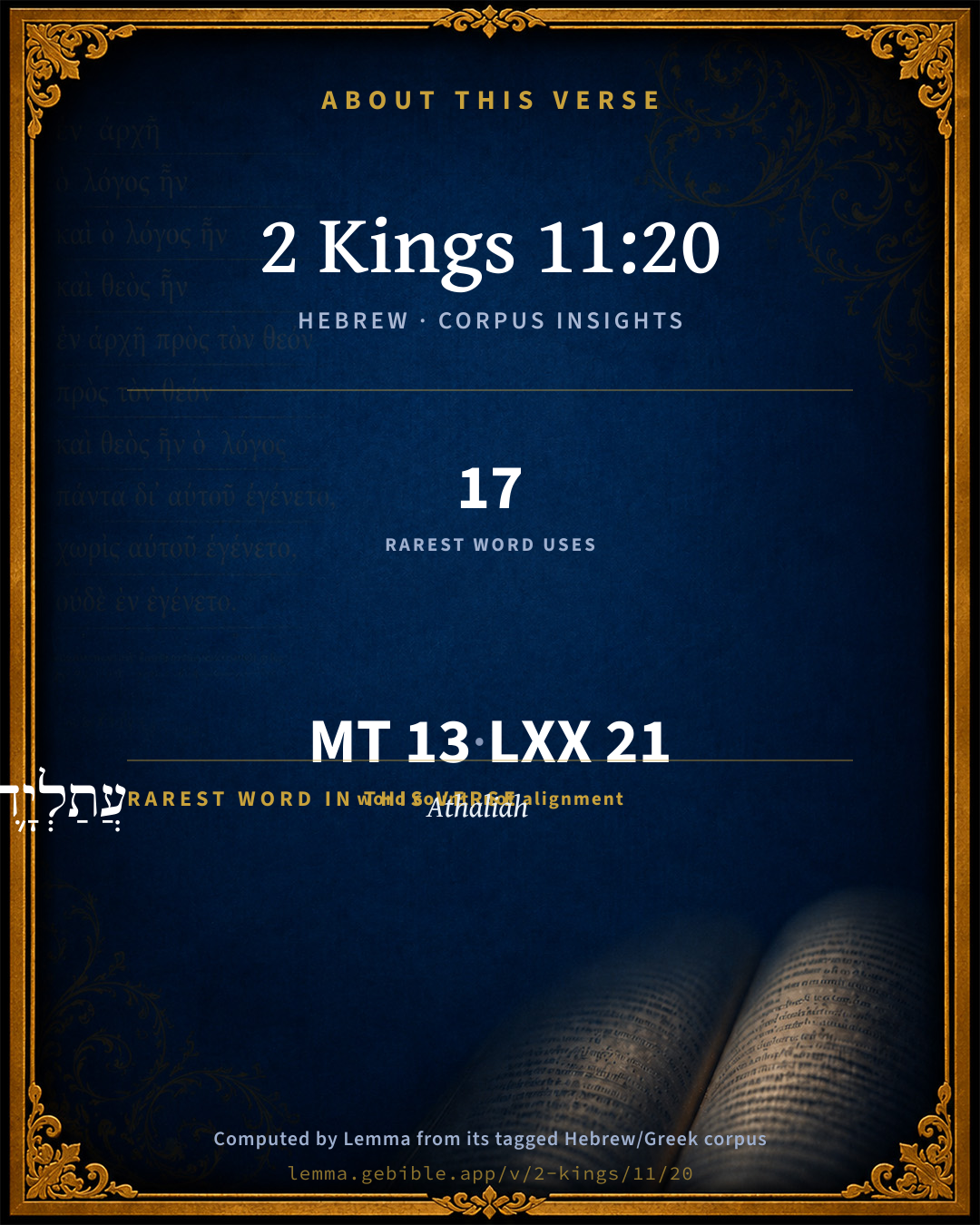
The rarest word here is עֲתַלְיָ֛הוּ Athaliah H6271 — appearing just 17 times in the whole Hebrew Bible.

Shared distinctive vocabulary

עֲתַלְיָ֛הוּ Athaliah H6271 occurs in 17 verses of the Hebrew Bible. Also found in:

Grammatical profile

  • 3 verbs
  • 9 nouns
  • 1 particle

Verb forms

  • וַיִּשְׂמַ֥ח Qal · Sequential Imperfect
  • שָׁקָ֑טָה Qal · Perfect
  • הֵמִ֥יתוּ Hiphil · Perfect

Repetition

A word recurs within this verse — often emphatic in Hebrew:

Hebrew & Septuagint length

In English translation the verse runs 24 words from the Hebrew and 27 from the Septuagint (LXX English) — closely comparable.

A rough comparison of the two English renderings, which tokenize alike — not a word-level alignment.

Word counts can differ between the Hebrew and the Greek without any difference in meaning — e.g. the Hebrew direct-object marker אֵת has no separate Greek word, and Greek often adds the article ὁ.

In the original languages it is 13 Hebrew tokens and 21 Greek tokens — but the two are counted differently (Hebrew bundles its prefixes and suffixes into one token; the Greek is in lemma form), so that isn’t a like-for-like length.

Cross-references

4

Topical passages linked to 2 Kings 11:20 in the Treasury of Scripture Knowledge — connected by theme and wording, ordered by reader-vote popularity; previews shown in the World English Bible.

  • Proverbs 11:10 When it goes well with the righteous, the city rejoices. When the wicked perish, there is shouting.
  • Proverbs 29:2 When the righteous thrive, the people rejoice; But when the wicked rule, the people groan.
  • 2 Kings 11:14 and she looked, and, behold, the king stood by the pillar, as the manner was, and the captains and the trumpets by the king; and all the people of the land rejoiced, and blew trumpets. Then Athaliah tore her clothes, and cried, Treason! treason!
  • 2 Chronicles 23:21 So all the people of the land rejoiced, and the city was quiet. Athaliah they had slain with the sword.

Cross-references courtesy of OpenBible.info (CC BY 4.0).

Hebrew and Greek witnesses Masoretic Hebrew ↔ Greek Septuagint

The same verse in the two great witnesses to the Old Testament, shown verse-for-verse.

These are two independent witnesses, not word-aligned to each other, and the Septuagint is shown in lemma (dictionary) form.

Hebrew 2 Kings 11:20 Masoretic · Westminster Leningrad Codex

וַיִּשְׂמַ֥ח כָּל עַם הָאָ֖רֶץ וְהָעִ֣יר שָׁקָ֑טָה וְאֶת עֲתַלְיָ֛הוּ הֵמִ֥יתוּ בַחֶ֖רֶב בֵּ֥ית מלך הַמֶּֽלֶךְ

So all the people of the land rejoiced, and the city was quiet. Athaliah they had slain with the sword at the king's house.

World English Bible · Public Domain

Greek LXX 2 Kings 11:20 Septuagint · lemma form

καί χαίρω πᾶς ὁ λαός ὁ γῆ καί ὁ πόλις ἡσυχάζω καί ὁ γοθολια θανατόω ἐν ῥομφαία ἐν οἶκος ὁ βασιλεύς

And all the people of the land rejoiced, and the city was at rest: and they killed Gotholia with the sword in the house of the king.

LXX2012 (modern English Septuagint) · Public Domain

Hebrew: Westminster Leningrad Codex (CC BY 4.0). Greek: Septuagint (public domain); English from LXX2012 (modern English Septuagint) (Public Domain). How the Septuagint differs from the Hebrew →

Targum (Aramaic paraphrase)

1

The Targum is the ancient Jewish Aramaic paraphrase of the Hebrew Scriptures — an interpretive translation, not the Hebrew text itself. Onkelos (literal) and Pseudo-Jonathan (expansive) render the Torah, and Jonathan the Prophets. Coverage is partial: where no permissively-licensed English translation exists for a verse, only the Aramaic is shown. This is verse-level text, not a word-by-word alignment to the Hebrew.

  1. Targum Jonathan Prophets (Joshua–Malachi)
    וַחֲדִי כָל עַמָא דְאַרְעָא וְקַרְתָּא שְׁדוֹכַת וְיַת עֲתַלְיָה קְטַלוּ בְּחַרְבָּא בֵּית מַלְכָּא:

    (no public-domain English translation for this verse)

    Targum Jonathan — Aramaic: “Mikraot Gedolot” (public domain). English: “Sefaria Community Translation” (CC0 1.0 (public-domain dedication)); “London "Chaldee Paraphrase," 1871” (public domain). Text via Sefaria.

Commentary

Notes on 2 Kings 11:20 from classic Christian and Jewish commentators (each source and its license shown beneath its notes). The classic Christian expositions comment on the surrounding passage and are grouped to its opening verse, so a note may address several verses; the Jewish commentaries on the Tanakh (Rashi and others) are per-verse, so they appear only where the commentator wrote on this verse.

Lemma curates 59 commentaries, every one of them public domain or Creative Commons licensed, each selected and text-cleaned for this edition rather than reprinted as found. About our sources →

Trapp's Complete Commentary

John Trapp

2Ki 11:20 And all the people of the land rejoiced, and the city was in quiet: and they slew Athaliah with the sword [beside] the king’s house.

Ver. 20. And they slew Athaliah with the sword] This being done by the consent of the whole people, or of the greater part, Deo fiebat auspice, saith Zuinglius, had God’s approbation; seeing she was both a usurper and a tyrant.

Beside the king’s house.] Congrue ibi caeditur ubl peccarat; she suffereth where she had most sinned.

John Trapp, A Commentary or Exposition upon All the Books of the Old and New Testament (1647–1656) — public domain. Text from a community e-Sword module.

Geneva Bible (1599)

Geneva Bible translators

Which by her cruelty and persecution had vexed the whole land before.

Geneva Bible (1599) marginal notes — public domain. Text via Bolls.life.

Adam Clarke's Commentary

Verse 20. The people - rejoiced] They were glad to get rid of the tyranny of Athaliah.

And the city was in quiet] She had no partisans to rise up and disturb the king's reign.

Adam Clarke's Commentary on the Bible (1810–1826) — public domain. Text from a community e-Sword/MySword module.

Ellicott's Commentary for English Readers

(20) All the people of the land . . . the city.—Thenius calls this an “evident contrast between the soldiery and the. citizens; the former exulting in their work, the latter not lifting a finger while the idolatrous tyrant was being put to death “ (connecting the first half of the verse with the second; after Ewald). But his assumption that “all the people of the land,” here and in 2Ki_11:14, means “the soldiery” (“die ganze in Jerusalem anwesende Kriegerische Landesmannschaft—Die Kriegsmannschaft”) is certainly wrong. “The people of the land” are plainly opposed to the royal guards—“the Praetorians”—who effected the revolution, as civilians to soldiers.

The city was in quiet.—The citizens of Jerusalem accepted the revolution without attempting any counter movement. No doubt there was a strong element of Baal-worshippers and partisans of Athaliah in the capital. “The people of the land” (i.e., probably, the people whom the centurions had called together from the country, at the instance of Jehoiada, according to 2Ch_23:2) are contrasted with the burghers of Jerusalem. The phrase, “the city was in quiet” (or “had rest,” Jdg_5:31), may, however, possibly refer to the deliverance from the tyranny of Athaliah.

And they slew Athaliah.—Rather, and Athaliah they had slain; an emphatic recurrence to the real climax of the story (2Ki_11:16), by way of conclusion.

Beside.—Rather, in, i.e., within the palace enclosure.

A Bible Commentary for English Readers, edited by Charles John Ellicott (1878–1897) — public domain. Text from a community e-Sword module.

The Cambridge Bible for Schools and Colleges

gen. ed. J. J. S. Perowne

20. And [R.V. So] all the people of the land rejoiced] The attachment of Judah to the family of David had always been very great, and to see a son of that family on the throne, even though some of his blood was of Ahab’s house, was far more to the mind of the people than to be ruled over by a daughter of Ahab.

and the city was in quiet] R.V. omits in, as is done in the parallel verse in 2 Chron. Cf. for the expression, the phrase so frequently recurring in Judges, ‘the land had rest’ (Jdg_3:30; Jdg_5:31; &c.).

beside [R.V. at] the king’s house] There is no preposition in the original as the italics of A.V. indicate; the noun is an accusative of place. Hence the ‘at’ of R.V. is warranted.

On the death of Athaliah Josephus (Ant. IX. 7. 3) says, ‘Jehoiada having called the captains ordered them to take Athaliah into the valley of Kidron and there to kill her’. In 2Ki_25:4 (see note there) we find that ‘the king’s garden’ was very near to the Kidron valley. It may be therefore that the place indicated here ‘beside (at) the king’s house’ was not far from the ‘king’s garden’ spoken of there.

The Cambridge Bible for Schools and Colleges (gen. ed. J. J. S. Perowne; Cambridge University Press, 1878–1918) — public domain. Text from a community e-Sword module.

John Gill's Exposition

Seven years old was Jehoash when he began to reign. Being a year old when his father was killed and having been hid six years in the temple.

Next: 2 Kings Chapter 12

John Gill's Exposition of the Whole Bible (1746–1763) — public domain (CC PDM 1.0). Text via the HelloAO Bible API.

Albert Barnes' Notes on the Bible

They slew Athaliah with the sword - This is one of the many little repetitions which mark the manner of the writer, and which generally contain some little point which has not been mentioned before (compare 2Ki 11:16).

Albert Barnes' Notes on the Bible (1834–1885) — public domain. Text from a community e-Sword/MySword module.

The Pulpit Commentary

And all the people of the land rejoiced. "All the people of the land" has here, perhaps, a wider signification than in vers. 18 and 19. The whole land was content with the revolution that had taken place. No opposition showed itself. Ewald has no ground for his statement that the heathenizing party was strong in Jerusalem, and that the worshippers of Jehovah "had for a long time to keep watch in the temple, to prevent surprise by the heathenizing party" ("History of Israel," vol. 4. p. 136, note 3). He has mistaken the intention of the last clause of ver. 18. If anything is clear from the entire narrative of the early reign of Joash (2Ki_11:3-21 2Ki_12:1-16; 2Ch_23:1-21 2Ch_24:1-14) it is that there was no heathenizing party in Jerusalem, or none that dared to show itself, until after the death of the high priest Jehoiada, which was later than the twenty-third year of Joash. And the cityi.e. Jerusalemwas in quiet: and they slew it might he translated, when they had slainAthaliah with the sword beside the king"s house. The intention of the writer is to connect the period of tranquility with the removal of Athaliah, and therefore to point her out as the cause of disturbance previously.

The Pulpit Commentary (1880–1919), ed. H.D.M. Spence-Jones & Joseph S. Exell — public domain. Text from a community e-Sword module.

Lesson kit

Teaching starters — assembled from the data on this page, not authored interpretation. Every prompt links to the verse data it draws on. Edit before teaching.

2 Kings, in the Historical, opens this verse with 13 words (12 distinct Hebrew lemmas). Its most distinctive word is ʻĂthalyâh (“Athaliah”). A historical commentator’s framing appears above. Read the whole chapter for the surrounding context.

Discussion questions

  1. The word ʻĂthalyâh carries the sense “Athaliah.” How does it shape the verse?
  2. 2 Kings 8:26 shares the word «Athaliah» with this verse. How do the two illuminate each other?
  3. “king” occurs 2× in this one verse. What is the effect of the repetition?
  4. These translations render this verse differently; the difference is in the English rendering, not the original. What questions does that raise?
  5. The verb «וַיִּשְׂמַ֥ח» is Qal Sequential Imperfect. How does its form color the action?
  6. Reading how Trapp's Complete Commentary and Geneva Bible (1599) read this verse, where do the two commentators agree and where do they part?

Things to notice

Reading settings

Reading text

Shown beneath each verse's original-language words.

Old Testament
Old Testament edition

Read the OT as the Masoretic Hebrew (MT) or the Greek Septuagint (LXX).

English shown for the Greek Septuagint (in the Hebrew ↔ Greek comparison).

Comparing translations? Open the Compare panel on any verse page to stack up to four side by side.