
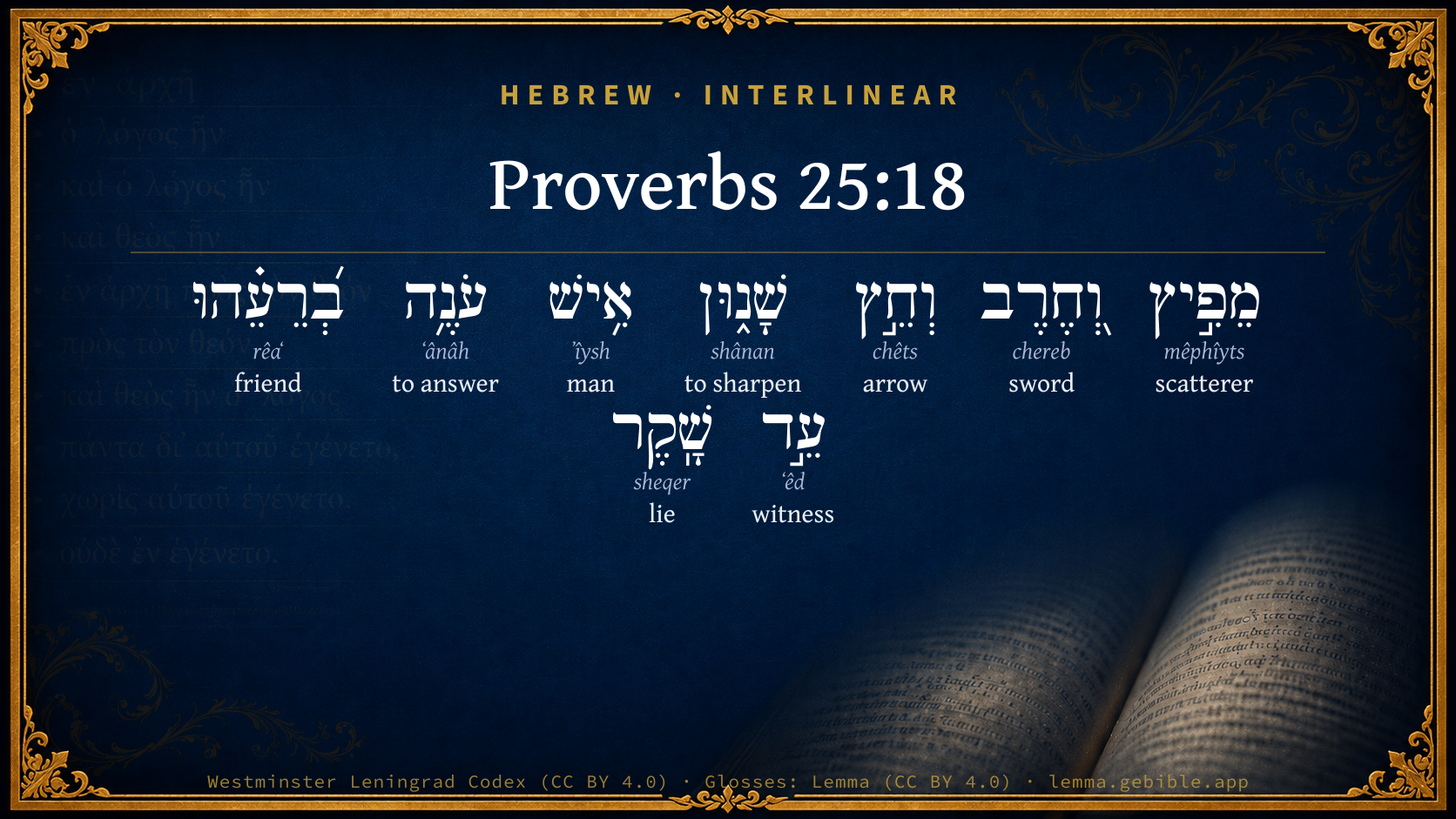
Proverbs 25:18

Hebrew (Westminster Leningrad Codex) Proverbs 25:18 appears in the Hebrew Old Testament. The text above is from the Westminster Leningrad Codex. Each word links to its Strong’s number, a concise gloss, and parsing drawn from the Open Scriptures Hebrew Bible morphology. Click any word for its full Brown-Driver-Briggs (BDB) entry.
Download image
Cite this verse

Proverbs 25:18 (World English Bible). Public Domain. Lemma interlinear Bible study tool, https://lemma.gebible.app/v/proverbs/25/18.

Show BibTeX & RIS
BibTeX
RIS
English Translation
A man who gives false testimony against his neighbor Is like a club, a sword, or a sharp arrow.
World English Bible · Public Domain
Highlights
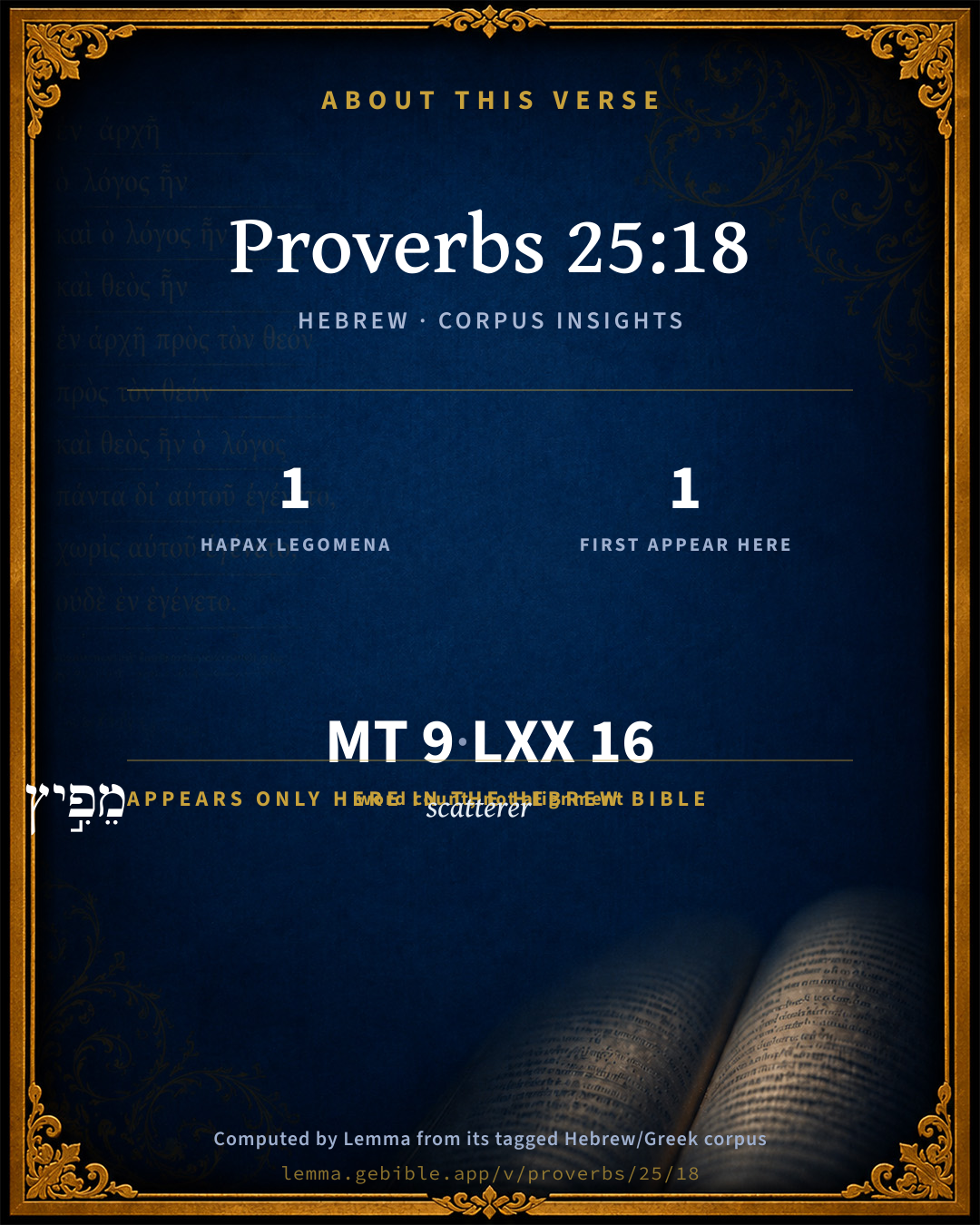
  • 1 hapax legomenon — only here in the Hebrew Bible
  • 1 first appearance in the Hebrew Bible
Full analysis ↓
Download a study sheet

One document with this verse’s original text, its word-by-word gloss line, the meaning frame, cross-references with their text, attributed commentary, and full source and license credits — printable, and it pastes into notes with its structure intact.

This verse Autodidact and up

Study sheet (.html) Plain text (.txt)

A passage Seminary Student

Up to 50 verses in one chapter. A passage sheet keeps up to 6 commentary sources and 12 cross-references per verse, in the order this page ranks them, and says so on the sheet whenever that leaves anything out. Ask for a single verse and you get the Autodidact verse sheet above.

Everything on this page stays free to read, with no account — the sheet is a download of what is already on screen, not access to it.

Want to remove ads? Support Godless Engineer
Compare translations 3

The same verse in 3 English versions, stacked beneath the original-language interlinear above. Click any original word for its lexicon entry.

Each is an independent rendering of the whole verse — the interlinear is not word-aligned to these translations.

Highlighted words mark where these versions differ — a whole-verse word diff, not a word-by-word alignment.

  • World English Bible Public Domain
    A man who gives false testimony against his neighbor Is like a club, a sword, or a sharp arrow.
  • King James Version Public Domain
    A man that beareth false witness against his neighbour is a maul, and a sword, and a sharp arrow.
  • unfoldingWord Literal Text CC BY-SA 4.0
    A hammer and a sword and a sharp arrow a man who answers a testimony of falsehood against his neighbor.

unfoldingWord Literal Text — © unfoldingWord, licensed CC BY-SA 4.0. Word-aligned USFM3 via Door43 (git.door43.org/unfoldingWord/en_ult).

Versions to compare (up to 4)

3 of 4 selected

Show all 18 translations

Every available English version of this verse, each an independent rendering of the whole verse.

  • World English Bible Public Domain
    A man who gives false testimony against his neighbor Is like a club, a sword, or a sharp arrow.
  • Berean Standard Bible Public Domain
    Like a club or sword or sharp arrow is a man who bears false witness against his neighbor.
  • Majority Standard Bible Public Domain
    Like a club or sword or sharp arrow is a man who bears false witness against his neighbor.
  • King James Version Public Domain
    A man that beareth false witness against his neighbour is a maul, and a sword, and a sharp arrow.
  • American Standard Version (1901) Public Domain
    A man that beareth false witness against his neighbor Is a maul, and a sword, and a sharp arrow.
  • Revised Version (1885) Public Domain
    A man that beareth false witness against his neighbour is a maul, and a sword, and a sharp arrow.
  • Geneva Bible (1599) Public Domain
    A man that beareth false witnes against his neighbour, is like an hammer and a sword, and a sharpe arrowe.
  • Douay-Rheims (1899) Public Domain
    A man that beareth false witness against his neighbour, is like a dart and a sword and a sharp arrow.
  • Young's Literal Translation Public Domain
    A maul, and a sword, and a sharp arrow, `Is' the man testifying against his neighbour a false testimony.
  • Literal Standard Version CC BY-SA 4.0
    A maul, and a sword, and a sharp arrow, || [Is] the man testifying a false testimony against his neighbor.
  • Unlocked Literal Bible CC BY-SA 4.0
    A man who bears false witness against his neighbor is like a club used in war, or a sword, or a sharp arrow.
  • unfoldingWord Literal Text CC BY-SA 4.0
    A hammer and a sword and a sharp arrow a man who answers a testimony of falsehood against his neighbor.
  • Darby Bible Public Domain
    A maul, and a sword, and a sharp arrow, is a man that beareth false witness against his neighbour.
  • World Messianic Bible Public Domain
    A man who gives false testimony against his neighbor is like a club, a sword, or a sharp arrow.
  • Webster's Bible Public Domain
    A man that beareth false witness against his neighbor is a maul, and a sword, and a sharp arrow.
  • Free Bible Version CC BY-SA 4.0
    Telling lies in court against a friend is like attacking them with a mace, or a sword, or an arrow.
  • Bible in Basic English Public Domain
    One who gives false witness against his neighbour is a hammer and a sword and a sharp arrow.
  • JPS Tanakh (1917) Public Domain
    As a maul, and a sword, and a sharp arrow, so is a man that beareth false witness against his neighbour.

Literal Standard Version (2020), Covenant Press — licensed CC BY-SA 4.0. Text via the HelloAO Bible API (eBible.org). Unlocked Literal Bible (unfoldingWord) — licensed CC BY-SA 4.0. Text via the HelloAO Bible API (eBible.org). unfoldingWord Literal Text — © unfoldingWord, licensed CC BY-SA 4.0. Word-aligned USFM3 via Door43 (git.door43.org/unfoldingWord/en_ult). Free Bible Version, Dr. Jonathan Gallagher — licensed CC BY-SA 4.0. Text via the HelloAO Bible API (eBible.org).

Word by word

More ways to search: Search by grammar → Find every occurrence → Compare this word →

Practice this passage: Drill this verse → Learn its vocabulary →

About this verse

These counts appear in no published source. They are computed here, from the morphology-tagged text and Lemma’s own curated glosses. What Lemma adds →

9
words
9
distinct lemmas
Wisdom
section

Notable vocabulary

1 hapax legomenon — a word that appears only here in the entire Hebrew Bible:

  • מֵפִ֣יץ scatterer H4650

First appearance in Scripture

This word makes its first canonical appearance in the Hebrew Bible here:

  • מֵפִ֣יץ scatterer H4650

Shared distinctive vocabulary

שָׁנ֑וּן to sharpen H8150 occurs in 9 verses of the Hebrew Bible. Also found in:

Grammatical profile

  • 2 verbs
  • 7 nouns

Verb forms

  • שָׁנ֑וּן Qal · Participle Passive
  • עֹנֶ֥ה Qal · Participle Active

Hebrew & Septuagint length

In English translation the verse runs 19 words from the Hebrew and 22 from the Septuagint (LXX English) — closely comparable.

A rough comparison of the two English renderings, which tokenize alike — not a word-level alignment.

Word counts can differ between the Hebrew and the Greek without any difference in meaning — e.g. the Hebrew direct-object marker אֵת has no separate Greek word, and Greek often adds the article ὁ.

In the original languages it is 9 Hebrew tokens and 16 Greek tokens — but the two are counted differently (Hebrew bundles its prefixes and suffixes into one token; the Greek is in lemma form), so that isn’t a like-for-like length.

Cross-references

10

Topical passages linked to Proverbs 25:18 in the Treasury of Scripture Knowledge — connected by theme and wording, ordered by reader-vote popularity; previews shown in the World English Bible.

  • Psalms 57:4 My soul is among lions. I lie among those who are set on fire, Even the sons of men, whose teeth are spears and arrows, And their tongue a sharp sword.
  • Proverbs 12:18 There is one who speaks rashly like the piercing of a sword, But the tongue of the wise heals.
  • Jeremiah 9:8 Their tongue is a deadly arrow; it speaks deceit: one speaks peaceably to his neighbor with his mouth, but in his heart he lays wait for him.
  • James 3:6 And the tongue is a fire. The world of iniquity among our members is the tongue, which defiles the whole body, and sets on fire the course of nature, and is set on fire by Gehenna.
  • Psalms 120:3–4 What will be given to you, and what will be done more to you, You deceitful tongue?
  • Jeremiah 9:3 They bend their tongue, [as it were] their bow, for falsehood; and they are grown strong in the land, but not for truth: for they proceed from evil to evil, and they don't know me, says Yahweh.
  • Psalms 52:2 Your tongue plots destruction, Like a sharp razor, working deceitfully.
  • Psalms 140:3 They have sharpened their tongues like a serpent. Viper's poison is under their lips. Selah.
  • Proverbs 24:28 Don't be a witness against your neighbor without cause. Don't deceive with your lips.
  • Psalms 55:21 His mouth was smooth as butter, But his heart was war. His words were softer than oil, Yet they were drawn swords.

Cross-references courtesy of OpenBible.info (CC BY 4.0).

Hebrew and Greek witnesses Masoretic Hebrew ↔ Greek Septuagint

The same verse in the two great witnesses to the Old Testament, shown verse-for-verse.

These are two independent witnesses, not word-aligned to each other, and the Septuagint is shown in lemma (dictionary) form.

Hebrew Proverbs 25:18 Masoretic · Westminster Leningrad Codex

מֵפִ֣יץ וְ֭חֶרֶב וְחֵ֣ץ שָׁנ֑וּן אִ֥ישׁ עֹנֶ֥ה בְ֝רֵעֵ֗הוּ עֵ֣ד שָֽׁקֶר

A man who gives false testimony against his neighbor Is like a club, a sword, or a sharp arrow.

World English Bible · Public Domain

Greek LXX Proverbs 25:18 Septuagint · lemma form

ῥόπαλον καί μάχαιρα καί τόξευμα ἀκιδωτόν οὕτως καί ἀνήρ ὁ καταμαρτυρέω ὁ φίλος αὐτός μαρτυρία ψευδής

As a club, and a dagger, and a pointed arrow, so also is a man who bears false witness against his friend.

LXX2012 (modern English Septuagint) · Public Domain

On this verse, Keil & Delitzsch discusses the Septuagint’s reading. Read the note in Commentary ↓

Hebrew: Westminster Leningrad Codex (CC BY 4.0). Greek: Septuagint (public domain); English from LXX2012 (modern English Septuagint) (Public Domain). How the Septuagint differs from the Hebrew →

Commentary

Notes on Proverbs 25:18 from classic Christian and Jewish commentators (each source and its license shown beneath its notes). The classic Christian expositions comment on the surrounding passage and are grouped to its opening verse, so a note may address several verses; the Jewish commentaries on the Tanakh (Rashi and others) are per-verse, so they appear only where the commentator wrote on this verse.

Lemma curates 59 commentaries, every one of them public domain or Creative Commons licensed, each selected and text-cleaned for this edition rather than reprinted as found. About our sources →

The Cambridge Bible for Schools and Colleges

gen. ed. J. J. S. Perowne

18. a maul] “i.e. a hammer, a variation of mall, from malleus … The Hebrew and English alike occur in Pro_25:18 only. But a derivative from the same root, and differing only slightly in form, is found in Jer_51:20, and is there translated by ‘battle-axe’ (or maul, R.V. marg.)—how incorrectly is shown by the constant repetition of the verb derived from the same root in the next three verses, and there uniformly rendered ‘break in pieces’ … There is no doubt that some heavy warlike instrument, a mace or club, is alluded to; probably such as that which is said to have suggested the name of Charles Martel.… A similar word is found once again in the original of Eze_9:2=‘weapon of smashing’ (A.V. and R.V. text, ‘slaughter-weapon).’ The sequel shows how terrible was the destruction such weapons could effect.”—Smith’s Dict. of Bible, Art. Maul. See note in this Series on Jer_51:20.

It is difficult to see why in this and the following verse (though not in Pro_25:14, or Pro_25:26,) R.V. should have followed A.V. in inverting the order of the two clauses in the Hebrew.

The Cambridge Bible for Schools and Colleges (gen. ed. J. J. S. Perowne; Cambridge University Press, 1878–1918) — public domain. Text from a community e-Sword module.

Trapp's Complete Commentary

John Trapp

Pro 25:18 A man that beareth false witness against his neighbour [is] a maul, and a sword, and a sharp arrow.

Ver. 18. Is a maul, and a sword, and a sharp arrow] A "maul," hammer, or club, to knock out his brains, and make them fly about the room, as the Hebrew word imports. A "sword," {Psa 42:10} or murdering weapon, to run him through and let out his bowels. And a "sharp arrow," {Psa 57:5} to pierce his flesh, and strike through his very heart. Lo, here the mischief of an evil tongue, thin, broad, and long, like a sword to let out the life blood of the poor innocent - nay, to destroy his soul too, as seducers do that bear false witness against the truth of God, and by their cunning lies "deceive the hearts of the simple."

John Trapp, A Commentary or Exposition upon All the Books of the Old and New Testament (1647–1656) — public domain. Text from a community e-Sword module.

Joseph Benson's Commentary

Pro 25:18. A man that beareth false witness, &c., is a maul — Or, club, by which a man’s fame and character are beaten down to the ground. And a sword, and a sharp arrow — By his tongue he is as cruel and pernicious to his neighbour as any instrument of death: he destroys him, not only when he is near, as with a sword, but when he is afar off, as with a sharp arrow shot at him.

Joseph Benson's Commentary on the Old and New Testaments (1811–1818) — public domain. Text from a community e-Sword module.

Keil & Delitzsch

C. F. Keil & F. Delitzsch

This group of proverbs has the word רע in each of them, connecting them together. The first of the group represents a false tongue:

Pro 25:18

18 A hammer, and a sword, and a sharp arrow -

A man that beareth false witness against his neighbour.

An emblematic, or, as we might also say, an iconological proverb; for 18a is a quodlibet of instruments of murder, and 18b is the subscription under it: that which these weapons of murder accomplish, is done to his neighbour by a man who bears false witness against him - he ruins his estate, takes away his honour, but yet more: he murders him, at one time more grossly, at another time with more refinement; at one time slowly, at another time more quickly. מפיץ, from פּוּץ, is equivalent to מפּץ, and מפּץ from נפץ; the Syr. and Targ. have instead פדועא (פדיעא) from פּדע = פּצע; the word פּריעא, on which Hitzig builds a conjecture, is an error of transcription (vid., Lagarde and Levy). The expression, 18b, is from the decalogue, Exo 20:16; Deu 5:17. It is for the most part translated the same here as there: he who speaks against his neighbour as a false witness. But rightly the lxx, Jerome, the Venet., and Luther: false testimony. As אל sA .y signifies both that which is mighty = power, and Him who is mighty = God, so עד signifies both him who bears testimony and the testimony that is borne, properly that which repeats itself and thereby strengthens itself; accordingly we say ענה עד, to give testimony in reply - viz. to the judge who asks - or generally to offer testimony (even unasked); as well as ענה לעד, Deu 31:21, i.e., as evidence (Jerome, pro testimonio). The prep. ב with this ענה has always the meaning of contra, also at Sa1 12:3; Gen 30:33 is, however, open to question.

Pro 25:19

19 A worthless tooth and an unsteady foot -

Trust in a faithless man in the day of need.

The form רעה (with Mercha on the antepenult), Isa 29:19, takes the place of an inf. absol.; רעה here (about the tone syllable of which Dech does not decide, thus without doubt Milra) is certainly not a subst.: tooth of breaking (Gesen.); for how strange such a designation of a worthless tooth! שׁן is indeed mas. in Sa1 14:5, but it can also be used as fem., as רגל, which is for the most part fem., also occurs as mas., Gttche. 650. Bttcher, in the new Aehrenlese, and in the Lehrbuch, takes רעה as fem. of an adj. רע, after the form חל; but חל is not an adj., and does not form a fem., although it means not merely profanity, but that which is profane; this is true also of the Aram. חוּל; for חוּלתּא, Est 2:9, Targ., is a female name mistaken by Buxtorf. Are we then to read רעה, with Hitzig, after the lxx? - an unimportant change. We interpret the traditional רעה, with Fleischer, as derived from רועעה, from רועע, breaking to pieces (crumbling), in an intransitive sense. The form מוּעדת is also difficult. Bttcher regards it as also, e.g., Aben Ezra after the example of Gecatilia as part. Kal. = מועדת, "only on account of the pausal tone and the combination of the two letters מע with instead of ." But this vocal change, with its reasons, is merely imaginary. מוּעדת is the part. Pual, with the preformative מ struck out, Ewald 169d. The objection that the part. Pual should be ממעד, after the form מבער, does not prove anything to the contrary; for מועדת cannot be the fem. so as not to coincide with the fem. of the part. Kal, cf. besides to the long the form without the Dagesh יוּקשׁים, Ecc 9:12 = מיקּשׁים (Arnheim, Gramm. p. 139). רגל מוּעדת is a leg that has become tottering, trembling. He who in a time of need makes a faithless man his ground of confidence, is like one who seeks to bite with a broken tooth, and which he finally crushes, and one who supports himself on a shaking leg, and thus stumbles and falls. The gen. connection מבטח בוגד signifies either the ground of confidence consisting in a faithless man, or the confidence placed in one who is faithless. But, after the Masora, we are to read here, as at Psa 65:6, מבטח, which Michlol 184a also confirms, and as it is also found in the Venice 1525, Basel 1619, and in Norzi. This מבטה is constr. according to Kimchi, notwithstanding the Kametz; as also משׁקל, Ezr 8:30 (after Abulwald, Kimchi, and Norzi). In this passage before us, מבטח בוגד may signify a deceitful ground of confidence (cf. Hab 2:5), but the two other passages present a genit. connection of the words. We must thus suppose that the ā of מבטח and משׁקל, in these three passages, is regarded as fixed, like the of the form (Arab.) mif'âl.

Pro 25:20

The above proverb, which connects itself with Pro 25:18, not only by the sound רע, but also by שׁן, which is assonant with שׁנון, is followed by another with the catchword רע:

20 He that layeth aside his coat on a day of frost, vinegar on nitre,

And he who welcomes with songs a dejected heart.

Is not this intelligible, sensible, ingenious? All these three things are wrong. The first is as wrong as the second, and the third, which the proverb has in view, is morally wrong, for one ought to weep with those that weep, Rom 12:15; he, on the contrary, who laughs among those who weep, is, on the most favourable judgment, a fool. That which is wrong in 20a, according to Bttcher in the Aehrenlese, 1849, consists in this, that one in severe cold puts on a fine garment. As if there were not garments which are at the same time beautiful, and keep warm? In the new Aehrenlese he prefers the reading משׁנּה: if one changes his coat. But that surely he might well enough do, if the one were warmer than the other! Is it then impossible that מעדה, in the connection, means transire faciens = removens? The Kal עדה, tarnsiit, occurs at Job 28:8. So also, in the poetic style. העדה might be used in the sense of the Aram. אעדּי. Rightly Aquila, Symmachus, περιαιρῶν; the Venet. better, ἀφαιρούμενος (Mid.). בּגד is an overcoat or mantle, so called from covering, as לבוּשׁ (R. לב, to fasten, fix), the garment lying next the body, vid., at Psa 22:19. Thus, as it is foolish to lay off upper clothing on a frosty day, so it is foolish also to pour vinegar on nitre; carbonic acid nitre, whether it be mineral (which may be here thought of) or vegetable, is dissolved in water, and serves diverse purposes (vid., under Isa 1:25); but if one pours vinegar on it, it is destroyed. לב־רע

(Note: The writing wavers between על לב־רע (cf. על עם־דּל) and על־בל רע dna )על ע.)

is, at Pro 26:23 and elsewhere, a heart morally bad, here a heart badly disposed, one inclined to that which is evil; for שׁר שׁיר is the contrast of קונן קינה, and always the consequence of a disposition joyfully excited; the inconsistency lies in this, that one thinks to cheer a sorrowful heart by merry singing, if the singing has an object, and is not much more the reckless expression of an animated pleasure in view of the sad condition of another. שׁיר על .rehtona signifies, as at Job 33:27, to sing to any one, to address him in singing; cf. דּבּר על, Jer 6:10, and particularly על־לב, Hos 2:16; Isa 40:2. The ב of בּשּׁרים is neither the partitive, Pro 9:5, nor the transitive, Pro 20:30, but the instrumental; for, as e.g., at Exo 7:20, the obj. of the action is thought of as its means (Gesen. 138, Anm. 3*); one sings "with songs," for definite songs underlie his singing. The lxx, which the Syr., Targ., and Jerome more or less follow, has formed from this proverb one quite different: "As vinegar is hurtful to a wound, so an injury to the body makes the heart sorrowful; as the moth in clothes, and the worm in wood, so the sorrow of a man injures his heart." The wisdom of this pair of proverbs is not worth much, and after all inquiry little or nothing comes of it. The Targ. at least preserves the figure 20b: as he who pours vinegar (Syr. chalo) on nitre; the Peshito, however, and here and there also the Targum, has jathro (arrow-string) instead of methro (nitre). Hitzig adopts this, and changes the tristich into the distich:

He that meeteth archers with arrow on the string,

Is like him who singeth songs with a sad heart.

The Hebrew of this proverb of Hitzig's (מרים קרה על־יתר) is unhebraic, the meaning dark as an oracle, and its moral contents nil.

Pro 25:21-22

21 If thine enemy hunger, feed him with bread;

And if he thirst, give him water to drink.

22 For thereby thou heapest burning coals on his head,

And Jahve will recompense it to thee.

The translation of this proverb by the lxx is without fault; Paul cites therefrom Rom 12:20. The participial construction of 22a, the lxx, rightly estimating it, thus renders: for, doing this, thou shalt heap coals on his head. The expression, "thou shalt heap" (σωρεύσεις), is also appropriate; for חתה certainly means first only to fetch or bring fire (vid., Pro 6:27); but here, by virtue of the constructio praegnans with על, to fetch, and hence to heap up - to pile upon. Burning pain, as commonly observed, is the figure of burning shame, on account of undeserved kindness shown by an enemy (Fleischer). But how burning coals heaped on the head can denote burning shame, is not to be perceived, for the latter is a burning on the cheeks; wherefore Hitzig and Rosenmller explain: thou wilt thus bring on him the greatest pain, and appease thy vengeance, while at the same time Jahve will reward thy generosity. Now we say, indeed, that he who rewards evil with good takes the noblest revenge; but if this doing of good proceed from a revengeful aim, and is intended sensibly to humble an adversary, then it loses all its moral worth, and is changed into selfish, malicious wickedness. Must the proverb then be understood in this ignoble sense? The Scriptures elsewhere say that guilt and punishment are laid on the head of any one when he is made to experience and to bear them. Chrysostom and others therefore explain after Psa 140:10 and similar passages, but thereby the proverb is morally falsified, and Pro 25:22 accords with Pro 25:21, which counsels not to the avenging of oneself, but to the requital of evil with good. The burning of coals laid on the head must be a painful but wholesome consequence; it is a figure of self-accusing repentance (Augustine, Zckler), for the producing of which the showing of good to an enemy is a noble motive. That God rewards such magnanimity may not be the special motive; but this view might contribute to it, for otherwise such promises of God as Isa 58:8-12 were without moral right. The proverb also requires one to show himself gentle and liberal toward a needy enemy, and present a twofold reason for this: first, that thereby his injustice is brought home to his conscience; and, secondly, that thus God is well-pleased in such practical love toward an enemy, and will reward it; - by such conduct, apart from the performance of a law grounded in our moral nature, one advances the happiness of his neighbour and his own.

Keil & Delitzsch — Biblical Commentary on the Old Testament (1861–1891) — public domain (CC PDM 1.0). Text via the HelloAO Bible API. (Old Testament only.)

Tyndale Open Study Notes

Tyndale Open Resources

25:18 Lying can have deadly consequences (see 6:16-19; 14:5, 25).

Tyndale Open Study Notes — © Tyndale Open Resources, licensed CC BY-SA 4.0. Text via the HelloAO Bible API.

Matthew Henry's Commentary

Here, 1. The sin condemned is bearing false witness against our neighbour, either in judgment or in common conversation, contrary to the law of the ninth commandment. 2. That which it is here condemned for is the mischievousness of it; it is in its power to ruin not only men's reputation, but their lives, estates, families, all that is dear to them. A false testimony is every thing that is dangerous; it is a maul (or club to knock a man's brains out with), a flail, which there is no fence against; it is a sword to wound near at hand and a sharp arrow to wound at a distance; we have therefore need to pray, Deliver my soul, O Lord! from lying lips, Psa 120:2.

Matthew Henry's Commentary on the Whole Bible (1708–1710) — public domain (CC PDM 1.0). Text via the HelloAO Bible API.

Jamieson, Fausset & Brown

Robert Jamieson, A. R. Fausset & David Brown

A false witness is as destructive to reputation, as such weapons to the body (Pro 24:28).

beareth . . . witness--literally, "answereth questions," as before a judge, against his neighbor.

Jamieson, Fausset & Brown — Commentary Critical and Explanatory on the Whole Bible (1871) — public domain (CC PDM 1.0). Text via the HelloAO Bible API.

Ellicott's Commentary for English Readers

(18) A maul—i.e., hammer, connected with “malleus” and “mallet.” A false witness is as mischievous as the most deadly weapons.

A Bible Commentary for English Readers, edited by Charles John Ellicott (1878–1897) — public domain. Text from a community e-Sword module.

John Gill's Exposition

A man that beareth false witness against his neighbour,.... In whose house he has often been, and whom he has frequently visited; and, observing what was done there, not only discovers and tells abroad the secrets of his family, but even things which are false; yea, in a court of judicature, appears a witness against him, and swears falsely to his hurt and prejudice. Such a man

is a maul, and a sword, and a sharp arrow; that is, to his neighbour, against whom he bears false witness; and, by so doing, he mauls his fame, his credit, character, and reputation; and, as with a sword, takes away his life; and against whom there is no more guarding than against a sharp arrow, that comes from afar, suddenly and swiftly.

John Gill's Exposition of the Whole Bible (1746–1763) — public domain (CC PDM 1.0). Text via the HelloAO Bible API.

Albert Barnes' Notes on the Bible

Maul - A heavy sledge hammer. The word is connected with “malleus:” its diminutive “mallet” is still in use.

Albert Barnes' Notes on the Bible (1834–1885) — public domain. Text from a community e-Sword/MySword module.

Matthew Poole's English Annotations

Is as cruel and pernicious to him as any instrument of death. The design of the proverb is to show the wickedness of slander, and that a false witness is in some respect as bad as a murderer.

Matthew Poole's English Annotations on the Holy Bible (1683–1685) — public domain. Text from a community e-Sword/MySword module.

Whedon's Commentary on the Bible

Daniel D. Whedon

18. A maul — Or a war club. As these were offensive and injurious weapons, so a false witness is among the most pernicious of men. Compare Pro_6:19; Pro_12:17; Pro_19:5; Pro_19:9; Pro_21:28; Psa_120:3-4.

Daniel D. Whedon (gen. ed.), Commentary on the Old and New Testaments (1874–1909) — public domain. Text from a community e-Sword module.

The Pulpit Commentary

Hebrew, A maul, and a sword, and a sharp arrow a man that beareth false witness against his neighbour (see on Ver. 11). One who bears false witness against his neighbour prepares for him the instruments of death, such as those mentioned here. "A maul" (mephits), usually a heavy wooden hammer (compare malleus and "mallet"); here a club, or mace, used in battle, ropalon . (Septuagint; comp. Jer_51:20) There is a kind of climax in the three offensive weapons named the club bruises, the sword inflicts wounds, the arrow pierces to the heart; and the three may represent the various baneful effects of false testimony, how it bruises reputation, spoils possessions, deprives of life. The second clause is from the Decalogue. (Exo_20:16)

The Pulpit Commentary (1880–1919), ed. H.D.M. Spence-Jones & Joseph S. Exell — public domain. Text from a community e-Sword module.

John Wesley's Explanatory Notes

A sword - Is as cruel and pernicious as any instrument of death.

John Wesley, Explanatory Notes Upon the Whole Bible (1754–1765) — public domain. Text via the GEBible commentary corpus.

Bridges on Proverbs

Charles Bridges

False witness is universally condemned. But where, save in the word of God, are its true character and deep aggravation of guilt adequately set forth? What a picture is here of cruelty and malice — nay — even of intentional murder! Three murderous instruments are before us, identifying the sixth and ninth commandments. The tongue, intended as "a tree of life," becomes a weapon of death.†1 Who can bear the sin involved in this fearful perversion? Often does the open perjury, as a sword and sharp arrow, pierce the fountain of life.†2 And little better are those calumnies and unkind insinuations — all breaches of charity — uttered so freely in common conversation. ’Consider, ye that deal in such conversation, whether you could think of treating the objects of your defamatory discourse, as Jael did Sisera (Jdg 4:21 ), or as Joab did Abner. (2Sa 3:27 .) Would you shrink with horror at the thought of beating out your neighbor’s brains with an hammer, or of piercing his bowels with a sword, or a sharp arrow? Why then do you indulge in the like barbarity; destroying as far as you can that reputation, which is dear to men as their life, and wounding all their best interests, by mangling their character?’†3 Other injuries a man may wear away or outlive. But defamation, notwithstanding all retrieving circumstances to heal the wound, too often leaves a scar to the dying day.

Truly affecting is it to think of the multitude of these mauls, swords, and sharp arrows even in the Church of God. It is not "setting the battle in array against the Philistines, army against army" (1Sa 17:21 ), but brother against brother. The Shibboleth of a party, not the standard of the cross, is the watchword for the destructive conflict. (Jdg 12:6 .) "How long! Lord! how Long?"

Footnotes:

†1 Pro 15:4, with Pro 12:18 . Jer 9:3, Jer 9:8 .

†2 Gen 39:14-20. 1Ki 21:10-13 . Mat 26:60-66 . Act 6:13-14.

†3 Lawson in loco. See God’s estimate and threatening. Psa 50:19-21 . Eze 22:5 .

Charles Bridges, An Exposition of the Book of Proverbs (1846) — public domain. Text from a community e-Sword module.

unfoldingWord translationNotes

Door43 World Missions Community

A man who bears false witness against his neighbor is like a club used in war, or a sword, or a sharp arrow

A false witness is compared to three weapons that can hurt or kill people. (See: Simile)

An unfaithful man in whom you trust in a time of trouble is like a bad tooth or a foot that slips

A foolish man is compared to a part of the body that causes trouble for a person. AT: "Trusting in an unfaithful man in time of trouble will bring you pain like a bad tooth or a foot that slips" (See: Simile)

translationWords

corrupt witness

neighbor

sword

bow and arrow

trust

faithful

trouble

unfoldingWord translationNotes — © Distant Shores Media and the Door43 World Missions Community, licensed CC BY-SA 4.0. Source: git.door43.org/Door43/en_tn.

Rashi

Rabbi Shlomo Yitzchaki (Rashi)

like a club, a sword Names of weapons.

Rashi on the Tanakh — English translations: “The Judaica Press complete Tanach with Rashi, translated by A. J. Rosenberg” (CC BY 4.0); “Pentateuch with Rashi's commentary by M. Rosenbaum and A.M. Silbermann, 1929-1934” (public domain); “The Metsudah Tanach series, Lakewood, N.J” (CC BY 4.0); and “The Book of Joshua, Metsudah Publications, 1997” (CC BY 4.0). Text via Sefaria.

Lesson kit

Teaching starters — assembled from the data on this page, not authored interpretation. Every prompt links to the verse data it draws on. Edit before teaching.

Proverbs, in the Wisdom, opens this verse with 9 words (9 distinct Hebrew lemmas). Its most distinctive word is mêphîyts (“scatterer”). A historical commentator’s framing appears above. Read the whole chapter for the surrounding context.

Discussion questions

  1. How does “scatterer” (mêphîyts) shape what this verse is saying?
  2. 1 word here appears nowhere else in the Hebrew Bible. Why might the author reach for such rare wording?
  3. This is the first place “scatterer” appears in Scripture (first appears here). What does its debut here establish?
  4. How does Deuteronomy 6:7, which shares the word «to sharpen», read alongside this verse?
  5. These translations render this verse differently; the difference is in the English rendering, not the original. What questions does that raise?
  6. «שָׁנ֑וּן» is a Qal Participle Passive verb. How does that grammatical form shape the action described?
  7. Compare how The Cambridge Bible for Schools and Colleges and Trapp's Complete Commentary read this verse. Where do they agree or differ?

Things to notice

Reading settings

Reading text

Shown beneath each verse's original-language words.

Old Testament
Old Testament edition

Read the OT as the Masoretic Hebrew (MT) or the Greek Septuagint (LXX).

English shown for the Greek Septuagint (in the Hebrew ↔ Greek comparison).

Comparing translations? Open the Compare panel on any verse page to stack up to four side by side.