
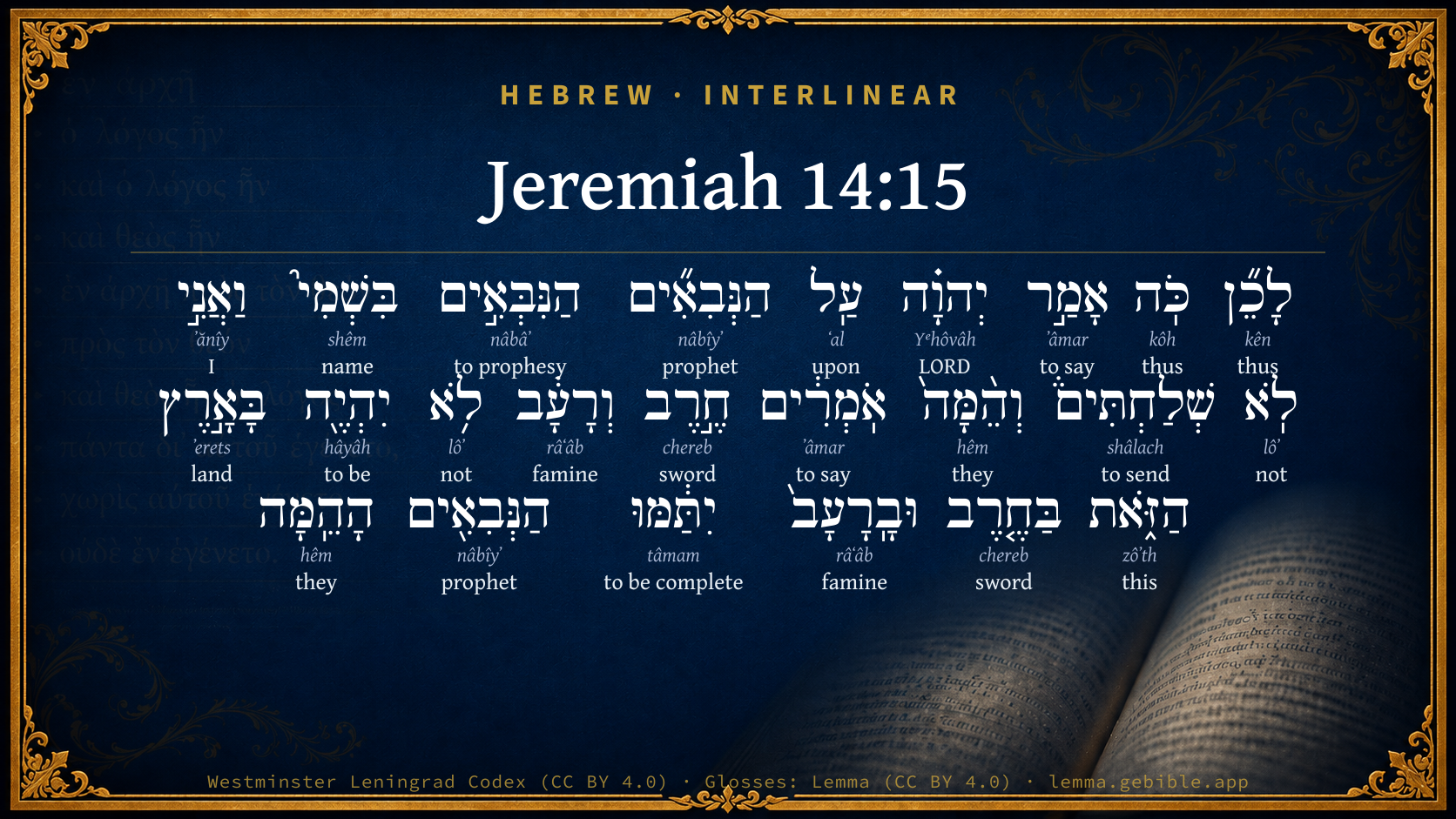
Jeremiah 14:15

Hebrew (Westminster Leningrad Codex) Jeremiah 14:15 appears in the Hebrew Old Testament. The text above is from the Westminster Leningrad Codex. Each word links to its Strong’s number, a concise gloss, and parsing drawn from the Open Scriptures Hebrew Bible morphology. Click any word for its full Brown-Driver-Briggs (BDB) entry.
Download image
Cite this verse

Jeremiah 14:15 (World English Bible). Public Domain. Lemma interlinear Bible study tool, https://lemma.gebible.app/v/jeremiah/14/15.

Show BibTeX & RIS
BibTeX
RIS
English Translation
Therefore thus says Yahweh concerning the prophets who prophesy in my name, and I didn't send them, yet they say, Sword and famine shall not be in this land: By sword and famine shall those prophets be consumed.
World English Bible · Public Domain
Download a study sheet

One document with this verse’s original text, its word-by-word gloss line, the meaning frame, cross-references with their text, attributed commentary, and full source and license credits — printable, and it pastes into notes with its structure intact.

This verse Autodidact and up

Study sheet (.html) Plain text (.txt)

A passage Seminary Student

Up to 50 verses in one chapter. A passage sheet keeps up to 6 commentary sources and 12 cross-references per verse, in the order this page ranks them, and says so on the sheet whenever that leaves anything out. Ask for a single verse and you get the Autodidact verse sheet above.

Everything on this page stays free to read, with no account — the sheet is a download of what is already on screen, not access to it.

Want to remove ads? Support Godless Engineer
Compare translations 3

The same verse in 3 English versions, stacked beneath the original-language interlinear above. Click any original word for its lexicon entry.

Each is an independent rendering of the whole verse — the interlinear is not word-aligned to these translations.

Highlighted words mark where these versions differ — a whole-verse word diff, not a word-by-word alignment.

  • World English Bible Public Domain
    Therefore thus says Yahweh concerning the prophets who prophesy in my name, and I didn't send them, yet they say, Sword and famine shall not be in this land: By sword and famine shall those prophets be consumed.
  • King James Version Public Domain
    Therefore thus saith the LORD concerning the prophets that prophesy in my name, and I sent them not, yet they say, Sword and famine shall not be in this land; By sword and famine shall those prophets be consumed.
  • unfoldingWord Literal Text CC BY-SA 4.0
    Therefore thus says Yahweh concerning the prophets, the ones prophesying in my name when I did not send them and they are saying, ‘Sword and famine there shall not be in this land.’ Those prophets shall perish by sword and by famine.

unfoldingWord Literal Text — © unfoldingWord, licensed CC BY-SA 4.0. Word-aligned USFM3 via Door43 (git.door43.org/unfoldingWord/en_ult).

Versions to compare (up to 4)

3 of 4 selected

Show all 18 translations

Every available English version of this verse, each an independent rendering of the whole verse.

  • World English Bible Public Domain
    Therefore thus says Yahweh concerning the prophets who prophesy in my name, and I didn't send them, yet they say, Sword and famine shall not be in this land: By sword and famine shall those prophets be consumed.
  • Berean Standard Bible Public Domain
    Therefore this is what the LORD says about the prophets who prophesy in My name: I did not send them, yet they say, ‘No sword or famine will touch this land.’ By sword and famine these very prophets will meet their end!
  • Majority Standard Bible Public Domain
    Therefore this is what the LORD says about the prophets who prophesy in My name: I did not send them, yet they say, ‘No sword or famine will touch this land.’ By sword and famine these very prophets will meet their end!
  • King James Version Public Domain
    Therefore thus saith the LORD concerning the prophets that prophesy in my name, and I sent them not, yet they say, Sword and famine shall not be in this land; By sword and famine shall those prophets be consumed.
  • American Standard Version (1901) Public Domain
    Therefore thus saith Jehovah concerning the prophets that prophesy in my name, and I sent them not, yet they say, Sword and famine shall not be in this land: By sword and famine shall those prophets be consumed.
  • Revised Version (1885) Public Domain
    Therefore thus saith the LORD concerning the prophets that prophesy in my name, and I sent them not, yet they say, Sword and famine shall not be in this land: By sword and famine shall those prophets be consumed.
  • Geneva Bible (1599) Public Domain
    Therefore thus saith the Lord, Concerning the prophets that prophecie in my Name, whom I haue not sent, yet they say, Sworde and famine shall not be in this land, by sword and famine shall those prophets be consumed.
  • Douay-Rheims (1899) Public Domain
    Therefore thus saith the Lord concerning the prophets that prophecy in my name, whom I did not send, that say: Sword and famine shall not be in this land: By sword and famine shall those prophets be consumed.
  • Young's Literal Translation Public Domain
    Therefore, thus said Jehovah concerning the prophets who are prophesying in My name, and I have not sent them, and they are saying, Sword and famine is not in this land: By sword and by famine are these prophets consumed.
  • Literal Standard Version CC BY-SA 4.0
    Therefore, thus said YHWH concerning the prophets who are prophesying in My Name and I have not sent them, and they are saying, Sword and famine is not in this land: By sword and by famine are these prophets consumed.
  • Unlocked Literal Bible CC BY-SA 4.0
    Therefore Yahweh says this, “About the prophets prophesying in my name but whom I did not send out—those who say there will be no sword or famine in this land: These prophets will perish by sword and famine.
  • unfoldingWord Literal Text CC BY-SA 4.0
    Therefore thus says Yahweh concerning the prophets, the ones prophesying in my name when I did not send them and they are saying, ‘Sword and famine there shall not be in this land.’ Those prophets shall perish by sword and by famine.
  • Darby Bible Public Domain
    Therefore thus saith Jehovah concerning the prophets that prophesy in my name, and I sent them not, and who say, Sword and famine shall not be in this land: By sword and by famine shall those prophets be consumed;
  • World Messianic Bible Public Domain
    Therefore the LORD says concerning the prophets who prophesy in my name, but I didn’t send them, yet they say, ‘Sword and famine will not be in this land.’ Those prophets will be consumed by sword and famine.
  • Webster's Bible Public Domain
    Therefore thus saith the LORD concerning the prophets that prophesy in my name, and I sent them not, yet they say, Sword and famine shall not be in this land; By sword and famine shall those prophets be consumed.
  • Free Bible Version CC BY-SA 4.0
    So this is what the Lord says about such prophets who prophesy in my name: I didn't send them, but even so they say, “This country won't suffer war or famine.” These same prophets will die from war or famine!
  • Bible in Basic English Public Domain
    So this is what the Lord has said about the prophets who make use of my name, though I sent them not, and say, The sword and need of food will not be in this land: the sword and need of food will put an end to those prophets.
  • JPS Tanakh (1917) Public Domain
    Therefore thus saith the LORD: As for the prophets that prophesy in My name, and I sent them not, yet they say: Sword and famine shall not be in this land, by sword and famine shall those prophets be consumed;

Literal Standard Version (2020), Covenant Press — licensed CC BY-SA 4.0. Text via the HelloAO Bible API (eBible.org). Unlocked Literal Bible (unfoldingWord) — licensed CC BY-SA 4.0. Text via the HelloAO Bible API (eBible.org). unfoldingWord Literal Text — © unfoldingWord, licensed CC BY-SA 4.0. Word-aligned USFM3 via Door43 (git.door43.org/unfoldingWord/en_ult). Free Bible Version, Dr. Jonathan Gallagher — licensed CC BY-SA 4.0. Text via the HelloAO Bible API (eBible.org).

Word by word

More ways to search: Search by grammar → Find every occurrence → Compare this word →

Practice this passage: Drill this verse → Learn its vocabulary →

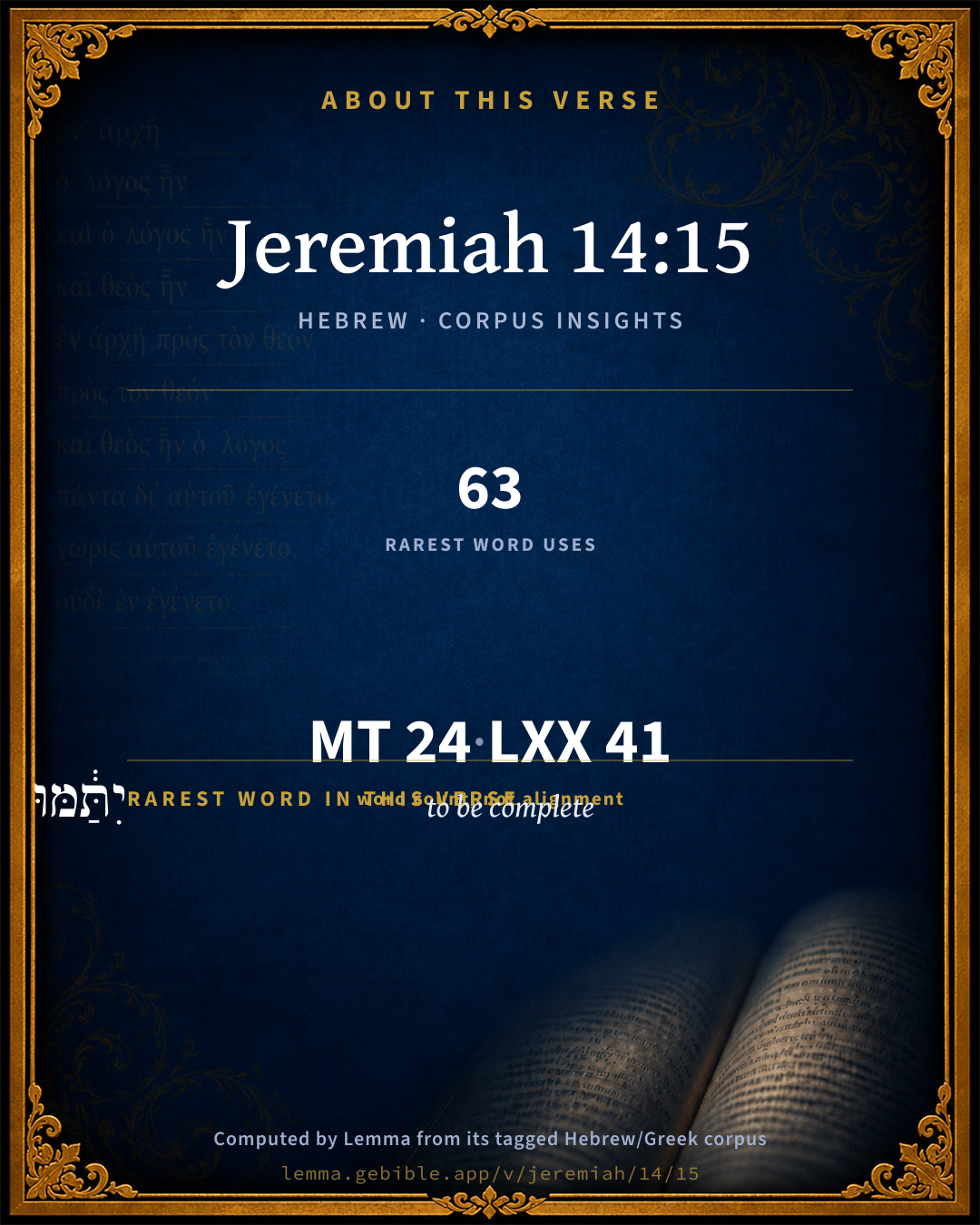
יִתַּ֔מּוּ
tâmam
H8552
“to be complete”
Verb, Qal, Imperfect, 3rd Person, Masculine, Plural
Part of Speech
Verb
Stem
Qal
Form
Imperfect
Person
3rd Person
Gender
Masculine
Number
Plural
Full BDB Definition

Origin: a primitive root

TWOT: 2522

to be complete, be finished, be at an end - (Qal) - to be finished, be completed - completely, wholly, entirely (as auxiliary with verb) - to be finished, come to an end, cease - to be complete (of number) - to be consumed, be exhausted, be spent - to be finished, be consumed, be destroyed - to be complete, be sound, be unimpaired, be upright - to complete, finish - to be completely crossed over - (Niphal) to be consumed - (Hiphil) - to finish, complete, perfect - to finish, cease doing, leave off doing - to complete, sum up, make whole - to destroy (uncleanness) - to make sound - (Hithpael) to deal in integrity, act uprightly
  1. לָכֵ֞ן kên H3651 “to/for · thus” Preposition + Adverb
  2. כֹּֽה kôh H3541 “thus” Adverb
  3. אָמַ֣ר ʼâmar H559 “to say” Verb, Qal, Perfect, 3rd Person, Masculine, Singular
  4. יְהוָ֗ה Yᵉhôvâh H3068 “LORD” Noun, Proper
  5. עַֽל ʻal H5921 “upon” Preposition
  6. הַנְּבִאִ֞ים nâbîyʼ H5030 “the · prophets” Particle, Definite Article + Noun, Common, Masculine, Plural, Absolute
  7. הַנִּבְּאִ֣ים nâbâʼ H5012 “the · prophesying” Particle, Definite Article + Verb, Niphal, Participle Active, Masculine, Plural, Absolute
  8. בִּשְׁמִי֮ shêm H8034 “in/at · name · my” Preposition + Noun, Common, Masculine, Singular, Construct + Suffix, Personal, 1st Person, Common, Singular
  9. וַאֲנִ֣י ʼănîy H589 “and · I” Conjunction + Pronoun, Personal, 1st Person, Common, Singular
  10. לֹֽא lôʼ H3808 “not” Particle, Negative
  11. שְׁלַחְתִּים֒ shâlach H7971 “to send · them” Verb, Qal, Perfect, 1st Person, Common, Singular + Suffix, Personal, 3rd Person, Masculine, Plural
  12. וְהֵ֨מָּה֙ hêm H1992 “and · they” Conjunction + Pronoun, Personal, 3rd Person, Masculine, Plural
  13. אֹֽמְרִ֔ים ʼâmar H559 “saying” Verb, Qal, Participle Active, Masculine, Plural, Absolute
  14. חֶ֣רֶב chereb H2719 “sword” Noun, Common, Feminine, Singular, Absolute
  15. וְרָעָ֔ב râʻâb H7458 “and · famine” Conjunction + Noun, Common, Masculine, Singular, Absolute
  16. לֹ֥א lôʼ H3808 “not” Particle, Negative
  17. יִהְיֶ֖ה hâyâh H1961 “to be” Verb, Qal, Imperfect, 3rd Person, Masculine, Singular
  18. בָּאָ֣רֶץ ʼerets H776 “in/at the · land” Preposition, Determined + Noun, Common, Both, Singular, Absolute
  19. הַזֹּ֑את zôʼth H2063 “the · this” Particle, Definite Article + Pronoun, Demonstrative, Feminine, Singular
  20. בַּחֶ֤רֶב chereb H2719 “in/at the · sword” Preposition, Determined + Noun, Common, Feminine, Singular, Absolute
  21. וּבָֽרָעָב֙ râʻâb H7458 “and · in/at the · famine” Conjunction + Preposition, Determined + Noun, Common, Masculine, Singular, Absolute
  22. הַנְּבִאִ֖ים nâbîyʼ H5030 “the · prophets” Particle, Definite Article + Noun, Common, Masculine, Plural, Absolute
  23. הָהֵֽמָּה hêm H1992 “the · they” Particle, Definite Article + Pronoun, Personal, 3rd Person, Masculine, Plural

About this verse

These counts appear in no published source. They are computed here, from the morphology-tagged text and Lemma’s own curated glosses. What Lemma adds →

24
words
18
distinct lemmas
Prophets
section

Grammatical profile

  • 6 verbs
  • 9 nouns
  • 4 pronouns
  • 1 preposition
  • 2 adverbs
  • 2 particles

Verb forms

  • אָמַ֣ר Qal · Perfect
  • הַנִּבְּאִ֣ים Niphal · Participle Active
  • שְׁלַחְתִּים֒ Qal · Perfect
  • אֹֽמְרִ֔ים Qal · Participle Active
  • יִהְיֶ֖ה Qal · Imperfect
  • יִתַּ֔מּוּ Qal · Imperfect

Repetition

Words recur within this verse — often emphatic in Hebrew:

  • אָמַ֣ר to say H559 ×2
  • הַנְּבִאִ֞ים prophet H5030 ×2
  • חֶ֣רֶב sword H2719 ×2
  • וְרָעָ֔ב famine H7458 ×2
  • לֹֽא not H3808 ×2
  • וְהֵ֨מָּה֙ they H1992 ×2

Hebrew & Septuagint length

In the original languages it is 24 Hebrew tokens and 41 Greek tokens — but the two are counted differently (Hebrew bundles its prefixes and suffixes into one token; the Greek is in lemma form), so that isn’t a like-for-like length.

Cross-references

14

Topical passages linked to Jeremiah 14:15 in the Treasury of Scripture Knowledge — connected by theme and wording, ordered by reader-vote popularity; previews shown in the World English Bible.

  • Jeremiah 5:12–13 They have denied Yahweh, and said, It is not he; neither shall evil come on us; neither shall we see sword nor famine:
  • Ezekiel 14:10 They shall bear their iniquity: the iniquity of the prophet shall be even as the iniquity of him who seeks [to him];
  • 1 Kings 22:25 Micaiah said, Behold, you shall see on that day, when you shall go into an inner chamber to hide yourself.
  • Jeremiah 6:15 Were they ashamed when they had committed abomination? nay, they were not at all ashamed, neither could they blush: therefore they shall fall among those who fall; at the time that I visit them they shall be cast down, says Yahweh.
  • Jeremiah 8:12 Were they ashamed when they had committed abomination? nay, they were not at all ashamed, neither could they blush: therefore shall they fall among those who fall; in the time of their visitation they shall be cast down, says Yahweh.
  • Jeremiah 20:6 You, Pashhur, and all who dwell in your house shall go into captivity; and you shall come to Babylon, and there you shall die, and there shall you be buried, you, and all your friends, to whom you have prophesied falsely.
  • Jeremiah 23:14–15 In the prophets of Jerusalem also I have seen a horrible thing: they commit adultery, and walk in lies; and they strengthen the hands of evil-doers, so that none does return from his wickedness: they are all of them become to me as Sodom, and the inhabitants of it as Gomorrah.
  • Jeremiah 28:15–17 Then said the prophet Jeremiah to Hananiah the prophet, Hear now, Hananiah: Yahweh has not sent you; but you make this people to trust in a lie.
  • Jeremiah 29:20–21 Hear you therefore the word of Yahweh, all you of the captivity, whom I have sent away from Jerusalem to Babylon.
  • Jeremiah 29:31–32 Send to all them of the captivity, saying, Thus says Yahweh concerning Shemaiah the Nehelamite: Because Shemaiah has prophesied to you, and I didn't send him, and he has caused you to trust in a lie;
  • Amos 7:17 Therefore thus says Yahweh: 'Your wife shall be a prostitute in the city, and your sons and your daughters shall fall by the sword, and your land shall be divided by line; and you yourself shall die in a land that is unclean, and Israel shall surely be led away captive out of his land.'"
  • 2 Peter 2:1–3 But there also arose false prophets among the people, as among you also there will be false teachers, who will secretly bring in destructive heresies, denying even the Master who bought them, bringing on themselves swift destruction.
  • 2 Peter 2:14–17 having eyes full of adultery, and who can't cease from sin; enticing unsettled souls; having a heart trained in greed; children of cursing;
  • Revelation 19:20 The beast was taken, and with him the false prophet who worked the signs in his sight, with which he deceived those who had received the mark of the beast and those who worshiped his image. These two were thrown alive into the lake of fire that burns with sulfur.

Cross-references courtesy of OpenBible.info (CC BY 4.0).

Hebrew and Greek witnesses Masoretic Hebrew ↔ Greek Septuagint

The same verse in the two great witnesses to the Old Testament, shown verse-for-verse.

These are two independent witnesses, not word-aligned to each other, and the Septuagint is shown in lemma (dictionary) form.

Hebrew Jeremiah 14:15 Masoretic · Westminster Leningrad Codex

לָכֵ֞ן כֹּֽה אָמַ֣ר יְהוָ֗ה עַֽל הַנְּבִאִ֞ים הַנִּבְּאִ֣ים בִּשְׁמִי֮ וַאֲנִ֣י לֹֽא שְׁלַחְתִּים֒ וְהֵ֨מָּה֙ אֹֽמְרִ֔ים חֶ֣רֶב וְרָעָ֔ב לֹ֥א יִהְיֶ֖ה בָּאָ֣רֶץ הַזֹּ֑את בַּחֶ֤רֶב וּבָֽרָעָב֙ יִתַּ֔מּוּ הַנְּבִאִ֖ים הָהֵֽמָּה

Therefore thus says Yahweh concerning the prophets who prophesy in my name, and I didn't send them, yet they say, Sword and famine shall not be in this land: By sword and famine shall those prophets be consumed.

World English Bible · Public Domain

Greek LXX Structure differs

In the Septuagint, Jeremiah is about an eighth shorter than the Hebrew and arranges its material differently — the Oracles Against the Nations (Hebrew chapters 46–51) appear in the middle of the Greek book, after 25:13. Because the chapter and verse boundaries do not line up, a verse-for-verse comparison with the Hebrew is not shown.

A verse-for-verse comparison isn’t shown here because the chapters and verses don’t line up. Switch to the LXX edition with the MT / LXX toggle above to read the Greek directly.

Hebrew: Westminster Leningrad Codex (CC BY 4.0). Greek: Septuagint (public domain); English from a public-domain English Septuagint. How the Septuagint differs from the Hebrew →

Targum (Aramaic paraphrase)

1

The Targum is the ancient Jewish Aramaic paraphrase of the Hebrew Scriptures — an interpretive translation, not the Hebrew text itself. Onkelos (literal) and Pseudo-Jonathan (expansive) render the Torah, and Jonathan the Prophets. Coverage is partial: where no permissively-licensed English translation exists for a verse, only the Aramaic is shown. This is verse-level text, not a word-by-word alignment to the Hebrew.

  1. Targum Jonathan Prophets (Joshua–Malachi)
    בְּכֵן כִּדְנַן אֲמַר יְיָ עַל נְבִיֵי שִׁקְרָא דְמִתְנַבָּן בִּשְׁמִי וַאֲנָא לָא שְׁלַחְתִּינוּן וְאִינוּן אָמְרִין חַרְבָּא וְכַפְנָא לָא יְהֵי בְאַרְעָא הָדָא בְּחַרְבָּא וּבְכַפְנָא יְסוּפוּן נְבִיֵי שִׁקְרָא הָאִינוּן:

    (no public-domain English translation for this verse)

    Targum Jonathan — Aramaic: “Mikraot Gedolot” (public domain). English: “Sefaria Community Translation” (CC0 1.0 (public-domain dedication)); “London "Chaldee Paraphrase," 1871” (public domain). Text via Sefaria.

Commentary

Notes on Jeremiah 14:15 from classic Christian and Jewish commentators (each source and its license shown beneath its notes). The classic Christian expositions comment on the surrounding passage and are grouped to its opening verse, so a note may address several verses; the Jewish commentaries on the Tanakh (Rashi and others) are per-verse, so they appear only where the commentator wrote on this verse.

Lemma curates 59 commentaries, every one of them public domain or Creative Commons licensed, each selected and text-cleaned for this edition rather than reprinted as found. About our sources →

Trapp's Complete Commentary

John Trapp

Jer 14:15 Therefore thus saith the LORD concerning the prophets that prophesy in my name, and I sent them not, yet they say, Sword and famine shall not be in this land; By sword and famine shall those prophets be consumed.

Ver. 15. Yet they say.] Heb., They are saying. This is all their song, though the present famine doth in part confute them; but the people were willing enough to be deceived, and were therefore worthily punished. Being infatuated, they were seduced; and being so seduced, they were justly judged, as Augustine somewhere. The blind led the blind, and both fell into the ditch, though it befell the blind guides to lie nethermost.

John Trapp, A Commentary or Exposition upon All the Books of the Old and New Testament (1647–1656) — public domain. Text from a community e-Sword module.

Jamieson, Fausset & Brown

Robert Jamieson, A. R. Fausset & David Brown

(Jer 5:12-13).

By sword and famine . . . consumed--retribution in kind both to the false prophets and to their hearers (Jer 14:16).

Jamieson, Fausset & Brown — Commentary Critical and Explanatory on the Whole Bible (1871) — public domain (CC PDM 1.0). Text via the HelloAO Bible API.

Adam Clarke's Commentary

Verse 15. By sword and famine shall those prophets be consumed.] Jeremiah had told Jehoiakim that, if he rebelled against Nebuchadnezzar, he should be overthrown, and the land wasted by sword and famine: the false prophets said there shall be neither sword nor famine, but peace and prosperity. The king believed them, and withheld the tribute. Nebuchadnezzar, being incensed, invaded and destroyed the land; and the false prophets fell in these calamities. See 2Kg 25:3; La 2:11-19.

Adam Clarke's Commentary on the Bible (1810–1826) — public domain. Text from a community e-Sword/MySword module.

John Calvin's Commentaries

Jeremiah, after having declared to the false prophets, that as they had by their flatteries deceived the people, they would have to suffer the punishment they had deserved, turns now his address to the people themselves. God might, however, have seemed to deal with them rather hardly, that he inflicted so severe a punishment on men who had been deceived; but the answer to this is evident; for it is certain that except the world winingly sought falsehoods, the power of the devil to deceive would not be so great. When men therefore are led astray by impostures, it happens through their own fault, inasmuch as they are more ready to embrace vanity than to submit to God and his word. And we must remember that saying of Paul, that all the reprobate are blinded and given up to a reprobate mind, because they wilfully seek falsehood, and will not obey the truth. (Romans 1:28) And on this account God declares that he tries the hearts of men, whenever false prophets come abroad; for every one who really fears God shall by no means be led away by the deceits of Satan and of impostors. Hence, whenever men are too credulous and readily embrace deceptions, it is certain that their hypocrisy is thus justly punished by God. And it was well known to the Prophet, that the Jews ever wished for such prophets as soothed their ears and promised them an abundant harvest and a fruitful vintage. (Micah 2:11) As then they had itching ears, a liberty was justly given to Satan to deluge the whole land with falsehood; and so indeed it happened. There is then no wonder that the Lord was so severe in chastising the people; for they had not been deceived except through their own fault. The same thing happens at this day. Though we are touched with pity when we see the ministers of Satan prevail in deceiving the common people: yet we must remember that a reward is rendered by heaven for the impiety of men, who either extinguish or smother the light of God as much as they can, and seek to plunge into darkness.

John Calvin's Commentaries (1540-1563) — public domain. Text from the Calvin Translation Society English edition (1840s-50s) via the Christian Classics Ethereal Library (ccel.org). Calvin's coverage is partial (roughly two-thirds of the Bible); uncommented books and verses are honest gaps, never fabricated. The 19th-century editor's footnotes and remarks are omitted so the notes are faithfully Calvin's own voice.

Ellicott's Commentary for English Readers

(15) Therefore thus saith the Lord.—To the mind of a true prophet, feeling that he was taught of God, nothing could be more hateful than the acts of those who, for selfish ends, were leading the people to their destruction. For them there was therefore the righteous retribution that they should perish in the very calamities which they had asserted would never come.

A Bible Commentary for English Readers, edited by Charles John Ellicott (1878–1897) — public domain. Text from a community e-Sword module.

The Cambridge Bible for Schools and Colleges

gen. ed. J. J. S. Perowne

15, 16. Gi. now (Metrik) omits these vv., apparently as failing to satisfy the metrical conditions which prevail elsewhere in the ch. (Ḳinah).

The Cambridge Bible for Schools and Colleges (gen. ed. J. J. S. Perowne; Cambridge University Press, 1878–1918) — public domain. Text from a community e-Sword module.

John Gill's Exposition

Therefore thus saith the Lord concerning the prophets,.... The false prophets, as the following description shows:

that prophecy in my name, and I sent them not; made use of his name, pretending his authority, though they were not sent by him:

yet they say, sword and famine shall not be in the land; though the Lord by his true prophet had said there should be both; which proves that they were not sent by the Lord, since what they said was in direct opposition to the word of the Lord; wherefore their doom in righteous judgment follows:

by sword and famine shall these prophets be consumed; they should be some of the first, if not the first that should perish by these calamities; which would abundantly prove the falsehood of their predictions, and show that their lies could neither secure themselves nor others from the judgments which the Lord had said should come upon them.

John Gill's Exposition of the Whole Bible (1746–1763) — public domain (CC PDM 1.0). Text via the HelloAO Bible API.

Matthew Poole's English Annotations

It is a most dangerous thing for ecclesiastical ministers to deliver that to people as the will of God which is not so. God here threateneth that these prophets, in testimony of the truth of the word of God delivered by Jeremiah, should die by these very judgments which they falsely prophesied to this people, as from God, an immunity from: see Jer 6:15; 20:6; 1Ki 22:25.

Matthew Poole's English Annotations on the Holy Bible (1683–1685) — public domain. Text from a community e-Sword/MySword module.

Whedon's Commentary on the Bible

Daniel D. Whedon

15, 16. I sent them not — A solemn reiteration of God’s purpose to execute his own truth as against all assurances to the contrary. The chariot-wheels of Jehovah’s purposes shall roll on, even though they roll in fire.

I will pour their wickedness upon them — it is the animus of wickedness to destroy all good and precious things, even God himself; hence this is the direst of threats.

Daniel D. Whedon (gen. ed.), Commentary on the Old and New Testaments (1874–1909) — public domain. Text from a community e-Sword module.

unfoldingWord translationNotes

Door43 World Missions Community

General Information:

Jeremiah has just been talking to Yahweh about the things the false prophets have been prophesying.

in my name

This phrase refers to speaking with Yahweh's power and authority or as his representative. See how you translated this in Jeremiah 14:14. (See: Metonymy)

there will be no sword ... and sword

Here the "sword" represents war. AT: "there will be no war ... and war" (See: Metonymy)

Then the people to whom they prophesied will be thrown out in the streets of Jerusalem because of famine and sword

This can be stated in active form. This means that whole families will die and people will throw their bodies into the streets instead of burying them. AT: "Then the people to whom they prophesied will die by famine and sword and people will throw their bodies into the streets of Jerusalem" (See: Active or Passive)

their wives, their sons, or their daughters

This describes who is referred to by the word "them," that is, everyone who died by famine and sword.

I will pour out their wickedness on them

Here Yahweh speaks of punishing the people in accordance to their wicknedness as if their own wickedness were a liquid that he would pour upon them. AT: "I will punish them like they deserve to be punished" (See: Metaphor)

translationWords

sword

famine

perish

Jerusalem

bury

evil

unfoldingWord translationNotes — © Distant Shores Media and the Door43 World Missions Community, licensed CC BY-SA 4.0. Source: git.door43.org/Door43/en_tn.

Lesson kit

Teaching starters — assembled from the data on this page, not authored interpretation. Every prompt links to the verse data it draws on. Edit before teaching.

Jeremiah, in the Prophets, opens this verse with 24 words (18 distinct Hebrew lemmas). Its most distinctive word is tâmam (“to be complete”). A historical commentator’s framing appears above. Read the whole chapter for the surrounding context.

Discussion questions

  1. The word tâmam carries the sense “to be complete.” How does it shape the verse?
  2. Jeremiah 5:12–13 shares this passage’s theme. How do the two illuminate each other?
  3. “to say” occurs 2× in this one verse. What is the effect of the repetition?
  4. These translations render this verse differently. What is at stake in choosing one wording over another?
  5. The verb «אָמַ֣ר» is Qal Perfect. How does its form color the action?
  6. Reading how Trapp's Complete Commentary and Jamieson, Fausset & Brown read this verse, where do the two commentators agree and where do they part?

Things to notice

Reading settings

Reading text

Shown beneath each verse's original-language words.

Old Testament
Old Testament edition

Read the OT as the Masoretic Hebrew (MT) or the Greek Septuagint (LXX).

English shown for the Greek Septuagint (in the Hebrew ↔ Greek comparison).

Comparing translations? Open the Compare panel on any verse page to stack up to four side by side.