
Joshua 10:32

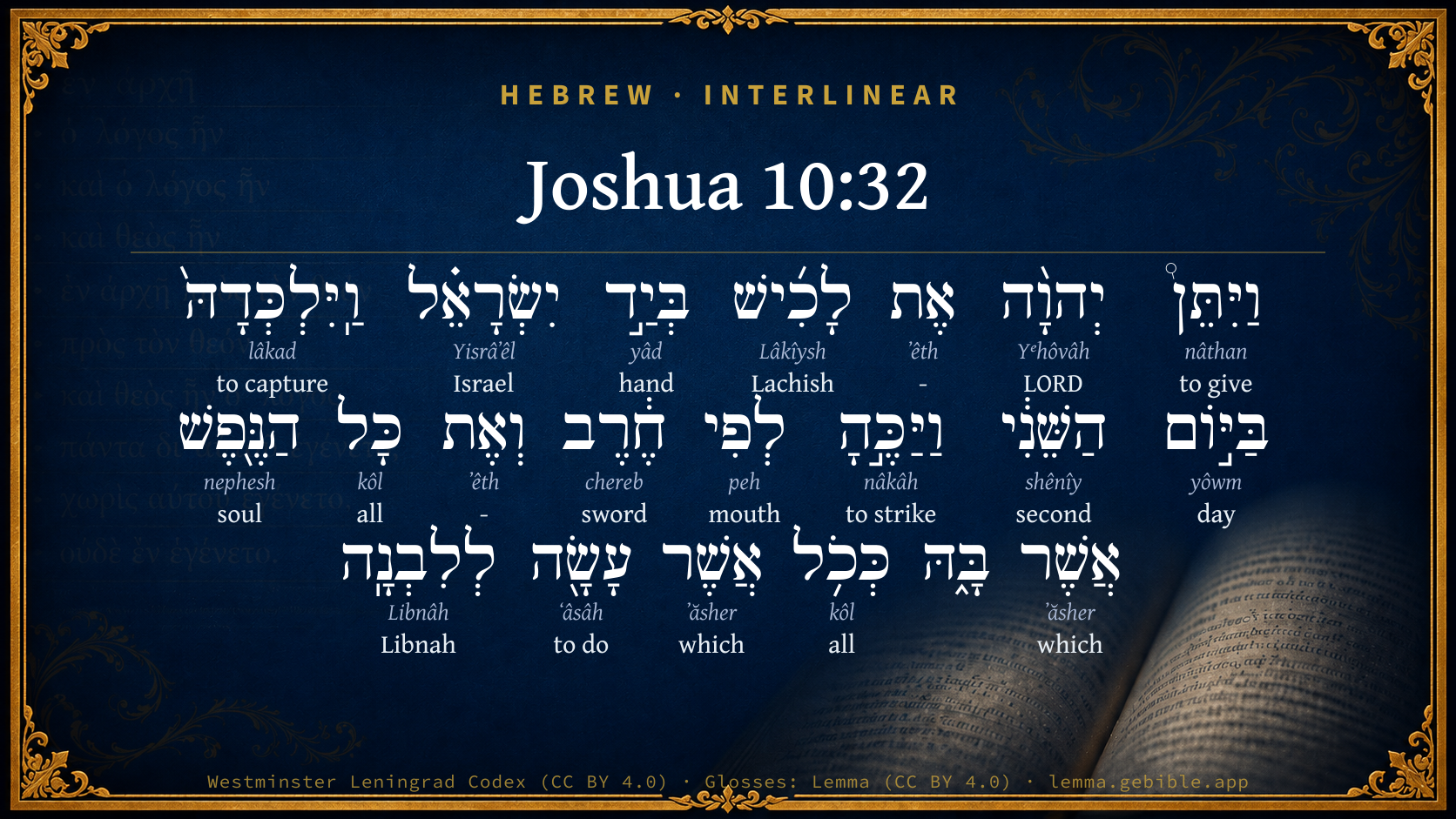
Hebrew (Westminster Leningrad Codex) Joshua 10:32 appears in the Hebrew Old Testament. The text above is from the Westminster Leningrad Codex. Each word links to its Strong’s number, a concise gloss, and parsing drawn from the Open Scriptures Hebrew Bible morphology. Click any word for its full Brown-Driver-Briggs (BDB) entry.
Download image
Cite this verse

Joshua 10:32 (World English Bible). Public Domain. Lemma interlinear Bible study tool, https://lemma.gebible.app/v/joshua/10/32.

Show BibTeX & RIS
BibTeX
RIS
English Translation
and Yahweh delivered Lachish into the hand of Israel; and he took it on the second day, and struck it with the edge of the sword, and all the souls who were therein, according to all that he had done to Libnah.
World English Bible · Public Domain
Download a study sheet

One document with this verse’s original text, its word-by-word gloss line, the meaning frame, cross-references with their text, attributed commentary, and full source and license credits — printable, and it pastes into notes with its structure intact.

This verse Autodidact and up

Study sheet (.html) Plain text (.txt)

A passage Seminary Student

Up to 50 verses in one chapter. A passage sheet keeps up to 6 commentary sources and 12 cross-references per verse, in the order this page ranks them, and says so on the sheet whenever that leaves anything out. Ask for a single verse and you get the Autodidact verse sheet above.

Everything on this page stays free to read, with no account — the sheet is a download of what is already on screen, not access to it.

Want to remove ads? Support Godless Engineer
Compare translations 3

The same verse in 3 English versions, stacked beneath the original-language interlinear above. Click any original word for its lexicon entry.

Each is an independent rendering of the whole verse — the interlinear is not word-aligned to these translations.

Highlighted words mark where these versions differ — a whole-verse word diff, not a word-by-word alignment.

  • World English Bible Public Domain
    and Yahweh delivered Lachish into the hand of Israel; and he took it on the second day, and struck it with the edge of the sword, and all the souls who were therein, according to all that he had done to Libnah.
  • King James Version Public Domain
    And the LORD delivered Lachish into the hand of Israel, which took it on the second day, and smote it with the edge of the sword, and all the souls that were therein, according to all that he had done to Libnah.
  • unfoldingWord Literal Text CC BY-SA 4.0
    And Yahweh gave Lachish into the hand of Israel, and he captured it on the second day and struck it and every soul that in it to the mouth of the sword, according to all that he had done to Libnah.

unfoldingWord Literal Text — © unfoldingWord, licensed CC BY-SA 4.0. Word-aligned USFM3 via Door43 (git.door43.org/unfoldingWord/en_ult).

Versions to compare (up to 4)

3 of 4 selected

Show all 18 translations

Every available English version of this verse, each an independent rendering of the whole verse.

  • World English Bible Public Domain
    and Yahweh delivered Lachish into the hand of Israel; and he took it on the second day, and struck it with the edge of the sword, and all the souls who were therein, according to all that he had done to Libnah.
  • Berean Standard Bible Public Domain
    And the LORD delivered Lachish into the hand of Israel, and Joshua captured it on the second day. He put all the people to the sword, just as he had done to Libnah.
  • Majority Standard Bible Public Domain
    And the LORD delivered Lachish into the hand of Israel, and Joshua captured it on the second day. He put all the people to the sword, just as he had done to Libnah.
  • King James Version Public Domain
    And the LORD delivered Lachish into the hand of Israel, which took it on the second day, and smote it with the edge of the sword, and all the souls that were therein, according to all that he had done to Libnah.
  • American Standard Version (1901) Public Domain
    and Jehovah delivered Lachish into the hand of Israel; and he took it on the second day, and smote it with the edge of the sword, and all the souls that were therein, according to all that he had done to Libnah.
  • Revised Version (1885) Public Domain
    and the LORD delivered Lachish into the hand of Israel, and he took it on the second day, and smote it with the edge of the sword, and all the souls that were therein, according to all that he had done to Libnah.
  • Geneva Bible (1599) Public Domain
    And the Lord gaue Lachish into the hand of Israel, which tooke it the second day, and smote it with the edge of the sword, and all the soules that were therein, according to all as he had done to Libnah.
  • Douay-Rheims (1899) Public Domain
    And the Lord delivered Lachis into the hands of Israel, and he took it the following day, and put it to the sword, and every soul that was in it, as he had done to Lebna.
  • Young's Literal Translation Public Domain
    And Jehovah giveth Lachish into the hand of Israel, and it captureth it on the second day, and smiteth it by the mouth of the sword, and every person who `is' in it, according to all that it did to Libnah.
  • Literal Standard Version CC BY-SA 4.0
    And YHWH gives Lachish into the hand of Israel, and [Joshua] captures it on the second day, and strikes it by the mouth of the sword, and every person who [is] in it, according to all that he did to Libnah.
  • Unlocked Literal Bible CC BY-SA 4.0
    Yahweh gave Lachish into the hand of Israel. Joshua captured it on the second day and struck it with the edge of the sword, and every person in it, just as he had done to Libnah.
  • unfoldingWord Literal Text CC BY-SA 4.0
    And Yahweh gave Lachish into the hand of Israel, and he captured it on the second day and struck it and every soul that in it to the mouth of the sword, according to all that he had done to Libnah.
  • Darby Bible Public Domain
    And Jehovah gave Lachish into the hand of Israel; and they took it on the second day, and smote it with the edge of the sword, and all the souls that were therein, according to all that he had done to Libnah.
  • World Messianic Bible Public Domain
    The LORD delivered Lachish into the hand of Israel. He took it on the second day, and struck it with the edge of the sword, with all the souls who were in it, according to all that he had done to Libnah.
  • Webster's Bible Public Domain
    And the LORD delivered Lachish into the hand of Israel, who took it on the second day, and smote it with the edge of the sword, and all the souls that were in it, according to all that he had done to Libnah.
  • Free Bible Version CC BY-SA 4.0
    The Lord gave the town to the Israelites who captured it on the second day. Joshua had everyone in it killed, just as he had done in Libnah.
  • Bible in Basic English Public Domain
    And the Lord gave Lachish into the hands of Israel, and on the second day he took it, putting it and every person in it to the sword without mercy, as he had done to Libnah.
  • JPS Tanakh (1917) Public Domain
    And the LORD delivered Lachish into the hand of Israel, and he took it on the second day, and smote it with the edge of the sword, and all the souls that were therein, according to all that he had done to Libnah.

Literal Standard Version (2020), Covenant Press — licensed CC BY-SA 4.0. Text via the HelloAO Bible API (eBible.org). Unlocked Literal Bible (unfoldingWord) — licensed CC BY-SA 4.0. Text via the HelloAO Bible API (eBible.org). unfoldingWord Literal Text — © unfoldingWord, licensed CC BY-SA 4.0. Word-aligned USFM3 via Door43 (git.door43.org/unfoldingWord/en_ult). Free Bible Version, Dr. Jonathan Gallagher — licensed CC BY-SA 4.0. Text via the HelloAO Bible API (eBible.org).

Word by word

More ways to search: Search by grammar → Find every occurrence → Compare this word →

Practice this passage: Drill this verse → Learn its vocabulary →

לְלִבְנָֽה
Libnâh
H3841
“to/for · Libnah”
Preposition + Noun, Proper
Part of Speech
Preposition + Noun
Type
Proper
Full BDB Definition

Origin: the same as H3839

TWOT: None

Libnah = "pavement" - a royal city of the Canaanites in the southwest captured by Joshua; allocated to Judah and made a Levitical city; site unknown - a station between Sinai and Kadesh of Israel during their wilderness wanderings
  1. וַיִּתֵּן֩ nâthan H5414 “and · to give” Conjunction + Verb, Qal, Sequential Imperfect, 3rd Person, Masculine, Singular
  2. יְהוָ֨ה Yᵉhôvâh H3068 “LORD” Noun, Proper
  3. אֶת ʼêth H853 “-” Particle, Direct Object
  4. לָכִ֜ישׁ Lâkîysh H3923 “Lachish” Noun, Proper
  5. בְּיַ֣ד yâd H3027 “in/at · hand of” Preposition + Noun, Common, Both, Singular, Construct
  6. יִשְׂרָאֵ֗ל Yisrâʼêl H3478 “Israel” Noun, Proper
  7. וַֽיִּלְכְּדָהּ֙ lâkad H3920 “and · to capture · her” Conjunction + Verb, Qal, Sequential Imperfect, 3rd Person, Masculine, Singular + Suffix, Personal, 3rd Person, Feminine, Singular
  8. בַּיּ֣וֹם yôwm H3117 “in/at the · day” Preposition, Determined + Noun, Common, Masculine, Singular, Absolute
  9. הַשֵּׁנִ֔י shênîy H8145 “the · second” Particle, Definite Article + Adjective, Ordinal number, Masculine, Singular, Absolute
  10. וַיַּכֶּ֣הָ nâkâh H5221 “and · to strike · her” Conjunction + Verb, Hiphil, Sequential Imperfect, 3rd Person, Masculine, Singular + Suffix, Personal, 3rd Person, Feminine, Singular
  11. לְפִי peh H6310 “to/for · mouth of” Preposition + Noun, Common, Masculine, Singular, Construct
  12. חֶ֔רֶב chereb H2719 “sword” Noun, Common, Feminine, Singular, Absolute
  13. וְאֶת ʼêth H853 “and · -” Conjunction + Particle, Direct Object
  14. כָּל kôl H3605 “all of” Noun, Common, Masculine, Singular, Construct
  15. הַנֶּ֖פֶשׁ nephesh H5315 “the · soul” Particle, Definite Article + Noun, Common, Both, Singular, Absolute
  16. אֲשֶׁר ʼăsher H834 “which” Particle, Relative
  17. כְּכֹ֥ל kôl H3605 “like/as · all” Preposition + Noun, Common, Masculine, Singular, Absolute
  18. אֲשֶׁר ʼăsher H834 “which” Particle, Relative
  19. עָשָׂ֖ה ʻâsâh H6213 “to do” Verb, Qal, Perfect, 3rd Person, Masculine, Singular

About this verse

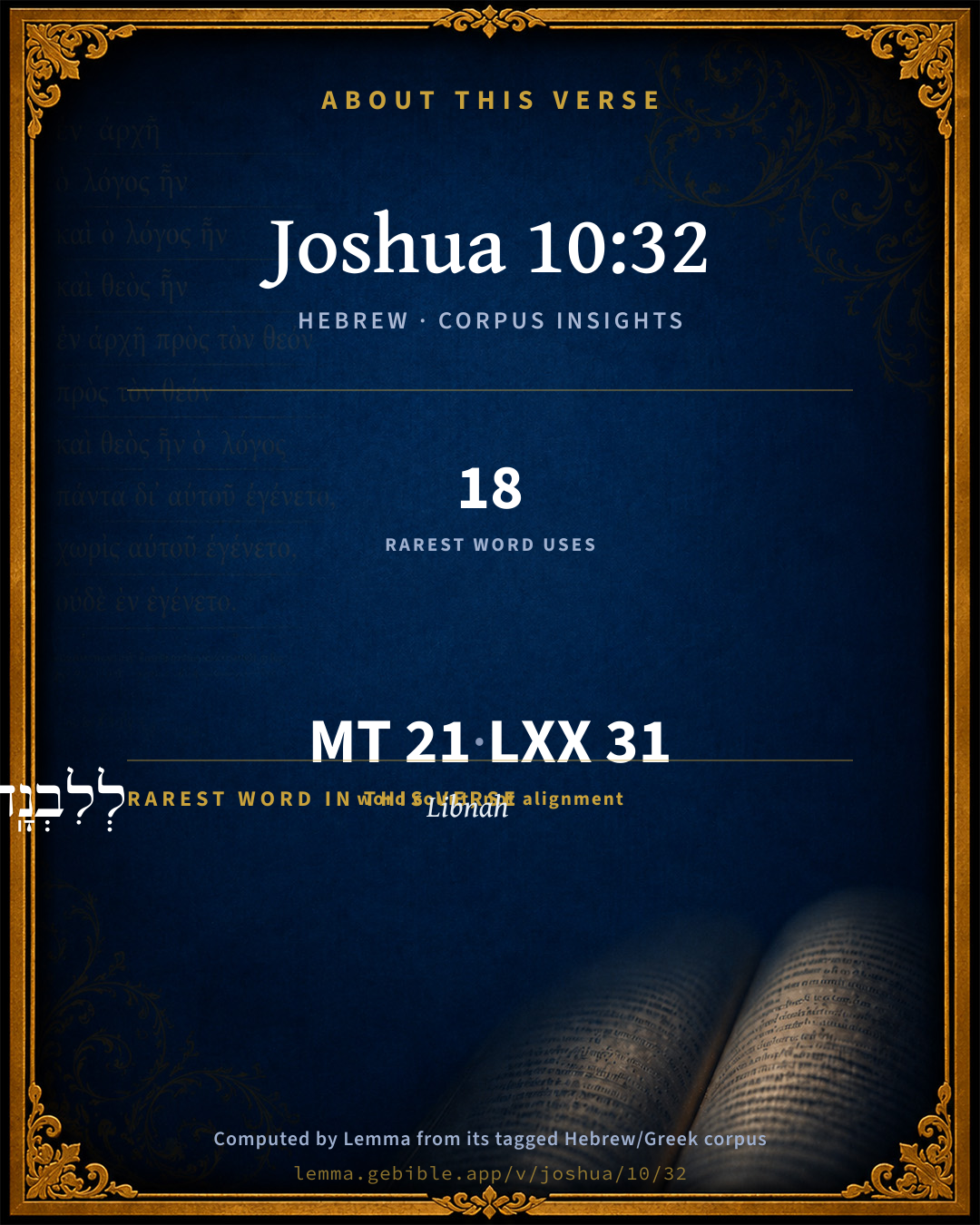
These counts appear in no published source. They are computed here, from the morphology-tagged text and Lemma’s own curated glosses. What Lemma adds →

21
words
17
distinct lemmas
Historical
section

Notable vocabulary

The rarest word here is לְלִבְנָֽה Libnah H3841 — appearing just 18 times in the whole Hebrew Bible.

Shared distinctive vocabulary

לְלִבְנָֽה Libnah H3841 occurs in 17 verses of the Hebrew Bible. Also found in:

Grammatical profile

  • 4 verbs
  • 11 nouns
  • 1 adjective
  • 1 preposition
  • 4 particles

Verb forms

  • וַיִּתֵּן֩ Qal · Sequential Imperfect
  • וַֽיִּלְכְּדָהּ֙ Qal · Sequential Imperfect
  • וַיַּכֶּ֣הָ Hiphil · Sequential Imperfect
  • עָשָׂ֖ה Qal · Perfect

Repetition

Words recur within this verse — often emphatic in Hebrew:

  • כָּל all H3605 ×2
  • אֲשֶׁר which H834 ×2

Hebrew & Septuagint length

In English translation the verse runs 42 words from the Hebrew and 41 from the Septuagint (LXX English) — closely comparable.

A rough comparison of the two English renderings, which tokenize alike — not a word-level alignment.

Word counts can differ between the Hebrew and the Greek without any difference in meaning — e.g. the Hebrew direct-object marker אֵת has no separate Greek word, and Greek often adds the article ὁ.

In the original languages it is 21 Hebrew tokens and 31 Greek tokens — but the two are counted differently (Hebrew bundles its prefixes and suffixes into one token; the Greek is in lemma form), so that isn’t a like-for-like length.

Hebrew and Greek witnesses Masoretic Hebrew ↔ Greek Septuagint

The same verse in the two great witnesses to the Old Testament, shown verse-for-verse.

These are two independent witnesses, not word-aligned to each other, and the Septuagint is shown in lemma (dictionary) form.

Hebrew Joshua 10:32 Masoretic · Westminster Leningrad Codex

וַיִּתֵּן֩ יְהוָ֨ה אֶת לָכִ֜ישׁ בְּיַ֣ד יִשְׂרָאֵ֗ל וַֽיִּלְכְּדָהּ֙ בַּיּ֣וֹם הַשֵּׁנִ֔י וַיַּכֶּ֣הָ לְפִי חֶ֔רֶב וְאֶת כָּל הַנֶּ֖פֶשׁ אֲשֶׁר בָּ֑הּ כְּכֹ֥ל אֲשֶׁר עָשָׂ֖ה לְלִבְנָֽה

and Yahweh delivered Lachish into the hand of Israel; and he took it on the second day, and struck it with the edge of the sword, and all the souls who were therein, according to all that he had done to Libnah.

World English Bible · Public Domain

Greek LXX Joshua 10:32 Septuagint · lemma form

καί παραδίδωμι κύριος ὁ λαχις εἰς ὁ χείρ ἰσραήλ καί λαμβάνω αὐτός ἐν ὁ ἡμέρα ὁ δεύτερος καί φονεύω αὐτός ἐν στόμα ξίφος καί ἐκὀλεθρεύω αὐτός ὅς τρόπος ποιέω ὁ λεβνα

And the Lord delivered Lachis into the hands of Israel; and they took it on the second day, and they put the inhabitants to death with the edge of the sword, and utterly destroyed it, as they had done to Lebna.

LXX2012 (modern English Septuagint) · Public Domain

Hebrew: Westminster Leningrad Codex (CC BY 4.0). Greek: Septuagint (public domain); English from LXX2012 (modern English Septuagint) (Public Domain). How the Septuagint differs from the Hebrew →

Targum (Aramaic paraphrase)

1

The Targum is the ancient Jewish Aramaic paraphrase of the Hebrew Scriptures — an interpretive translation, not the Hebrew text itself. Onkelos (literal) and Pseudo-Jonathan (expansive) render the Torah, and Jonathan the Prophets. Coverage is partial: where no permissively-licensed English translation exists for a verse, only the Aramaic is shown. This is verse-level text, not a word-by-word alignment to the Hebrew.

  1. Targum Jonathan Prophets (Joshua–Malachi)
    וּמְסַר יְיָ יַת לָכִישׁ בִּידָא דְיִשְׂרָאֵל וְכַבְשָׁהּ בְּיוֹמָא תִנְיָנָא וּמְחָהּ לְפִתְגַם דְחָרֶב וְיַת כָּל נַפְשָׁתָא דְבָהּ כְּכָל דַעֲבַד לְלִבְנָה:

    (no public-domain English translation for this verse)

    Targum Jonathan — Aramaic: “Mikraot Gedolot” (public domain). English: “Sefaria Community Translation” (CC0 1.0 (public-domain dedication)); “London "Chaldee Paraphrase," 1871” (public domain). Text via Sefaria.

Commentary

Notes on Joshua 10:32 from classic Christian and Jewish commentators (each source and its license shown beneath its notes). The classic Christian expositions comment on the surrounding passage and are grouped to its opening verse, so a note may address several verses; the Jewish commentaries on the Tanakh (Rashi and others) are per-verse, so they appear only where the commentator wrote on this verse.

Lemma curates 59 commentaries, every one of them public domain or Creative Commons licensed, each selected and text-cleaned for this edition rather than reprinted as found. About our sources →

Trapp's Complete Commentary

John Trapp

Jos 10:32 And the LORD delivered Lachish into the hand of Israel, which took it on the second day, and smote it with the edge of the sword, and all the souls that [were] therein, according to all that he had done to Libnah.

Ver. 32. On the second day,] viz., After he had besieged it. For Joshua took towns faster than did Timotheus the Athenian, into whose toils they were said to come while he slept, till such time as he began to sacrifice to his own net; for then he lost them again as fast. {a}

{a} Plut., in Syll.

John Trapp, A Commentary or Exposition upon All the Books of the Old and New Testament (1647–1656) — public domain. Text from a community e-Sword module.

Adam Clarke's Commentary

Verse 32. Lachish] It appears that this was anciently a very strong place; notwithstanding the people were panic-struck, and the Israelites flushed with success, yet Joshua could not reduce it till the second day, and the king of Assyria afterwards was obliged to raise the siege. See above, and See Clarke on Jos 10:3.

Adam Clarke's Commentary on the Bible (1810–1826) — public domain. Text from a community e-Sword/MySword module.

Ellicott's Commentary for English Readers

(32) On the second day.—With this fact we may connect two other facts of later history. When Sennacherib, king of Assyria, “came up against all the fenced cities of Judah and took them” (2Ki_18:13), although he “laid siege to Lachish, and all his power with him” (2Ch_32:9), he had to abandon the siege (2Ki_19:8). Again, when Nebuchadnezzar invaded the kingdom of Judah in the reign of Zedekiah, the last king, we read ( Jer_34:7) of his army fighting “against Jerusalem and against all the cities of Judah that were left, against Lachish and against Azekah, for these defenced cities remained of the cities of Judah.” All these notices of Lachish point to its being a fortress of considerable strength. And the undesigned and indirect agreement of these three passages, which lie so far asunder, is worthy of observation.

A Bible Commentary for English Readers, edited by Charles John Ellicott (1878–1897) — public domain. Text from a community e-Sword module.

The Cambridge Bible for Schools and Colleges

gen. ed. J. J. S. Perowne

32. which took it on the second day] Observe: 1. All the other cities seem to have fallen before Joshua at once except Lachish. Of Lachish, and Lachish alone, is it said that he took it on the second day.

The Cambridge Bible for Schools and Colleges (gen. ed. J. J. S. Perowne; Cambridge University Press, 1878–1918) — public domain. Text from a community e-Sword module.

John Gill's Exposition

Then Horam king of Gezer came up to help Lachish,.... Perhaps the rather induced to it, because it had no king to defend it. In Jerom's (e) time it was a village called Gazera, four miles from Nicopolis, or Emmaus, to the north: if this king came before the city was taken, he was not able to raise the siege; and if he came after, and so too late, he fell into the hands of Joshua:

and Joshua smote him, and his people, until he had left him none remaining; destroyed him and all his army, so that there were none left to return and relate their unhappy case.

(e) De loc. Heb. fol. 92. A.

John Gill's Exposition of the Whole Bible (1746–1763) — public domain (CC PDM 1.0). Text via the HelloAO Bible API.

Haydock's Catholic Bible Commentary

Lachis was still farther south. Josue took it the second day of the siege.

George Leo Haydock (1774–1849), Haydock's Catholic Family Bible and Commentary, 1859 edition — public domain. Excludes Psalms (Douay-Rheims chapter numbering differs from Protestant) and Deuterocanonical books (Catholic canon only).

Matthew Poole's English Annotations

On the second day; either the day after his first laying of the siege, or after the taking of Makkedah and Libnah.

Matthew Poole's English Annotations on the Holy Bible (1683–1685) — public domain. Text from a community e-Sword/MySword module.

Whedon's Commentary on the Bible

Daniel D. Whedon

32. On the second day — The second day of the siege.

Daniel D. Whedon (gen. ed.), Commentary on the Old and New Testaments (1874–1909) — public domain. Text from a community e-Sword module.

Lesson kit

Teaching starters — assembled from the data on this page, not authored interpretation. Every prompt links to the verse data it draws on. Edit before teaching.

Joshua, in the Historical, opens this verse with 21 words (17 distinct Hebrew lemmas). Its most distinctive word is Libnâh (“Libnah”). A historical commentator’s framing appears above. Read the whole chapter for the surrounding context.

Discussion questions

  1. The word Libnâh carries the sense “Libnah.” How does it shape the verse?
  2. Numbers 33:20 shares the word «Libnah» with this verse. How do the two illuminate each other?
  3. “all” occurs 2× in this one verse. What is the effect of the repetition?
  4. The translations on this page render this verse differently — a whole-verse word diff, not a word-by-word alignment. What might account for the different wordings?
  5. The verb «וַיִּתֵּן֩» is Qal Sequential Imperfect. How does its form color the action?
  6. Reading how Trapp's Complete Commentary and Adam Clarke's Commentary read this verse, where do the two commentators agree and where do they part?

Things to notice

Reading settings

Reading text

Shown beneath each verse's original-language words.

Old Testament
Old Testament edition

Read the OT as the Masoretic Hebrew (MT) or the Greek Septuagint (LXX).

English shown for the Greek Septuagint (in the Hebrew ↔ Greek comparison).

Comparing translations? Open the Compare panel on any verse page to stack up to four side by side.