
1 Samuel 14:20

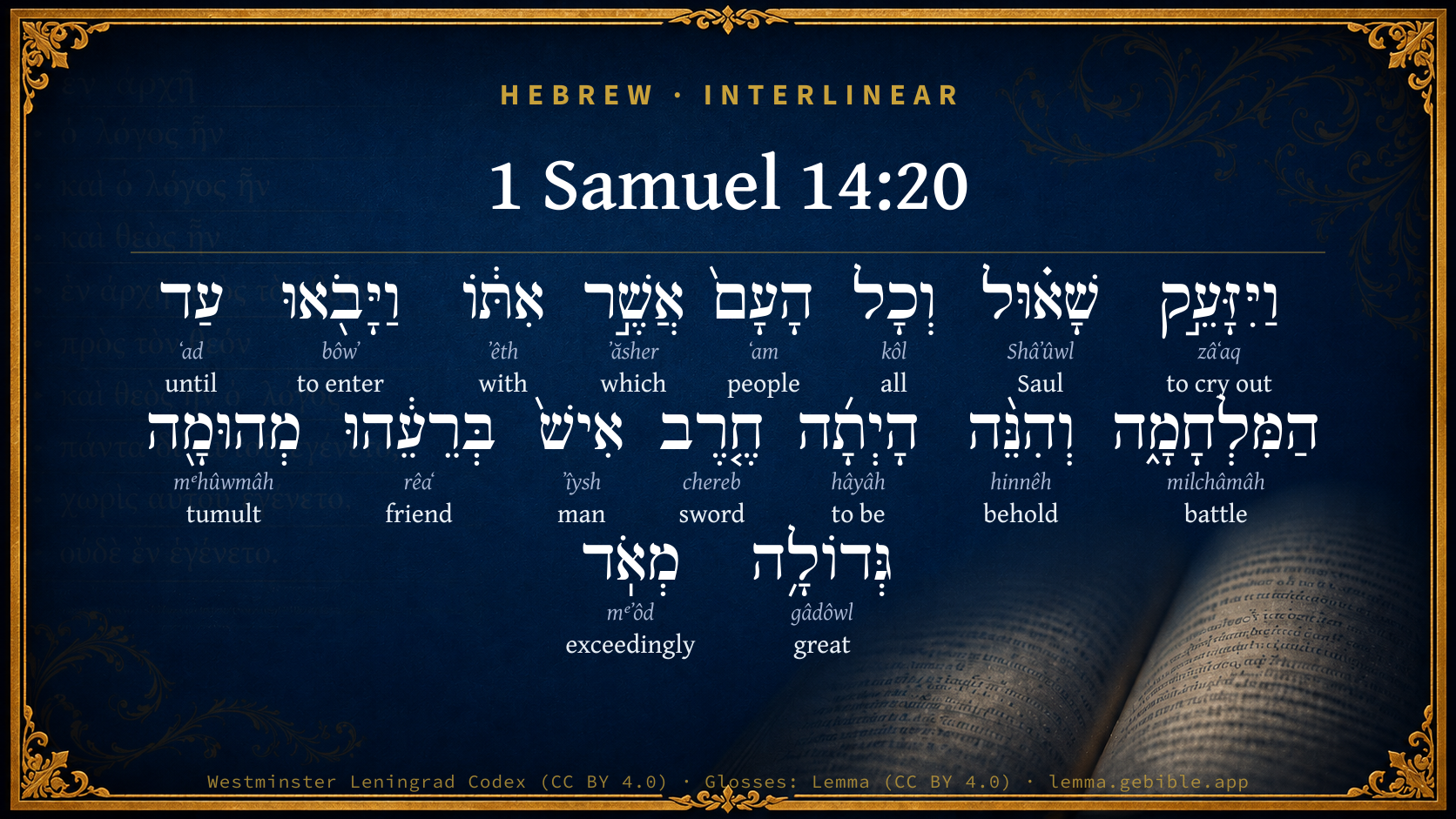
Hebrew (Westminster Leningrad Codex) 1 Samuel 14:20 appears in the Hebrew Old Testament. The text above is from the Westminster Leningrad Codex. Each word links to its Strong’s number, a concise gloss, and parsing drawn from the Open Scriptures Hebrew Bible morphology. Click any word for its full Brown-Driver-Briggs (BDB) entry.
Download image
Cite this verse

1 Samuel 14:20 (World English Bible). Public Domain. Lemma interlinear Bible study tool, https://lemma.gebible.app/v/1-samuel/14/20.

Show BibTeX & RIS
BibTeX
RIS
English Translation
Saul and all the people who were with him were gathered together, and came to the battle: and, behold, every man's sword was against his fellow, [and there was] a very great confusion.
World English Bible · Public Domain
Download a study sheet

One document with this verse’s original text, its word-by-word gloss line, the meaning frame, cross-references with their text, attributed commentary, and full source and license credits — printable, and it pastes into notes with its structure intact.

This verse Autodidact and up

Study sheet (.html) Plain text (.txt)

A passage Seminary Student

Up to 50 verses in one chapter. A passage sheet keeps up to 6 commentary sources and 12 cross-references per verse, in the order this page ranks them, and says so on the sheet whenever that leaves anything out. Ask for a single verse and you get the Autodidact verse sheet above.

Everything on this page stays free to read, with no account — the sheet is a download of what is already on screen, not access to it.

Want to remove ads? Support Godless Engineer
Compare translations 3

The same verse in 3 English versions, stacked beneath the original-language interlinear above. Click any original word for its lexicon entry.

Each is an independent rendering of the whole verse — the interlinear is not word-aligned to these translations.

Highlighted words mark where these versions differ — a whole-verse word diff, not a word-by-word alignment.

  • World English Bible Public Domain
    Saul and all the people who were with him were gathered together, and came to the battle: and, behold, every man's sword was against his fellow, [and there was] a very great confusion.
  • King James Version Public Domain
    And Saul and all the people that were with him assembled themselves, and they came to the battle: and, behold, every man's sword was against his fellow, and there was a very great discomfiture.
  • unfoldingWord Literal Text CC BY-SA 4.0
    And Saul and all of the people who with him were called together, and they came to the battle. And behold, the sword of a man was against his fellow, a very great tumult.

unfoldingWord Literal Text — © unfoldingWord, licensed CC BY-SA 4.0. Word-aligned USFM3 via Door43 (git.door43.org/unfoldingWord/en_ult).

Versions to compare (up to 4)

3 of 4 selected

Show all 18 translations

Every available English version of this verse, each an independent rendering of the whole verse.

  • World English Bible Public Domain
    Saul and all the people who were with him were gathered together, and came to the battle: and, behold, every man's sword was against his fellow, [and there was] a very great confusion.
  • Berean Standard Bible Public Domain
    Then Saul and all his troops assembled and marched to the battle, and they found the Philistines in total confusion, with each man wielding the sword against his neighbor.
  • Majority Standard Bible Public Domain
    Then Saul and all his troops assembled and marched to the battle, and they found the Philistines in total confusion, with each man wielding the sword against his neighbor.
  • King James Version Public Domain
    And Saul and all the people that were with him assembled themselves, and they came to the battle: and, behold, every man's sword was against his fellow, and there was a very great discomfiture.
  • American Standard Version (1901) Public Domain
    And Saul and all the people that were with him were gathered together, and came to the battle: and, behold, every man's sword was against his fellow, `and there was' a very great discomfiture.
  • Revised Version (1885) Public Domain
    And Saul and all the people that were with him were gathered together, and came to the battle: and, behold, every man’s sword was against his fellow, and there was a very great discomfiture.
  • Geneva Bible (1599) Public Domain
    And Saul was assembled with all the people that were with him, and they came to the battell: and behold, euery mans sworde was against his fellow, and there was a very great discomfiture.
  • Douay-Rheims (1899) Public Domain
    Then Saul and all the people that were with him, shouted together, and they came to the place of the fight: and behold every man's sword was turned upon his neighbour, and there was a very great slaughter.
  • Young's Literal Translation Public Domain
    And Saul is called, and all the people who `are' with him, and they come in unto the battle, and, lo, the sword of each hath been against his neighbour -- a very great destruction.
  • Literal Standard Version CC BY-SA 4.0
    And Saul is called, and all the people who [are] with him, and they come to the battle, and behold, the sword of each has been against his neighbor—a very great destruction.
  • Unlocked Literal Bible CC BY-SA 4.0
    Saul and all the people who were with him rallied and went into battle. Every Philistine's sword was against his fellow countrymen, and there was very great confusion.
  • unfoldingWord Literal Text CC BY-SA 4.0
    And Saul and all of the people who with him were called together, and they came to the battle. And behold, the sword of a man was against his fellow, a very great tumult.
  • Darby Bible Public Domain
    And Saul and all the people that were with him were called together, and they came to the battle; and behold, every man's sword was against his fellow, a very great confusion.
  • World Messianic Bible Public Domain
    Saul and all the people who were with him were gathered together, and came to the battle; and behold, they were all striking each other with their swords in very great confusion.
  • Webster's Bible Public Domain
    And Saul and all the people that were with him assembled themselves, and they came to the battle: and behold, every man's sword was against his fellow, and there was a very great discomfiture.
  • Free Bible Version CC BY-SA 4.0
    Then Saul and all his army assembled and went into battle. They discovered the Philistines were in total disarray, attacking each other with swords.
  • Bible in Basic English Public Domain
    And Saul and all the people with him came together and went forward to the fight: and every man's sword was turned against the man at his side, and there was a very great noise.
  • JPS Tanakh (1917) Public Domain
    And Saul and all the people that were with him were gathered together, and came to the battle; and, behold, every man's sword was against his fellow, and there was a very great discomfiture.

Literal Standard Version (2020), Covenant Press — licensed CC BY-SA 4.0. Text via the HelloAO Bible API (eBible.org). Unlocked Literal Bible (unfoldingWord) — licensed CC BY-SA 4.0. Text via the HelloAO Bible API (eBible.org). unfoldingWord Literal Text — © unfoldingWord, licensed CC BY-SA 4.0. Word-aligned USFM3 via Door43 (git.door43.org/unfoldingWord/en_ult). Free Bible Version, Dr. Jonathan Gallagher — licensed CC BY-SA 4.0. Text via the HelloAO Bible API (eBible.org).

Word by word

More ways to search: Search by grammar → Find every occurrence → Compare this word →

Practice this passage: Drill this verse → Learn its vocabulary →

מְהוּמָ֖ה
mᵉhûwmâh
H4103
“tumult”
Noun, Common, Feminine, Singular, Absolute
Part of Speech
Noun
Type
Common
Gender
Feminine
Number
Singular
State
Absolute
Full BDB Definition

Origin: from H1949

TWOT: 486a

tumult, confusion, disquietude, discomfiture, destruction, trouble, vexed, vexation - tumult, confusion, disturbance, turmoil, disquietude, panic - discomfiture
  1. וַיִּזָּעֵ֣ק zâʻaq H2199 “and · to cry out” Conjunction + Verb, Niphal, Sequential Imperfect, 3rd Person, Masculine, Singular
  2. שָׁא֗וּל Shâʼûwl H7586 “Saul” Noun, Proper
  3. וְכָל kôl H3605 “and · all of” Conjunction + Noun, Common, Masculine, Singular, Construct
  4. הָעָם֙ ʻam H5971 “the · people” Particle, Definite Article + Noun, Common, Masculine, Singular, Absolute
  5. אֲשֶׁ֣ר ʼăsher H834 “which” Particle, Relative
  6. אִתּ֔וֹ ʼêth H854 “with · him” Preposition + Suffix, Personal, 3rd Person, Masculine, Singular
  7. וַיָּבֹ֖אוּ bôwʼ H935 “and · to enter” Conjunction + Verb, Qal, Sequential Imperfect, 3rd Person, Masculine, Plural
  8. עַד ʻad H5704 “until” Preposition
  9. הַמִּלְחָמָ֑ה milchâmâh H4421 “the · battle” Particle, Definite Article + Noun, Common, Feminine, Singular, Absolute
  10. וְהִנֵּ֨ה hinnêh H2009 “and · behold” Conjunction + Particle, Demonstrative
  11. הָיְתָ֜ה hâyâh H1961 “to be” Verb, Qal, Perfect, 3rd Person, Feminine, Singular
  12. חֶ֤רֶב chereb H2719 “sword of” Noun, Common, Feminine, Singular, Construct
  13. אִישׁ֙ ʼîysh H376 “man” Noun, Common, Masculine, Singular, Absolute
  14. בְּרֵעֵ֔הוּ rêaʻ H7453 “in/at · friend · his” Preposition + Noun, Common, Masculine, Singular, Construct + Suffix, Personal, 3rd Person, Masculine, Singular
  15. גְּדוֹלָ֥ה gâdôwl H1419 “great” Adjective, Adjective, Feminine, Singular, Absolute
  16. מְאֹֽד mᵉʼôd H3966 “exceedingly” Adverb

About this verse

These counts appear in no published source. They are computed here, from the morphology-tagged text and Lemma’s own curated glosses. What Lemma adds →

17
words
17
distinct lemmas
Historical
section

Notable vocabulary

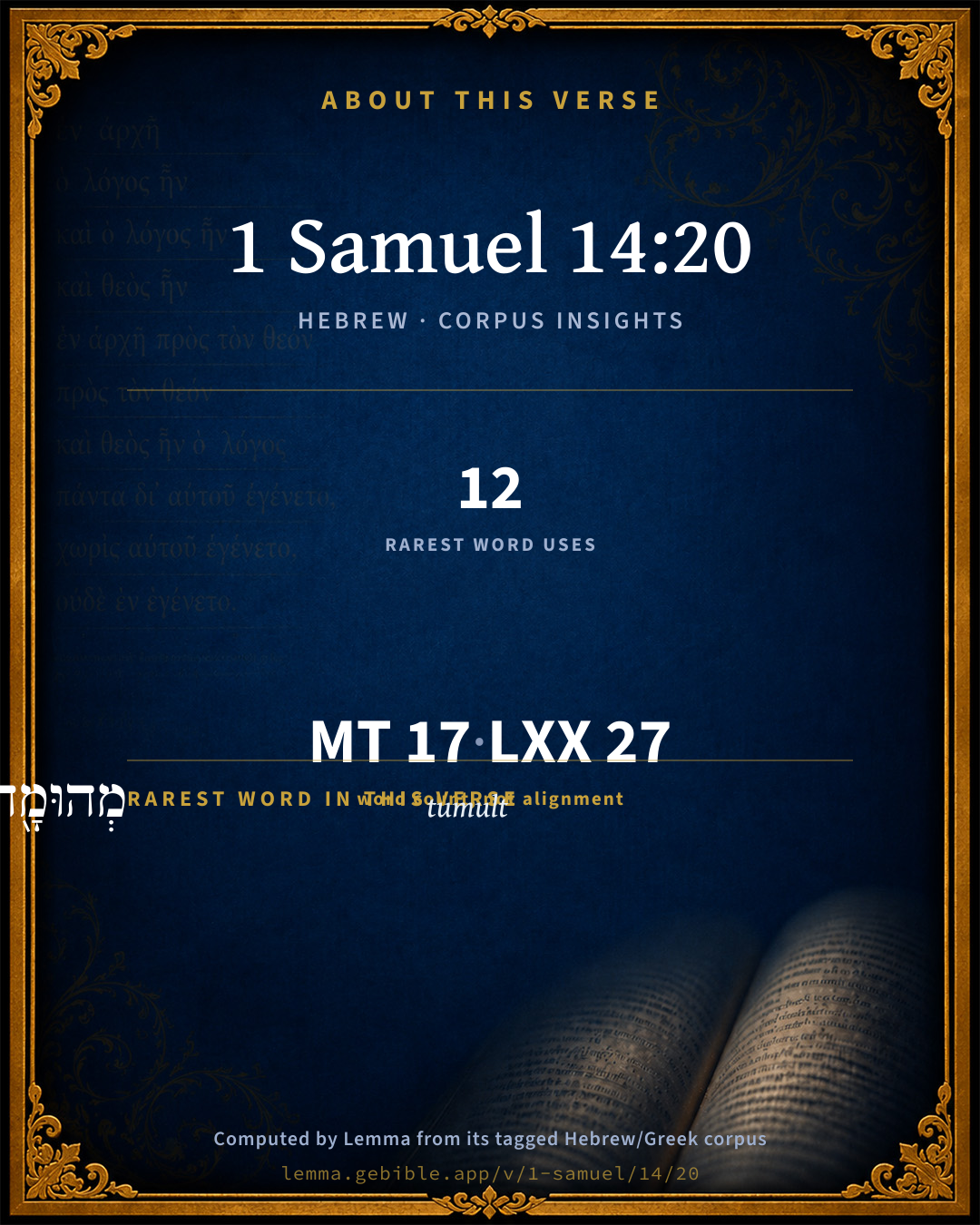
The rarest word here is מְהוּמָ֖ה tumult H4103 — appearing just 12 times in the whole Hebrew Bible.

Shared distinctive vocabulary

מְהוּמָ֖ה tumult H4103 occurs in 12 verses of the Hebrew Bible. Also found in:

Grammatical profile

  • 3 verbs
  • 8 nouns
  • 1 adjective
  • 2 prepositions
  • 1 adverb
  • 2 particles

Verb forms

  • וַיִּזָּעֵ֣ק Niphal · Sequential Imperfect
  • וַיָּבֹ֖אוּ Qal · Sequential Imperfect
  • הָיְתָ֜ה Qal · Perfect

Hebrew & Septuagint length

In English translation the verse runs 33 words from the Hebrew and 31 from the Septuagint (LXX English) — closely comparable.

A rough comparison of the two English renderings, which tokenize alike — not a word-level alignment.

Word counts can differ between the Hebrew and the Greek without any difference in meaning — e.g. the Hebrew direct-object marker אֵת has no separate Greek word, and Greek often adds the article ὁ.

In the original languages it is 17 Hebrew tokens and 27 Greek tokens — but the two are counted differently (Hebrew bundles its prefixes and suffixes into one token; the Greek is in lemma form), so that isn’t a like-for-like length.

Cross-references

5

Topical passages linked to 1 Samuel 14:20 in the Treasury of Scripture Knowledge — connected by theme and wording, ordered by reader-vote popularity; previews shown in the World English Bible.

  • Judges 7:22 They blew the three hundred trumpets, and Yahweh set every man's sword against his fellow, and against all the host; and the host fled as far as Beth-shittah toward Zererah, as far as the border of Abel Meholah, by Tabbath.
  • 2 Chronicles 20:23 For the children of Ammon and Moab stood up against the inhabitants of Mount Seir, utterly to kill and destroy them: and when they had made an end of the inhabitants of Seir, everyone helped to destroy another.
  • 1 Samuel 14:16 The watchmen of Saul in Gibeah of Benjamin looked; and, behold, the multitude melted away, and they went [here] and there.
  • Isaiah 9:19–21 Through the wrath of Yahweh of hosts is the land burnt up; and the people are as the fuel of fire: no man spares his brother.
  • Isaiah 19:2 I will stir up the Egyptians against the Egyptians: and they shall fight everyone against his brother, and everyone against his neighbor; city against city, [and] kingdom against kingdom.

Cross-references courtesy of OpenBible.info (CC BY 4.0).

Hebrew and Greek witnesses Masoretic Hebrew ↔ Greek Septuagint

The same verse in the two great witnesses to the Old Testament, shown verse-for-verse.

These are two independent witnesses, not word-aligned to each other, and the Septuagint is shown in lemma (dictionary) form.

Hebrew 1 Samuel 14:20 Masoretic · Westminster Leningrad Codex

וַיִּזָּעֵ֣ק שָׁא֗וּל וְכָל הָעָם֙ אֲשֶׁ֣ר אִתּ֔וֹ וַיָּבֹ֖אוּ עַד הַמִּלְחָמָ֑ה וְהִנֵּ֨ה הָיְתָ֜ה חֶ֤רֶב אִישׁ֙ בְּרֵעֵ֔הוּ מְהוּמָ֖ה גְּדוֹלָ֥ה מְאֹֽד

Saul and all the people who were with him were gathered together, and came to the battle: and, behold, every man's sword was against his fellow, [and there was] a very great confusion.

World English Bible · Public Domain

Greek LXX 1 Samuel 14:20 Septuagint · lemma form

καί ἀναβοάω σαούλ καί πᾶς ὁ λαός ὁ μετά αὐτός καί ἔρχομαι ἕως ὁ πόλεμος καί ἰδού γίγνομαι ῥομφαία ἀνήρ ἐπί ὁ πλησίον αὐτός σύγχυσις μέγας σφόδρα

And Saul went up and all the people that were with him, and they come to the battle: and, behold, every man's sword was against his neighbor, a very great confusion.

LXX2012 (modern English Septuagint) · Public Domain

Hebrew: Westminster Leningrad Codex (CC BY 4.0). Greek: Septuagint (public domain); English from LXX2012 (modern English Septuagint) (Public Domain). How the Septuagint differs from the Hebrew →

Targum (Aramaic paraphrase)

1

The Targum is the ancient Jewish Aramaic paraphrase of the Hebrew Scriptures — an interpretive translation, not the Hebrew text itself. Onkelos (literal) and Pseudo-Jonathan (expansive) render the Torah, and Jonathan the Prophets. Coverage is partial: where no permissively-licensed English translation exists for a verse, only the Aramaic is shown. This is verse-level text, not a word-by-word alignment to the Hebrew.

  1. Targum Jonathan Prophets (Joshua–Malachi)
    וְאִתְכְּנִישׁ שָׁאוּל וְכָל עַמָא דְעִמֵיהּ וְאָתוֹ עַד קְרָבָא וְהָא הֲוַת חַרְבָּא גְבַר בְּחַבְרֵיהּ שִׁגוּשָׁא רַב לַחֲדָא:

    (no public-domain English translation for this verse)

    Targum Jonathan — Aramaic: “Mikraot Gedolot” (public domain). English: “Sefaria Community Translation” (CC0 1.0 (public-domain dedication)); “London "Chaldee Paraphrase," 1871” (public domain). Text via Sefaria.

Commentary

Notes on 1 Samuel 14:20 from classic Christian and Jewish commentators (each source and its license shown beneath its notes). The classic Christian expositions comment on the surrounding passage and are grouped to its opening verse, so a note may address several verses; the Jewish commentaries on the Tanakh (Rashi and others) are per-verse, so they appear only where the commentator wrote on this verse.

Lemma curates 59 commentaries, every one of them public domain or Creative Commons licensed, each selected and text-cleaned for this edition rather than reprinted as found. About our sources →

Trapp's Complete Commentary

John Trapp

1Sa 14:20 And Saul and all the people that [were] with him assembled themselves, and they came to the battle: and, behold, every man’s sword was against his fellow, [and there was] a very great discomfiture.

Ver. 20. Every man’s sword was against his fellow.] See on 1Sa 14:16. So Jdg 7:22 2Ch 20:23.

And there was a very great discomfiture.] Notwithstanding Saul’s sin, Samuel’s departure, and the people’s diffidence, God wrought for his own name’s sake: and lest the enemy should vaunt and say, "Our hand is high, and the Lord hath not done all this." {Deu 32:27} Josephus saith that there were threescore thousand Philistines slain at this bout. {a}

{a} Joseph., lib. vi. cap. 7.

John Trapp, A Commentary or Exposition upon All the Books of the Old and New Testament (1647–1656) — public domain. Text from a community e-Sword module.

Joseph Benson's Commentary

1Sa 14:20-21. There was a very great discomfiture — Namely, in the army of the Philistines; which, it is likely, consisted of various nations, and in the confusion into which they were thrown, they fell upon one another, not distinguishing friends from enemies. The Hebrews that were with the Philistines — Having gone with their army, either by constraint, as servants, or in policy, to gain their favour and protection. They also turned to be with the Israelites — In the midst of this battle they went over to their own countrymen.

Joseph Benson's Commentary on the Old and New Testaments (1811–1818) — public domain. Text from a community e-Sword module.

Jamieson, Fausset & Brown

Robert Jamieson, A. R. Fausset & David Brown

Saul and all the people--All the warriors in the garrison at Gibeah, the Israelite deserters in the camp of the Philistines, and the fugitives among the mountains of Ephraim, now all rushed to the pursuit, which was hot and sanguinary.

Jamieson, Fausset & Brown — Commentary Critical and Explanatory on the Whole Bible (1871) — public domain (CC PDM 1.0). Text via the HelloAO Bible API.

Ellicott's Commentary for English Readers

(20) Assembled themselves.—In the margin of the English Version we find “were cried together,” that is, “were assembled by the trumpet call.” The Syriac and Vulg., however, more accurately render the Hebrew shouted, that is, raised the war-cry of Israel.

Every man’s sword was against his fellow.—The statement in the next verse (21) explains this. Profiting by the wild confusion which reigned now throughout the Philistine host, a portion of their own auxiliaries—unwilling allies, doubtless—turned their arms against their employers or masters. From this moment no one in the panic-stricken army could rightly distinguish friend from foe. In such a scene of confusion the charge of Saul, at the head of his small but well-trained soldierly band, must have done terrible execution. Shouting the well-known war-cry of Benjamin, it penetrated wedge-like into the heart of the broken Philistine host.

A Bible Commentary for English Readers, edited by Charles John Ellicott (1878–1897) — public domain. Text from a community e-Sword module.

The Cambridge Bible for Schools and Colleges

gen. ed. J. J. S. Perowne

20. every man’s sword was against his fellow] Cp. Jdg_7:22; 2Ch_20:23.

The Cambridge Bible for Schools and Colleges (gen. ed. J. J. S. Perowne; Cambridge University Press, 1878–1918) — public domain. Text from a community e-Sword module.

John Gill's Exposition

And Saul, and all the people that were with him, assembled themselves,.... The six hundred men that were with him, unless we can suppose the 1000 that had been with Jonathan in Gibeah were here still, see Sa1 13:2.

and they came to the battle; to the field of battle, the place where the army of the Philistines had lain encamped:

and, behold, every man's sword was against his fellow; taking one another for Hebrews, or treacherous and disaffected persons; so that, though the Israelites had neither swords nor spears, they needed none, for the Philistines destroyed one another with their own swords; and there was a

very great discomfiture; noise, tumult, confusion, slaughter, and destruction.

John Gill's Exposition of the Whole Bible (1746–1763) — public domain (CC PDM 1.0). Text via the HelloAO Bible API.

Albert Barnes' Notes on the Bible

Assembled themselves - See marg. Many versions give the sense “shouted,” which is far preferable, and only requires a different punctuation.

Albert Barnes' Notes on the Bible (1834–1885) — public domain. Text from a community e-Sword/MySword module.

Matthew Poole's English Annotations

The Philistines slew one another; which might come, either from mistake, of which see on 1Sa 14:16; or from mutual jealousies and passions, to which God could easily dispose them.

Matthew Poole's English Annotations on the Holy Bible (1683–1685) — public domain. Text from a community e-Sword/MySword module.

The Pulpit Commentary

Saul and all the people assembled themselves. Margin, were cried together, i.e. summoned by trumpet note. The Syriac and Vulgate, however, make the verb active, and translate, "And Saul and all the people with him shouted and advanced to the battle." Discomfiture. Rather, "dismay," "consternation," as in 1Sa_5:9.

The Pulpit Commentary (1880–1919), ed. H.D.M. Spence-Jones & Joseph S. Exell — public domain. Text from a community e-Sword module.

unfoldingWord translationNotes

Door43 World Missions Community

the people who were with him

the remnant of the Israelite army that remained with Saul

Every Philistine's sword was against his fellow countrymen

The swords are spoken of as if they were living people. AT: "The Philistine soldiers were striking each other with their swords" (See: Personification)

translationWords

sword

Hebrew

unfoldingWord translationNotes — © Distant Shores Media and the Door43 World Missions Community, licensed CC BY-SA 4.0. Source: git.door43.org/Door43/en_tn.

Lesson kit

Teaching starters — assembled from the data on this page, not authored interpretation. Every prompt links to the verse data it draws on. Edit before teaching.

1 Samuel, in the Historical, opens this verse with 17 words (17 distinct Hebrew lemmas). Its most distinctive word is mᵉhûwmâh (“tumult”). A historical commentator’s framing appears above. Read the whole chapter for the surrounding context.

Discussion questions

  1. What does “tumult” (mᵉhûwmâh) contribute to the verse as a whole?
  2. How does Deuteronomy 7:23, which shares the word «tumult», read alongside this verse?
  3. These translations render this verse differently; the difference is in the English rendering, not the original. What questions does that raise?
  4. «וַיִּזָּעֵ֣ק» is a Niphal Sequential Imperfect verb. How does that grammatical form shape the action described?
  5. Compare how Trapp's Complete Commentary and Joseph Benson's Commentary read this verse. Where do they agree or differ?

Things to notice

Reading settings

Reading text

Shown beneath each verse's original-language words.

Old Testament
Old Testament edition

Read the OT as the Masoretic Hebrew (MT) or the Greek Septuagint (LXX).

English shown for the Greek Septuagint (in the Hebrew ↔ Greek comparison).

Comparing translations? Open the Compare panel on any verse page to stack up to four side by side.