
Psalms 144:10

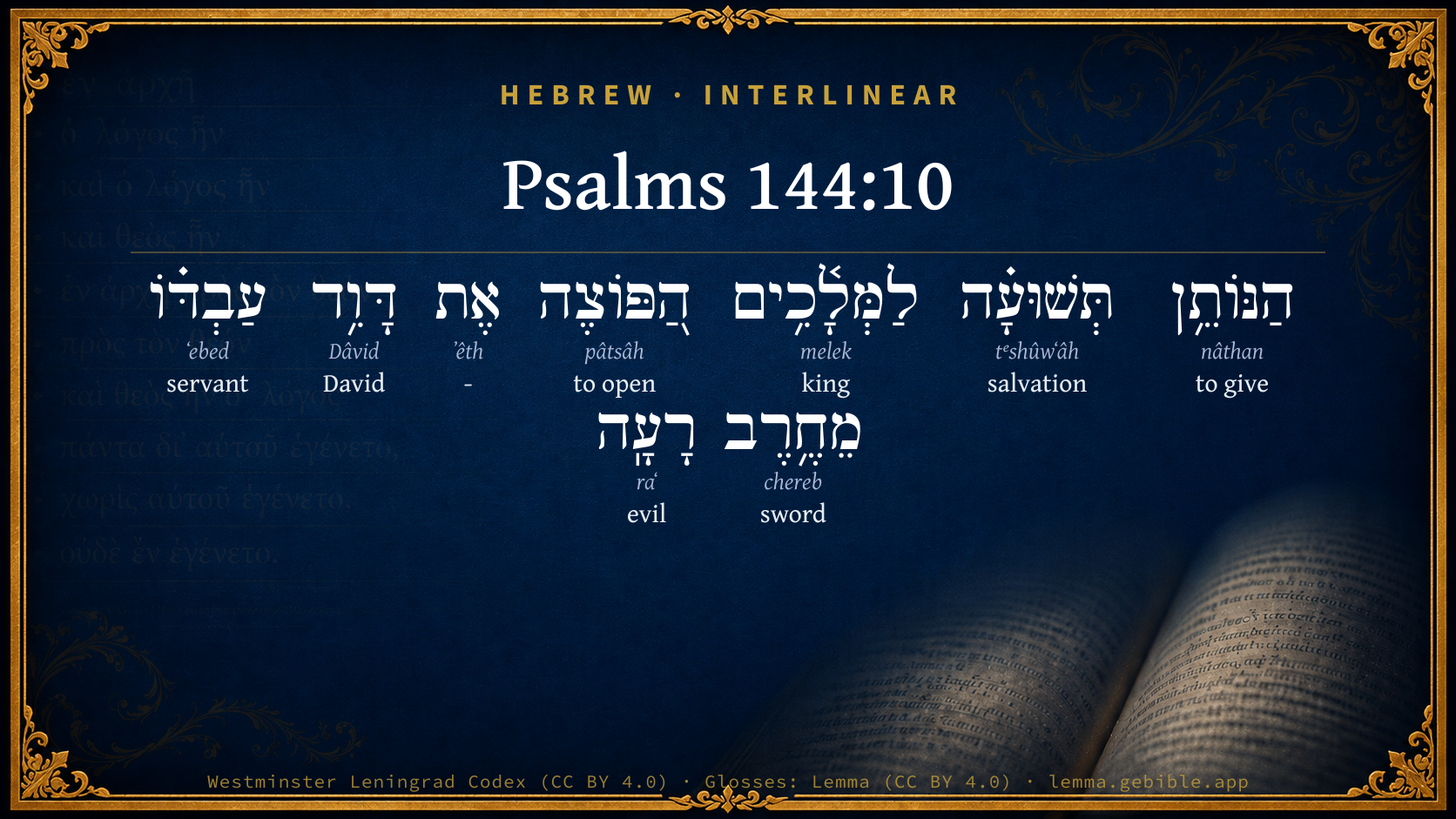
Hebrew (Westminster Leningrad Codex) Psalms 144:10 appears in the Hebrew Old Testament. The text above is from the Westminster Leningrad Codex. Each word links to its Strong’s number, a concise gloss, and parsing drawn from the Open Scriptures Hebrew Bible morphology. Click any word for its full Brown-Driver-Briggs (BDB) entry.
Download image
Cite this verse

Psalms 144:10 (World English Bible). Public Domain. Lemma interlinear Bible study tool, https://lemma.gebible.app/v/psalms/144/10.

Show BibTeX & RIS
BibTeX
RIS
English Translation
You are he who gives salvation to kings, Who rescues David, his servant, from the deadly sword.
World English Bible · Public Domain
Download a study sheet

One document with this verse’s original text, its word-by-word gloss line, the meaning frame, cross-references with their text, attributed commentary, and full source and license credits — printable, and it pastes into notes with its structure intact.

This verse Autodidact and up

Study sheet (.html) Plain text (.txt)

A passage Seminary Student

Up to 50 verses in one chapter. A passage sheet keeps up to 6 commentary sources and 12 cross-references per verse, in the order this page ranks them, and says so on the sheet whenever that leaves anything out. Ask for a single verse and you get the Autodidact verse sheet above.

Everything on this page stays free to read, with no account — the sheet is a download of what is already on screen, not access to it.

Want to remove ads? Support Godless Engineer
Compare translations 3

The same verse in 3 English versions, stacked beneath the original-language interlinear above. Click any original word for its lexicon entry.

Each is an independent rendering of the whole verse — the interlinear is not word-aligned to these translations.

Highlighted words mark where these versions differ — a whole-verse word diff, not a word-by-word alignment.

  • World English Bible Public Domain
    You are he who gives salvation to kings, Who rescues David, his servant, from the deadly sword.
  • King James Version Public Domain
    It is he that giveth salvation unto kings: who delivereth David his servant from the hurtful sword.
  • unfoldingWord Literal Text CC BY-SA 4.0
    the one giving salvation to kings, the one breaking free David his servant from the evil sword.

unfoldingWord Literal Text — © unfoldingWord, licensed CC BY-SA 4.0. Word-aligned USFM3 via Door43 (git.door43.org/unfoldingWord/en_ult).

Versions to compare (up to 4)

3 of 4 selected

Show all 18 translations

Every available English version of this verse, each an independent rendering of the whole verse.

  • World English Bible Public Domain
    You are he who gives salvation to kings, Who rescues David, his servant, from the deadly sword.
  • Berean Standard Bible Public Domain
    to Him who gives victory to kings, who frees His servant David from the deadly sword.
  • Majority Standard Bible Public Domain
    to Him who gives victory to kings, who frees His servant David from the deadly sword.
  • King James Version Public Domain
    It is he that giveth salvation unto kings: who delivereth David his servant from the hurtful sword.
  • American Standard Version (1901) Public Domain
    Thou art he that giveth salvation unto kings; Who rescueth David his servant from the hurtful sword.
  • Revised Version (1885) Public Domain
    It is he that giveth salvation unto kings: who rescueth David his servant from the hurtful sword.
  • Geneva Bible (1599) Public Domain
    It is he that giueth deliuerance vnto Kings, and rescueth Dauid his seruant from the hurtfull sworde.
  • Douay-Rheims (1899) Public Domain
    teach me to do thy will, for thou art my God. Thy good spirit shall lead me into the right land:
  • Young's Literal Translation Public Domain
    Who is giving deliverance to kings, Who is freeing David His servant from the sword of evil.
  • Literal Standard Version CC BY-SA 4.0
    Who is giving deliverance to kings, || Who is freeing His servant David from the sword of evil.
  • Unlocked Literal Bible CC BY-SA 4.0
    who give salvation to kings, who rescued David your servant from an evil sword.
  • unfoldingWord Literal Text CC BY-SA 4.0
    the one giving salvation to kings, the one breaking free David his servant from the evil sword.
  • Darby Bible Public Domain
    Who givest salvation unto kings; who rescuest David thy servant from the hurtful sword.
  • World Messianic Bible Public Domain
    You are he who gives salvation to kings, who rescues David, his servant, from the deadly sword.
  • Webster's Bible Public Domain
    It is he that giveth salvation to kings: who delivereth David his servant from the hurtful sword.
  • Free Bible Version CC BY-SA 4.0
    to you, the one who gives victory to kings. You saved your servant David from death by the sword.
  • Bible in Basic English Public Domain
    It is God who gives salvation to kings; and who kept his servant David from the wounding sword.
  • JPS Tanakh (1917) Public Domain
    Who givest salvation unto kings, who rescuest David Thy servant from the hurtful sword.

Literal Standard Version (2020), Covenant Press — licensed CC BY-SA 4.0. Text via the HelloAO Bible API (eBible.org). Unlocked Literal Bible (unfoldingWord) — licensed CC BY-SA 4.0. Text via the HelloAO Bible API (eBible.org). unfoldingWord Literal Text — © unfoldingWord, licensed CC BY-SA 4.0. Word-aligned USFM3 via Door43 (git.door43.org/unfoldingWord/en_ult). Free Bible Version, Dr. Jonathan Gallagher — licensed CC BY-SA 4.0. Text via the HelloAO Bible API (eBible.org).

Word by word

More ways to search: Search by grammar → Find every occurrence → Compare this word →

Practice this passage: Drill this verse → Learn its vocabulary →

הַ֭פּוֹצֶה
pâtsâh
H6475
“the · opening”
Particle, Definite Article + Verb, Qal, Participle Active, Masculine, Singular, Absolute
Part of Speech
Particle + Verb
Stem
Qal
Form
Participle Active
Gender
Masculine
Number
Singular
State
Absolute
Full BDB Definition

Origin: a primitive root

TWOT: 1795

to part, open, separate, set free - (Qal) - to open (mouth), utter - to snatch away, set free
  1. הַנּוֹתֵ֥ן nâthan H5414 “the · giving” Particle, Definite Article + Verb, Qal, Participle Active, Masculine, Singular, Absolute
  2. תְּשׁוּעָ֗ה tᵉshûwʻâh H8668 “salvation” Noun, Common, Feminine, Singular, Absolute
  3. לַמְּלָ֫כִ֥ים melek H4428 “to/for the · kings” Preposition, Determined + Noun, Common, Masculine, Plural, Absolute
  4. אֶת ʼêth H853 “-” Particle, Direct Object
  5. דָּוִ֥ד Dâvid H1732 “David” Noun, Proper
  6. עַבְדּ֗וֹ ʻebed H5650 “servant · his” Noun, Common, Masculine, Singular, Construct + Suffix, Personal, 3rd Person, Masculine, Singular
  7. מֵחֶ֥רֶב chereb H2719 “from · sword” Preposition + Noun, Common, Feminine, Singular, Absolute
  8. רָעָֽה raʻ H7451 “evil” Adjective, Adjective, Feminine, Singular, Absolute

About this verse

These counts appear in no published source. They are computed here, from the morphology-tagged text and Lemma’s own curated glosses. What Lemma adds →

9
words
9
distinct lemmas
Wisdom
section

Notable vocabulary

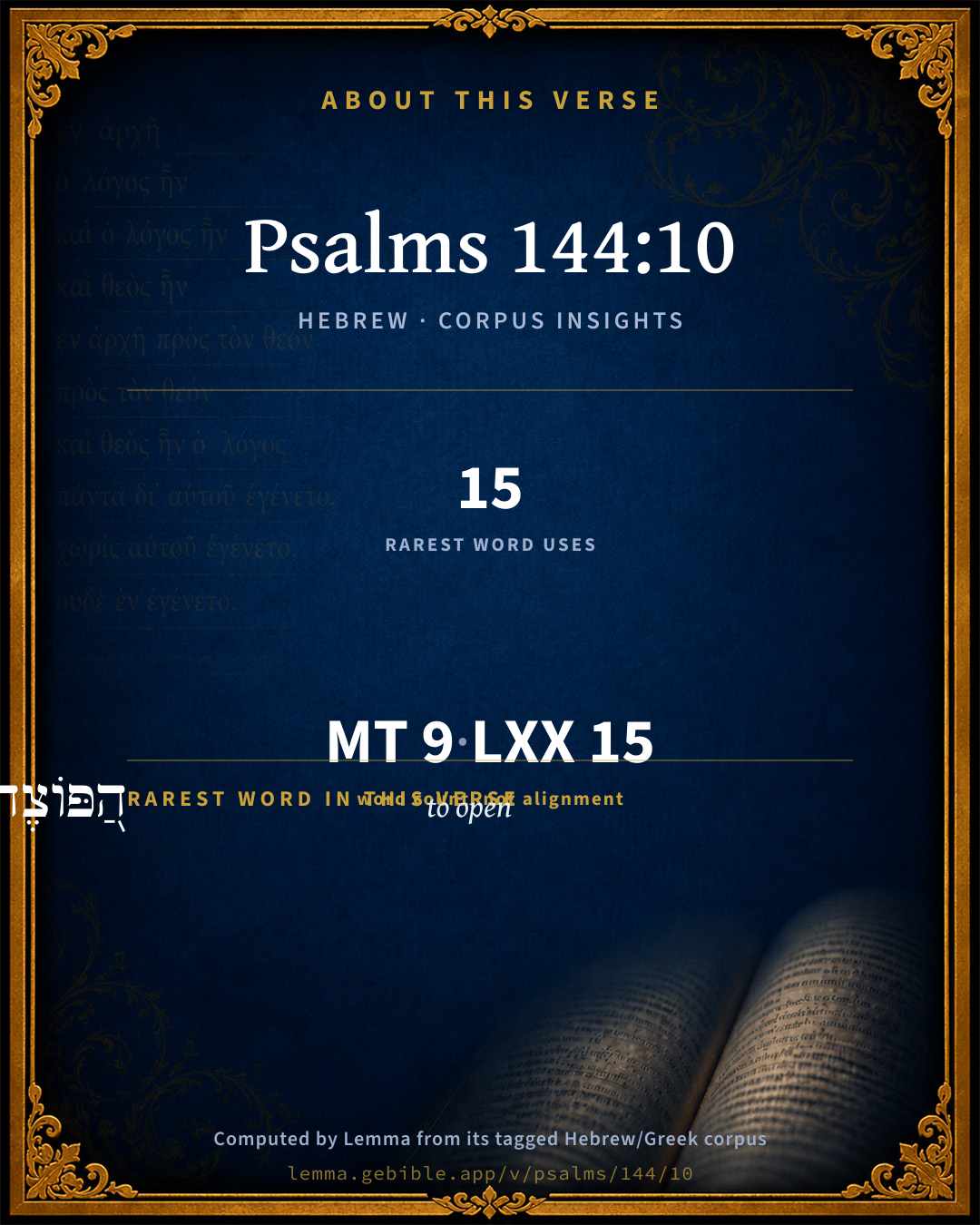
The rarest word here is הַ֭פּוֹצֶה to open H6475 — appearing just 15 times in the whole Hebrew Bible.

Shared distinctive vocabulary

הַ֭פּוֹצֶה to open H6475 occurs in 15 verses of the Hebrew Bible. Also found in:

Grammatical profile

  • 2 verbs
  • 5 nouns
  • 1 adjective
  • 1 particle

Verb forms

  • הַנּוֹתֵ֥ן Qal · Participle Active
  • הַ֭פּוֹצֶה Qal · Participle Active

Hebrew & Septuagint length

In English translation the verse runs 17 words from the Hebrew and 17 from the Septuagint (LXX English) — the same length.

A rough comparison of the two English renderings, which tokenize alike — not a word-level alignment.

Word counts can differ between the Hebrew and the Greek without any difference in meaning — e.g. the Hebrew direct-object marker אֵת has no separate Greek word, and Greek often adds the article ὁ.

In the original languages it is 9 Hebrew tokens and 15 Greek tokens — but the two are counted differently (Hebrew bundles its prefixes and suffixes into one token; the Greek is in lemma form), so that isn’t a like-for-like length.

Cross-references

10

Topical passages linked to Psalms 144:10 in the Treasury of Scripture Knowledge — connected by theme and wording, ordered by reader-vote popularity; previews shown in the World English Bible.

  • Psalms 18:50 He gives great deliverance to his king, And shows loving kindness to his anointed, To David and to his seed, forevermore.
  • Psalms 140:7 Yahweh, the Lord, the strength of my salvation, You have covered my head in the day of battle.
  • Psalms 33:16–18 There is no king saved by the multitude of a host. A mighty man is not delivered by great strength.
  • 1 Samuel 17:45–46 Then said David to the Philistine, You come to me with a sword, and with a spear, and with a javelin: but I come to you in the name of Yahweh of hosts, the God of the armies of Israel, whom you have defied.
  • 2 Samuel 5:19–25 David inquired of Yahweh, saying, Shall I go up against the Philistines? will you deliver them into my hand? Yahweh said to David, Go up; for I will certainly deliver the Philistines into your hand.
  • 2 Samuel 8:6–14 Then David put garrisons in Syria of Damascus; and the Syrians became servants to David, and brought tribute. Yahweh gave victory to David wherever he went.
  • 2 Samuel 21:16–17 and Ishbibenob, who was of the sons of the giant, the weight of whose spear was three hundred [shekels] of brass in weight, he being girded with a new [sword], thought to have slain David.
  • Isaiah 45:1–6 Thus says Yahweh to his anointed, to Cyrus, whose right hand I have held, to subdue nations before him, and I will loose the loins of kings; to open the doors before him, and the gates shall not be shut:
  • 2 Kings 5:1 Now Naaman, captain of the host of the king of Syria, was a great man with his master, and honorable, because by him Yahweh had given victory to Syria: he was also a mighty man of valor, [but he was] a leper.
  • Jeremiah 27:6–8 Now have I given all these lands into the hand of Nebuchadnezzar the king of Babylon, my servant; and the animals of the field also have I given him to serve him.

Cross-references courtesy of OpenBible.info (CC BY 4.0).

Hebrew and Greek witnesses Masoretic Hebrew ↔ Greek Septuagint

The same verse in the two great witnesses to the Old Testament, shown verse-for-verse.

You’re reading Greek Psalm 143 (Hebrew Psalm 144). The Septuagint counts the superscription, so verse numbers can differ from the Hebrew — chapter-level alignment, not verse-by-verse. Numbering follows Rahlfs.

These are two independent witnesses, not word-aligned to each other, and the Septuagint is shown in lemma (dictionary) form.

Hebrew Psalms 144:10 Masoretic · Westminster Leningrad Codex

הַנּוֹתֵ֥ן תְּשׁוּעָ֗ה לַמְּלָ֫כִ֥ים הַ֭פּוֹצֶה אֶת דָּוִ֥ד עַבְדּ֗וֹ מֵחֶ֥רֶב רָעָֽה

You are he who gives salvation to kings, Who rescues David, his servant, from the deadly sword.

World English Bible · Public Domain

Greek LXX Greek Psalm 143:10 Septuagint · lemma form

ὁ δίδωμι ὁ σωτηρία ὁ βασιλεύς ὁ λυτρόω δαυίδ ὁ δοῦλος αὐτός ἐκ ῥομφαία πονηρός

Even to him who gives salvation to kings: who redeems his servant David from the hurtful sword.

LXX2012 (modern English Septuagint) · Public Domain

Hebrew: Westminster Leningrad Codex (CC BY 4.0). Greek: Septuagint (public domain); English from LXX2012 (modern English Septuagint) (Public Domain). How the Septuagint differs from the Hebrew →

Commentary

Notes on Psalms 144:10 from classic Christian and Jewish commentators (each source and its license shown beneath its notes). The classic Christian expositions comment on the surrounding passage and are grouped to its opening verse, so a note may address several verses; the Jewish commentaries on the Tanakh (Rashi and others) are per-verse, so they appear only where the commentator wrote on this verse.

Lemma curates 59 commentaries, every one of them public domain or Creative Commons licensed, each selected and text-cleaned for this edition rather than reprinted as found. About our sources →

Trapp's Complete Commentary

John Trapp

Psa 144:10 [It is he] that giveth salvation unto kings: who delivereth David his servant from the hurtful sword.

Ver. 10. It is he that giveth salvation (or victory) unto kings] Ferdinand, king of Arragon, sending his son against the Florentines, thus bespake him: Victoria mihi crede, non hominum disciplinis aut industria comparatur, sed Dei O.M. benignitate et arbitrio, Deum igitur imprimis cole, in eum confide, a quo tum victorias omnes tum optima quaeque provenire dubio procul est, &c.: Believe me, son, victories are not gotten by art or industry, but given of God (Val. Max. Christian., p. 516).

Who delivereth David his servant] All kings are God’s servants for the common good of mankind, saith Plutarch, but David by a specialty (Plut. προς ηγεμονα απαιδευτον).

From the hurtful sword] Of Goliath, saith the Chaldee, and of all his other enemies; for (as it was said of Queen Elizabeth) he swam to the crown through a sea of sorrows, and might rather marvel that he was, than muse that he should not be, were it not that God’s holy hand had protected him beyond expectation.

John Trapp, A Commentary or Exposition upon All the Books of the Old and New Testament (1647–1656) — public domain. Text from a community e-Sword module.

The Biblical Illustrator

Joseph S. Exell

Psa_144:10

It is He that giveth salvation unto kings.

The care of Providence in defence of kings

God in the government of the world exercises a peculiar and extraordinary providence over the persons and lives of princes.

I. Upon what account any act of Gods providence may be said to be peculiar and extraordinary.

1. When a thing falls out beside the common and usual operation of its proper cause.

2. When a thing falls out beside or contrary to the design of expert, politic, and shrewd persons, contriving or acting in it.

3. When a thing comes to pass visibly and apparently beyond the power of the cause immediately employed in it.

II. How and by what means God does after such an extraordinary manner save and deliver princes.

1. By endowing them with a more than ordinary sagacity and quickness of understanding above other men (1Ki_4:29; Pro_20:8; Pro_25:5).

2. By giving them a singular courage and presence of mind in cases of difficulty and danger (1Sa_10:9; 1Sa_11:6).

3. By disposing of events and accidents in a strange concurrence for their advantage and preservation.

4. By wonderfully inclining the hearts and wills of men to a benign affection towards them (2Sa_19:14).

5. By rescuing them from unseen and unknown mischiefs prepared against them.

6. By imprinting a certain awe and dread of their persons and authority upon the minds of their subjects (Dan_5:12).

7. By disposing their hearts to such virtuous and pious courses as He has promised a blessing to; and by restraining them from those ways to which He has denounced a curse. And this is the greatest deliverance of all; as having a prospect upon the felicity of both worlds, and laying a foundation for all other deliverances.

III. The reasons why Providence is so much concerned in the salvation and deliverance of kings.

1. They are the greatest instruments in the hand of Providence to support government and civil society in the world.

2. They have the most powerful influence upon the concerns of religion, and the preservation of the Church, of all other persons whatsoever.

IV. Some useful deductions.

1. The duty and behaviour of princes towards God. It shows them from whom, in their distress, they are to expect, and to whom, in their glory, they are to ascribe, all their deliverances.

2. Does not God by such a protecting providence over kings point out to us the sacredness of their persons? and command a reverence where tie Himself thinks fit to place an honour? Does not every extraordinary deliverance of a prince carry this inscription upon it in the brightest characters, Touch not Mine anointed? (R. South, D. D.)

The Biblical Illustrator, edited by Joseph S. Exell (c. 1880s–1900s) — public domain. Text from a community e-Sword module.

J. A. Alexander on Psalms

Joseph Addison Alexander

10. (Psa 144:10) The (one) giving salvation to kings; the (one) ridding David his servant from an evil sword. This mode of connecting sentences, by a participle agreeing with a noun in the foregoing context, is a characteristic feature of Psalms 18. The kings particularly meant are the theocratical sovereigns, the royal family of David. Ridding, the participle of the verb so rendered in Psa 144:7. David (as) his servant, because he is his servant, in the sense repeatedly explained already. See above, on Psa 143:2; Psa 143:12. David speaks of himself by name, not only here but in Psa 18:50; Psa 61:6; Psa 63:11, 2Sa 7:26. An evil sword, not only dangerous but wicked. Compare Psa 22:20).

Joseph Addison Alexander, The Psalms Translated and Explained (1850) — public domain. Text from a community e-Sword module.

Geneva Bible (1599)

Geneva Bible translators

Though wicked kings be called God’s servants, as Cyrus, Isa. 45:1, forasmuch as he useth them to execute his judgments: yet David because of God’s promise, and they that rule godly, are properly so called, because they serve not their own affections, but set forth God’s glory.

Geneva Bible (1599) marginal notes — public domain. Text via Bolls.life.

Adam Clarke's Commentary

Verse 10. He that giveth salvation unto kings] Monarchy, in the principle, is from God: it is that form of government which, in the course of the Divine providence, has principally prevailed; and that which, on the whole, has been most beneficial to mankind. God, therefore, has it under his peculiar protection. It is by him that kings reign; and by his special providence they are protected.

Adam Clarke's Commentary on the Bible (1810–1826) — public domain. Text from a community e-Sword/MySword module.

Ellicott's Commentary for English Readers

(10) David his servant.—See Psa_18:50.

A Bible Commentary for English Readers, edited by Charles John Ellicott (1878–1897) — public domain. Text from a community e-Sword module.

The Cambridge Bible for Schools and Colleges

gen. ed. J. J. S. Perowne

10. Cp. Psa_18:50. Who giveth salvation (or victory) unto kings may be meant as a general truth not to be limited to Israel only (cp. Psa_33:16), and David his servant may denote the typical ruler of Jehovah’s people (cp. Eze_34:23); or the reference may be historical, who gave victory … who rescued David.

the hurtful (lit. evil) sword] i.e. from the calamity of war. The Targ. renders ‘the evil sword of Goliath,’ but the reference is quite general.

The Cambridge Bible for Schools and Colleges (gen. ed. J. J. S. Perowne; Cambridge University Press, 1878–1918) — public domain. Text from a community e-Sword module.

John Gill's Exposition

It is he that giveth salvation to kings,.... Which is the reason of singing the new song to the Lord, or this is the matter of it. The Lord is the Preserver of men and beasts, the Saviour of all men, and especially of them that believe; who are in a spiritual sense kings and priests unto God; and in a temporal sense he saves high and low, rich and poor: but there is a particular providence respecting kings; who, as they are the powers ordained of God, and are his vicegerents on earth, and represent him, so they are preserved by him; were they not, there would soon be an end to all public order and government: they cannot save themselves; nor are they saved by their bodyguards about them; nor is any king saved by the multitude of his host, but by the Lord, Psa 33:16. Or, "he that giveth victory to kings"; over their enemies; which is not obtained by the strength and force of their armies, and by their military skill valour; but by the right hand and arm of the Lord: and therefore, whenever this is the case, a new song should be sung to him; see Psa 98:1. David no doubt has regard to himself, and to the many salvations God had wrought for him, and the victories he had given him; as also to the King Messiah, whom God heard and helped, as man and Mediator, in the day of salvation, and gave it to him, and in which he rejoiced, Isa 49:8;

who delivereth David his servant from the hurtful sword; David literally, the servant of the Lord by creation, redemption, and grace, as well as by his office, as king of Israel; him the Lord delivered from the sword of Goliath, as the Targum; from the sword of Saul, as Jarchi and Kimchi; and from the sword of strange children, as Arama; of all his enemies he had been or was engaged with in war: and David mystically, Christ the son of David, God's righteous servant, he chose, called, upheld; and in whom he was glorified, by doing his work diligently, faithfully, and completely; him he delivered from the sword of justice, when he had satisfied it; and from wicked men, like a sword; and from all his enemies, and death itself, when he raised him from the dead, and gave him glory; see Psa 22:20. Aben Ezra thinks there is a defect of the copulative "and": and that it should be read, "from the sword and evil"; every evil person or thing; and observes, that some take it for an adjective, and understand it of an evil camp or company.

John Gill's Exposition of the Whole Bible (1746–1763) — public domain (CC PDM 1.0). Text via the HelloAO Bible API.

Albert Barnes' Notes on the Bible

It is he that giveth salvation unto kings - Margin, “Victory.” The Hebrew word means “salvation,” but it is used here in the sense of deliverance or rescue. Even “kings,” with all their armies, have no hope but in God. They seem to be the most powerful of men, but they are, like all other people, wholly dependent on him for deliverance from danger. David thus recognizes his own entire dependence. Though a king in the divine purpose and in fact, yet he had no power but as derived from God; he had no hope of deliverance but in him. It is implied further that God might as readily be supposed to be willing to interpose in behalf of kings as of other people when their cause was right, and when they looked to him for aid. See the notes at Psa 33:16 : “there is no king saved by the multitude of an host.” Compare Psa 44:5-6.

Who delivereth David his servant from the hurtful sword - Who has done it; who can do it again; on whom alone David is dependent as all other men are. David speaks of himself by name elsewhere. See Psa 18:50; 2Sa 7:26. He refers to himself also under the name of “the king,” Psa 61:6; Psa 63:11. Caesar, in his writings, often speaks of himself in the same way.

Albert Barnes' Notes on the Bible (1834–1885) — public domain. Text from a community e-Sword/MySword module.

Matthew Poole's English Annotations

Kings are not preserved by their own power or prudence, but by God’s special providence, which for the public good of the world watcheth over them.

Matthew Poole's English Annotations on the Holy Bible (1683–1685) — public domain. Text from a community e-Sword/MySword module.

The Treasury of David

Charles H. Spurgeon

Ver. 10. It is he that giveth salvation unto kings. Those whom the Lord sets up he will keep up. Kings, from their conspicuous position, are exposed to special danger, and when their lives and their thrones are preserved to them they should give the Lord the glory of it. In his many battles David would have perished had not almighty care preserved him. He had by his valour wrought salvation for Israel, but he lays his laurels at the feet of his Lord and Preserver. If any men need salvation kings do, and if they get it the fact is so astonishing that it deserves a verse to itself in the psalm of praise.

Who delivereth David his servant from the hurtful sword. He traces his escape from death to the delivering hand of God. Note, he speaks in the present tensedelivereth, for this was an act which covered his whole life. He puts his name to the confession of his indebtedness: it is David who owns without demur to mercy given to himself. He styles himself the Lord's servant, accepting this as the highest title he had attained or desired.

Ver. 10. It is he that giveth salvation unto kings. Ferdinand, king of Aragon, sending his son against the Florentines, thus bespake him: Believe me, son, victories are not gotten by art or subtlety, but given of God. John Trapp.

Ver. 10. It is he that giveth salvation unto kings. What a doctrine this for the kings and great men of the earth to remember! Could they be brought to feel and acknowledge it, they would not trust to the sagacity of their own councils, nor to the strength of their own arm; but would ever remember that the Most High is the ruler among the nations, and that he putteth down one and raiseth up another according to the dictates of his own all perfect will. Such remembrances as this would stain the pride of all human glory, and would lead men to feel that the Lord alone is to be exalted. John Morison.

Psalms 144:11*

Charles H. Spurgeon's The Treasury of David (1869–1885) — public domain. Psalms only. Text from a community e-Sword/MySword module.

The Pulpit Commentary

It is he that giveth salvation unto kings. There has always been a belief, especially in the East, that "a divinity doth hedge a king." Saul himself was regarded by David as sacrosanct, and to kill him, even at his own request, was a sacrilege. (2Sa_1:14-16) Who delivereth David his servant from the hurtful sword. David speaks of himself by name, not only here, but in Psa_18:50 2Sa_7:26.

The first stage of salvation is deliverance.

"Who rescueth David his servant from the hurtful sword." This describes what is involved in "giving salvation unto kings." An act of deliverance is always the beginning of salvation; but such act of deliverance is only a beginning.

I AN ACT OF DELIVERANCE IS THE BEGINNING OF SALVATION. This is the truth of a fact that is once for all illustrated in the history of Israel. God would saw that people in a large sense of saving. He must begin by a formal act of deliverance, in bringing his people out from bondage in Egypt. That truth once presented in so large a way, is afterwards presented again and again in more limited spheres. In the time of the Judges, when God would save his people, he began the salvation by a formal act of deliverance, as is seen strikingly in the case of Gideon. When God would save his people from captivity in Babylon, he began by the formal act of liberation made by Cyrus. And it was the same with the great spiritual salvation of men. Its beginning is that sublime act of sacrifice which is man"s rescue from the thraldom of sin. The formal act of surrender made on the cross was Christ"s triumph over man"s sin, his "leading captivity captive." And so in personal experience salvation begins in that act of consecration to Christ which we make, and which is met by Christ"s act of delivering us from the power of self and sin.

II SUCH AN ACT OF DELIVERANCE IS ONLY THE BEGINNING. The deliverance of Israel from Egypt was only a beginning of God"s dealings in their salvation. Gideon"s overthrow of the Midianites was only a beginning. Cyrus"s decree was only a beginning. Our Lord"s sacrifice was only a beginning. Our consciousness of acceptance is only a beginning. The salvation of a nation is a large and comprehensive thing; so is the salvation of a man. But in every case God"s beginning is the pledge that he will carry on the work and perfect it. R.T.

The Pulpit Commentary (1880–1919), ed. H.D.M. Spence-Jones & Joseph S. Exell — public domain. Text from a community e-Sword module.

Rashi

Rabbi Shlomo Yitzchaki (Rashi)

Who gives salvation to kings This speaks about the Rock of the Divisions, when David was close to being seized by Saul (I Sam. 23:27): “A messenger came to Saul, saying, ‘Make haste and go, etc.’” He saved Saul from shedding innocent blood, and David from being killed.

Rashi on the Tanakh — English translations: “The Judaica Press complete Tanach with Rashi, translated by A. J. Rosenberg” (CC BY 4.0); “Pentateuch with Rashi's commentary by M. Rosenbaum and A.M. Silbermann, 1929-1934” (public domain); “The Metsudah Tanach series, Lakewood, N.J” (CC BY 4.0); and “The Book of Joshua, Metsudah Publications, 1997” (CC BY 4.0). Text via Sefaria.

Lesson kit

Teaching starters — assembled from the data on this page, not authored interpretation. Every prompt links to the verse data it draws on. Edit before teaching.

Psalms, in the Wisdom, opens this verse with 9 words (9 distinct Hebrew lemmas). Its most distinctive word is pâtsâh (“to open”). A historical commentator’s framing appears above. Read the whole chapter for the surrounding context.

Discussion questions

  1. What does “to open” (pâtsâh) contribute to the verse as a whole?
  2. Genesis 4:11 shares the word «to open» with this verse. How do the two illuminate each other?
  3. These translations render this verse differently; the difference is in the English rendering, not the original. What questions does that raise?
  4. The verb «הַנּוֹתֵ֥ן» is Qal Participle Active. How does its form color the action?
  5. Reading how Trapp's Complete Commentary and The Biblical Illustrator read this verse, where do the two commentators agree and where do they part?

Things to notice

Reading settings

Reading text

Shown beneath each verse's original-language words.

Old Testament
Old Testament edition

Read the OT as the Masoretic Hebrew (MT) or the Greek Septuagint (LXX).

English shown for the Greek Septuagint (in the Hebrew ↔ Greek comparison).

Comparing translations? Open the Compare panel on any verse page to stack up to four side by side.