Genesis 34:26

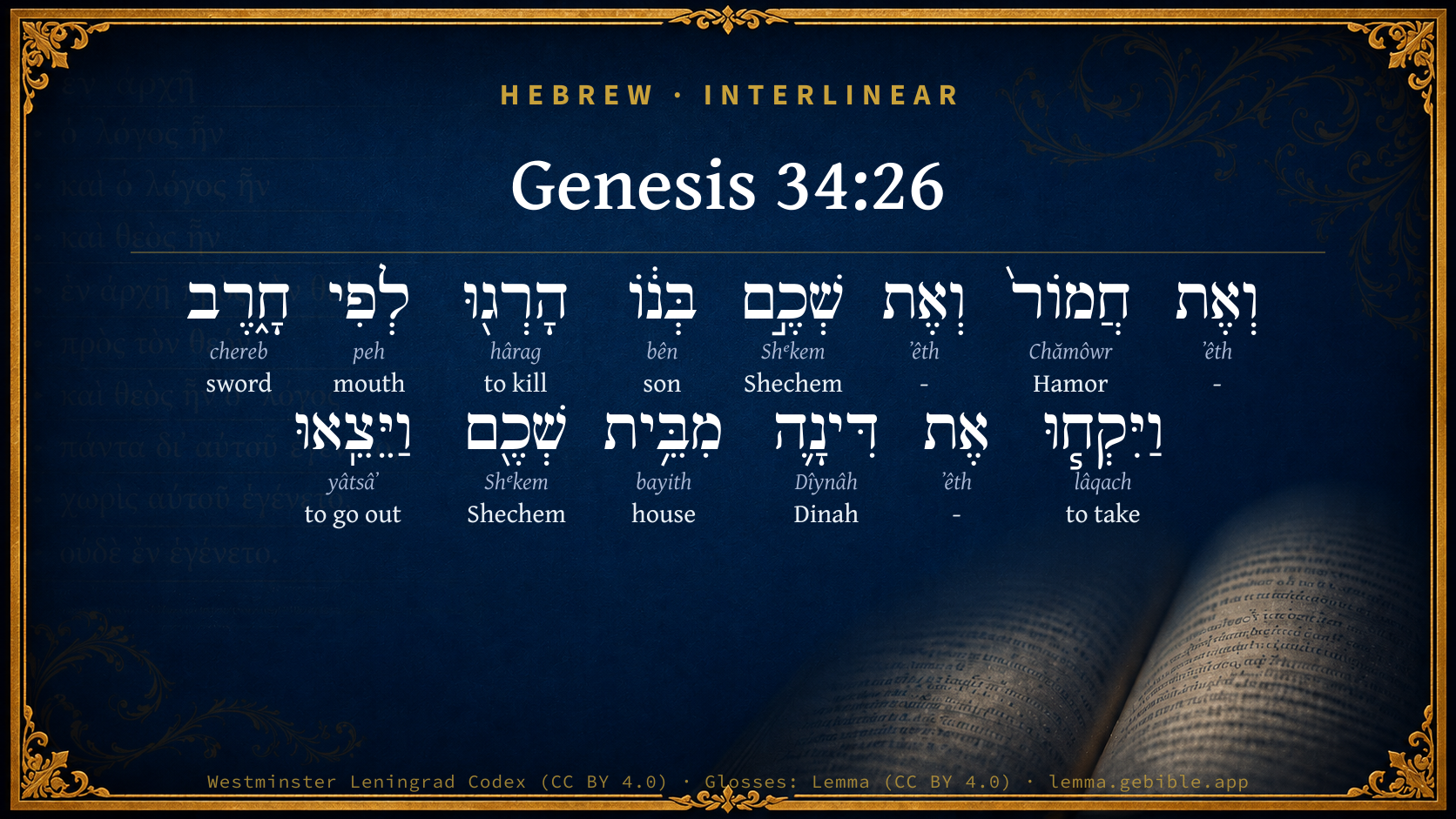
Hebrew (Westminster Leningrad Codex) Genesis 34:26 appears in the Hebrew Old Testament. The text above is from the Westminster Leningrad Codex. Each word links to its Strong’s number, a concise gloss, and parsing drawn from the Open Scriptures Hebrew Bible morphology. Click any word for its full Brown-Driver-Briggs (BDB) entry.
Download image
Cite this verse

Genesis 34:26 (World English Bible). Public Domain. Lemma interlinear Bible study tool, https://lemma.gebible.app/v/genesis/34/26.

Show BibTeX & RIS
BibTeX
RIS
English Translation
They killed Hamor and Shechem, his son, with the edge of the sword, and took Dinah out of Shechem's house, and went away.
World English Bible · Public Domain
Download a study sheet

One document with this verse’s original text, its word-by-word gloss line, the meaning frame, cross-references with their text, attributed commentary, and full source and license credits — printable, and it pastes into notes with its structure intact.

This verse Autodidact and up

Study sheet (.html) Plain text (.txt)

A passage Seminary Student

Up to 50 verses in one chapter. A passage sheet keeps up to 6 commentary sources and 12 cross-references per verse, in the order this page ranks them, and says so on the sheet whenever that leaves anything out. Ask for a single verse and you get the Autodidact verse sheet above.

Everything on this page stays free to read, with no account — the sheet is a download of what is already on screen, not access to it.

Want to remove ads? Support Godless Engineer
Compare translations 3

The same verse in 3 English versions, stacked beneath the original-language interlinear above. Click any original word for its lexicon entry.

Each is an independent rendering of the whole verse — the interlinear is not word-aligned to these translations.

Highlighted words mark where these versions differ — a whole-verse word diff, not a word-by-word alignment.

  • World English Bible Public Domain
    They killed Hamor and Shechem, his son, with the edge of the sword, and took Dinah out of Shechem's house, and went away.
  • King James Version Public Domain
    And they slew Hamor and Shechem his son with the edge of the sword, and took Dinah out of Shechem's house, and went out.
  • unfoldingWord Literal Text CC BY-SA 4.0
    And they killed Hamor and Shechem his son with the mouth of the sword, and they took Dinah from the house of Shechem and left.

unfoldingWord Literal Text — © unfoldingWord, licensed CC BY-SA 4.0. Word-aligned USFM3 via Door43 (git.door43.org/unfoldingWord/en_ult).

Versions to compare (up to 4)

3 of 4 selected

Show all 18 translations

Every available English version of this verse, each an independent rendering of the whole verse.

  • World English Bible Public Domain
    They killed Hamor and Shechem, his son, with the edge of the sword, and took Dinah out of Shechem's house, and went away.
  • Berean Standard Bible Public Domain
    They killed Hamor and his son Shechem with their swords, took Dinah out of Shechem’s house, and went away.
  • Majority Standard Bible Public Domain
    They killed Hamor and his son Shechem with their swords, took Dinah out of Shechem’s house, and went away.
  • King James Version Public Domain
    And they slew Hamor and Shechem his son with the edge of the sword, and took Dinah out of Shechem's house, and went out.
  • American Standard Version (1901) Public Domain
    And they slew Hamor and Shechem his son with the edge of the sword, and took Dinah out of Shechem's house, and went forth.
  • Revised Version (1885) Public Domain
    And they slew Hamor and Shechem his son with the edge of the sword, and took Dinah out of Shechem’s house, and went forth.
  • Geneva Bible (1599) Public Domain
    They slewe also Hamor and Shechem his sonne with the edge of the sword, and tooke Dinah out of Shechems house, and went their way.
  • Douay-Rheims (1899) Public Domain
    And they killed also Hemor and Sichem, and took away their sister Dina, out of Sichem's house.
  • Young's Literal Translation Public Domain
    and Hamor, and Shechem his son, they have slain by the mouth of the sword, and they take Dinah out of Shechem's house, and go out.
  • Literal Standard Version CC BY-SA 4.0
    and Hamor, and his son Shechem, they have slain by the mouth of the sword, and they take Dinah out of Shechem’s house, and go out.
  • Unlocked Literal Bible CC BY-SA 4.0
    They killed Hamor and his son Shechem with the edge of the sword. They took Dinah from Shechem's house and went away.
  • unfoldingWord Literal Text CC BY-SA 4.0
    And they killed Hamor and Shechem his son with the mouth of the sword, and they took Dinah from the house of Shechem and left.
  • Darby Bible Public Domain
    And Hamor and Shechem his son they slew with the edge of the sword; and took Dinah out of Shechem's house; and went out.
  • World Messianic Bible Public Domain
    They killed Hamor and Shechem, his son, with the edge of the sword, and took Dinah out of Shechem’s house, and went away.
  • Webster's Bible Public Domain
    And they slew Hamor and Shechem his son with the edge of the sword, and took Dinah out of Shechem's house, and went out.
  • Free Bible Version CC BY-SA 4.0
    They killed Hamor and Shechem with their swords, took Dinah from Shechem's house, and left.
  • Bible in Basic English Public Domain
    And Hamor and his son they put to death with the sword, and they took Dinah from Shechem's house and went away.
  • JPS Tanakh (1917) Public Domain
    And they slew Hamor and Shechem his son with the edge of the sword, and took Dinah out of Shechem's house, and went forth.

Literal Standard Version (2020), Covenant Press — licensed CC BY-SA 4.0. Text via the HelloAO Bible API (eBible.org). Unlocked Literal Bible (unfoldingWord) — licensed CC BY-SA 4.0. Text via the HelloAO Bible API (eBible.org). unfoldingWord Literal Text — © unfoldingWord, licensed CC BY-SA 4.0. Word-aligned USFM3 via Door43 (git.door43.org/unfoldingWord/en_ult). Free Bible Version, Dr. Jonathan Gallagher — licensed CC BY-SA 4.0. Text via the HelloAO Bible API (eBible.org).

Word by word

More ways to search: Search by grammar → Find every occurrence → Compare this word →

Practice this passage: Drill this verse → Learn its vocabulary →

דִּינָ֛ה
Dîynâh
H1783
“Dinah”
Noun, Proper
Part of Speech
Noun
Type
Proper
Full BDB Definition

Origin: from H1779

TWOT: None

Dinah = "judgment" - daughter of Jacob by Leah, full sister of Simeon and Levi
  1. וְאֶת ʼêth H853 “and · -” Conjunction + Particle, Direct Object
  2. חֲמוֹר֙ Chămôwr H2544 “Hamor” Noun, Proper
  3. וְאֶת ʼêth H853 “and · -” Conjunction + Particle, Direct Object
  4. שְׁכֶ֣ם Shᵉkem H7927 “Shechem” Noun, Proper
  5. בְּנ֔וֹ bên H1121 “son · his” Noun, Common, Masculine, Singular, Construct + Suffix, Personal, 3rd Person, Masculine, Singular
  6. הָרְג֖וּ hârag H2026 “to kill” Verb, Qal, Perfect, 3rd Person, Common, Plural
  7. לְפִי peh H6310 “to/for · mouth of” Preposition + Noun, Common, Masculine, Singular, Construct
  8. חָ֑רֶב chereb H2719 “sword” Noun, Common, Feminine, Singular, Absolute
  9. וַיִּקְח֧וּ lâqach H3947 “and · to take” Conjunction + Verb, Qal, Sequential Imperfect, 3rd Person, Masculine, Plural
  10. אֶת ʼêth H853 “-” Particle, Direct Object
  11. מִבֵּ֥ית bayith H1004 “from · house of” Preposition + Noun, Common, Masculine, Singular, Construct
  12. שְׁכֶ֖ם Shᵉkem H7927 “Shechem” Noun, Proper
  13. וַיֵּצֵֽאוּ yâtsâʼ H3318 “and · to go out” Conjunction + Verb, Qal, Sequential Imperfect, 3rd Person, Masculine, Plural

About this verse

These counts appear in no published source. They are computed here, from the morphology-tagged text and Lemma’s own curated glosses. What Lemma adds →

14
words
11
distinct lemmas
Pentateuch
section

Notable vocabulary

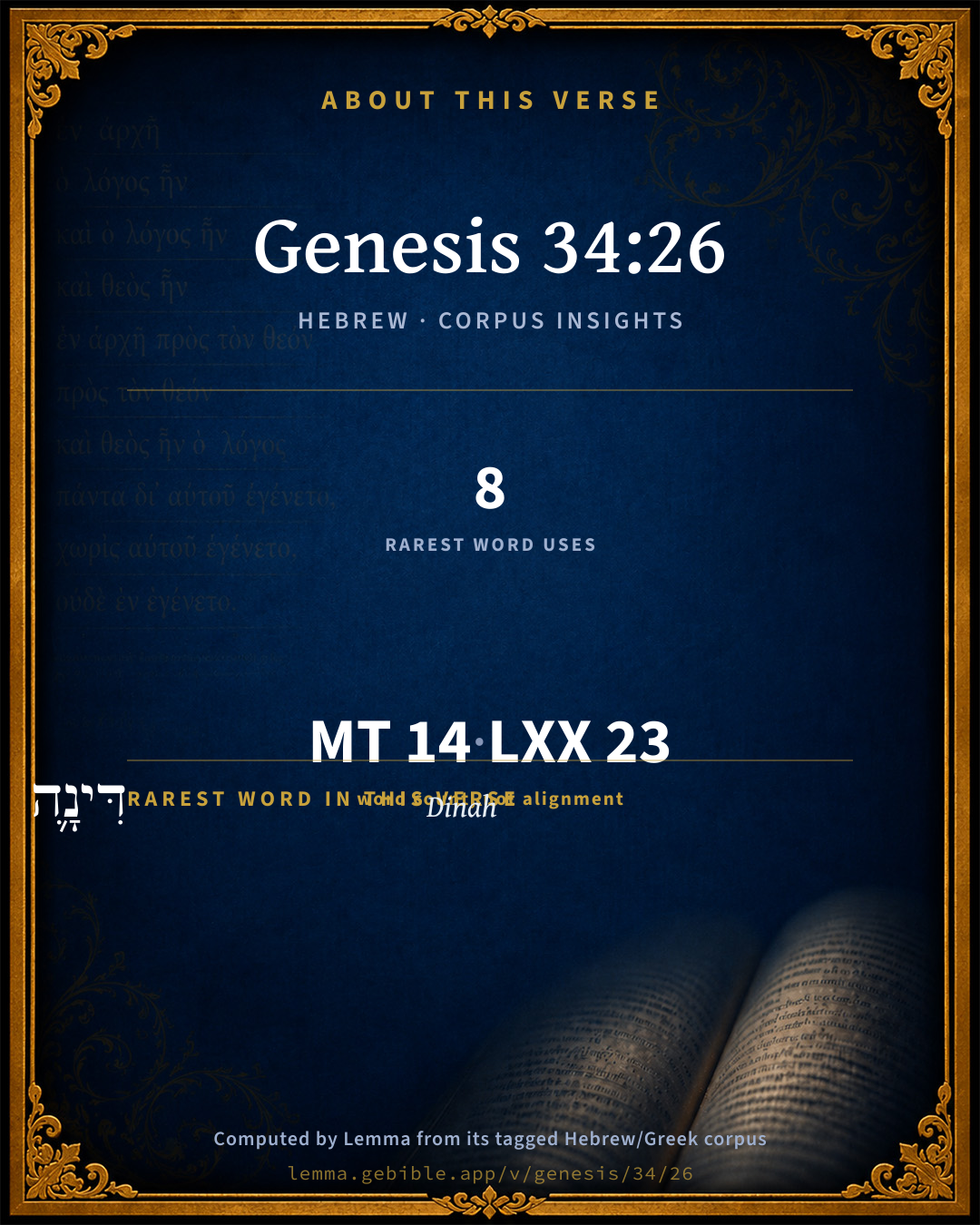
The rarest word here is דִּינָ֛ה Dinah H1783 — appearing just 8 times in the whole Hebrew Bible.

Shared distinctive vocabulary

דִּינָ֛ה Dinah H1783 occurs in 8 verses of the Hebrew Bible. Also found in:

Grammatical profile

  • 3 verbs
  • 8 nouns
  • 3 particles

Verb forms

  • הָרְג֖וּ Qal · Perfect
  • וַיִּקְח֧וּ Qal · Sequential Imperfect
  • וַיֵּצֵֽאוּ Qal · Sequential Imperfect

Repetition

A word recurs within this verse — often emphatic in Hebrew:

  • שְׁכֶ֣ם Shechem H7927 ×2

Hebrew & Septuagint length

In English translation the verse runs 23 words from the Hebrew and 26 from the Septuagint (LXX English) — closely comparable.

A rough comparison of the two English renderings, which tokenize alike — not a word-level alignment.

Word counts can differ between the Hebrew and the Greek without any difference in meaning — e.g. the Hebrew direct-object marker אֵת has no separate Greek word, and Greek often adds the article ὁ.

In the original languages it is 14 Hebrew tokens and 23 Greek tokens — but the two are counted differently (Hebrew bundles its prefixes and suffixes into one token; the Greek is in lemma form), so that isn’t a like-for-like length.

Cross-references

3

Topical passages linked to Genesis 34:26 in the Treasury of Scripture Knowledge — connected by theme and wording, ordered by reader-vote popularity; previews shown in the World English Bible.

  • Deuteronomy 32:42 I will make my arrows drunk with blood, My sword shall devour flesh; With the blood of the slain and the captives, From the head of the leaders of the enemy.
  • 2 Samuel 2:26 Then Abner called to Joab, and said, "Shall the sword devour forever? Don't you know that it will be bitterness in the latter end? How long shall it be then, before you bid the people return from following their brothers?"
  • Isaiah 31:8 The Assyrian shall fall by the sword, not of man; and the sword, not of men, shall devour him; and he shall flee from the sword, and his young men shall become subject to forced labor.

Cross-references courtesy of OpenBible.info (CC BY 4.0).

Hebrew and Greek witnesses Masoretic Hebrew ↔ Greek Septuagint

The same verse in the two great witnesses to the Old Testament, shown verse-for-verse.

These are two independent witnesses, not word-aligned to each other, and the Septuagint is shown in lemma (dictionary) form.

Hebrew Genesis 34:26 Masoretic · Westminster Leningrad Codex

וְאֶת חֲמוֹר֙ וְאֶת שְׁכֶ֣ם בְּנ֔וֹ הָרְג֖וּ לְפִי חָ֑רֶב וַיִּקְח֧וּ אֶת דִּינָ֛ה מִבֵּ֥ית שְׁכֶ֖ם וַיֵּצֵֽאוּ

They killed Hamor and Shechem, his son, with the edge of the sword, and took Dinah out of Shechem's house, and went away.

World English Bible · Public Domain

Greek LXX Genesis 34:26 Septuagint · lemma form

ὁ τε εμμωρ καί συχεμ ὁ υἱός αὐτός ἀποκτείνω ἐν στόμα μάχαιρα καί λαμβάνω ὁ δινα ἐκ ὁ οἶκος ὁ συχεμ καί ἐκἔρχομαι

And they killed Emmor and Sychem his son with the edge of the sword, and took Dina out of the house of Sychem, and went forth.

LXX2012 (modern English Septuagint) · Public Domain

Hebrew: Westminster Leningrad Codex (CC BY 4.0). Greek: Septuagint (public domain); English from LXX2012 (modern English Septuagint) (Public Domain). How the Septuagint differs from the Hebrew →

Targum (Aramaic paraphrase)

2

The Targum is the ancient Jewish Aramaic paraphrase of the Hebrew Scriptures — an interpretive translation, not the Hebrew text itself. Onkelos (literal) and Pseudo-Jonathan (expansive) render the Torah, and Jonathan the Prophets. Coverage is partial: where no permissively-licensed English translation exists for a verse, only the Aramaic is shown. This is verse-level text, not a word-by-word alignment to the Hebrew.

  1. Targum Onkelos Torah (Genesis–Deuteronomy)
    וְיָת חֲמוֹר וְיָת שְׁכֶם בְּרֵהּ קְטָלוּ לְפִתְגַּם דְּחָרֶב וּדְבָרוּ יָת דִּינָה מִבֵּית שְׁכֶם וּנְפָקוּ

    (no public-domain English translation for this verse)

    Targum Onkelos — Aramaic: “Onkelos Genesis” (public domain); “Onkelos Exodus” (public domain); “Onkelos Leviticus” (public domain); “Onkelos Numbers” (public domain); “Onkelos Deuteronomy” (public domain). English: “Sefaria Community Translation” (CC0 1.0 (public-domain dedication)); “J.W. Etheridge. The Targums of Onkelos and Jonathan Ben Uzziel on the Pentateuch. London: Longmans, Green, 1862” (public domain). Text via Sefaria.

  2. Targum Pseudo-Jonathan Torah (Genesis–Deuteronomy)
    וְיַת חֲמוֹר וְיַת שְׁכֶם בְּרֵיהּ קְטָלוּ לְפִתְגַם דְחָרֶב וּדְבָרוּ יַת דִינָה מִבֵּית שְׁכֶם וּנְפָקוּ

    And Hamor and Shekem his son they killed with the edge of the sword; and they took Dinah from the house of Shekem, and went forth.

    Targum Pseudo-Jonathan — Aramaic: “Targum Jonathan on Genesis” (public domain); “Targum Jonathan on Exodus” (public domain); “Targum Jonathan on Leviticus” (public domain); “Targum Jonathan on Numbers” (public domain); “Targum Jonathan on Deuteronomy” (public domain). English: “The Targum of Jonathan ben Uzziel, trans. J. W. Etheridge, London, 1862” (public domain). Text via Sefaria.

Commentary

Notes on Genesis 34:26 from classic Christian and Jewish commentators (each source and its license shown beneath its notes). The classic Christian expositions comment on the surrounding passage and are grouped to its opening verse, so a note may address several verses; the Jewish commentaries on the Tanakh (Rashi and others) are per-verse, so they appear only where the commentator wrote on this verse.

Lemma curates 59 commentaries, every one of them public domain or Creative Commons licensed, each selected and text-cleaned for this edition rather than reprinted as found. About our sources →

Trapp's Complete Commentary

John Trapp

Gen 34:26 And they slew Hamor and Shechem his son with the edge of the sword, and took Dinah out of Shechem’s house, and went out.

Ver. 26. And they slew Hamor and Shechem.] This is commended in apocryphal Judith { Jdt 9:2} for zeal; which the canonical Scripture condemneth for self-will; and Jacob, on his death bed, cursed it for cruelty, and blessed himself from their assembly. {Gen 49:6-7} Quest. But why doth he not more sharply reprove it here? Ans. First, he considered God’s just judgment on the Shechemites; who, without the knowledge and faith of God, had profaned the sacrament of circumcision. A sin that God suffers not to pass without a sensible check, {1Co 11:29-30} in his dearest children; how much less in strangers and enemies? The Donatists, that cast the holy elements of the Lord’s Supper to dogs, were devoured of dogs. He that came without his wedding garment, was taken from the table to the tormerntor. Secondly, Jacob gave place, for present, to his sons’ rage and fury. Discretion in the choice of seasons for reproving, is no less necessary than zeal and faithfulness in reproving. Good physicians use not to evacuate the body, in the extremities of heat and cold. Good mariners do not hoise up sail in every wind.

John Trapp, A Commentary or Exposition upon All the Books of the Old and New Testament (1647–1656) — public domain. Text from a community e-Sword module.

Geneva Bible (1599)

Geneva Bible translators

Hebrew, mouth of the sword.

Geneva Bible (1599) marginal notes — public domain. Text via Bolls.life.

The Cambridge Bible for Schools and Colleges

gen. ed. J. J. S. Perowne

26. slew Hamor and Shechem … took Dinah … went forth] In this verse we have the narrative in which Simeon and Levi (cf. Gen_34:25; Gen_34:30) alone entered the city, slew Hamor and Shechem, took Dinah from Shechem’s house, and made off with her. Their act is one of family vengeance for the honour of their sister.

with the edge of the sword] Lit. “according to the mouth of the sword,” i.e. according to the sword’s power to devour, unmercifully. Cf. 2Sa_2:26; 2Sa_11:25.

The Cambridge Bible for Schools and Colleges (gen. ed. J. J. S. Perowne; Cambridge University Press, 1878–1918) — public domain. Text from a community e-Sword module.

John Gill's Exposition

The sons of Jacob came upon the slain,.... That is, the rest of them, as the Targum of Jonathan paraphrases it; understanding what their two brothers had done, they came and joined them, and partook of stripping the slain of their clothes, or from them what they found of any worth about them:

and spoiled the city; plundered it of all its goods and substance, spoiled all the inhabitants of it of their wealth:

because they had defiled their sister; one of them had done it, which is imputed to them all, they not restraining him from it, when it was in their power; and perhaps approving of it, and made a laugh of and jest at it; or however did not punish him for it.

John Gill's Exposition of the Whole Bible (1746–1763) — public domain (CC PDM 1.0). Text via the HelloAO Bible API.

The Pulpit Commentary

And they slew Hamor and Shechem his son, with the edge (literally, the mouth) of the sword, without excusing the inhuman barbarity of this remorseless massacre, Kurtz offers an elaborate and interesting analysis of the complex motive of which it was the outcome, in particular showing how in Jacob"s sons that strange admixture of religious zeal and carnal passion, of lofty faith and low craft, existed which formed so large a portion of the character of the patriarch himself (vide "Hist. of the Old Covenant," vol. 1. and took Dinah out of Shechem"s house, in which up to this time she had been detained against her will (Alford), though this may be open to question (Kalisch) and went out.

The Pulpit Commentary (1880–1919), ed. H.D.M. Spence-Jones & Joseph S. Exell — public domain. Text from a community e-Sword module.

Radak

Rabbi David Kimhi (Radak)

ויקחו את דינה; there is an aggadic commentary (Bereshit Rabbah 80,11) according to which Dinah felt so ashamed that she did not want to leave the house of Shechem until Shimon swore to her that he would marry her, and that this is the meaning of 46,10 where among the issue of Shimon one is described as being named “Sha-ul son of the Canaanite (woman). “Supposedly, the father of that child was Shechem, i.e. Dinah had conceived him at the time of the rape.

Radak on the Tanakh — English translations: “Sefaria Community Translation” (CC0 1.0 (public-domain dedication)); “Eliyahu Munk, HaChut Hameshulash” (CC BY 4.0); “Rabbi Mike Feuer, Jerusalem Anthology” (CC BY 4.0); and “R. David Kimhi on the first book of Psalms, Translated by R.G. Finch, London, 1919” (public domain). Text via Sefaria.

Lesson kit

Teaching starters — assembled from the data on this page, not authored interpretation. Every prompt links to the verse data it draws on. Edit before teaching.

Genesis, in the Pentateuch, opens this verse with 14 words (11 distinct Hebrew lemmas). Its most distinctive word is Dîynâh (“Dinah”). A historical commentator’s framing appears above. Read the whole chapter for the surrounding context.

Discussion questions

  1. The word Dîynâh carries the sense “Dinah.” How does it shape the verse?
  2. How does Genesis 30:21, which shares the word «Dinah», read alongside this verse?
  3. What does the repetition of “Shechem” (2× in this one verse) do in this verse?
  4. These translations render this verse differently; the difference is in the English rendering, not the original. What questions does that raise?
  5. «הָרְג֖וּ» is a Qal Perfect verb. How does that grammatical form shape the action described?
  6. Compare how Trapp's Complete Commentary and Geneva Bible (1599) read this verse. Where do they agree or differ?

Things to notice

Reading settings

Reading text

Shown beneath each verse's original-language words.

Old Testament
Old Testament edition

Read the OT as the Masoretic Hebrew (MT) or the Greek Septuagint (LXX).

English shown for the Greek Septuagint (in the Hebrew ↔ Greek comparison).

Comparing translations? Open the Compare panel on any verse page to stack up to four side by side.