Proverbs 30:14

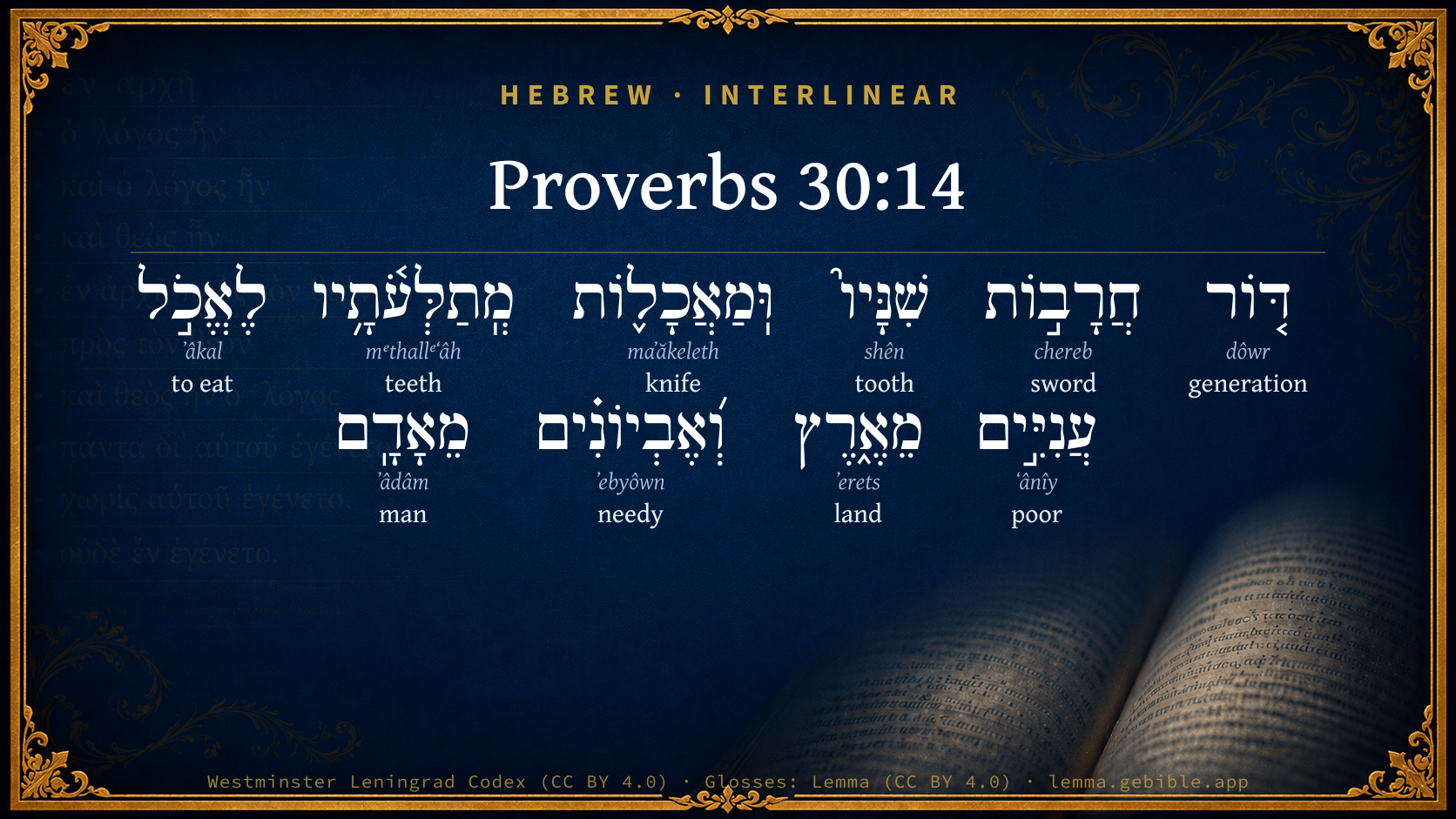
Hebrew (Westminster Leningrad Codex) Proverbs 30:14 appears in the Hebrew Old Testament. The text above is from the Westminster Leningrad Codex. Each word links to its Strong’s number, a concise gloss, and parsing drawn from the Open Scriptures Hebrew Bible morphology. Click any word for its full Brown-Driver-Briggs (BDB) entry.
Download image
Cite this verse

Proverbs 30:14 (World English Bible). Public Domain. Lemma interlinear Bible study tool, https://lemma.gebible.app/v/proverbs/30/14.

Show BibTeX & RIS
BibTeX
RIS
English Translation
There is a generation whose teeth are like swords, And their jaws like knives, To devour the poor from the earth, and the needy from among men.
World English Bible · Public Domain
Download a study sheet

One document with this verse’s original text, its word-by-word gloss line, the meaning frame, cross-references with their text, attributed commentary, and full source and license credits — printable, and it pastes into notes with its structure intact.

This verse Autodidact and up

Study sheet (.html) Plain text (.txt)

A passage Seminary Student

Up to 50 verses in one chapter. A passage sheet keeps up to 6 commentary sources and 12 cross-references per verse, in the order this page ranks them, and says so on the sheet whenever that leaves anything out. Ask for a single verse and you get the Autodidact verse sheet above.

Everything on this page stays free to read, with no account — the sheet is a download of what is already on screen, not access to it.

Want to remove ads? Support Godless Engineer
Compare translations 3

The same verse in 3 English versions, stacked beneath the original-language interlinear above. Click any original word for its lexicon entry.

Each is an independent rendering of the whole verse — the interlinear is not word-aligned to these translations.

Highlighted words mark where these versions differ — a whole-verse word diff, not a word-by-word alignment.

  • World English Bible Public Domain
    There is a generation whose teeth are like swords, And their jaws like knives, To devour the poor from the earth, and the needy from among men.
  • King James Version Public Domain
    There is a generation, whose teeth are as swords, and their jaw teeth as knives, to devour the poor from off the earth, and the needy from among men.
  • unfoldingWord Literal Text CC BY-SA 4.0
    a generation, its teeth swords and its fangs knives for devouring the afflicted from the earth and the needy from man.

unfoldingWord Literal Text — © unfoldingWord, licensed CC BY-SA 4.0. Word-aligned USFM3 via Door43 (git.door43.org/unfoldingWord/en_ult).

Versions to compare (up to 4)

3 of 4 selected

Show all 18 translations

Every available English version of this verse, each an independent rendering of the whole verse.

  • World English Bible Public Domain
    There is a generation whose teeth are like swords, And their jaws like knives, To devour the poor from the earth, and the needy from among men.
  • Berean Standard Bible Public Domain
    there is a generation whose teeth are swords and whose jaws are knives, devouring the oppressed from the earth and the needy from among men.
  • Majority Standard Bible Public Domain
    there is a generation whose teeth are swords and whose jaws are knives, devouring the oppressed from the earth and the needy from among men.
  • King James Version Public Domain
    There is a generation, whose teeth are as swords, and their jaw teeth as knives, to devour the poor from off the earth, and the needy from among men.
  • American Standard Version (1901) Public Domain
    There is a generation whose teeth are `as' swords, and their jaw teeth `as' knives, To devour the poor from off the earth, and the needy from among men.
  • Revised Version (1885) Public Domain
    There is a generation whose teeth are as swords, and their jaw teeth as knives, to devour the poor from off the earth, and the needy from among men.
  • Geneva Bible (1599) Public Domain
    There is a generation, whose teeth are as swordes, and their chawes as kniues to eate vp the afflicted out of the earth, and the poore from among men.
  • Douay-Rheims (1899) Public Domain
    A generation, that for teeth hath swords, and grindeth with their jaw teeth, to devour the needy from off the earth, and the poor from among men.
  • Young's Literal Translation Public Domain
    A generation -- swords `are' their teeth, And knives -- their jaw-teeth, To consume the poor from earth, And the needy from `among' men.
  • Literal Standard Version CC BY-SA 4.0
    A generation—their teeth [are] swords, || And their jaw-teeth [are] knives, || To consume the poor from earth, || And the needy from [among] men.
  • Unlocked Literal Bible CC BY-SA 4.0
    There is a generation whose teeth are swords, and their jawbones are like knives, so they may devour the poor from the earth and the needy from among humanity.
  • unfoldingWord Literal Text CC BY-SA 4.0
    a generation, its teeth swords and its fangs knives for devouring the afflicted from the earth and the needy from man.
  • Darby Bible Public Domain
    -- a generation whose teeth are swords, and their jaw-teeth knives, to devour the afflicted from off the earth, and the needy from [among] men.
  • World Messianic Bible Public Domain
    There is a generation whose teeth are like swords, and their jaws like knives, to devour the poor from the earth, and the needy from among men.
  • Webster's Bible Public Domain
    There is a generation, whose teeth are as swords, and their jaw-teeth as knives, to devour the poor from off the earth, and the needy from among men.
  • Free Bible Version CC BY-SA 4.0
    There are some who have teeth like swords, incisors like knives, ready to devour the poor from the earth, the needy from society.
  • Bible in Basic English Public Domain
    There is a generation whose teeth are like swords, their strong teeth like knives, for the destruction of the poor from the earth, and of those who are in need from among men.
  • JPS Tanakh (1917) Public Domain
    There is a generation whose teeth are as swords, and their great teeth as knives, to devour the poor from off the earth, and the needy from among men.

Literal Standard Version (2020), Covenant Press — licensed CC BY-SA 4.0. Text via the HelloAO Bible API (eBible.org). Unlocked Literal Bible (unfoldingWord) — licensed CC BY-SA 4.0. Text via the HelloAO Bible API (eBible.org). unfoldingWord Literal Text — © unfoldingWord, licensed CC BY-SA 4.0. Word-aligned USFM3 via Door43 (git.door43.org/unfoldingWord/en_ult). Free Bible Version, Dr. Jonathan Gallagher — licensed CC BY-SA 4.0. Text via the HelloAO Bible API (eBible.org).

Word by word

More ways to search: Search by grammar → Find every occurrence → Compare this word →

Practice this passage: Drill this verse → Learn its vocabulary →

מְֽתַלְּעֹ֫תָ֥יו
mᵉthallᵉʻâh
H4973
“teeth · his”
Noun, Common, Feminine, Plural, Construct + Suffix, Personal, 3rd Person, Masculine, Singular
Part of Speech
Noun
Type
Common
Gender
Feminine
Number
Plural
State
Construct
Full BDB Definition

Origin: contr. from H3216

TWOT: 2516d

teeth, fangs, incisors
  1. דּ֤וֹר dôwr H1755 “generation” Noun, Common, Masculine, Singular, Absolute
  2. חֲרָב֣וֹת chereb H2719 “swords” Noun, Common, Feminine, Plural, Absolute
  3. שִׁנָּיו֮ shên H8127 “teeth · his” Noun, Common, Both, Dual, Construct + Suffix, Personal, 3rd Person, Masculine, Singular
  4. וּֽמַאֲכָל֪וֹת maʼăkeleth H3979 “and · knives” Conjunction + Noun, Common, Feminine, Plural, Absolute
  5. לֶאֱכֹ֣ל ʼâkal H398 “to eat” Preposition + Verb, Qal, Infinitive Construct
  6. עֲנִיִּ֣ים ʻânîy H6041 “poor” Adjective, Adjective, Masculine, Plural, Absolute
  7. מֵאֶ֑רֶץ ʼerets H776 “from · land” Preposition + Noun, Common, Both, Singular, Absolute
  8. וְ֝אֶבְיוֹנִ֗ים ʼebyôwn H34 “and · needy” Conjunction + Adjective, Adjective, Masculine, Plural, Absolute
  9. מֵאָדָֽם ʼâdâm H120 “from · man” Preposition + Noun, Common, Masculine, Singular, Absolute

About this verse

These counts appear in no published source. They are computed here, from the morphology-tagged text and Lemma’s own curated glosses. What Lemma adds →

10
words
10
distinct lemmas
Wisdom
section

Notable vocabulary

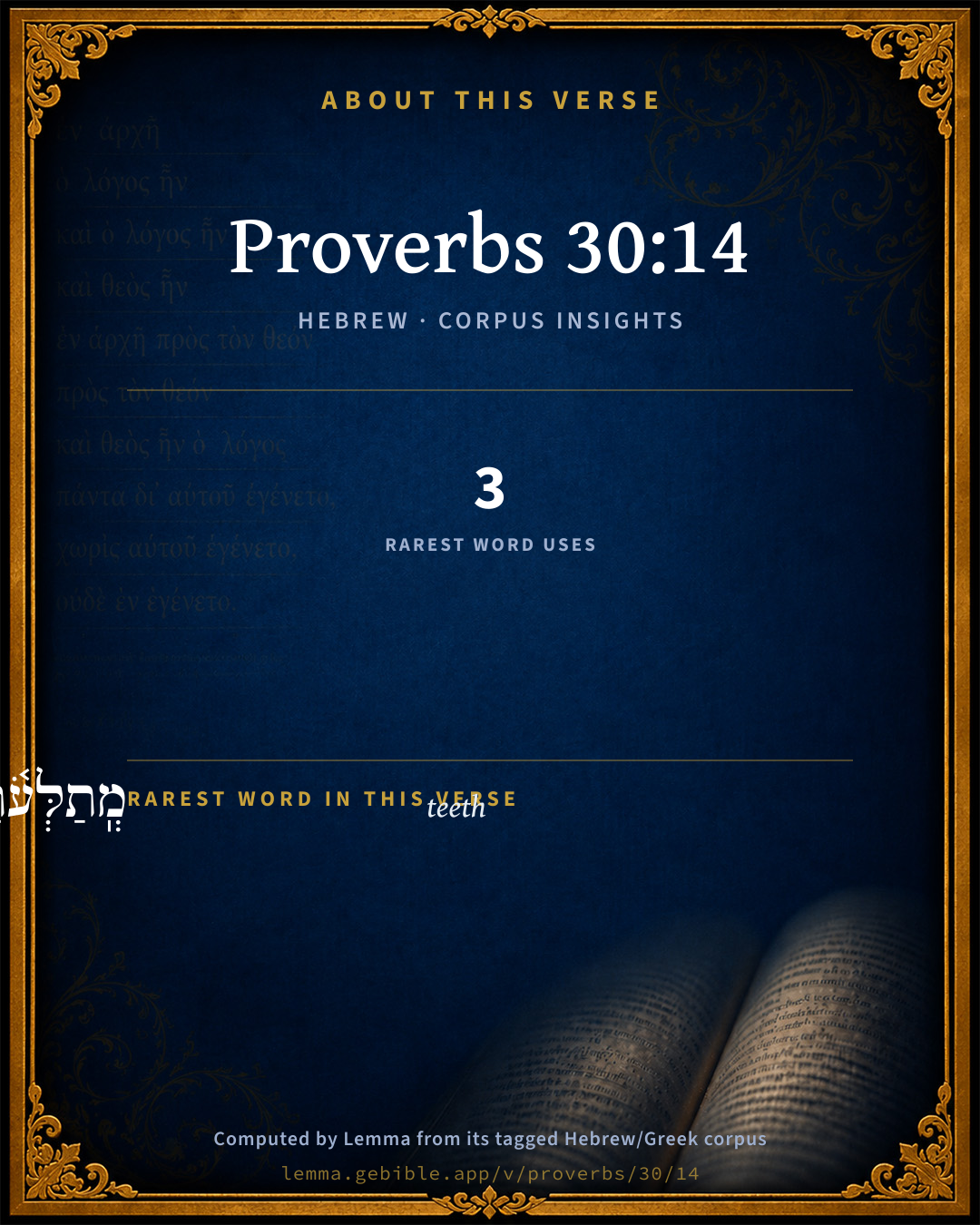
The rarest word here is מְֽתַלְּעֹ֫תָ֥יו teeth H4973 — appearing just 3 times in the whole Hebrew Bible.

Shared distinctive vocabulary

מְֽתַלְּעֹ֫תָ֥יו teeth H4973 occurs in 3 verses of the Hebrew Bible. Also found in:

Grammatical profile

  • 1 verb
  • 7 nouns
  • 2 adjectives

Verb forms

  • לֶאֱכֹ֣ל Qal · Infinitive Construct

Hebrew & Septuagint length

In English translation the verse runs 27 words from the Hebrew and 31 from the Septuagint (LXX English) — closely comparable.

A rough comparison of the two English renderings, which tokenize alike — not a word-level alignment.

Word counts can differ between the Hebrew and the Greek without any difference in meaning — e.g. the Hebrew direct-object marker אֵת has no separate Greek word, and Greek often adds the article ὁ.

Cross-references

24

Topical passages linked to Proverbs 30:14 in the Treasury of Scripture Knowledge — connected by theme and wording, ordered by reader-vote popularity; previews shown in the World English Bible.

  • Psalms 57:4 My soul is among lions. I lie among those who are set on fire, Even the sons of men, whose teeth are spears and arrows, And their tongue a sharp sword.
  • Psalms 3:7 Arise, Yahweh! Save me, my God! For you have struck all of my enemies on the cheek bone. You have broken the teeth of the wicked.
  • Psalms 14:4 Have all the workers of iniquity no knowledge, Who eat up my people as they eat bread, And don't call on Yahweh?
  • Job 29:17 I broke the jaws of the unrighteous, And plucked the prey out of his teeth.
  • Psalms 12:5 "Because of the oppression of the weak and because of the groaning of the needy, I will now arise," says Yahweh; "I will set him in safety from those who malign him."
  • Psalms 58:6 Break their teeth, God, in their mouth. Break out the great teeth of the young lions, Yahweh.
  • Ecclesiastes 4:1 Then I returned and saw all the oppressions that are done under the sun: and, behold, the tears of those who were oppressed, and they had no comforter; and on the side of their oppressors there was power; but they had no comforter.
  • Amos 8:4 Hear this, you who desire to swallow up the needy, And cause the poor of the land to fail,
  • Revelation 9:8 They had hair like women's hair, and their teeth were like those of lions.
  • Psalms 10:8–9 He lies in wait near the villages. From ambushes, he murders the innocent. His eyes are secretly set against the helpless.
  • Micah 2:1–2 Woe to those who devise iniquity And work evil on their beds! When the morning is light, they practice it, Because it is in the power of their hand.
  • Psalms 52:2 Your tongue plots destruction, Like a sharp razor, working deceitfully.
  • Proverbs 12:18 There is one who speaks rashly like the piercing of a sword, But the tongue of the wise heals.
  • Proverbs 22:16 Whoever oppresses the poor for his own increase and whoever gives to the rich, Both come to poverty.
  • Proverbs 28:3 A needy man who oppresses the poor Is like a driving rain which leaves no crops.
  • Isaiah 32:7 The instruments of the churl are evil: he devises wicked devices to destroy the humble with lying words, even when the needy speaks right.
  • Daniel 7:5–7 Behold, another animal, a second, like a bear; and it was raised up on one side, and three ribs were in its mouth between its teeth: and they said thus to it, Arise, devour much flesh.
  • Amos 2:7 They trample on the dust of the earth on the head of the poor, And deny justice to the oppressed; And a man and his father use the same maiden, to profane my holy name;
  • Amos 4:1 Listen to this word, you cows of Bashan, who are on the mountain of Samaria, who oppress the poor, who crush the needy, who tell their lords, "Bring, and let us drink."
  • Micah 3:1–5 I said, "Please listen, you heads of Jacob, And rulers of the house of Israel: Isn't it for you to know justice?
  • Habakkuk 3:14 You pierced the heads of his warriors with their own spears. They came as a whirlwind to scatter me, Gloating as if to devour the wretched in secret.
  • Zephaniah 3:3 Her princes in the midst of her are roaring lions. Her judges are evening wolves. They leave nothing until the next day.
  • Matthew 23:13 "Woe to you, scribes and Pharisees, hypocrites! For you devour widows' houses, and as a pretense you make long prayers. Therefore you will receive greater condemnation.
  • James 5:1–4 Come now, you rich, weep and howl for your miseries that are coming on you.

Cross-references courtesy of OpenBible.info (CC BY 4.0).

Hebrew and Greek witnesses Masoretic Hebrew ↔ Greek Septuagint

The same verse in the two great witnesses to the Old Testament, shown verse-for-verse.

These are two independent witnesses, not word-aligned to each other, and the Septuagint is shown in lemma (dictionary) form.

Hebrew Proverbs 30:14 Masoretic · Westminster Leningrad Codex

דּ֤וֹר חֲרָב֣וֹת שִׁנָּיו֮ וּֽמַאֲכָל֪וֹת מְֽתַלְּעֹ֫תָ֥יו לֶאֱכֹ֣ל עֲנִיִּ֣ים מֵאֶ֑רֶץ וְ֝אֶבְיוֹנִ֗ים מֵאָדָֽם

There is a generation whose teeth are like swords, And their jaws like knives, To devour the poor from the earth, and the needy from among men.

World English Bible · Public Domain

Greek LXX Proverbs 30:14 Septuagint · lemma form

ἔκγονος κακός μάχαιρα ὁ ὀδούς ἔχω καί ὁ μύλη τομίς ὥστε ἀναἁλίσκω καί καταἐσθίω ὁ ταπεινός ἀπό ὁ γῆ καί ὁ πένης αὐτός ἐκ ἄνθρωπος

A wicked generation have swords for teeth and jaw teeth as knives, so as to destroy and devour the lowly from the earth, and the poor of them from among men.

LXX2012 (modern English Septuagint) · Public Domain

Hebrew: Westminster Leningrad Codex (CC BY 4.0). Greek: Septuagint (public domain); English from LXX2012 (modern English Septuagint) (Public Domain). How the Septuagint differs from the Hebrew →

Commentary

Notes on Proverbs 30:14 from classic Christian and Jewish commentators (each source and its license shown beneath its notes). The classic Christian expositions comment on the surrounding passage and are grouped to its opening verse, so a note may address several verses; the Jewish commentaries on the Tanakh (Rashi and others) are per-verse, so they appear only where the commentator wrote on this verse.

Lemma curates 59 commentaries, every one of them public domain or Creative Commons licensed, each selected and text-cleaned for this edition rather than reprinted as found. About our sources →

Trapp's Complete Commentary

John Trapp

Pro 30:14 [There is] a generation, whose teeth [are as] swords, and their jaw teeth [as] knives, to devour the poor from off the earth, and the needy from [among] men.

Ver. 14. There is a generation whose teeth, &c.] These are sycophants and greedy gripers, of whom before, often, in this book. In the year 1235, there were spread through England certain Roman usurers, called Caursini, quasi capientis ursi, devouring bears, quoth Paris, who had entangled the king, nobles, and all that had to do with them. These were called the "Pope’s merchants." {a}

{a} Speed.

John Trapp, A Commentary or Exposition upon All the Books of the Old and New Testament (1647–1656) — public domain. Text from a community e-Sword module.

Adam Clarke's Commentary

Verse 14. The fourth, The greedy, cruel, and oppressive, and, especially, oppressive to the poor.

Adam Clarke's Commentary on the Bible (1810–1826) — public domain. Text from a community e-Sword/MySword module.

The Cambridge Bible for Schools and Colleges

gen. ed. J. J. S. Perowne

14. Comp. Psa_57:4.

The Cambridge Bible for Schools and Colleges (gen. ed. J. J. S. Perowne; Cambridge University Press, 1878–1918) — public domain. Text from a community e-Sword module.

John Gill's Exposition

There is a generation whose teeth are as swords,.... As sharp as swords; like such the beasts of prey have; cruel, barbarous, and inhuman creatures; see Psa 57:4;

and their jaw teeth as knives; exceeding sharp and biting:

to devour the poor from off the earth, and the needy from among men: by their tyranny, oppression, and cruelty, to deprive them of the little they have; and even to take away their lives from them, and utterly destroy them; of this disposition are all tyrants and persecutors: such were Rome Pagan, compared to a red dragon in the times of the ten Heathen persecutions; and such is Rome Papal, signified by a beast, like a leopard, bear, and lion; and which has been drunk with the blood of the saints.

John Gill's Exposition of the Whole Bible (1746–1763) — public domain (CC PDM 1.0). Text via the HelloAO Bible API.

Matthew Poole's English Annotations

Extortioners, and cruel oppressors, who grind the faces of the poor.

Matthew Poole's English Annotations on the Holy Bible (1683–1685) — public domain. Text from a community e-Sword/MySword module.

The Pulpit Commentary

A generation, whose teeth are as swords, and their jaw teeth as knives. The fourth evil is insatiable cupidity, which leads to oppression and injurious treatment of the helpless and poor, which makes men as cruel and remorseless in destroying others and despoiling them of their substance, as the very steel which they use in their operations. Similarly, the psalmist speaks of his enemies as men "whose teeth are spears and arrows, and their tongue a sharp sword". (Psa_57:4; comp. Isa_9:12 Jer_5:17) To devour the poor from off the earth; i.e. so as to be no more seen in the world. Amo_8:4, "Hear this, O ye that would swallow up the needy, and cause the poor of the land to fail". (comp. Psa_14:4)

From cruelty to kindness.

To those who are even ordinarily humane, the accounts which are sometimes given of horrible cruelty seem to be barely credible; it is difficult to understand how a heart that is anywise human can hold such fearful feelings as are thus expressed. On the other hand, to those who have been brutalized by the long practice of cruelty, it is often found almost incredible that men and women can be capable of great generosity either of heart or hand. From the lowest depth of cruelty to the noblest height of kindness there is a very large ascent.

I THE MORAL SCALE. At the very bottom of this scale is:

1. An absolute and even a keen delight in inflicting and in witnessing pain: this is nothing short of fiendish. Then comes, perhaps:

2. A hard indifference; an utter unconcern when suffering is beheld; a perfect readiness that it should be inflicted and endured. Less iniquitous, perhaps, than this is:

3. The steeling of the heart against the appeal which is made by suffering, and which is not altogether unfelt; the presence of some sensibility, but the endeavour, for some reason, to suppress the emotion that is excited.

4. The inward acknowledgment that interposition is due and should be rendered, but the careful and ingenious avoidance of the duty; the passing by on the other side.

5. The compounding of a felt obligation to help by tendering some almost worthless contribution. Then, moving upward, we arrive at:

6. The act of practical kindness to the sorrowful or the needy.

7. The act of generous succour, wherein that which is given is really felt.

8. The summit of self-sacrificing love, on which we "lay down our lives for the brethren," even as our Lord laid down his life for us all.

II OUR PLACE IN THIS SCALE. The question for us to answer is Where do we stand? How far from the height? how near to the depth? Must we stand condemned? or may we hope that it is well with us in this most serious feature of human character?

III THE WAY UPWARD. We shall probably conclude that, although our spirit is far from that of the "generation whose teeth are as swords," etc., it is not as truly and as thoroughly the spirit of Christ, the pitiful, the merciful, the magnanimous One, as we would that it were. And we want to know what we can do to leave all cruelty, all unkindness, and even all inconsiderateness, far below us, and to rise to the exalted altitude of pure and noble beneficence. Our best plan will be to make an earnest endeavour:

1. To realize the essential brotherhood of man as being based upon that great fact of the Fatherhood of God.

2. To dwell upon the great and almost boundless capacities of mankind, on the extent to which we can suffer both in body and in spirit, and the degree of joy and excellency to which we may be raised.

3. To study with devout diligence the life and the language, the spirit and the will, of Jesus Christ.

4. To move freely and frequently, both in actual life and in the paths of literature, amongst the gracious and the generous, the kind-hearted and the noble-minded.

5. To address ourselves seriously to the work of showing kindness in every open way to those whom we can reach. Whom we help we pity, whom we serve we love. C.

The Pulpit Commentary (1880–1919), ed. H.D.M. Spence-Jones & Joseph S. Exell — public domain. Text from a community e-Sword module.

John Wesley's Explanatory Notes

Devour - Extortioners, and cruel oppressors.

John Wesley, Explanatory Notes Upon the Whole Bible (1754–1765) — public domain. Text via the GEBible commentary corpus.

Rashi

Rabbi Shlomo Yitzchaki (Rashi)

A generation whose teeth are [like] swords [These are] the outer [teeth].

and its molars Its inner teeth.

Rashi on the Tanakh — English translations: “The Judaica Press complete Tanach with Rashi, translated by A. J. Rosenberg” (CC BY 4.0); “Pentateuch with Rashi's commentary by M. Rosenbaum and A.M. Silbermann, 1929-1934” (public domain); “The Metsudah Tanach series, Lakewood, N.J” (CC BY 4.0); and “The Book of Joshua, Metsudah Publications, 1997” (CC BY 4.0). Text via Sefaria.

Lesson kit

Teaching starters — assembled from the data on this page, not authored interpretation. Every prompt links to the verse data it draws on. Edit before teaching.

Proverbs, in the Wisdom, opens this verse with 10 words (10 distinct Hebrew lemmas). Its most distinctive word is mᵉthallᵉʻâh (“teeth”). A historical commentator’s framing appears above. Read the whole chapter for the surrounding context.

Discussion questions

  1. How does “teeth” (mᵉthallᵉʻâh) shape what this verse is saying?
  2. How does Job 29:17, which shares the word «teeth», read alongside this verse?
  3. These translations render this verse differently; the difference is in the English rendering, not the original. What questions does that raise?
  4. «לֶאֱכֹ֣ל» is a Qal Infinitive Construct verb. How does that grammatical form shape the action described?
  5. Compare how Trapp's Complete Commentary and Adam Clarke's Commentary read this verse. Where do they agree or differ?

Things to notice

Reading settings

Reading text

Shown beneath each verse's original-language words.

Old Testament
Old Testament edition

Read the OT as the Masoretic Hebrew (MT) or the Greek Septuagint (LXX).

English shown for the Greek Septuagint (in the Hebrew ↔ Greek comparison).

Comparing translations? Open the Compare panel on any verse page to stack up to four side by side.