
Numbers 22:31

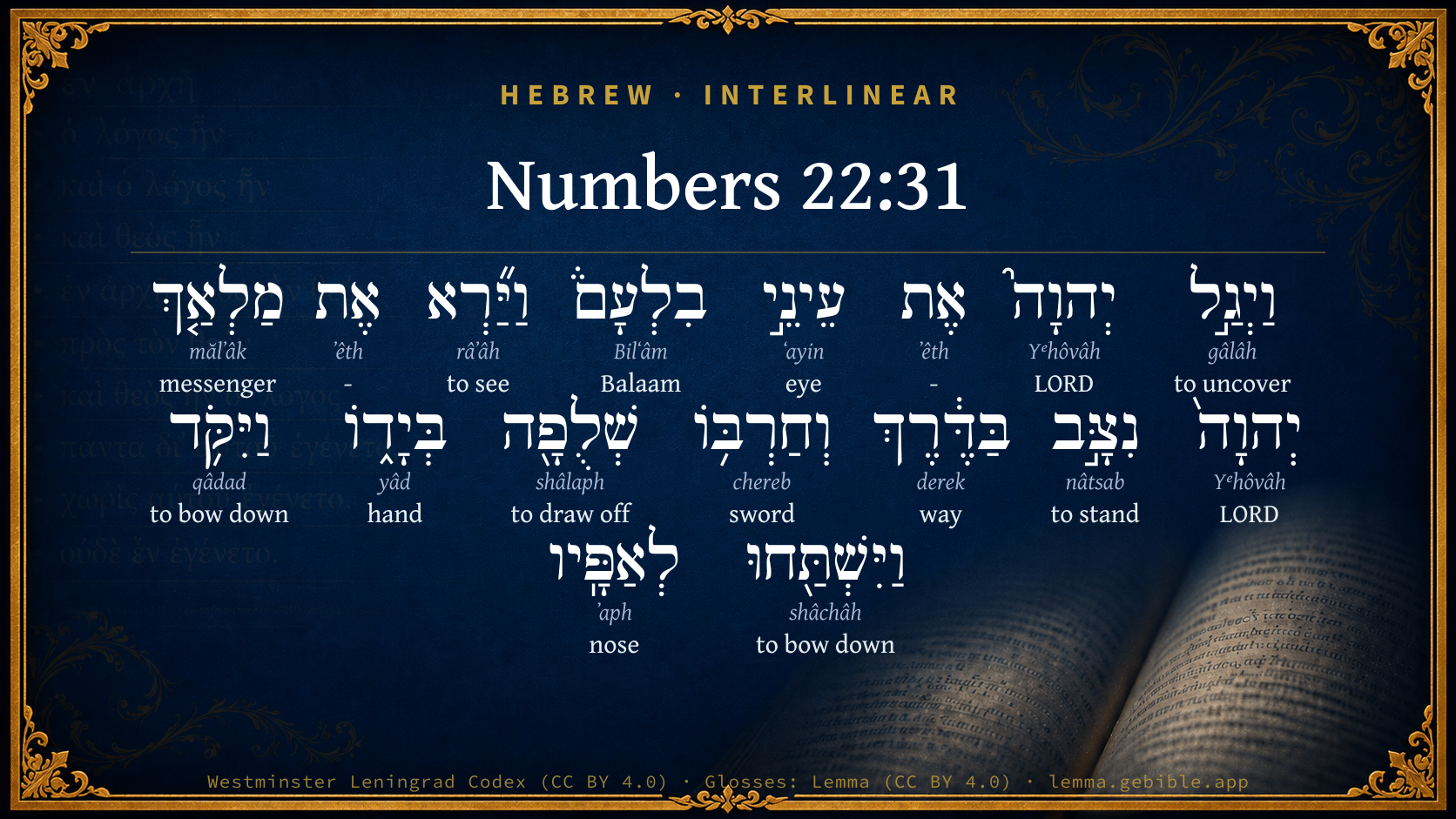
Hebrew (Westminster Leningrad Codex) Numbers 22:31 appears in the Hebrew Old Testament. The text above is from the Westminster Leningrad Codex. Each word links to its Strong’s number, a concise gloss, and parsing drawn from the Open Scriptures Hebrew Bible morphology. Click any word for its full Brown-Driver-Briggs (BDB) entry.
Download image
Cite this verse

Numbers 22:31 (World English Bible). Public Domain. Lemma interlinear Bible study tool, https://lemma.gebible.app/v/numbers/22/31.

Show BibTeX & RIS
BibTeX
RIS
English Translation
Then Yahweh opened the eyes of Balaam, and he saw the angel of Yahweh standing in the way, with his sword drawn in his hand; and he bowed his head, and fell on his face.
World English Bible · Public Domain
Download a study sheet

One document with this verse’s original text, its word-by-word gloss line, the meaning frame, cross-references with their text, attributed commentary, and full source and license credits — printable, and it pastes into notes with its structure intact.

This verse Autodidact and up

Study sheet (.html) Plain text (.txt)

A passage Seminary Student

Up to 50 verses in one chapter. A passage sheet keeps up to 6 commentary sources and 12 cross-references per verse, in the order this page ranks them, and says so on the sheet whenever that leaves anything out. Ask for a single verse and you get the Autodidact verse sheet above.

Everything on this page stays free to read, with no account — the sheet is a download of what is already on screen, not access to it.

Want to remove ads? Support Godless Engineer
Compare translations 3

The same verse in 3 English versions, stacked beneath the original-language interlinear above. Click any original word for its lexicon entry.

Each is an independent rendering of the whole verse — the interlinear is not word-aligned to these translations.

Highlighted words mark where these versions differ — a whole-verse word diff, not a word-by-word alignment.

  • World English Bible Public Domain
    Then Yahweh opened the eyes of Balaam, and he saw the angel of Yahweh standing in the way, with his sword drawn in his hand; and he bowed his head, and fell on his face.
  • King James Version Public Domain
    Then the LORD opened the eyes of Balaam, and he saw the angel of the LORD standing in the way, and his sword drawn in his hand: and he bowed down his head, and fell flat on his face.
  • unfoldingWord Literal Text CC BY-SA 4.0
    And Yahweh uncovered the eyes of Balaam, and he saw the angel of Yahweh stationed in the road and his sword drawn in his hand. And he bowed and prostrated himself to his nose.

unfoldingWord Literal Text — © unfoldingWord, licensed CC BY-SA 4.0. Word-aligned USFM3 via Door43 (git.door43.org/unfoldingWord/en_ult).

Versions to compare (up to 4)

3 of 4 selected

Show all 18 translations

Every available English version of this verse, each an independent rendering of the whole verse.

  • World English Bible Public Domain
    Then Yahweh opened the eyes of Balaam, and he saw the angel of Yahweh standing in the way, with his sword drawn in his hand; and he bowed his head, and fell on his face.
  • Berean Standard Bible Public Domain
    Then the LORD opened Balaam’s eyes, and he saw the angel of the LORD standing in the road with a drawn sword in his hand. And Balaam bowed low and fell facedown.
  • Majority Standard Bible Public Domain
    Then the LORD opened Balaam’s eyes, and he saw the angel of the LORD standing in the road with a drawn sword in his hand. And Balaam bowed low and fell facedown.
  • King James Version Public Domain
    Then the LORD opened the eyes of Balaam, and he saw the angel of the LORD standing in the way, and his sword drawn in his hand: and he bowed down his head, and fell flat on his face.
  • American Standard Version (1901) Public Domain
    Then Jehovah opened the eyes of Balaam, and he saw the angel of Jehovah standing in the way, with his sword drawn in his hand; and he bowed his head, and fell on his face.
  • Revised Version (1885) Public Domain
    Then the LORD opened the eyes of Balaam, and he saw the angel of the LORD standing in the way, with his sword drawn in his hand: and he bowed his head, and fell on his face.
  • Geneva Bible (1599) Public Domain
    And the Lord opened the eyes of Balaam, and he sawe the Angel of the Lord standing in the way with his sword drawen in his hande: then he bowed him selfe, and fell flat on his face.
  • Douay-Rheims (1899) Public Domain
    Forthwith the Lord opened the eyes of Balaam, and he saw the angel standing in the way with a drawn sword, and he worshipped him falling flat on the ground.
  • Young's Literal Translation Public Domain
    And Jehovah uncovereth the eyes of Balaam, and he seeeth the messenger of Jehovah standing in the way, and his drawn sword in his hand, and he boweth and doth obeisance, to his face;
  • Literal Standard Version CC BY-SA 4.0
    And YHWH uncovers the eyes of Balaam, and he sees the Messenger of YHWH standing in the way with His drawn sword in His hand, and he bows and pays respect, to his face;
  • Unlocked Literal Bible CC BY-SA 4.0
    Then Yahweh opened Balaam's eyes, and he saw the angel of Yahweh standing in the road with his drawn sword in his hand. Balaam lowered his head and lay facedown.
  • unfoldingWord Literal Text CC BY-SA 4.0
    And Yahweh uncovered the eyes of Balaam, and he saw the angel of Yahweh stationed in the road and his sword drawn in his hand. And he bowed and prostrated himself to his nose.
  • Darby Bible Public Domain
    Then Jehovah opened the eyes of Balaam, and he saw the Angel of Jehovah standing in the way, and his sword drawn in his hand; and he bowed and prostrated himself on his face.
  • World Messianic Bible Public Domain
    Then the LORD opened the eyes of Balaam, and he saw the LORD’s angel standing in the way, with his sword drawn in his hand; and he bowed his head, and fell on his face.
  • Webster's Bible Public Domain
    Then the LORD opened the eyes of Balaam, and he saw the angel of the LORD standing in the way, and his sword drawn in his hand: and he bowed down his head, and fell flat on his face.
  • Free Bible Version CC BY-SA 4.0
    Then the Lord gave Balaam the ability to see the angel of the Lord standing in the road holding a drawn sword. Balaam bowed low and fell facedown on the ground.
  • Bible in Basic English Public Domain
    Then the Lord made Balaam's eyes open, and he saw the angel of the Lord in the way with his sword in his hand: and he went down on his face to the earth.
  • JPS Tanakh (1917) Public Domain
    Then the LORD opened the eyes of Balaam, and he saw the angel of the LORD standing in the way, with his sword drawn in his hand; and he bowed his head, and fell on his face.

Literal Standard Version (2020), Covenant Press — licensed CC BY-SA 4.0. Text via the HelloAO Bible API (eBible.org). Unlocked Literal Bible (unfoldingWord) — licensed CC BY-SA 4.0. Text via the HelloAO Bible API (eBible.org). unfoldingWord Literal Text — © unfoldingWord, licensed CC BY-SA 4.0. Word-aligned USFM3 via Door43 (git.door43.org/unfoldingWord/en_ult). Free Bible Version, Dr. Jonathan Gallagher — licensed CC BY-SA 4.0. Text via the HelloAO Bible API (eBible.org).

Word by word

More ways to search: Search by grammar → Find every occurrence → Compare this word →

Practice this passage: Drill this verse → Learn its vocabulary →

וַיִּקֹּ֥ד
qâdad
H6915
“and · to bow down”
Conjunction + Verb, Qal, Sequential Imperfect, 3rd Person, Masculine, Singular
Part of Speech
Conjunction + Verb
Stem
Qal
Form
Sequential Imperfect
Person
3rd Person
Gender
Masculine
Number
Singular
Full BDB Definition

Origin: a primitive root

TWOT: 1985

(Qal) to bow down
  1. וַיְגַ֣ל gâlâh H1540 “and · to uncover” Conjunction + Verb, Piel, Sequential Imperfect, 3rd Person, Masculine, Singular
  2. יְהוָה֮ Yᵉhôvâh H3068 “LORD” Noun, Proper
  3. אֶת ʼêth H853 “-” Particle, Direct Object
  4. עֵינֵ֣י ʻayin H5869 “eyes of” Noun, Common, Both, Dual, Construct
  5. בִלְעָם֒ Bilʻâm H1109 “Balaam” Noun, Proper
  6. וַיַּ֞רְא râʼâh H7200 “and · to see” Conjunction + Verb, Qal, Sequential Imperfect, 3rd Person, Masculine, Singular
  7. אֶת ʼêth H853 “-” Particle, Direct Object
  8. מַלְאַ֤ךְ mălʼâk H4397 “messenger of” Noun, Common, Masculine, Singular, Construct
  9. יְהוָה֙ Yᵉhôvâh H3068 “LORD” Noun, Proper
  10. נִצָּ֣ב nâtsab H5324 “standing” Verb, Niphal, Participle Active, Masculine, Singular, Absolute
  11. בַּדֶּ֔רֶךְ derek H1870 “in/at the · way” Preposition, Determined + Noun, Common, Both, Singular, Absolute
  12. וְחַרְבּ֥וֹ chereb H2719 “and · sword · his” Conjunction + Noun, Common, Feminine, Singular, Construct + Suffix, Personal, 3rd Person, Masculine, Singular
  13. שְׁלֻפָ֖ה shâlaph H8025 “drawn off” Verb, Qal, Participle Passive, Feminine, Singular, Absolute
  14. בְּיָד֑וֹ yâd H3027 “in/at · hand · his” Preposition + Noun, Common, Both, Singular, Construct + Suffix, Personal, 3rd Person, Masculine, Singular
  15. וַיִּשְׁתַּ֖חוּ shâchâh H7812 “and · to bow down” Conjunction + Verb, Hithpael, Sequential Imperfect, 3rd Person, Masculine, Singular
  16. לְאַפָּֽיו ʼaph H639 “to/for · nostrils · his” Preposition + Noun, Common, Masculine, Dual, Construct + Suffix, Personal, 3rd Person, Masculine, Singular

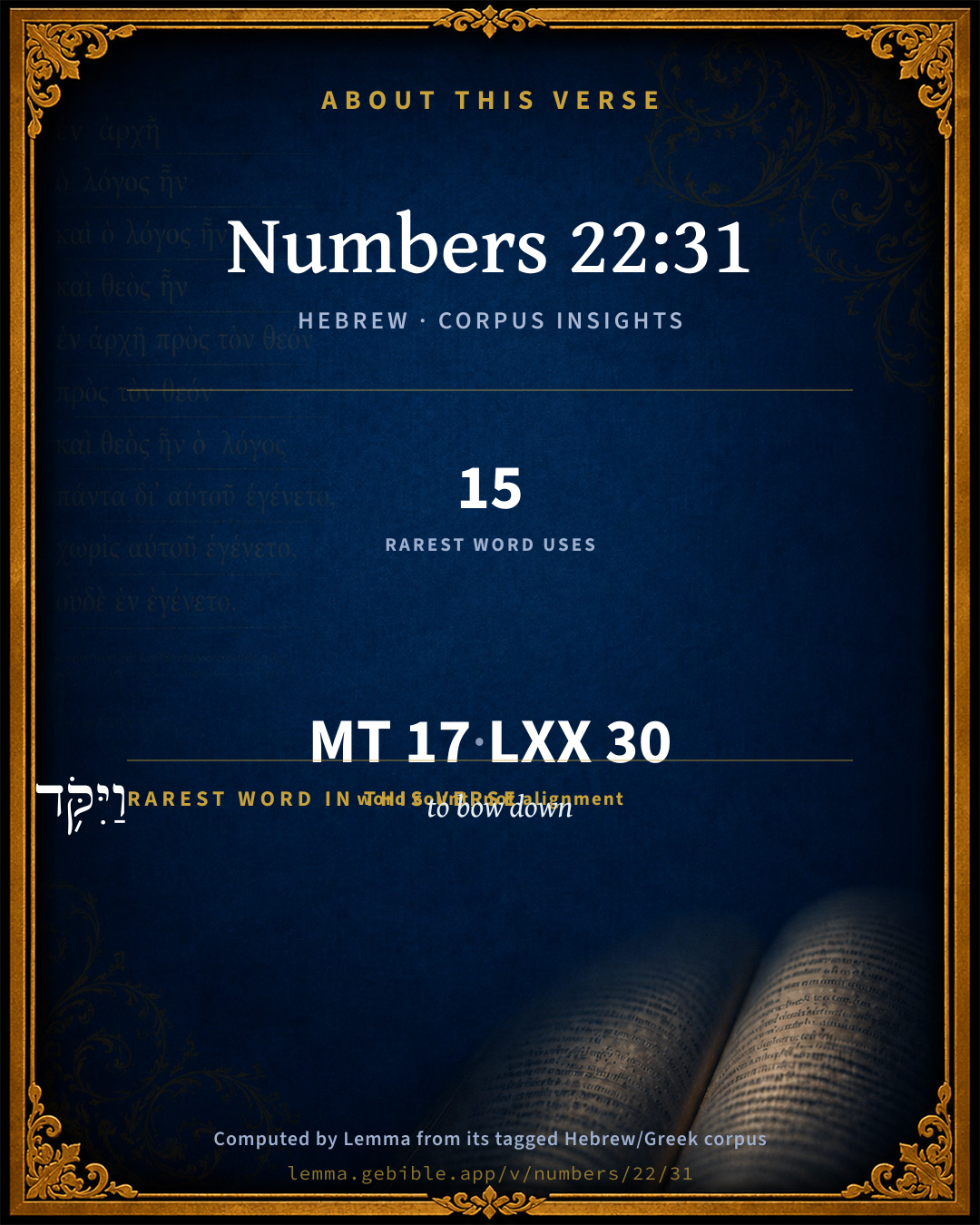
About this verse

These counts appear in no published source. They are computed here, from the morphology-tagged text and Lemma’s own curated glosses. What Lemma adds →

17
words
15
distinct lemmas
Pentateuch
section

Notable vocabulary

The rarest word here is וַיִּקֹּ֥ד to bow down H6915 — appearing just 15 times in the whole Hebrew Bible.

Shared distinctive vocabulary

וַיִּקֹּ֥ד to bow down H6915 occurs in 15 verses of the Hebrew Bible. Also found in:

Grammatical profile

  • 6 verbs
  • 9 nouns
  • 2 particles

Verb forms

  • וַיְגַ֣ל Piel · Sequential Imperfect
  • וַיַּ֞רְא Qal · Sequential Imperfect
  • נִצָּ֣ב Niphal · Participle Active
  • שְׁלֻפָ֖ה Qal · Participle Passive
  • וַיִּקֹּ֥ד Qal · Sequential Imperfect
  • וַיִּשְׁתַּ֖חוּ Hithpael · Sequential Imperfect

Repetition

A word recurs within this verse — often emphatic in Hebrew:

  • יְהוָה֮ LORD H3068 ×2

Hebrew & Septuagint length

In English translation the verse runs 35 words from the Hebrew and 36 from the Septuagint (LXX English) — closely comparable.

A rough comparison of the two English renderings, which tokenize alike — not a word-level alignment.

Word counts can differ between the Hebrew and the Greek without any difference in meaning — e.g. the Hebrew direct-object marker אֵת has no separate Greek word, and Greek often adds the article ὁ.

In the original languages it is 17 Hebrew tokens and 30 Greek tokens — but the two are counted differently (Hebrew bundles its prefixes and suffixes into one token; the Greek is in lemma form), so that isn’t a like-for-like length.

Cross-references

11

Topical passages linked to Numbers 22:31 in the Treasury of Scripture Knowledge — connected by theme and wording, ordered by reader-vote popularity; previews shown in the World English Bible.

  • Genesis 21:19 God opened her eyes, and she saw a well of water. She went, filled the bottle with water, and gave the boy drink.
  • Luke 24:31 Their eyes were opened, and they recognized him, and he vanished out of their sight.
  • Numbers 24:4 He says, who hears the words of God, Who sees the vision of the Almighty, Falling down, and having his eyes open:
  • Numbers 24:16 He says, who hears the words of God, Knows the knowledge of the Most High, Who sees the vision of the Almighty, Falling down, and having his eyes open:
  • 1 Chronicles 21:16 David lifted up his eyes, and saw the angel of Yahweh standing between earth and the sky, having a drawn sword in his hand stretched out over Jerusalem. Then David and the elders, clothed in sackcloth, fell on their faces.
  • Luke 24:16 But their eyes were kept from recognizing him.
  • Acts 26:18 to open their eyes, that they may turn from darkness to light and from the power of Satan to God, that they may receive remission of sins and an inheritance among those who are sanctified by faith in me.'
  • Exodus 34:8 Moses hurried and bowed his head toward the earth, and worshiped.
  • Psalms 9:20 Put them in fear, Yahweh. Let the nations know that they are only men. Selah.
  • John 18:6 When therefore he said to them, "I AM," they went backward, and fell to the ground.
  • 2 Kings 6:17–20 Elisha prayed, and said, Yahweh, Please open his eyes, that he may see. Yahweh opened the eyes of the young man; and he saw: and, behold, the mountain was full of horses and chariots of fire round about Elisha.

Cross-references courtesy of OpenBible.info (CC BY 4.0).

Hebrew and Greek witnesses Masoretic Hebrew ↔ Greek Septuagint

The same verse in the two great witnesses to the Old Testament, shown verse-for-verse.

These are two independent witnesses, not word-aligned to each other, and the Septuagint is shown in lemma (dictionary) form.

Hebrew Numbers 22:31 Masoretic · Westminster Leningrad Codex

וַיְגַ֣ל יְהוָה֮ אֶת עֵינֵ֣י בִלְעָם֒ וַיַּ֞רְא אֶת מַלְאַ֤ךְ יְהוָה֙ נִצָּ֣ב בַּדֶּ֔רֶךְ וְחַרְבּ֥וֹ שְׁלֻפָ֖ה בְּיָד֑וֹ וַיִּקֹּ֥ד וַיִּשְׁתַּ֖חוּ לְאַפָּֽיו

Then Yahweh opened the eyes of Balaam, and he saw the angel of Yahweh standing in the way, with his sword drawn in his hand; and he bowed his head, and fell on his face.

World English Bible · Public Domain

Greek LXX Numbers 22:31 Septuagint · lemma form

ἀποκαλύπτω δέ ὁ θεός ὁ ὀφθαλμός βαλααμ καί ὁράω ὁ ἄγγελος κύριος ἀντιἵστημι ἐν ὁ ὁδός καί ὁ μάχαιρα σπάω ἐν ὁ χείρ αὐτός καί κύπτω προςκυνέω ὁ πρόσωπον αὐτός

And God opened the eyes of Balaam, and he sees the angel of the Lord withstanding him in the way, and his sword drawn in his hand, and he stooped down and worshipped on his face.

LXX2012 (modern English Septuagint) · Public Domain

Hebrew: Westminster Leningrad Codex (CC BY 4.0). Greek: Septuagint (public domain); English from LXX2012 (modern English Septuagint) (Public Domain). How the Septuagint differs from the Hebrew →

Targum (Aramaic paraphrase)

2

The Targum is the ancient Jewish Aramaic paraphrase of the Hebrew Scriptures — an interpretive translation, not the Hebrew text itself. Onkelos (literal) and Pseudo-Jonathan (expansive) render the Torah, and Jonathan the Prophets. Coverage is partial: where no permissively-licensed English translation exists for a verse, only the Aramaic is shown. This is verse-level text, not a word-by-word alignment to the Hebrew.

  1. Targum Onkelos Torah (Genesis–Deuteronomy)
    וּגְלָא יְיָ יַת עֵינֵי בִלְעָם וַחֲזָא יַת מַלְאָכָא דַיְיָ מְעַתַּד בְּאָרְחָא וְחַרְבֵּיהּ שְׁלִיפָא בִידֵיהּ וּכְרַע וּסְגִיד לְאַפּוֹהִי

    (no public-domain English translation for this verse)

    Targum Onkelos — Aramaic: “Onkelos Genesis” (public domain); “Onkelos Exodus” (public domain); “Onkelos Leviticus” (public domain); “Onkelos Numbers” (public domain); “Onkelos Deuteronomy” (public domain). English: “Sefaria Community Translation” (CC0 1.0 (public-domain dedication)); “J.W. Etheridge. The Targums of Onkelos and Jonathan Ben Uzziel on the Pentateuch. London: Longmans, Green, 1862” (public domain). Text via Sefaria.

  2. Targum Pseudo-Jonathan Torah (Genesis–Deuteronomy)
    וּגְלָא יְיָ יַת עֵינוֹי דְבִלְעָם וַחֲמָא יַת מַלְאָכָא דַיְיָ מְעַתַּד בְּאִיסְרַטָא וְסַיְיפֵיהּ שְׁלִיפָא בִּידֵיהּ וְגָחַן וּסְגִיד עַל אַנְפּוֹי

    And the Lord unveiled the eyes of Bileam, and he beheld the angel of the Lord standing in the way, his sword unsheathed in his hand; and he bowed, and worshipped on his face.

    Targum Pseudo-Jonathan — Aramaic: “Targum Jonathan on Genesis” (public domain); “Targum Jonathan on Exodus” (public domain); “Targum Jonathan on Leviticus” (public domain); “Targum Jonathan on Numbers” (public domain); “Targum Jonathan on Deuteronomy” (public domain). English: “The Targum of Jonathan ben Uzziel, trans. J. W. Etheridge, London, 1862” (public domain). Text via Sefaria.

Commentary

Notes on Numbers 22:31 from classic Christian and Jewish commentators (each source and its license shown beneath its notes). The classic Christian expositions comment on the surrounding passage and are grouped to its opening verse, so a note may address several verses; the Jewish commentaries on the Tanakh (Rashi and others) are per-verse, so they appear only where the commentator wrote on this verse.

Lemma curates 59 commentaries, every one of them public domain or Creative Commons licensed, each selected and text-cleaned for this edition rather than reprinted as found. About our sources →

Joseph Benson's Commentary

Num 22:31-32. The Lord opened the eyes of Balaam — He presented the angel to his view, who had hitherto been invisible to him. He fell flat on his face — In token of reverence and submission. Thy way is perverse — Springing from covetousness.

Joseph Benson's Commentary on the Old and New Testaments (1811–1818) — public domain. Text from a community e-Sword module.

Geneva Bible (1599)

Geneva Bible translators

For whose eyes the Lord doth not open, they can neither see his anger, nor his love.

Geneva Bible (1599) marginal notes — public domain. Text via Bolls.life.

John Gill's Exposition

And Balaam said unto the angel of the Lord, I have sinned,.... That is, in beating the ass; not that he was sensible of his sin of covetousness, and of the evil disposition of his mind, and of his wicked intention in going along with the princes to curse Israel, if possible, and get Balak's presents and preferments:

for I knew not that thou stoodest in the way against me; signifying, that if he had known it, he should not have smitten the ass, but submitted himself to the will of the angel:

now therefore, if it displease thee, I will get me back again; which he spoke very coldly and faintly, not caring heartily to go back, unless forced to it; for seeing a drawn sword in his hand, he might be afraid of his life should he persist in his journey, and therefore feigns a readiness to go back, quitting it on condition that his going forwards was displeasing; whereas he knew it was, especially his going with an evil mind to hurt Israel if possible.

John Gill's Exposition of the Whole Bible (1746–1763) — public domain (CC PDM 1.0). Text via the HelloAO Bible API.

Haydock's Catholic Bible Commentary

Ground, with religious worship; not as God, but as an angel. See Exodus xx. (Worthington)

George Leo Haydock (1774–1849), Haydock's Catholic Family Bible and Commentary, 1859 edition — public domain. Excludes Psalms (Douay-Rheims chapter numbering differs from Protestant) and Deuterocanonical books (Catholic canon only).

Matthew Poole's English Annotations

In token of reverence and submission.

Matthew Poole's English Annotations on the Holy Bible (1683–1685) — public domain. Text from a community e-Sword/MySword module.

Whedon's Commentary on the Bible

Daniel D. Whedon

31. Opened the eyes — His natural eyes, which up to this time had been unable to see the angel. Luk_24:16, note. Says Hengstenberg, “This is a statement which cannot possibly be understood of any thing but the inward eye.” Query: Did the ass also see the angel with his inward eye? Was the beast in an ecstatic state? The literal exegesis is far more rational than that which reduces this whole affair to a phantasm supernaturally wrought in the mind of the man and the beast.

Fell flat on his face — Hebrew, he bowed himself to his face, that is, either upon his own face, or to the face of the angel, in adoration. “Adored him, [falling,] prone to the ground.” — Vulgate. “He bowed, and worshipped upon his face.” — Targum of Onkelos.

Daniel D. Whedon (gen. ed.), Commentary on the Old and New Testaments (1874–1909) — public domain. Text from a community e-Sword module.

The Pulpit Commentary

The Lord opened the eyes of Balaam, and he saw the angel. As on other occasions, the angel was not perceptible to ordinary sight, but only to eyes in some way quickened and purged by the Divine operation. This explains the fact that Balaam"s companions would appear to have seen nothing. (cf. Act_9:7)

Vers. 31-35. Balaam the arrest.

The secret willingness of Balaam to yield to the solicitations of Balak, seen at first in the tone of his answer, "The Lord refuseth," &c., was still more manifest in his parleying with the second appeal. Though he felt the resistless force of the Divine restraint, yet he delayed the return of the messengers for the night in hope of getting a reversal of the sentence (verses 18, 19). No wonder God"s anger was kindled against him, and that, though permission was at last given him to go, he was made in this startling way to feel that he was in the hands of a Power that would not be mocked. Whatever view we take of the strange incidents of this narrative, whether as objective realities, or as the visions of a trance, the moral lessons remain substantially the same. Three features of Balaam"s conduct are specially prominent. ;

I His CRUEL ANGER. His rough treatment of the dumb ass is marked with reprobation. It was both itself evil and the symptom of a hidden evil.

1. We may believe that the secret unrest of his conscience had a great dealto do with this outburst of anger. Note the subtle connection that often exists between certain unusual phases of conduct and the hidden workings of the heart. Jonah"s anger at the withering of the gourd was but one of the signs of his general want of sympathy with the Divine procedure. Balaam, perhaps, was not a cruel man, but the sense of wrong within and the feeling that he was doing wrong betrayed itself even in this form of behaviour. Conscience made him a coward, and cowardice is always cruel. If it had not been for the "madness" of his passion, he might have judged, as a diviner, that the unwillingness of the beast to pursue her journey counseled him to return; but when a man"s heart is not right with God, resentment is often roused against that which is meant to turn him into a better way. "Am I become your enemy because I tell you the truth?". (Gal_4:16)

2. It illustrates the sad subjection of the inferior creatures to the curse of moral evil. "The creature was made subject to vanity, not willingly." "The whole creation groaneth," &c. We think it strange that the dumb ass should "speak with man"s voice and rebuke the prophet"s madness," but, to the ear that can hear it, such a voice is continually going forth from all the innocent creatures that suffer the cruel consequences of man"s abuse. Well may St. Paul represent them as "waiting with earnest expectation for the manifestation of the sons of God". ; (Rom_8:19, Rom_8:22)

II HIS BLIND INFATUATION. It is deeply significant that he should not have seen the angel. Even the poor dumb creature that he rode saw more than he did. It was his moral perversity, the frenzy of his carnal ambition, that was the true cause of the dullness of his spiritual vision. Note

1. Sin blinds men to the things that it is most needful for them to apprehend and know. Mental blindness often, not always, has a moral cause. "This people"s heart is waxed gross, and their ears are dull of hearing," &c. ; (Mat_13:15) The highest spiritual truths, realities of the spirit world, tokens of the Divine presence and working, eternal moral laws, sacred responsibilities of life, &c. all these are darkly hidden from him whose heart is "thoroughly set in him to do evil. ;

2. Even animal instinct is a safer guide than the moral sense of a bad man.It effectually warns of danger, and prompts to the pursuit of the good nature requires. It is to the animal a sufficient law. But when the "spirit in man, the inspiration of the Almighty that giveth him understanding," the sovereignty of reason and conscience, is overborne by base fleshly lust, man sinks lower than the brutes that perish. Their obedience to the law of their being puts him to shame. Though they "speak not with man"s voice," their silent wisdom "rebukes him for his iniquity." "If the light that is in thee be darkness," &c. ; (Mat_6:23)

III HIS HELPLESSNESS. This is seen

1. In his abject submission. "He bowed down his head, and fell fiat on hisface," saying, "I have sinned;" "now, therefore, if it displease thee, I will get me back again." He must have known from the beginning that his obstinate self-will was displeasing to God, but now that the consequences of it stare him in the face he is filled with alarm. There are those who grieve over their sin only when it is found out. It is not the evil itself they dread, but only its discovery and punishment. Fear often makes men repent and reform when there is no genuine abhorrence of wrong-doing.

2. In the Divine compulsion under which he is placed to pursue his Journey."go with the men," &c. He would fain draw back, but it is too late now; he must do the work and bear the testimony that God has determined for him.

When men are bent upon that which is evil, God often allows them to become entangled in circumstances of danger from which there is no escape, that "they may eat of the fruit of their own way, and be filled with their own devices". W. (Pro_1:31)

The Pulpit Commentary (1880–1919), ed. H.D.M. Spence-Jones & Joseph S. Exell — public domain. Text from a community e-Sword module.

John Wesley's Explanatory Notes

On his face - In token of reverence and submission.

John Wesley, Explanatory Notes Upon the Whole Bible (1754–1765) — public domain. Text via the GEBible commentary corpus.

unfoldingWord translationNotes

Door43 World Missions Community

Then Yahweh opened Balaam's eyes, and he saw the angel of Yahweh

To "open one's eyes" is associated with being able to see. AT: "Then Yahweh gave Balaam the ability to see the angel of Yahweh" (See: Metonymy)

with his drawn sword

A sword is drawn from its sheath in order to be ready to use. See how you translated this in Numbers 22:23. AT: "with his sword ready to attack" (See: Assumed Knowledge and Implicit Information)

Balaam lowered his head and lay facedown

This indicates that Balaam is humbling himself before the angel. (See: Symbolic Action)

Why have you struck your donkey these three times?

This rhetorical question is used to accuse Balaam of doing wrong. This can be translated as a statement. AT: "You should not have struck your donkey these three times." (See: Rhetorical Question)

as someone hostile to you

"as an enemy to you" or "to oppose you"

If she had not turned ... killed you and spared her life

This hypothetical statement indicated what could have happened, but it did not because the donkey's actions saved Balaam. (See: Hypothetical Situations)

translationWords

Yahweh

angel

sword

donkey

evil

turn

unfoldingWord translationNotes — © Distant Shores Media and the Door43 World Missions Community, licensed CC BY-SA 4.0. Source: git.door43.org/Door43/en_tn.

Ramban (Nachmanides)

Rabbi Moshe ben Nachman (Ramban / Nachmanides)

AND THE ETERNAL OPENED THE EYES OF BALAAM. From this verse we learn that Balaam was not a prophet [who habitually received Divine messages], because had he been a prophet, how could it be that he required “opening of the eyes” to see the angel, which is the term used by Scripture about someone who has not reached the degree of prophecy, such as Elisha’s young man,. or Hagar the Egyptian,. and Scripture does not speak in this manner about the prophets! And indeed Scripture calls him, Balaam the son of Beor, the soothsayer. And when Balaam said, as the Eternal may speak unto me, he called his [ability] to know future events by means of his soothsaying “the word of G-d,” [and it does not refer to the gift of prophecy]. But for the sake of the honor of Israel G-d [indeed] came to him that night, Verse 9. [in a prophet-like vision], and afterwards he was favored with “opening of the eyes” in seeing the angel, and speaking to him, and finally he attained the degree of [seeing] the vision of the Almighty — all this being for the sake of Israel and in their honor. But after he returned to his land, however, he [reverted to the status of a mere] soothsayer, for that is how Scripture describes him at [the time of] his death, [saying]: And Balaam the son of Beor, the soothsayer, did the children of Israel slay with the sword, and G-d forbid that they should stretch forth a hand against a prophet of G-d! And so did the Rabbis say in the Midrash Bamidbar Sinai Rabbah: “Balaam partook of the Ruach Hakodesh, Note 71 and Ramban ibid. but after he associated himself with Balak, the Ruach Hakodesh departed from him and he became again a [mere] soothsayer, as he had been originally. Therefore he complained: ‘I was elevated [in prophecy], but Balak brought about my descent.’”

Ramban (Nachmanides) on the Tanakh — English translation: “Commentary on the Torah by Ramban (Nachmanides). Translated and annotated by Charles B. Chavel. New York, Shilo Pub. House, 1971-1976” (CC BY 4.0). Text via Sefaria.

Lesson kit

Teaching starters — assembled from the data on this page, not authored interpretation. Every prompt links to the verse data it draws on. Edit before teaching.

Numbers, in the Pentateuch, opens this verse with 17 words (15 distinct Hebrew lemmas). Its most distinctive word is qâdad (“to bow down”). A historical commentator’s framing appears above. Read the whole chapter for the surrounding context.

Discussion questions

  1. What does “to bow down” (qâdad) contribute to the verse as a whole?
  2. Genesis 24:26 shares the word «to bow down» with this verse. How do the two illuminate each other?
  3. “LORD” occurs 2× in this one verse. What is the effect of the repetition?
  4. These translations render this verse differently; the difference is in the English rendering, not the original. What questions does that raise?
  5. The verb «וַיְגַ֣ל» is Piel Sequential Imperfect. How does its form color the action?
  6. Reading how Joseph Benson's Commentary and Geneva Bible (1599) read this verse, where do the two commentators agree and where do they part?

Things to notice

Reading settings

Reading text

Shown beneath each verse's original-language words.

Old Testament
Old Testament edition

Read the OT as the Masoretic Hebrew (MT) or the Greek Septuagint (LXX).

English shown for the Greek Septuagint (in the Hebrew ↔ Greek comparison).

Comparing translations? Open the Compare panel on any verse page to stack up to four side by side.