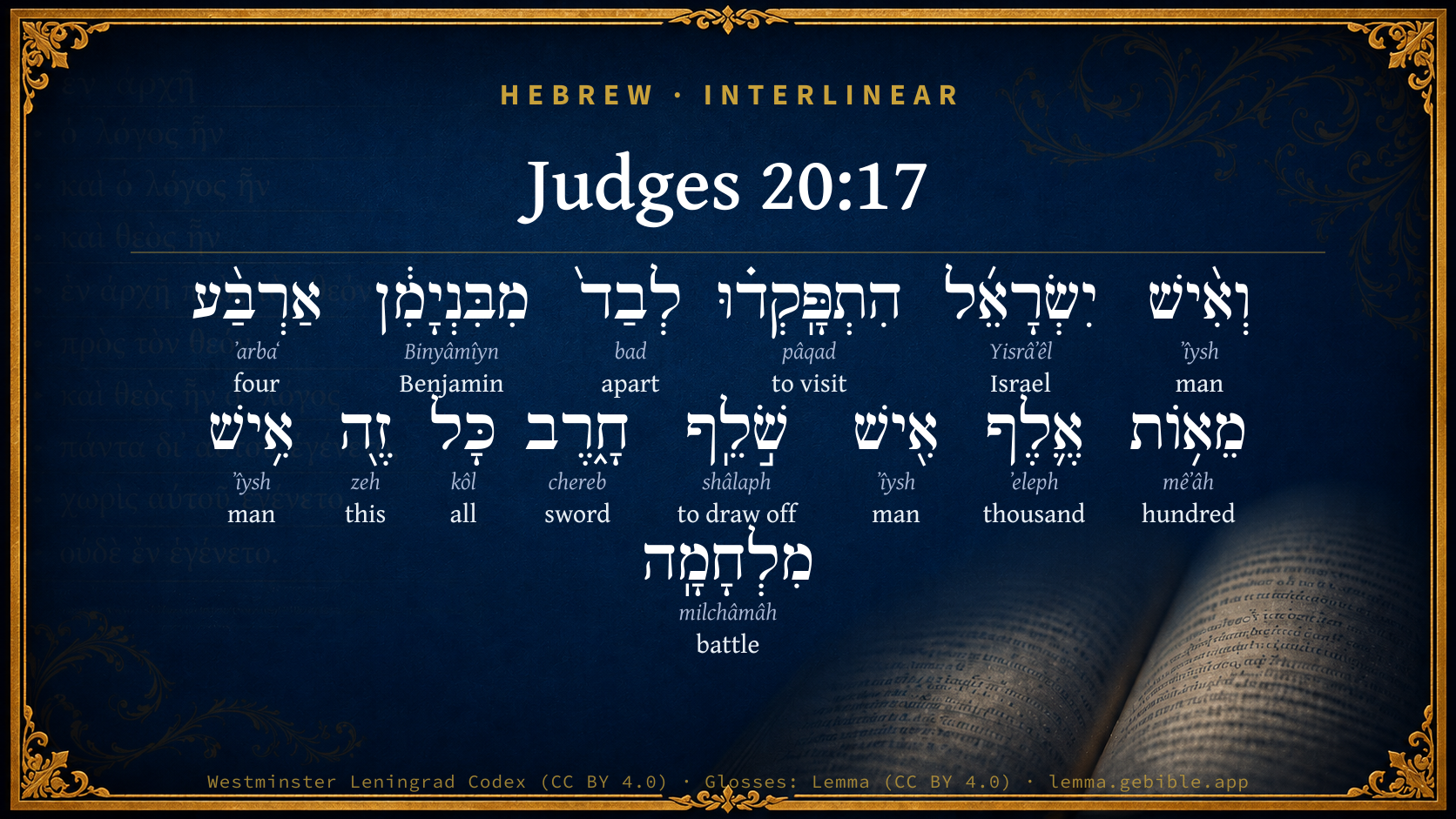
Judges 20:17

Hebrew (Westminster Leningrad Codex) Judges 20:17 appears in the Hebrew Old Testament. The text above is from the Westminster Leningrad Codex. Each word links to its Strong’s number, a concise gloss, and parsing drawn from the Open Scriptures Hebrew Bible morphology. Click any word for its full Brown-Driver-Briggs (BDB) entry.
Download image
Cite this verse

Judges 20:17 (World English Bible). Public Domain. Lemma interlinear Bible study tool, https://lemma.gebible.app/v/judges/20/17.

Show BibTeX & RIS
BibTeX
RIS
English Translation
The men of Israel, besides Benjamin, were numbered four hundred thousand men who drew sword: all these were men of war.
World English Bible · Public Domain
Download a study sheet

One document with this verse’s original text, its word-by-word gloss line, the meaning frame, cross-references with their text, attributed commentary, and full source and license credits — printable, and it pastes into notes with its structure intact.

This verse Autodidact and up

Study sheet (.html) Plain text (.txt)

A passage Seminary Student

Up to 50 verses in one chapter. A passage sheet keeps up to 6 commentary sources and 12 cross-references per verse, in the order this page ranks them, and says so on the sheet whenever that leaves anything out. Ask for a single verse and you get the Autodidact verse sheet above.

Everything on this page stays free to read, with no account — the sheet is a download of what is already on screen, not access to it.

Want to remove ads? Support Godless Engineer
Compare translations 3

The same verse in 3 English versions, stacked beneath the original-language interlinear above. Click any original word for its lexicon entry.

Each is an independent rendering of the whole verse — the interlinear is not word-aligned to these translations.

Highlighted words mark where these versions differ — a whole-verse word diff, not a word-by-word alignment.

  • World English Bible Public Domain
    The men of Israel, besides Benjamin, were numbered four hundred thousand men who drew sword: all these were men of war.
  • King James Version Public Domain
    And the men of Israel, beside Benjamin, were numbered four hundred thousand men that drew sword: all these were men of war.
  • unfoldingWord Literal Text CC BY-SA 4.0
    And the men of Israel, besides Benjamin, mobilized themselves, 400, 000 men drawing the sword, each of them a man of war.

unfoldingWord Literal Text — © unfoldingWord, licensed CC BY-SA 4.0. Word-aligned USFM3 via Door43 (git.door43.org/unfoldingWord/en_ult).

Versions to compare (up to 4)

3 of 4 selected

Show all 18 translations

Every available English version of this verse, each an independent rendering of the whole verse.

  • World English Bible Public Domain
    The men of Israel, besides Benjamin, were numbered four hundred thousand men who drew sword: all these were men of war.
  • Berean Standard Bible Public Domain
    The Israelites, apart from Benjamin, mobilized 400,000 swordsmen, each one an experienced warrior.
  • Majority Standard Bible Public Domain
    The Israelites, apart from Benjamin, mobilized 400,000 swordsmen, each one an experienced warrior.
  • King James Version Public Domain
    And the men of Israel, beside Benjamin, were numbered four hundred thousand men that drew sword: all these were men of war.
  • American Standard Version (1901) Public Domain
    And the men of Israel, besides Benjamin, were numbered four hundred thousand men that drew sword: all these were men of war.
  • Revised Version (1885) Public Domain
    And the men of Israel, beside Benjamin, were numbered four hundred thousand men that drew sword: all these were men of war.
  • Geneva Bible (1599) Public Domain
    Also the men of Israel, beside Beniamin, were nombred foure hundreth thousande men that drew sword, euen all men of warre.
  • Douay-Rheims (1899) Public Domain
    Of the men of Israel also, beside the children of Benjamin, were found four hundred thousand that drew swords, and were prepared to fight.
  • Young's Literal Translation Public Domain
    And the men of Israel numbered themselves, apart from Benjamin, four hundred thousand men, drawing sword, each of these a man of war.
  • Literal Standard Version CC BY-SA 4.0
    And the men of Israel numbered themselves, apart from Benjamin, four hundred thousand men, drawing sword, each of these a man of war.
  • Unlocked Literal Bible CC BY-SA 4.0
    The people of Israel, not counting the number from Benjamin, numbered 400,000 men, who were trained to fight with the sword. All of these were men of war.
  • unfoldingWord Literal Text CC BY-SA 4.0
    And the men of Israel, besides Benjamin, mobilized themselves, 400, 000 men drawing the sword, each of them a man of war.
  • Darby Bible Public Domain
    And the men of Israel, apart from Benjamin, mustered four hundred thousand men that drew sword; all these were men of war.
  • World Messianic Bible Public Domain
    The men of Israel, besides Benjamin, were counted four hundred thousand men who drew sword. All these were men of war.
  • Webster's Bible Public Domain
    And the men of Israel, besides Benjamin, were numbered four hundred thousand men that drew sword: all these were men of war.
  • Free Bible Version CC BY-SA 4.0
    The Israelite army (excluding Benjamin) numbered four hundred thousand seasoned warriors, all armed with swords.
  • Bible in Basic English Public Domain
    And the men of Israel, other than Benjamin, were four hundred thousand in number, all armed with swords; they were all men of war.
  • JPS Tanakh (1917) Public Domain
    And the men of Israel, beside Benjamin, numbered four hundred thousand men that drew sword; all these were men of war.

Literal Standard Version (2020), Covenant Press — licensed CC BY-SA 4.0. Text via the HelloAO Bible API (eBible.org). Unlocked Literal Bible (unfoldingWord) — licensed CC BY-SA 4.0. Text via the HelloAO Bible API (eBible.org). unfoldingWord Literal Text — © unfoldingWord, licensed CC BY-SA 4.0. Word-aligned USFM3 via Door43 (git.door43.org/unfoldingWord/en_ult). Free Bible Version, Dr. Jonathan Gallagher — licensed CC BY-SA 4.0. Text via the HelloAO Bible API (eBible.org).

Word by word

More ways to search: Search by grammar → Find every occurrence → Compare this word →

Practice this passage: Drill this verse → Learn its vocabulary →

שֹׁ֣לֵֽף
shâlaph
H8025
“drawing off”
Verb, Qal, Participle Active, Masculine, Singular, Absolute
Part of Speech
Verb
Stem
Qal
Form
Participle Active
Gender
Masculine
Number
Singular
State
Absolute
Full BDB Definition

Origin: a primitive root

TWOT: 2402

to draw out or off, take off - (Qal) - to draw out - to draw off - to shoot up, draw out (of blade of grass on roof)
  1. וְאִ֨ישׁ ʼîysh H376 “and · man of” Conjunction + Noun, Common, Masculine, Singular, Construct
  2. יִשְׂרָאֵ֜ל Yisrâʼêl H3478 “Israel” Noun, Proper
  3. הִתְפָּֽקְד֗וּ pâqad H6485 “to visit” Verb, Hithpael, Perfect, 3rd Person, Common, Plural
  4. לְבַד֙ bad H905 “to/for · apart” Preposition + Noun, Common, Masculine, Singular, Absolute
  5. מִבִּנְיָמִ֔ן Binyâmîyn H1144 “from · Benjamin” Preposition + Noun, Proper
  6. אַרְבַּ֨ע ʼarbaʻ H702 “four” Adjective, Cardinal number, Feminine, Singular, Absolute
  7. מֵא֥וֹת mêʼâh H3967 “hundred” Adjective, Cardinal number, Both, Plural, Absolute
  8. אֶ֛לֶף ʼeleph H505 “thousand” Adjective, Cardinal number, Both, Singular, Absolute
  9. אִ֖ישׁ ʼîysh H376 “man” Noun, Common, Masculine, Singular, Absolute
  10. חָ֑רֶב chereb H2719 “sword” Noun, Common, Feminine, Singular, Absolute
  11. כָּל kôl H3605 “all of” Noun, Common, Masculine, Singular, Construct
  12. זֶ֖ה zeh H2088 “this” Pronoun, Demonstrative, Masculine, Singular
  13. אִ֥ישׁ ʼîysh H376 “man of” Noun, Common, Masculine, Singular, Construct
  14. מִלְחָמָֽה milchâmâh H4421 “battle” Noun, Common, Feminine, Singular, Absolute

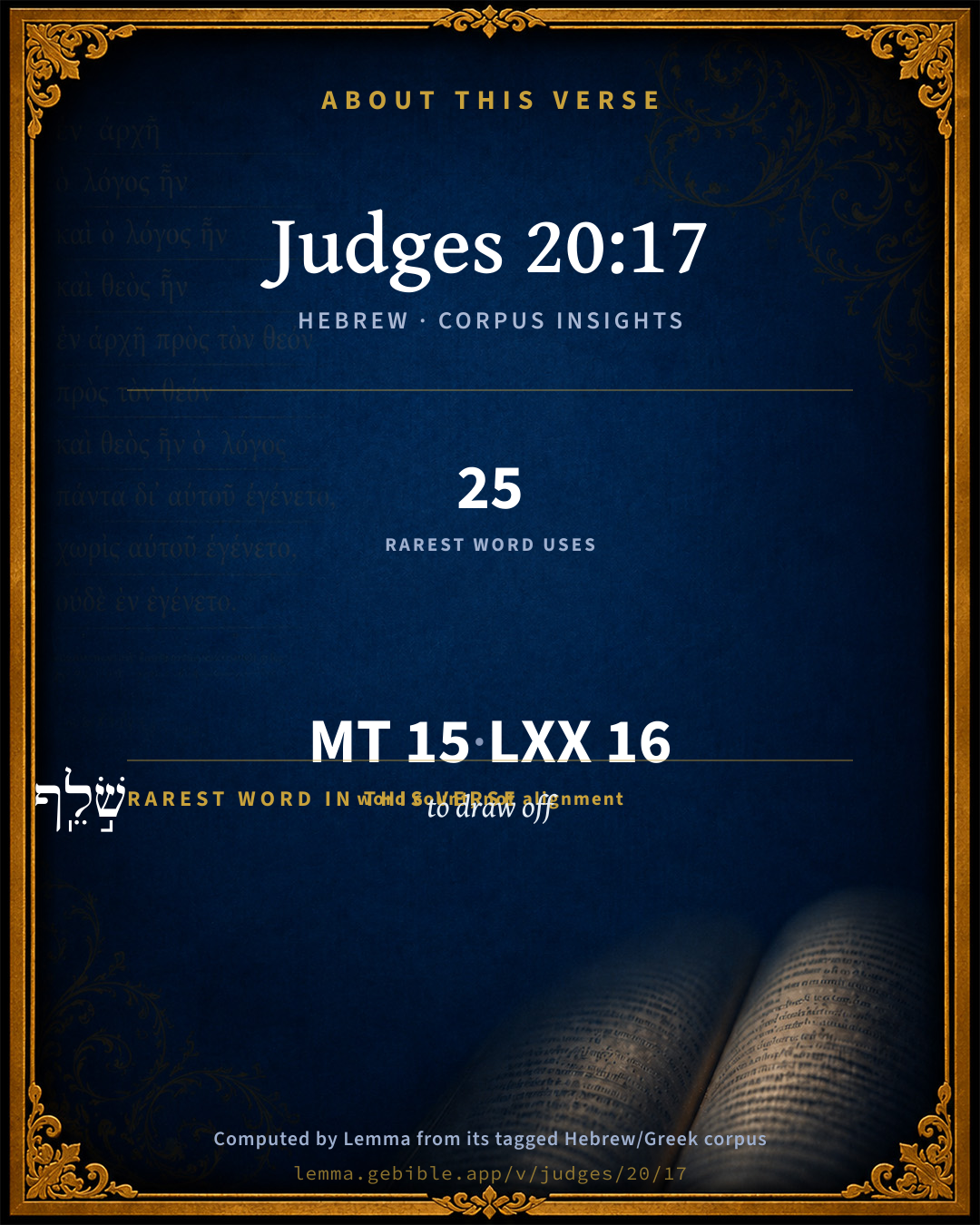
About this verse

These counts appear in no published source. They are computed here, from the morphology-tagged text and Lemma’s own curated glosses. What Lemma adds →

15
words
13
distinct lemmas
Historical
section

Notable vocabulary

The rarest word here is שֹׁ֣לֵֽף to draw off H8025 — appearing just 25 times in the whole Hebrew Bible.

Shared distinctive vocabulary

שֹׁ֣לֵֽף to draw off H8025 occurs in 24 verses of the Hebrew Bible. Also found in:

Grammatical profile

  • 2 verbs
  • 9 nouns
  • 3 adjectives
  • 1 pronoun

Verb forms

  • הִתְפָּֽקְד֗וּ Hithpael · Perfect
  • שֹׁ֣לֵֽף Qal · Participle Active

Repetition

A word recurs within this verse — often emphatic in Hebrew:

  • וְאִ֨ישׁ man H376 ×3

Hebrew & Septuagint length

In English translation the verse runs 21 words from the Hebrew and 23 from the Septuagint (LXX English) — closely comparable.

A rough comparison of the two English renderings, which tokenize alike — not a word-level alignment.

Word counts can differ between the Hebrew and the Greek without any difference in meaning — e.g. the Hebrew direct-object marker אֵת has no separate Greek word, and Greek often adds the article ὁ.

In the original languages it is 15 Hebrew tokens and 16 Greek tokens — but the two are counted differently (Hebrew bundles its prefixes and suffixes into one token; the Greek is in lemma form), so that isn’t a like-for-like length.

Cross-references

7

Topical passages linked to Judges 20:17 in the Treasury of Scripture Knowledge — connected by theme and wording, ordered by reader-vote popularity; previews shown in the World English Bible.

  • Numbers 1:46 even all those who were numbered were six hundred three thousand five hundred fifty.
  • Numbers 26:51 These are those who were numbered of the children of Israel, six hundred one thousand seven hundred thirty.
  • Judges 20:2 The chiefs of all the people, even of all the tribes of Israel, presented themselves in the assembly of the people of God, four hundred thousand footmen who drew sword.
  • 1 Samuel 11:8 He numbered them in Bezek; and the children of Israel were three hundred thousand, and the men of Judah thirty thousand.
  • 1 Samuel 15:4 Saul summoned the people, and numbered them in Telaim, two hundred thousand footmen, and ten thousand men of Judah.
  • 1 Chronicles 21:5 Joab gave up the sum of the numbering of the people to David. All those of Israel were one million one hundred thousand men who drew sword: and in Judah were four hundred seventy thousand men who drew sword.
  • 2 Chronicles 17:14–18 This was the numbering of them according to their fathers' houses: Of Judah, the captains of thousands: Adnah the captain, and with him mighty men of valor three hundred thousand;

Cross-references courtesy of OpenBible.info (CC BY 4.0).

Hebrew and Greek witnesses Masoretic Hebrew ↔ Greek Septuagint

The same verse in the two great witnesses to the Old Testament, shown verse-for-verse.

These are two independent witnesses, not word-aligned to each other, and the Septuagint is shown in lemma (dictionary) form.

Hebrew Judges 20:17 Masoretic · Westminster Leningrad Codex

וְאִ֨ישׁ יִשְׂרָאֵ֜ל הִתְפָּֽקְד֗וּ לְבַד֙ מִבִּנְיָמִ֔ן אַרְבַּ֨ע מֵא֥וֹת אֶ֛לֶף אִ֖ישׁ שֹׁ֣לֵֽף חָ֑רֶב כָּל זֶ֖ה אִ֥ישׁ מִלְחָמָֽה

The men of Israel, besides Benjamin, were numbered four hundred thousand men who drew sword: all these were men of war.

World English Bible · Public Domain

Greek LXX Judges 20:17 Septuagint · lemma form

καί ἀνήρ ἰσραήλ ἐπισκέπτομαι ἐκτός ὁ βενιαμίν τετρακόσιοι χιλιάς ἀνήρ ἕλκω ῥομφαία πᾶς οὗτος ἀνήρ παράταξις

And the men of Israel, exclusive of Benjamin, were numbered four hundred thousand men that drew sword; all these were men of war.

LXX2012 (modern English Septuagint) · Public Domain

Hebrew: Westminster Leningrad Codex (CC BY 4.0). Greek: Septuagint (public domain); English from LXX2012 (modern English Septuagint) (Public Domain). How the Septuagint differs from the Hebrew →

Targum (Aramaic paraphrase)

1

The Targum is the ancient Jewish Aramaic paraphrase of the Hebrew Scriptures — an interpretive translation, not the Hebrew text itself. Onkelos (literal) and Pseudo-Jonathan (expansive) render the Torah, and Jonathan the Prophets. Coverage is partial: where no permissively-licensed English translation exists for a verse, only the Aramaic is shown. This is verse-level text, not a word-by-word alignment to the Hebrew.

  1. Targum Jonathan Prophets (Joshua–Malachi)
    וֶאֱנַשׁ יִשְׂרָאֵל אִתְמַנִיאוּ בַּר מִדְבֵית בִּנְיָמִין אַרְבַּע מְאָה אַלְפִין גַבְרָא שַׁלְפֵי סַיְפָא כָּל אִלֵין גַבְרֵי עָבְדֵי קְרָבָא:

    (no public-domain English translation for this verse)

    Targum Jonathan — Aramaic: “Mikraot Gedolot” (public domain). English: “Sefaria Community Translation” (CC0 1.0 (public-domain dedication)); “London "Chaldee Paraphrase," 1871” (public domain). Text via Sefaria.

Commentary

Notes on Judges 20:17 from classic Christian and Jewish commentators (each source and its license shown beneath its notes). The classic Christian expositions comment on the surrounding passage and are grouped to its opening verse, so a note may address several verses; the Jewish commentaries on the Tanakh (Rashi and others) are per-verse, so they appear only where the commentator wrote on this verse.

Lemma curates 59 commentaries, every one of them public domain or Creative Commons licensed, each selected and text-cleaned for this edition rather than reprinted as found. About our sources →

Trapp's Complete Commentary

John Trapp

Jdg 20:17 And the men of Israel, beside Benjamin, were numbered four hundred thousand men that drew sword: all these [were] men of war.

Ver. 17. Four hundred thousand men.] Besides those that supplied the camp when they came out of Egypt, they were six hundred thousand: but then Benjamin also was reckoned with them: and there were not a few cut off in the late conquest of Canaan, &c.

John Trapp, A Commentary or Exposition upon All the Books of the Old and New Testament (1647–1656) — public domain. Text from a community e-Sword module.

Joseph Benson's Commentary

Jdg 20:17. The men of Israel were four hundred thousand — That is, those that were here present, for it is probable they had a far greater number of men, being six hundred thousand before their entrance into Canaan.

Joseph Benson's Commentary on the Old and New Testaments (1811–1818) — public domain. Text from a community e-Sword module.

John Gill's Exposition

And the men of Israel, beside Benjamin,.... Who did not join them in this affair, but opposed them:

were numbered four hundred thousand men that drew sword: see Jdg 20:9.

all these were men of war; inured to it, skilful and courageous.

John Gill's Exposition of the Whole Bible (1746–1763) — public domain (CC PDM 1.0). Text via the HelloAO Bible API.

Haydock's Catholic Bible Commentary

Thousand. Their numbers had decreased since they came out fo Egypt, (Numbers i., and xxvi.) when they were 600,000 fighting men. (Menochius) --- But we must reflect, that some would be left to garrison the cities, &c. The Benjamites must surely have been infatuated to encounter so great a force in such a cause. (Haydock)

George Leo Haydock (1774–1849), Haydock's Catholic Family Bible and Commentary, 1859 edition — public domain. Excludes Psalms (Douay-Rheims chapter numbering differs from Protestant) and Deuterocanonical books (Catholic canon only).

Matthew Poole's English Annotations

The men of Israel, to wit, such as were here present, Jdg 20:2, for otherwise it is most probable they had a far greater number of men, being 600,000 before their entrance into Canaan, Num 1:2.

Matthew Poole's English Annotations on the Holy Bible (1683–1685) — public domain. Text from a community e-Sword/MySword module.

The Pulpit Commentary

A repetition of the statement in ver. 2.

The Pulpit Commentary (1880–1919), ed. H.D.M. Spence-Jones & Joseph S. Exell — public domain. Text from a community e-Sword module.

John Wesley's Explanatory Notes

Men of Israel - Such as were here present, for it is probable they had a far greater number of men, being six hundred thousand before their entrance into Canaan.

John Wesley, Explanatory Notes Upon the Whole Bible (1754–1765) — public domain. Text via the GEBible commentary corpus.

Keil & Delitzsch

C. F. Keil & F. Delitzsch

The forces of the other tribes amounted when numbered to 400,000 men. These numbers (26,000 Benjaminites and 400,000 Israelites) will not appear too great if we consider that the whole of the congregation of Israel took part in the war, with the simple exception of Jabesh in Gilead (Jdg 21:8), and that in the time of Moses the twelve tribes numbered more than 600,000 men of twenty years old and upwards (Num 26), so that not much more than two-thirds of the whole of the fighting men went out to the war.

Jdg 20:18

Before opening the campaign the Israelites went to Bethel, to inquire of God which tribe should commence the war, i.e., should fight at the head of the other tribes (on the fact itself, see Jdg 1:1); and God appointed the tribe of Judah, as in Jdg 1:2. They went to Bethel,

(Note: Rendered "the house of God" in the English version. - Tr.)

not to Shiloh, where the tabernacle was standing, because that place was too far from the seat of war. The ark of the covenant was therefore brought to Bethel, and Phinehas the high priest inquired of the Lord before it through the Urim and Thummim (Jdg 20:27, Jdg 20:28). Bethel was on the northern boundary of the tribe of Benjamin, and was consecrated to this purpose before any other place by the revelations of God which had been made to the patriarch Jacob there (Gen 28 and 35).

Keil & Delitzsch — Biblical Commentary on the Old Testament (1861–1891) — public domain (CC PDM 1.0). Text via the HelloAO Bible API. (Old Testament only.)

unfoldingWord translationNotes

Door43 World Missions Community

not counting

"not including"

400,000

"four hundred thousand men" (See: Numbers)

asked for advice from God

"asked God what to do" or "asked God how to continue"

translationWords

Israel

raise

Bethel

God

Yahweh

Judah

unfoldingWord translationNotes — © Distant Shores Media and the Door43 World Missions Community, licensed CC BY-SA 4.0. Source: git.door43.org/Door43/en_tn.

Lesson kit

Teaching starters — assembled from the data on this page, not authored interpretation. Every prompt links to the verse data it draws on. Edit before teaching.

Judges, in the Historical, opens this verse with 15 words (13 distinct Hebrew lemmas). Its most distinctive word is shâlaph (“to draw off”). A historical commentator’s framing appears above. Read the whole chapter for the surrounding context.

Discussion questions

  1. What does “to draw off” (shâlaph) contribute to the verse as a whole?
  2. Numbers 22:23 shares the word «to draw off» with this verse. How do the two illuminate each other?
  3. “man” occurs 3× in this one verse. What is the effect of the repetition?
  4. These translations render this verse differently; the difference is in the English rendering, not the original. What questions does that raise?
  5. The verb «הִתְפָּֽקְד֗וּ» is Hithpael Perfect. How does its form color the action?
  6. Reading how Trapp's Complete Commentary and Joseph Benson's Commentary read this verse, where do the two commentators agree and where do they part?

Things to notice

Reading settings

Reading text

Shown beneath each verse's original-language words.

Old Testament
Old Testament edition

Read the OT as the Masoretic Hebrew (MT) or the Greek Septuagint (LXX).

English shown for the Greek Septuagint (in the Hebrew ↔ Greek comparison).

Comparing translations? Open the Compare panel on any verse page to stack up to four side by side.