Deuteronomy 32:42

Hebrew (Westminster Leningrad Codex) Deuteronomy 32:42 appears in the Hebrew Old Testament. The text above is from the Westminster Leningrad Codex. Each word links to its Strong’s number, a concise gloss, and parsing drawn from the Open Scriptures Hebrew Bible morphology. Click any word for its full Brown-Driver-Briggs (BDB) entry.
Download image
Cite this verse

Deuteronomy 32:42 (World English Bible). Public Domain. Lemma interlinear Bible study tool, https://lemma.gebible.app/v/deuteronomy/32/42.

Show BibTeX & RIS
BibTeX
RIS
English Translation
I will make my arrows drunk with blood, My sword shall devour flesh; With the blood of the slain and the captives, From the head of the leaders of the enemy.
World English Bible · Public Domain
Highlights
  • 1 first appearance in the Hebrew Bible
Full analysis ↓
Download a study sheet

One document with this verse’s original text, its word-by-word gloss line, the meaning frame, cross-references with their text, attributed commentary, and full source and license credits — printable, and it pastes into notes with its structure intact.

This verse Autodidact and up

Study sheet (.html) Plain text (.txt)

A passage Seminary Student

Up to 50 verses in one chapter. A passage sheet keeps up to 6 commentary sources and 12 cross-references per verse, in the order this page ranks them, and says so on the sheet whenever that leaves anything out. Ask for a single verse and you get the Autodidact verse sheet above.

Everything on this page stays free to read, with no account — the sheet is a download of what is already on screen, not access to it.

Want to remove ads? Support Godless Engineer
Compare translations 3

The same verse in 3 English versions, stacked beneath the original-language interlinear above. Click any original word for its lexicon entry.

Each is an independent rendering of the whole verse — the interlinear is not word-aligned to these translations.

Highlighted words mark where these versions differ — a whole-verse word diff, not a word-by-word alignment.

  • World English Bible Public Domain
    I will make my arrows drunk with blood, My sword shall devour flesh; With the blood of the slain and the captives, From the head of the leaders of the enemy.
  • King James Version Public Domain
    I will make mine arrows drunk with blood, and my sword shall devour flesh; and that with the blood of the slain and of the captives, from the beginning of revenges upon the enemy.
  • unfoldingWord Literal Text CC BY-SA 4.0
    I will make my arrows drunk with blood, and my sword will devour flesh, with the blood of the slain and the captives, from the heads of the leaders of the enemy.”’ ts\*

unfoldingWord Literal Text — © unfoldingWord, licensed CC BY-SA 4.0. Word-aligned USFM3 via Door43 (git.door43.org/unfoldingWord/en_ult).

Versions to compare (up to 4)

3 of 4 selected

Show all 18 translations

Every available English version of this verse, each an independent rendering of the whole verse.

  • World English Bible Public Domain
    I will make my arrows drunk with blood, My sword shall devour flesh; With the blood of the slain and the captives, From the head of the leaders of the enemy.
  • Berean Standard Bible Public Domain
    I will make My arrows drunk with blood, while My sword devours flesh—the blood of the slain and captives, the heads of the enemy leaders.”
  • Majority Standard Bible Public Domain
    I will make My arrows drunk with blood, while My sword devours flesh—the blood of the slain and captives, the heads of the enemy leaders.”
  • King James Version Public Domain
    I will make mine arrows drunk with blood, and my sword shall devour flesh; and that with the blood of the slain and of the captives, from the beginning of revenges upon the enemy.
  • American Standard Version (1901) Public Domain
    I will make mine arrows drunk with blood, And my sword shall devour flesh; With the blood of the slain and the captives, From the head of the leaders of the enemy.
  • Revised Version (1885) Public Domain
    I will make mine arrows drunk with blood, And my sword shall devour flesh; With the blood of the slain and the captives, From the head of the leaders of the enemy.
  • Geneva Bible (1599) Public Domain
    I will make mine arrowes drunke with blood, (and my sword shall eate flesh) for the blood of the slaine, and of the captiues, when I beginne to take vengeance of the enemie.
  • Douay-Rheims (1899) Public Domain
    I will make my arrows drunk with blood, and my sword shall devour flesh, of the blood of the slain and of the captivity, of the bare head of the enemies.
  • Young's Literal Translation Public Domain
    I make drunk Mine arrows with blood, And My sword devoureth flesh, From the blood of the pierced and captive, From the head of the freemen of the enemy.
  • Literal Standard Version CC BY-SA 4.0
    I make My arrows drunk with blood, || And My sword devours flesh, || From the blood of the pierced and captive, || From the head of the leaders of the enemy.
  • Unlocked Literal Bible CC BY-SA 4.0
    I will make my arrows drunk with blood, and my sword will devour flesh with the blood of the killed and the captives, and from the heads of the leaders of the enemy.'”
  • unfoldingWord Literal Text CC BY-SA 4.0
    I will make my arrows drunk with blood, and my sword will devour flesh, with the blood of the slain and the captives, from the heads of the leaders of the enemy.”’ ts\*
  • Darby Bible Public Domain
    Mine arrows will I make drunk with blood, And my sword shall devour flesh; [I will make them drunk] with the blood of the slain and of the captives, With the head of the princes of the enemy.
  • World Messianic Bible Public Domain
    I will make my arrows drunk with blood. My sword shall devour flesh with the blood of the slain and the captives, from the head of the leaders of the enemy.”
  • Webster's Bible Public Domain
    I will make my arrows drunk with blood, and my sword shall devour flesh; and that with the blood of the slain and of the captives from the beginning of revenges upon the enemy.
  • Free Bible Version CC BY-SA 4.0
    My arrows will become drunk with blood, as my sword eats flesh; the blood of those who are killed and captured, the heads of the enemy's leaders.”
  • Bible in Basic English Public Domain
    I will make my arrows red with blood, my sword will be feasting on flesh, with the blood of the dead and the prisoners, of the long-haired heads of my haters.
  • JPS Tanakh (1917) Public Domain
    I will make Mine arrows drunk with blood, and My sword shall devour flesh; with the blood of the slain and the captives, from the long-haired heads of the enemy.'

Literal Standard Version (2020), Covenant Press — licensed CC BY-SA 4.0. Text via the HelloAO Bible API (eBible.org). Unlocked Literal Bible (unfoldingWord) — licensed CC BY-SA 4.0. Text via the HelloAO Bible API (eBible.org). unfoldingWord Literal Text — © unfoldingWord, licensed CC BY-SA 4.0. Word-aligned USFM3 via Door43 (git.door43.org/unfoldingWord/en_ult). Free Bible Version, Dr. Jonathan Gallagher — licensed CC BY-SA 4.0. Text via the HelloAO Bible API (eBible.org).

Word by word

More ways to search: Search by grammar → Find every occurrence → Compare this word →

Practice this passage: Drill this verse → Learn its vocabulary →

פַּרְע֥וֹת
parʻâh
H6546
“commanders of”
Noun, Common, Masculine, Plural, Construct
Part of Speech
Noun
Type
Common
Gender
Masculine
Number
Plural
State
Construct
Full BDB Definition

Origin: fem of H6545 (in the sense of beginning)

TWOT: 1822a

leader, commander
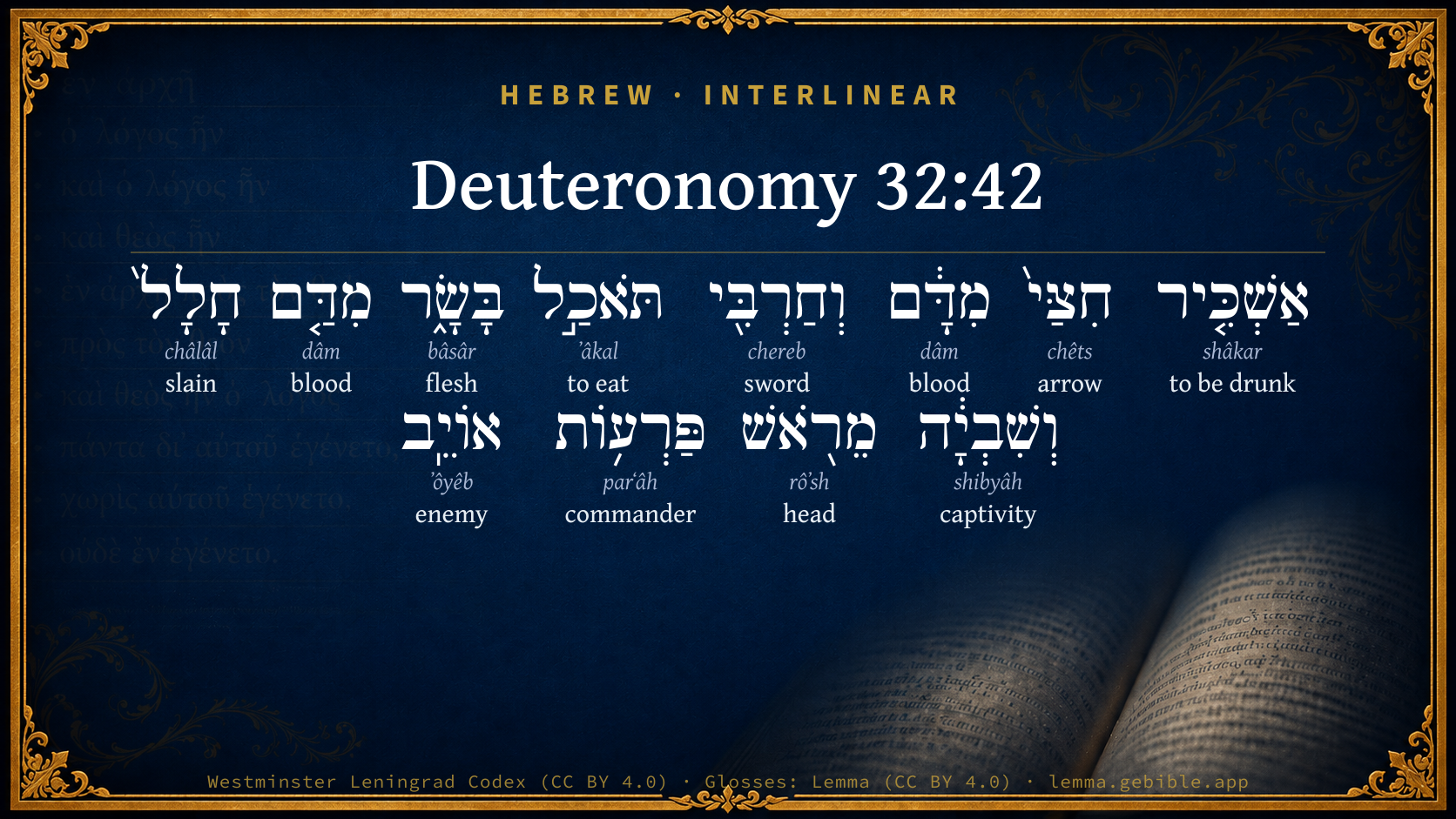
  1. אַשְׁכִּ֤יר shâkar H7937 “to be drunk” Verb, Hiphil, Imperfect, 1st Person, Common, Singular
  2. חִצַּי֙ chêts H2671 “arrows · my” Noun, Common, Masculine, Plural, Construct + Suffix, Personal, 1st Person, Common, Singular
  3. מִדָּ֔ם dâm H1818 “from · blood” Preposition + Noun, Common, Masculine, Singular, Absolute
  4. וְחַרְבִּ֖י chereb H2719 “and · sword · my” Conjunction + Noun, Common, Feminine, Singular, Construct + Suffix, Personal, 1st Person, Common, Singular
  5. תֹּאכַ֣ל ʼâkal H398 “to eat” Verb, Qal, Imperfect, 3rd Person, Feminine, Singular
  6. בָּשָׂ֑ר bâsâr H1320 “flesh” Noun, Common, Masculine, Singular, Absolute
  7. מִדַּ֤ם dâm H1818 “from · blood of” Preposition + Noun, Common, Masculine, Singular, Construct
  8. חָלָל֙ châlâl H2491 “slain” Adjective, Adjective, Masculine, Singular, Absolute
  9. וְשִׁבְיָ֔ה shibyâh H7633 “and · captivity” Conjunction + Noun, Common, Both, Singular, Absolute
  10. מֵרֹ֖אשׁ rôʼsh H7218 “from · head of” Preposition + Noun, Common, Masculine, Singular, Construct
  11. אוֹיֵֽב ʼôyêb H341 “enemy” Verb, Qal, Participle Active, Masculine, Singular, Absolute

About this verse

These counts appear in no published source. They are computed here, from the morphology-tagged text and Lemma’s own curated glosses. What Lemma adds →

12
words
11
distinct lemmas
Pentateuch
section

Notable vocabulary

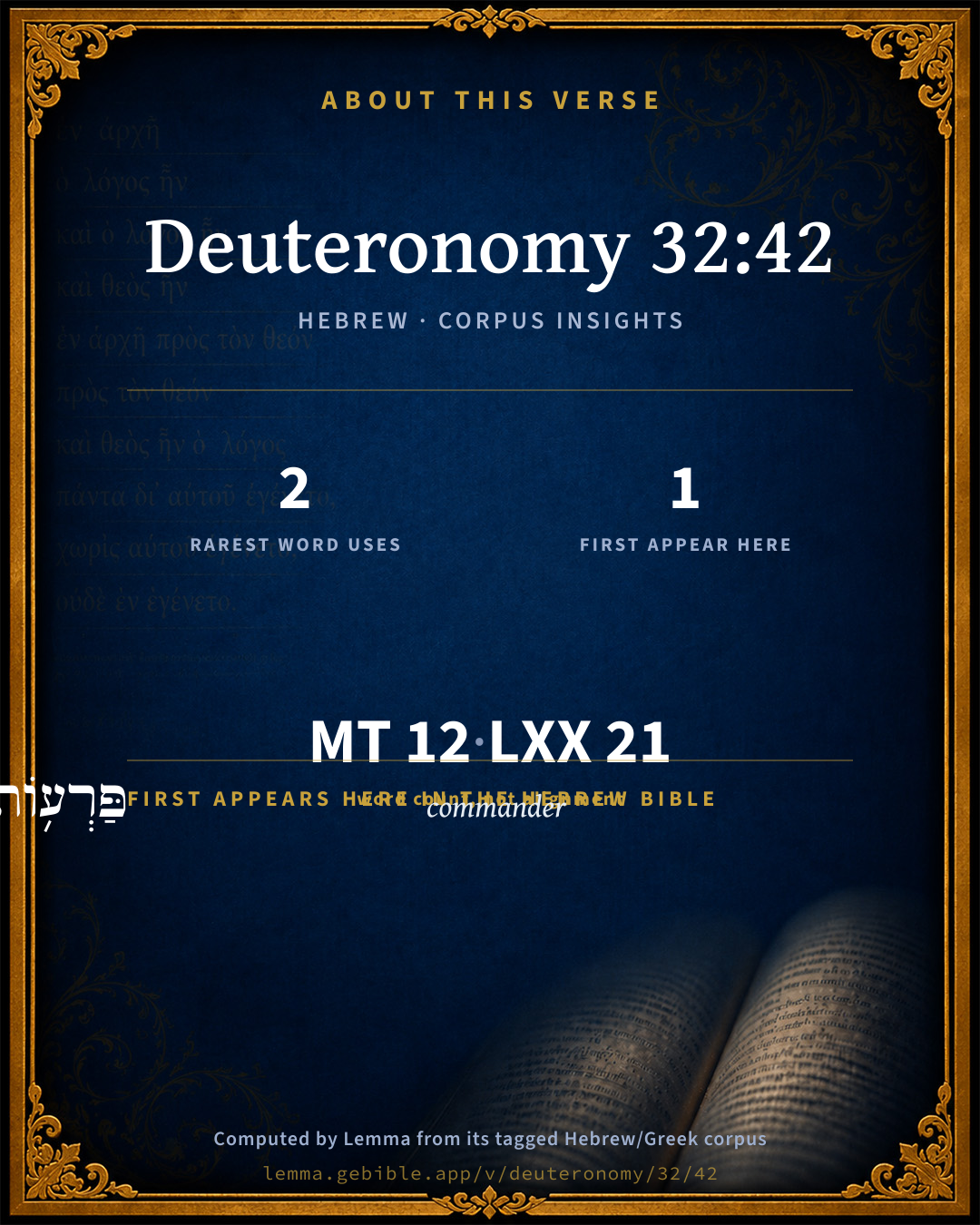
The rarest word here is פַּרְע֥וֹת commander H6546 — appearing just 2 times in the whole Hebrew Bible.

First appearance in Scripture

This word makes its first canonical appearance in the Hebrew Bible here:

  • פַּרְע֥וֹת commander H6546

Shared distinctive vocabulary

פַּרְע֥וֹת commander H6546 occurs in 2 verses of the Hebrew Bible. Also found in:

Grammatical profile

  • 3 verbs
  • 8 nouns
  • 1 adjective

Verb forms

  • אַשְׁכִּ֤יר Hiphil · Imperfect
  • תֹּאכַ֣ל Qal · Imperfect
  • אוֹיֵֽב Qal · Participle Active

Repetition

A word recurs within this verse — often emphatic in Hebrew:

  • מִדָּ֔ם blood H1818 ×2

Hebrew & Septuagint length

In English translation the verse runs 31 words from the Hebrew and 38 from the Septuagint (LXX English) — closely comparable.

A rough comparison of the two English renderings, which tokenize alike — not a word-level alignment.

Word counts can differ between the Hebrew and the Greek without any difference in meaning — e.g. the Hebrew direct-object marker אֵת has no separate Greek word, and Greek often adds the article ὁ.

In the original languages it is 12 Hebrew tokens and 21 Greek tokens — but the two are counted differently (Hebrew bundles its prefixes and suffixes into one token; the Greek is in lemma form), so that isn’t a like-for-like length.

Cross-references

12

Topical passages linked to Deuteronomy 32:42 in the Treasury of Scripture Knowledge — connected by theme and wording, ordered by reader-vote popularity; previews shown in the World English Bible.

  • Deuteronomy 32:23 I will heap evils on them; I will spend my arrows on them:
  • Jeremiah 46:10 For that day is [a day] of the Lord, Yahweh of Hosts, a day of vengeance, that he may avenge him of his adversaries: and the sword shall devour and be satiate, and shall drink its fill of their blood; for the Lord, Yahweh of hosts, has a sacrifice in the north country by the river Euphrates.
  • Ezekiel 38:21–22 I will call for a sword against him to all my mountains, says the Lord Yahweh: every man's sword shall be against his brother.
  • Job 13:24 Why hide you your face, And hold me for your enemy?
  • Psalms 45:5 Your arrows are sharp. The nations fall under you, with arrows in the heart of the king's enemies.
  • Psalms 68:23 That you may crush them, dipping your foot in blood, That the tongues of your dogs may have their portion from your enemies."
  • Jeremiah 16:10 It shall happen, when you shall show this people all these words, and they shall tell you, Why has Yahweh pronounced all this great evil against us? or what is our iniquity? or what is our sin that we have committed against Yahweh our God?
  • Jeremiah 30:14 All your lovers have forgotten you; they don't seek you: for I have wounded you with the wound of an enemy, with the chastisement of a cruel one, for the greatness of your iniquity, because your sins were increased.
  • Jeremiah 46:14 Declare you in Egypt, and publish in Migdol, and publish in Memphis and in Tahpanhes: say you, Stand forth, and prepare you; for the sword has devoured round about you.
  • Lamentations 2:5 The Lord is become as an enemy, he has swallowed up Israel; He has swallowed up all her palaces, he has destroyed his strongholds; He has multiplied in the daughter of Judah mourning and lamentation.
  • Ezekiel 35:6–8 therefore, as I live, says the Lord Yahweh, I will prepare you to blood, and blood shall pursue you: since you have not hated blood, therefore blood shall pursue you.
  • Isaiah 34:6–8 The sword of Yahweh is filled with blood, it is made fat with fatness, with the blood of lambs and goats, with the fat of the kidneys of rams; for Yahweh has a sacrifice in Bozrah, and a great slaughter in the land of Edom.

Cross-references courtesy of OpenBible.info (CC BY 4.0).

Hebrew and Greek witnesses Masoretic Hebrew ↔ Greek Septuagint

The same verse in the two great witnesses to the Old Testament, shown verse-for-verse.

These are two independent witnesses, not word-aligned to each other, and the Septuagint is shown in lemma (dictionary) form.

Hebrew Deuteronomy 32:42 Masoretic · Westminster Leningrad Codex

אַשְׁכִּ֤יר חִצַּי֙ מִדָּ֔ם וְחַרְבִּ֖י תֹּאכַ֣ל בָּשָׂ֑ר מִדַּ֤ם חָלָל֙ וְשִׁבְיָ֔ה מֵרֹ֖אשׁ פַּרְע֥וֹת אוֹיֵֽב

I will make my arrows drunk with blood, My sword shall devour flesh; With the blood of the slain and the captives, From the head of the leaders of the enemy.

World English Bible · Public Domain

Greek LXX Deuteronomy 32:42 Septuagint · lemma form

μεθύω ὁ βέλος ἐγώ ἀπό αἷμα καί ὁ μάχαιρα ἐγώ καταἐσθίω κρέας ἀπό αἷμα τραυματίας καί αἰχμαλωσία ἀπό κεφαλή ἄρχων ἐχθρός

I will make my weapons drunk with blood, and my sword shall devour flesh, it shall glut itself with the blood of the wounded, and from the captivity of the heads of their enemies that rule over them.

LXX2012 (modern English Septuagint) · Public Domain

On this verse, The Cambridge Bible for Schools and Colleges discusses the Septuagint’s reading. Read the note in Commentary ↓

Hebrew: Westminster Leningrad Codex (CC BY 4.0). Greek: Septuagint (public domain); English from LXX2012 (modern English Septuagint) (Public Domain). How the Septuagint differs from the Hebrew →

Targum (Aramaic paraphrase)

2

The Targum is the ancient Jewish Aramaic paraphrase of the Hebrew Scriptures — an interpretive translation, not the Hebrew text itself. Onkelos (literal) and Pseudo-Jonathan (expansive) render the Torah, and Jonathan the Prophets. Coverage is partial: where no permissively-licensed English translation exists for a verse, only the Aramaic is shown. This is verse-level text, not a word-by-word alignment to the Hebrew.

  1. Targum Onkelos Torah (Genesis–Deuteronomy)
    אֱרַוֵי גִירַי מִדְמָא וְחַרְבִּי תִּקְטוֹל בְּעַמְמַיָא מִדַם קְטִילָן וְשִׁבְיָן לְאַעְדָאָה כִתְרִין מֵרֵישׁ סָנְאָה וּבְעַל דְבָבָא

    (no public-domain English translation for this verse)

    Targum Onkelos — Aramaic: “Onkelos Genesis” (public domain); “Onkelos Exodus” (public domain); “Onkelos Leviticus” (public domain); “Onkelos Numbers” (public domain); “Onkelos Deuteronomy” (public domain). English: “Sefaria Community Translation” (CC0 1.0 (public-domain dedication)); “J.W. Etheridge. The Targums of Onkelos and Jonathan Ben Uzziel on the Pentateuch. London: Longmans, Green, 1862” (public domain). Text via Sefaria.

  2. Targum Pseudo-Jonathan Torah (Genesis–Deuteronomy)
    אֵירַוֵי גִירְרַי מִן אֲדַם קְטוֹלֵיהוֹן וּסְיָיפַי תִגְמוֹר בִּשְרֵיהוֹן מִדַם קְטִילִין וְשִׁיבִין מִשֵׁירוֹי פּוּרְעָנוּת סַנְאֵיהוֹן דְעַמִי

    I will make My arrows drunk with their blood, and My sword shall consume their flesh; with the blood of the destroyers of My people, their captives, and the chieftains of their hosts.

    Targum Pseudo-Jonathan — Aramaic: “Targum Jonathan on Genesis” (public domain); “Targum Jonathan on Exodus” (public domain); “Targum Jonathan on Leviticus” (public domain); “Targum Jonathan on Numbers” (public domain); “Targum Jonathan on Deuteronomy” (public domain). English: “The Targum of Jonathan ben Uzziel, trans. J. W. Etheridge, London, 1862” (public domain). Text via Sefaria.

Commentary

Notes on Deuteronomy 32:42 from classic Christian and Jewish commentators (each source and its license shown beneath its notes). The classic Christian expositions comment on the surrounding passage and are grouped to its opening verse, so a note may address several verses; the Jewish commentaries on the Tanakh (Rashi and others) are per-verse, so they appear only where the commentator wrote on this verse.

Lemma curates 59 commentaries, every one of them public domain or Creative Commons licensed, each selected and text-cleaned for this edition rather than reprinted as found. About our sources →

Trapp's Complete Commentary

John Trapp

Deu 32:42 I will make mine arrows drunk with blood, and my sword shall devour flesh; [and that] with the blood of the slain and of the captives, from the beginning of revenges upon the enemy.

Ver. 42. From the beginning of revenges.] I will begin my revenges at the beginning of theirs. Esau began early with his brother Jacob, even in the very womb, and so held on; but God was even with him.

John Trapp, A Commentary or Exposition upon All the Books of the Old and New Testament (1647–1656) — public domain. Text from a community e-Sword module.

Tyndale Open Study Notes

Tyndale Open Resources

32:42 The phrase arrows drunk with blood combines personification and hyperbole to show the extent of the carnage that will result from God’s judgment of the nations.

Tyndale Open Study Notes — © Tyndale Open Resources, licensed CC BY-SA 4.0. Text via the HelloAO Bible API.

Adam Clarke's Commentary

Verse 42. From the beginning of revenges] The word פרעות paroth, rendered revenges, a sense in which it never appears to be taken, has rendered this place very perplexed and obscure. Mr. Parkhurst has rendered the whole passage thus: -

I will make my arrows drunk with blood;

And my sword shall devour flesh,

With the blood of the slain and captive

From the hairy head of the enemy.

Probably מראש פרעות merosh paroth may be more properly translated, from the naked head - the enemy shall have nothing to shield him from my vengeance; the crown of dignity shall fall off, and even the helmet be no protection against the sword and arrows of the Lord.

Adam Clarke's Commentary on the Bible (1810–1826) — public domain. Text from a community e-Sword/MySword module.

Ellicott's Commentary for English Readers

(42) My sword shall devour flesh.—Comp. Isa_66:16 : “For by fire and by His sword will the Lord plead with all flesh, and the slain of the Lord shall be many”

With blood.—Literally, from the blood of the slain and of the captivity, from the beginning of revenges upon the enemy. Judgment must begin at the house of God, as it did in Ezekiel’s vision (Eze_9:6), “and begin at my sanctuary;” but it will not end there.

A Bible Commentary for English Readers, edited by Charles John Ellicott (1878–1897) — public domain. Text from a community e-Sword module.

The Cambridge Bible for Schools and Colleges

gen. ed. J. J. S. Perowne

42. and the captives] Assigned to death later.

leaders] So LXX ἀρχόντων, Heb. para‘ôth, Ar. fara‘, to excel; A.V. beginning of revenges from the analogy of Aram. phara. In Num_6:5, Eze_44:20, pere‘ = flowing locks. Cp. W. R. Smith on Jdg_5:2, in Black’s Judges, in Smaller Cambridge Bible for Schools.

43 Sing, O ye nations, His people,

For His servants’ blood He avengeth,

And vengeance He wreaks on His foes,

And assoils the land of His people.

The Cambridge Bible for Schools and Colleges (gen. ed. J. J. S. Perowne; Cambridge University Press, 1878–1918) — public domain. Text from a community e-Sword module.

John Gill's Exposition

Rejoice, O ye nations, with his people,.... Or, "rejoice, ye nations", who are "his" people; so Kimchi and Ben Melech interpret it; the Gentiles, who are the Lord's chosen and covenant people, redeemed and called, and the fulness of them now brought in, and so matter of great rejoicing; or rather, as the Septuagint, which is approved and confirmed by the Apostle Paul, "rejoice, ye Gentiles, with his people", Rom 15:10; and as it is there applied to the then state of the Christian church, when Jews and Gentiles were incorporated and united together; so here it respects future time, when, as the fulness of the Gentiles will be brought in, so the Jews will be converted, and the "loammi", Hos 1:9, will be taken off from them, and they will be reckoned among the people of God; and Jews and Gentiles will be joined together in the same Gospel church state, and so are called upon to rejoice in their common salvation, and in their common blessings and privileges, and particularly for what follows:

for he will avenge the blood of his servants, and will render vengeance to his adversaries; by his servants are meant the martyrs of Jesus, whose blood has been shed by antichrist, and the antichristian powers, his adversaries; as the blood of the Waldenses in the valleys of Piedmont, the Albigenses in Spain, and the Petrobrussians in France, the Bohemians in Germany, the Wickliffites, Lollards and the "martyrs" in Queen Mary's days in England, with many others; and when inquisition is made for blood, the blood of those will be found out, and vengeance rendered for it:

and will be merciful unto his land, and to his people: or "will atone for" (z), expiate, cleanse, and purge both land and people; clear the whole earth, which is the Lord's, from Mahometanism, Paganism, and Popery, and cover it with the knowledge of the Lord by the everlasting Gospel, which will be preached to all nations; and particularly the land of Canaan, laid under an anathema or curse, as threatened, Mal 4:6; under which it has lain ever since the destruction of it by the Romans, and has ever since been inhabited by Pagans, Mahometans, and Papists; and, though once a land flowing with milk and honey, has been turned into a barren wilderness, and will thus remain, and Jerusalem, its metropolis, trodden down by the Gentiles, until their times are fulfilled; which now will be, and then it will be restored to its former fruitfulness and fertility, Luk 21:24; and will be inhabited by the converted Jews, to whom the Lord will be pacified, upon the foot or Christ's atonement, which now will be made known and applied unto them, with the full and free pardon of all their sins, Rom 11:25; and thus ends this most excellent and wonderful song, which is of such a large extent and compass, as to reach from the beginning of the Jewish nation, and before it, to the conversion of the Jews in the latter day; an history of more than four thousand years already; and how long more is yet to come before all in it is fulfilled no man call say.

(z) "propitiabitur", Pagninus, Montanus; "expiabit", Vatablus; "expiat", Junius & Tremellius.

John Gill's Exposition of the Whole Bible (1746–1763) — public domain (CC PDM 1.0). Text via the HelloAO Bible API.

Haydock's Catholic Bible Commentary

Enemies. I will tear the crown from off their head. Chaldean, I will destroy the king, as well as the meanest captives. Protestants, "from the beginning of revenges upon the enemy." At the very first I will completely destroy them. (Haydock) --- I will punish them for the slaughter and captivity of my people, whom they have shaved, as a mark of their servile condition. (Menochius) --- Their bare head, or vain counsels, will be detected and punished. (Worthington)

George Leo Haydock (1774–1849), Haydock's Catholic Family Bible and Commentary, 1859 edition — public domain. Excludes Psalms (Douay-Rheims chapter numbering differs from Protestant) and Deuterocanonical books (Catholic canon only).

Matthew Poole's English Annotations

Of the captives; whom my sword hath sorely wounded, though not utterly killed.

From the beginning of revenges upon the enemy, i.e. when once I begin to revenge myself and my people upon mine and their enemies, I will go on and make a full end. Or, with the head, or with the blood of the head, i.e. of the chief or chiefs, of the revenges of the enemy, i. e. of the revengeful or malicious enemy of God and of his people. The noun substantive is oft put for the adjective; as Gen 17:5, a multitude of nations is put for many nations, Rom 4:17; Gen 45:22, changes of raiment, i.e. changeable raiment; and Psa 99:4, the king’s strength, i.e. the strong and mighty king; and so here, the revenges of the enemy, i.e. the revengeful enemy. And by the head may be here understood either the devil, or the beads and rulers of those empires which were enemies to God’s people. Or, of the head shall be the revenges upon the enemies, i.e. I will take vengeance upon all mine enemies, yea, upon the head or heads of them.

Matthew Poole's English Annotations on the Holy Bible (1683–1685) — public domain. Text from a community e-Sword/MySword module.

Whedon's Commentary on the Bible

Daniel D. Whedon

42. From the beginning of revenges upon the enemy — The translation in our Authorized Version is manifestly incorrect. From the heads of the leaders of the enemy is a literal translation.

Daniel D. Whedon (gen. ed.), Commentary on the Old and New Testaments (1874–1909) — public domain. Text from a community e-Sword module.

The Pulpit Commentary

My sword shall devour flesh; literally, shall eat flesh; "the edge of the sword is called its mouth, because, like a mouth, it is said to eat and devour" (Gesenius). From the beginning of revenges upon the enemy. Different renderings of this have been given: LXX, ajpontwn ejcqrwn, "from the head of the hostile princes;" "from the head of the chiefs of the enemy" (Geseuius, Furst, Rosenm "from the hairy head of the foe" (Keil, Herxheimer, Knobel). twOrp, the plural of rp, hair, locks, signifies primarily hairs, and a head of hairs, and may be taken as equivalent to "a hairy head;" but the word is also used in the sense of "princes" or "chiefs" (probably because such were distinguished by copious flowing locks; cf.; Jud_1:5:2) hence the rendering, "head of the chiefs." The former is to be preferred here, for why chiefs or princes should be referred to in this connection does not appear. (cf. Psa_68:22) The rendering of the Authorized Version is wholly unauthorized. This verse presents an instance of alternate parallelism; each half falls into two members, and of the four members thus constituted, the third corresponds to the first, and the fourth to the second; thus"I will make my arrows drunk with blood, And my sword shall devour flesh; With the blood of the slain and the captives, From the hairy head of the foe.

The Pulpit Commentary (1880–1919), ed. H.D.M. Spence-Jones & Joseph S. Exell — public domain. Text from a community e-Sword module.

John Wesley's Explanatory Notes

Captives - Whom my sword hath sorely wounded, though not utterly killed. From the beginning - When once I begin to revenge myself and my people upon mine and their enemies, I will go on and make a full end.

John Wesley, Explanatory Notes Upon the Whole Bible (1754–1765) — public domain. Text via the GEBible commentary corpus.

unfoldingWord translationNotes

Door43 World Missions Community

General Information:

Moses speaks a poetic song to the people of Israel. (See: Parallelism)

I will make my arrows drunk with blood, and my sword will devour flesh with the blood

Yahweh speaks of arrows as if they were people to whom he could give alcohol and make them drunk, and of a sword as if it were a person who was so hungry that he would eat an animal before draining the blood out. These metaphors are metonyms for a soldier using arrows and a sword to kill many enemies. This in turn is a metaphor for Yahweh killing his enemies in war. (See: Metaphor and Metonymy and Personification)

from the heads of the leaders of the enemy

A possible meaning is "from the long-haired heads of the enemy."

translationWords

bow and arrow

drunk

blood

sword

devour

flesh

captive

head

adversary

unfoldingWord translationNotes — © Distant Shores Media and the Door43 World Missions Community, licensed CC BY-SA 4.0. Source: git.door43.org/Door43/en_tn.

Rashi

Rabbi Shlomo Yitzchaki (Rashi)

אשכיר חצי מדם I WILL MAKE MY ARROWS DRUNK WITH BLOOD of the enemy,

וחרבי תאכל AND MY SWORD SHALL DEVOUR their FLESH.

מדם חלל ושביה FROM THE BLOOD OF THE SLAIN AND THE CAPTIVE i.e., this will happen to them because of the sin of those slain in Israel (i.e., on account of their blood; מדם), and because of the captives they have made amongst them,

מראש פרעות אויב — because of the sin of even the very first (ראש) breach (פרעות) made by the enemy (פרצות = פרעות); because when the Holy One, blessed be He, exacts punishment from the heathen nations for the wrongs they have inflicted upon Israel, He visits on them their own sin and the sins of their ancestors, from the very first breach they have made in Israel (Sifrei Devarim 332:5).

Rashi on the Tanakh — English translations: “The Judaica Press complete Tanach with Rashi, translated by A. J. Rosenberg” (CC BY 4.0); “Pentateuch with Rashi's commentary by M. Rosenbaum and A.M. Silbermann, 1929-1934” (public domain); “The Metsudah Tanach series, Lakewood, N.J” (CC BY 4.0); and “The Book of Joshua, Metsudah Publications, 1997” (CC BY 4.0). Text via Sefaria.

Lesson kit

Teaching starters — assembled from the data on this page, not authored interpretation. Every prompt links to the verse data it draws on. Edit before teaching.

Deuteronomy, in the Pentateuch, opens this verse with 12 words (11 distinct Hebrew lemmas). Its most distinctive word is parʻâh (“commander”). A historical commentator’s framing appears above. Read the whole chapter for the surrounding context.

Discussion questions

  1. What does “commander” (parʻâh) contribute to the verse as a whole?
  2. The word “commander” first appears here in Scripture. What is being introduced at this debut?
  3. Judges 5:2 shares the word «commander» with this verse. How do the two illuminate each other?
  4. “blood” occurs 2× in this one verse. What is the effect of the repetition?
  5. These translations render this verse differently; the difference is in the English rendering, not the original. What questions does that raise?
  6. The verb «אַשְׁכִּ֤יר» is Hiphil Imperfect. How does its form color the action?
  7. Reading how Trapp's Complete Commentary and Tyndale Open Study Notes read this verse, where do the two commentators agree and where do they part?

Things to notice

Reading settings

Reading text

Shown beneath each verse's original-language words.

Old Testament
Old Testament edition

Read the OT as the Masoretic Hebrew (MT) or the Greek Septuagint (LXX).

English shown for the Greek Septuagint (in the Hebrew ↔ Greek comparison).

Comparing translations? Open the Compare panel on any verse page to stack up to four side by side.