
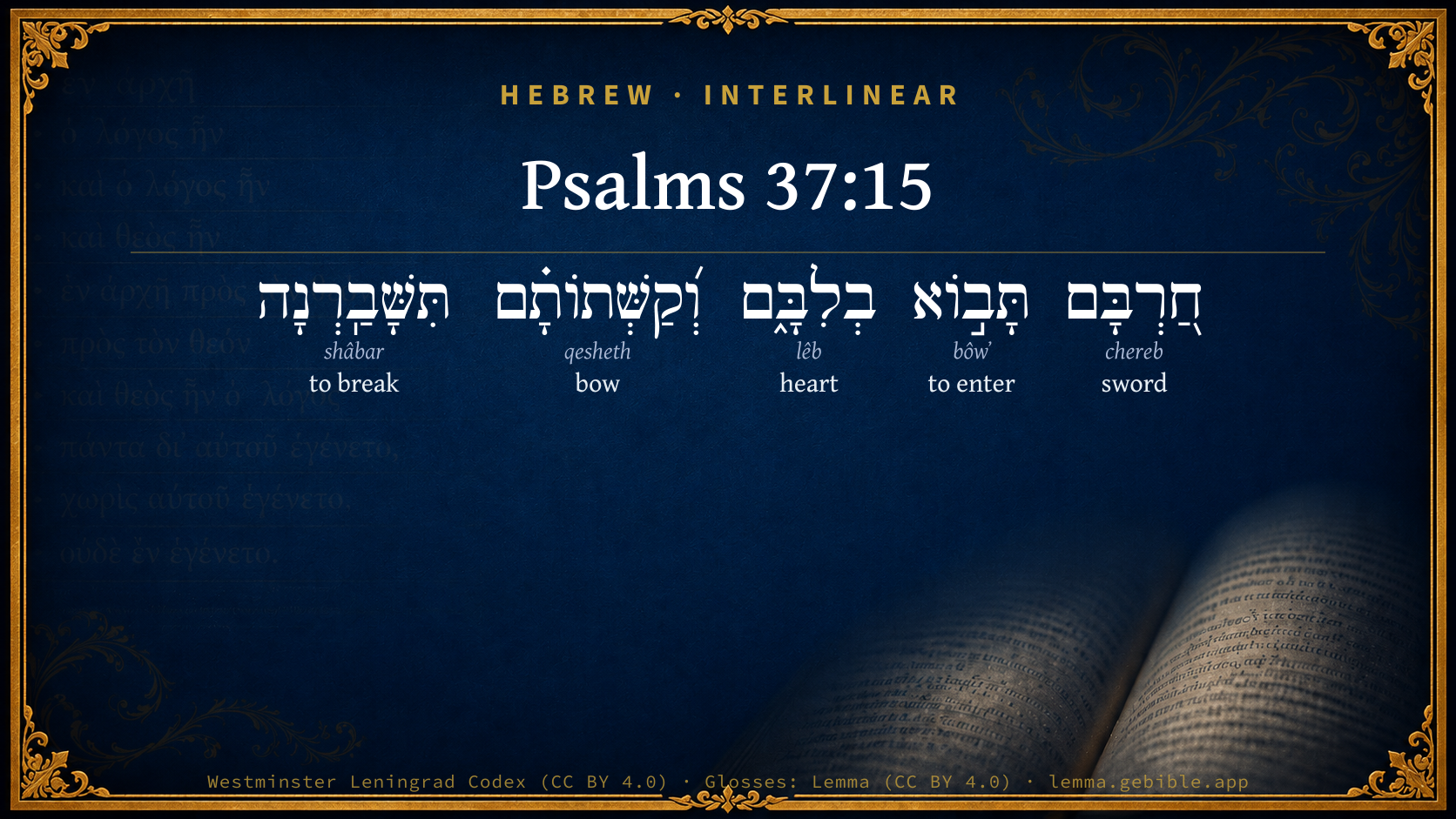
Psalms 37:15

Hebrew (Westminster Leningrad Codex) Psalms 37:15 appears in the Hebrew Old Testament. The text above is from the Westminster Leningrad Codex. Each word links to its Strong’s number, a concise gloss, and parsing drawn from the Open Scriptures Hebrew Bible morphology. Click any word for its full Brown-Driver-Briggs (BDB) entry.
Download image
Cite this verse

Psalms 37:15 (World English Bible). Public Domain. Lemma interlinear Bible study tool, https://lemma.gebible.app/v/psalms/37/15.

Show BibTeX & RIS
BibTeX
RIS
English Translation
Their sword shall enter into their own heart. Their bows shall be broken.
World English Bible · Public Domain
Download a study sheet

One document with this verse’s original text, its word-by-word gloss line, the meaning frame, cross-references with their text, attributed commentary, and full source and license credits — printable, and it pastes into notes with its structure intact.

This verse Autodidact and up

Study sheet (.html) Plain text (.txt)

A passage Seminary Student

Up to 50 verses in one chapter. A passage sheet keeps up to 6 commentary sources and 12 cross-references per verse, in the order this page ranks them, and says so on the sheet whenever that leaves anything out. Ask for a single verse and you get the Autodidact verse sheet above.

Everything on this page stays free to read, with no account — the sheet is a download of what is already on screen, not access to it.

Want to remove ads? Support Godless Engineer
Compare translations 3

The same verse in 3 English versions, stacked beneath the original-language interlinear above. Click any original word for its lexicon entry.

Each is an independent rendering of the whole verse — the interlinear is not word-aligned to these translations.

Highlighted words mark where these versions differ — a whole-verse word diff, not a word-by-word alignment.

  • World English Bible Public Domain
    Their sword shall enter into their own heart. Their bows shall be broken.
  • King James Version Public Domain
    Their sword shall enter into their own heart, and their bows shall be broken.
  • unfoldingWord Literal Text CC BY-SA 4.0
    Their sword will come into their heart, and their bows will be broken.

unfoldingWord Literal Text — © unfoldingWord, licensed CC BY-SA 4.0. Word-aligned USFM3 via Door43 (git.door43.org/unfoldingWord/en_ult).

Versions to compare (up to 4)

3 of 4 selected

Show all 18 translations

Every available English version of this verse, each an independent rendering of the whole verse.

  • World English Bible Public Domain
    Their sword shall enter into their own heart. Their bows shall be broken.
  • Berean Standard Bible Public Domain
    But their swords will pierce their own hearts, and their bows will be broken.
  • Majority Standard Bible Public Domain
    But their swords will pierce their own hearts, and their bows will be broken.
  • King James Version Public Domain
    Their sword shall enter into their own heart, and their bows shall be broken.
  • American Standard Version (1901) Public Domain
    Their sword shall enter into their own heart, And their bows shall be broken.
  • Revised Version (1885) Public Domain
    Their sword shall enter into their own heart, and their bows shall be broken.
  • Geneva Bible (1599) Public Domain
    But their sword shall enter into their owne heart, and their bowes shalbe broken.
  • Douay-Rheims (1899) Public Domain
    Let their sword enter into their own hearts, and let their bow be broken.
  • Young's Literal Translation Public Domain
    Their sword doth enter into their own heart, And their bows are shivered.
  • Literal Standard Version CC BY-SA 4.0
    Their sword enters into their own heart, || And their bows are shattered.
  • Unlocked Literal Bible CC BY-SA 4.0
    Their swords will pierce their own hearts, and their bows will be broken.
  • unfoldingWord Literal Text CC BY-SA 4.0
    Their sword will come into their heart, and their bows will be broken.
  • Darby Bible Public Domain
    their sword shall enter into their own heart, and their bows shall be broken.
  • World Messianic Bible Public Domain
    Their sword shall enter into their own heart. Their bows shall be broken.
  • Webster's Bible Public Domain
    Their sword shall enter into their own heart, and their bows shall be broken.
  • Free Bible Version CC BY-SA 4.0
    But the swords of the wicked will slice through their own hearts, and their bows will be broken.
  • Bible in Basic English Public Domain
    But their swords will be turned into their hearts, and their bows will be broken.
  • JPS Tanakh (1917) Public Domain
    Their sword shall enter into their own heart, and their bows shall be broken.

Literal Standard Version (2020), Covenant Press — licensed CC BY-SA 4.0. Text via the HelloAO Bible API (eBible.org). Unlocked Literal Bible (unfoldingWord) — licensed CC BY-SA 4.0. Text via the HelloAO Bible API (eBible.org). unfoldingWord Literal Text — © unfoldingWord, licensed CC BY-SA 4.0. Word-aligned USFM3 via Door43 (git.door43.org/unfoldingWord/en_ult). Free Bible Version, Dr. Jonathan Gallagher — licensed CC BY-SA 4.0. Text via the HelloAO Bible API (eBible.org).

Word by word

More ways to search: Search by grammar → Find every occurrence → Compare this word →

Practice this passage: Drill this verse → Learn its vocabulary →

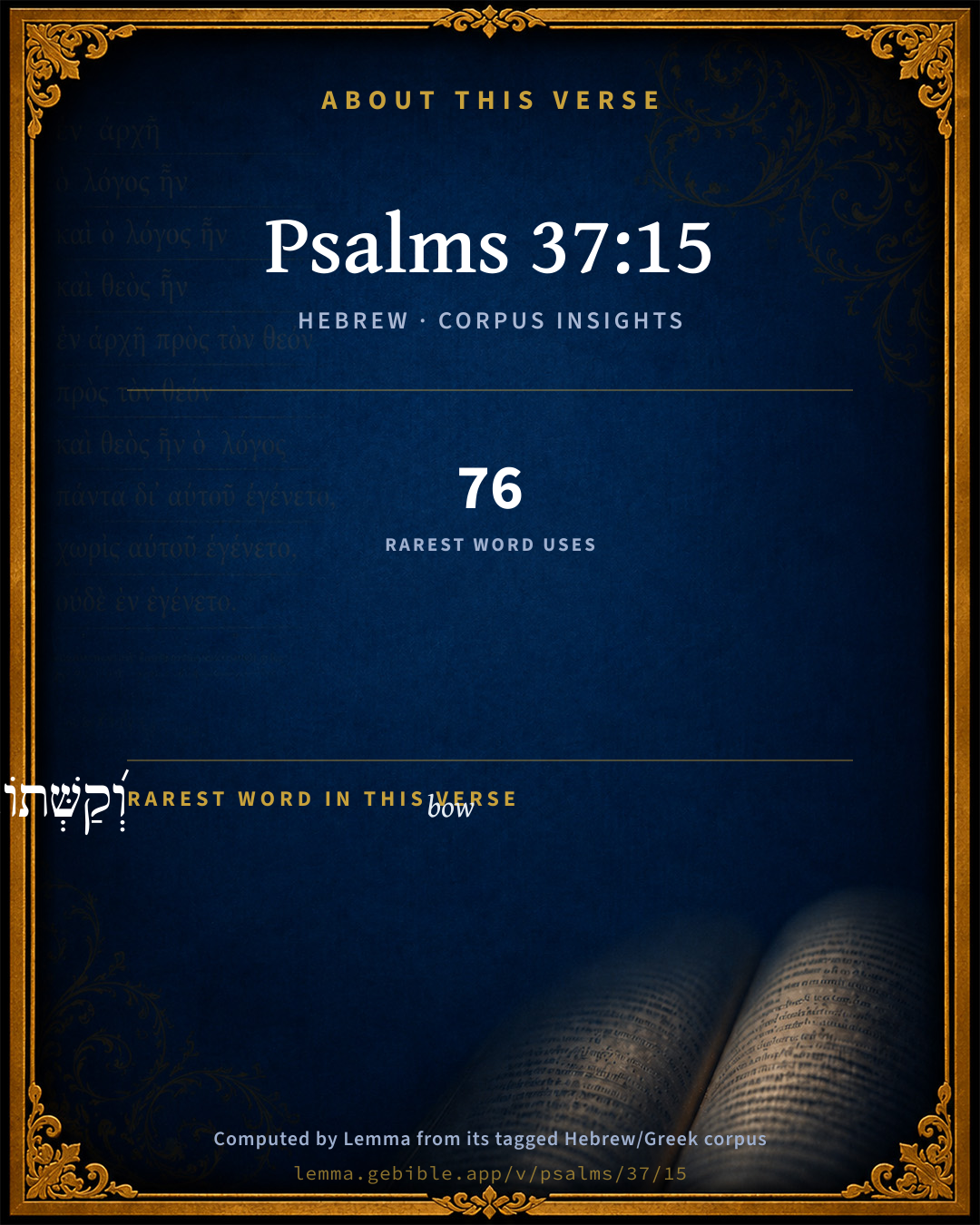
About this verse

These counts appear in no published source. They are computed here, from the morphology-tagged text and Lemma’s own curated glosses. What Lemma adds →

5
words
5
distinct lemmas
Wisdom
section

Grammatical profile

  • 2 verbs
  • 3 nouns

Verb forms

  • תָּב֣וֹא Qal · Imperfect
  • תִּשָּׁבַֽרְנָה Niphal · Imperfect

Hebrew & Septuagint length

In English translation the verse runs 13 words from the Hebrew and 13 from the Septuagint (LXX English) — the same length.

A rough comparison of the two English renderings, which tokenize alike — not a word-level alignment.

Word counts can differ between the Hebrew and the Greek without any difference in meaning — e.g. the Hebrew direct-object marker אֵת has no separate Greek word, and Greek often adds the article ὁ.

Cross-references

14

Topical passages linked to Psalms 37:15 in the Treasury of Scripture Knowledge — connected by theme and wording, ordered by reader-vote popularity; previews shown in the World English Bible.

  • Psalms 7:14–15 Behold, he travails with iniquity; Yes, he has conceived mischief, And brought forth falsehood.
  • Psalms 35:8 Let destruction come on him unawares. Let his net that he has hidden catch himself. Let him fall into that destruction.
  • 1 Samuel 31:4 Then said Saul to his armor bearer, Draw your sword, and thrust me through therewith, lest these uncircumcised come and thrust me through, and abuse me. But his armor bearer would not; for he was sore afraid. Therefore Saul took his sword, and fell on it.
  • 2 Samuel 17:23 When Ahithophel saw that his counsel was not followed, he saddled his donkey, and arose, and got him home, to his city, and set his house in order, and hanged himself; and he died, and was buried in the tomb of his father.
  • Psalms 46:9 He makes wars cease to the end of the earth. He breaks the bow, and shatters the spear. He burns the chariots in the fire.
  • Jeremiah 51:56 for the destroyer is come on her, even on Babylon, and her mighty men are taken, their bows are broken in pieces; for Yahweh is a God of recompenses, he will surely requite.
  • Hosea 1:5 It will happen in that day that I will break the bow of Israel in the valley of Jezreel."
  • Hosea 2:18 In that day I will make a covenant for them with the animals of the field, And with the birds of the sky, And with the creeping things of the ground. I will break the bow, the sword, and the battle out of the land, And will make them lie down safely.
  • 1 Samuel 2:4 The bows of the mighty men are broken; Those who stumbled are girded with strength.
  • Esther 7:9–10 Then said Harbonah, one of the chamberlains who were before the king, Behold also, the gallows fifty cubits high, which Haman has made for Mordecai, who spoke good for the king, stands in the house of Haman. The king said, Hang him thereon.
  • Psalms 76:3–6 There he broke the flaming arrows of the bow, The shield, and the sword, and the weapons of war. Selah.
  • Isaiah 37:38 It happened, as he was worshipping in the house of Nisroch his god, that Adrammelech and Sharezer his sons struck him with the sword; and they escaped into the land of Ararat. Esar Haddon his son reigned in his place.
  • Matthew 27:4–5 saying, "I have sinned in that I betrayed innocent blood." But they said, "What is that to us? You see to it."
  • Micah 5:6 They will rule the land of Assyria with the sword, And the land of Nimrod in its gates. He will deliver us from the Assyrian, When he invades our land, And when he marches within our border.

Cross-references courtesy of OpenBible.info (CC BY 4.0).

Hebrew and Greek witnesses Masoretic Hebrew ↔ Greek Septuagint

The same verse in the two great witnesses to the Old Testament, shown verse-for-verse.

You’re reading Greek Psalm 36 (Hebrew Psalm 37). The Septuagint counts the superscription, so verse numbers can differ from the Hebrew — chapter-level alignment, not verse-by-verse. Numbering follows Rahlfs.

These are two independent witnesses, not word-aligned to each other, and the Septuagint is shown in lemma (dictionary) form.

Hebrew Psalms 37:15 Masoretic · Westminster Leningrad Codex

חַ֭רְבָּם תָּב֣וֹא בְלִבָּ֑ם וְ֝קַשְּׁתוֹתָ֗ם תִּשָּׁבַֽרְנָה

Their sword shall enter into their own heart. Their bows shall be broken.

World English Bible · Public Domain

Greek LXX Greek Psalm 36:15 Septuagint · lemma form

ὁ ῥομφαία αὐτός εἰςἔρχομαι εἰς ὁ καρδία αὐτός καί ὁ τόξον αὐτός συντρίβω

Let their sword enter into their own heart, and their bows be broken.

LXX2012 (modern English Septuagint) · Public Domain

Hebrew: Westminster Leningrad Codex (CC BY 4.0). Greek: Septuagint (public domain); English from LXX2012 (modern English Septuagint) (Public Domain). How the Septuagint differs from the Hebrew →

Commentary

Notes on Psalms 37:15 from classic Christian and Jewish commentators (each source and its license shown beneath its notes). The classic Christian expositions comment on the surrounding passage and are grouped to its opening verse, so a note may address several verses; the Jewish commentaries on the Tanakh (Rashi and others) are per-verse, so they appear only where the commentator wrote on this verse.

Lemma curates 59 commentaries, every one of them public domain or Creative Commons licensed, each selected and text-cleaned for this edition rather than reprinted as found. About our sources →

Trapp's Complete Commentary

John Trapp

Psa 37:15 Their sword shall enter into their own heart, and their bows shall be broken.

Ver. 15. Their sword shall enter into their own heart] As did Saul’s, and his armourbearer’s, 1Sa 31:4-5 see Psa 7:1.

Per quod quis peccat, per idem punitur et ipse.

And their bows shall be broken] Neither their bows only, but their arms also, Psa 37:17. They shall utterly be disarmed and disabled when once God takes them to do; which is commonly when they are at the strongest and most confident.

John Trapp, A Commentary or Exposition upon All the Books of the Old and New Testament (1647–1656) — public domain. Text from a community e-Sword module.

Adam Clarke's Commentary

Verse 15. Their sword shall enter into their own heart] All their execrations and maledictions shall fall upon themselves, and their power to do mischief shall be broken.

Adam Clarke's Commentary on the Bible (1810–1826) — public domain. Text from a community e-Sword/MySword module.

John Calvin's Commentaries

In the 15th verse, David is not speaking of the laughter of God, but is denouncing vengeance against the ungodly, just as we have already seen in the second psalm, at the fourth verse, that although God, by conniving at the wicked, has often suffered them for a time to run to every excess in mirth and rioting, yet he at length speaks to them in his anger to overthrow them. The amount of what is stated is, that the ungodly should prevail so little, that the sword which they had drawn should return into their own bowels, and that their bow should be broken in pieces.

John Calvin's Commentaries (1540-1563) — public domain. Text from the Calvin Translation Society English edition (1840s-50s) via the Christian Classics Ethereal Library (ccel.org). Calvin's coverage is partial (roughly two-thirds of the Bible); uncommented books and verses are honest gaps, never fabricated. The 19th-century editor's footnotes and remarks are omitted so the notes are faithfully Calvin's own voice.

Ellicott's Commentary for English Readers

(15) Their sword.—The lex talionis. (Comp. Psa_7:15-16.)

A Bible Commentary for English Readers, edited by Charles John Ellicott (1878–1897) — public domain. Text from a community e-Sword module.

John Gill's Exposition

A little that a righteous man hath,.... It is the portion of the righteous, for the most part, to have but little of this world's goods; some indeed have been rich, as Abraham, Lot, David, Joseph of Arimathea, and others; but, generally speaking, the wicked have the largest share of worldly things, and the righteous but little, and are as having nothing comparatively; and yet their little

is better than the riches of many wicked; not that a little is better than much, or that poverty is better than riches, or a poor man better than a rich man; but the comparison is between a righteous man and a wicked man; the emphasis lies there; and the sense is, that a "righteous" man's "little" is better than a "wicked" man's "much"; the righteous have a right to what they have, through Christ, who is heir of all things, but not the wicked; they have what they have in love and with a blessing, not so the wicked; they are contented in their state and condition, when the wicked are never satisfied; they possess and enjoy what they have, even all they have, when God oftentimes does not give the wicked an heart to eat and drink of what they are possessed, but a stranger eats it; they have the presence of God with them, and that makes a little sweet, and to go a great way; and they live without any anxious, distressing, burdensome care; not so the wicked; and before long the tables will be turned, and they will have their good things, and the wicked their evil things; see Pro 16:8; wherefore they have no need to fret under present circumstances, nor envy the happiness of wicked men. Arama interprets it, of a little help that a righteous man has, better than the riches of many wicked; and Gussetius (r) understands all this not of the smallness and largeness of the substance of different persons, but of their numbers, the one small, the other large; and Jarchi, that the sense is, that a few persons with the righteous, which was the case of Abraham and Gideon, are better and succeed more than the multitude of many wicked persons; and the church should be content with a small number of believers, and not draw in a multitude of wicked men into their communion.

(r) Ebr. Comment. p. 213, 475.

John Gill's Exposition of the Whole Bible (1746–1763) — public domain (CC PDM 1.0). Text via the HelloAO Bible API.

Albert Barnes' Notes on the Bible

Their sword shall enter into their own heart - Their purposes will recoil on themselves; or they will themselves suffer what they had devised for others. See the same sentiment expressed in Psa 7:15-16; Psa 9:15; compare Est 7:10.

And their bows shall be broken - They will be defeated in their plans. God will cut them off, and not suffer them to execute their designs.

Albert Barnes' Notes on the Bible (1834–1885) — public domain. Text from a community e-Sword/MySword module.

Matthew Poole's English Annotations

God will not only defend the upright from their mischievous designs, but will make them to fall upon their own heads.

Matthew Poole's English Annotations on the Holy Bible (1683–1685) — public domain. Text from a community e-Sword/MySword module.

The Treasury of David

Charles H. Spurgeon

Ver. 15. Their sword shall enter into their own heart. Like Haman they shall be hanged upon the gallows built by themselves for Mordecai. Hundreds of times has this been the case. Saul, who sought to slay David, fell on his own sword; and the bow, his favourite weapon, the use of which he taught the children of Israel, was not able to deliver him on Gilboa. And their bows shall be broken. Their inventions of evil shall be rendered useless. Malice outwits itself. It drinks the poisoned cup which it mixed for another, and burns itself in the fire which it kindled for its neighbour. Why need we fret at the prosperity of the wicked when they are so industriously ruining themselves while they fancy they are injuring the saints? The next nine verses mainly describe the character and blessedness of the godly, and the light is brought out with a few black touches descriptive of the wicked and their doom.

Ver. 15. The self destructive nature of evil.

Psalms 37:16*

Charles H. Spurgeon's The Treasury of David (1869–1885) — public domain. Psalms only. Text from a community e-Sword/MySword module.

The Pulpit Commentary

Their sword shall enter into their own heart. Such as "take the sword" often "perish by the sword". (Mat_26:52) Absalom"s rebellion cost him his life. Marauders would sometimes meet with a stout resistance, and be slain by those whom they had intended to plunder. And their bows shall be broken; i.e. they shall meet with failure.

The Pulpit Commentary (1880–1919), ed. H.D.M. Spence-Jones & Joseph S. Exell — public domain. Text from a community e-Sword module.

Lesson kit

Teaching starters — assembled from the data on this page, not authored interpretation. Every prompt links to the verse data it draws on. Edit before teaching.

Psalms, in the Wisdom, opens this verse with 5 words (5 distinct Hebrew lemmas). Its most distinctive word is qesheth (“bow”). A historical commentator’s framing appears above. Read the whole chapter for the surrounding context.

Discussion questions

  1. How does “bow” (qesheth) shape what this verse is saying?
  2. Psalms 7:14–15 shares this passage’s theme. How do the two illuminate each other?
  3. These translations render this verse differently. What is at stake in choosing one wording over another?
  4. The verb «תָּב֣וֹא» is Qal Imperfect. How does its form color the action?
  5. Reading how Trapp's Complete Commentary and Adam Clarke's Commentary read this verse, where do the two commentators agree and where do they part?

Things to notice

Reading settings

Reading text

Shown beneath each verse's original-language words.

Old Testament
Old Testament edition

Read the OT as the Masoretic Hebrew (MT) or the Greek Septuagint (LXX).

English shown for the Greek Septuagint (in the Hebrew ↔ Greek comparison).

Comparing translations? Open the Compare panel on any verse page to stack up to four side by side.