Judges 1:8

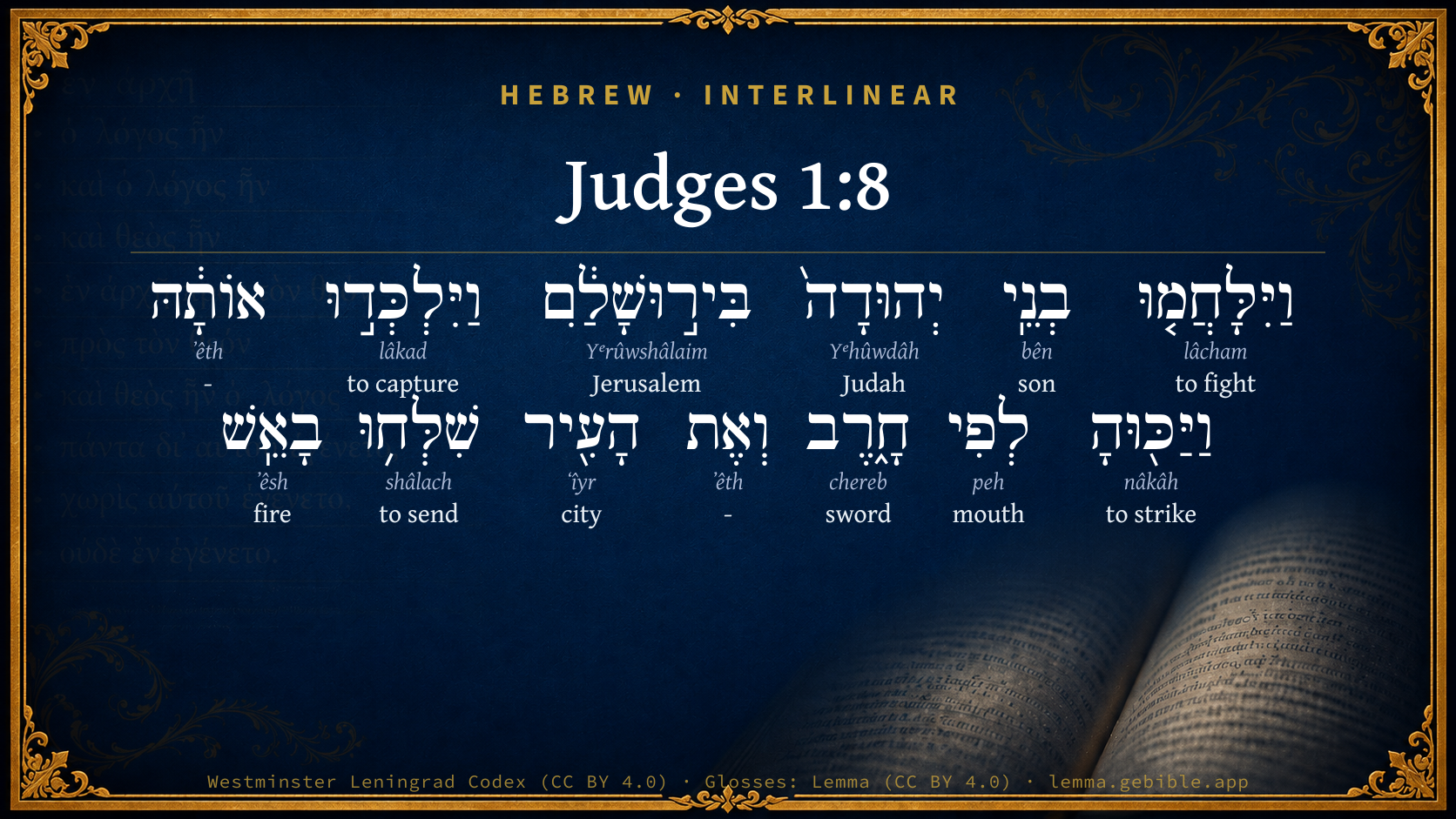
Hebrew (Westminster Leningrad Codex) Judges 1:8 appears in the Hebrew Old Testament. The text above is from the Westminster Leningrad Codex. Each word links to its Strong’s number, a concise gloss, and parsing drawn from the Open Scriptures Hebrew Bible morphology. Click any word for its full Brown-Driver-Briggs (BDB) entry.
Download image
Cite this verse

Judges 1:8 (World English Bible). Public Domain. Lemma interlinear Bible study tool, https://lemma.gebible.app/v/judges/1/8.

Show BibTeX & RIS
BibTeX
RIS
English Translation
The children of Judah fought against Jerusalem, and took it, and struck it with the edge of the sword, and set the city on fire.
World English Bible · Public Domain
Download a study sheet

One document with this verse’s original text, its word-by-word gloss line, the meaning frame, cross-references with their text, attributed commentary, and full source and license credits — printable, and it pastes into notes with its structure intact.

This verse Autodidact and up

Study sheet (.html) Plain text (.txt)

A passage Seminary Student

Up to 50 verses in one chapter. A passage sheet keeps up to 6 commentary sources and 12 cross-references per verse, in the order this page ranks them, and says so on the sheet whenever that leaves anything out. Ask for a single verse and you get the Autodidact verse sheet above.

Everything on this page stays free to read, with no account — the sheet is a download of what is already on screen, not access to it.

Want to remove ads? Support Godless Engineer
Compare translations 3

The same verse in 3 English versions, stacked beneath the original-language interlinear above. Click any original word for its lexicon entry.

Each is an independent rendering of the whole verse — the interlinear is not word-aligned to these translations.

Highlighted words mark where these versions differ — a whole-verse word diff, not a word-by-word alignment.

  • World English Bible Public Domain
    The children of Judah fought against Jerusalem, and took it, and struck it with the edge of the sword, and set the city on fire.
  • King James Version Public Domain
    Now the children of Judah had fought against Jerusalem, and had taken it, and smitten it with the edge of the sword, and set the city on fire.
  • unfoldingWord Literal Text CC BY-SA 4.0
    And the sons of Judah fought with Jerusalem and captured it. And they struck it to the mouth of the sword, and they sent the city into fire.

unfoldingWord Literal Text — © unfoldingWord, licensed CC BY-SA 4.0. Word-aligned USFM3 via Door43 (git.door43.org/unfoldingWord/en_ult).

Versions to compare (up to 4)

3 of 4 selected

Show all 18 translations

Every available English version of this verse, each an independent rendering of the whole verse.

  • World English Bible Public Domain
    The children of Judah fought against Jerusalem, and took it, and struck it with the edge of the sword, and set the city on fire.
  • Berean Standard Bible Public Domain
    Then the men of Judah fought against Jerusalem and captured it. They put the city to the sword and set it on fire.
  • Majority Standard Bible Public Domain
    Then the men of Judah fought against Jerusalem and captured it. They put the city to the sword and set it on fire.
  • King James Version Public Domain
    Now the children of Judah had fought against Jerusalem, and had taken it, and smitten it with the edge of the sword, and set the city on fire.
  • American Standard Version (1901) Public Domain
    And the children of Judah fought against Jerusalem, and took it, and smote it with the edge of the sword, and set the city on fire.
  • Revised Version (1885) Public Domain
    And the children of Judah fought against Jerusalem, and took it, and smote it with the edge of the sword, and set the city on fire.
  • Geneva Bible (1599) Public Domain
    (Nowe the children of Iudah had fought against Ierusalem, and had taken it and smitten it with the edge of the sworde, and had set the citie on fire.)
  • Douay-Rheims (1899) Public Domain
    And the children of Juda besieging Jerusalem, took it, and put it to the sword, and set the whole city on fire.
  • Young's Literal Translation Public Domain
    And the sons of Judah fight against Jerusalem, and capture it, and smite it by the mouth of the sword, and the city they have sent into fire;
  • Literal Standard Version CC BY-SA 4.0
    And the sons of Judah fight against Jerusalem, and capture it, and strike it by the mouth of the sword, and they have sent the city into fire;
  • Unlocked Literal Bible CC BY-SA 4.0
    The men of Judah fought against the city of Jerusalem and took it. They attacked it with the edge of the sword and they set the city on fire.
  • unfoldingWord Literal Text CC BY-SA 4.0
    And the sons of Judah fought with Jerusalem and captured it. And they struck it to the mouth of the sword, and they sent the city into fire.
  • Darby Bible Public Domain
    And the men of Judah fought against Jerusalem, and took it, and smote it with the edge of the sword, and set the city on fire.
  • World Messianic Bible Public Domain
    The children of Judah fought against Jerusalem, took it, struck it with the edge of the sword, and set the city on fire.
  • Webster's Bible Public Domain
    (Now the children of Judah had fought against Jerusalem, and had taken it, and smitten it with the edge of the sword, and set the city on fire.)
  • Free Bible Version CC BY-SA 4.0
    The men of Judah attacked Jerusalem and conquered it. They killed the inhabitants with the sword and burned the town down.
  • Bible in Basic English Public Domain
    Then the children of Judah made an attack on Jerusalem, and took it, burning down the town after they had put its people to the sword without mercy.
  • JPS Tanakh (1917) Public Domain
    And the children of Judah fought against Jerusalem, and took it, and smote it with the edge of the sword, and set the city on fire.

Literal Standard Version (2020), Covenant Press — licensed CC BY-SA 4.0. Text via the HelloAO Bible API (eBible.org). Unlocked Literal Bible (unfoldingWord) — licensed CC BY-SA 4.0. Text via the HelloAO Bible API (eBible.org). unfoldingWord Literal Text — © unfoldingWord, licensed CC BY-SA 4.0. Word-aligned USFM3 via Door43 (git.door43.org/unfoldingWord/en_ult). Free Bible Version, Dr. Jonathan Gallagher — licensed CC BY-SA 4.0. Text via the HelloAO Bible API (eBible.org).

Word by word

More ways to search: Search by grammar → Find every occurrence → Compare this word →

Practice this passage: Drill this verse → Learn its vocabulary →

וַיִּלְכְּד֣וּ
lâkad
H3920
“and · to capture”
Conjunction + Verb, Qal, Sequential Imperfect, 3rd Person, Masculine, Plural
Part of Speech
Conjunction + Verb
Stem
Qal
Form
Sequential Imperfect
Person
3rd Person
Gender
Masculine
Number
Plural
Full BDB Definition

Origin: a primitive root

TWOT: 1115

to capture, take, seize - (Qal) - to capture, seize - to capture (of men) (figuratively) - to take (by lot) - (Niphal) - to be captured - to be caught (of men in trap, snare) (figuratively) - (Hithpael) to grasp each other
  1. וַיִּלָּחֲמ֤וּ lâcham H3898 “and · to fight” Conjunction + Verb, Niphal, Sequential Imperfect, 3rd Person, Masculine, Plural
  2. בְנֵֽי bên H1121 “sons of” Noun, Common, Masculine, Plural, Construct
  3. יְהוּדָה֙ Yᵉhûwdâh H3063 “Judah” Noun, Proper
  4. בִּיר֣וּשָׁלִַ֔ם Yᵉrûwshâlaim H3389 “in/at · Jerusalem” Preposition + Noun, Proper
  5. אוֹתָ֔הּ ʼêth H853 “- · her” Particle, Direct Object + Suffix, Personal, 3rd Person, Feminine, Singular
  6. וַיַּכּ֖וּהָ nâkâh H5221 “and · to strike · her” Conjunction + Verb, Hiphil, Sequential Imperfect, 3rd Person, Masculine, Plural + Suffix, Personal, 3rd Person, Feminine, Singular
  7. לְפִי peh H6310 “to/for · mouth of” Preposition + Noun, Common, Masculine, Singular, Construct
  8. חָ֑רֶב chereb H2719 “sword” Noun, Common, Feminine, Singular, Absolute
  9. וְאֶת ʼêth H853 “and · -” Conjunction + Particle, Direct Object
  10. הָעִ֖יר ʻîyr H5892 “the · city” Particle, Definite Article + Noun, Common, Feminine, Singular, Absolute
  11. שִׁלְּח֥וּ shâlach H7971 “to send” Verb, Piel, Perfect, 3rd Person, Common, Plural
  12. בָאֵֽשׁ ʼêsh H784 “in/at the · fire” Preposition, Determined + Noun, Common, Both, Singular, Absolute

About this verse

These counts appear in no published source. They are computed here, from the morphology-tagged text and Lemma’s own curated glosses. What Lemma adds →

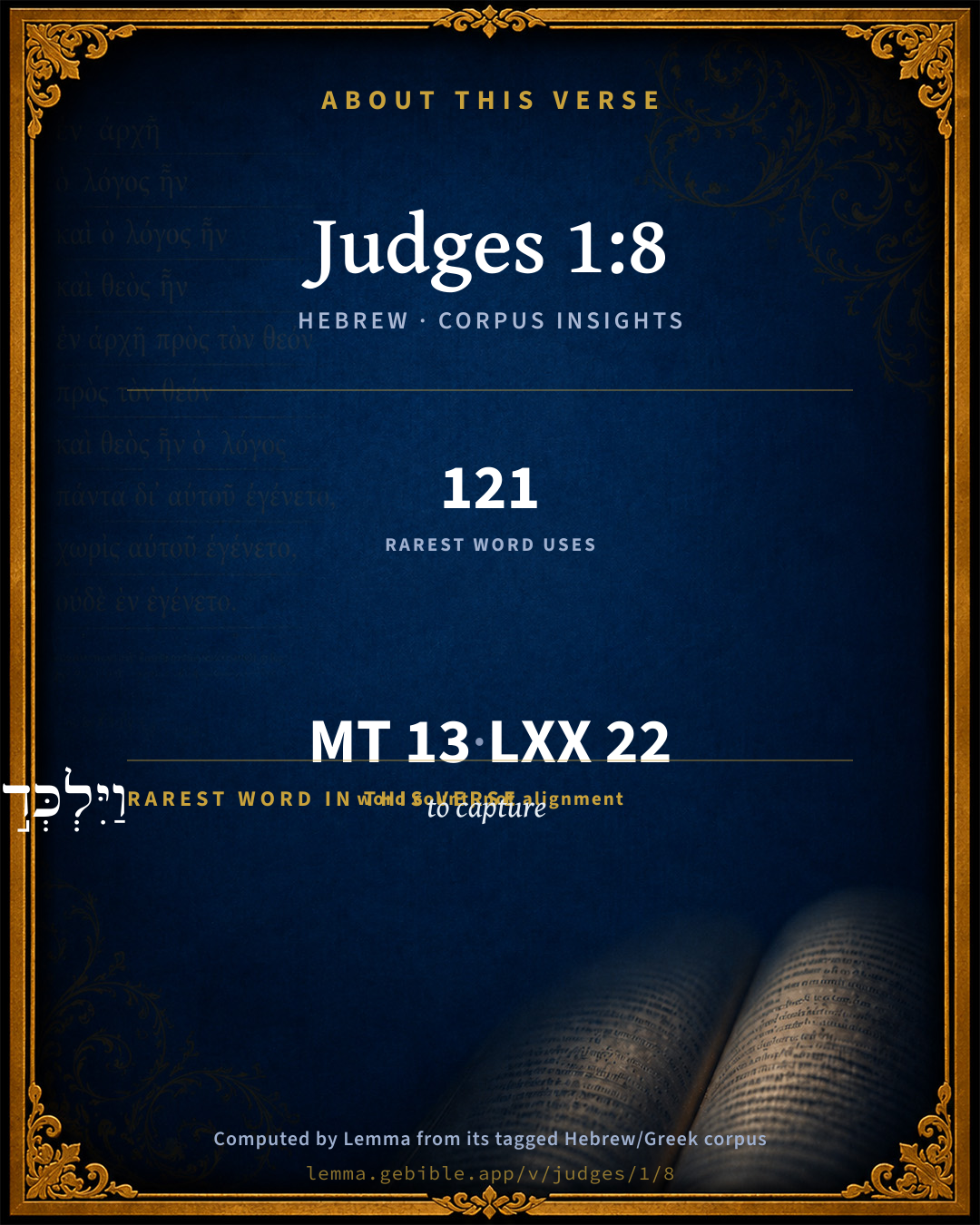
13
words
12
distinct lemmas
Historical
section

Grammatical profile

  • 4 verbs
  • 7 nouns
  • 2 particles

Verb forms

  • וַיִּלָּחֲמ֤וּ Niphal · Sequential Imperfect
  • וַיִּלְכְּד֣וּ Qal · Sequential Imperfect
  • וַיַּכּ֖וּהָ Hiphil · Sequential Imperfect
  • שִׁלְּח֥וּ Piel · Perfect

Hebrew & Septuagint length

In English translation the verse runs 25 words from the Hebrew and 26 from the Septuagint (LXX English) — closely comparable.

A rough comparison of the two English renderings, which tokenize alike — not a word-level alignment.

Word counts can differ between the Hebrew and the Greek without any difference in meaning — e.g. the Hebrew direct-object marker אֵת has no separate Greek word, and Greek often adds the article ὁ.

In the original languages it is 13 Hebrew tokens and 22 Greek tokens — but the two are counted differently (Hebrew bundles its prefixes and suffixes into one token; the Greek is in lemma form), so that isn’t a like-for-like length.

Cross-references

2

Topical passages linked to Judges 1:8 in the Treasury of Scripture Knowledge — connected by theme and wording, ordered by reader-vote popularity; previews shown in the World English Bible.

  • Joshua 15:63 As for the Jebusites, the inhabitants of Jerusalem, the children of Judah couldn't drive them out: but the Jebusites dwell with the children of Judah at Jerusalem to this day.
  • Judges 1:21 The children of Benjamin did not drive out the Jebusites who inhabited Jerusalem; but the Jebusites dwell with the children of Benjamin in Jerusalem to this day.

Cross-references courtesy of OpenBible.info (CC BY 4.0).

Hebrew and Greek witnesses Masoretic Hebrew ↔ Greek Septuagint

The same verse in the two great witnesses to the Old Testament, shown verse-for-verse.

These are two independent witnesses, not word-aligned to each other, and the Septuagint is shown in lemma (dictionary) form.

Hebrew Judges 1:8 Masoretic · Westminster Leningrad Codex

וַיִּלָּחֲמ֤וּ בְנֵֽי יְהוּדָה֙ בִּיר֣וּשָׁלִַ֔ם וַיִּלְכְּד֣וּ אוֹתָ֔הּ וַיַּכּ֖וּהָ לְפִי חָ֑רֶב וְאֶת הָעִ֖יר שִׁלְּח֥וּ בָאֵֽשׁ

The children of Judah fought against Jerusalem, and took it, and struck it with the edge of the sword, and set the city on fire.

World English Bible · Public Domain

Greek LXX Judges 1:8 Septuagint · lemma form

καί πολεμέω ὁ υἱός ιουδα ὁ ἰερουσαλήμ καί καταλαμβάνω αὐτός καί πατάσσω αὐτός ἐν στόμα ῥομφαία καί ὁ πόλις ἐνπίμπρημι ἐν πῦρ

And the children of Judas fought against Jerusalem, and took it, and struck with the edge of the sword, and they burnt the city with fire.

LXX2012 (modern English Septuagint) · Public Domain

Hebrew: Westminster Leningrad Codex (CC BY 4.0). Greek: Septuagint (public domain); English from LXX2012 (modern English Septuagint) (Public Domain). How the Septuagint differs from the Hebrew →

Targum (Aramaic paraphrase)

1

The Targum is the ancient Jewish Aramaic paraphrase of the Hebrew Scriptures — an interpretive translation, not the Hebrew text itself. Onkelos (literal) and Pseudo-Jonathan (expansive) render the Torah, and Jonathan the Prophets. Coverage is partial: where no permissively-licensed English translation exists for a verse, only the Aramaic is shown. This is verse-level text, not a word-by-word alignment to the Hebrew.

  1. Targum Jonathan Prophets (Joshua–Malachi)
    וְאַגִיחוּ קְרָבָא בְנֵי יְהוּדָה בִּירוּשְׁלֵם וּכְבַשׁוּ יָתָהּ וּמְחוֹהָא לְפִתְגַם דְחָרֶב וְיַת קַרְתָּא אוֹקִידוּ בְנוּרָא:

    (no public-domain English translation for this verse)

    Targum Jonathan — Aramaic: “Mikraot Gedolot” (public domain). English: “Sefaria Community Translation” (CC0 1.0 (public-domain dedication)); “London "Chaldee Paraphrase," 1871” (public domain). Text via Sefaria.

Commentary

Notes on Judges 1:8 from classic Christian and Jewish commentators (each source and its license shown beneath its notes). The classic Christian expositions comment on the surrounding passage and are grouped to its opening verse, so a note may address several verses; the Jewish commentaries on the Tanakh (Rashi and others) are per-verse, so they appear only where the commentator wrote on this verse.

Lemma curates 59 commentaries, every one of them public domain or Creative Commons licensed, each selected and text-cleaned for this edition rather than reprinted as found. About our sources →

The Cambridge Bible for Schools and Colleges

gen. ed. J. J. S. Perowne

8. fought against Jerusalem, and took it] Jerusalem was not taken till the time of David; this verse contradicts Jdg_1:21 and the known course of history; see Jdg_19:11 f.; 2Sa_5:6-9. We have here a late insertion, founded on a misunderstanding of Jdg_1:7 b, and designed to explain how the Judahites came to carry the wounded chief to Jerusalem.

with the edge of the sword] An expression often used in connexion with the exterminating wars against the Canaanites, e.g. Gen_34:26, Exo_17:13 JE, Deu_13:15 etc.

Jdg_1:9 is merely a generalizing summary (cf. Jos_9:1; Jos_10:40 D) from the same hand as Jdg_1:8, and from the same standpoint; note went down, i.e. from the high ground near Jerusalem.

in the hill country, and in the South, and in the lowland] A summary description of the land of Judah, cf. Jer_17:26; Jer_32:44 etc. The entire central range of Palestine was called ‘the Highlands,’ lit. ‘the mountain’ (Deu_1:7, Jos_9:1); it was divided into the Highlands of Judah, of Ephraim, of Naphtali, Jos_20:7; here the Highlands of Judah are meant. ‘The South,’ in Hebr. ‘the Negeb,’ i.e. ‘the dry land,’ was the tract of country S. of Hebron, between the Highlands and the desert which bounds the lower part of Palestine; it is sometimes called the Negeb of Judah, of the Kenites, of Caleb, etc. (Jdg_1:10 ff., Jdg_1:16; 1Sa_27:10; 1Sa_30:14). This ‘dry land’ being in the south of Palestine, Negeb came to have the general meaning, ‘south.’ ‘The lowland,’ in Hebr. ‘the Shephçlah,’ is the region of low hills and plains on the W. and S.W. of Judah, sloping down from the Highlands to the sea; the list of Judaean cities in Jos_15:33-47 indicates the extent of this district. For ‘Shephçlah’ the original narrative uses the word ‘valley’ in this chapter, Jdg_1:19; Jdg_1:34.

The Cambridge Bible for Schools and Colleges (gen. ed. J. J. S. Perowne; Cambridge University Press, 1878–1918) — public domain. Text from a community e-Sword module.

Trapp's Complete Commentary

John Trapp

Jdg 1:8 Now the children of Judah had fought against Jerusalem, and had taken it, and smitten it with the edge of the sword, and set the city on fire.

Ver. 8. Had taken it.] As also Hebron and Debir, while Joshua was yet alive, {Jos 10:42; Jos 15:63} which yet some hold to be there set down by way of anticipation.

8 Likewise also these filthy dreamers defile the flesh, despise dominion, and speak evil of dignities.

Ver. 8. Likewise also] Or, yet nevertheless; albeit these dreadful executions are set before them for an example.

These filthy dreamers] Or, these sound sleepers, these whom the devil hath cast into a dead lethargy of damned security. (Sopiti. Beza.) Or, these Nehelamites, that pretend dreams and divine inspirations. See Jer 29:24; Jer 29:31.

Defile the flesh] By nocturnal pollutions, which we must pray against. The devil can fasten that filth upon the soul when we sleep, that he cannot do at another time.

Despise dominion] Gr. αθετουσι, set it at nought. {See Trapp on "2Pe 2:10"} Under pretence of Christian liberty, they "set it aside," they "put it from its place" with scorn and contempt.

And speak evil of dignities] Gr. blaspheme glories: so the Papists do familiarly those princes they count heretics, as Henry IV of France, whom they called Huguenot Dog, &c. Our Edward VI, bastard. Of Queen Elizabeth they reported in print some years after her death, that she died without sense or feeling of God’s mercies. Sanders calleth her the English wolf; Rhiston, the English lioness, far surpassing in cruelty all the Athaliahs, Maacahs, Jezebels, Herodiases, that ever were. Os durum! Harsh mouth. (Rivetti Jesuita vapulans, 263.)

John Trapp, A Commentary or Exposition upon All the Books of the Old and New Testament (1647–1656) — public domain. Text from a community e-Sword module.

Joseph Benson's Commentary

Jdg 1:8-10. Judah had fought against Jerusalem, and taken it — Yet some of the inhabitants retired into the castle, and held out there till David’s time. Judah went against the Canaanites in Hebron — Under the conduct of Caleb, as is recorded Jos 15:14, &c., for that relation and this are doubtless one and the same expedition, and it is mentioned there by anticipation.

Joseph Benson's Commentary on the Old and New Testaments (1811–1818) — public domain. Text from a community e-Sword module.

Whedon's Commentary on the Bible

Daniel D. Whedon

CAPTURE AND BURNING OF JERUSALEM, Jdg_1:8.

8. Had fought — This pluperfect rendering of the verb has grown out of the notion that the Israelites brought Adoni-bezek to Jerusalem, and therefore the city must have been already in their possession. But much better is it to follow the more natural rendering of the Hebrew, and understand that this stronghold of the Jebusites was still held by its old possessors, (Jos_15:63,) and that when these Canaanites and Perizzites were smitten at Bezek, they fled to this strong city, which had escaped even the all-conquering sword of Joshua. The rendering should therefore be, Then fought the children of Judah against Jerusalem, and took it, and smote it with the edge of the sword, and sent it in the fire; that is committed it to the flames. After the forces of Judah passed on to the south, Jerusalem seems to have fallen again into the hands of the Jebusites, and then Benjamin was unable to expel them. Jdg_1:21. The complete conquest was subsequently made by David. See notes on Jos_15:63; 2Sa_5:6.

Set the city on fire — Not to purify symbolically, as some suppose, but to destroy, as in the case of other cities that were burned. Compare Jdg_20:48. It is not said, however, that the city was entirely consumed, and, perhaps, the higher city, or fortress of the Jebusites, was not taken at all.

Daniel D. Whedon (gen. ed.), Commentary on the Old and New Testaments (1874–1909) — public domain. Text from a community e-Sword module.

Keil & Delitzsch

C. F. Keil & F. Delitzsch

After his defeat, Judah and Simeon went against Jerusalem, and conquered this city and smote it, i.e., its inhabitants, with the edge of the sword, or without quarter (see Gen 34:26), and set the city on fire. בּאשׁ שׁלּח, to set on fire, to give up to the flames, only occurs again in Jdg 20:48; Kg2 8:12, and Psa 74:7. Joshua had already slain the king of Jerusalem and his four allies after the battle at Gibeon (Jos 10:3, Jos 10:18-26), but had not conquered Jerusalem, his capital. This was not done till after Joshua's death, when it was taken by the tribes of Judah and Simeon. But even after this capture, and notwithstanding the fact that it had been set on fire, it did not come into the sole and permanent possession of the Israelites. After the conquerors had advanced still farther, to make war upon the Canaanites in the mountains, in the Negeb, and in the shephelah (vv. 9ff.), the Jebusites took it again and rebuilt it, so that in the following age it was regarded by the Israelites as a foreign city (Jdg 19:11-12). The Benjaminites, to whom Jerusalem had fallen by lot, were no more able to drive out the Jebusites than the Judaeans had been. Consequently they continued to live by the side of the Benjaminites (Jdg 1:21) and the Judaeans (Jos 15:63), who settled, as time rolled on, in this the border city of their possessions; and in the upper town especially, upon the top of Mount Zion, they established themselves so firmly, that they could not be dislodged until David succeeded in wresting this fortress from them, and make the city of Zion the capital of his kingdom (Sa2 5:6.).

(Note: In this way we may reconcile in a very simple manner the different accounts concerning Jerusalem in Jos 15:63; Jdg 1:8, Jdg 1:21; Jdg 19:11., Sa1 17:54, and 2 Sam 5-6, without there being the slightest necessity to restrict the conquest mentioned in this verse to the city that was built round Mount Zion, as Josephus does, to the exclusion of the citadel upon Zion itself; or to follow Bertheau, and refer the account of the Jebusites dwelling by the children of Judah in Jerusalem (Jos 15:63) to a time subsequent to the conquest of the citadel of Zion by David-an interpretation which is neither favoured by the circumstance that the Jebusite Araunah still held some property there in the time of David (Sa2 24:21.), nor by the passage in Kg1 9:20., according to which the descendants of the Amorites, Hittites, Perizzites, Hivites, and Jebusites who still remained in the land were made into tributary bondmen by Solomon, and set to work upon the buildings that he had in hand.)

Jdg 1:9-15

After the conquest of Jerusalem, the children of Judah (together with the Simeonites, Jdg 1:3) went down to their own possessions, to make war upon the Canaanites in the mountains, the Negeb, and the shephelah (see at Jos 15:48; Jos 21:33), and to exterminate them. They first of all conquered Hebron and Debir upon the mountains (Jdg 1:10-15), as has already been related in Jos 15:14-19 (see the commentary on this passage). The forms עלּית and תּחתּית (Jdg 1:15), instead of עלּיּות and תּחתּיּות (Jos 15:19), are in the singular, and are construed with the plural form of the feminine גּלּות, because this is used in the sense of the singular, "a spring" (see Ewald, 318, a.).

Keil & Delitzsch — Biblical Commentary on the Old Testament (1861–1891) — public domain (CC PDM 1.0). Text via the HelloAO Bible API. (Old Testament only.)

Geneva Bible (1599)

Geneva Bible translators

Which was afterward built again, and possessed by the Jebusites, 2 Sam. 5:6.

Geneva Bible (1599) marginal notes — public domain. Text via Bolls.life.

Jamieson, Fausset & Brown

Robert Jamieson, A. R. Fausset & David Brown

Now the children of Judah had fought against Jerusalem, and had taken it--The capture of this important city, which ranks among the early incidents in the war of invasion (Jos 15:63), is here noticed to account for its being in the possession of the Judahites; and they brought Adoni-bezek thither [Jdg 1:7], in order, probably, that his fate being rendered so public, might inspire terror far and wide. Similar inroads were made into the other unconquered parts of Judah's inheritance [Jdg 1:9-11]. The story of Caleb's acquisition of Hebron is here repeated (Jos 15:16-19). [See on Jos 15:16.]

Jamieson, Fausset & Brown — Commentary Critical and Explanatory on the Whole Bible (1871) — public domain (CC PDM 1.0). Text via the HelloAO Bible API.

Adam Clarke's Commentary

Verse 8. Had fought against Jerusalem] We read this verse in a parenthesis, because we suppose that it refers to the taking of this city by Joshua; for as he had conquered its armies and slew its king, Jos 10:26, it is probable that he took the city: yet we find that the Jebusites still dwelt in it, Jos 15:63; and that the men of Judah could not drive them out, which probably refers to the strong hold or fortress on Mount Zion, which the Jebusites held till the days of David, who took it, and totally destroyed the Jebusites. See 2Sa 5:6-9, and 1Ch 11:4-8. It is possible that the Jebusites who had been discomfited by Joshua, had again become sufficiently strong to possess themselves of Jerusalem; and that they were now defeated, and the city itself set on fire: but that they still were able to keep possession of their strong fort on Mount Zion, which appears to have been the citadel of Jerusalem.

Adam Clarke's Commentary on the Bible (1810–1826) — public domain. Text from a community e-Sword/MySword module.

Ellicott's Commentary for English Readers

(8) Now.—Rather, And.

Had fought against Jerusalem, and had taken it.—Our version here most unwarrantably interpolates the word “had,” meaning it perhaps as a sort of explanatory gloss to imply that the conquest took place before the fact mentioned in the last verse. If we are right in supposing that these chapters refer in greater or less detail to events already touched upon in the Book of Joshua, we must then supplement this brief notice by Jos_12:8-10; Jos_15:63, from which it appears that though the people of Jerusalem were slaughtered, the king conquered, and the city burnt, yet the Jebusites either secured the citadel (as Josephus implies) or succeeded in recovering the city. In Jdg_19:11-12, the city is called Jebus (with the remark, “which is Jerusalem”), and the Levite expressly refuses to enter it, because it is a “city of the Jebusites,” “the city of a stranger.”

With the edge of the sword.—Literally, with the mouth of the sword (Gen_34:26; Jos_8:24; Jos_10:28. Comp. Jdg_4:15; Jdg_20:37). It seems to mean that no quarter was given.

Set the city on fire.—Literally, sent the city into fire, as in Jdg_20:48; 2Ki_8:12; Psa_74:7. The phrase does not occur elsewhere. And at a later period Josephus tells us that the siege occupied a long time, from the strength of the position (2Sa_5:7).

A Bible Commentary for English Readers, edited by Charles John Ellicott (1878–1897) — public domain. Text from a community e-Sword module.

John Gill's Exposition

Now the children of Judah had fought against Jerusalem, and had taken it,.... Which accounted for their carrying Adonibezek thither. This they had done in the times of Joshua; for when the king of that place was taken and slain by Joshua, it seems that he and Israel went and fought against the city, and took that in which the tribe of Judah had a principal concern; so Kimchi and Ben Gersom interpret it; but Jarchi and Abarbinel are of opinion, that now from Bezek they went up to Jerusalem, and fought against it, and took it; and so others think, because only the children of Judah are mentioned, and not all Israel, who fought together in Joshua's time; nor is there any mention made of its being taken in his time, and yet it seems plain that it was inhabited in part by the children of Judah, Jos 15:63; some therefore have thought that it was twice taken; that after Joshua had taken it, he and the children of Israel being employed in making conquests in other parts of the land, the Jebusites repossessed it, from whence they were now again in part driven, not wholly; and Josephus says (k), the lower part was taken, and all the inhabitants killed, but the upper part was hard to be taken, because of the strength of the walls, and the nature of the place:

and smitten it with the edge of the sword; the "inhabitants of it", so far as they got possession of it:

and set the city on fire; some part of it only, for in some part of it dwelt the children of Judah, and in another part the Jebusites.

(k) Ut supra. (Antiqu. l. 5. c. 2. sect. 2.)

John Gill's Exposition of the Whole Bible (1746–1763) — public domain (CC PDM 1.0). Text via the HelloAO Bible API.

Albert Barnes' Notes on the Bible

Render “and the children of Judah fought against Jerusalem, and took it, and smote it,” etc. With regard to the capture of Jerusalem there is some obscurity. It is here said to have been taken, smitten with the edge of the sword, and burned, by the children of Judah. In Jos 12:8, Jos 12:10 the Jebusite and the king of Jerusalem are enumerated among Joshua’s conquests, but without any distinct mention of the capture of the city; and in the marginal reference we read that the Jebusites were not expelled from Jerusalem, but dwelt with the children of Judah (compare Jdg 1:21). Further, we learn from Jdg 19:10-12 that Jerusalem was wholly a Jebusite city in the lifetime of Phinehas Jdg 20:28, and so it continued until the reign of David 2Sa 5:6-9. The conclusion is that Jerusalem was only taken once, namely, at the time here described, and that this was in the lifetime of Joshua; but that the children of Judah did not occupy it in sufficient force to prevent the return of the Jebusites, who gradually recovered complete possession.

Set the city on fire - A phrase found only at Jdg 20:48; 2Ki 8:12, and Psa 74:7.

Albert Barnes' Notes on the Bible (1834–1885) — public domain. Text from a community e-Sword/MySword module.

Haydock's Catholic Bible Commentary

Jerusalem. This city was divided into two; one part was called Jebus, the other Salem; the one was in the tribe of Juda, the other in the tribe of Benjamin. After it was taken and burnt by the men of Juda, it was quickly rebuilt again by the Jebusites, as we may gather from ver. 21, and continued in their possession till it was taken by king David. (Challoner) --- Fire. They treated it with such severity, because it seems to have revolted, (Serarius) though the text of Josue (x. 25,) only says that the king was slain. But [in] (Josue xv. 63., and here) ver. 21., it is said, that the children of Juda and of Benjamin dwelt along with the Jebusites.

George Leo Haydock (1774–1849), Haydock's Catholic Family Bible and Commentary, 1859 edition — public domain. Excludes Psalms (Douay-Rheims chapter numbering differs from Protestant) and Deuterocanonical books (Catholic canon only).

Matthew Poole's English Annotations

To wit, in Joshua’s time; which though done before, may be here repeated, to show why they brought Adoni-bezek to Jerusalem, because that city was in their hands, having been taken before, as may be gathered from Jos 15:63. And the taking of this city may be ascribed

to the children of Judah rather than to Joshua, because the city was not taken by Joshua and the whole body of the army in that time when so many kings were destroyed, Jos 10; Jos 12, (for there is mention made of the destroying of the king of Jerusalem, Jos 10:23; 12:10; but not a word of the taking of Jerusalem, as there is of the taking of Makkedah, and Libnah, and other cities belonging to the kings there mentioned, Jos 10:28, &c.,) but by the children of Judah after they had received their lot, when at the desire and with the consent of the Benjamites, in whose lot Jerusalem fell, Jos 18:28, they assaulted and took it, and thereby, as it seems, acquired the right of copartnership with the Benjamites in the possession of that city. Though some think Jerusalem was twice taken; once in Joshua’s lifetime; and being afterwards recovered by the Canaanites, was now retaken by the children of Judah.

Matthew Poole's English Annotations on the Holy Bible (1683–1685) — public domain. Text from a community e-Sword/MySword module.

The Pulpit Commentary

Read Fought against Jerusalem, and took it, and smote it. It is the continuation of the narrative of the exploits of Judah and Simeon in conquering their respective lots.

Vers. 8-20. Faith.

The principal incident in this section is the conquest of Hebron by Caleb (see note, ver. 20), and in it we have a most striking illustration

(1) of the nature of faith,

(2) of the triumph of faith,

(3) of the faithfulness of God"s promises, and

(4) of the extension of God"s covenant to men of every nation and kindred.

I THE NATURE OF FAITH. When the Israelites were in Kadesh Barnea, near the borders of Canaan, in the second year of the exodus, it was determined on their own suggestion, with the full approval of Moses, to send spies to search out the land, and to bring back word what road they ought to take, and into what cities they would come. Thus far there had been only a due exercise of human wisdom and caution. But when the spies returned after forty clays they brought back a mixed report. On the one hand they reported that it was indeed a goodly land. Its fertile soil, its genial climate, its beauty and its richness, were attested by its abundant produce. As they held up the heavy bunch of the grapes of Eshcol, a burden for two men to carry upon a staff, as they showed them the luscious figs and the juicy pomegranates, who could doubt that it was a land worth possessing? It was rich too in its pastures and in its cattle, and its wildflowers were as good as the thyme of Hymettus for the bees that swarmed amongst them. It was a land flowing with milk and honey. But here their good report stopped. This good land was guarded, they said, by a mighty people. It was a gigantic race that possessed it, and they dwelt in fenced cities with Cyclopean walls rising up to heaven. How could the children of Israel hope to wrest their land from them? It would be a vain enterprise, and could only end in their own discomfiture and death. Those men of great stature would crush them like grasshoppers under their feet. At these unbelieving words the hearts of the whole congregation melted within them, and anger against Moses filled every breast. The suggestion ran from mouth to mouth to choose a captain and return to Egypt. The promises of God were all forgotten. The mighty wonders at the Red Sea, at Sinai, in the wilderness, were lost sight of, and their hearts sunk through unbelief. Then Caleb"s faith shone out, and spoke out before the people. "Let us go up at once and possess the land, for we are well able to overcome it." "Fear not the people of the land; for they are bread for us: their defence is departed from them, and the Lord is with us: fear them not." "If the Lord delight in us, then he will bring us into this land and give it us." That was faith, laying hold of God"s promises and God"s almighty power, and making no account of apparent difficulties, or of human weakness. Just such was Abraham"s faith, who "staggered not at the promise of God through unbelief, but was strong in faith, giving glory to God, and fully persuaded that what he had promised he was able also to perform". (Rom_4:20, Rom_4:21) Such has been the faith of saints at all times, piercing through the mists and clouds of the present, and seeing the bright sun of the future; despising the visible because, like Elisha in Dothan, it sees the invisible; (2Ki_6:13-17) calculating truly, because it takes into account the power and faithfulness of God which are left out of the calculations of the unbelieving.

II THE TRIUMPH OF FAITH. And we see here the triumph of faith. The whole congregation of the unbelieving, of those who in their hearts turned back to Egypt, and dared not face the sons of Anak, had all perished in the wilderness. They died and were buried, and never saw the land of promise. But Caleb was alive, and in the full vigour of his strength he marched against the stronghold of the Anakim, and took it, and slew the sons of Anak in spite of their great stature, and took possession of their city in spite of its lofty walls, and it became his possession for ever. That was the triumph of faith, that faith which disappoints not, and maketh not ashamed.

III THE FAITHFUL PROMISES. We have here too an eminent illustration of the faithfulness of God"s promises. Caleb"s triumphant possession of Hebron chimes in in exact harmony with all the records of God"s performances as compared with his promises. "He hath helped his servant Israel as he promised to our forefathers". (Luk_1:54) "He hath remembered his mercy and truth toward the house of Israel". (Psa_98:3) "He hath visited and redeemed his people, as he spake by the mouth of his holy prophets,... to perform the mercy promised to our fathers, and to remember his holy covenant; to perform the oath which he sware to our forefather Abraham". (Luk_1:68-73, PP. B. Version) "He is "faithful" that promised". (Heb_10:23) Blessed is she that believed: for there shall be a performance of those things which were told her from the Lord". (Luk_1:45) "There failed not aught of any good thing which the Lord had spoken unto the house of Israel; all came to pass". (Jos_21:45) A thorough appreciation of faithfulness to his Word as one of the prominent attributes of God is the inevitable result of a full knowledge of the Scriptures, as it is most conducive to the stability of the Christian character. "For ever, O Lord, thy word is settled in heaven; thy faithfulness is unto all generations". (Psa_119:89, Psa_119:90)

IV A GLIMPSE OF THE MYSTERY. But we must also notice the illustration here given of God"s purpose to extend his covenant to men of all nations. Caleb was not an Israelite by birth. He was a Kenezite, i.e. a descendant of Kenaz, whose name is a clear proof of Edomite origin. (Gen_36:15, Gen_36:42) And accordingly we are told, Unto Caleb the son of Jephunneh he gave a part among the children of Judah"; (Jos_15:13) and again, "Hebron became the inheritance of Caleb the son of Jephunneh the Kenezite, because that he wholly followed the Lord God of Israel", (Jos_14:14) language clearly pointing to Caleb"s foreign origin. We have here then the breadth of God"s grace and love breaking out in the narrowness of the Jewish dispensation; we have a glimpse of the mystery, which St. Paul spoke of so rapturously, that it was God"s good pleasure in the dispensation of the fulness of times to gather together into one all things in Christ, and that the Gentiles should be fellow-heirs, and of the same body, and partakers of his promise in Christ by the gospel. (Eph_1:9, 10 3:6) Caleb, possessing his inheritance in the midst of Judah because he wholly followed the Lord the God of Israel, was the forerunner of that great multitude of all nations and kindreds and peoples and tongues who shall stand before the Lamb clothed in white robes and palms in their hands, and shall sit down with Abraham, Isaac, and Jacob, in the kingdom of God.

The Pulpit Commentary (1880–1919), ed. H.D.M. Spence-Jones & Joseph S. Exell — public domain. Text from a community e-Sword module.

John Wesley's Explanatory Notes

And took - Yet some of the inhabitants retired into the castle, and held out there 'till David's time.

John Wesley, Explanatory Notes Upon the Whole Bible (1754–1765) — public domain. Text via the GEBible commentary corpus.

unfoldingWord translationNotes

Door43 World Missions Community

the city of Jerusalem and took it

Here "city" represents the people. AT: "the people who lived in Jerusalem and defeated them" (See: Metonymy)

They attacked it

Here "it" refers to the city which represents the people of the city. AT: "They attacked the people of the city" (See: Metonymy)

with the edge of the sword

"with the point of the sword." Here "sword" represents the swords and other weapons that the soldiers used in battle. AT: "with their swords" or "with their weapons" (See: Synecdoche)

the men of Judah went down to fight

It was common to use the word "down" when it refers to traveling from Jerusalem. AT: "the men of Judah went to fight"

in the Negev

"in the southern Judean wilderness"

foothills

hills at the base of a mountain or mountain range

the name of Hebron was previously Kiriath Arba

This is background information. Some people who first read this book had probably heard of Kiriath Arba but did not know that it was the same as the city that they called Hebron. (See: Background Information)

Sheshai, Ahiman, and Talmai

These are the names of three Canaanite leaders of Hebron. Each leader represents his army. AT: "Sheshai, Ahiman, Talmai, and their armies" (See: How to Translate Names and Metonymy)

translationWords

Judah

Jerusalem

sword

fire

Canaan

Negev

Hebron

unfoldingWord translationNotes — © Distant Shores Media and the Door43 World Missions Community, licensed CC BY-SA 4.0. Source: git.door43.org/Door43/en_tn.

Rashi

Rabbi Shlomo Yitzchaki (Rashi)

They set [literally 'sent'] fire. They sent the fire throughout it.

Rashi on the Tanakh — English translations: “The Judaica Press complete Tanach with Rashi, translated by A. J. Rosenberg” (CC BY 4.0); “Pentateuch with Rashi's commentary by M. Rosenbaum and A.M. Silbermann, 1929-1934” (public domain); “The Metsudah Tanach series, Lakewood, N.J” (CC BY 4.0); and “The Book of Joshua, Metsudah Publications, 1997” (CC BY 4.0). Text via Sefaria.

Lesson kit

Teaching starters — assembled from the data on this page, not authored interpretation. Every prompt links to the verse data it draws on. Edit before teaching.

Judges, in the Historical, opens this verse with 13 words (12 distinct Hebrew lemmas). Its most distinctive word is lâkad (“to capture”). A historical commentator’s framing appears above. Read the whole chapter for the surrounding context.

Discussion questions

  1. What does “to capture” (lâkad) contribute to the verse as a whole?
  2. How does Joshua 15:63, which shares this passage’s theme, read alongside this verse?
  3. These translations render this verse differently. What is at stake in choosing one wording over another?
  4. «וַיִּלָּחֲמ֤וּ» is a Niphal Sequential Imperfect verb. How does that grammatical form shape the action described?
  5. Compare how The Cambridge Bible for Schools and Colleges and Trapp's Complete Commentary read this verse. Where do they agree or differ?

Things to notice

Reading settings

Reading text

Shown beneath each verse's original-language words.

Old Testament
Old Testament edition

Read the OT as the Masoretic Hebrew (MT) or the Greek Septuagint (LXX).

English shown for the Greek Septuagint (in the Hebrew ↔ Greek comparison).

Comparing translations? Open the Compare panel on any verse page to stack up to four side by side.