
1 Kings 2:8

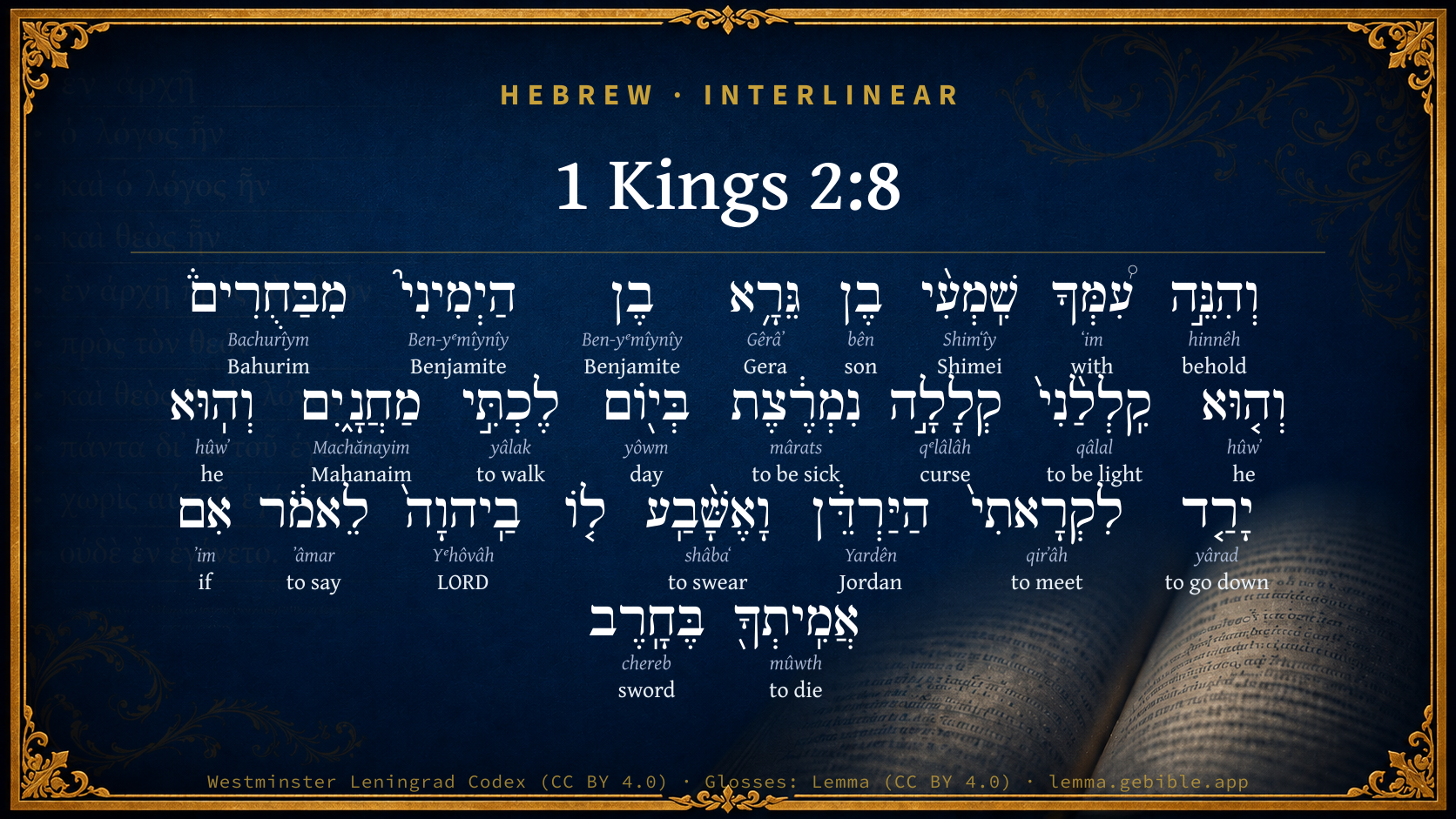
Hebrew (Westminster Leningrad Codex) 1 Kings 2:8 appears in the Hebrew Old Testament. The text above is from the Westminster Leningrad Codex. Each word links to its Strong’s number, a concise gloss, and parsing drawn from the Open Scriptures Hebrew Bible morphology. Click any word for its full Brown-Driver-Briggs (BDB) entry.
Download image
Cite this verse

1 Kings 2:8 (World English Bible). Public Domain. Lemma interlinear Bible study tool, https://lemma.gebible.app/v/1-kings/2/8.

Show BibTeX & RIS
BibTeX
RIS
English Translation
Behold, there is with you Shimei the son of Gera, the Benjamite, of Bahurim, who cursed me with a grievous curse in the day when I went to Mahanaim; but he came down to meet me at the Jordan, and I swore to him by Yahweh, saying, I will not put you to death with the sword.
World English Bible · Public Domain
Highlights
  • 1 first appearance in the Hebrew Bible
Full analysis ↓
Download a study sheet

One document with this verse’s original text, its word-by-word gloss line, the meaning frame, cross-references with their text, attributed commentary, and full source and license credits — printable, and it pastes into notes with its structure intact.

This verse Autodidact and up

Study sheet (.html) Plain text (.txt)

A passage Seminary Student

Up to 50 verses in one chapter. A passage sheet keeps up to 6 commentary sources and 12 cross-references per verse, in the order this page ranks them, and says so on the sheet whenever that leaves anything out. Ask for a single verse and you get the Autodidact verse sheet above.

Everything on this page stays free to read, with no account — the sheet is a download of what is already on screen, not access to it.

Want to remove ads? Support Godless Engineer
Compare translations 3

The same verse in 3 English versions, stacked beneath the original-language interlinear above. Click any original word for its lexicon entry.

Each is an independent rendering of the whole verse — the interlinear is not word-aligned to these translations.

Highlighted words mark where these versions differ — a whole-verse word diff, not a word-by-word alignment.

  • World English Bible Public Domain
    Behold, there is with you Shimei the son of Gera, the Benjamite, of Bahurim, who cursed me with a grievous curse in the day when I went to Mahanaim; but he came down to meet me at the Jordan, and I swore to him by Yahweh, saying, I will not put you to death with the sword.
  • King James Version Public Domain
    And, behold, thou hast with thee Shimei the son of Gera, a Benjamite of Bahurim, which cursed me with a grievous curse in the day when I went to Mahanaim: but he came down to meet me at Jordan, and I sware to him by the LORD, saying, I will not put thee to death with the sword.
  • unfoldingWord Literal Text CC BY-SA 4.0
    And behold, with you Shimei, the son of Gera, the Benjaminite from Bahurim. And he, he cursed me with a severe curse on the day of my going to Mahanaim. But he, he went down to meet me the Jordan, and I swore to him by Yahweh, saying, ‘If I should kill you with the sword.’

unfoldingWord Literal Text — © unfoldingWord, licensed CC BY-SA 4.0. Word-aligned USFM3 via Door43 (git.door43.org/unfoldingWord/en_ult).

Versions to compare (up to 4)

3 of 4 selected

Show all 18 translations

Every available English version of this verse, each an independent rendering of the whole verse.

  • World English Bible Public Domain
    Behold, there is with you Shimei the son of Gera, the Benjamite, of Bahurim, who cursed me with a grievous curse in the day when I went to Mahanaim; but he came down to meet me at the Jordan, and I swore to him by Yahweh, saying, I will not put you to death with the sword.
  • Berean Standard Bible Public Domain
    Keep an eye on Shimei the son of Gera, the Benjamite from Bahurim who is with you. He called down bitter curses against me on the day I went to Mahanaim, but when he came down to meet me at the Jordan, I swore to him by the LORD: ‘I will never put you to the sword.’
  • Majority Standard Bible Public Domain
    Keep an eye on Shimei the son of Gera, the Benjamite from Bahurim who is with you. He called down bitter curses against me on the day I went to Mahanaim, but when he came down to meet me at the Jordan, I swore to him by the LORD: ‘I will never put you to the sword.’
  • King James Version Public Domain
    And, behold, thou hast with thee Shimei the son of Gera, a Benjamite of Bahurim, which cursed me with a grievous curse in the day when I went to Mahanaim: but he came down to meet me at Jordan, and I sware to him by the LORD, saying, I will not put thee to death with the sword.
  • American Standard Version (1901) Public Domain
    And, behold, there is with thee Shimei the son of Gera, the Benjamite, of Bahurim, who cursed me with a grievous curse in the day when I went to Mahanaim; but he came down to meet me at the Jordan, and I sware to him by Jehovah, saying, I will not put thee to death with the sword.
  • Revised Version (1885) Public Domain
    And, behold, there is with thee Shimei the son of Gera, the Benjamite, of Bahurim, who cursed me with a grievous curse in the day when I went to Mahanaim: but he came down to meet me at Jordan, and I sware to him by the LORD, saying, I will not put thee to death with the sword.
  • Geneva Bible (1599) Public Domain
    And beholde, with thee is Shimei the sonne of Gera, the sonne of Iemini, of Bahurim, which cursed mee with an horrible curse in the day when I went to Mahanaim: but hee came downe to meete me at Iorden, and I sware to him by the Lord, saying, I will not slay thee with the sword.
  • Douay-Rheims (1899) Public Domain
    Thou hast also with thee Semei the son of Gera the son of Jemini of Bahurim, who cursed me with a grievous curse, when I went to the camp: but because he came down to meet me when I passed over the Jordan, and I swore to him by the Lord, saying: I will not kill thee with a sword:
  • Young's Literal Translation Public Domain
    `And lo, with thee `is' Shimei son of Gera, the Benjamite of Bahurim, and he reviled me -- a grievous reviling -- in the day of my going to Mahanaim; and he hath come down to meet me at the Jordan, and I swear to him by Jehovah, saying, I do not put thee to death by the sword;
  • Literal Standard Version CC BY-SA 4.0
    And behold, Shimei son of Gera, the Benjamite of Bahurim, [is] with you, and he reviled me—a grievous reviling—in the day of my going to Mahanaim; and he has come down to meet me at the Jordan, and I swear to him by YHWH, saying, I do not put you to death by the sword;
  • Unlocked Literal Bible CC BY-SA 4.0
    Look, there is with you Shimei son of Gera, the Benjamite of Bahurim, who cursed me with a violent curse on the day I went to Mahanaim. Shimei came down to meet me at the Jordan, and I swore to him by Yahweh, saying, 'I will not put you to death with the sword.'
  • unfoldingWord Literal Text CC BY-SA 4.0
    And behold, with you Shimei, the son of Gera, the Benjaminite from Bahurim. And he, he cursed me with a severe curse on the day of my going to Mahanaim. But he, he went down to meet me the Jordan, and I swore to him by Yahweh, saying, ‘If I should kill you with the sword.’
  • Darby Bible Public Domain
    And behold, there is with thee Shimei the son of Gera, the Benjaminite of Bahurim, who cursed me with a grievous curse in the day that I went to Mahanaim; but he came down to meet me at the Jordan, and I swore to him by Jehovah saying, I will not put thee to death with the sword.
  • World Messianic Bible Public Domain
    “Behold, there is with you Shimei the son of Gera, the Benjamite of Bahurim, who cursed me with a grievous curse in the day when I went to Mahanaim; but he came down to meet me at the Jordan, and I swore to him by the LORD, saying, ‘I will not put you to death with the sword.’
  • Webster's Bible Public Domain
    And behold, thou hast with thee Shimei the son of Gera, a Benjaminite of Bahurim, who cursed me with a grievous curse in the day when I went to Mahanaim: but he came down to meet me at Jordan, and I swore to him by the LORD, saying, I will not put thee to death with the sword.
  • Free Bible Version CC BY-SA 4.0
    Don't you forget Shimei, son of Gera, the Benjamite from Bahurim who cursed me with painful words when I went to Mahanaim. When he met me at the Jordan I swore to him by the Lord, ‘I will not kill you with the sword.’
  • Bible in Basic English Public Domain
    Now you have with you Shimei, the son of Gera the Benjamite of Bahurim, who put a bitter curse on me on the day when I went to Mahanaim; but he came down to see me at Jordan, and I gave him my oath by the Lord, saying, I will not put you to death by the sword.
  • JPS Tanakh (1917) Public Domain
    And, behold, there is with thee Shimei the son of Gera, the Benjamite, of Bahurim, who cursed me with a grievous curse in the day when I went to Mahanaim; but he came down to meet me at the Jordan, and I swore to him by the LORD, saying: I will not put thee to death with the sword.

Literal Standard Version (2020), Covenant Press — licensed CC BY-SA 4.0. Text via the HelloAO Bible API (eBible.org). Unlocked Literal Bible (unfoldingWord) — licensed CC BY-SA 4.0. Text via the HelloAO Bible API (eBible.org). unfoldingWord Literal Text — © unfoldingWord, licensed CC BY-SA 4.0. Word-aligned USFM3 via Door43 (git.door43.org/unfoldingWord/en_ult). Free Bible Version, Dr. Jonathan Gallagher — licensed CC BY-SA 4.0. Text via the HelloAO Bible API (eBible.org).

Word by word

More ways to search: Search by grammar → Find every occurrence → Compare this word →

Practice this passage: Drill this verse → Learn its vocabulary →

נִמְרֶ֔צֶת
mârats
H4834
“being sick”
Verb, Niphal, Participle Active, Feminine, Singular, Absolute
Part of Speech
Verb
Stem
Niphal
Form
Participle Active
Gender
Feminine
Number
Singular
State
Absolute
Full BDB Definition

Origin: a primitive root

TWOT: 1245

to be or make sick - (Niphal) to be grievous or painful - (Hiphil) to make sick
  1. וְהִנֵּ֣ה hinnêh H2009 “and · behold” Conjunction + Particle, Demonstrative
  2. עִ֠מְּךָ ʻim H5973 “with · you” Preposition + Suffix, Personal, 2nd Person, Masculine, Singular
  3. שִֽׁמְעִ֨י Shimʻîy H8096 “Shimei” Noun, Proper
  4. בֶן bên H1121 “son of” Noun, Common, Masculine, Singular, Construct
  5. גֵּרָ֥א Gêrâʼ H1617 “Gera” Noun, Proper
  6. בֶן Ben-yᵉmîynîy H1145 “Benjamite of” Noun, Common, Masculine, Singular, Construct
  7. הַיְמִינִי֮ Ben-yᵉmîynîy H1145 “the · Benjamite” Particle, Definite Article + Noun, Gentilic, Masculine, Singular, Absolute
  8. מִבַּחֻרִים֒ Bachurîym H980 “from · Bahurim” Preposition + Noun, Proper
  9. וְה֤וּא hûwʼ H1931 “and · he” Conjunction + Pronoun, Personal, 3rd Person, Masculine, Singular
  10. קִֽלְלַ֨נִי֙ qâlal H7043 “to be light · me” Verb, Piel, Perfect, 3rd Person, Masculine, Singular + Suffix, Personal, 1st Person, Common, Singular
  11. קְלָלָ֣ה qᵉlâlâh H7045 “curse” Noun, Common, Feminine, Singular, Absolute
  12. בְּי֖וֹם yôwm H3117 “in/at · day of” Preposition + Noun, Common, Masculine, Singular, Construct
  13. לֶכְתִּ֣י yâlak H3212 “to walk · me” Verb, Qal, Infinitive Construct + Suffix, Personal, 1st Person, Common, Singular
  14. מַחֲנָ֑יִם Machănayim H4266 “Mahanaim” Noun, Proper
  15. וְהֽוּא hûwʼ H1931 “and · he” Conjunction + Pronoun, Personal, 3rd Person, Masculine, Singular
  16. יָרַ֤ד yârad H3381 “to go down” Verb, Qal, Perfect, 3rd Person, Masculine, Singular
  17. לִקְרָאתִי֙ qirʼâh H7125 “to meet · me” Preposition + Verb, Qal, Infinitive Construct + Suffix, Personal, 1st Person, Common, Singular
  18. הַיַּרְדֵּ֔ן Yardên H3383 “the · Jordan” Particle, Definite Article + Noun, Proper
  19. וָאֶשָּׁ֨בַֽע shâbaʻ H7650 “and · to swear” Conjunction + Verb, Niphal, Sequential Imperfect, 1st Person, Common, Singular
  20. בַֽיהוָה֙ Yᵉhôvâh H3068 “in/at · LORD” Preposition + Noun, Proper
  21. לֵאמֹ֔ר ʼâmar H559 “to say” Preposition + Verb, Qal, Infinitive Construct
  22. אִם ʼim H518 “if” Conjunction
  23. אֲמִֽיתְךָ֖ mûwth H4191 “to die · you” Verb, Hiphil, Imperfect, 1st Person, Common, Singular + Suffix, Personal, 2nd Person, Masculine, Singular
  24. בֶּחָֽרֶב chereb H2719 “in/at the · sword” Preposition, Determined + Noun, Common, Feminine, Singular, Absolute

About this verse

These counts appear in no published source. They are computed here, from the morphology-tagged text and Lemma’s own curated glosses. What Lemma adds →

26
words
23
distinct lemmas
Historical
section

Notable vocabulary

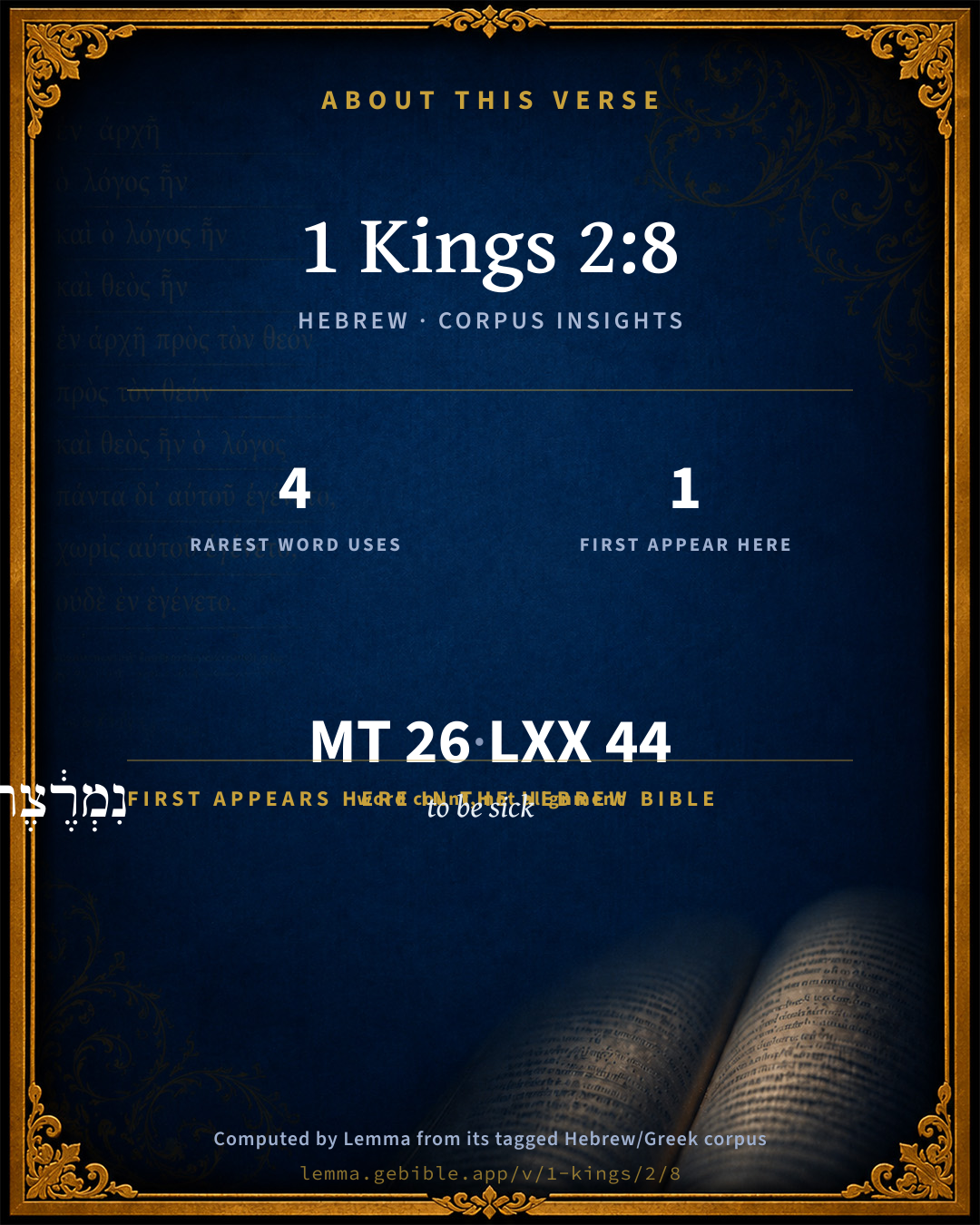
The rarest word here is נִמְרֶ֔צֶת to be sick H4834 — appearing just 4 times in the whole Hebrew Bible.

First appearance in Scripture

This word makes its first canonical appearance in the Hebrew Bible here:

  • נִמְרֶ֔צֶת to be sick H4834

Shared distinctive vocabulary

נִמְרֶ֔צֶת to be sick H4834 occurs in 4 verses of the Hebrew Bible. Also found in:

Grammatical profile

  • 8 verbs
  • 12 nouns
  • 2 pronouns
  • 2 prepositions
  • 1 conjunction
  • 1 particle

Verb forms

  • קִֽלְלַ֨נִי֙ Piel · Perfect
  • נִמְרֶ֔צֶת Niphal · Participle Active
  • לֶכְתִּ֣י Qal · Infinitive Construct
  • יָרַ֤ד Qal · Perfect
  • לִקְרָאתִי֙ Qal · Infinitive Construct
  • וָאֶשָּׁ֨בַֽע Niphal · Sequential Imperfect
  • לֵאמֹ֔ר Qal · Infinitive Construct
  • אֲמִֽיתְךָ֖ Hiphil · Imperfect

Repetition

Words recur within this verse — often emphatic in Hebrew:

  • בֶן Benjamite H1145 ×2
  • וְה֤וּא he H1931 ×2

Hebrew & Septuagint length

In English translation the verse runs 57 words from the Hebrew and 60 from the Septuagint (LXX English) — closely comparable.

A rough comparison of the two English renderings, which tokenize alike — not a word-level alignment.

Word counts can differ between the Hebrew and the Greek without any difference in meaning — e.g. the Hebrew direct-object marker אֵת has no separate Greek word, and Greek often adds the article ὁ.

In the original languages it is 26 Hebrew tokens and 44 Greek tokens — but the two are counted differently (Hebrew bundles its prefixes and suffixes into one token; the Greek is in lemma form), so that isn’t a like-for-like length.

Cross-references

4

Topical passages linked to 1 Kings 2:8 in the Treasury of Scripture Knowledge — connected by theme and wording, ordered by reader-vote popularity; previews shown in the World English Bible.

  • 2 Samuel 16:5–8 When king David came to Bahurim, behold, a man of the family of the house of Saul came out, whose name was Shimei, the son of Gera. He came out, and cursed still as he came.
  • 1 Kings 2:36–46 The king sent and called for Shimei, and said to him, Build yourself a house in Jerusalem, and dwell there, and don't go forth from there any where.
  • Jeremiah 4:2 and you shall swear, As Yahweh lives, in truth, in justice, and in righteousness; and the nations shall bless themselves in him, and in him shall they glory.
  • 2 Samuel 19:16–23 Shimei the son of Gera, the Benjamite, who was of Bahurim, hurried and came down with the men of Judah to meet king David.

Cross-references courtesy of OpenBible.info (CC BY 4.0).

Hebrew and Greek witnesses Masoretic Hebrew ↔ Greek Septuagint

The same verse in the two great witnesses to the Old Testament, shown verse-for-verse.

These are two independent witnesses, not word-aligned to each other, and the Septuagint is shown in lemma (dictionary) form.

Hebrew 1 Kings 2:8 Masoretic · Westminster Leningrad Codex

וְהִנֵּ֣ה עִ֠מְּךָ שִֽׁמְעִ֨י בֶן גֵּרָ֥א בֶן הַיְמִינִי֮ מִבַּחֻרִים֒ וְה֤וּא קִֽלְלַ֨נִי֙ קְלָלָ֣ה נִמְרֶ֔צֶת בְּי֖וֹם לֶכְתִּ֣י מַחֲנָ֑יִם וְהֽוּא יָרַ֤ד לִקְרָאתִי֙ הַיַּרְדֵּ֔ן וָאֶשָּׁ֨בַֽע ל֤וֹ בַֽיהוָה֙ לֵאמֹ֔ר אִם אֲמִֽיתְךָ֖ בֶּחָֽרֶב

Behold, there is with you Shimei the son of Gera, the Benjamite, of Bahurim, who cursed me with a grievous curse in the day when I went to Mahanaim; but he came down to meet me at the Jordan, and I swore to him by Yahweh, saying, I will not put you to death with the sword.

World English Bible · Public Domain

Greek LXX 1 Kings 2:8 Septuagint · lemma form

καί ἰδού μετά σύ σεμεϊ υἱός γηρα υἱός ὁ ιεμενι ἐκ βαουριμ καί αὐτός καταἀράομαι ἐγώ κατάρα ὀδυνηρός ὁ ἡμέρα ὅς πορεύομαι εἰς παρεμβολή καί αὐτός καταβαίνω εἰς ἀπαντή ἐγώ εἰς ὁ ἰορδάνης καί ὄμνυμι αὐτός ἐν κύριος λέγω εἰ θανατόω σύ ἐν ῥομφαία

And, behold, there is with you Semei the son of Gera, a Benjamite of Baurim: and he cursed me with a grievous curse in the day when I went into the camp; and he came down to Jordan to meet me, and I swore to him by the Lord, saying, I will not put you to death with the sword.

LXX2012 (modern English Septuagint) · Public Domain

On this verse, The Pulpit Commentary discusses the Septuagint’s reading. Read the note in Commentary ↓

Hebrew: Westminster Leningrad Codex (CC BY 4.0). Greek: Septuagint (public domain); English from LXX2012 (modern English Septuagint) (Public Domain). How the Septuagint differs from the Hebrew →

Targum (Aramaic paraphrase)

1

The Targum is the ancient Jewish Aramaic paraphrase of the Hebrew Scriptures — an interpretive translation, not the Hebrew text itself. Onkelos (literal) and Pseudo-Jonathan (expansive) render the Torah, and Jonathan the Prophets. Coverage is partial: where no permissively-licensed English translation exists for a verse, only the Aramaic is shown. This is verse-level text, not a word-by-word alignment to the Hebrew.

  1. Targum Jonathan Prophets (Joshua–Malachi)
    וְהָא עִמָךְ שִׁמְעִי בַר גֵרָא בַּר מִשֵׁבֶט בִּנְיָמִין מֵעוּלֵימַת וְהוּא לְוָטַנִי לְוָטָן מְרִירַן בְּיוֹמָא דַאֲזַלִית לְמַחֲנָיִם וְהוּא נְחַת לָקֳדָמוּתִי לְיַרְדְנָא וְקַיְמִית לֵיהּ בְּמֵימְרָא דַייָ לְמֵימָר דְלָא אֶקְטְלִינָךְ בְּחַרְבָּא:

    (no public-domain English translation for this verse)

    Targum Jonathan — Aramaic: “Mikraot Gedolot” (public domain). English: “Sefaria Community Translation” (CC0 1.0 (public-domain dedication)); “London "Chaldee Paraphrase," 1871” (public domain). Text via Sefaria.

Commentary

Notes on 1 Kings 2:8 from classic Christian and Jewish commentators (each source and its license shown beneath its notes). The classic Christian expositions comment on the surrounding passage and are grouped to its opening verse, so a note may address several verses; the Jewish commentaries on the Tanakh (Rashi and others) are per-verse, so they appear only where the commentator wrote on this verse.

Lemma curates 59 commentaries, every one of them public domain or Creative Commons licensed, each selected and text-cleaned for this edition rather than reprinted as found. About our sources →

The Cambridge Bible for Schools and Colleges

gen. ed. J. J. S. Perowne

8. thou hast with thee Shimei] Shimei was not at present living in Jerusalem (see 1Ki_2:36), but that his conduct might be more closely watched Solomon compelled him to come and dwell in the city.

Bahurim] Besides its connexion with the story of Shimei, this place is mentioned (2Sa_17:18) as the spot where Jonathan and Ahimaaz were concealed in the well, or cistern, to avoid the pursuit of Absalom’s servants; and in the account of Phaltiel’s separation from Michal when she was sent back to David (2Sa_3:16) by Ishbosheth. It must have been situate near the road from Jerusalem to the fords of the Jordan, but it is not mentioned in Joshua, nor has its situation been identified.

Mahanaim] was on the east of Jordan, and was so named by Jacob (Gen_32:2) because he there saw the host (Mahaneh) of God. Abner made his head-quarters there while he was supporting Ishbosheth against David (2Sa_2:8). Its strong position and fortification, which are specially dwelt on by Josephus (Ant. vii. 9, 8) no doubt led Abner to choose it, as did David likewise in his flight before Absalom.

came down to meet me] Shimei makes a merit of being among the first to give the king welcome on his return (2Sa_19:20). And though Abishai urged that he should straightway be put to death, David refused to have the day of his restoration stained by the blood of any man.

The Cambridge Bible for Schools and Colleges (gen. ed. J. J. S. Perowne; Cambridge University Press, 1878–1918) — public domain. Text from a community e-Sword module.

Trapp's Complete Commentary

John Trapp

1Ki 2:8 And, behold, [thou hast] with thee Shimei the son of Gera, a Benjamite of Bahurim, which cursed me with a grievous curse in the day when I went to Mahanaim: but he came down to meet me at Jordan, and I sware to him by the LORD, saying, I will not put thee to death with the sword.

Ver. 8. Thou hast with thee Shimei the son of Gerah.] Some think that, moved by David’s favour in forgiving him, {2Sa 19:23} he would not take part with Adonijah. {1Ki 1:8} But if it were the same Shimei, and not rather another and better of his name, {1Ki 4:18} yet now he must answer for his old faults. So that deferring payment is no breach of bond: there will come a time wherein the Lord will have a full blow at the impenitent person, be the pretences of impunity what they will.

Which cursed me with a grievous curse.] Heb., Strong; Gr., Dolorous; Chald., Bitter. Indeed his mouth was "full of cursing and bitterness," as if he had been as far as hell to fetch every word. {2Sa 16:5-13}

And I sware to him.] See on 2Sa 19:23.

John Trapp, A Commentary or Exposition upon All the Books of the Old and New Testament (1647–1656) — public domain. Text from a community e-Sword module.

The Biblical Illustrator

Joseph S. Exell

1Ki_2:8-9

And, behold, thou hast with thee Shimei, the son of Gera.

David and Shimei

Davids death-bed has never been without its own difficulties to thoughtful and reverential readers. For Shimei with all his good and his bad uses comes back again to Davids death-bed to tempt and to try David, and to discover what is in David s dying heart. The death-bed sayings of Gods saints have a special interest and a delightful edification to us; but Davids last words to Solomon about Shimei--we would pass them by if we could. Three or four several explanations of those terrible words of David have been offered to the distressed reader by able men and men of authority in such matters. I shall only mention those offered explanations, and leave you to judge for yourselves. Well, some students of the Old Testament are bold to take Davids dreadful words about Shimei out of Davids mouth altogether, and to put them into the mouth of the prophet who has preserved to us Davids life and death. Those awful words, they say, are that righteous prophets explanation and vindication of the too late execution of Shimei by Solomon after his reprieve, as Matthew Henry calls it, had come to an end with the death of David. Others again, and they, too, some of our most conservative and orthodox scholars, say to us that the text should run in English in this way: Hold him not guiltless; at the same time bring not his hoar head down to the grave with blood. You will blame me for my too open ear to such bold scholarship; and you will think it very wrong in me to listen to such evil men. But the heart has its reasons, as Pascal says, and my heart would stretch a considerable point in textual criticism to get Shimeis blood wiped off Davids death-bed. Another interpretation is to take the text as it stands, and to hear David judicially charging Solomon about a care of too long delayed justice against a blasphemer of God and the king. And then the last explanation is the most painful one of all, and it is this, that David had never really and truly, and at the bottom of his heart, forgiven Shimei for his brutality and malignity at Bahurim, and that all Davids long-suppressed revenge rushed out of his heart against his old enemy when he lay on his bed and went back on the day on which he had fled from Jerusalem. You can choose your own way of looking at Davids death-bed. But, in any case, it is Bahurim that we shall all carry home, and carry for ever henceforth, in our hearts. We shall have, God helping us, Davids Bahurim-mind always in us henceforth amid all those who insult and injure us, and say all manner of evil against us falsely; and amid all manner of adverse and sore circumstances, so as to see the Lord in it all, and so as to work out our salvation amid it all. And the Lord will look upon our affliction also, and will requite us good for all this evil, if only we wisely and silently and adoringly submit ourselves to it. (Alex. Whyte, D. D.)

The sins of godly men

There are three ways in which David may have been influenced in giving this dying injunction to his son--

I. As the agent, unconscious or otherwise, of Divine justice. We cannot conceive this measure as being the consummation of a Divine purpose, it had apparently so much about it of human plan. The Almightys power, when exerted in support of justice, has always been certain and direct in its action, without any reference to contingencies. A mans punishment ,never precedes his crime, nor is inflicted without one. With God it is all justice or all mercy; no half measures. No sparing for a time in uncertainty or doubt as to our guilt, begetting in us a sense of false security, till suddenly the knell of.doom sounds on our deafened ears. How different from mans punishment this. The very manner of Shimeis death is the greatest argument against its having been ordained by God (verses 36-46.) Davids conduct in giving this dying injunction to his son may have been influenced--

II. By a conscientious desire to administer human justice, according to the will of God. David, we are told, was a man of God, one after His own heart. How; then, with such clear perceptions of the Divine attributes, can we conceive of him as acting in this matter conscientiously and with cool judgment, in the full belief of the harmony of his decree with Almighty rectitude? To do so is to dishonour the unswerving uprightness of Gods justice, or to depreciate Davids experiences and knowledge of the Divine character. We would rather be left to our final alternative in--

III. Regarding his injunction as prompted by revenge. As a man he forgave Shimei at the time of his crime, which, then, should have been utterly effaced from his memory. Heavenly justice, if not satisfied, would have taken its own way of vindicating itself, without further action on Davids part. With David as a man of God and Israels law-giver, we must utterly disconnect this act, and attribute it entirely to a flaw in his character, which, at the last, reasserted its natural power in antagonism to Divine grace. In nothing, during life, do men differ so greatly as at death. The weakest on earth often enter the gates of heaven triumphant. While yet in the flesh, one foot is firmly planted on the threshold of the mansion prepared for them. On the other hand, the spiritual giant now is frequently then but as a timid and fearful child; often, indeed, appearing to lose his entire spiritual existence in the fearful struggle which Satan and his earthly nature keep up in endeavouring to wrest another soul from heaven to people the wilderness of hell. (R. Liswil, B. A.)

The Biblical Illustrator, edited by Joseph S. Exell (c. 1880s–1900s) — public domain. Text from a community e-Sword module.

Joseph Benson's Commentary

1Ki 2:8. Behold thou hast with thee Shimei, &c., which cursed me with a grievous curse — “David,” says Delaney, “when he was importuned to punish Shimei, (2Sa 16:9; 2Sa 19:21,) imitated the mercy of God, who waits that he may be gracious. Had he copied after any lower pattern, he had not spared Shimei, in the very instant of passion and provocation; nor would he afterward have forgiven him, in the fulness of prosperity and power. He very well knew how much the remission of personal injuries became the kingly character, and, therefore, he gave Shimei his life, and confirmed the grant by an oath. But then it must be remembered, that the obligation of the oath was purely personal; for so he himself explains it, saying, I sware unto him by the Lord, I will not put thee to death by the sword. And, therefore, though David was bound, Solomon was at full liberty to vindicate the majesty of kings, in chastising this high insult upon his father in such a manner as he thought fit: nor was there any danger of doing this to excess, when the chastisement was deferred to the calm and cool season of dispassionate justice; when neither passion nor personal resentment could inflame the vengeance. David well knew how much it became the piety of his character to submit himself and his concerns to the divine disposal, throughout the whole course of his life; but could he, for this reason, wholly renounce the interest of justice? Or, if he could, he very well knew how dangerous an example it might be to his successors, to suffer such injuries and insults upon majesty to pass unpunished: and, therefore, when he had acted up to the piety and dignity of his own character, he very wisely admonished his son to act up to the wisdom of his.”

Joseph Benson's Commentary on the Old and New Testaments (1811–1818) — public domain. Text from a community e-Sword module.

Tyndale Open Study Notes

Tyndale Open Resources

2:8 Mahanaim was David’s refuge during Absalom’s rebellion (2 Sam 17:24). The Egyptian pharaoh, Shishak, invaded it during Rehoboam’s reign (see 1 Kgs 14:25).

Tyndale Open Study Notes — © Tyndale Open Resources, licensed CC BY-SA 4.0. Text via the HelloAO Bible API.

Jamieson, Fausset & Brown

Robert Jamieson, A. R. Fausset & David Brown

thou hast with thee Shimei--Though David promised him a pardon, which being enforced by the presence of a thousand followers, could not have been well refused, he warned his son against Shimei as a turbulent and dangerous character. It must not be supposed that in these dying instructions David was evincing a fierce, vindictive spirit. He is rather to be considered as acting in the character of a king and magistrate, in noticing crimes which he had not been in a condition to punish, and pointing out persons of whom Solomon would be under a necessity to rid himself as dangerous to the state. The grateful mention of Barzillai's kindness [Kg1 2:7] was, however, a personal feeling that does honor to the warmth of his heart; and his silence as to Mephibosheth, the son of his beloved Jonathan, would imply the previous death of that prince.

Jamieson, Fausset & Brown — Commentary Critical and Explanatory on the Whole Bible (1871) — public domain (CC PDM 1.0). Text via the HelloAO Bible API.

Adam Clarke's Commentary

Verse 8. Thou hast with thee Shimei] See on 2Sa 16:5, c., and the notes on 2Sa 19:18-23.

Adam Clarke's Commentary on the Bible (1810–1826) — public domain. Text from a community e-Sword/MySword module.

Ellicott's Commentary for English Readers

(8) Thou hast with thee Shimei.—The most ungenerous charge is the virtual withdrawal of the pardon, freely granted to Shimei long before (2Sa_19:18-23). It is, perhaps, partly dictated by policy; for the notice of Shimei (2Sa_16:5-8; 2Sa_19:17) shows that he was powerful, and that he assumed a dangerous championship of the fallen house of Saul. But there are unmistakable traces of the old grudge rankling in David’s heart, reminding us of the bitterness of such psalms as Psalms 69.

A Bible Commentary for English Readers, edited by Charles John Ellicott (1878–1897) — public domain. Text from a community e-Sword module.

John Gill's Exposition

And behold thou hast with thee Shimei the son of Gera, a Benjamite of Bahurim,.... Of whom, and of his native place; see Gill on Sa2 16:5; he was now at Jerusalem, and so with Solomon, or near at hand; and was on his side, and of his party; see Kg1 1:8; but not to be trusted, or looked upon as a real friend:

which cursed me with a grievous curse, when I went to Mahanaim; a place on the other side Jordan, of which place, and the curses this man cursed David, with, see Sa2 16:7;

but he came down to me at Jordan; after the defeat of Absalom, and when David was returning, and humbled himself to him, and begged his pardon:

and I sware unto him by the Lord, saying, I will not put thee to death with the sword; but this oath was not binding upon his successor, and especially should he commit a new crime.

John Gill's Exposition of the Whole Bible (1746–1763) — public domain (CC PDM 1.0). Text via the HelloAO Bible API.

Haydock's Catholic Bible Commentary

Curse. Saying, Go out, &c., 2 Kings xvi. 5. --- Camp. Hebrew Machanayim. (Haydock) --- Sword. He would revenge his private wrongs, but reserved the punishment of a notorious offender, till a time when passion would have no influence. Solomon was not bound by the personal oath of his father.

George Leo Haydock (1774–1849), Haydock's Catholic Family Bible and Commentary, 1859 edition — public domain. Excludes Psalms (Douay-Rheims chapter numbering differs from Protestant) and Deuterocanonical books (Catholic canon only).

Matthew Poole's English Annotations

With thee, i.e. in thy power, as that phrase is oft used.

Cursed me with a grievous curse; or, reproached me with bitter reproaches, 2Sa 16:7,8; which David could not but deeply resent from him, though, as it was an affliction sent from God, he patiently submitted to it.

I will not put thee to death with the sword.

Quest. How then could David lawfully engage Solomon to punish him for it? And did David upon his death-bed bear malice against Shimei?

Answ. First, David was not a private person, which might remit such offences without any inconvenience; but a public magistrate, who for the honour and maintenance of government was obliged to punish such insolent and opprobrious speeches, if the necessity of his affairs had not then engaged him to pass it by. Otherwise it appears from divers passages of the Psalms, and of this history, how free David was from a rancorous and revengeful spirit, even towards his enemies.

Secondly, The following advice is not contrary to David’s oath, both because that was only personal, that David would not kill him either at that time, as Abishai desired him, or whilst he lived, and did not oblige his successors; and especially, because it was not David’s mind that Shimei should be put to death for that fault, (as is evident; for then there was no need of Solomon’s wisdom to find out an occasion, but only of his justice to punish him for the old crime,) but for some other competent crime, which Solomon’s wisdom, narrowly prying into all his actions, would easily find out. And if the condition which Solomon imposed upon Shimei, 1Ki 2:36,37, seem hard, it must be remembered that David only swore that he would pardon him as to life, but not that he would exempt him from all punishment or confinement.

Matthew Poole's English Annotations on the Holy Bible (1683–1685) — public domain. Text from a community e-Sword/MySword module.

Whedon's Commentary on the Bible

Daniel D. Whedon

8. Shimei the son of Gera — The same remarks which show the nature of David’s charge concerning Joab, 1Ki_2:5, apply here also. It is not so much the charge of a dying father to a son as of a righteous ruler to his successor on the throne. David feels that in some things his hands have been too feeble in the punishment of crimes. In the case of Shimei he had allowed the royal majesty of Israel to be insulted and the offender to go unpunished.

I sware to him… I will not put thee to death — But David’s oath was not binding on Solomon.

Daniel D. Whedon (gen. ed.), Commentary on the Old and New Testaments (1874–1909) — public domain. Text from a community e-Sword module.

The Pulpit Commentary

And, behold, thou hast with thee Bahr understands by "near thee," (in deiner Nahe) because Bahurim was near Jerusalem. Keil gathers from this word that Shimei "was living at that time in Jerusalem," and refers to ver. 36, which, if anything, implies that he was not. But it is worth suggesting whether Shimei may not be the Shimei to whom reference is made in 1Ki_1:8. (Dean Stanley notices this as a possibility, but alleges nothing in support of it: "Jewish Church," vol. 2 p. 171, note.) We there find Shimei and Rei mentioned as firm adherents of Solomon at the time of Adonijah"s rising, and in these words, they "were not with Adonijah. Surely it is not an unfair presumption if there is nothing to rebut it that the Shimei subsequently mentioned as "with" Solomon is the same person. But it has been objected (e.g., by Kitto) that the false part that Shimei played at the time of Absalom"s revolt would have forever prevented his being recognized and mentioned as one of Solomon"s supporters. I very much doubt it. The great influence which Shimei possessed must be taken into account. Nothing shows that influence more clearly than the fact that on the day of David"s restoration, despite the part he had taken, and the possible disgrace and danger that awaited him, he could still command the attendance of one thousand men of Benjamin. (2Sa_19:17) Probably the secret of his influence lay in the fact that he was "of the family of the house of Saul," and possibly, owing to the insignificance of Saul"s descendants, was the mainstay and chief representative of that house. And if so, there is nothing at all surprising in the mention of the fact that he was "not with Adonijah," and was subsequently "with" Solomon. It may have been a matter of great consequence at that critical time, which side Shimei and the thousand or more Benjamites at his back espoused. And if he did then declare for Solomon, it could hardly fail to procure him some amount of favour and consideration. He would thenceforward rank amongst the friends of the young king, and the words "thou hast with thee" would accurately describe his position Shimei, the son of Gera another Shimei, the son of Elah, is mentioned (1Ki_4:11) as Solomon"s officer in Benjamin. Gera must not be thought of as the "father" of Shimei, except in the sense of ancestor. He was removed from him by many generations, being the son of Bela and the grandson of Benjamin (Gen_46:21; cf. 1Ch_7:6) Ehud, three hundred years earlier, is also described as "a son of Gera,", Jud_1:3:15 a Benjamite lit., the Benjamite, meaning that Gera, not Shimei, was the Benjamite. He was well known as the son of Benjamin"s firstborn, (1Ch 8:50) and the head of a house in Benjamin. Professor Gardiner (American translation of Lange, textual note, p. 29), following the LXX and Vulg., insists that, yniymiYhAB, (with the article) can only mean "son of the Jaminite, i.e., of the descendants of Jamin, a son of Simeon." But this is directly contrary to what we read 9 Samuel 16., viz., that Shimei was of "a family of the house of Saul," i.e., a Benjamite. And to this the grammar agrees. Jud_1:3:15 is an exact parallel, and compare ymijLhAtyBeLhAtyBe, 1Sa_6:14, 1Sa_6:18, and ymij Samuel 16:1, 18; 17:58 of Bahurim the name means The young men." It was some six miles distant from Jerusalem, in Benjamin, and on (or off, as Josephus, Ant. 7:9, 7, implies) the main road to Jericho and the Jordan valley. It may have lain in one of the waddies branching out from the ravine which runs continuously alongside the steep descent to Jericho. The event narrated in 2Sa_3:16 as happening at Bahurim may well have served to inflame Shimei"s hatred. In spite of his rancorous hostility, however, we gather from, 2Sa_17:18, that David had some faithful adherents there which lit., "and he" cursed me with a grievous acc. to Gesenius, al., " strong," i.e., sweeping; Keil, vehement; Thenius, heillos," flagitious. LXX, kataran ojdunhran. Vulg., maledictio pessima curse in the day when I went to Mahanaim; 2Sa_16:5 but he came down to meet me at Jordan lit., the Jordan, i.e. , the descender, so called from the rapidity of the stream (it has a fall of 1400 feet in about 100 miles) or from the steep descents which lead to it. The word always has the defin. art., and I sware to him by the Lord, saying, I will not put thee to death with the sword. (2Sa_19:23)

The Pulpit Commentary (1880–1919), ed. H.D.M. Spence-Jones & Joseph S. Exell — public domain. Text from a community e-Sword module.

John Wesley's Explanatory Notes

I will not, &c. - The words are, The king said unto Shimei, thou shalt not die: and the king swear unto him, 2 Sam. xix, 23. The oath, we see, was absolute. It was not, "I will not put thee to death now." or, "I will not put thee to death with the sword." But who can reconcile his charge to Solomon with this oath? Surely, considering the time of that charge, this next to the matter of Uriah, is the greatest blemish in all David's life.

John Wesley, Explanatory Notes Upon the Whole Bible (1754–1765) — public domain. Text via the GEBible commentary corpus.

unfoldingWord translationNotes

Door43 World Missions Community

General Information:

King David continues to tell Solomon how to lead Israel.

Shimei ... Gera

men's names (See: How to Translate Names)

Benjamite

descendant of Benjamin

Bahurim ... Mahanaim

place names (See: How to Translate Names)

do not let him go free from punishment

This can be expressed positively. AT: "be sure to punish him" (See: Double Negatives)

bring his gray head down to the grave with blood

Blood is a metonym for violent death, and the head is synecdoche for the whole person. AT: "make sure he dies a violent death" (See: Metonymy and Synecdoche)

translationWords

Shimei

son

Benjamin

curse

Jordan River

oath

die

sword

free

punish

wise

unfoldingWord translationNotes — © Distant Shores Media and the Door43 World Missions Community, licensed CC BY-SA 4.0. Source: git.door43.org/Door43/en_tn.

Rashi

Rabbi Shlomo Yitzchaki (Rashi)

An explicit curse. [נמרצת means] concise, as in, “what will bring clarity [ימריצך] to you,” [and as in,] “and how clear [נמרצו are right words],” the same as an interpretation [נמלצו].

Rashi on the Tanakh — English translations: “The Judaica Press complete Tanach with Rashi, translated by A. J. Rosenberg” (CC BY 4.0); “Pentateuch with Rashi's commentary by M. Rosenbaum and A.M. Silbermann, 1929-1934” (public domain); “The Metsudah Tanach series, Lakewood, N.J” (CC BY 4.0); and “The Book of Joshua, Metsudah Publications, 1997” (CC BY 4.0). Text via Sefaria.

Lesson kit

Teaching starters — assembled from the data on this page, not authored interpretation. Every prompt links to the verse data it draws on. Edit before teaching.

1 Kings, in the Historical, opens this verse with 26 words (23 distinct Hebrew lemmas). Its most distinctive word is mârats (“to be sick”). A historical commentator’s framing appears above. Read the whole chapter for the surrounding context.

Discussion questions

  1. What does “to be sick” (mârats) contribute to the verse as a whole?
  2. This is the first place “to be sick” appears in Scripture (first appears here). What does its debut here establish?
  3. How does Job 6:25, which shares the word «to be sick», read alongside this verse?
  4. What does the repetition of “Benjamite” (2× in this one verse) do in this verse?
  5. These translations render this verse differently; the difference is in the English rendering, not the original. What questions does that raise?
  6. «קִֽלְלַ֨נִי֙» is a Piel Perfect verb. How does that grammatical form shape the action described?
  7. Compare how The Cambridge Bible for Schools and Colleges and Trapp's Complete Commentary read this verse. Where do they agree or differ?

Things to notice

Reading settings

Reading text

Shown beneath each verse's original-language words.

Old Testament
Old Testament edition

Read the OT as the Masoretic Hebrew (MT) or the Greek Septuagint (LXX).

English shown for the Greek Septuagint (in the Hebrew ↔ Greek comparison).

Comparing translations? Open the Compare panel on any verse page to stack up to four side by side.